6 Breastfeeding Positions (With Photos) To Try If You’re New To This Whole Shebang

If you choose to breastfeed, those first few weeks where you’re figuring out comfortable positions and how to get your baby to latch properly can be a real rollercoaster.

I remember sobbing on day four because feeding was so painful and my boobs were like boulders (not so much in size, but more in how full they were – it felt like they were filled with concrete).

My baby didn’t seem to be latching right either, the pinching sensations on my nipples were diabolical – so yeah, not a fun time for all involved.

Fast forward a week and – after some latching support from a midwife and health visitor – things were looking up. Well, aside from me routinely and explosively spraying my poor baby in the face with milk – we later learned I had an overactive letdown.

Finding a breastfeeding position that works for you can make such a huge difference, especially during those periods of cluster-feeding when you’re spending most of your time sat down with a baby glued to your boob.

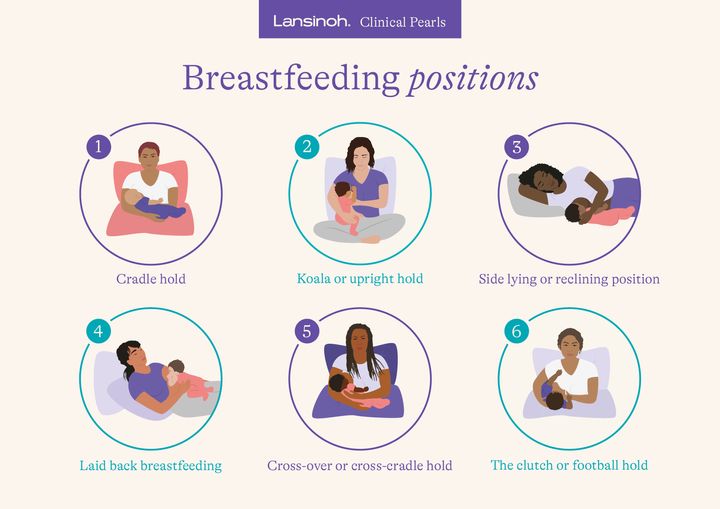
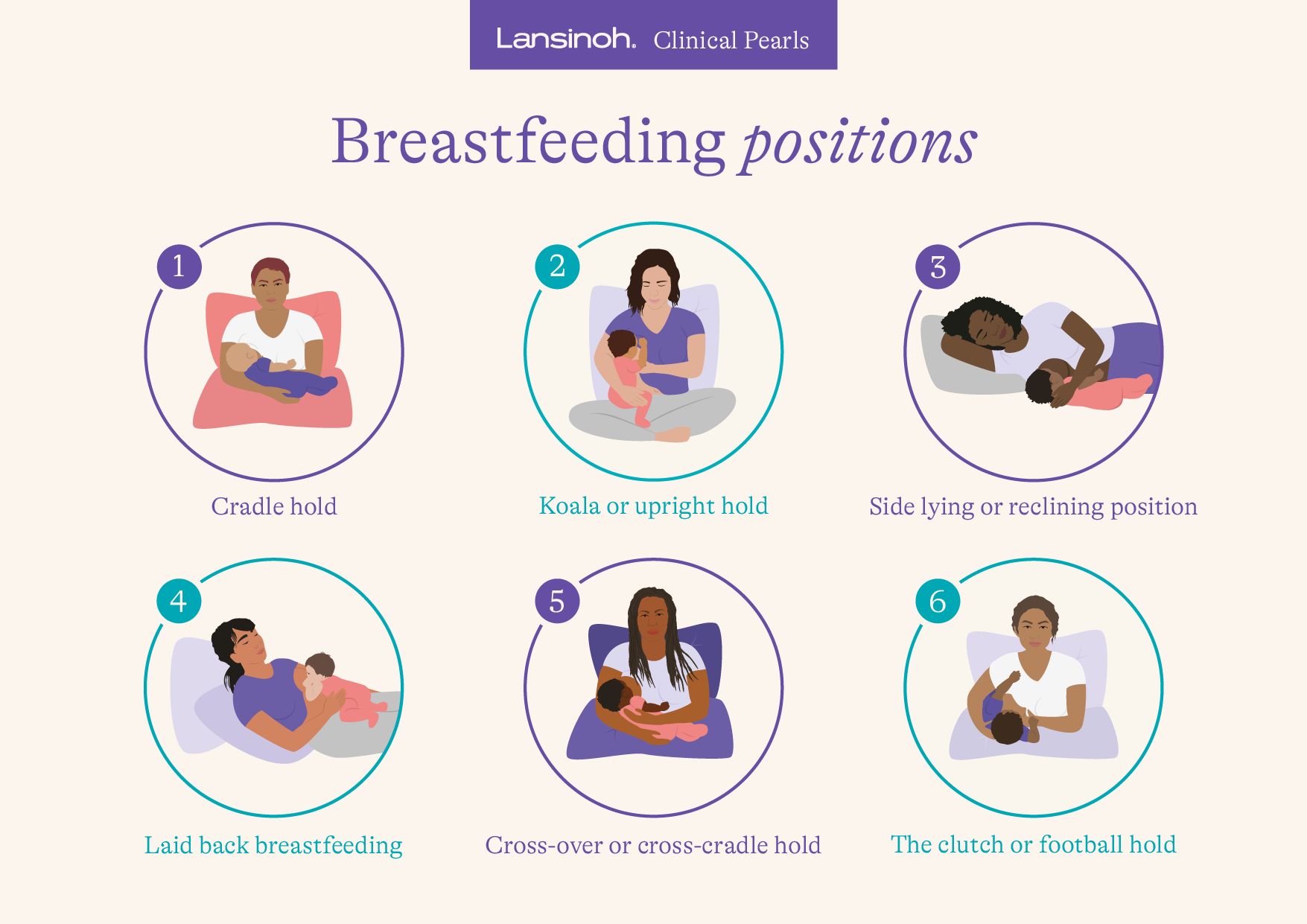
Here are some of the most commonly used breastfeeding positions – with supporting images and illustrations from Lansinoh – to help you on your way.

Breastfeeding positions illustrated.

1. Cradle hold

This is one of the most common positions for breastfeeding, however it might be uncomfortable for those who have had a caesarean, the NHS notes.

To do this position, sit in a comfy chair with arm rests or on a bed with cushions around you. Then, lie your baby across your lap, facing you. Their tummy should be facing yours.

Place your baby’s head on your forearm, with their nose towards your nipple. Your arms should be supporting their body. Meanwhile, place your baby’s lower arm under yours.

Check to make sure your baby’s ear, shoulder and hip are in a straight line.
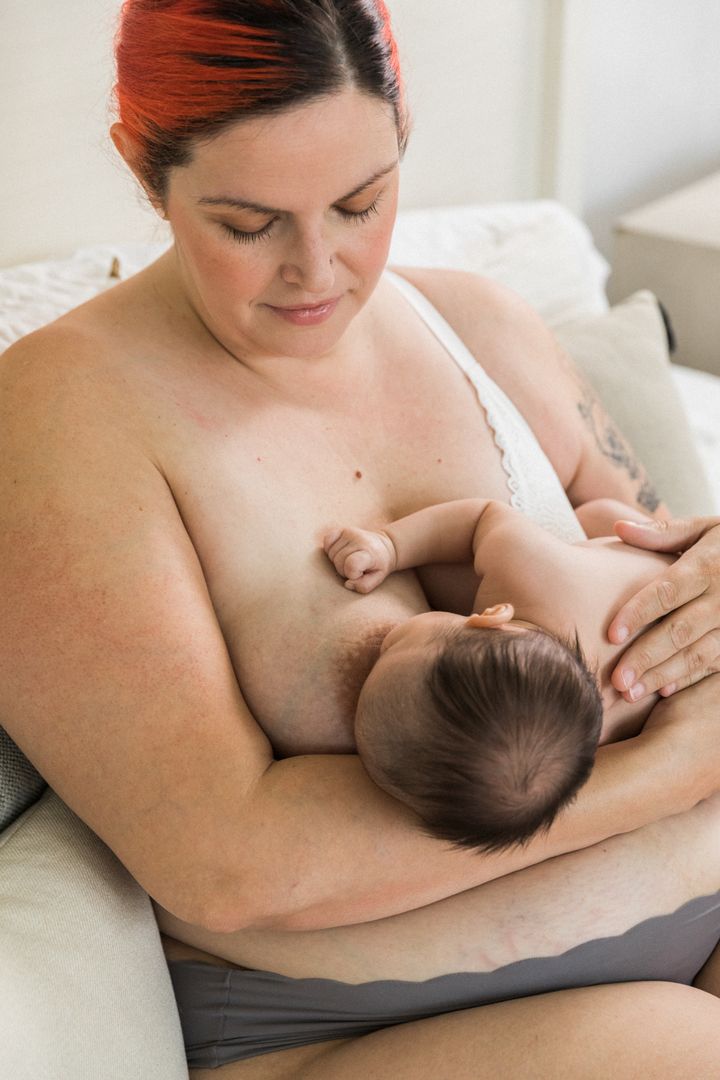
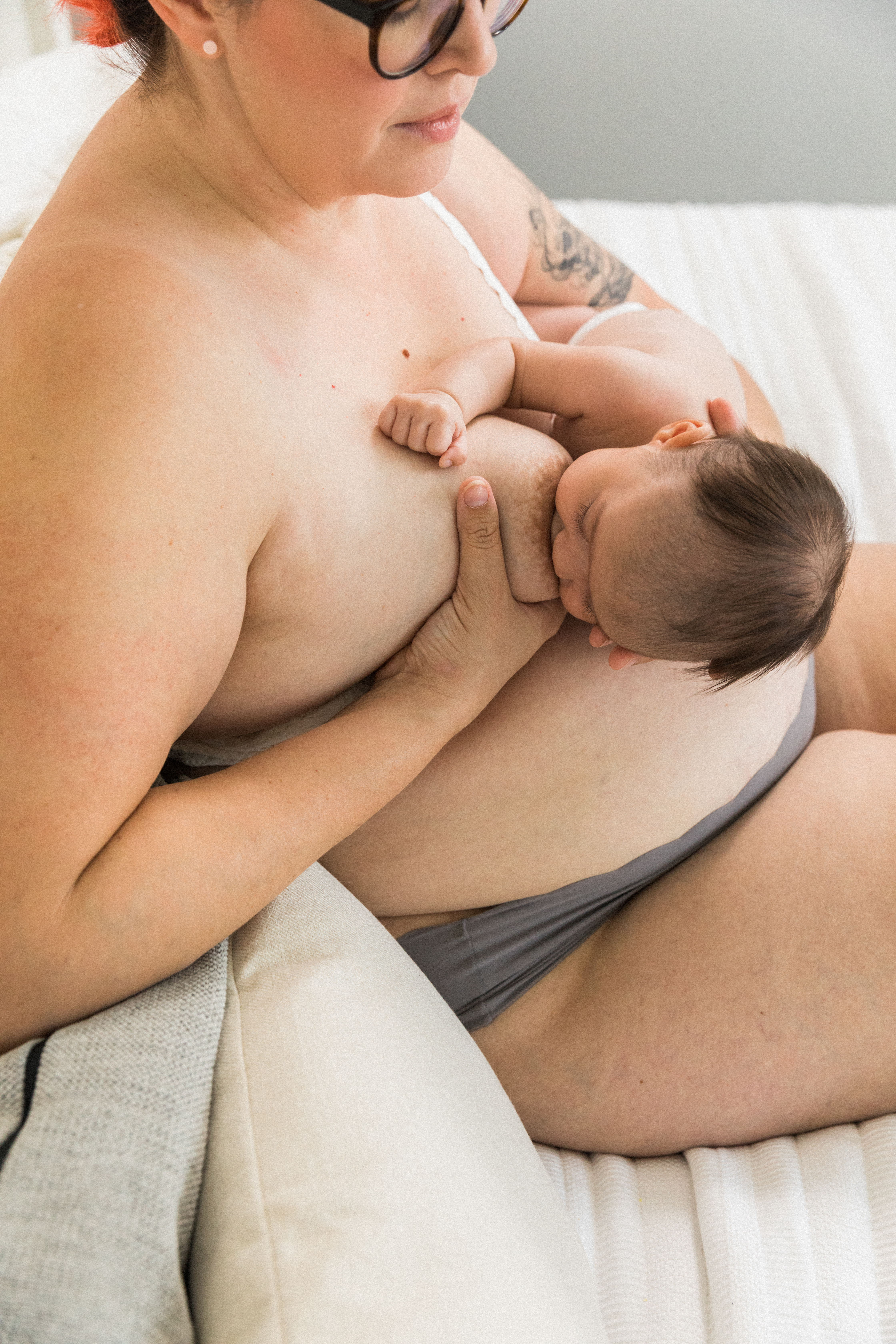
A baby feeding in the cradle position.

Cathlin McCullough/Lansinoh

A baby feeding in the cradle position.

2. Cross-cradle hold

This is touted as a good position for those with smaller babies and newborns. It’s similar to cradle hold, except your arms switch roles – so your baby’s body is basically lying across the opposite forearm to the boob you’re feeding them from.

Your forearm will basically be supporting their back and spine, with your palm supporting their shoulder blades, and your fingers under their ears.

As breast pump experts at Medela explain: “Because your baby is fully supported on your opposite arm, you have more control over his positioning, and you can use your free hand to shape your breast.”

For a demonstration of how to do cross-cradle, check out this video from a postpartum nurse on TikTok (@thepostpartumnurse).
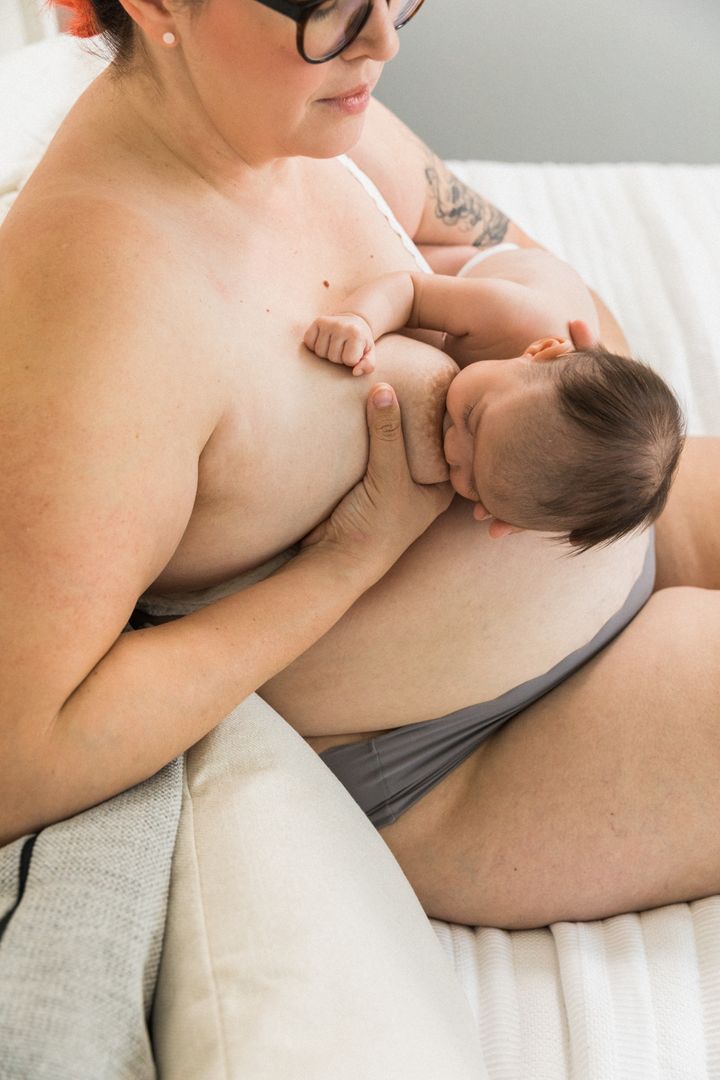
A baby feeding in the cross-cradle position.

Cathlin McCullough/Lansinoh

A baby feeding in the cross-cradle position.

3. Side-lying position

This is a great position to try if you’re breastfeeding in the night, or you’ve had a caesarean or difficult delivery.

First, lay down on your side with your baby facing you, so you’re lying tummy to tummy. Your baby’s ear, shoulder and hip should be in a straight line.

It might help to put some cushions or pillows behind you for support and the NHS recommends a rolled up baby blanket popped behind your baby to help support them, if they can’t quite stay on their side yet.

Tuck the arm you’re lying on under your head or pillow and use your free arm to support and guide your baby’s head to your breast.

Need a visual guide? Check out this handy video from lactation counsellor Grace (@latchingwithgrace) on how she gets comfortable in the side-lying position.

A baby feeding in the side-lying position.

4. Laid-back nursing

The laid-back position is pretty much what it says on the tin: you’re seated in a semi-reclined position – either on a sofa or bed. The position can be done by most mothers, however if you’ve had a C-section you might want to lie your baby across from you and away from your incision, the NHS suggests.

It’s also a great shout for those who have an overactive letdown (where the milk comes out forcefully) and, according to lactation counsellor Angela Das (@motherhooduntamed) it can also help them achieve a deeper latch.

To nail this position, lean back (but not flat) on your sofa or bed, propping yourself up with cushions so your back, shoulders and neck are supported.

Now, place your baby on your front so their tummy is resting on your tummy. For those who’ve had C-sections, this is the part where you would lay them to one side.

The NHS advises parents to be seated upright enough that they can look into their baby’s eyes, and to gently support their baby, guiding them to the nipple.

A baby feeding in the laid-back nursing position.

Cathlin McCullough/Lansinoh

A baby feeding in the laid-back nursing position.

5. Rugby ball hold

The rugby hold can feel a bit tricky to begin with, however it’s another good position for those who’ve had C-sections, as there’s no pressure on the incision area, as well as parents of twins.

To do this, you’ll need to sit in a chair with a cushion (or two) along your side. Then, position your baby (/babies) at your side, under your arm, with their hip close to your hip. Their upper body will be positioned along your forearm. The NHS suggests your baby’s nose should be level with your nipple.

Support your baby’s neck with the palm of your hand and gently guide them to your nipple.

Check out this video from midwife and lactation consultant Libby Cain (@libbyandco_nz) on how to do the rugby hold.

A baby feeding in the rugby position.

6. Koala hold

This position can be good for mothers who have older babies or an overactive letdown. It can also be done with newborns however they’ll need lots of support.

According to experts at Medela, this position can also be more comfortable for babies who have reflux, ear infections, tongue-tie or low muscle tone.

In this particular position, the baby will sit on your thigh, with their legs dangling either side. Their spine and head will be upright as they feed. For a demo of this nursing position, check out this video from lactation consultant Kathryn Stagg (@kathrynstaggibclc).

A baby feeding in the upright/koala position.

More support for people who are breastfeeding:

Share Button

‘Doctors Said Our Baby Had Epilepsy – After Months Searching For Answers, We Finally Learned The Truth’

In My Story, readers share their unique, life-changing experiences. This week we hear from Richard Poulin, 40, who currently lives in Bangkok, Thailand.

My wife and I accepted new teaching jobs in Singapore. Before leaving America, we proudly showed our newborn daughter, Rylae-Ann, to family. All was right in the world, and we eagerly boarded a plane to begin our new life.

However, when Rylae-Ann was three months old, we saw signs that all was not right.

She was missing developmental milestones. We would play games to encourage her to reach out, do exercises to practice sitting independently, and give massages to coax her to engage her core muscles. But nothing seemed to work.

One day my wife, Judy, went to look for homes while I stayed back at the hotel with our daughter. During one of the sessions, Rylae-Ann tensed her arms and legs. Her eyes briefly crossed, and her tongue made a thrusting action.

Despite it lasting a few seconds, I was concerned. I attributed it to my pushing her too hard, causing muscle cramps. I tapered my eagerness for my daughter to progress.

The fleeting actions caused enough concern that I did some Googling. I did not dare tell Judy. I didn’t want her to start worrying.

I came across an article about a girl with a deadly ultra-rare disease. I admonished myself. I had become one of those parents who Googled symptoms and ended up with an obscure diagnosis for my daughter. I closed my laptop and tried to focus on my family’s new life in Singapore.

As the days passed, Rylae-Ann's parents realised she was missing developmental milestones.

Richard Poulin

As the days passed, Rylae-Ann’s parents realised she was missing developmental milestones.

Over the next few months, our lives began to unravel. The tensing of muscles in our daughter’s tiny limbs became more intense and lasted longer; it was the only time we ever saw any movement from her.

We began to refer to them as ‘spells’. These spells came every three days like clockwork. She had trouble staying asleep. When she was awake, she looked sleepy and constantly cried.

Rylae-Ann’s developmental milestones remained paused at the three-month mark. She couldn’t hold up her head, she did not reach out and grasp things, and her eyes remained tiny slits. The photographer commented on her sleepy look when we got her identification card.

We went to doctors who reassured us that babies develop at different rates. But as the spells’ intensity and duration grew, we could no longer sit idly by. We began visiting more doctors and researching.

One rainy night, the spell lasted longer and was more intense – we were filled with fear. We rushed out of the door to the car we’d booked on a ride-sharing app and headed to the nearest hospital. I willed all the lights to turn green while Judy cooed softly into Rylae-Ann’s ear. Once we arrived, the nurses did an assessment and put our daughter at the front of the triage line.

They gave our daughter diazepam for fear she would have another seizure. A doctor came and assigned an initial assessment of epilepsy. The doctors admitted Rylae-Ann, and we were separated from her for the first time.

Judy and I discussed the diagnosis when we returned home to get clothes and necessities. What the doctor was telling us didn’t seem right, mainly because we thought what the doctor saw as a seizure was something else due to its three-day cyclical nature.

After a barrage of tests, the doctors said she had epilepsy. They prescribed her medication, and we went home. But her symptoms did not improve. The medicine left her sleeping all day and she felt lifeless when we picked her up – we stopped the drug after a few days.

We continued to visit the doctor, trying to explain why we thought it wasn’t epilepsy. Despite genetic testing, blood tests, EEGs (which record brain activity), MRI, CSF (cerebrospinal fluid) tests, and more coming back normal or inconclusive, the doctors did not change their diagnosis, so we went to other doctors. We even travelled to other countries searching for answers.

As we collected second opinions, we improved our description and came armed with digital evidence. Doctors had different opinions, including epilepsy, dystonia, cerebral palsy, and other neurotransmitter disorders. However, no definitive answer came.

Our daughter was regularly admitted to emergency care during the onslaught of medical tests. We were always in the hospital, so much so, the nurses knew our daughter by name. Most were lung-related issues such as aspiration, pneumonia, and collapsed lung. But also, a typical childhood viral infection would cause her to be extremely weak to the point that the doctors required her to be in intensive care.

Answers never came. Instead, a random Facebook post about a child with similar symptoms caught the eye of Judy’s older brother. When Judy shared the article with me, it triggered a memory of a post I saw earlier.

The name AADC stuck with me because of its similarity to a classic rock band. I remember the article discussing the extremely rare disease, affecting around 130 people worldwide since 1990.

Rylae-Ann would often end up in intensive care.

Richard Poulin

Rylae-Ann would often end up in intensive care.

I explained how it was improbable. However, Judy pointed out that although it is an extremely rare genetic disorder, many of the children were from Taiwan, where her parents are from.

AADC deficiency is a rare disease that causes a mutation in the DDC gene. This gene instructs the body to produce the AADC enzyme, which is responsible for dopamine and serotonin.

Children with AADC deficiency have little or no dopamine and serotonin. Both are responsible for several critical bodily functions to sustain life and movement.

That night, alarms were going off in my head. I sat up in bed and went to work, reading research papers about the disease. The more I read, the more I knew our daughter had this. One glaring reality was that children with this disease die early in life due to the severity of the symptoms.

One of the reports talked about how a doctor in Taiwan had completed clinical trials for an experimental, innovative treatment. There was no word if the treatment was available, but I knew we had to visit this doctor.

Rylae-Ann struggled to sit upright or feed.

Richard Poulin

Rylae-Ann struggled to sit upright or feed.

Judy’s younger brother still lived in Taiwan, so we asked him to make an appointment as soon as possible. The next day he told us we had an appointment booked a week later, the day after Christmas.

We packed our bags and landed in Taiwan on Christmas day. That night, Judy and I sat at the park drinking a small bottle of vodka, trying to process how we went from cloud nine, to falling from a cliff, to Hell over six months. As the bottle’s contents disappeared, I promised my wife we would never have a Christmas like this again.

On the day of our appointment, we met the doctor who was surprised to receive patients thinking their child had a rare disease – and even more surprised at our knowledge of the disease.

After a short observation and using the information we provided, the doctor felt confident that our daughter did, in fact, have an aromatic L-amino decarboxylase (AADC) deficiency.

“The doctor felt confident that our daughter did, in fact, have an aromatic L-amino decarboxylase (AADC) deficiency.”

I asked if the treatment in the article was available. We held our breath. “No,” he replied. Tears welled. “But, there is another clinical trial recruiting. However, it is only available for Taiwanese.”

“She is Taiwanese!” we screamed. We had recently applied for her citizenship. Although Judy is Taiwanese, she never lived there. We grew up in Thailand, where Rylae-Ann was born. Rylae-Ann only had an American passport, but her Taiwanese passport would soon be ready.

She enrolled in the clinical trial for a new exploratory treatment known as gene therapy. However, she had to wait 11 months to begin treatment – another year of trying to keep her alive and healthy.

Yet with the mystery uncovered, we had more information on how to care for her.

The 11 months also gave us time to figure out the logistics of how our daughter would participate in the study. She would have to stay in Taiwan for six months, so we decided to have Judy’s mum and nanny remain in Taiwan for that period while Judy and I took turns flying back so we could continue earning money at our new jobs in Singapore.

Judy and Rylae-Ann on the day of her surgery.

Richard Poulin

Judy and Rylae-Ann on the day of her surgery.

On 13 November, when Rylae-Ann was 18 months old, she underwent brain surgery for gene therapy. Family and friends asked us if we were worried. We weren’t. We had our backs against the wall and fought to keep our daughter alive.

While alive, she depended on us for everything. Managing work to pay the mounting health care bills was extremely difficult. There was no downtime or social life. I remember telling Judy that the lack of sleep was making me mad.

We felt blessed that our daughter would have an opportunity in life.

The surgery lasted several hours. It was Judy’s turn to be in Taiwan, so I waited for a video chat update.

The way we explain gene therapy to other parents is it involves injecting a shell of a virus into the brain. The virus normally goes unnoticed by the body, so it is able to bypass the body’s immune system. Researchers used this situation to inject good DNA into the virus. The virus then “infects” the good DNA in the body. In our daughter’s case, it was in the area of the brain where dopamine is produced.

The surgery was a success. A few days later, to Judy’s surprise, Rylae-Ann was discharged. We began physical therapy immediately.

The results came quickly. One month later, she sat up on her own. This was a huge milestone. Since then, she has continued to make progress. Every day we supported her, but we did it in a way where we could still make memories as a family.

Just over a year after gene therapy, our daughter was swimming, walking, running, and even riding a horse. Today, she is an independent child who continues to explore the world. Not only does our daughter have a chance to live, but we also have a chance to be parents.

Rylae-Ann has grown into an independent child who continues to explore the world.

Richard Poulin

Rylae-Ann has grown into an independent child who continues to explore the world.

Judy and Rich now use their spare time to help other families in the rare disease community and have launched a non-profit organisation called Teach RARE, where they work to raise awareness and teach caregivers how to combine educational activities with therapy goals.

To take part in HuffPost UK’s My Story series, email uklife@huffpost.com.

Share Button

Donald Trump Pleads Not Guilty, Again, This Time To Charges From His January 6 Coup Attempt

WASHINGTON — For the third time in four months, Donald Trump was dragged into a courtroom on Thursday and charged with felonies that could bring him years in prison, this time for his schemes to remain in power despite having lost the 2020 election that culminated in his violent January 6, 2021, coup attempt.

The former president, technically under arrest yet again while the judge set the conditions of his release, pleaded not guilty to four counts of conspiring to defraud the United States, conspiracy to obstruct an official proceeding, obstructing an official proceeding and unlawfully depriving voters of their civil rights.

Trump stated his name, his age, told the magistrate judge that he had not take any medication that would affect his ability to understand the proceedings, and then listened to her explain that he could face a cumulative 55 years if convicted on all four counts. He then stood and pleaded not guilty to all the charges.

Judge Moxila Upadhyaya then warned Trump not to speak about the case with other witnesses, before informing him that he would not be required to appear personally at his next court date, August 28. That hearing will be before the US District Judge Tanya Chutkan, who has earned a reputation for handing out stiff sentences to January 6 insurrections who have been convicted in her courtroom.

As he has for each of the previous indictments against him, Trump remained defiant and claimed prosecutors were only charging him to hurt his campaign. “I AM NOW GOING TO WASHINGTON, D.C., TO BE ARRESTED FOR HAVING CHALLENGED A CORRUPT, RIGGED, & STOLEN ELECTION. IT IS A GREAT HONOR, BECAUSE I AM BEING ARRESTED FOR YOU. MAKE AMERICA GREAT AGAIN!!!” he wrote on his social media platform early on Thursday afternoon.

The arraignment took place at the E Barrett Prettyman federal courthouse on Constitution Avenue, just eight blocks from the White House, where Trump is accused of having carried out crimes with at least six as-yet-unnamed co-conspirators, but whose identities likely include advisers such as lawyers Rudy Giuliani and John Eastman.

The courthouse is also just four blocks from the Capitol, where a mob of Trump’s followers, incited by a rally where he continued pushing his lies that the 2020 election had been “stolen” from him, assaulted police officers to enter the building in an attempt to stop the congressional ceremony to certify Democrat Joe Biden’s win.

Trump supporters wave flags outside the E. Barrett Prettyman U.S. District Court House ahead of Donald Trump's arrival on Aug. 3, 2023, ahead of his scheduled arraignment in Washington, D.C.
Trump supporters wave flags outside the E. Barrett Prettyman U.S. District Court House ahead of Donald Trump’s arrival on Aug. 3, 2023, ahead of his scheduled arraignment in Washington, D.C.

Chip Somodevilla via Getty Images

The conspiracy to defraud and obstruction charges are based on Trump’s plan to get Republicans in seven states Biden won to submit fake slates of electors to the National Archives and the US Senate, with the goal of using these forged certifications to coerce then-Vice President Mike Pence into awarding Trump a second term. The civil rights charge is based on the argument that Trump disenfranchised millions of voters in those states by attempting to have their votes nullified.

The new indictment, unsealed on Tuesday, follows another federal indictment in June that charged Trump with illegally retaining secret documents at this Florida country club and then trying to hide them from authorities seeking their return. He was also indicted in New York City in April for falsifying business records to conceal a $130,000 hush-money payment to a porn star in the days leading up to the 2016 election.

A fourth indictment against Trump is possible in Georgia, where the Atlanta-area district attorney is presenting evidence to a grand jury that Trump attempted to coerce state officials into overturning his loss to Biden in that state.

Trump would, if convicted in the cases to date, face decades in prison. But if he succeeds in regaining the White House in next year’s election, he would have the authority to end the federal prosecutions against him entirely and would likely be able to persuade state courts to suspend criminal cases against him for the duration of his presidency.

Despite all the criminal cases against Trump, though, his Republican rivals, with few exceptions, have been unwilling to criticise him for his actions that led to the charges, choosing instead to attack the prosecutions as politically motivated. Possibly as a result of this, Trump dominates the GOP field in polling for the 2024 nomination, with massive leads in national surveys and double-digit leads in the early-voting states.

Material from The Associated Press was used in this report.

This is a breaking news story and will be updated. Follow HuffPost UK on Twitter, Facebook and Instagram.

Share Button

Ah Joy – ‘Mother’s Wrist’ Is A Painful Reality For Some New Mums. But Why?

‘Mother’s wrist’ – or de Quervain’s tenosynovitis, as it’s more formally known – is a very painful, not to mention common, issue for new mums.

Yet unless you’ve suffered with it, you’ve probably never heard of it.

The ailment causes pain in the base of the thumb and wrist whenever you use your thumb. It can make activities like opening jars, unscrewing the lid of milk bottles, changing nappies and lifting your tiny tot utterly agonising.

Big Bang Theory’s Kaley Cuoco gave birth to her first child, Matilda, back in March – and took to Instagram in July to share a photo of herself wearing a compression bandage on her wrist. “They call it ‘mommy wrist,’” she wrote in the caption of the Instagram Story, later adding that she had it in both hands. Ouch.

“I’ve had this for the past nine months from my baby and it’s NO joke!” said one parent, after Entertainment Tonight shared photos of Cuoco’s wrists on Instagram.

“I had it with my third child, it was awful, I couldn’t pick her up,” added another mum. “I couldn’t lift anything, I got a steroid shot directly in my wrist and it went away within hours, never had an issue with it again.”

Kaley Cuoco pictured at Pacific Design Center on June 01, 2023.

Axelle/Bauer-Griffin via Getty Images

Kaley Cuoco pictured at Pacific Design Center on June 01, 2023.

What causes the issue?

According to the Health Service Executive (HSE), it could be caused by a combination of hormonal changes and increased pressure on the wrist tendons when lifting and holding a baby – which makes a lot of sense.

Women who breastfeed also have a higher chance of developing it, but it’s not clear why.

Symptoms

If you have ‘mother’s wrist’, you’ll certainly know about it. Symptoms include:

  • Pain on the thumb side of the wrist, which is aggravated by lifting the thumb or using scissors. The pain might travel up the arm.
  • Tenderness if you press on the site of pain
  • Swelling of the site of pain
  • Clicking or snapping of the tendons.

Experts at Bristol Chiropractic shared a handy way to know if you have the issue. Grip your thumb and gently pull it down and forwards away from you.

“If this causes pain, there is a good chance that this is the type of ‘baby wrist’ you are suffering with,” they explained.

Treatment

The good news is that milder cases of ‘mother’s wrist’ tend to go away in a couple of weeks – although sometimes this is more like months.

In the meantime, if you’re struggling, HSE recommends easing the pain with ice massages, stretches, painkillers (paracetamol) or even wearing a rigid wrist splint. These can usually be obtained from a sports shop or physiotherapist.

It can also help to relieve the pain by resting the hand – although that’s easier said than done with a baby.

If the pain doesn’t ease off, speak to your GP or book in with a physiotherapist.

Guidance from the British Society for Surgery of the Hand (BSSH) suggests a steroid injection relieves the pain in about 70% of cases. However, some thinning or colour change in the skin at the site of injection may occur.

In severe cases, some parents might require surgery, which typically sorts the problem out.

Share Button

‘My Adult Son Has Moved Home Again And I Desperately Want Him To Move Out’

You’re reading Between Us, a place for parents to offload and share their tricky parenting dilemmas. Share your parenting dilemma here and we’ll seek advice from experts.

With the cost of living crisis, rocketing bills, and soaring rent payments, a growing number of adult children – dubbed ‘boomerang kids’ – are moving back in with their parents.

In fact, as of 2021, there were 620,000 more adult children living with their parents compared to 10 years previous, census data found.

While lots of parents will enjoy the chance to spend more time with their grown-up children, having them move back in can also cause tension and rifts.

Such is the case for one anonymous HuffPost UK reader, who shared their parenting dilemma with us:

“Our adult son has moved home for the second time, and I desperately want him to move out. He came home after a highly toxic relationship breakdown during which time he had wiped out all of his savings. He reluctantly came home at my insistence, and said it would only be for 2-3 weeks, but never left, and never asked us if he could stay permanently.

“As such the ‘ground rules’ conversations never took place, although we’ve tried to have them several times since with no impact or improvement. Since moving home seven months ago, he has not changed his sheets, washed his towels, he’s doing nothing to improve his job prospects in order to earn a consistent living wage that would allow him to move out, he’s not doing what we suggest to save money to clear his debts quicker. He doesn’t routinely help out around the home – he’ll clean his own plate but won’t unload the dishwasher, for example. He’ll remove his clothes from the washing line but leave everything else in the rain.

“He pays us ‘rent’ weekly which is now consistent, but resents it. This is about a third of what it would cost him to live in a house-share where we live. We have tried to address all of the above issues many times, but nothing changes. I feel we have no choice but to ask him to leave, but I fear making him homeless.”

So, what can they do?

1. Sit down and talk

While the situation is clearly hard for the parent, therapists recommend they take a step back and consider that their son is probably struggling quite a bit at the moment, too.

“Are these current behaviours new, or are they out of character? I would want to know more about how your family have communicated in the past – do things get heated?” asks Counselling Directory member Octavia Landy.

She recommends setting a specific time for a family meeting and, in the first instance, talking with the son about what is happening for him. The parent needs to find out: how is he? Is he struggling at the moment? What would he like to happen in his life?

During this conversation, the parent can also talk to their son about how it feels for them when he is not pulling his weight, and how it’s impacting the rest of the family, she suggests.

This isn’t a finger-pointing exercise, so at the same time the parent can remind their son that they care – this could be as simple as asking him what he needs or figuring out how the family can work towards this goal together. Empathy is key.

“It sounds like he is feeling lost and needs to make some changes, perhaps he feels overwhelmed,” adds the therapist.

2. Be prepared to listen calmly

When things get heated – which they can in these scenarios – it can be easy to just storm off and not really hear each other out. But every effort needs to be made, on both sides, to properly listen.

“As the parents, you will need to model consistency and keep calm,” suggests Landy.

“Bring the conversation back to the matter at hand, reiterate what you need to change, but also listen to your son. It sounds like there is something deeper happening for him, and by connecting on a new level, you can support each other and work together.”

3. Set clear boundaries

“Boundaries and communication lie at the heart of this dilemma,” says counsellor Georgina Sturmer, addressing the parent directly.

“At the moment, it feels as if the lack of boundaries is leading to a sense of anger and resentment on your part. It sounds like it might be time for you to communicate more effectively, ‘adult to adult’, about how you want your relationship to be.”

The Counselling Directory member also suggests a bit of self-reflection on how the relationship with the son has changed since he became an adult.

“Consider what your boundaries look like,” adds Sturmer. “How do you communicate with him about what constitutes acceptable behaviour?”

It’s also important to figure out where the partner stands on all this, because if there’s disagreement over how is best to handle the situation, it could fuel the son’s behaviour further.

As there wasn’t really a clear cut establishing of boundaries when the son moved back in, now is the time to lay down the law and sweep any uncertainty under the rug.

“Work together to establish ground rules and a timeline for these to be reviewed. It will be important to check in with him on how things are progressing,” adds Landy.

4. Ask yourself what you need to feel happy in your home

Sturmer suggests the parent should ask themselves what they need in order to be able to feel happy and safe in their home – and the answer might be a difficult one to come to terms with.

“It might be that this means that you need to ask him to leave,” she says. “If this triggers fears about him becoming homeless, then address these fears directly.

“Perhaps you can find a way to work together on a timeframe for him to leave home. Or if you don’t feel able to ask him to leave, start setting stricter ‘ground rules’, based on what you might expect from an adult living in your home.

“This can shift the dynamic from ‘parent to child’ to ‘adult to adult’. Even though he may always be your baby, remember that he is an adult, and he deserves to have an opportunity to be independent.”

Ultimately, communicating clearly, really listening to each other, and setting firm boundaries (and timelines) will be key in making all of this work.

Landy concludes: “Change needs to happen, and whilst that can be scary, by working together you can hopefully support your son to stand on his own again, without having to ask him to leave.”

Help and support:

  • Mind, open Monday to Friday, 9am-6pm on 0300 123 3393.
  • Samaritans offers a listening service which is open 24 hours a day, on 116 123 (UK and ROI – this number is FREE to call and will not appear on your phone bill).
  • CALM (the Campaign Against Living Miserably) offer a helpline open 5pm-midnight, 365 days a year, on 0800 58 58 58, and a webchat service.
  • The Mix is a free support service for people under 25. Call 0808 808 4994 or email help@themix.org.uk
  • Rethink Mental Illness offers practical help through its advice line which can be reached on 0808 801 0525 (Monday to Friday 10am-4pm). More info can be found on rethink.org.
Share Button

Love Island Star Chris Hughes Calls Female Cricketer ‘A Little Barbie’ During Cringe BBC Interview

Chris Hughes, a former Love Island contestant, has been “spoken to” by the BBC after calling female cricketer Maitlan Brown a “little Barbie”.

Hughes was working for the broadcaster as an in-game interviewer during its coverage of The Hundred, the domestic limited-overs competition that the English Cricket Board hopes will expand the appeal of the game.

The presenter was interviewing Brown, an Australian player, as she was representing the Southern Braves during their clash against Trent Rockets.

Speaking about the togetherness in her team, Brown said: “We watched Barbie the other night all together and it was really good team bonding and the group is gelling really well together.”

Hughes replied: “You’re a little Barbie yourself, aren’t you, with your blue eyes.” As Brown laughed nervously, Hughes added: “She’s blushing now.”

After the comments generated a backlash on social media, a BBC spokesperson said: “We have spoken to Chris and explained that his comment was not appropriate.”

As well as presenting coverage of The Hundred, Hughes has also worked on ITV’s horse racing programmes. He appeared in the 2017 series of Love Island, finishing third.

Share Button

Can I Take Ibuprofen While Breastfeeding? Pharmacist Explains All

When you become pregnant, and then give birth, there are a lot of dos and don’ts as far as taking medication is concerned.

For instance, ibuprofen isn’t advised for those who are pregnant – unless prescribed by a doctor. This, says Jana Abelovska, superintendent pharmacist at Click Pharmacy, is “due to the negative effects ibuprofen can have on a baby’s kidneys and circulatory system”.

But after your baby has been born and is breastfeeding, what happens then? Should you still avoid it?

It’s no wonder then that ‘can I take ibuprofen while breastfeeding?’ is a commonly Googled query – alongside other popular asks like whether you can have Lemsip or Strepsils when breastfeeding.

We asked Abelovska to walk us through what pain relief medication parents can take, and should steer clear of, when breastfeeding little ones. Here’s her advice.

Is it safe to take ibuprofen when breastfeeding?

The good news is that for breastfeeding women, ibuprofen is “completely safe” to take – and is actually one of the recommended painkillers for women while breastfeeding, says the pharmacist.

You can take it as a tablet or use it on your skin.

“Ultimately, only minuscule amounts of the drug pass from the breast milk into the baby’s body, and therefore pose no real risk to babies,” Abelovska explains.

Well, that’s a relief.

Can I take Lemsip when breastfeeding?

With cold and flu season lurking around the corner as we head towards the cooler months (sorry), people are also understandably interested in whether it’s OK to take decongestants like Lemsip when breastfeeding.

Abelovska says: “Interestingly, while decongestants – like Lemsip – are unlikely to directly affect a breastfeeding baby, they can have a negative effect on the mother’s milk supply.

“Therefore, it is recommended that breastfeeding mothers avoid all types of medical decongestants and instead use safer alternatives, such as inhaling steam.”

Experts at NetDoctor agree, saying the production of breast milk can decrease “with just one or two doses,” so Lemsip is “best avoided by mothers who are breastfeeding”.

What about Strepsils?

Throat lozenges can help ease a sore throat if you’re struggling – but it’s always best to ask your pharmacist to recommend one that is safe for breastfeeding, according to the Health Service Executive (HSE).

In the case of Strepsils specifically, Abelovska says the Honey and Lemon varieties “seemingly pose no risk to breastfeeding women.”

But she warns other Strepsil products, such as Extra Triple Action Blackcurrant Lozenges, are not recommended.

“Strepsils’ package leaflet for the triple action throat sweets recommends avoiding the product if pregnant or breastfeeding,” she explains.

If you’re confused about what’s best to take, Abelovska recommends having an open discussion with your GP who can advise further.

What medicines should you avoid when breastfeeding?

There are a wealth of medications that aren’t recommended for women while breastfeeding, says the pharmacist. “This can be for various reasons such as affecting milk supply or the risk of the medication getting into the milk.”

Some of these medications include:

Share Button

This ‘Cute Baby Software Glitch’ Makes Babies Look Like They’re Dancing

A video of a baby “two-stepping” is melting hearts everywhere.

In the clip, a healthcare worker can be seen stroking down each side of a newborn’s spine, with its bottom instinctively wiggling in the same direction.

But is this wizardry? Or is there a reason why babies do this?

Dr Karan Raj, a medical doctor and author of This Book May Save Your Life, took to TikTok to explain the phenomenon, which is known as the Galant reflex.

The purpose of the reflex is to “encourage movement and develop a range of motion in the hips”, he said, which helps prepare babies for crawling and walking.

The reflex can also be tested in newborns so healthcare professionals can help rule out brain damage at birth, the doctor explained.

The doctor describes is as a “cute baby software glitch” because hypothetically, it should disappear by around nine months old.

Reflexes happen when our bodies are stimulated in some way and our muscles respond to that stimulation.

“The presence and strength of a reflex is an important sign of nervous system development and function,” say experts at Mount Sinai.

A lot of infant reflexes – like the Galant reflex – disappear as a child gets older. If it’s still present as they age, it can be a sign of brain or nervous system damage.

Another fascinating reflex babies are born with is the rooting reflex, which happens when a baby’s mouth is stroked or touched.

According to Stanford Medicine, in response to this touch, the baby should turn their head and open their mouth to follow and root in the direction of the stroking.

It basically helps them find the breast or bottle so they can fill up on milk.

They also have a suck reflex, whereby when the root of their mouth is touched, they’ll automatically start to suck.

And one many parents will be familiar with is the Moro reflex – otherwise known as the startle reflex. When there’s a loud noise or movement, a baby will throw back their head and extend their arms or legs out, like they’re falling.

Share Button

7 Key Takeaways From Donald Trump’s January 6 Indictment

Former President Donald Trump has been indicted over his attempt to remain in power after he lost the 2020 presidential election, yet another moment of reckoning amid a torrent of criminal charges.

Trump faces four felony charges as part of a sweeping, 45-page indictment filed in the U.S. District Court for the District of Columbia. Special counsel Jack Smith’s team of investigators accused the former president of multiple conspiracies to defraud the United States, to obstruct an official proceeding and to deprive people of their right to vote and have that vote counted under the Constitution.

Here are seven key things to know.

1. Trump knew his claims were false but spread them anyway to create an “intense national atmosphere of mistrust and anger.”

Prosecutors note that Trump, like every American, had the right to speak publicly about the election “and even to claim, falsely,” that there had been “outcome-determinative fraud.”

But his efforts became unlawful when he moved to defraud the United States and attempt to subvert the process of collecting, counting and certifying the election results. That plan, the indictment says, included a multi-prong approach to spread lies, install slates of fake electors in swing states and convince election officials and then-Vice President Mike Pence to subvert the will of the people.

“Despite having lost, the Defendant was determined to remain in power,” the indictment says.

Trump faces four felony charges in the special counsel's investigation into his effort to remain in the Oval Office despite losing reelection in 2020.
Trump faces four felony charges in the special counsel’s investigation into his effort to remain in the Oval Office despite losing reelection in 2020.

via Associated Press

2. The indictment identifies six co-conspirators.

Trump was aided in his effort to overturn the 2020 election by six unnamed co-conspirators, the indictment says.

Five of them are identifiable through details and information provided in the filing documents:

1. Rudy Giuliani is listed as “an attorney who was willing to spread knowingly false claims and pursue strategies that the Defendant’s 2020 re-election campaign attorneys would not.”

2. John Eastman is listed as “an attorney who devised and attempted to implement a strategy to leverage the Vice President’s ceremonial role overseeing the certification proceeding to obstruct the certification of the presidential election.”

3. Sidney Powell is listed as “an attorney whose unfounded claims of election fraud the Defendant privately acknowledged to others sounded ‘crazy.’”

4. Jeffrey Clark is identified as “a Justice Department official who worked on civil matters and who, with the Defendant, attempted to use the Justice Department to open sham election crime investigations and influence state legislatures with knowingly false claims of election fraud.”

5. Kenneth Chesebro is listed as “an attorney who assisted in devising and attempting to implement a plan to submit fraudulent slates of presidential electors to obstruct the certification proceeding.”

6. The sixth co-conspirator is so far unknown but is identified as “a political consultant who helped implement a plan to submit fraudulent slates of presidential electors to obstruct the certification proceeding.”

3. People in Trump’s orbit repeatedly told him there was no evidence of voter fraud.

The indictment alleges Trump and his co-conspirators made repeated, “prolific” claims of election fraud despite knowing they were false. Prosecutors say that Trump was repeatedly told by his inner circle his claims were untrue but that he “deliberately disregarded the truth.”

Smith’s team pointed to conversations Trump had with Vice President Mike Pence, senior leaders at the Justice Department, the director of national intelligence, the Department of Homeland Security and many aides, White House attorneys and campaign staffers, all of whom said his claims were unsubstantiated.

The indictment names six co-conspirators, five of whom can be identified. They include attorneys Sidney Powell (left) and Rudy Giuliani.

Tom Williams via Getty Images

4. Trump acknowledged claims about election fraud and voting machines pushed by a co-conspirator sounded “crazy.”

The indictment notes that even as Trump’s legal advisers were working to undercut election results in Georgia, he knew the claims were unfounded and even described Co-Conspirator 3’s plan as “crazy.”

That sentiment spread through Trump’s close advisers as the effort to install slates of fake electors in swing states began in force in an effort to obstruct a true count of the Electoral College votes.

“Here’s the thing the way this has morphed it’s a crazy play so I don’t know who wants to put their name on it,” Trump’s deputy campaign manager at the time texted to other aides. No one agreed to put their name on the plan as they couldn’t “stand by it.”

5. Trump pressured the Justice Department to support him and threatened to remove those who refused to go along with his plan.

Trump repeatedly tried to get the Department of Justice to support his false claims of election fraud, “thus giving the Defendant’s lies the backing of the federal government.” But the acting attorney general and acting deputy attorney general both refused, saying the agency would not and could not change the outcome of the election.

“Just say that the election was corrupt and leave the rest to me and the Republican congressmen,” Trump replied, the indictment says.

The former president then attempted to install Co-Conspirator 4 as acting attorney general to help further the plot. Trump backed down after many in the White House threatened a mass resignation.

Vice President Mike Pence and Speaker of the House Nancy Pelosi (D-Calif.) read the final certification of Electoral College votes cast in the 2020 presidential election at the Capitol on Jan. 7, 2021, hours after the congressional session was halted by rioting Trump supporters.

J. Scott Applewhite/Associated Press

6. Pence’s notes helped the special counsel craft his case.

Trump heavily pressured Pence to support his effort to remain in power and reject the ceremonial certification of Joe Biden as the winner of the election.

Prosecutors pieced together details of Trump’s conversations and thinking around the time using Pence’s “contemporaneous notes” in the days leading up to Jan. 6.

The vice president rejected Trump’s attempts, telling him to his face that he didn’t believe he had the authority to do what Trump asked.

Trump later told Pence that he would have to publicly criticize him, the indictment says, which prompted his chief of staff to inform the Secret Service about fears for Pence’s safety.

7. Trump waited and watched on TV as his supporters stormed the Capitol.

The indictment claims Trump exploited the violence at the Capitol on Jan. 6 and resisted pleas from his aides and supporters to speak out as the insurrection grew.

“When advisors urged the Defendant to issue a calming message aimed at the rioters, the Defendant refused, instead repeatedly remarking that the people at the Capitol were angry because the election had been stolen,” the document says.

Share Button

Mehdi Hasan Spots ‘Devastating’ News For Ron DeSantis’ Presidential Hopes

MSNBC’s Mehdi Hasan said a new poll should be considered “funeral rites” for Republicans hoping to defeat Donald Trump in next year’s presidential primary.

And it’s especially bad news for Florida Governor Ron DeSantis, who has been the former president’s chief rival.

“Simply put, it’s done,” Hasan said on Monday evening. “If you had any doubts that this is Trump’s race and Trump’s race to lose, this poll will clear things up for you.”

The New York Times/Siena College poll released Monday shows Trump leading DeSantis by 37 percentage points and ahead by 31 points in a one-on-one matchup. No other candidate pulled more than 3% support. (The poll of 932 likely Republican primary voters was conducted from July 23 to 27.)

DeSantis has made “fighting wokeness” his signature issue, but Hasan noted that Trump polls ahead of him even on that topic.

“Not even close,” Hasan said.

The poll also shows that Trump has sealed his control over the GOP as most Republican voters are unswayed by the criminal charges against the former president.

Overall, just 17% of Republicans polled said they believed Trump had committed a crime. Among “MAGA” Republicans, that number is 0%.

“Oh, it’s not a cult,” Hasan said sarcastically.

See his full analysis below:

Share Button