Reducing Mental Effort – Part 1

Cognitive load is the mental effort required to complete a task or project.

If you can reduce the average cognitive load of your days, your days will feel easier and less stressful, you can get more done, and you can end your days feeling less fatigued. You’ll also have extra mental resources to apply to your most difficult tasks.

Moreover, with a lower cognitive burden from your routine tasks, you’ll gain some excess mental capacity, which you can use to set and pursue more ambitious goals or tackle major transitions.

When your cognitive load is high, it’s difficult to add more to your plate without feeling overwhelmed. You may feel more stressed, frustrated, or burdened when your cognitive load gets too high. And when you’re dealing with too much pressure, it can made the problem even worse by causing you to fall out of sync with your best habits. Even tasks that you used to handle well begin to pile up, and now you have even more issues to deal with – and a reduced capacity to deal with them.

A good way to unbury yourself from mounting problems and a backlog of to-dos is to reduce the cognitive load you must deal with. Get your mind back to a place where you have excess capacity, and you feel that you can intelligently and reasonably handle everything you’re taking on.

Since this is such an important topic, I’m going to explore it through a series of posts over several days, so we can break this down into bite-sized pieces (which is also a way to reduce cognitive load).

Let’s begin with the most important item:

Cardio Exercise

If you only apply one idea from this series, adding regular cardio exercise to your life would be the most important, perhaps as important as all the other items combined.

The mental benefits of cardio exercise are profound. Think of cardio exercise as garbage collection and optimization for your brain – it rebalances hormones and neurotransmitters, cleans out dead cells, and strengthens existing cells. If you don’t do it, waste products build up and drag you down mentally and emotionally, thereby reducing the cognitive load you can handle. Cardio exercise is a highly effective anti-depressant as well – it’s one of the best mood boosters available.

What many people don’t realize is that cardio exercises the brain too. Your brain must work harder when you exercise to regulate your body’s systems as a faster pace. Your brain cells get a quality workout too, which makes them stronger and more efficient.

Not exercising is roughly equivalent to smoking in terms of the effects on health and longevity. So if you think that quitting smoking is wise, then quitting not-exercising is at least a wise too.

Know that if you’re not exercising, you’re a mental and emotional slug relative to where you could be if you made this an integral part of your life. The mental load you can handle is greatly diminished if you don’t give your brain what it needs to clean and rebalance itself. Give yourself the gift of a sharp, clear, focused mind – and a resilient emotional system that can handle whatever life dishes out.

I’ve long observed that any kind of mental task feels easier when I exercise regularly and more burdensome when I don’t. Whenever I want to make my life mentally and emotionally easier, I look to my exercise habits. When those habits are flowing well, so many other parts of my life flow well too.

Consider that if you’re dealing with a lot of issues across multiple areas of life – social problems, financial problems, business problems, etc – your capacity to intelligently solve any or all of them can be improved by elevating your mind and your mood, and cardio exercise does both beautifully. You could notice significant improvements after just one good workout, and the benefits are cumulative.

The ideal duration is about 45 minutes of cardio, which probably sounds like a lot if you’re not doing it. And if it does sound like a lot, that’s a hint that your cognitive capacity has gone downhill because 45 minutes really isn’t much at all relative to the impressive array of benefits. Ideally you should get to the point where 45 minutes feels normal, worthwhile, and engaging. But any amount is better than zero. If all you can do is a few minutes, then do that, and build up from there.

Getting your heart rate up is important for the neurological benefits, and many exercises can get you there, including weight training (if you do it circuit training style to keep your heart rate up) and yoga (if it’s strenuous enough like vinyasa, power yoga, or hot yoga). Use a heart monitor (like the Apple Watch) to make sure you’re getting into your aerobic range.

While walking is great, it normally doesn’t provide the same neurological benefits unless you walk fast enough (or do lots of hills) to get your heart rate higher.

If your workouts are more rest breaks than activity, the mental benefits may not be so great. Some workouts may actually increase your cognitive load if you have to spend extra effort thinking about the workouts while not gaining much of a mental capacity boost in return.

Since the benefits of exercise are systemic, this is the primary place to begin when you want to increase your mental capacity and reduce mental effort. A clear, stronger, more efficient brain makes so many other parts of life easier and less effortful. You’ll feel like you can handle more than you could before, and problems that used to phase you will finally start getting solved.

If this habit looks difficult, realize that the perceived difficulty is yet another symptom of a flabby brain that isn’t getting enough exercise. This habit only looks too difficult if your mental and emotional capacity has dropped to a level you ought to consider personally unacceptable. It may feel burdensome to raise your standards, but that feeling will pass once you get back in the flow of giving your brain what it needs.

Consider that if you continue the not-exercising habit, your brain will punish you for that habit the rest of your (shorter) life. You won’t feel as good emotionally. You won’t get as much done. You won’t be as confident. And you’ll feel more stressed, confused, and overwhelmed. That’s an awfully high price to pay.

We’ll continue this series tomorrow, so stay tuned. But please do at least one good workout before you read the next part. Your brain needs it.

Share Button

Side Quests

In yesterday’s article about different types of quests, I defined side quests like this:

A side quest is an optional side project that doesn’t directly support your main quest, but completing a side quest could make it a little easier to tackle your main quest or a subquest, such as by building up your skills or gaining additional resources.

In a game a side quest may involve doing a favor for a townsperson to earn some extra gold, weapons, or items, none of which you actually need to complete the main quest.

I want to delve into the value of side quests a bit more here.

A side quest fits somewhere between a subquest and a minigame. A side quest doesn’t fit your main purpose like a subquest does, so side quests usually do feel like they’re off to the side of the main thread of your life or work. But they also feel a little more important and less trivial than minigames.

A good side quest can still provide meaning and value, but it may not support your biggest goals in life. However, it’s common for a side quest to eventually become part of your main quest or evolve into a new main quest.

In 1999 while I was busy running my computer games business, I wrote an article and got it published in a trade association newsletter. I’d call this a side quest – an interesting mode of expression to explore on the side. I wrote the article for other software developers, not to attract more game customers.

Over the following 5 years, I wrote about 25 free articles that were published, plus some extra ones that I wrote for CNET for which I got paid (around $7000 total if I recall). I’d say that all of these were side quests. But these activities began having side effects, such as raising my profile in my field, attracting more networking opportunities, and building an increasing base of readers who appreciated the articles and wanted more. I also began getting some invitations to speak at conferences.

As another type of side quest that began even earlier, I invested a lot of time exploring personal growth, including reading hundreds of books, doing many audio courses, and attending occasional workshops and seminars.

In 2004 I started blogging, and my side quests of writing articles and exploring personal growth combined to help me define a new main quest. In retrospect, I could regard those pursuits as subquests of a new main quest that was yet to be identified. But most of the time I engaged in these hobbies, they just felt like side quests.

I’ve seen similar patterns play out for many people. Our side quests often turn out to be subquests in disguise. Some years later we may discover a new main quest emerging from one or more side quests, which often leads to a business, career, or lifestyle transition.

I recommend investing in interesting side quests that you enjoy since it’s hard to predict how your main quest will change over time. And if you don’t really have a main quest yet, it may very well evolve from your exploration of side quests.

If you don’t invest in any side quests, you may feel more trapped or stressed. If your current main quest dries up or feels finished, where will you look for your next main quest? You may resist letting go, even when your old direction is dead or dying, because you haven’t developed other options via side quests.

You don’t have to engage in a side quest with the intention of making it a main quest. Side quests often evolve in directions that are hard to predict in advance. When I started writing articles, I wrote for software developers at first. It was only much later that I connected the dots between writing and personal growth and began writing articles for non-developers.

The world may also evolve to make it easier for one of your side quests to grow into a main quest. WordPress 1.0 didn’t come out till about five years after I started writing articles. There wasn’t really a blogosphere that I could see when I started. But eventually this opportunity opened up, and it was great timing for growing my side quests into a new main quest.

There can also be a tendency to force a side quest in the direction of a main quest before it’s ready for that type of transition. Sometimes side quests need a longer incubation period before they’re ready to give birth to new main quests.

Learning guitar is a current side quest for me. I started last year, and I’m continuing to take weekly lessons with the same teacher. My progress is slow and gradual since I’m not investing a huge amount of practice time in this, but I like learning the instrument as well as music theory, and I’m getting a little better each month. I just got a capo today, and I just started learning to play one of my favorite songs, “Personal Jesus” by Depeche Mode. Do I see how this could become a main quest somewhere down the road? Not really. For now this definitely feels like a side quest. Pushing it in the direction of a main quest would feel forced and unnatural at this point.

That said, I still like to remind myself that life can be very fluid and that side quests have the potential to evolve into main quests. So I do keep this in mind while learning and practicing guitar. When I’m having a hard time with a new skill and feeling a bit frustrated, such as when practicing chords that make me feel like I don’t have enough fingers, I note that there could be a bigger purpose that I can’t see yet. And that helps me keep investing in the learning and skill-building experience – and to keep showing up for more lessons, even when I’m not feeling good about a week’s progress.

It’s easy to abandon a side quest by telling ourselves that it’s not important enough. Sometimes we just have to trust our intuition when it keeps nudging us to invest in something on the side. We may not see where a side quest will lead, and we may not be able to justify the decision to anyone else, but sometimes the inner guidance knows best.

Share Button

Main Quest, Subquest, Side Quest, or Minigame

This was an idea that came up in a discussion thread in Conscious Growth Club this week, and I thought it might make an interesting article. You may like this way of thinking if you’re into video games, especially games that involve different types of quests.

Main Quest

Your main quest is whatever you consider most important in life right now. This could be your life purpose or mission. It could be your alignment with certain values that you consider sacred. It could be a major transition that you’re considering or facing.

In a game you main quest is whatever goal you must eventually accomplish in order to complete the game and activate the victory sequence. That could be defeating a major opponent, saving the world, solving a mystery, etc.

Your purpose for playing games is probably to have fun. Making progress towards your main quest is part of what makes the game fun and interesting. It’s also rewarding to finish games that have an ending, so keeping the main quest in mind is wise if you eventually want to finish.

However, the main quest in a big game can often feel pretty distant, especially early in the game. So most of the time, you’re probably not focusing on the main quest directly, even when other characters remind you of it repeatedly. You may not even be capable of directly working on the main quest, such as if you cannot find or access the main opponent that you’re supposed to defeat.

Subquest

A subquest is a smaller goal or project that directly supports your main quest. Subquests serve as milestones or stepping stones on a direct path to accomplish your main quest. Subquests are generally mandatory. While you may be able to sidestep them now and then, you’d probably have to be extra creative or cheat a bit to skip one of them.

In a game a subquest may involve assembling a team, acquiring a critical item, or unlocking access to a new area of the map – anything that’s in the critical sequence of actions to complete the main quest and finish the game.

Most of your progress towards the main quest will be through subquests. You pick away at these subquests one by one until you’re ready to work on the final run to complete the main quest.

Depending on the game, these subquests may be very linear, meaning that you have to do them in a defined order. Or they may be more flexible, so you get to choose the sequencing to some extent. With flexible sequencing you may have multiple subquests open at any given time, each in different stages of completion, because many games let you begin new subquests before you’ve completed previous subquests.

A common source of confusion (and sometimes a little frustration) is having too many or too few open subquests. With too few subquests, you may have few options for what to do next to advance your main quest, and if you can’t advance at least one subquest, you can’t advance your main quest.

With too many subquests open, you may feel overwhelmed, like you have too many details to keep track of. You may feel a desire to thin out your options by completing more subquests, and it may even frustrate you when you get assigned more subquests. Different players have different tolerances for how many subquests they like to have open at any given time.

Side Quest

A side quest is an optional side project that doesn’t directly support your main quest, but completing a side quest could make it a little easier to tackle your main quest or a subquest, such as by building up your skills or gaining additional resources.

In a game a side quest may involve doing a favor for a townsperson to earn some extra gold, weapons, or items, none of which you actually need to complete the main quest.

Side quests can make a game more fun, expansive, and rewarding, but they also make it take longer to finish. If you’re not in a hurry, they can be interesting and worthwhile since they can add extra nuances to the storyline and more depth to the world, but they don’t necessarily provide the same sense of progress that subquests do. If you get bogged down in side quests, it’s easy to feel like you’re spinning your wheels and not progressing the main storyline much, which could make you feel impatient or bored.

Depending on your personality, you may want to complete every side quest to feel like you’ve fully completed every part of the game. Or you may want to focus on the subquests and move the main storyline along faster.

Minigame

A minigame is a small game within the larger game. It doesn’t really support your main quest or subquests, and it’s more trivial than a side quest. A minigame is mostly a diversion.

In a game world, a minigame typically has dynamics that are different from other parts of the game, which is what distinguishes them from side quests. A side quest is also typically completed just once while a minigame can often be played repeatedly. Minigames can still be beneficial, like playing a gambling game to earn extra gold, but a minigame normally doesn’t advance or add value to the story.

Minigames can be fun and interesting, or they can turn into distractions that slow you down, depending on how you engage with them and how difficult they are. Minigames can add extra charm and playfulness to a larger game, even serving as a nice break from more complex quests. But they can also be a big time waster that can chew up extra hours without providing much value, especially if you get caught up in using them to grind out extra resources.

While I’ve tried to make these definitions relatively crisp, there are gray areas among them, and the definitions are just for the purposes of this article, so we can use these ideas as analogies. Try not to get hung up on the terms I’m using – they’re only meant for the context of this article.

Your Playing Style

How you play through a big game depends on your priorities and personality.

Some players will try to get to the end efficiently, skipping most of the side quests while enjoying the storyline as they pick away at the subquests till they complete the main quest. Then they call it done and move on to the next game.

The extreme version of efficiency would be speedrunning a game, in which players try to complete all or part of a game as fast as possible, including finding shortcuts the designers may not have intended or anticipated. Speedrunners are often able to skip subquests that most players would consider essential or expected for completing the game. For instance, a speedrunner might complete a game in a few hours that most players would take dozens or hundreds of hours to finish. A speedrunner completes the main quest a lot faster than most. But do they enjoy the game as much? That’s a matter of debate, but it usually takes a lot of extra practice to speedrun a game. Players don’t usually attempt to speedrun a game until they’ve already played through the game more slowly.

Many players may want to savor the experience of the game. They aren’t racing towards the end result, so they’ll do many or all of the side quests, and they may engage with the minigames too. They figure the game out as they go, and they’re not in a rush to get to the end. They may enjoy exploring and revisiting different areas of the game. They may have different personal priorities for playing that don’t always align with advancing the main storyline. And some may not care that much if they finish the game or not.

And of course some people are obsessive about finishing every piece of the game, including completing every side quest (regardless of how trivial or frustrating it may be) and perhaps mastering every minigame too. They might even use this knowledge to create extensive guides for other players.

You may have different preferred playing styles for different types of games too. A playing style that’s fun for you in one game world may feel boring or stressful in another, so you also have to take into account what styles the game mechanics reward.

Your Playing Style in Real Life

If you think about playing games as an analogy for how you play the game of life overall, what do you observe about your real life playing styles?

What kind of player are you? How do you prefer to play the game of life? What style of play feels most natural and rewarding for you?

Do you like to go with the flow and play mostly for fun, not caring much about finishing subquests or main quests?

Do you like focusing on subquests and a main quest, preferring not to get distracted by side quests and minigames?

Do you sometimes enjoy speedrunning by finding shortcuts?

Do you get bogged down in side quests or minigames when you’d actually prefer to work on subquests and main quests?

Do you know what your current main quest is? Do you have one? Is it something that could be completed eventually?

Do you know what your current subquests are? Is it clear how your subquests will help you make progress towards you main quest?

Perhaps the most important aspect to look at here is the alignment between your playing style and the mechanics of real life. Is your playing style a good match for the reward mechanisms of real life? Do you appreciate the way that life rewards your character? Or are you fighting or resisting life’s reward structures in some way?

If a bunch of experienced gamers were to watch you play the game of real life, making live commentary on your “play” as you went through a typical week, what sorts of things would they say? What would they conclude about your current playing style? Would they come to see your playing style as being a good and natural fit for you?

I actually encourage you to take this seriously and write down some one-line comments you think such people might offer up as observations if they actually watched you for a week, such as:

  • Does you even know what game you’re playing?
  • Nice example of thrashing there.
  • This is painful to watch.
  • Yawn… let’s order pizza. I’ll nap till it gets here.
  • Ooooh, good move!
  • Wow, you sure do love Netflix minigames…
  • Oh boy… it’s the 10th social media side quest of the day… how many more likes do we need again?
  • Where are our teammates? I thought this was a multiplayer game…

How Are You Questing?

Consider what your approach may look like in different parts of life, such as your health and fitness, relationships and social life, work and career, finances, etc.

If you feel that a particular area of life is going well for you, notice how that area looks when you view it through the gaming lens. What’s your current style of play in that area? Why do you think that area is working well for you? What sort of commentary would a group of gamers make about your style of play in this area?

And then look at other areas of life that may not be working so well. How are you approaching those areas?

Could you transplant your successful approaches to the less successful areas?

Could you customize your approach for each area of life?

This doesn’t necessarily mean you need to have a main quest in every area of life. Not everyone cares about that. But suppose you find that when your life is working well in a certain area, you’re exploring a lot, taking time for side quests, and enjoying the occasional minigame. And suppose that in the areas of life that aren’t working well for you, you’re trying to speedrun or focus too intently on the main quest. You might find more enjoyment in life – and make better progress too – if you explore more and go at a slower pace.

If all out speed is what matters to you in some area of life, are you looking for shortcuts and finding them like a speedrunner would? Does it help to think about better ways to speedrun your goals? Are you asking questions like: How could I accomplish in 2 hours what most people would do in 200 hours? What’s a much faster way to make this goal happen? Can I accomplish the main mission today, even if it’s not how other people would do it?

Many goals can be speedrun, and the best candidates for speedrunning are goals that are similar to once you’ve already achieved. Another advantage of speedrunning is that you can show other people how to speedrun similar goals. There’s extra money and prestige for those who can do that.

Making Real Life Changes

I wrote this article to encourage you to look at your life from a different perspective to see if these ideas spark any useful insights that could lead to real life changes that may benefit you. How could you leverage these ideas to improve your style of play?

As a personal example, for many years my exercise routine mainly involved early morning runs or elliptical workouts. Some I was into weight training or bodyweight exercises. It felt like I was mainly doing maintenance exercise, which was still useful, but there wasn’t any sense of working towards a main quest or even subquests.

Exercising felt mostly like a daily side quest. It was still worthwhile and supported my other subquests by helping my character have good energy, but I felt like it had drifted away from my ideal playing style.

Even when I was getting stronger, what did that matter? It’s nice to be able to lift heavier and feel more muscle on my body, but it still felt like a side quest, given how I was approaching it.

When I enjoyed exercise the most, it was when I did marathon training and martial arts classes. I really liked the group energy. I liked training up, such as by earning new belt ranks or running longer distances. This approach to fitness felt more like a subquest or even a main quest, at least in the physical aspect of life. Finishing the L.A. Marathon 20 years ago was a nice accomplishment, and I still have the finisher’s medal from that race.

Last weekend Rachelle and I joined a new local fitness studio, as I wrote about in the recent post on making exercise more fun and social. This morning we finished our 7th day in a row of group workouts. This has been a really nice change.

I love going to new studio and taking different classes. This past week we did a yoga intro class, yin yoga (twice), hot yoga, vinyasa yoga, hot yin yoga, and indoor cycling. Tomorrow we’ll probably do a TRX class or a boxing class for the first time.

This has been a terrific change in my style of play for this area of life. Instead of doing maintenance exercise, I feel like I’m training up my character in meaningful ways, such as by doing some yin yoga to balance aspects of my life that tend to be more yang in nature.

The social aspect makes this feel like a multiplayer game instead of a solo game, which increases the feeling of engagement. Every class has an instructor, so it feels like I’m working with a trainer every day too.

Now physical exercise feels more like a subquest that aligns much better with other priorities, such as improving my social life, improving my energy, and improving my overall life balance. This part of life feels more purposeful and engaging than it did the previous month. It feels like a better fit for my current character.

How is your current style of play working for you? Does it feel fun, stimulating, and balanced? Has it grown stale? Do you feel inclined to mix it up?

Changing your style of play isn’t easy. It takes some effort, it involves some risk, and you may need to experiment to get it right. It may feel a bit uncomfortable too, like trying to do familiar moves with the opposite hand. But what’s the point in playing when your mind and heart aren’t fully engaged anymore? When you’ve sunken to that point, it’s time to freshen up your style of play or to switch to a different game.

If you’ve outgrown your current game or your current style of play, move on.

Share Button

Energy Wants to Flow

One mindset challenge that plagues many of my readers is an almost obsessive focus on their own needs, problems, and challenges – when they aren’t successfully distracting themselves from it.

I also spent a lot of time stuck there. It’s a great mindset for generating lots of stress. But other results? Not so much.

One mental shift that helped me a lot was thinking of goals, plans, projects, and desires in terms of energy flows that are in motion. My previous tendency was to think in terms of end points and static states.

So instead of fussing over where I am and where I want to be (the end points), I prefer to observe where energy seems to be flowing well in my life and where it’s getting stuck and becoming stagnant. Then I work on getting the stagnant energy unstuck and getting it flowing again.

This is a key distinction. When people focus on getting from A to B, they often run into some problems, namely two main ones:

  1. What if the goal (endpoint B) isn’t clearly defined?
  2. What if the path to the goal (from A to B) isn’t clear?

Then what they tend to do (if they invest enough effort) is figure out what B is supposed to look like, and figure out what the path from A to B will be. But there’s a big problem with this approach because they’re trying to gain clarity while they still have all this stuck, stagnant energy swirling around at endpoint A and not really flowing. And while they don’t have enough clarity to tell themselves that it’s time to move, this stuck energy is causing problems for them.

People often spend years waiting for clarity on these two simple questions, telling themselves they cannot go full throttle till they have stable, believable answers. And that is a huge mistake.

Suppose point A is having a job you dislike and point B is having a job you love. People try to clearly define B and then plot a course from A to B before they start moving, and this rarely works well because the energy at A isn’t flowing. Such people often feel de-energized and demotivated by all the stuck, stagnant energy the job at A. How are they supposed to have the energy necessary to create clarity about B, let alone plot the full course from A to B? Of course what really happens is that they stay stuck at A, often for a very long time – till this energy finally demands release, and they get fired or laid off, quit out of desperation, or succumb to health problems and feel compelled to finally transition.

Feeling needy, stressed, or frustrated is a sign of stagnant energy. So if you notice yourself feeling needy and self-absorbed with your personal concerns and stresses, consider that this is a hint to look for areas of stuck energy.

When energy is flowing nicely, there’s a certain grace and ease to life – it feels more open, fun, playful, loving, and expansive. We feel more connected, supported, trusting, cooperative, and hopeful. We feel more courageous and confident.

Energy wants to flow. It likes being in motion. It isn’t even that particular about where it flows. It just wants to flow somewhere. And if it doesn’t have anywhere to go, it tries to move around in whatever space it has available. When it’s bottled up inside you, that energy goes into creating circular thinking much of the time. You may experience this as worry, confusion, stress, or anxiety. This stuck energy can also manifest as physical illness.

Note also that this idea of energy flows is just a model – a way of thinking about reality. You don’t have to believe in energy flows in order to use this model and benefit from it, much as I explained in the recent article Your Least Favorite Screwdriver. You also have some flexibility in how you frame this. You could imagine electrical currents flowing through your nervous system, spiritual energy flowing through your chakras and astral body, or thoughts and feelings flowing through your mind. I often merge the physical, mental, emotional, and spiritual frames when I think about energy flows because this model helps me solve problems no matter how I frame it.

I sometimes find myself stuck trying to plot a course from A to B, especially when I’m not super clear about what B looks like. But when I’m trying to build clarity while my energy is still stuck at A, this can be frustrating. I start feeling impatient after a while. I sense that the stuck energy wants to move, but I’m keeping it bottled up waiting for clarity.

And you know what? This is okay sometimes. It’s okay to have some stuck energy now and then, as long as we’re aware of the stuckness and we’re working on getting it flowing again. It’s okay to keep it stuck for a few weeks while we work on some clarity – as long as we have good reason to believe that we can and will converge on enough clarity to get that energy moving.

If we’re moving towards mental clarity and making genuine progress, this is helping some of the energy to get flowing again. A good indicator that our clarity efforts are helping is that we start to feel a rising sense of hope and optimism. The little bit of energy that’s getting back into flow often generates some mild enthusiasm. We can feel that bigger changes feel increasingly inevitable. Negative stress starts going down, often replaced with feelings of relief or surrender to the unfolding transition.

For instance, I knew a couple of months ago that I wanted to shift up my exercise and social investments this year. I’ve been building towards such changes for a while. But I also felt that I had too much on my plate in December and January. I expected, however, that my schedule would lighten up a bit in February, and I’d have more capacity to make other changes without feeling overwhelmed. So I let the energy of these desired changes stay stuck for a while, knowing that I’d get the energy flowing again. And that’s exactly how it played out. Earlier this month, I joined a new meetup group and a new fitness studio, and I love how the energy is flowing again in new directions.

But I also tried to create a modest relief valve to let the stuck energy know my intention for getting it flowing again. I would visit or walk by the fitness studio before joining, and I’d browse through the classes on their website. Sometimes I imagined doing workouts there. I leaning into the meetup group in a similar manner, signaling an intention. I noticed the telltale signs of increasing optimism and enthusiasm as I did this, as if the stuck energy approved of my plans and was onboard with it. I think this helped the energy remain calm and relaxed instead of creating too much stress.

On the other hand, if you’ve been dealing with stuck energy for months or years, and you aren’t getting any closer to converging on enough clarity to see your path from A to B, then don’t keep waiting for clarity since your stuck energy isn’t going to like that. You have to give it some reasonable hope that it will get flowing again.

If you lack clarity and aren’t clearly converging on a solution, then get the energy unstuck and flowing in any direction. Get that energy back into motion, so you can use it. If the energy gets too stuck, you may feel chronically drained, stressed, anxious, or worried. If you’re already experiencing such states daily or close to it, then it’s time for change without fussing so much about where you’ll land. You’ll be amazed at just how much more becomes possible for you when chronically stuck energy suddenly becomes free and flowing again.

If you’re in a chronically stuck situation, what you may not see is just how stuck you truly are. Long-term stuckness starts to feel normal after a while. It is NOT normal or healthy though. When your energy is trapped for so long, it causes problems for you mentally, emotionally, and physically. It’s so important to just get out of the stuckness any way you can. Sometimes that means taking the evil exit – for your own health and sanity.

Simply using this model of energy flows has been super helpful on my path of growth. It’s helped me in pretty much every area of life. In fact, I often write articles by asking myself: Where does the energy want to flow today? When energy (especially creative energy) is flowing nicely through my life, I can co-create with it. I can summon and ride waves of inspiration instead of having to push myself. The energy carries me forward much of the time.

But when I allow this energy to get stuck, life becomes so much harder. It feels like I have to fuel everything with my own power, yet I lack the motivation and focus to do as much (because the energy is stuck instead of flowing), which leaves me feeling even more stuck.

Energy wants to flow. If you help it flow, it will help you even more.

Share Button

Replacing Mission Statements with Invitation Statements

Google’s corporate mission is: to organize the world’s information and make it universally accessible and useful.

Facebook’s mission is: to give people the power to build community and bring the world closer together.

Microsoft’s mission statement is: to empower every person and every organization on the planet to achieve more.

The mission statement of Amazon is: We strive to offer our customers the lowest possible prices, the best available selection, and the utmost convenience.

What I find interesting about these (and many other mission statements) is that they’re about empowerment. They’re about giving people greater abilities, access, and resources.

They’re also infinite in scope. There will always be more information to organize, more communities to build, more people and organizations to serve, and more selection and convenience to develop.

Moreover, these missions aren’t necessarily at odds with each other. They can all co-exist. They could cooperate with each other.

Imagine if we combined all four of these companies into one and gave them a singular mission statement. What would that look like?

Let’s pull out the key elements first:

  • organize information
  • provide useful access
  • empower people
  • build community
  • grow closer
  • achieve more
  • save money
  • expand options
  • improve accessibility

I think we can compress this a bit more since some items are related:

  • organize information
  • empower people
  • connect people
  • achieve more
  • expand options
  • improve accessibility

Ultimately I think we could compress this all the way to just one item: empower people.

I’d say this is pretty close to the mission of the Pakleds in the Star Trek: The Next Generation episode “Samaritan Snare”:

We look for things that make us go.

Unfortunately, when the Enterprise crew tries to graciously help the Pakleds, the Pakleds kidnap the chief engineer and make him do their bidding without consent. The Pakleds don’t see a problem with this. They’re just following their normal mission.

I find it interesting that what’s missing from these mission statements (and countless others) is consent. If you think about it, there’s a certain aggressiveness and pushiness to them.

Organizing the world’s information requires capturing it. The world has a lot of information, much of it stored in people’s brains. Google’s mission as-is would require getting at these contents and making them accessible to all.

Facebook’s mission could be seen as pushing some people to connect in ways they may not want to. Does everyone want to be nudged closer together? What if some people don’t consent to that and would rather keep their distance? Communities empowered by Facebook are already impacting our lives in ways we didn’t consent to. That’s true even for people who’ve never directly participated in the service.

Where did we consent to achieving more? Not everyone wants that. Some are quite content achieving the same or less. Yet Microsoft’s mission is to give the gift of increased productivity to everyone “on the planet.” How does a child consent to this? Wouldn’t that mission eventually lead us to Borg implants from birth?

If you’re an Amazon customer, do you necessarily want the “lowest possible prices”? Is that even a good idea? What if you prefer higher quality at higher prices but with less waste, reduced environmental impact, and more sustainability? Non-customers have to endure the impacts of this mission without their consent.

Can anyone simply spin up a new global mission and foist it upon us without our consent? Yes, presently they can, and they do. And this will continue because Pakleds are abundant in the galaxy.

This non-consent aspect of corporate missions gives rise to much resistance though. Other people and organizations eventually start pushing back, especially when they’re being personally affected by missions they don’t agree with.

When someone else defines a mission whose impact will affect your life even if you never become a customer, isn’t there a part of you that wants to respond, “How dare you!” or “You arrogant bastard!” or something worse?

What’s the alternative though?

While I don’t think it’s realistic to predict all of the ripples a business may create over time, especially a big one, I do think we can at least consider the consent angle and develop less aggressive, more consent-based statements that still empower people.

At the very least, some common sense could be used. With billions of people on earth, there’s a good chance that someone will object no matter what mission statement you come up with, so it probably shouldn’t be about pushing some transformation for everyone on earth. You can limit it to those who’d accept and appreciate it.

So perhaps a better statement for Microsoft would be: to empower people and organizations who invite and appreciate Microsoft’s help and support to achieve more.

Now it’s an invitation, not something you’re forcefully ramming down my throat. I feel less resistance towards it. The revised statement would give me squishier feelings towards Microsoft. The old statement makes me feel inclined to object or at least to make jokes about it – mainly because the everyone-on-the-planet aspect is ridiculous and stupid. Maybe I’ll make it my mission to help everyone at Microsoft acknowledge this.

Here’s a thought – what if we did away with mission statements altogether? Where did those come from anyway? Don’t these trace back to religious missionaries who forcefully pushed their views on other people without consent? And military missions to fight and kill people? Why are we continuing this violent tradition?

How about if we replace mission statements with invitation statements instead? Invitations are much more agreeable. Invite people to participate in your vision to create a better future, but don’t push your vision on the whole world because people will fight you on that. If you force your mission onto people without consent, so much of your otherwise creative energy will be wasted on defending yourselves eventually, and you’ll deserve that kind of response.

Invite people to your party, but don’t make attendance mandatory, and show some respect for your neighbors who may be affected by the party.

You don’t have permission to change the whole world. Maybe you think you don’t need permission and you can do it anyway, and you can use that frame, but it will result in a rising resistance because that framing is violent. If you want to set yourself up for fight because you think it’s noble or something, that’s up to you, but then you have no right to be surprised, shocked, or outraged when people push back because that’s a predictable outcome of your framing.

It’s awesome to empower people, and kudos for doing that. But consider the benefits of inviting consent for where, when, and how you do this. If it’s a cool invitation, people will say yes and show up. And even when they decline, they may still appreciate being invited. This means less energy wasted on defending against rising resistance… and more energy you can invest in throwing bigger, better, and more interesting parties… parties that make us go. 🙂

Share Button

You Can Change Today

Let’s consider four different variations on the title of this post, each emphasizing a different word.

YOU Can Change Today

You are the driving force of change in your life. You don’t have to wait for something external to happen first. You don’t need anyone else’s permission. If some part of your life is going to change, it’s up to you and you alone.

This is a reminder to take responsibility for your situation. It’s your life. You’ll need to initiate and propel any changes you wish to make. Be proactive about that, not passive.

Even if your current circumstances weren’t entirely of your choosing, you still have the ability to create change. You can influence and direct the path forward.

Change is personal.

You CAN Change Today

Even when you don’t see it, you still have the ability to create change. Change is always a possibility. You’re not stuck in a tunnel. There are exits all around you at every point. You can stop, leave, or change course.

Change is a choice. We don’t always see that option, but it’s there in each moment. When you want something different, you can choose to create change.

If you don’t choose change, you choose the status quo. If you’re happy with the status quo, showing up as usual may be a wise choice. Otherwise remind yourself that you can change the status quo, often by not showing up to it anymore.

There’s a way to change now.

You Can CHANGE Today

Living today the same as you did yesterday is optional. Today could be a little different. Today could be radically different.

Sometimes change happens to us. A big event occurs, and it grabs our attention and makes us focus elsewhere. The shift in focus creates change.

You can direct your attention consciously too. Rattle yourself today instead of waiting to be rattled. Look where you don’t normally look. Listen where you’d usually tune out. Take actions you’ve never taken.

What’s different about today? Today isn’t the same as any other day. It’s new. It’s fresh. It’s unique. It’s an opportunity to experience what you’ve never previously experienced.

Will you use today to repeat the sameness of the past? Will you use today to create something a little different? Will you make today wildly different?

What will you do today that you’ve never done before?

That idea that just popped into your head…

The one you just tried to suppress…

Yup, that one…

Yes, really….

What if you did it today?

You Can Change TODAY

Your power to create change exists now, in the present moment. Change doesn’t happen yesterday or tomorrow, only today. Every yesterday and every tomorrow exists beyond the realm of change. But today is always within that realm.

If you chose to do so, you could be in a new city within hours. You could begin a new job, career, or business today. You could exit or enter a relationship today. You could begin a new lifestyle today. You could invest in something new and different today.

Or you could make simpler changes. You could have that difficult conversation today. You could begin that new exercise program today. You could at least clean the bathroom.

It’s good to remind yourself direct action can make today a day of change.

What part of you wants to change today?

Share Button

Launch Principles

In case you might find this interesting, these are the principles I use for designing course launches. I tweak this list for each new course, but overall it’s been pretty stable.

When I have a tricky design decision to make while developing the project design document (or during the launch itself), I consult this list. It’s a way of refreshing my alignment with the principles I want to follow. Careful thought went into coming up with this list, and they’ve already proven themselves to me, so I know that I can trust them.

Trust

Assume trust, and launch to people who trust me. Don’t chase low-trust people. Let people invest when they’re ready.

Encouragement

Encourage consumption of the pre-launch content. Encourage buying. Encourage consumption of the program.

Openness

Be open and up front about the offer. Don’t hide or obfuscate my desire for people to buy and appreciate what I’ve created.

Co-creativity

Stay flexible and adaptable throughout the launch. Invite feedback. Quickly incorporate worthwhile suggestions. Show that I’m listening and responding with action to improve our co-creative alignment.

Enthusiasm

Share enthusiasm for the co-creative experience. Help people feel proud of their investment.

Groundedness

Share logical reasons why participating and saying yes to the offer is a good idea for those who are aligned with it. Also point out the potential shortcomings of the offer and how that may affect people. Be straight with people, and don’t overplay the benefits. Building long-term trust is more important than a one-time sale.

Caring

Express genuine caring for people throughout the launch process, the delivery of the program, and beyond. Don’t stoop to tactics that amount to “pretending to care.”

Playfulness

Embrace light-hearted humor and fun, especially when it’s spontaneous.

Honor

Hold myself and others accountable to a high standard of honor. Hold people accountable to doing their part once they accept the offer.

Gentleness

Gently invite people to participate and invest. Open the door, and let them be free to walk through it.

Safety

Keep the process psychologically safe for participants. Don’t use tactics to trigger people emotionally. Connect with compassion, not forceful persuasion, and let them maintain emotional control.

Alignment

Favor alignment over sales volume. Filter for aligned people, and seek to dissuade misaligned people from participating. Attract people who are very likely to benefit from the offer. Make heart-aligned decisions at each step.

Win-Win-Win

Make win-win-win offers: good for them, good for me and my team, and good ripples for the world. Use this standard for pricing decisions too.

Boldness

Offer strong, bold, unique growth experiences that pack in a lot of value.

Simplicity

Don’t complicate the process unnecessarily. Don’t slow people down if they’re ready to progress faster.

Share Button

How I Use Scrivener to Design Course Launches

Scrivener is an outlining and word processing app for writers. It’s especially suitable for large creative projects like a book or screenplay. It helps me organize and structure my thoughts, research, notes, and more as I gradually piece together a larger work.

I’ve been using the Mac version for many years, and I’ve been very pleased with it. It has way more features than I need, but the features that I do use work solidly. I like the flexibility of it, and the interface does a reasonable job of balancing accessibility and complexity. There’s a little bit of a learning curve at the beginning, but a good tutorial walks you through it. Afterwards with a little practice, it’s easy to settle into a more personalized way of using the software.

I create a new Scrivener doc for every large creative project. This is where I work through all aspects of a project, including the initial concept, the intended transformations, the offer, the launch, the marketing, the content, the delivery, the bonus material, and more. Every piece of the project has some representation in the associated Scrivener doc.

I have detailed Scrivener design docs for each course that we’ve published so far: Deep Abundance Integration, Submersion, and Stature. Each of those design docs would be 100 to 200 pages if I were to print them out.

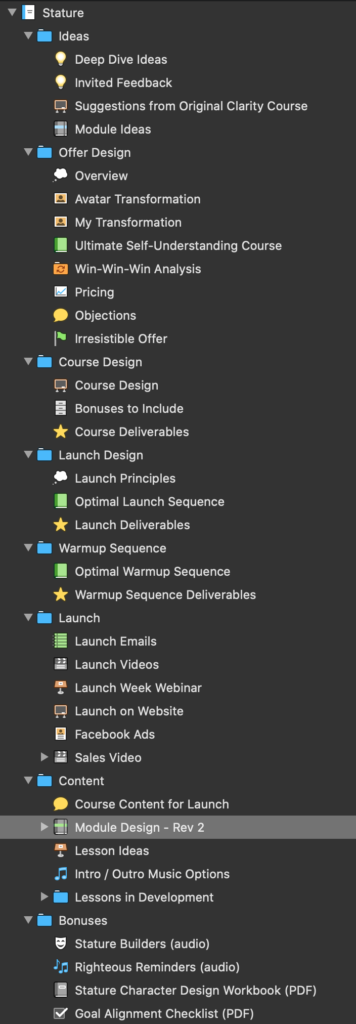
Here’s an example of what my left Scrivener sidebar looks like for the Stature design doc, just to give you an idea of how I structure the outline. There’s a bit more that’s not shown as the outline continues, but this is most of it.

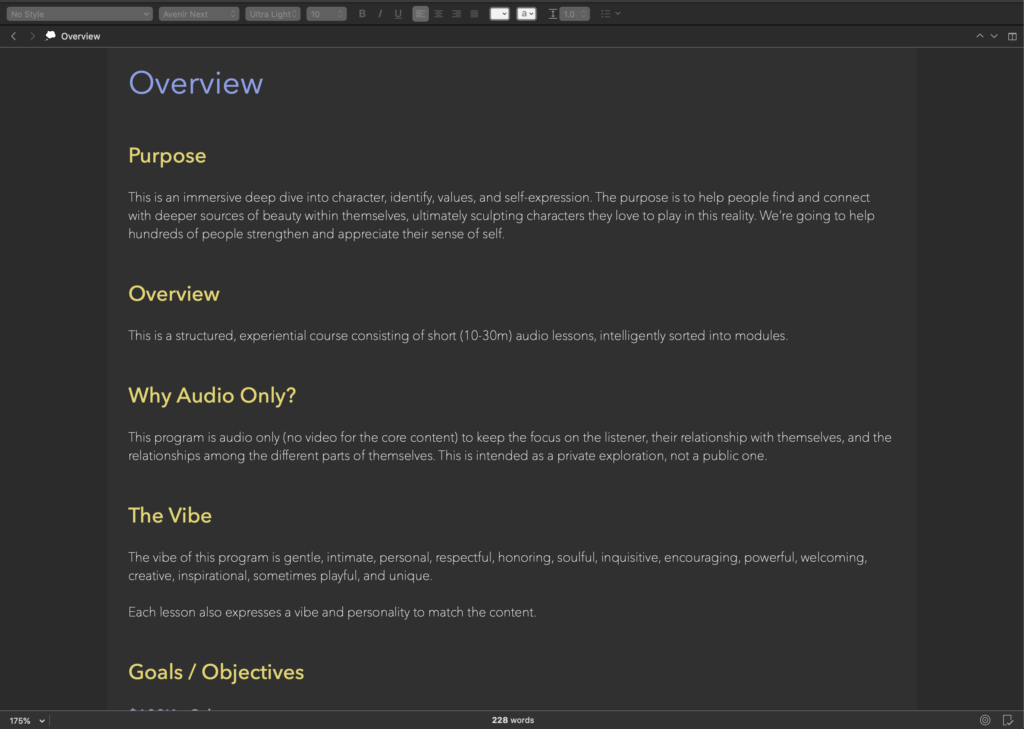
If I click on any of those items, it opens up the relevant part of the larger document that contains the details in a separate window pane on the right side, so it provides instant access to all the details. So it’s like each piece of the outline has its own associated text document.

Here’s an example of what the right window pane looks like, from the Overview section of the Stature course:

What I like about Scrivener is that it provides an expandable and collapsible outline structure, so I can delve into any one part of a project while hiding the other details. I can also click and drag these outline elements and move them around.

This is especially nice for jumping around a lot during the design phase, when I might get a random idea that I may wish to capture while working on some other part of the doc. Then can I click over to the appropriate section, add the idea to process and integrate later, and then return to work on the previous section. Sometimes early in a project, I’ll have a separate capture section, where I collect ideas to process later.

I don’t just use these docs to outline and create the course content. I use Scrivener to work through all of the relevant decisions for a large project. I spend a good bit of time clarifying the purpose of the project. I work through how it’s a win for the participants, a win for me, and a win for the world. I anticipate objections and decide how I’ll address them. I carefully decide what bonus content to create to provide a more well-rounded package. I go over the offer again and again, refining it till it looks really solid. I consider different pricing options.

Many weeks and often months of work go into the project before it’s ready to launch – there are just so many decisions to be made. A launch that looks smooth and simple on the front end is usually way more complex on the back end. If it looks simple, that’s because of all the careful thought that went into simplifying and improving the alignment. People don’t see all the alternative ideas that were considered, evaluated, and rejected along the way.

Some parts of the larger doc are like journal entries where I go over my reasoning for making certain decisions. Then if I ever feel doubtful about a choice later on, I can review my reasoning and see if it still seems sound or if I want to update it. This keeps me moving forward and prevents running in circles while still allowing room to make improvements to earlier ideas. It also gives me an archive where I can look back on previous decisions and see why I made them as I did, even years later. This helps me unearth my own best practices and learn from experience, especially after I’m able to assess the long-term feedback and results of a project.

As this larger document gets filled out, the overall project takes shape. It’s a lot of work to create this type of doc, but it gives me good progress visibility on how far along I am, and it ensures that I attend to every important detail. Most importantly, it helps me anticipate and address potential risks.

Risk reduction is a big reason that I invest so much in creating these design docs. There are lots of things that can go wrong with a launch, and it’s much better to anticipate potential problems early and develop plans for dealing with them. My design docs often include multiple options and contingency plans in case my original plans don’t quite work.

I probably put the most effort into designing the offer. The quality of the offer is the most sensitive part of a launch and the biggest risk in my opinion. It’s where I see many friends endure failed launches – their offer just didn’t land well with their audience. This is why I prefer to invest in co-creating the offer with my readers and especially with previous course participants. When I start seeing some interest and enthusiasm, I know the offer is becoming more solid. Much of this involves picking the right topic and the right transformations to focus on, so people can expect to gain real benefits from going through a course. It’s all about helping people move the needle forward in their lives.

I’ve found that a good way to choose topics is to focus on the relationships we all want to improve. Each course focuses on a different relationship dynamic in our lives. Deep Abundance Integration works on improving your relationship with abundance, money, and even with scarcity. Submersion seeks to improve your relationship with reality, including your relationship to past traumas and painful experiences. And Stature seeks to improve your relationship with yourself, including the relationships between different parts within you to create more synergy and reduce inner conflict and resistance. Our next course after Stature will delve into your relationship with work, especially the creativity and productivity aspects – there’s already a design doc underway for that one.

I think this level of thorough preparation is one reason that all of our course launches have gone very well, not just financially but in the deep satisfaction that people have been gaining and the happy emails about the results people have been achieving.

The launch and development of a major personal development course may look like ease and flow to some, but there really is a tremendous amount of careful thought and detailed consideration that goes into each decision, often long before the launch. Stature’s design doc, for instance, was begun in early 2018, almost two years before it actually launched. It went through several iterations before it converged to the point where it was ready to launch.

I also maintain separate Scrivener docs for Conscious Growth Club, for ongoing marketing and business strategy, and for my overall goals and plans. So I don’t only use these docs for courses and launches.

I often come up with more ideas that I can implement, so these Scrivener docs are good for capturing those “someday / maybe” ideas as well. For instance, I worked through the idea of hosting a free webinar during Stature’s launch week, but I just didn’t have time to work it in, so that had to be cut. However, by documenting the idea in the design doc, I could potentially transplant it into a future project, thereby benefitting from the work I’ve already put into this idea.

Moreover, design docs serve as a nice record of what worked and didn’t work. After a project is fully done, I conduct a postmortem to review what worked, what didn’t work, and what could be improved for next time. Then for future projects, I can keep doing more of what worked (without forgetting) and do less of what didn’t work.

I like to incorporate at least one new idea into each project, and then if it works well enough, I can continue doing it for future projects. It takes a lot of time and energy to develop and implement a new idea, but it takes a lot less effort to repeat the implementation of a good idea that worked before. For Stature, for instance, the new idea was to invite people to connect in a launch Facebook group. It worked well enough that I decided to keep the group open even after the launch finished in mid-January. People who are going through the course are still actively sharing their progress and realizations in the group. I wouldn’t say the group is super active, and a lot of my readers don’t like Facebook, but it was relatively easy to implement, and it provides a nice extra channel to interact with some of the people going through the course.

Each time I develop a new course, I begin with the previous project’s template, and then I can refine it from there. So this gives me an evolving skeleton template to carry over from one project to the next. Just carrying over the structure of the previous project helps to capture the wisdom accumulated thus far, and it makes egregious mistakes less likely.

Perhaps the main benefit of these design docs is that they help me focus. A course and its launch have so many pieces that I can’t keep all of the details in my mind. So I use Scrivener for my go-to capture and design system. This frees my mind to let go of the pieces that I know are already recorded, so I can focus on considering options, making decisions, and moving the project forward instead of being worried that I might forget something important.

Even though these projects are a lot of work, I really do enjoy the creative process. I like Scrivener’s nice touches like how it provides a choice of icons for different sections of a project, so it looks more visually appealing. Dark mode looks nice as well. When I find an app appealing, it reduces friction and makes it easier for me to want to engage with it.

Share Button

Fully Disengaged Rest Breaks

A lot of time and energy are poorly utilized by working with partial engagement and then taking half-engaged breaks, like to web surf or check email.

A great way to increase productivity is to focus on a single task when working and fully engage with it. If the task is a little dull, a good way to make it more engaging is to try to do it faster than usual but at the same level of quality.

Then when focus starts to fade, take a break that’s fully disengaged for several minutes, doing nothing other than resting your mind. Don’t check email or social media. Don’t count eating or going to the bathroom or chatting with someone as a break. Just disengage completely.

When I want to take a disengaged break, I put my feet up on my desk, kick back in my chair (which has a headrest), close my eyes, and let my mind go blank. Sometimes I’ll start with 1-3 minutes of deep breaths with the Breathe App on Apple Watch (at the rate of 4 breaths per minute). Afterwards I’ll zone out completely with eyes closed, usually for 5 to 15 minutes. I don’t try to think about anything. I don’t usually listen to music. I just rest my mind. If my mind tries to stay active, I just think “Shhhhhh” now and then.

Sometimes I nod off and fall asleep during this time. Other times I just feel my mind going into low gear and slowing down. Normally I don’t set a timer. I trust my mind to let me know when it’s ready to return to work. The signal to re-engage is usually pretty clear. I feel my mind speeding up again, and at some point my eyes pop open, and I feel a desire to get back into work mode.

Another type of break is to lie down on the couch and take a nap. That’s really good in the early afternoon. I usually set a 20-minute timer but normally don’t need it unless I’m extra tired. Typically I pop awake automatically within 16-18 minutes. Rachelle and I often like to cuddle nap together on the couch if we both want this kind of break at the same time. Naps are terrific for restoring focus.

A third method I use for full rest breaks is to lie down on the couch and listen to some meditative music for 15-30 minutes. I often do this when I desire a longer break, like when I’m doing lots of creative work, and I sense my mind could use more downtime to rejuvenate itself. For this I usually listen to Brain.fm “relax” tracks, and there are 4 different modes to choose from: chill, recharge, destress, and unwind. I’ve tested all four of these, and I get the best results from the unwind tracks. They usually take me down to a deep level of relaxation, and when the track ends I feel nicely refreshed and ready to get back to work.

With a few of these types of breaks during a workday, I can normally be productive all day long. They don’t take a lot of time, and they’re very restorative. Even five minutes of mental disengagement once per day makes a notable difference.

While I’m resting I do my best to focus solely on rest, and I try to avoid doing anything else. If I take semi-breaks only, like a break that’s really a meal or a break that includes some low-engagement online interaction, more fatigue accumulates, and it gets harder to focus later in the day. I especially notice the difference when I’m doing creative work or design work that requires careful decisions and attention to detail.

In the past I often thought it would be productive to switch to low-engagement tasks during breaks from high-engagement work. But it’s normally counter-productive to do that. It’s so much more restorative when I let my brain basically go offline. Of course it doesn’t really switch off, but it often feels like some parts are able to power down for a while.

Have you tested fully disengaged breaks during your workday? If not, I encourage you to do so. Tune out completely, and let your only mental activity during such breaks be relaxation or sleep. Hold the intentions to rest deeply, to allow some parts of your brain to go inactive, and to notice the signal to return to work when you’re feeling refreshed.

Share Button

Aligning Rewards

We had an interesting discussion on a recent Conscious Growth Club coaching call about making sure that the financial rewards of your career path are aligned with the ways you’d like to be rewarded.

For instance, you may want or expect to be rewarded for some of the following:

  • devising a creative solution to a problem
  • successfully completing a project
  • helping a co-worker solve a problem
  • reporting a problem that could cost the company if not solved
  • acting with honor and integrity
  • telling the truth in a difficult situation
  • encouraging and/or mentoring a team member
  • stretching yourself to develop a new skill
  • working hard

But what people are actually rewarded for often includes:

  • keeping your mouth shut and your head down
  • obeying orders without question
  • agreeing with the boss
  • looking busy
  • lying
  • closing sales at any cost
  • successfully hiding how distracted and unproductive you are
  • leaning on team members to cover for you
  • completing trivial tasks
  • generating data that doesn’t help the company achieve any meaningful purpose

Misalignments like these can occur regardless of how much control and independence you have over your work.

When I started my computer games business in 1994, I expected to be rewarded for my creativity, programming skills, work ethic, and for project completion. I went bankrupt waiting for such rewards to come through.

What actually generated income was closing deals with publishers, and those deals introduced dynamics which were misaligned with my expectations. Creativity wasn’t high on the list of what publishers wanted at the time.

Eventually I was able to create better alignment, partly by shifting my expectations and partly by shifting the reward structure of my business. That involved changing my business model. No one really cared about my programming skills but me, but at least I could be rewarded for my creative ideas and execution. The area where I most had to shift my expectations was marketing. In order to succeed with that business, I needed to up-level my marketing skills, and I had to adjust my expectations to account for good marketing as an activity that would be financially rewarded. I also had to note that weak marketing was financially punished.

I ran into similar challenges with my personal development business some years later. My initial income streams rewarded me in mixed ways. When I generated income from ads on the site, I was rewarded for blogging, for traffic growth, and also for selling and optimizing ads. I was okay with the first two, but I wasn’t as fond of being rewarded for people clicking on ads and leaving the site instead of sticking around to read more articles.

I dropped that model in 2008 and explored other models that felt more aligned. My current models, such as doing workshops, offering courses, and hosting Conscious Growth Club, are good at rewarding me for helping people achieve positive transformations. The more people get good results, the better it is for me since this means more repeat business. This also financially incentivizes me to keep creating more and better courses, to design and deliver more workshops, and to keep supporting and improving Conscious Growth Club.

In this case too, however, I also have to adapt to what the real-world situation rewards. Almost any business, including mine, rewards good marketing. I’ve wanted to improve at marketing too, so I’m okay with this. I’ve tried to set things up so as to align my rewards with doing marketing honestly and honorably, and that’s been working well.

When the actual rewards are nicely aligned with the desired behaviors, life and business flow more easily. You can focus on doing the work and getting better at your core skills, and you can expect to be rewarded for this because the business model is aligned with rewarding you for such behaviors.

What can really mess you up is when your business or employment situation has a misaligned reward structure, so you get rewarded for behaviors you’d rather not reinforce, and/or you don’t get rewarded for behaviors where you feel like you really do deserve some acknowledgement.

In this article so far, I’ve mainly focused on the financial rewards since those tend to be the easiest to assess and measure. But we can extend this to other rewards such as how you’re being appreciated.

When I generated income from ads, people would thank me for my articles and how they benefitted from my writing and ideas. They wouldn’t usually thank me for the ads, although some people did when an ad helped them discover something personally useful.

These days I normally get thanked for insights and ideas I share, especially those that help people get results. I get thanked most often for course lessons, for blog articles, and for helping people in Conscious Growth Club. So that’s all pretty well aligned because these are all areas where I’m continuing to invest.

I don’t typically receive appreciation or rewards for all the study, research, and experimentation I do in private, unless I share something beneficial to others along the way. I don’t get rewarded for making mistakes or pursuing false starts, such as partly developing something that never ships. But I do get rewarded down the road for the results that these activities eventually lead to, and that seems adequate for now.

It’s important to keep an eye on sustainability too. I can be rewarded temporarily for overworking, for instance, but then I get punished for it when it catches up with me. I can generate surges of extra income when I want, such as by launching something new, but if I overdo it, then I get punished on the lifestyle side when life becomes nothing but work, work, work all the time.

Take a look at how you’re being financially (and otherwise) rewarded in life and business. How well do these rewards align with your desired behaviors? Are you being incentivized to grow, improve, and execute in the ways you like? Is the current reward structure sculpting your character in ways you like and appreciate? How are you being over-rewarded or under-rewarded?

If you like what you see, great. And if not, then you have an important problem to solve. One option is to re-align your personal priorities, and get with the program. See if you can release resistance to how you’re being rewarded, and agree to let those rewards sculpt your character as they will. So if you’re rewarded for sales, then get aligned with up-leveling your sales skills, and accept that you’re pursuing a path of becoming a better salesperson. Sometimes this is workable while other times it’s just too unpalatable.

Your other option is to change the reward structure. This may involve negotiating with an employer for different terms, switching employers to find a more aligned reward structure, or changing the business model you’re using.

It’s important to be proactive here. You do have options. If you don’t like what the current reward structure is doing to you, then get into a more aligned reward structure, even if you have to design the business model yourself.

Share Button