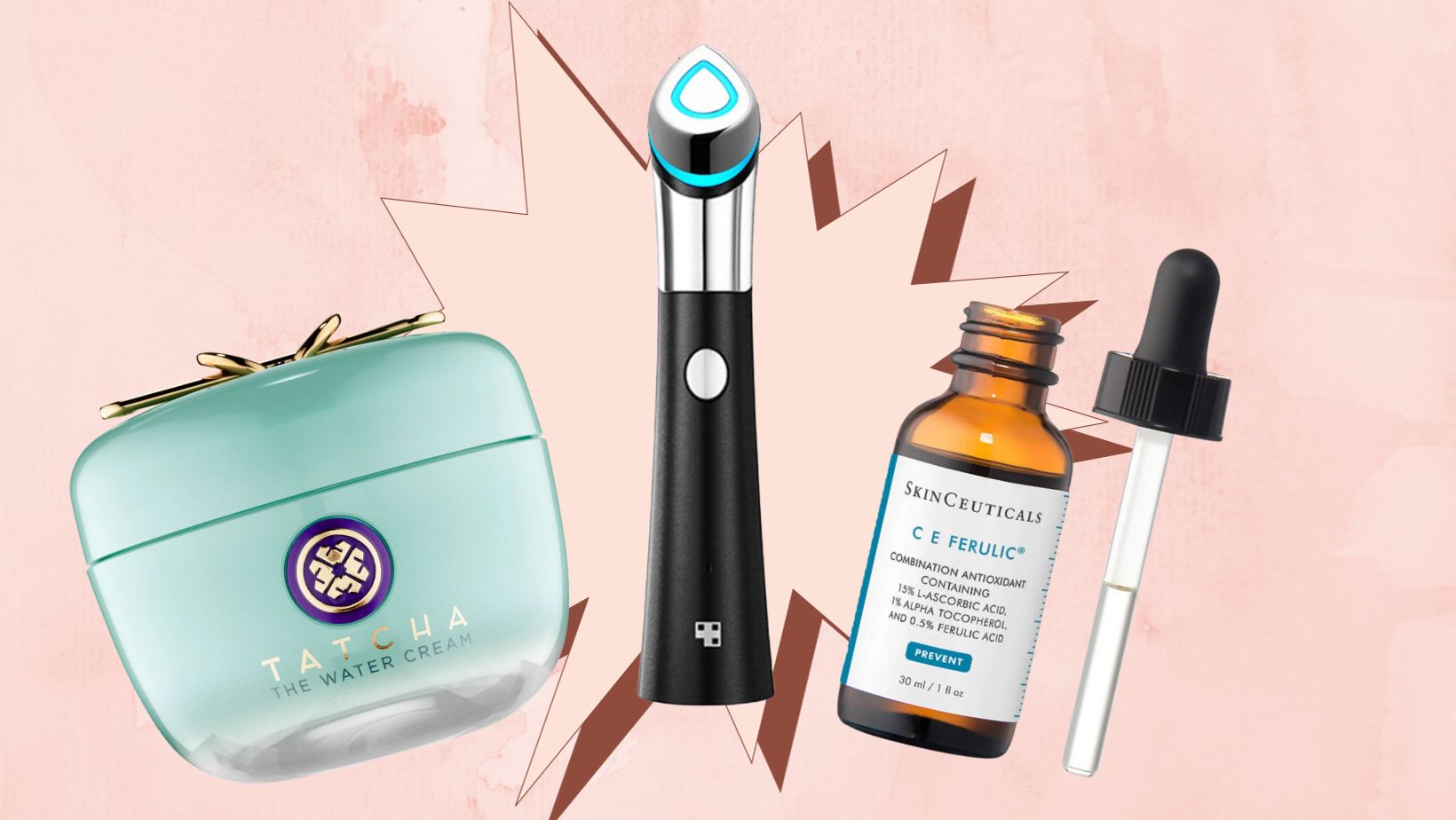
For people of a certain age, these are the wonder years — the years when you look in the mirror and wonder, “What happened to my face?” If the children’s story “TheSaggy Baggy Elephant” is starting to hit a little too close to home, you might want to see how our panel of experts can help you understand what’s happening and what you can do about it.
Why does the skin on your face sag, anyway?
Advertisement
Yes, you can blame the matrix, no matter which color pill you took. “The structural foundation of your skin is provided by something called the dermal extracellular matrix,” dermatologistBrandon Kirsch told HuffPost. “This matrix is composed of molecules such as collagen, elastin and glycosaminoglycans, also known as hyaluronic acid, which is an active ingredient in skin fillers. Aging and environmental factors such as sun exposure, stress, pollution and smoking lead to the breakdown of these substances, leading to wrinkles, crepiness and sagging skin,” he added.
The face you have today is not the same one you had yesterday. “Our face is kind of a moving target, with changes over time in the bones of our skull, as well as the fat and muscles underneath the skin,” dermatologistArianne Shadi Kourosh, assistant professor at Harvard Medical School, told HuffPost. “Loss of these underlying support structures that are holding up the skin, and shifting of the fat from our cheeks downward toward the jowls and jawline, can add to the sagging appearance of the face.”
Gravity is great for keeping us, well, grounded, but it’s not our friend when it comes to sagging skin. “The facial bones that provide a framework start to resorb and lose density and structure, so it’s like the hanger holding up the garment loses its strength,” dermatologistCorey L. Hartman told HuffPost. “Youthful fat pads also start to shrink and disappear, leading to the decrease of another layer of deep, structural support.”
Lifestyle Changes To Make Right Now
Advertisement
There are simple changes you can make to prevent even more sagging, the experts say. Here are some suggestions:
“A sugary diet can cause a process called glycation of collagen, in which sugars bind to it and accelerate the sagging and aging of the skin,” Kourosh said. “Drink enough water and maintain a healthy, low-glycemic index diet,” Hartman suggested. And knock off the sauce, too. “Alcohol is a diuretic, which means it will deplete your body’s natural store of water,” Kirsch said.
Advertisement
“This further weakens the skin, and it creates textural irregularities and pigment changes, as well,” Hartman said. “Avoiding exposure to first- and secondhand tobacco smoke is of critical importance, since that smoke contains a high concentration of free radicals, which are highly oxidative and damaging to all human tissue,” Kirsch said.
“Chronic exposure to ultraviolet light causes reduction in collagen and elastin, as free radicals contribute to an increase in matrix metalloproteinases that further degrade collagen, which gives our skin firmness,” Hartman said. “Commit to using daily sunscreen with SPF 30 to 50.”
Weight Loss
“Massive weight changes, especially weight loss, can affect the skin’s sagginess,” dermatologistJaniene Luke told HuffPost. “There may be redundant or excess skin when a large amount of weight is lost suddenly.”
How Topical Treatments Can Help To Firm Up Sagging Skin
There’s no such thing as a facelift in a jar, but there are some products that might help. “Certain ingredients in topical creams can be helpful in small and gradual ways,” Kourosh said. “But they’re limited in the depth and extent of their effects.”
“While topical products do not give the same results as a cosmetic procedure would, there are some that are effective and can help improve the appearance of aging, sagging skin,” Luke said. “Many of my patients are either afraid of or not interested in undergoing surgical procedures or facelifts, so they’re more inclined to try products or non-invasive procedures.”
“Although few results are documented with high-quality and objective evidence, based on my decades of clinical experience, it’s clear that limited benefits for sagging skin can be achieved with topical products,” Kirsch said. “These topicals work primarily to stimulate the formation of collagen, elastin and other structural components of the skin matrix. In addition, good moisturizers, when used in a regimented manner, can provide modest improvements by hydrating the skin.”
Ingredients To Look For
Advertisement
When you’re shopping, Kouroush said she tells her patients to “take a scientific approach, read labels and look for the right ingredients that have evidence behind them.” Here are some ingredients the experts said to watch for:
Antioxidants, Plant Extracts And Peptides
“Antioxidants scavenge free radicals that cause a breakdown of collagen, and they act as a cofactor in the production of new collagen,” Hartman said. “Antioxidants like Vitamins C and E, as well as plant extracts and peptides, have been used with some success to address the various pathways involved in sagging skin,” Kirsch said. “They target the extracellular matrix to address the loss of supportive structure and elasticity, and the antioxidants protect against contributing environmental factors.”
“Antioxidants such as Vitamin C and niacinamide have been shown in the literature to increase collagen production,” Luke said. “Peptides are amino acids that can penetrate the skin and signal our cells to produce more collagen and elastin.”
“Some eye creams contain caffeine because it’s a vasoconstrictor, which means that it shrinks blood vessels,” Kourosh said. “This helps because it reduces blood flow, which decreases inflammation and redness and ‘depuffs’ swollen areas of skin. Some slimming or cellulite creams also can contain caffeine or xanthene stimulants, which are found in cocoa beans, tea and yerba mate. It’s also possible that regular massaging of the cream into affected areas improves circulation and the appearance of the skin.”
“These are the building blocks of a healthy skin barrier, like the mortar that secures the ‘bricks’ of skin cells,” Hartman said.
Growth Factors
“They promote healthy, efficient production of key proteins in the skin,” Hartman said.
Advertisement
Hydroxy Acids
“Also called fruit acids, these are some of the most widely used and studied anti-aging skin care compounds,” Kirsch said. “When applied to the skin, they increase epidermal proliferation, thickness and hydration. Clinical trials have shown the effectiveness of these ingredients in reversing the effects of photo-aging and improving wrinkles, skin elasticity, tone and hydration. The two main classes to look for are alpha hydroxy acid, such as glycolic acid, and beta hydroxy acid, such as salicylic acid.”
“The highest level of medical evidence supports the use of retinoids such as retinol, tretinoin, adapalene and tazarotene,” Kirsch said. “They’re closely related to Vitamin A, and they’re well-recognized for their ability to stimulate collagen production and enhance the appearance of skin by effacing fine wrinkles, lightening age spots, firming skin and improving surface texture. They also imbue the skin with a flattering, rosy glow.”
“They can help slow the sagging process, especially in those who use them regularly for months to year,” Kourosh added.
The Top Anti-sagging Skin Care Products Recommended By Experts
HuffPost may receive a share from purchases made via links on this page. Prices and availability subject to change.
La Roche-Posay Toleriane Double Face Moisturizer
La Roche-Posay
“For those whose skin requires more moisture than a lightweight serum, this is a good choice,” Kirsch said. “It’s also great for sensitive skin types, and its soft, oil-free texture is easily absorbed.”
Alastin Restorative Neck Complex (left) “This is ideal for helping skin that’s aging, has dark spots or is tissue-paper thin,” Kirsch said. “It helps increase skin hydration and supports the production of new, healthy elastin and collagen.” Get Alastin Restorative Neck Complex for $110.Alastin Restorative Skin Complex (right) “This is ideal for fine lines and wrinkles,” Kirsch said. “It restores volume by supporting production of healthy elastin and collagen, and it improves skin texture and evens skin tone. It’s great for reducing dryness caused by dry climates and retinoids, because its potent antioxidants help protect the skin from free radical damage.” Get Alastin Restorative Skin Complex for $195.
Revision Skincare
Revision Skincare
SkinCeuticals Triple Lipid Restore
SkinCeuticals
SkinCeuticals Silymarin CF
SkinCeuticals
Hartman said, “This is the first antioxidant serum made with oily, acne-prone patients in mind. In addition, it contains vitamin C and ferulic acid, plus salicylic acid and silybin to control oiliness.” Kirsch noted that this product has been clinically proven to reduce environmental oxidative damage by up to 41%.
Luke and Hartman both recommended this product. Luke said, “It’s pricy, but worthwhile for the growth factor serum that produces visible results in four weeks. The new improved formulation builds upon the TNS technology that made SkinMedica a household brand, but with the inclusion of peptides and antioxidants, and no more smelly odor.”
“This is the one product I’ve used that has made a noticeable difference in my face when it comes to tightening and toning skin,” makeup artist Ashley Rebecca told HuffPost. “The microcurrent technology is incredible, and I use it every day for at least five minutes. I recommend this to all my clients as well, and they’ve been loving their results.”
You’re defying age and almost every other human standard? Congrats, you’ve unlocked the J-Lo effect. You’ve set the bar higher for everyone else? J-Lo effect once again. You’re dating a man whose hotness has now multiplied because of you? Ding-ding-ding, J-Lo effect.
Jennifer Lopez has done it all. Whether it’s frolicking under the Capri sun with her former flame Ben Affleck, showing off what the new 52 looks like, or just being a total badass at work, J-Lo is killing it.
Advertisement
The New York Times recently published an article marvelling at J-Lo’s professional and personal achievements, dubbing it the J-Lo Effect. The multi-hyphenate’s accomplishments include managing to secure $12 million (£8.6 million) to replace Simon Cowell on American Idol, plus booking a Las Vegas residency and the Super Bowl halftime show at 50.
Though she’s had her fair share of flops too, J-Lo has been able to do something other celebrities with a 30-year career have not: stayed relevant.
A new context has also been added to the phrase – the desirability of Ben Affleck as a result of their pairing. By virtue of being with with her, Affleck is considered more desirable, or so the theory goes.
Advertisement
On Urban Dictionary, the J-Lo effect has a different meaning altogether – describing it as wearing tight trousers to make one’s butt look bigger.
To get more of an idea of this diverse concept, we spoke to Dr Hannah Hamad, a media and communication lecturer at Cardiff University, to ask what she understands the phrase to mean.
Jason Armond via Getty Images
Jennifer Lopez performing in May 2021.
“The J-Lo effect is a phrase that has entered pop culture parlance and the celebrity gossip lexicon to refer to a phenomenon whereby the perceived sexual desirability of a man increases when he successfully couples with a woman who commentators and observers understand to exist in celebrity culture with higher levels of social, cultural and industry capital than him,” Dr Hamad explains. “In other words, she is ‘hotter’ than him, and she is ‘out of his league’.
“However, his levels of capital increase as a result of his association with her via their romantic or sexual relationship.”
Advertisement
Another connotation of the phrase is how Lopez bucks the trend for female celebrities being lambasted for ageing.
“In experiencing the levels of cultural cachet and industry power that she is at this time of her life (her 50s), she is bucking cultural and industry trends that have seen female stars criticised in the media for ageing appropriately – see for example the scorn that was heaped upon Renee Zellweger and the scrutiny to which she was subjected as a result of a noticeable change to her facial appearance in 2014,” Dr Hamad says. “Equally, we saw this in the ‘tragic spinster’ discourse that has attached itself to celebrity gossip media’s coverage of Jennifer Aniston in the post-Friends decades.”
She adds: “Lopez is not only escaping what previously appeared to be the inevitability of these cultural scripts of ‘bad ageing’ that attach themselves to female stars as they enter the mid-life decades, but is rather successfully channelling renewed confidence, energy and vitality into her celebrity career both on screen [her central figure in Hustlers is a glorious example of this] and beyond, as we see in the noteworthy levels of positive interest being taken in her reunion with Affleck.”
The rest of us might not have her fame and fortune, but we can certainly channel J-Lo’s big, baddie energy.
Life coach Kiran Singh says it’s more a state of mind. “Confidence is a daily practice. You need to connect with yourself and call out the limiting thoughts every single day,” she tells HuffPost UK. “You need to get yourself to a point where you become your own best friend, your own coach and your own cheerleader. Where you know how to talk yourself through moments of doubt and pump yourself up to take action.”
Singh believes confidence is a “by-product of action”, so you need to develop your own hype routine to pump yourself up to take action.
“Learn to love and validate yourself so that the opinions of others are irrelevant,” she says. “You do this by getting to know yourself and what you like about yourself and living in alignment with that and by overcoming the limiting stories that you are not enough through reprogramming your mindset.”
And lastly, remember “confidence is an ever-evolving journey, and the development of it is one that you will be on forever”. So if you’re not Jenny from the yacht just yet, there’s still time.
There’s been plenty of Tokyo 2020 headlines about Hend Zaza, the Syrian table tennis prodigy who, at 12 years old, is one of the youngest Olympians of all time.
But there’s some striking personal stories on the other side of the age spectrum, too.
“I feel very good to be here. But this will for sure be my last Olympics,” she told reporters. “I’m 46 years old. Nothing is going to change it.”
“I’m alive, I’m happy, I’m here without any injuries, and I can stand on my own,” she added with a laugh.
Then there’s Australian equestrian Mary Hanna, who at age 66 is the second-oldest female athlete in Olympic history and the oldest Olympian competing in Tokyo.
Advertisement
Through their efforts, Hanna and Chusovitina are changing the conversation around age and agility. They’re proof that you can compete or put yourself up to a physical challenge way past what is considered “your prime,” said Michael Stones, a professor emeritus at Lakehead University in Ontario, Canada, who researches healthy aging and physical performance.
“It’s terrific that this year’s Olympics includes so many younger and older athletes,” he told HuffPost. “They show that age alone is not an insurmountable barrier to excellence in physical activities.”
These Olympians also lend the games some experience and maturity, especially in team sports, said Sandra Hunter, a professor of exercise science and director of the Human and Athletic Performance Research Center at Marquette University in Milwaukee, Wisconsin.
“These older athletes can help mentor the younger ones, particularly with all the mental and psychological challenges that we’ve seen,” she said. “They bring a level of maturity to the teams and surrounding athletes that allow the younger athletes to learn.”
Advertisement
Below, we spotlight 10 older Olympians who are giving it their all at the Tokyo Summer Games.
Mary Hanna, 66
Ryan Pierse via Getty Images
At 66, Australian equestrian dressage competitor Mary Hanna is the second-oldest woman in Olympics history, after U.K. equestrian Lorna Johnstone, who was 70 at the 1972 Games.
Hanna, pictured here at the 2016 Rio de Janeiro Olympic games with Team Australia’s Aislin Jones, already has sights set on the 2024 Summer Olympics in Paris.
“It’s only three years away,” she said after competing in dressage qualifiers in Tokyo. “Unless my body really breaks down, I’m certainly aiming for Paris.”
Tokyo was Hoy’s eighth Games appearance and if he has his way, he’ll compete in the the 2032 Olympic Games in Brisbane.
“I’ve got my eyes set on 2032 — Brisbane,” Hoy said. “Big incentive to get there. We will wait and see. Vassily [my horse] is going really well. While I’m healthy I will continue doing what I love doing.”
Xia Lian Ni, 58
ANDREJ ISAKOVIC via Getty Images
Tokyo 2020 marks Xia Lian Ni of Luxembourg’s fifth Olympic appearance. The 58-year-old lost her second-round match to South Korea’s Shin Yubin, who is an Olympic first-timer.
Ni isn’t your typical Olympian: According to Radii China, the Shanghai-born mom practices only two or three times per week, warms up for just 10 minutes pre-game and oftentimes relies on her instinct over her sight because of presbyopia.
Oksana Chusovitina, 46
LOIC VENANCE via Getty Images
Though she didn’t qualify for the vault finals, Uzbekistan’s Oksana Chusovitina received a standing ovation and overwhelming support from her fellow gymnasts after competing in her eighth and likely last Olympics.
“It was really nice,” she told reporters after her event. “I cried tears of happiness because so many people have supported me for a long time.”
“I didn’t look at the results, but I feel very proud and happy,” she added. “I’m saying goodbye to sports. It’s kind of mixed feelings.”
Nino Salukvadze, 52
Sergei Bobylev via Getty Images
After her Tokyo efforts last weekend, Georgian shooter Nino Salukvadzebecome the only woman in Olympic history to compete in nine Olympic Games.
If her son has his way, Salukvadze will compete in her 10th Olympics in three years in Paris.
“The whole time we were talking [last], he kept saying, ‘This is out of the question. There are three years left. You can go for your tenth Olympics, you have a chance. Why not take it? If you quit, I will quit too!’ And I don’t want him to quit,” she said.
Abdelkebir Ouaddar, 59
JEAN-SEBASTIEN EVRARD via Getty Images
Santiago Raul Lange, 59
Clive Mason via Getty Images
Savate Sresthaporn, 58
Kevin C. Cox via Getty Images
It’s never too late to start! Shooter Savate Sresthaporn of Team Thailand didn’t begin shooting until 2007, after being encouraged to take up the sport by a friend.
Abdullah Al-Rashidi, 58
Kevin C. Cox via Getty Images
Phillip Dutton, 57
Molly Darlington via Reuters
At age 57, Australian-born Phillip Dutton is competing in his seventh Olympic Games. Dutton, an equestrian who’s competed for Team USA in his last three Olympics, said he’s inspired by NFL quarterback Tom Brady.
“I was very inspired by Tom Brady in the Super Bowl, because he kind of proved that there’s no set age or number for when you can do your best,” he told Sidelines Magazine in May. “Certainly, I think along those lines and don’t think there’s a set number when you have to stop.”
“I’d like to go for as long as I can, but I also don’t want to be stupid about it,” he said. “I don’t see a retirement date at this stage. As long as I’m not embarrassing me or the family, I think I can keep going for a while!”
If you’re talking about paper streamers to hang in the gym, then “crepe” is a perfectly good word. But when you’re talking about your eyes, face, neck, hands, arms and even (ugh) your knees, then it becomes something truly dispiriting.
Crepey skin, or, in medical terms, skin that has lost laxity, tends to show up more often in women than in men, and it usually becomes more noticeable with aging.
Advertisement
“I liken it to a warped and stretched-out rubber band that doesn’t retract back to normal, leaving the skin loose and wrinkled,” dermatologist Stacy Chimento told HuffPost. “In severe cases, the skin can appear as thin as tissue paper.”
“It’s the kind of skin you can ‘pinch and gather,’” plastic surgeon Tanuj Nakra told HuffPost.
The thinner the skin to begin with, the more vulnerable it is to the ol’ pinch and gather. And if there’s a spot you’ve always ignored, watch out. “I always tell younger women that I wish someone told me when I was their age that my arms would get wrinkles,” Joan Sutton, CEO and founder of 707 Flora, told HuffPost. “I’m over 50, and I’ve been diligent about staying out of the sun, using good skin care and getting facials regularly, so my face and decolletage look good — but I neglected my arms, and now I feel like I’m fighting to hold back the crepey skin in those areas.”
Crepe happens. Here’s how.
Advertisement
What in the world is going on here? Mostly, the passage of time. If you’ve hung around the planet for enough revolutions around the sun, you’re likely to notice skin like this somewhere on your lovely self.
“By the time people reach 50, or sometimes even at younger ages, the skin experiences degradation or loss of collagen and elastin/elastic fibers,” dermatologist Jeremy Brauer told HuffPost. “That results in compromised resiliency and increased fragility in the skin.”
Drazen_ via Getty Images
Dermatologists’ top suggestion for preventing crepey skin is to be diligent about wearing sunscreen.
For every time you forgot to put on sunscreen, there might be some new crepe creep happening. “Excessive sun damage is a key factor for accelerating the breakdown of elastin in the skin, which gives it that natural snapback,” Chimento said.
For women, lucky us, there also are hormonal issues at play. “The ovaries gradually decrease estrogen production starting in perimenopause, which typically begins around age 40,”Bryan Barron, content and research director atPaula’s Choice, told HuffPost. “The decline in estrogen leads to further loss of collagen, fragmentation of elastin fibers, reduced capacity for skin to hold on to water and thinning of skin’s surface layers, due to a slowdown of hyaluronic acid and ceramide synthesis.” And once these losses begin to occur, the skin needs more help than ever. “That decline in estrogen leaves unprotected, exposed skin even more vulnerable to environmental damage, increasing the need for daily UV protection with a broad spectrum sunscreen,” he said.
Advertisement
And if you’ve done your best to stay in shape, here’s some bad news: “I see many over-50 women who are thin and fit, but that can make the skin look much more aged and crepey,” dermatologist Sheila Farhang told HuffPost. Because a lower overall body fat percentage means a smaller overall “facial volume,” Farhang says that fitter or thinner people often will have less fat around areas like the temples, eyes, mid-cheek and lower face. “Fat pads usually hold everything up and together,” she said. “Less fat, especially in these areas, can contribute to crepey skin in mature women.”
Here’s how to prevent crepey skin in the first place.
The experts we spoke with had a number of suggestions for lifestyle changes you can make to help reduce crepey skin. The top one was wearing sunscreen year-round on any part of your body that’s exposed to the sun.
If you smoke, well, you know what we’re going to say: “Quit as soon as possible,” Barron said. “Smoking deprives skin of the nutrients it needs to repair itself. Also, moderate your intake of caffeine and alcohol, both of which dehydrate skin and exaggerate a crepey texture.” DermatologistDiAnne Davis pointed to smoking and other air pollutants as contributing factors: “They produce free radicals that can damage plump, healthy skin cells, and that can lead to crepeiness,” she told HuffPost.
“It’s also important to maintain a healthy weight,” dermatologistDeanne Mraz Robinson told HuffPost. “Fluctuations of big gains and losses can cause the skin to stretch and retract, wearing down the elasticity.”
Take it easy when you clean up, too, dermatologistSeemal R. Desai told HuffPost: “It’s a good idea to avoid excessively hot showers.” Barron suggested using a gentle, moisturizing body wash. “You don’t want to use highly fragranced shower gel or worse, bar soap.” He recommendedDove Sensitive Skin Body Wash. “It produces a skin-smoothing, creamy lather that won’t leave skin depleted,” he said. You’ll also want to avoid harsh body scrubs that scratch and tear at already delicate skin. “Crepe-like texture can’t be scrubbed away,” he said.
And since what you put into your body tends to be reflected on the outside, many of the experts we spoke to urged increasing water intake and eating a balanced, healthy diet, both of which can contribute to overall skin wellness. You may want to consider supplements, too. “More studies are emerging supporting collagen supplements, and I usually recommend them for my over-50 patients,” Farhang said.
If you want to take your treatment up a notch, you can work with a doctor.
If you’d like to work with a dermatologist for in-office treatments, here are some of the most popular ways people address crepey skin:
Fractionated radiofrequency: “The No. 1 procedure in my office for crepey skin is fractionated radiofrequency with microneedling, such as Inmode Morpheus8, which stimulates collagen production,” Farhang said.
Advertisement
Ulthera: “This uses targeted ultrasound energy to heat the supporting tissues below your skin. This intense heat breaks down some of the cells and stimulates the growth of collagen to tighten your skin,” Robinson said.
Fraxel and Pico: “These laser therapies use heat to create columns of injury to the skin, which will stimulate the growth of new collagen. This helps support your skin and smooth out wrinkling from the inside out,” Robinson said.
Dermal fillers: “The Food and Drug Administration (FDA) has approved Restylane Lyft, a hyaluronic acid filler traditionally used in the face for use in the hands, which is a commonly affected area of the body for crepey skin,” Robinson said. “I use a hyper-diluted Radiesse dermal filler to the chest, arms and above the knees,” Farhang said.
Get after it early and relax a little, OK?
Just in case you know a Zoomer who’s eager to hear your skin care advice, or if you plan to return to earth in another life and take much better care of your skin, keep these words from Chimento in mind: “It’s best to start treating the body as carefully as the face as early as your 20s.”
Finally, remember this: “It’s not so easy getting older, and as women, we tend to put a lot of pressure on ourselves for how we look,” Sutton summed up. “I’ve been concerned about aging since I was 30, which is a crazy thought to me now, at age 51. I’m still chasing youthful skin, but I’m also embracing the imperfections that come with age and that have taken me decades to create.”
These are products experts recommended to treat crepey skin.
HuffPost may receive a share from purchases made via links on this page. Prices and availability subject to change.
CeraVe Moisturizing Cream
CeraVe
“I recommend moisturizing with thick emollients, which helps to replace the ceramides and lipid concentration in the skin, which can help with overall skin hydration,” Desai said. “I really like the CeraVe moisturizing brand line, and I recommend the creams over lotions. One of my favorite moisturizers in the entire world, and one I recommend to patients every day, is the CeraVe Moisturizing Cream. It’s a rich, non-greasy and fast-absorbing cream that releases a steady stream of moisturizing ingredients, including essential ceramides and hyaluronic acid. It’s also fragrance-free, so it’s great for even the most sensitive skin types.”
“I think it’s really important to use a retinoid at bedtime to help stimulate collagen production,” Brauer said. “I like this brand because it significantly reduces the appearance of crepey skin and wrinkles, with little-to-no irritation.”
Eyelids often are one of the first places crepey skin appears. Eye Bright Cream reduces crepey changes and infuses active ingredients to reverse puffing and aging. “For night, Hyrdroveda Eye Cream is the perfect companion product, since it deeply hydrates the thin eyelid skin and reverses UV damage from the day,” Nakra said.
SkinBetter InterFuse Treatment Cream for Face and Neck
SkinBetter Science
707 Flora Moisture Matrix
707 Flora
“This product works wonders with crepey skin — and I know that firsthand,” Sutton said. “Its formula plumps skin with humectants like apple saccharides that draw in moisture and hydration. I use it on my arms every time I get out of the shower and it really makes a difference.”
Arianna Sholes-Douglas remembers the moment her body was in the grips of perimenopause ― though she didn’t recognize it for what it was at the time, despite being an OB-GYN and integrative health physician focusing on women’s health. Sholes-Douglas was performing a C-section, a surgery she estimates she had done over a thousand times, and her brain just blanked.
“I had a total brain freeze. I couldn’t remember what to do,” she recalled. “It was very scary, and I didn’t know who to talk to or what to do.”
Advertisement
At first, she worried it was early-onset Alzheimer’s. But the big changes she’d been experiencing in cognitive function were hormonal. She was going through perimenopause, the transitional period before menopause when a woman’s body starts making less estrogen until eventually her ovaries stop releasing eggs.
And she’s not alone about being in the dark. Many Gen X women and cusp millennials — who are at the age range when perimenopause has begun or could soon start — have far too little support and information.
“Because in their minds, they’re thinking menopause is an old lady issue,” she added. “They think it’s only relevant when they stop having a period.”
Advertisement
But that’s not true. So here are three important things “Xennial” women should know about perimenopause:
It can start in your 30s or 40s.
There aren’t lines around when perimenopause begins, in part because it varies by individual and also because the types of symptoms are so broad. The term perimenopause really just means “around menopause.”
It’s also a stretch of time that can drag on for a while. Many women start to experience symptoms five or even 10 years before they stop having a period (though the average is about four years). And given that full menopause can happen when women are in their 40s or 50s, perimenopause can begin when they’re in their early 40s or even mid-30s.
Advertisement
“Since 5% to 7% of women are fully menopausal by age 45 (they’ve gone that magical full year without a period), they could be experiencing these symptoms at age 40, not thinking a thing about menopause — because these symptoms can be very vague and don’t come with a big sign ‘You are entering perimenopause,’” said Mary Jane Minkin, an OB-GYN with Yale University and founder of the informational website Madame Ovary.
You’re still able to get pregnant during perimenopause.
If you’re a woman in your 30s or 40s who is planning to have children (and many women are) and you’re fretting that you might instead enter perimenopause, don’t freak out. It’s very much still possible for women to get pregnant during this phase, though it’s definitely worth bringing up with your doctor if you have concerns.
The symptoms go way beyond hot flashes.
When most people think menopause, they think of hot flashes. And many (if not most) women getting closer to menopause will experience hot flashes, or brief feelings of being overheated, at some point — ranging from pretty mild to really severe.
But there are so many other symptoms that can come along with perimenopause, including missed periods or periods that are heavier or lighter than usual, mood swings, changes in cholesterol levels and bone density, urinary incontinence and cognitive fuzziness.
“Many [women] get disrupted sleep ― usually falling asleep quickly as they are exhausted, but are then up at 1 a.m., sometimes with a hot flash, sometimes without. They may have headaches, they may be achy, they may have some vaginal dryness or urinary leakage (although that usually comes later),” Minkin said.
Perimenopause can affect your sexual health and well-being, as well. “The sexual aspect part of perimenopause is something I deal with a lot,” Sholes-Douglas said. “Women are very much caught off-guard when they experience a decline in libido, vaginal pain, vaginal dryness — and they don’t know why.”
But while the possible symptoms associated with perimenopause are wide-ranging, they all really come back to the hormonal changes women go through in the run-up to menopause, as estrogen and progesterone levels fall — or rise and fall in uneven spikes.
The Good Brigade via Getty Images
Finding appropriate care is not always easy for women during perimenopause.
Finding adequate care and support can still be difficult.
Advertisement
Though there’s far more information available to women and health care providers now than had been the case a few decades ago, and many active support communities have flourished, perimenopause is still something women aren’t adequately educated about, according to experts.
Minkin said Gen X women are probably “slightly better prepared, but not dramatically so.” Sholes-Douglas was more emphatic: “Most women are just not prepared.”
There are a few reasons for this, one of which is that there simply isn’t a test doctors can perform to see if women have entered perimenopause.
“Hormone levels may not show much,” Minkin said. For example, a doctor might do an estradiol test to check your estrogen levels, but since normal levels during a menstrual cycle range wildly (from 45 to 350 picograms per milliliter), it’s hard to know where your level should be.
“Let’s say we draw a blood level of 50. Well, is that normal? It may be. But if your level should be 300, that’s low,” Minkin explained.
“It’s a tough diagnosis to make at the time,” she added. “When the patient goes that year without the period, you can then say, ‘Well, hey that was all perimenopausal!’”
On top of which there is a lack of consensus about how to treat symptoms of perimenopause even if it is clear that’s the issue. Hormone therapy, which involves taking supplemental hormones, is one option, but some past studies have indicated it can come with other health risks. Some doctors might recommend lifestyle changes to help manage symptoms; in other cases, women might take medications to more directly address such symptoms as vaginal dryness or mental health changes.
Unfortunately, a lot of this ends up falling on women. They end up needing to connect the dots in their own symptoms and find health care providers who have experience dealing with perimenopause. Which is why it is so important for Xennial women to be aware of what’s happening in their bodies now, or what lies just ahead.
“I’ve had countless patients tell me they went to the doctor and told them they suspected they were perimenopausal, and the doctor said: ‘Oh, you’re too young for that. You’re too young for that,’” Sholes-Douglas said.
“You should not assume that your doctor is going to know more about this than you do,” she added. “On some level, obviously they will. But don’t underestimate the power you have.”
A couple of years ago, while on a bike-packing trip through Armenia and Georgia, my friend Amy and I walked through the streets of Tbilisi. We were both 49 years old at the time, and I told her about how, over the last year, I felt as if I had become more emotional and more easily angered than I used to be and I didn’t know why.
“Ummm, perimenopause?” she said, laughing. The thought had never crossed my mind. I don’t know why perimenopause and menopause aren’t talked about more, why this huge transition in a woman’s life seems to be such a “secret” subject in polite society. Once I figured out that I was indeed in the midst of perimenopause (and I still am two years later), so many things began to make sense. I think I’ve experienced every possible symptom of perimenopause, including hot flashes, trouble sleeping, brain fog, forgetfulness, anxiety and heavier period bleeding than usual. And then there are the skin issues.
Advertisement
I’ve never in my life had any kind of acne, but over the past couple of years, a lone pimple would pop up every month or so. The skin on my elbows was drier than it ever used to be. And small hairs from my Eastern European heritage would show up more consistently on my chin.
I talked to some medical experts to understand some of what was going on.
What happens during perimenopause
Dr. Mary Jane Minkin, clinical professor in the Department of Obstetrics, Gynecology, and Reproductive Sciences at the Yale University School of Medicine and a board-certified obstetrician and gynecologist, first told me that I’d be all right. I’d make it through this transition, even if sometimes I felt as if I were going crazy. Then she explained that the cause of most of my issues was sporadic, fluctuating hormone levels.
Advertisement
“The way I describe it to my medical students,” Minkin said, “is that if you were to draw a picture of what hormone levels do during perimenopause, they would look like the Dow Jones industrial average in September of 2008: It went very far down but it wasn’t smooth; it was jaggedy.”
As Minkin outlined for me, during a normal Jane Doe menstrual cycle, estrogen and progesterone levels vary significantly, but usually in a regular, cyclical way. A ballpark baseline level for estrogen at the beginning of a woman’s period is 40 to 50 picograms(pg) per milliliter. A week or so before the start of the period, levels go up to a high of 300 or 350 pg per milliliter. During ovulation, the area the egg comes out of makes progesterone as well. Post-menopause, estrogen levels go below 20 pg per milliliter and stay that way while the ovaries cease making progesterone.
“And then,” Minkin said, “there’s perimenopause. That’s the tricky area, because what happens is things go really crazy.” What she meant by this is that estrogen and progesterone levels no longer go up and down in a regular way. They are sporadic, sometimes spiking, then dropping more quickly than during a normal cycle. And this causes all sorts of havoc in our bodies (and emotions).
What perimenopause does to your skin
Advertisement
As far as skin-related issues go, testosterone is predominantly to blame. Our ovaries, besides making estrogen and progesterone, also make testosterone. On average, the ovaries stop making estrogen at 51 years old, while testosterone production can go on until about the age of 60. “Your estrogen levels are declining, but you’re still chugging out a good amount of testosterone,” Minkin told me.
And the unwanted hair? Testosterone is to blame for that, too. “As your estrogen is reduced, testosterone becomes more prominent and may cause unwanted hair growth,” said Dr. Laura Carinci, clinical assistant professor in the Department of Obstetrics and Gynecology at NYU Langone Health.
It’s androgens (a group of hormones responsible for “traditional” masculine traits and reproductivity) that cause unwanted hair. “Some people in general have hair follicles that are more sensitive to male hormones, which anti-androgen therapycan help with,” Carinci explained.
Estrogen, on the other hand, is responsible for helping to keep collagen in our skin. When estrogen levels go down, so does collagen production, which can exacerbate wrinkles or dry skin.
How to treat skin issues associated with perimenopause
So what can we do to treat skin issues related to perimenopause? Minkin encouraged women to talk to their doctor about the possibility of estrogen therapy. “A lot of my patients take estrogen because of skin issues,” she said, “because they don’t like having skin dryness and loss of elasticity, and estrogen does help.”
“The biggest thing in terms of preventing and helping yourself with skin changes really is skin protection, wearing sunblock that blocks both UVA and UVB rays, such as products with zinc and titanium oxide,” Carinci said.
<div class="js-react-hydrator" data-component-name="Slideshow" data-component-id="7946" data-component-props="{"index":21,"contentListType":"slideshow","id":"60ae664be4b019ef10e26752","title":"Sunscreens That Won't Make You Break Out","enhancements":{"fonts":{"primary":{},"accent":{},"caption":{}}},"dek":null,"view":"slideshow","slides":[{"embedData":{"type":"hector","url":"https://img.huffingtonpost.com/asset/60ae662f1e00000493102a61.jpeg","queryParams":{},"width":1800,"height":1800,"credit":"Sunday Riley"},"type":"image","common":{"id":"60ae6662e4b03135479f33ab","caption":"This mineral-chemical hybrid sunscreen contains anti-inflammatory turmeric to help reduce redness, as well as lutein, a plant-derived nutrient that can help protect against damage caused by blue light.
Get Sunday Riley Light Hearted Broad Spectrum SPF 30 Daily Face Sunscreen for $35.","credit":"Sunday Riley","creditUrl":"","source":"","thumbnail":{"url":{"fileName":"60ae662f1e00000493102a61.jpeg","type":"hectorUrl"},"caption":"This mineral-chemical hybrid sunscreen contains anti-inflammatory turmeric to help reduce redness, as well as lutein, a plant-derived nutrient that can help protect against damage caused by blue light.
Get Sunday Riley Light Hearted Broad Spectrum SPF 30 Daily Face Sunscreen for $35.","credit":"Sunday Riley","width":1800,"height":1800,"ops":""},"title":"Sunday Riley Light Hearted Broad Spectrum SPF 30 Daily Face Sunscreen","type":"image","meta":null,"summary":null,"badge":null},"provider":null},{"embedData":{"type":"hector","url":"https://img.huffingtonpost.com/asset/60ae65f821000031907f2828.jpeg","queryParams":{},"width":1200,"height":1200,"credit":"Elta MD"},"type":"image","common":{"id":"60ae6676e4b0d56a83f1cb5c","caption":"This hybrid sunscreen is a favorite among people with skin issues, as it contains niacinamide, which can help with acne, rosacea and discoloration. It’s also available in a tinted version.
Get EltaMD UV Clear Broad-Spectrum SPF 46 for $37.","credit":"Elta MD","creditUrl":"","source":"","thumbnail":{"url":{"fileName":"60ae65f821000031907f2828.jpeg","type":"hectorUrl"},"caption":"This hybrid sunscreen is a favorite among people with skin issues, as it contains niacinamide, which can help with acne, rosacea and discoloration. It’s also available in a tinted version.
Get EltaMD UV Clear Broad-Spectrum SPF 46 for $37.","credit":"Elta MD","width":1200,"height":1200,"ops":""},"title":"EltaMD UV Clear Broad-Spectrum SPF 46","type":"image","meta":null,"summary":null,"badge":null},"provider":null},{"embedData":{"type":"hector","url":"https://img.huffingtonpost.com/asset/60ae660b2200007680f080ed.jpeg","queryParams":{},"width":600,"height":600,"credit":"Kinship"},"type":"image","common":{"id":"60ae666ee4b0d45b7531605e","caption":"This reef-safe, non-nano zinc oxide formula contains turmeric and a proprietary probiotic that supports healthy, clear skin.
Get Kinship Self Reflect Probiotic Moisturizing Sunscreen Zinc Oxide SPF 32 for $42.","credit":"Kinship","width":600,"height":600,"ops":""},"title":"Kinship Self Reflect Probiotic Moisturizing Sunscreen Zinc Oxide SPF 32","type":"image","meta":null,"summary":null,"badge":null},"provider":null},{"embedData":{"type":"hector","url":"https://img.huffingtonpost.com/asset/60ae663f2200007680f080f3.jpeg","queryParams":{},"width":750,"height":750,"credit":"Tatcha"},"type":"image","common":{"id":"60ae6658e4b0a256831acf1a","caption":"Good for all skin types, Tatcha’s sunscreen contains Japanese wild rose, which helps improve texture and reduce the appearance of pores. It also acts as a primer underneath makeup.
Get Tatcha Silken Pore Perfecting Sunscreen Broad Spectrum SPF 35 for $65.","credit":"Tatcha","creditUrl":"","source":"","thumbnail":{"url":{"fileName":"60ae663f2200007680f080f3.jpeg","type":"hectorUrl"},"caption":"Good for all skin types, Tatcha’s sunscreen contains Japanese wild rose, which helps improve texture and reduce the appearance of pores. It also acts as a primer underneath makeup.
Get Tatcha Silken Pore Perfecting Sunscreen Broad Spectrum SPF 35 for $65.","credit":"Tatcha","width":750,"height":750,"ops":""},"title":"Tatcha Silken Pore Perfecting Sunscreen Broad Spectrum SPF 35","type":"image","meta":null,"summary":null,"badge":null},"provider":null},{"embedData":{"type":"hector","url":"https://img.huffingtonpost.com/asset/60ae66021e00000993102a5e.jpg","queryParams":{},"width":4934,"height":7398,"credit":"Fenty"},"type":"image","common":{"id":"60ae6672e4b0d45b75316076","caption":"This two-in-one sunscreen and moisturizer goes on sheer, making it suitable for all skin tones, and works well under makeup. It also contains niacinamide, which helps to even skin tone and reduce oiliness.
Get Fenty Skincare Hydra Vizor Invisible Moisturizer Broad Spectrum SPF 30 Sunscreen for $35.","credit":"Fenty","creditUrl":"","source":"","thumbnail":{"url":{"fileName":"60ae66021e00000993102a5e.jpg","type":"hectorUrl"},"caption":"This two-in-one sunscreen and moisturizer goes on sheer, making it suitable for all skin tones, and works well under makeup. It also contains niacinamide, which helps to even skin tone and reduce oiliness.
Get Fenty Skincare Hydra Vizor Invisible Moisturizer Broad Spectrum SPF 30 Sunscreen for $35.","credit":"Fenty","width":4934,"height":7398,"ops":""},"title":"Fenty Skincare Hydra Vizor Invisible Moisturizer Broad Spectrum SPF 30 Sunscreen","type":"image","meta":null,"summary":null,"badge":null},"provider":null},{"embedData":{"type":"hector","url":"https://img.huffingtonpost.com/asset/60ae6637220000c07ff080f1.jpg","queryParams":{},"width":1301,"height":1306,"credit":"Supergoop!"},"type":"image","common":{"id":"60ae665de4b0a256831acf3d","caption":"Apply this mineral powder when you need to reapply your SPF and combat oiliness during the day.
Get Supergoop! (Re)setting 100% Mineral Powder SPF 35 for $30.","credit":"Supergoop!","creditUrl":"","source":"","thumbnail":{"url":{"fileName":"60ae6637220000c07ff080f1.jpg","type":"hectorUrl"},"caption":"Apply this mineral powder when you need to reapply your SPF and combat oiliness during the day.
Get Supergoop! (Re)setting 100% Mineral Powder SPF 35 for $30.","credit":"Supergoop!","width":1301,"height":1306,"ops":"crop_11_22_1253_1280"},"title":"Supergoop! (Re)setting 100% Mineral Powder SPF 35","type":"image","meta":null,"summary":null,"badge":null},"provider":null},{"embedData":{"type":"hector","url":"https://img.huffingtonpost.com/asset/60ae661f210000368f7f282c.jpg","queryParams":{},"width":2000,"height":2000,"credit":"Sun Bum"},"type":"image","common":{"id":"60ae6666e4b019ef10e267f3","caption":"Keep this noncomedogenic sunscreen in your bag so you can easily apply it. It contains soothing aloe as well as vitamin E, which helps fight oxidative stress and may even help combat damage from sun exposure.
Get Sun Bum Original SPF 30 Sunscreen Face Stick for $10.99.","credit":"Sun Bum","creditUrl":"","source":"","thumbnail":{"url":{"fileName":"60ae661f210000368f7f282c.jpg","type":"hectorUrl"},"caption":"Keep this noncomedogenic sunscreen in your bag so you can easily apply it. It contains soothing aloe as well as vitamin E, which helps fight oxidative stress and may even help combat damage from sun exposure.
Get Sun Bum Original SPF 30 Sunscreen Face Stick for $10.99.","credit":"Sun Bum","width":2000,"height":2000,"ops":""},"title":"Sun Bum Original SPF 30 Sunscreen Face Stick","type":"image","meta":null,"summary":null,"badge":null},"provider":null},{"embedData":{"type":"hector","url":"https://img.huffingtonpost.com/asset/60ae65ee2200006f80f080eb.jpg","queryParams":{},"width":2950,"height":3929,"credit":"Colleen Rothschild"},"type":"image","common":{"id":"60ae667ae4b0d56a83f1cb70","caption":"Boasting an oil-controlling, noncomedogenic formula, this mineral sunscreen won’t clog your pores. It also contains chia seed, which helps reduce inflammation while calming the skin.
Get the Colleen Rothschild Beauty Triple Defense Sunscreen Broad-Spectrum SPF 40 for $48.","credit":"Colleen Rothschild","creditUrl":"","source":"","thumbnail":{"url":{"fileName":"60ae65ee2200006f80f080eb.jpg","type":"hectorUrl"},"caption":"Boasting an oil-controlling, noncomedogenic formula, this mineral sunscreen won’t clog your pores. It also contains chia seed, which helps reduce inflammation while calming the skin.
Get the Colleen Rothschild Beauty Triple Defense Sunscreen Broad-Spectrum SPF 40 for $48.","credit":"Colleen Rothschild","width":2950,"height":3929,"ops":""},"title":"Colleen Rothschild Beauty Triple Defense Sunscreen Broad-Spectrum SPF 40","type":"image","meta":null,"summary":null,"badge":null},"provider":null},{"embedData":{"type":"hector","url":"https://img.huffingtonpost.com/asset/60ae66152100004c927f282a.jpg","queryParams":{},"width":792,"height":1024,"credit":"Renée Rouleau"},"type":"image","common":{"id":"60ae666ae4b03135479f33ea","caption":"Rouleau’s own sunscreen is a lightweight, two-in-one moisturizer that works well for oily and sensitive skin types and won’t leave a white cast.
Get Renée Rouleau Weightless Protection SPF 30 for $57.50.","credit":"Renée Rouleau","creditUrl":"","source":"","thumbnail":{"url":{"fileName":"60ae66152100004c927f282a.jpg","type":"hectorUrl"},"caption":"Rouleau’s own sunscreen is a lightweight, two-in-one moisturizer that works well for oily and sensitive skin types and won’t leave a white cast.
Get Renée Rouleau Weightless Protection SPF 30 for $57.50.","credit":"Renée Rouleau","width":792,"height":1024,"ops":""},"title":"Renée Rouleau Weightless Protection SPF 30","type":"image","meta":null,"summary":null,"badge":null},"provider":null}],"options":{"device":"desktop","editionInfo":{"id":"us","name":"U.S.","link":"https://www.huffpost.com","locale":"en_US"},"slideshowAd":{"scriptTags":[],"otherHtml":""},"slideshowEndCard":{"scriptTags":[{"attribs":{},"scriptBody":"\r\n (function(){\r\n var c = document.getElementById(‘taboola-endslate-thumbnails’);\r\n c.id += ‘-‘ + Math.round(Math.random()*1e16);\r\n \r\n var taboolaParams = {\r\n loader: \"//cdn.taboola.com/libtrc/aol-huffingtonpost/loader.js\",\r\n mode: \"thumbnails-b\",\r\n container: c.id,\r\n placement: \"Endslate Thumbnails\",\r\n target_type: \"mix\"\r\n };\r\n \r\n if (typeof window.modulousQueue === \"function\") {\r\n \twindow.modulousQueue.add(function(){ doTaboola(taboolaParams); });\r\n } else {\r\n \tdoTaboola(taboolaParams);\r\n }\r\n }());\r\n"}],"otherHtml":"
If you’re experiencing a lot of skin issues during perimenopause, you may also want to take a look at the products you’re using.
“There are a lot of hormonal shifts that are taking place in your body andit’s not linear. Your levels can go up and down unexpectedly,” said Dr. Rajani Katta, a dermatologist at the Baylor College of Medicine and McGovern Medical School at University of Texas Houston. “You may need to change the kinds of skin care products you’re using.”
Katta recommended switching to heavier creams or ointments for moisturizing in lieu of lotions, which have a high water content. “As soon as you get out of the shower, while your skin is still damp, apply a cream on top to lock that moisture into the skin,” she said.
Advertisement
According to Katta, the most common places for hormonal acne are the chin and jawline. While teenagers tend to get blackheads and white lumps, women who are dealing with hormonal acne usually get those red pimples that come from under the surface.
“Most importantly, you want to make sure all your skin care products are non-comedogenic,” Katta said. Non-comedogenic means the product is formulated specially to not block the skin’s pores. Katta explained that over-the-counter acne spot treatments with ingredients such as benzoyl peroxide or salicylic acid formulated in a cream base do dry up pimples and are likely more suited for hormonal acne, because they are not quite as intense and drying (to the skin) as prescription treatments. The reason for this is that most prescribed acne medicine has a gel base — and may even contain alcohol — which is more drying.
“For people who are experiencing fine lines and wrinkles in some areas on their face, we do recommend medicated products with a vitamin A derivative and retinoids, because those can help build up collagen,” Katta said. Just remember, though, that balance is always key.
“I’ve seen people start to go with anti-aging skin care products that just irritate the heck out of their skin. So it’s really important to find that right balance between something that will help you without irritating you,” she cautioned.
“It’s a phase and it will get better. It gets better. I find many of my patients in menopause really feel good once they’re there. Maybe because it’s a different stage of life, but many feel a sense of freedom and I think it can be a really great stage of life. I think you should look forward to it,” Carinci said.
“Dad needs an STD check,” I said to my brother, our father’s health care proxy, worried about Dad’s health, given his propensity and condition. Dad, a handsome widower after 51 years of marriage, was 87 and suffering from dementia.
After decades in the Big Apple, my return to Missouri at 42 forced me to confront my dad’s sex life in a new way. Sex was a subject my parents never addressed and actually tried to hide while raising me in a strict Irish-Catholic home. They left my education to a former nun at my all-girls’ Catholic high school who taught a class, “Good Grief and Sexuality.” The combination of sex and mortality, including lessons about Elisabeth Kübler-Ross’s stages of grief, in my sophomore year lectures were suddenly oddly relevant as I started a new life and Dad neared the end of his.
My brother said he’d look into the test for our father. I closed my eyes and leaned back on my couch. A year earlier, it had sat in my tiny Brooklyn studio, and now the sofa was in my office in the large house I shared with my fiancé, his two dogs and three sons in a suburb near St. Louis.
In late 2017, I’d taken a leave of absence from my single Wall Street lawyer life to help my father in Missouri. During week one, I sobbed from the stress of tackling Dad’s legal, medical, financial and end-of-life plans, and repeatedly telling Dad’s buddy to stop trying to trade guns with him because of Dad’s dementia.
I quickly grew weary of caring for Dad. In an instant he could go from a smart, sassy man, making jokes and telling war stories, into a 4-year-old throwing temper tantrums. He refused to zip his coat despite freezing temperatures, carried wads of cash around stores instead of putting the money in his wallet and rejected cups of coffee not filled to the brim, which he spilled after shouting, “More, more, more.” I learned to distract him with cookies I had begun to carry in my purse.
Overwhelmed, I sought distraction with the dating app Bumble. One swipe led me to Steve. Early on a Sunday morning at a Starbucks five minutes from Dad, Steve and I met. Afterward, I wrote in my journal, I met my husband. Steve told his sister, “I found her!”
As Steve and I planned for a long-distance relationship, Dad prepared to transition from my sister’s home to a senior community. Days before his move, we made our regular walk down the driveway to check the mailbox. I held his arm, and he held the mailbox contents to his chest. Inside, he tried to hide one bulky envelope under a hat on a box in the entrance way. Suspicious of the package, I reminded him my sister kept his medication in her bathroom.
“Not that one,” he said and marched with the envelope into the kitchen.
“Are those little blue pills?” I asked, knowing a sibling previously had found a bottle of male enhancement tablets stuffed into a clothes bag. At that time, Dad had three girlfriends. He was 84 and couldn’t drive.
“Yes, and I’m taking them to that place,” Dad said. He called friends and told them he was moving into the “cat house,” making me regret we’d shared the male/female ratio at his senior community.
At Dad’s new apartment, I met with a nurse, who would dispense Dad’s pills. After discussing his daily medications, I took a deep breath and fought my embarrassment. “I found one other medication that Dad got in the mail from the Veterans Association. It’s in a sock in his shoe in the closet.”
“We don’t dispense ‘take as necessary’ medications,” the nurse said.
Courtesy of Tess Clarkson
The author’s father in Missouri in April 2019.
Dad settled into his new home. He bowled, played cards and met with the veterans’ coffee group, but happy hour became his favorite activity. Dad soon spoke of a girlfriend, Ellen, a petite woman with short-cropped hair.
Six months after meeting Steve, I left New York and moved to Missouri. One evening, I accompanied Dad to happy hour. To and from the bar, Dad stopped and talked to every woman on his path. From the seat beside me, he blew kisses at the 92-year-old former dance teacher, who blew kisses back until her friend tapped her and said, “He has a girlfriend.”
Dad broke up with Ellen, saying she complained more in two months than Mom had in 50 years. In August, he met Ann, a former Army captain who told stories about her days with Gen. Douglas MacArthur and captivated Dad despite her dementia. A month later, I FaceTimed Dad before happy hour. Upon answering, he said, “There’s going to be a new Clarkson in the family.”
“Who’s having a baby?” I asked, terrified a teenage niece was pregnant.
“No one. Ann and I are engaged!” Dad grinned.
When I asked why he waited two days to tell me, he said, “I wanted to be sure Ann remembered I’d asked and remembered she’d said yes.”
I congratulated my father, not knowing how else to respond to his excitement, and he informed me the marriage would take place in December.
“For taxes?” I asked.
“No. We’re old.” Dad said Ann was only three months younger than him. They were of similar age and mental capacity.
Five days after Dad’s engagement, Steve and I traveled to Paris, where he proposed to me under the Eiffel Tower. The timing made me suspect Steve’s recent visit to Dad requesting approval to marry me was actually what had inspired Dad to pop the same question to Ann.
Back in Missouri, Steve and I bought a house. Dad bought us a wedding present: an antique crystal dish from a newly widowed beauty down the hall. While picking up our gift, Dad told Steve stories. Evidently, Dad had worked as a plumber at the Playboy Club and would help the bunnies fix their corsets by taking them off and retying them. Dad remarked on their breasts. Steve struggled to keep a straight face. I turned red.
The next day, I FaceTimed Dad. He was kissing Ellen in the hallway while walking to visit Ann.
Dad’s dementia progressed. Ann’s did too. While Dad forgot words and names, she forgot to eat. Her family transferred her into the assisted-living section and forbade Dad from visiting her. Ann could no longer give consent.
“I pray for the man above to take me,” Dad lamented on the phone, missing Ann.
To distract him, I took him to do errands. Upon returning, Dad stopped a woman at the elevator. She was a new resident, a widow, who flirted with Dad and told me he was “very friendly.” They gave each other air kisses. The next week he introduced me to his new friend, Rita, who had coffee with him in the dining room and called Dad “charming” and “fascinating.”
Following a trip to the grocery store, I chatted with the woman at the reception desk. She’d been extra helpful to me when Dad first moved into the community, and we spoke often.
“I regret my mom never got to live here,” I said.
“Have no regrets. Your dad is really social,” she said.
“Mom would have been, too.”
“No. Your dad is really social.”
I understood. Dad’s behavior only intensified with dementia and couldn’t be ignored. His sexual propensity had colored my childhood, despite my parents’ attempts to shield me. All of my suspicions were confirmed in my late 20s when I finally confronted my father about one of the women, my mother’s friend. My own pre-Steve litany of men who drank, womanized and couldn’t commit reflected my daddy issues.
Nonetheless, as Mom’s health declined, I witnessed Dad care for her, taking her to the bathroom day and night. Mom told me I needed a man who did what Dad did, meaning put her on the potty. She assured me I could do everything else I needed by myself.
Courtesy of Tess Clarkson
The author and her dad at her niece’s wedding rehearsal in St. Louis in August 2019.
In the wake of my mother’s death, I learned to accept my parents for their limits, their humanness, their mistakes, and I found that I finally could stop entangling myself with younger versions of my father. It was only after I forgave that I met Steve, a man unlike any other I’d encountered. Steve is loving, humble, accomplished and self-aware, with roots similar to my own and a spiritual path remarkably parallel. He has a work ethic that I admire and a smile that warms me.
As I built a future with my husband and my father neared his end, our roles were strangely reversed. I had to parent my father. I worried about him, his life at the senior community and the rising rate of sexually transmitted diseases among seniors. I worried I’d need to tell my octogenarian father, “We need to talk about the birds and the bees.”
But COVID-19 isolation last year meant Dad’s “take as necessary pills” stayed in his sock in the shoe in his closet. In November, Dad was hospitalized in a COVID ward, struggling to breathe. A nurse called my brother and complained that Dad kissed her through her shield. My brother warned her to watch her backside because Dad sometimes grabbed pretty women, not realizing he shouldn’t. His dementia and his age combined made it difficult for him to understand the difference between flirting and harassment.
Days later, my brother and I sat beside my father, who was given only hours left to live. A nurse walked into the room.
“Thank you for taking care of our dad,” I said.
“My pleasure. Every time I visited, he told me I was beautiful,” she said.
“Oh, Dad,” I said, shaking my head. But I smiled through my mask, knowing my 89-year-old father must have enjoyed the beautiful nurse’s company during his last week while alone in the hospital.
Upon leaving Dad’s room, I threw away my protective gear before texting my husband, We got to say goodbye. Headed home.
Tucking my phone into my purse, memories of my father played like a silent film in my head. Our relationship had challenged me, sometimes without me even fully realizing it. But in time, my anger toward him had transformed into a deep love.
The next morning, my sister texted that Dad had passed with her by his side. When I read the message, Steve was at my side, sitting on our sofa. I passed him my phone, tears flowing down my cheeks. As he wrapped his arms around me, I felt a wave of gratitude for my father that I didn’t expect, like all the struggles we had encountered had had a purpose. Dad had pushed me to grow, reflect, communicate and act in ways I could have never expected. I was me because he was him. I could love because he’d taught me how.
I looked up, catching sight of my teenage stepson holding our dog. Photos of my parents, in-laws and Steve with the boys filled the shelves. My life had come full circle. I was back in Missouri, but this time, thanks to Dad, my heart was full and I was surrounded by family and with a partner who supported me in a way I never before had allowed.
Tess Clarkson, an Irish dancer turned lawyer and yogi, lives in Missouri and is working on a memoir, “Beyond the Beaded Curtain.” Her essays have been published in The Washington Post and AARP’s The Girlfriend. Follow her on Instagram @tessclarkson7 and Twitter @tess_clarkson.
Do you have a compelling personal story you’d like to see published on HuffPost? Find out what we’re looking for here and send us a pitch!
MORE FROM HUFFPOST PERSONAL…
Calling all HuffPost superfans!
Sign up for membership to become a founding member and help shape HuffPost’s next chapter
I sat in a friend’s backyard beside his new pool, sipping iced tea his wife had just set down for us. As a favor, Brian, a financial planner, had generously agreed to meet with me to take a look at my situation.
“You’re a 37-year-old childless woman married to an older man. Chances are, later in life you’re going to be alone,” he told me. “If you want to take care of yourself, you’re going to need money.”
His words made my head momentarily swim, but I nodded. He was right ― I needed a new plan.
For most of my adult life, I made a decent living teaching Pilates, and in my late 20s, I opened a tiny studio that I still own and operate myself ― a one-woman show with minimal overhead and lots of flexibility. Up until that moment, I felt I was good with money: no credit card debt, no student loans, a small but existent emergency fund. My husband had his own retirement sorted. A career firefighter, he would receive a pension, but that would disappear when he died.
As a couple, my husband and I have been fortunate enough to land in a place where we can pay our bills and still be left with some discretionary income, which is, I realize, a situation that many Americans and others around the world may never have.
Growing up white, at the lower end of the middle class with a stable two-parent household, had no doubt stacked the deck in my favor and provided me with privileges that paved the way for this backyard meeting and made the luxury of thinking about retirement and long term savings even possible.
Marrying young had also lent me a certain outlier quality among my childhood friends. As they were preparing to go off to college, I was buying my first house. As they traipsed around the globe on a gap year, I was already working. This meant I had arrived in my early 30s with several major life milestones already under my belt, and just enough discretionary income to try to make up for what sometimes felt like a thwarted youth.
It’s not surprising, then, that as a millennial ingrained with an “experience over stuff” mentality, all my extraneous income from the previous decade had gone to travel, filling my passport with stamps from foreign countries. I wore my outlier status as a badge of honor and, bent on solidifying this idealized independent status, I booked solo trips all over the world and leaned hard into that other millennial mainstay, minimalism. Aside from travel, sometimes all I wanted to do was sell all my stuff and move into a van.
My husband, an avid surfer and fellow traveler, would often leave home for months at a time, so I spent extended periods of time living alone. I told myself that, given my experience with traveling and living on my own, I would be fine to navigate old age by myself.
And yet here I sat, 37 years old, being handed an alarming dose of reality. A kind yet blunt financial planner was informing me that I was actually woefully unprepared to take care of myself in the years to come.
I realized I was surrounded by women who were all staring down a similar barrel: the potential of being alone at an older age, fending for ourselves, and with maybe not enough money.
My friend advised me to set aside enough cash to be able to hire help as I aged. Not a bad plan in itself, but looking at my income, my current lack of retirement savings and my penchant for foreign travel, this was going to be no easy feat. I also wasn’t too happy about the possibility of spending my final days among strangers. Still, his advice was not lost on me, and I set up my first investment accounts, thereby taking my adulting to the next level.
Hoping for some consolation and solidarity, I began polling my friends about their plans for aging. A couple of us are married, but most of my friends are not. A few of us have become parents, but most of us don’t have kids. But, honestly, these two mainstays of conventional aid for aging provide little protection against the peril women face later in life.
Having children is not a sure bet either, as many parents still find themselves living out the end of their lives alone or placed in a home. To be a “childless woman,” whether by choice or by circumstance, can leave one feeling even more vulnerable. And in today’s U.S. economy, women are still only averaging 80 cents on the dollar of their male counterparts.
Looking around me, I realized I was surrounded by women who were all staring down a similar barrel: the potential of being alone at an older age, fending for ourselves, and with maybe not enough money.
But hadn’t we all just spent the last 20 years traveling with friends, living with friends, relying on friends? Did that have to change as we aged?
So, I reasoned, why couldn’t we use Blanche, Rose, Dorothy and Sophia as a model to plot our own post-midlife sorority setup? As my panic dissipated, I could see an alternative to the other less-than-appealing options I had been considering ― and I wasn’t the only one.
Two of my friends in their 40s have been joking for more than a decade about spending old age on a shared front porch, sipping lemonade in Juicy Couture velour tracksuits.
Another friend in her 50s had already started to hash out more concrete details of a timeshare-style retirement plan with former college classmates. At some point, each single, successful woman would purchase a small home or condo in some desirable locale around the globe to be shared by the group of friends, thereby creating a rotating ring of old lady tenants and roommates. Sick of someplace or someone? Simply book a ticket and change your current live-in buddy.
There are very few valiant knights, and more than likely, no one is coming to save us. Maybe it’s best to accept that our lives might not provide us with the traditional structure of having children or spouses to care for us in the end.
This brought to mind a story told to me by a retired octogenarian NASA engineer. While she was still in her 40s, her then 90-year-old grandmother had told her, “By the time you’re 70, half your friends are dead. If you don’t want to be alone at 90, make younger friends ― take younger women under [your] wing.”
Clearly, women taking care of women is nothing new. The plans these women were making seemed to me a more stable — and dare I say, more enjoyable — way to grow old than living alone or in a van. The same can be said for queer people who have long formed their own chosen families and relied on each other through the good times and the bad.
The idea began to feel exciting ― a way not only to mitigate loneliness and retain autonomy but also to remain vibrant and have fun well into our golden years. I could already picture which of my friends would fall into the role of hedonistic Blanche, filling our imagined home with a parade of younger men, and who would be Dorothy, with her pragmatism and dry wit. We would not only care for each other but feed off each other, keeping ourselves vital and young-hearted as long as possible.
While this still does seem like a distant future to me, just the notion of living among friends into old age has taken a weight off me that I didn’t even realize I was carrying. It has long been a dream of mine to not just travel, but to one day live abroad, so I have started sending like-minded friends listings for cheap Italian homes in need of renovation and teaching myself French in the hopes that maybe some of us will be brave enough to see out our later years overseas.
The truth is though, it might not go that way at all. My husband may outlive me, or we might simply be fortunate enough to spend our later years together. Maybe he’ll end up living with me and my friends ― or maybe he’ll live across the street. Time will tell, but for now, as I make my new IRA contributions and daydream with girlfriends about what cities we all might want to grow old in together, what I’m actually left with is this: There are very few valiant knights, and more than likely, no one is coming to save us. Maybe it’s best to accept that our lives might not provide us with the traditional structure of having children or spouses to care for us in the end.
I think that’s OK. Because even if we do have kids or partners in the picture, we’re still completely capable of saving ourselves ― and each other.
No matter what my living situation looks like in the years to come ― whether I’m officially living the Golden Girls life or not ― I will still want to live out the end of my days surrounded by friends. Few things in life are guaranteed, but the power and support of a circle of women is certain, no matter what stage of life we’re in.
Ashley Brooks is a writer, journalist and owner of a boutique Pilates studio. She can be reached at ashley.brooks.writer@gmail.com.
Do you have a compelling personal story you’d like to see published on HuffPost? Find out what we’re looking for here and send us a pitch!
MORE FROM HUFFPOST PERSONAL…
Calling all HuffPost superfans!
Sign up for membership to become a founding member and help shape HuffPost’s next chapter
“Dirty 30.” “Thirty, flirty and thriving.” There are many quippy ways to describe this significant decade.
But perhaps the best descriptions of this stage of life come from the funny and relentlessly honest folks on Twitter. Whether you’re getting stoked about home decor or feeling the pain of hangovers more than ever before, this time is all about new experiences.
Below, we’ve rounded up 30 tweets about being in your 30s.
You’ve probably never turned on the nightly news and heard the anchors talking about menopause or gone to a charity event where all the women were discussing who was still getting their period.
That’s because menopause is something women go through mostly alone. And as our bodies and our hormones are unique to us, we don’t all share the same experience when we’re going through it. While some women experience nothing other than their period ending, other women experience the full monty of side effects, including hot flashes, weight gain and hormone swings.
Even knowing about the possible side effects, menopause was something I looked forward to. If my youth was going to go into retirement, not getting my period was a pretty good part of the severance package. Since there’s no way to know for sure when you’ll start menopause, most doctors make an educated guess based on when your mother or grandmother went through it. My mother had a hysterectomy in her 40s, and there was a rumor in my family that my grandmother went through it in her 60s, but I was hoping that was apocryphal. I decided arbitrarily that at the age of 47, my period would be over. Unfortunately, my body wasn’t on the same page.
When I turned 48, almost all my friends, even ones younger, had gone through menopause. They no longer had to worry about bringing feminine products on vacation ― things that still took up room in my suitcase where I could have brought something more important like a fourth bathing suit.
Before you go through menopause, you go through perimenopause. It’s that in-between time when you truly don’t know what your body is doing. Before perimenopause, there are distinct signs that your period is coming. The slight cramping you start to feel lets you know that you have two more weeks to feel good before you want to sell your kids to the circus. During perimenopause, though, nothing you feel is a guarantee that you’re getting your period. Many times, I’d get cramps, feel lousy, start crying when my favorite show was canceled, only to find my period didn’t arrive for two more months.
Every year on my birthday, I would think: This has to be the year when my period will stop, but every year I was wrong. When I turned 50, my period still hadn’t disappeared, but the very next day, hot flashes and night sweats invaded my life. Happy birthday to me!
I would’ve felt sorry for my husband, but I was annoyed that he wasn’t having the same symptoms. All night, I’d roll over and throw the covers off both of us, then throw them back on when I started freezing. With each twist and turn, I woke him up. After a while, he couldn’t see straight at work, and he kindly bought me a fan for my side of the bed.
When I was 51 and my youngest child left for college, I was sure my body would get the memo that I was in a new stage of life. I was now mothering long distance; I didn’t need my reproductive organs anymore. I didn’t want to get rid of them, I just wanted them to go dormant. And no more miracle babies; I’d sent two of those off to college. I’d done my time making peanut butter and jelly sandwiches and signing school emergency forms.
When I was 52, at my annual gynecologist appointment, she asked me when my last period was, and I was embarrassed to say two weeks ago. Her response was that I was lucky. Lucky? I couldn’t think of one reason I was lucky, but she had many of them. She said if a woman was still getting her period it meant her estrogen levels hadn’t dropped, so her heart would be healthier, her weight easier to control, and she would feel younger. If never getting my period again meant I would be a wrinkled mess with a heart condition, I’d take it. OK, maybe I wouldn’t, I’m a little vain ― but you get the point.
When I was 53 and working on my debut novel, ”After Happily Ever After,” I realized I’d gone three months without a period. Then it was four, then five, then six months. I was hesitant to be excited, yet I was. This was finally it! I bought a bottle of Champagne and celebrated, and the next morning, I got my period, and I had to pour out the rest of the bottle. Well, actually I didn’t. Who would waste Dom Perignon?
Mother Nature teased me for a few more years, and then finally at 55, I was busy finishing that novel, when I realized I hadn’t gotten my period in eight months. I knew my older sister had gone 10 months before starting back up again, so this time I wasn’t going to be fooled. Month after month, I waited, and when I went back to the gynecologist five months later and she asked when my last period was, I enthusiastically exclaimed that it was a year and a month ago. I was free!
When you’re a teenager and you get your period the first time, you’re told that you’re now a woman. Nobody is a woman because they can bear children; you’re a woman because that’s who you are. Menopause is not only just another one of life’s many transitions, but also a rebirth. As much as I’m grateful for my sons and impressed by almost everything they do, I’d always put their needs first and mine on the back burner. But by the time I went through menopause, they were independent, which gave me the time to get to know myself again. I have more energy, I’m smarter and wiser and I know what I want, and I have the time to go after it.
I wish I knew all this when I was younger, but I believe society is slowly changing. After all, we have our first woman vice president in her 50s, and no one’s calling her old. We need to tell our daughters that whether you go through it in your early 40s, or later 50s, you still have many more years ahead of you to be productive and contribute to the world around you. Embrace this end of an era, celebrate and be joyful, and pack that fourth swimsuit.
Leslie A. Rasmussen is the author of “After Happily Ever After,” a novel that deals with love, marriage, family, the empty nest, aging parents and what happens when they all come crashing down at the same time. Learn more at lesliearasmussen.com.
Do you have a compelling personal story you’d like to see published on HuffPost? Find out what we’re looking for here and send us a pitch!
RELATED…
Calling all HuffPost superfans!
Sign up for membership to become a founding member and help shape HuffPost’s next chapter