Hancock Confirms Plan To Make Covid Vaccines Compulsory For All NHS And Care Workers

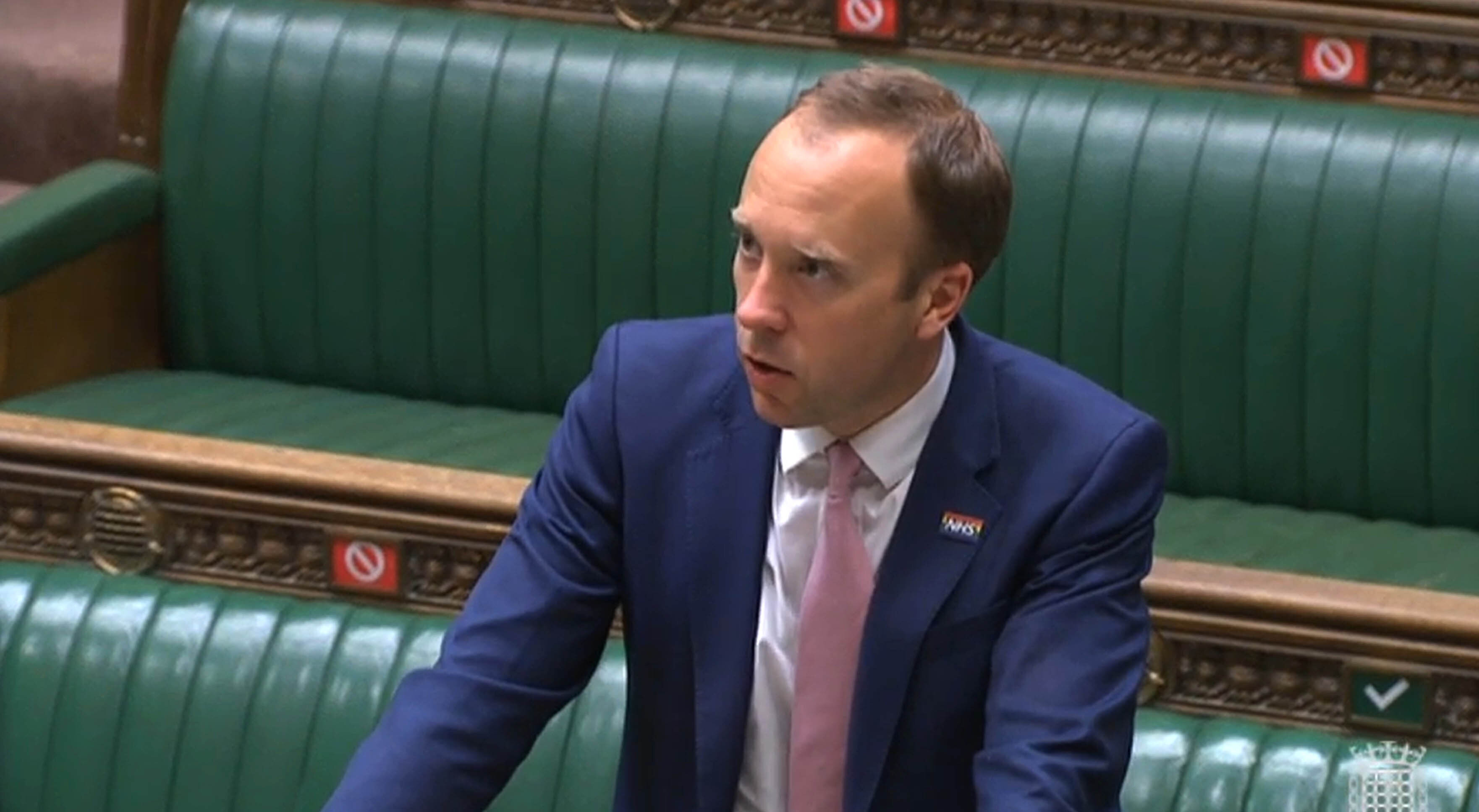
Matt Hancock has confirmed that Covid vaccination is to be a condition of employment for care home staff and that the government will consult on a similar rule for NHS staff.

The health secretary told MPs of the move, despite opposition from Labour, trade unions and others who fear it could prove counter-productive.

Speaking in the Commons, Hancock said: “The vast majority of staff in care homes are already vaccinated but not all, and we know that the vaccine not only protects you but protects those around you.

“Therefore we will be taking forward the measures to ensure the mandation as a condition of deployment for staff in care homes and we will consult on the same approach in the NHS in order to save lives and protect patients from disease.”

He added that he would now consult on whether all healthcare staff, including those in the NHS and domiciliary care, should face similar rules.

“The principle of vaccination for those in a caring responsibility is already embedded and indeed there is a history going back more than a century of vaccination being required in certain circumstances, and I think these are reasonable circumstances.

“So, we will go ahead for those who work in care homes and we will consult for those in domiciliary care and on the NHS.”

He added that he had no wider proposals to make the vaccinations compulsory for the public, but did say that the state had a lesser “duty” toward those who had refused to be jabbed.

Former minister Steve Baker suggested carers should have a right to choose between the vaccine or daily lateral flow tests, but Hancock replied: “It is a matter of risk and we know the vaccine reduces that risk very significantly.”

The prime minister’s official spokesperson said that no vote by MPs would be required to enact the change.  “I don’t believe this is something that would be voted on in parliament,” he said.

England’s chief medical officer, Professor Chris Whitty, has said doctors and care workers have a “professional responsibility” to protect their patients, just as they already have a “duty” to get jabbed for hepatitis B.

But the backlash against making Covid vaccinations effectively compulsory for care home staff began in earnest, with some in the sector warning it would make it harder to attract badly-needed employees and could lead to some quitting.

The GMB union claimed more than a third of carers would consider leaving their jobs if vaccinations become compulsory.

NHS figures to June 6 show overall that 84% of staff in older adult care homes in England have had one dose of vaccine, and almost 69% have had both jabs.

But the data shows that in Hackney, east London, for example, just 66.7% of staff in older adult care homes have had their first dose, with only 58.6% of staff in the borough having both doses.

Dr Susan Hopkins, strategic response director for Covid-19 at Public Health England, told MPs “people may vote with their feet, and not want to have the vaccine, and therefore not work in a care home, and that could lead to staff supply issues in care homes”.

She told the Science and Technology Committee: “I will remain a little bit concerned that we will have shortages of care staff once the mandate has come in, but I’m sure that the vast majority of care workers do want to do the right thing and get vaccinated to protect the elderly under their care.”

Research published last month by the London School of Hygiene & Tropical Medicine (LSHTM) found Black African and mixed Black African staff are almost twice as likely to decline a vaccination as white British and white Irish participants.

Reasons included concerns about a lack of research and distrust in the vaccines, healthcare providers, and policymakers.

Unison general secretary Christina McAnea said: “The only way out of the pandemic is for everyone that can to have their jabs. Encouragement has the best results and research shows coercion makes the nervous less likely to be vaccinated.

“The government’s sledgehammer approach now runs the risk that some care staff may simply walk away from an already understaffed, undervalued and underpaid sector.”

GMB national officer Rachel Harrison said: “The government could do a lot to help care workers: address their pay, terms and conditions, increasing the rate of and access to contractual sick pay, banning zero hours, and ensuring more mobile NHS vaccination teams so those working night shifts can get the jab.

“Instead, ministers are ploughing ahead with plans to strong-arm care workers into taking the vaccine without taking seriously the massive blocks these workers still face in getting jabbed.”

Mike Padgham, chairman of the Independent Care Group (ICG) which represents care homes in Yorkshire, said “it will put people off coming into the service”.

“The second problem is people who are already working in the service who might not want the vaccine. We are so stretched for frontline staff. It sounds easy to redeploy them but it isn’t easy to replace them when you redeploy them. And I think people will be put off.”

Director of public health for Gateshead, Alice Wiseman, told Times Radio she backed the move, saying: “This is a really difficult decision because nobody ever wants to take away an individual’s right to have that choice.

“But we do make some vaccines mandatory in other aspects of healthcare. So, for example, we ensure all surgeons have their hep B vaccination, and it’s really important that we do this where we’re protecting those people who we are caring for.”
Share Button

How Many Deaths Is Boris Johnson Willing To Tolerate To Keep His July 19 Promise?

You’re reading The Waugh Zone, our daily politics briefing. Sign up now to get it by email in the evening.

It’s barely three weeks since Dominic Cummings gave his evidence to MPs, yet it already feels like a long time ago. Boris Johnson’s former chief adviser may have electrified Westminster but he left the public just shrugging its shoulders in contempt, leaving barely a trace.

Still, Cummings’ real impact may have been in highlighting the need for the PM to be extra-cautious about Covid, heeding the warning signs when case numbers spike and forcing him to really listen to his medical and scientific advisers.

We also have Cummings’ testimony to thank for getting on record Johnson’s frustration last autumn that he hadn’t acted more like “the Mayor from Jaws”. And today, Labour pounced on that phrase to ram home what it thinks is one of his biggest blunders of the pandemic: not closing the borders to India.

In possibly his best speech since taking the job of shadow home secretary, Nick Thomas-Symonds said that the 14 day delay in putting India on the “red list” was a “fortnight of failure” driven by Johnson’s desire to have a photo-op with Narendra Modi. It was not the India variant, nor the Delta variant, but “the Johnson variant”.

Moreover, Thomas-Symonds said Johnson’s Jaws mayor tribute act had had tragic consequences with “British people..attacked in their thousands” by the shark of Covid. He even conjured up the image of Keir Starmer as police chief Martin Brody from that same movie: “eyes on the shark, doing everything to keep people safe”.

Some in Labour have been pushing hard for months to ram home this attack line about the need for tighter borders. It turns Johnson’s “take back control” Brexit mantra into a judo throw aimed at knocking him off his balance. Allied with more state funded support for the aviation and travel industry, it is at least a coherent strategy and one that anticipated imports like the Delta variant.

Though it avoids the “hindsight” charge, there are pitfalls. One risk is that Labour can appear to be banking on the virus outpacing the vaccines in coming weeks, in the hope of proving itself right about Johnson’s border failure. Without careful handling, that could turn out to be an even worse look than an opposition which relies on increases in unemployment to win power.

Then again, as I mentioned last night, there is a real risk entailed in the PM claiming July 19 is a “terminus” date. Michael Gove highlighted the implicit logic of that approach this morning when he refused to deny that hundreds of deaths would now be tolerated once the final unlocking happens.

“Hundreds” is of course much less than the “thousands” (or “tens of thousands” the PM referred to at one point yesterday) that would have died if the June 21 unlocking had gone ahead. Yet the Sage papers released on Monday night made for grim reading. Even with a five-week delay, one model estimates between 31,200 and 62,900 extra deaths by December 31.

Those death numbers are much, much higher than the worst winter flu outbreaks, even though that’s the comparison increasingly made by ministers. On ConHome’s Moggcast, Jacob Rees-Mogg said “you can’t run society just to stop the hospitals being full”, but he also said deaths were the key metric – and on this measure the Indian variant could yet wreak havoc.

Rees-Mogg has proved he has more lives than Gavin Williamson in his current post and that may in part be because he reflects the lockdown sceptic views of some backbenchers. The PM too is more of a Mayor Vaughn than a Chief Brody. He is clearly braced for more fatalities, the question remains just how many he will tolerate, and whether he will tell us what the number is.

But just how many excess deaths will the public tolerate? The phrase you’ll hear in coming weeks is that we all have to “learn to live with” Covid. For the families of those who fall prey to this awful virus, that may sound like learning to die with Covid. And even Boris Johnson’s famed political skills may have trouble with that soundbite.

Share Button

Rees-Mogg Says Lockdown Can’t Continue ‘Just To Stop The Hospitals Being Full’

Leon Neal via Getty Images

Cabinet minister Jacob Rees-Mogg has come under fire from Labour after he suggested that lockdown curbs can’t continue “just to stop the hospitals being full”.

The Commons Leader told ConservativeHome.com’s “Moggcast” podcast that “the NHS is there to serve the British people, not the British people there to serve the NHS”.

He also suggested that protecting the health service should no longer be the government’s top priority and that patients entering hospital for a few days was “not very important”.

Rees-Mogg said that “infections are not what matters any more”, adding that the number of deaths from Covid should be the key consideration as the UK came out of the pandemic and ministers weighed up the need for personal freedom.

The minister was asked about the prospect of the Indian variant of Covid spreading further in the absence of two doses of vaccines for all adults, and the prospect of hospitals being “clogged up” as they struggled with a backlog of non-Covid cases.

He replied: “Ultimately, the NHS is there to serve the British people, not the British people there to serve the NHS, and therefore we may need to spend more money on hospitals but you can’t run society just to stop the hospitals being full.

“Otherwise you’d never let us get in our cars and drive anywhere or do any of the other things that people want to do. There has to be some proportionality within that. The government doesn’t have the right to take charge of people’s lives purely to prevent them seeing the doctor.”

He went on: “Actually, otherwise we’d never be allowed in our kitchens where a disproportionate number of accidents in the home take place or our bathrooms, so we’d become very hungry and very smelly on that basis.”

Rees-Mogg, who spoke just hours before Boris Johnson confirmed the final removal of Covid restrictions would be delayed from June 21 to July 19, added that with the older population jabbed young people who caught Covid were less of a worry.

“If everybody in the top nine categories has had the double vaccination and has had two weeks afterwards, people below those categories aren’t at a particular risk,” he said.

“Infections are not what matters anymore. Two things that matter: can the NHS cope and the number of deaths. Overwhelmingly important is the number of deaths. People going into hospital for a couple of days and coming out again, it’s not very important. If they’re dying, it’s very important.”

Shadow health minister Justin Madders said: “Rees Mogg spends so much time with nanny he thinks the nanny state lurks around every corner. Comparing a pandemic with accidents at home is a ludicrous analogy to make and shows a complete detachment from how this virus has affected people.

“His statement that it’s not the government’s job to protect the NHS is foolish in the extreme and of course contrary to his own government’s policy for the last year. The mask has slipped if he doesn’t think the NHS is worth protecting. As for his comments that people going into hospital with Covid for a few days is ‘not very important’, has he even heard of Long Covid?

“His claim that ‘infections are not what matters any more’ is plainly contrary to the advice of the government’s scientific advisers, because it is rising infections from the Delta variant that has delayed Freedom Day, which is entirely down to the government’s negligence.”

No.10 refused to endorse the cabinet minister’s remarks, preferring to underline that the government’s four tests for each stage of its “roadmap” out of lockdown still applied.

One of those tests is that “infection rates do not risk a surge in hospitalisations which would put unsustainable pressure on the NHS”, and a rapid increase in hospital admissions in recent weeks has put it in doubt.

The other key test – that “the assessment of the risks is not fundamentally changed by new variants of concern” – has not been passed, chief medical officer Chris Whitty confirmed on Monday.

Asked if Rees-Mogg was representing the government’s position by saying society couldn’t be run to avoid hospitals being full, the PM’s official spokesperson replied: “The position we’re using is the four tests.

“And on that basis, we don’t meet those four tests and so that is why we are not proceeding.”

He added that ahead of the July 19 date: “We will decide using the four tests when we come up to that period a week beforehand.”

Share Button

Will Boris Johnson Come To Regret Making July 19 The Terminus Of His Roadmap?

You’re reading The Waugh Zone, our daily politics briefing. Sign up now to get it by email in the evening.

Just when you think you’ve got it beat, Covid-19 somehow comes back stronger. Like Arnold Schwarzenegger but without the charm, this Terminator of a virus has an “I’ll be back” menace that risks undoing all the hard work of the UK’s stunning vaccine rollout.

The epic battle between the vaccines and the virus certainly has high stakes. Perhaps that’s why Boris Johnson sounded unusually nervous as he announced he would indeed be postponing ‘Freedom Day’ by another four weeks. Instead of the sunshine of Midsummer Merrie England, there was a blizzard of scary charts of projected hospitalisations.

Fluffing his lines, the PM referred to “the adults of this company” (he meant “country”) and then wrongly declared the new unlocking date was July 29th (correcting it later to July 19th). Polling shows most of the public are relaxed about a delay, but Johnson is acutely aware that the 24% who are unhappy include several of his own backbenchers, and it showed.

Nowhere was this more telling than in his repeated reassurance that the Freedom Day Mk II was the real deal. He was “pretty confident” that July 19 will be “the terminus date” (he said “terminal date” too). June 21 was always a “‘not before’ date”, whereas this was much firmer, he suggested. This was not a defeat for lockdown sceptics, it was a victory, he seemed to imply.

That spin may or may not work on Tory MPs, but it could paint the PM into a corner for the first time in months. Ever since he bowed to Chris Whitty and Patrick Vallance’s plan for a cautious roadmap, he has been able to fall back on their insistence that all four tests have to be met (the new variant test was particularly shrewd) and that “data not dates” will drive his decisions.

But now with talk of “terminal” and fixed timelines, it feels like dates not data is the new approach. Steve Baker, Mark Harper and Sir Charles Walker, who will probably vote against the delay, have much more concrete evidence of a breach of faith should that July 19 date somehow slip again.

Whitty and Vallance gave the PM invaluable backing at the press conference. The chief medical officer in particular pointed out that even without the Indian variant, the very restoration of unrestricted indoor mixing of “households that are unrelated” was always going to lead to an uptick in cases. He added there had to come a point where fatalities switched from “deaths averted” to deaths delayed”, as with flu.

Patrick Vallance even suggested that locking down beyond July 19 would be counter-productive. And he made the case for that date containing the Goldilocks calculation of just how hot or cold to make the roadmap porridge. Giving over-18s their first jab and pushing unlockdown closer to the school holidays certainly added some sugar, as did a lifting of the cap on wedding numbers.

Still, for Keir Starmer, the talk of 19 July as a “terminal” date is an opportunity for a Judgement Day on Johnson’s competence. If the vaccination programme can’t sufficiently flatten the Delta variant spike, he is sure to step up his own attack line that Johnson’s failure to stop flights from India is the real culprit. Already today, the Labour leader hardened his rhetoric to say it was a “pathetic” border policy that had postponed freedoms.

Starmer’s clear aim is to drive a big wedge between the excellence of the NHS vaccine rollout and the government’s wider failures. It’s unclear whether it was the PM’s desire to keep alive post-Brexit trade talks with Narendra Modi that prompted his inaction, but the suggestion that he recklessly undermined both the NHS’s programme and public sacrifices is a toxic one.

Today’s failure to offer extra financial support to businesses added extra political risk too. Those firms which were hanging on by their fingertips will now face having to pay their share of furlough bills, with no extra income to fund them. Add in the self-employed already upset and an Opposition that was pro-enterprise could make inroads.

To oversee one Covid wave is a misfortune, to allow two begins to look like carelessness. But to trigger a third wave, squandering all the good work of your own vaccine success story, could be seen as unforgivable by a public which has to date been incredibly forgiving of its prime minister.

Share Button

Lockdown Extension: The New Roadmap For Lifting Covid Restrictions In England

England’s long-awaited exit from lockdown has been delayed, with Boris Johnson warning a spike in cases of the Delta variant could lead to a surge in hospitalisations.  

This is the new timeline for reaching stage 4 of the government’s roadmap.

Stage 4 – July 19

The prime minister had hoped to lift the remaining social distancing rules on June 21.

But speaking at a press conference on Monday, he confirmed this date has been pushed back to July 19.

There will be a check point on June 28, where the government will review the infection data, if it still looks bad then the current Covid rules will be kept in place until July 19.

Confirmation, or otherwise, of the July 19 unlocking will be made on July 12.

The previous three stages of the unlocking, were as below.

Stage 1 – March 8 

Two people were allowed to meet for a coffee or picnic and were allowed to meet one other from another household outdoors.

All schools and colleges returned.

Care home visits indoors resumed, with residents allowed one regular named visitor.

The government’s ‘stay at home’ order remained in place. 

March 29 

The rule of six on socials gathering returned. It allowed six people from up to two households to meet outside or in private gardens. 

The stay at home advice was replaced by new guidance to “stay local where possible”.

People were asked to work at home if they could, however, and the overseas travel ban remained in place. 

People were allowed to travel to meet someone but not stay overnight. 

Outdoor facilities such as tennis courts, golf courses and basketball courts reopened.  

Stage 2 – April 12 

Non-essential retail and personal care businesses, such as hairdressers and nail salons, reopened. 

Pubs and restaurants reopened but only for outdoor hospitality, although table service was compulsory.

Public buildings, including libraries, reopened.

People were allowed begin to exercising indoors with the reopening of gyms and swimming pools.

Driving lessons resumed. Weddings and funerals resumed with guests of up to 30 and wakes could include 15 people. 

People were allowed to stay in self-contained holiday lets or camp sites where facilities are not shared, but only with members of their own household.  

Stage 3 – May 17

Pubs and restaurants could begin hosting people indoors.

Gatherings outdoors were allowed for up to 30 people. 

The rule of six/group comprised of two households was also extended to include indoor settings.

Overnight stays were permitted. 

The ban on international travel was lifted, replaced with a traffic light system with different destinations rated green, amber or red.

Hotels and museums could reopen. 

There were also new rules on entertainment venues, such as cinemas and theatre, and indoor sports venues. 

Indoors venues could host 1,000 people or be half full, whichever number was lower. Outdoors, a maximum capacity of 4,000, or half full whichever was lower, was allowed. 

For larger football stadiums, such as Wembley, the crowd could be as large as 10,000 or the venue be a quarter full. 

Exercising indoors in larger groups was allowed, so, for example, exercise classes could resume. 

Share Button

Will Lockdown Be Extended? What We Know About Covid Rules On June 21

After weeks of ‘will they won’t they’ debate about whether Boris Johnson will delay the June 21 final lifting of Covid restrictions, we are finally about to find out what happens next.

The prime minister will deliver a press conference on Monday evening at which he will set out his plan for step four of the road map out of lockdown.

A delay is widely expected, amid a spike in Covid cases driven by the Delta variant first detected in India.

But there remain questions over how long it will be, whether rules for weddings or other activities could be relaxed, and what a delay means for the government’s pandemic strategy.

Here’s what we know so far:

What is happening with England’s lockdown?

The prime minister will meet senior ministers and officials on Sunday evening to make a final decision about whether to proceed with the June 21 unlocking.

He is then expected to deliver his verdict to the nation during a Monday evening press conference from Downing Street, after racing back from the Nato summit in Brussels.

Will lockdown easing be delayed?

Johnson looks almost certain to delay the widespread easing of restrictions, admitting over the weekend there are “grounds for caution”.

Reports suggest that he is mulling over a two or four-week delay.

But the smart money looks on the latter with England’s chief medical officer Chris Whitty reportedly favouring a longer delay.

Scientists advising the government have also now predicted that the PM will announce a delay on Monday.

Why will the June 21 unlocking be delayed?

The latest figures from Public Health England (PHE) on Friday showed there have been 42,323 cases of the Delta variant confirmed in the UK, up by 29,892 from the previous week.

It estimates the strain is 60% more transmissible compared with the previously dominant Alpha, or Kent, variant, and that cases are doubling every four-and-a-half days in some parts of England.

The Delta variant also now accounts for 96% of new infections.

Johnson said on Saturday that cases and hospitalisations are now going up and that he has “serious concern” about this potentially feeding through to more deaths.

Foreign secretary Dominic Raab said on Sunday that ministers would be looking at whether vaccinations have “broken the link” between rising cases and rising hospitalisations, “not just severed or weakened it”.

Professor Andrew Hayward, a member of the Nervtag group which advises ministers on new respiratory diseases, said it was clear the country was facing a “substantial” third wave of the disease.

He said the key issue was the extent to which that led to more people becoming seriously ill and requiring hospital treatment.

“We still don’t know how bad it could be,” he told BBC’s The Andrew Marr Show.

But what about Covid vaccines?

More than three quarters (78.9%) of adults have now had their first dose of the vaccine.

But the latest PHE estimates suggest that one dose of Pfizer or AstraZeneca is only around 33% effective against the Delta variant, compared with around 50% against the previously dominant Alpha variant.

Encouragingly though, once people have two jabs the vaccines’ effectiveness is only slightly reduced – from around 88% to 80%.

The problem is only 56% of adults have had both jabs, so a delay would give the NHS more time to give more people their second dose, and so reduce the risk of rising hospitalisations that could put the NHS under pressure.

Johnson said on Saturday that “we need to make sure we give the vaccines extra legs.”

On the plus side, deaths are still very low, although there is always a lag between rising cases feeding through to more deaths.

Could a lockdown delay last longer than four weeks?

WPA Pool via Getty Images

Boris Johnson has refused to say whether the June 21 schedule could be pushed back. 

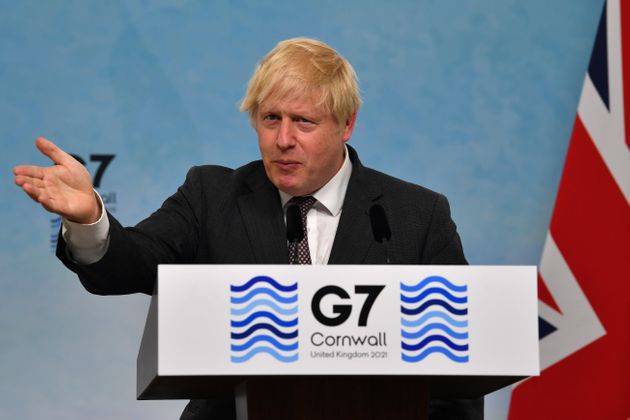
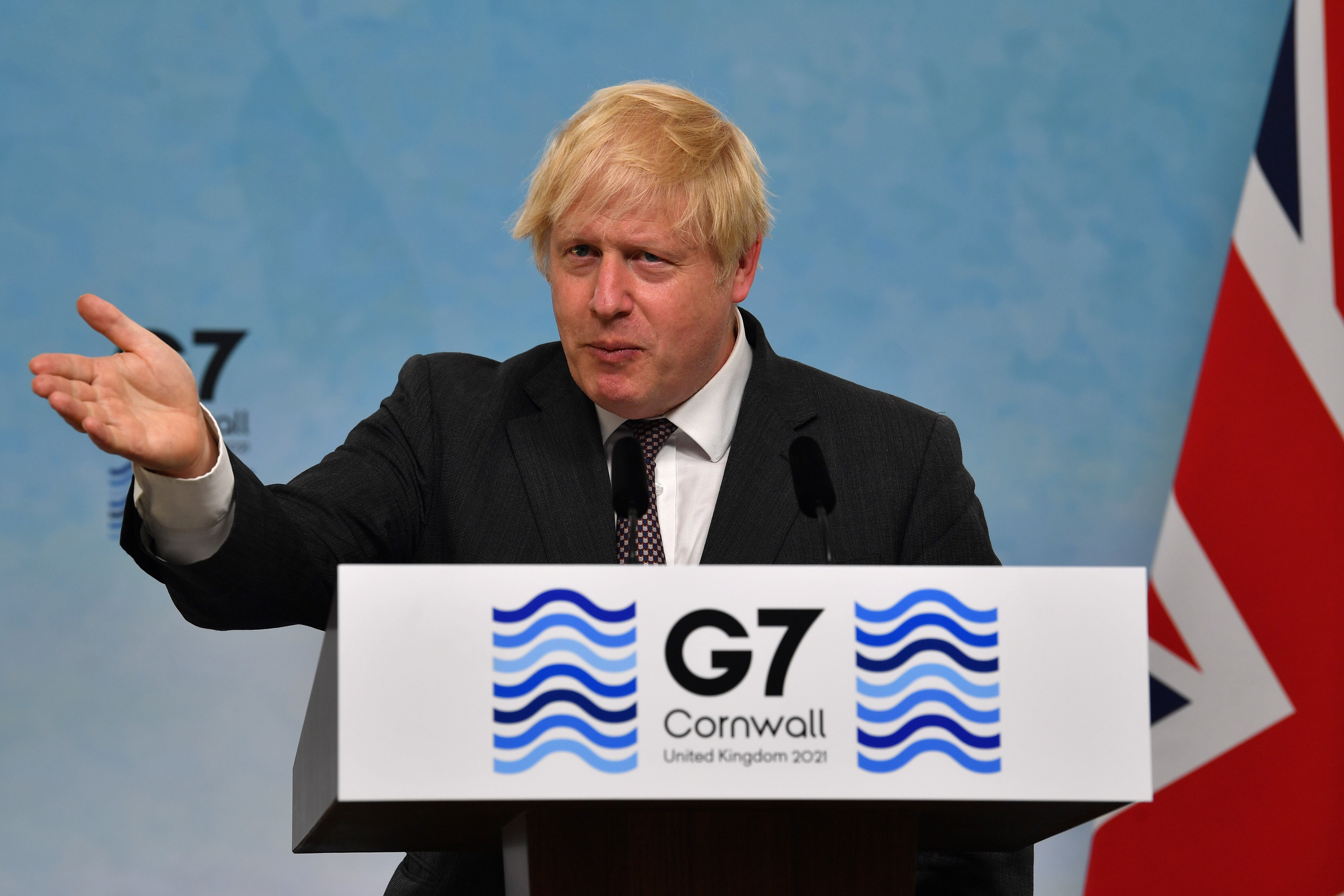
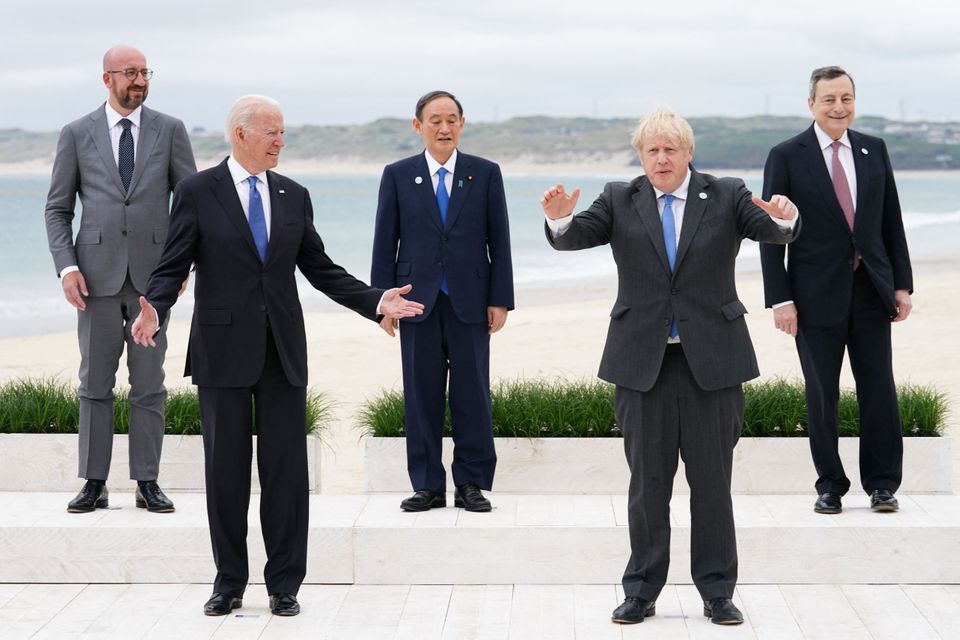
At a Sunday press conference to close the G7 summit in Cornwall, Johnson refused to say whether the June 21 schedule could be pushed back longer than four weeks.

Foreign secretary Dominic Raab meanwhile said that unlocking needed to be “irreversible” and so the government needed to proceed “carefully and cautiously”.

“We don’t want to yo-yo back in and out of measures,” he said.

He also refused to rule out the possibility that restrictions could stay in place beyond the end of July.

“We want to be irreversible so we have just got to be careful that we are there in terms of data,” he said.

Professor Stephen Reicher, a member of the Scientific Pandemic Insights Group on Behaviours (Spi-B), has meanwhile warned that there is a risk the Covid situation could go “backwards”.

He called on the government to provide more financial support to help people self isolate to stop the spread of the virus.

Could there still be some relaxation of Covid rules?

HuffPost UK last week revealed that Michael Gove said he would “bet” on some kind of “relaxation” of restrictions.

Reports suggest that Johnson may delay most of the roadmap, but lift the cap on the number of people who can attend weddings, which is currently at 30.

The PM may also choose to relax rules around attendance of large events to enable at least half-full stadiums at Euro 2020 games hosted at Wembley, including the final.

Will there be a backlash?

Polling by Opinium suggested broad public support for the government’s approach, with 54% in favour of a delay and 37% against.

But there is frustration among some Conservative MPs – already unhappy over the impact on the economy and on civil liberties – at the prospect of further delay.

Writing in the Mail on Sunday, Sir Graham Brady, the influential chairman of the backbench Tory 1922 Committee, said that it must be the final time.

“On any reasonable assessment we should be still on target for lifting restrictions on June 21,” he wrote.

“There is no excuse for this further catastrophic delay. It is unacceptable to restrict people’s most fundamental rights. And it must never ever happen again.”

Share Button

G7 Leaders Fall Short Of Directly Sharing 1bn Vaccine Doses Around The World

Leaders of the G7 group of wealthy nations have fallen short of directly providing one billion Covid vaccine doses to poorer countries over the next year.

The final communique of the Boris Johnson-hosted summit in Cornwall revealed that the leaders only managed to commit to sharing 870m spare doses over the next year, despite a high profile commitment to a billion.

The document insists that taken together with separate financial commitments it would mean the G7 has shared more than two billion doses since the start of the pandemic, and has met the 1bn target for the next year.

But the leaders are facing criticism from the likes of Oxfam, which accused leaders of “cooking the books” with its vaccine figures.

“A billion vaccine doses would have been a drop in the bucket, but they didn’t even manage that,” the charity said.

Earlier, former UK prime minister Gordon Brown said the summit will go down as “unforgivable moral failure” as the World Health Organisation (WHO) estimates that 11bn doses – more than ten times the number pledged – are needed to stamp out the pandemic.

At his closing summit press conference, Johnson rejected Brown’s criticism, highlighting US president Joe Biden’s commitment to providing 500m Pfizer vaccines for 92 low and lower-middle income countries and the African Union.

 “This is another billion made up of a massive contribution by the United States and other friends,” the UK prime minister said.

He said the UK’s contribution is another 100m from now to next June of the vaccines.

He said: “Already of the 1.5bn vaccines that have been distributed around the world, I think that people in this country should be very proud that half a billion of them are as a result of the actions taken by the UK government in doing that deal with the Oxford scientists and AstraZeneca to distribute it at cost.”

He added: “We are going flat out and we are producing vaccines as fast as we can, and distributing them as fast as we can”. 

The target to vaccinate the world by the end of next year will be done “very largely thanks to the efforts of the countries who have come here today”, according to Johnson.

But Oxfam’s head of inequality policy Max Lawson said leaders had “cooked the books” on vaccines and “completely failed” to meet the challenge of the biggest health emergency in a century.

“This G7 summit will live on infamy,” he concluded.

Edwin Ikhuoria, of the anti-poverty campaign One, said: “Throughout the summit we have heard strong words from the leaders but without the new investment to make their ambitions a reality.

“Crucially, the failure to get life-saving vaccines to the whole planet as fast as possible, means this was not the historic moment that people around the world were hoping for and leaves us little closer to ending the pandemic.”

What else was agreed at the G7 summit? 

Covid

G7 leaders renewed calls for a further investigation into the origin of Covid-19, following Biden’s surprise decision to order US intelligence agencies to continue probing the Wuhan “lab leak” theory.

The final summit communique called for a “timely, transparent, expert-led, and science-based WHO [World Health Organisation]-convened phase 2 Covid-19 origins study” including in China.

Johnson said that the best advice available to him remained that the virus jumped species from an animal.

However he said that it was important to keep an open mind as to what exactly happened.

“At the moment, the advice that we have had is that it doesn’t look as though this particular disease of zoonotic origin came from a lab,” he said.

“Clearly anybody sensible would want to keep an open mind about that.”

China

America’s wariness of China is continuing despite Biden replacing Donald Trump in the White House.

The president managed to convince leaders to sign up to a rival to Beijing’s influential Belt and Road investment programme in an effort to counter growing Chinese influence.

The Build Back Better World (B3W) programme will fund infrastructure, including green technology, and support growth in developing countries.

Leaders meanwhile pledged to call on China to “respect human rights and fundamental freedoms”, including in Xinjiang where Uighurs are believed to be suffering brutal human rights abuses that some say amount to genocide.

It also raised the situation in Hong Kong, calling on Beijing to respect its “rights, freedoms and high degree of autonomy”.

But reports suggest that there were some disagreements over how strong the language on China should be.

Environment

The G7 is committed to supporting a green revolution that creates jobs, cuts emissions and seeks to limit the rise in global temperatures to 1.5 degrees

Leaders set out the action they will take to slash carbon emissions, including measures like ending the use of unabated coal power – although they were unable to set a deadline for this.

The leaders did commit to ending funding for carbon-emitting overseas projects by the end of the year but the failure to agree a timeline may worry Johnson in the run-up to the Cp26 climate summit in Glasgow at which he is hoping to strike a much bigger global deal.

The G7 also set a goal of conserving or protecting at least 30% of their land and marine areas by 2030 as part of a push to reach that level of protection globally.

But Oxfam criticised the failure to make new pledges of climate finance, arguing that developing nations were looking for progress ahead of Cop26.

“Vague promises of new financing for green development projects should not distract from this goal,” the charity said.

Share Button

G7 Leaders Discussed The ‘Lab Leak’ Covid Origin Theory, WHO Chief Reveals

G7 leaders discussed the theory that Covid-19 leaked from a laboratory in the Chinese city of Wuhan, the head of the World Health Organisation (WHO) has revealed.

WHO director-general Tedros Adhanom Ghebreyesus said leaders discussed the so-called “lab leak” theory during talks on Covid on Saturday.

It comes after a leaked draft communique for the summit seen by Bloomberg suggested G7 leaders will call for a new investigation into the origins of coronavirus.

Most experts believe that Covid jumped to humans from an animal host naturally.

But US president Joe Biden surprisingly last month decided to expand an American investigation into the virus’s origins, with one of the country’s intelligence agencies leaning towards the lab leak theory, while two others believe it had natural origin.

G7 leaders are likely to have discussed the theory Covid leaked from the Wuhan Institute of Virology at the instigation of Biden.

At a summit media briefing, Tedros was asked: “In today’s whole summit of the G7 did the origin of Covid come up, in particular the Wuhan lab leak theory?”

Tedros replied: “It was raised.

“We discussed… the origins.

“What we discussed was on the future and the challenges of sharing information, sharing data, sharing pathogens or in sharing biological materials and in sharing technology like vaccines.

“Now we are having vaccine equity problems and we are seeing a two-track pandemic – some countries are doing well while others are actually in trouble because of lack of access to vaccines.

“So we are going to address all these problems and address the origin issues for the future, we need to have a binding pandemic treaty so there will be rules of the game and we have countries abiding to laws and so we can have all the challenges we are facing now addressed.

“So the origins was discussed in relation to now, but more in relation to how this should be handled in the future.”

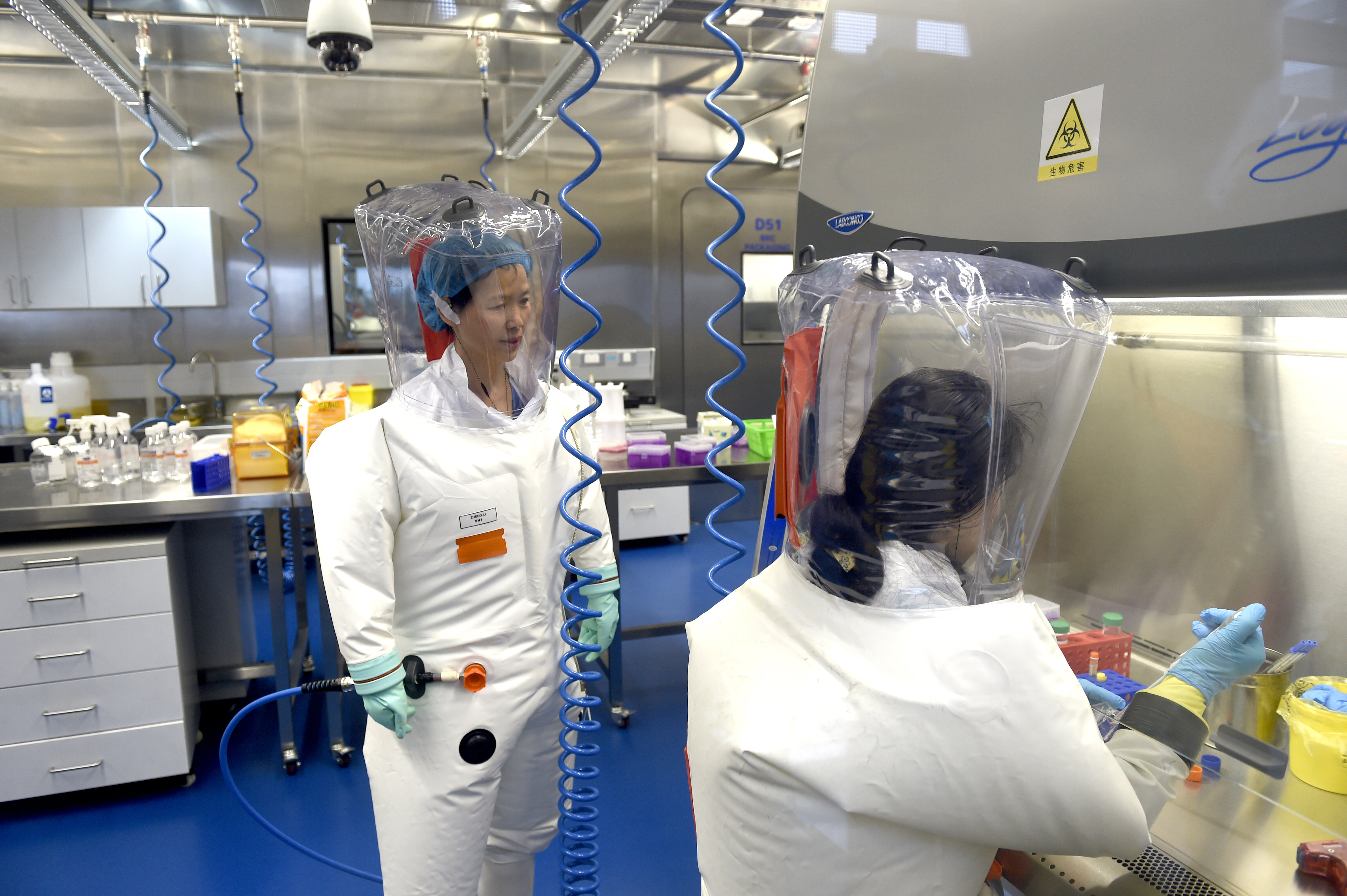
Barcroft Media via Getty Images

Scientists work at the Wuhan Institute of Virology

Tedros meanwhile urged China to be more transparent when the WHO begins the second phase of its Covid origins inquiry.

“More than 174m people have been confirmed [with] Covid illness, this is actually an underestimate, it could be more,” he said.

“And so far 3.75m people have died.

“This is very tragic and I think the respect these people deserve is knowing what the origin of this virus is so that we can prevent it from happening again.

“The origin study is something the WHO takes really seriously.

“We are preparing for the second phase.

“We will need cooperation from the Chinese side, we need transparency in order to understand or find the origin of this virus.”

Share Button

Boris Johnson Threatens To Suspend Key Brexit Deal Over Sausage War

Boris Johnson has threatened to suspend a key Brexit deal on Northern Ireland in an increasingly bitter row with the EU.

The prime minister spoke after meeting key EU players in the margins of the G7 summit in Cornwall, as wrangling over the Northern Ireland protocol threatened to overshadow the gathering.

French president Emmanuel Macron on Saturday morning urged Johnson to “keep his word” and apply the protocol in full, while European Commission president Ursula von der Leyen and European Council leader Charles Michel told him to “implement what we agreed on”.

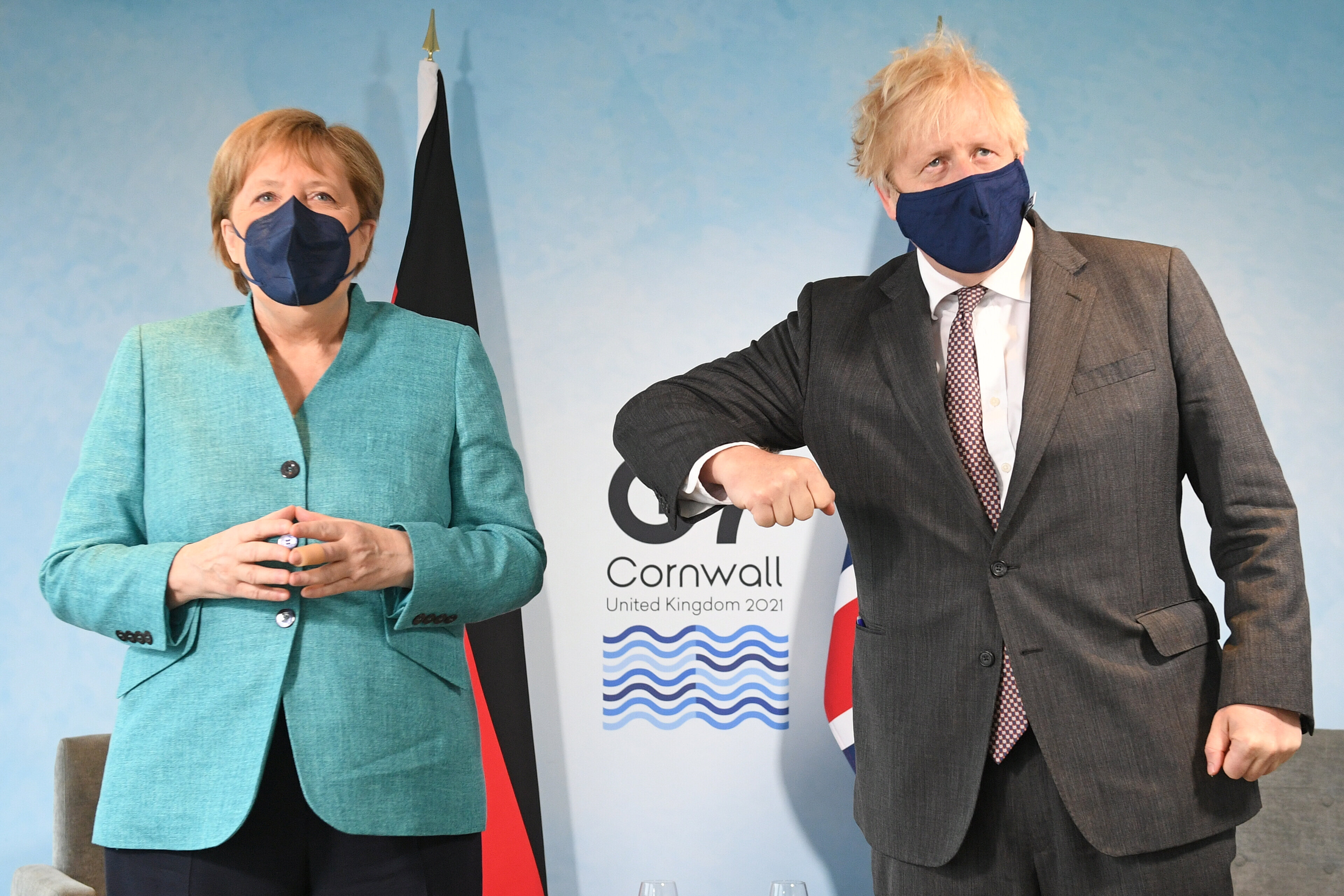
German chancellor Angela Merkel also discussed the issue in talks with Johnson, who has now hit back with a complaint that the EU was being “theologically draconian” about the deal.

EXPLAINED Why A Brexit Sausage War Risks Overshadowing The Entire G7 Summit

Downing Street has indicated the UK would be prepared to unilaterally delay the full implementation of the protocol to prevent a ban on chilled meats crossing the Irish Sea from Great Britain.

Restrictions on British-produced chilled meats entering Northern Ireland are due to come into force at the end of the month, triggering talk of a so-called “sausage war”.

Johnson has now warned that unless there was a solution he would invoke Article 16 of the protocol which allows either side to take unilateral action to suspend the deal if its implementation were to lead to “serious economic, societal or environmental difficulties”.

Explaining his position, the PM told Channel 4 News: “It’s stated abundantly in the text that the protocol should be implemented in such a way as to ensure free trade, free movement of goods between Great Britain and Northern Ireland and all parts of the UK.

“It’s not working like that at the moment. We need to make sure it’s applied in a sensible way.

“There’s no reason at all to have prohibitions or barriers to the movement of potted plants, tractor parts, guide dogs for the blind, chilled meats – you name it – from Great Britain to Northern Ireland.”

On Sky News, he added: “I think we can sort it out but… it is up to our EU friends and partners to understand that we will do whatever it takes.

“I think if the protocol continues to be applied in this way, then we will obviously not hesitate to invoke Article 16, as I have said before.

“Don’t forget, the EU themselves invoked Article 16 in January, to disapply the protocol, so they can stop removal of vaccines from the EU to the UK.

“I’ve talked to some of our friends here today, who do seem to misunderstand that the UK is a single country, a single territory. I just need to get that into their heads.”

Johnson used the meetings with EU leaders to call for “pragmatism and compromise on all sides”, repeating his call to “minimise the impact [of the protocol] on the day-to-day lives of people in Northern Ireland”.

“I certainly think that the protocol is capable of being used and interpreted – by the way, up to the EU – in a pragmatic way or a theologically draconian way,” he told Channel 5.

“At the moment we are seeing… a lot of unnecessary difficulties. I think we can sort it out, with goodwill.

“What we don’t want to see is any more unnecessary barriers to trade and we want to sort it out as fast as we can, I’m sure with goodwill we can.”

Asked if there would be a trade war if agreement could not be reached, Johnson said: “The UK will do whatever we need to do to protect the UK internal market.”

“I don’t happen to think that a trade war is a very sensible or likely way forward. 

“I just think that we need some pragmatic solutions.”

Share Button

Emmanuel Macron Wants His Own ‘Special Relationship’ With Joe Biden

Boris Johnson this week confirmed that he doesn’t like to call the UK and United States’ close ties the “special relationship”, believing it makes Britain look “needy”.

But it appears Emmanuel Macron has no such concerns.

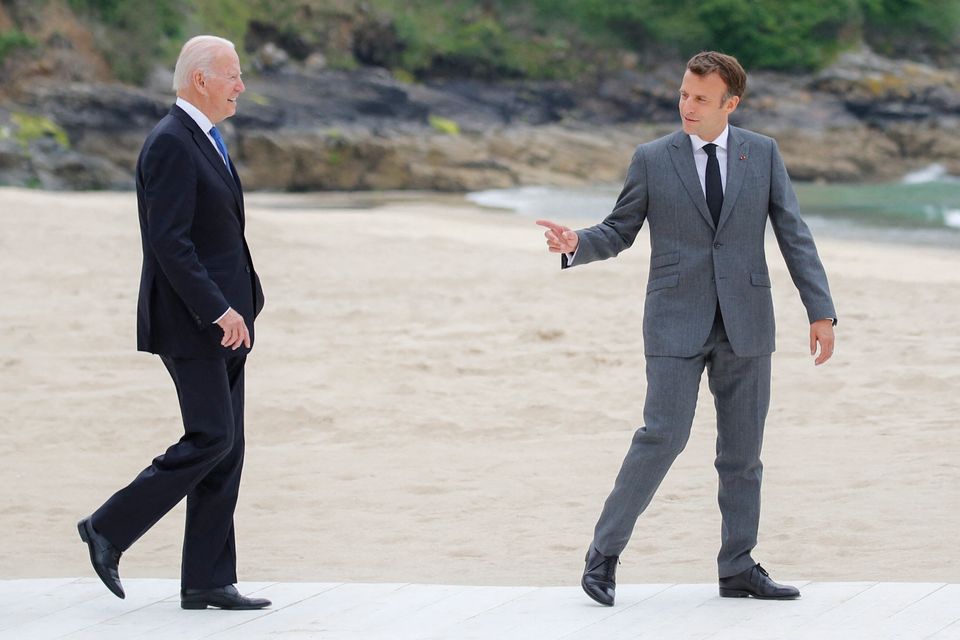
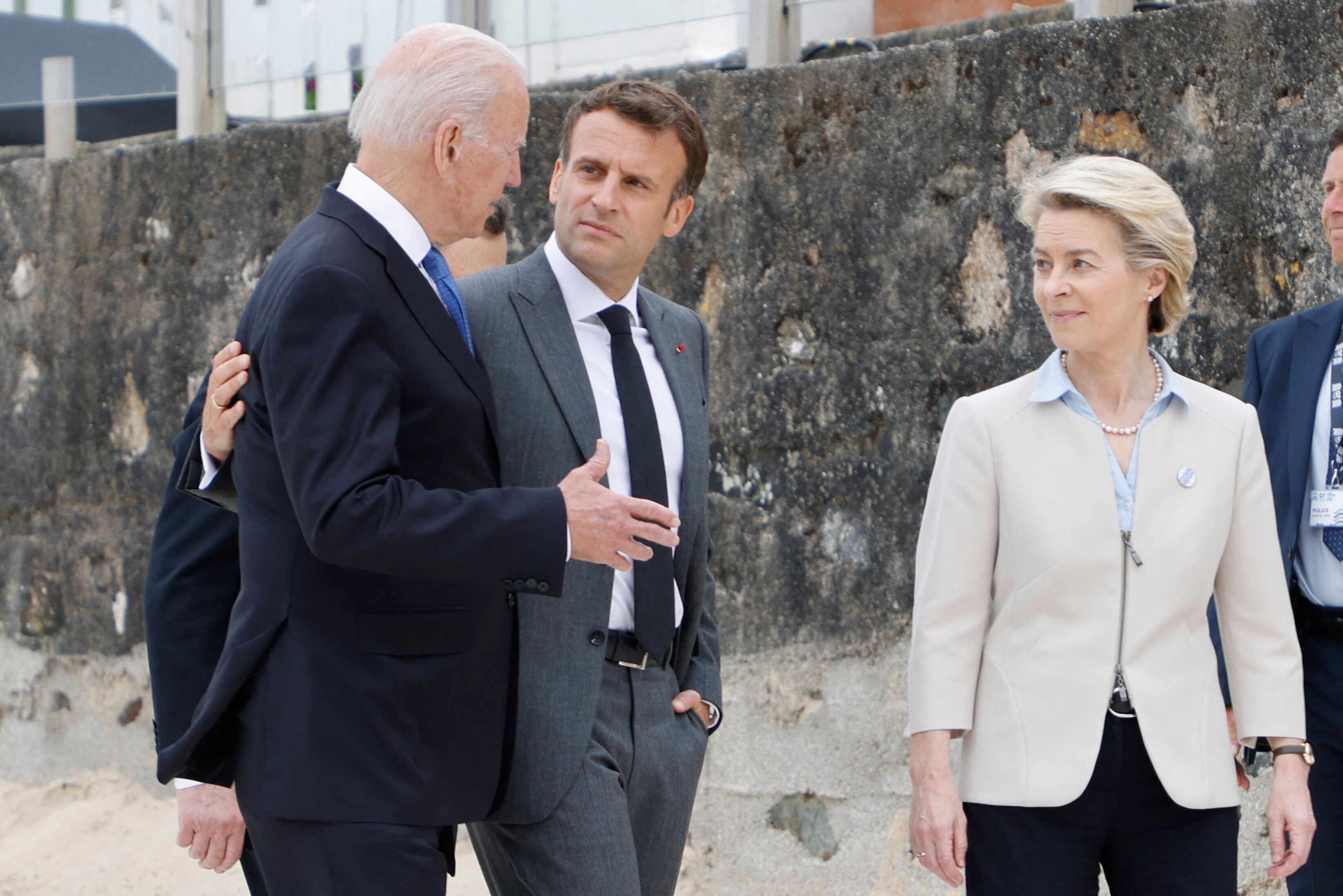
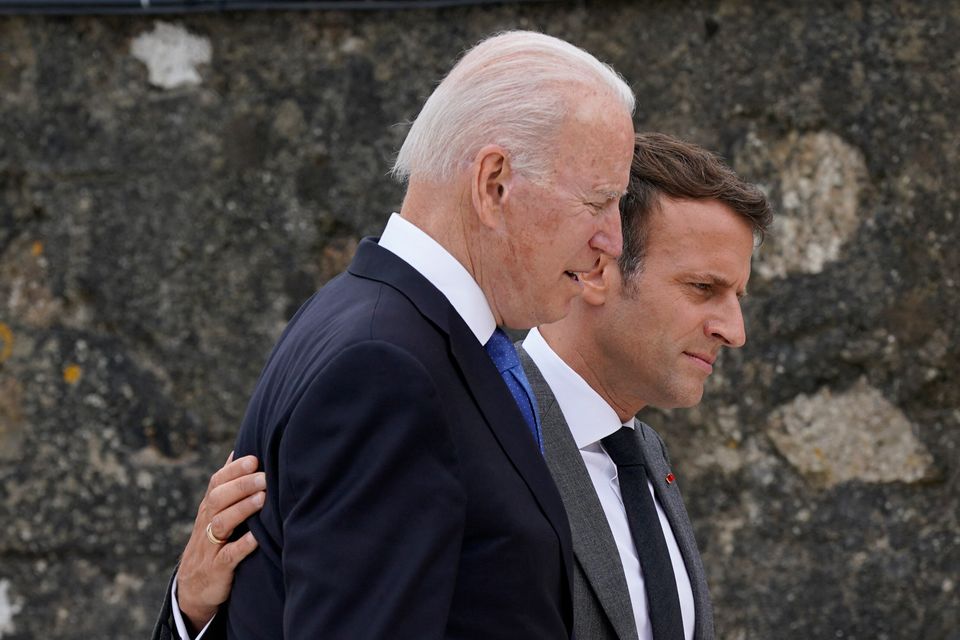
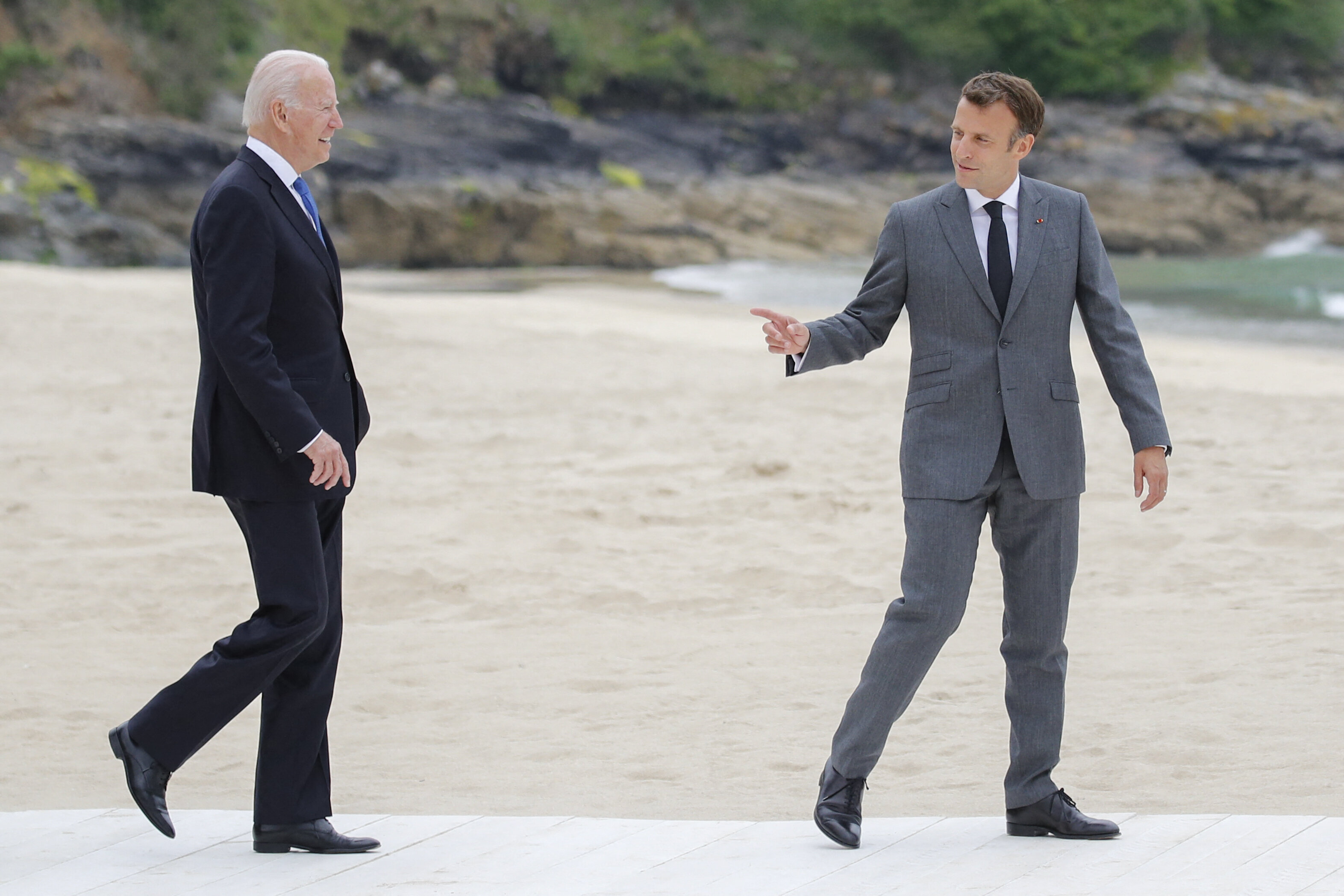
After the G7 summit got underway with an awkward “family photo” on the beach, the French president made a beeline for Joe Biden, throwing his arm around the American’s shoulders and beginning an animated discussion

The Frenchman’s remarks were inaudible, but Johnson – who was out ahead of the pair after Angela Merkel told him “you are the leader” – will be hoping Macron was not trying to lobby Biden on the Brexit sausage war that is threatening to overshadow the G7 meeting.

PHIL NOBLE via Getty Images

French president Emmanuel Macron (right) greets US president Joe Biden at the G7 summit

LUDOVIC MARIN via Getty Images

Macron was flanked by European Commission president Ursula von der Leyen

PATRICK SEMANSKY via Getty Images

The vignette was one of several moments in which G7 leaders appeared uneasy at their first face-to-face meeting since the start of the Covid pandemic.

Biden at one point tried to break the tension, joking “everybody in the water” after leaders and their spouses were greeted with elbow bumps from Boris and Carrie Johnson on the beach at Carbis Bay in Cornwall.

After strolling down a lengthy walkway to the seafront, Jill Biden meanwhile joked that “I feel like we are at a wedding” while Johnson later agreed that it was like “walking down the aisle”.

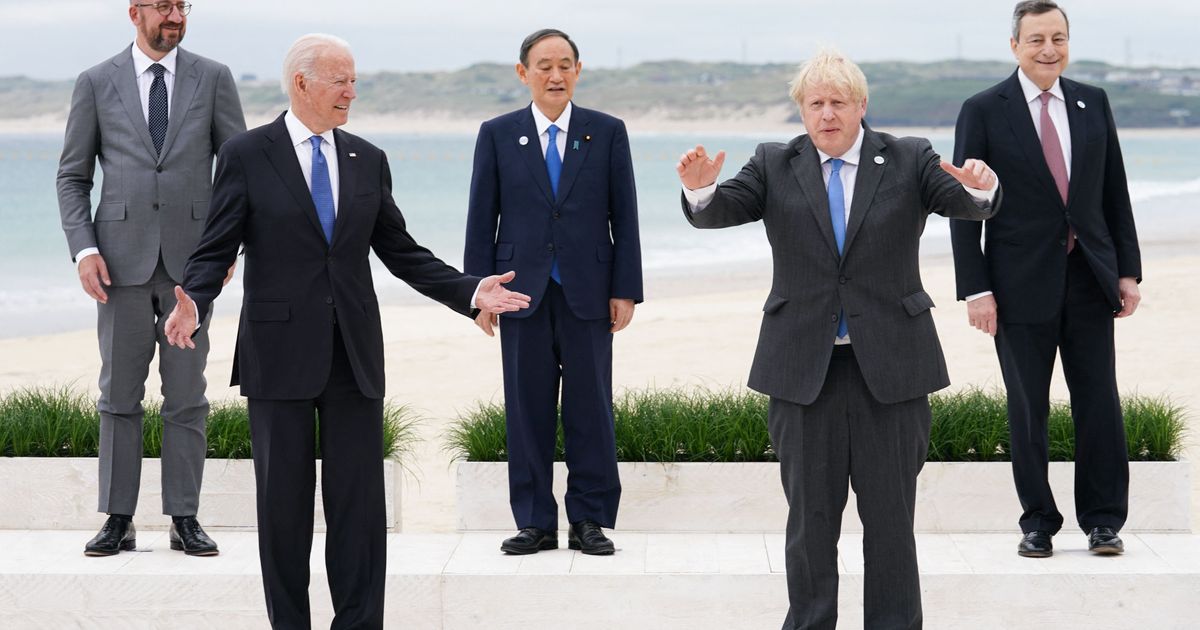
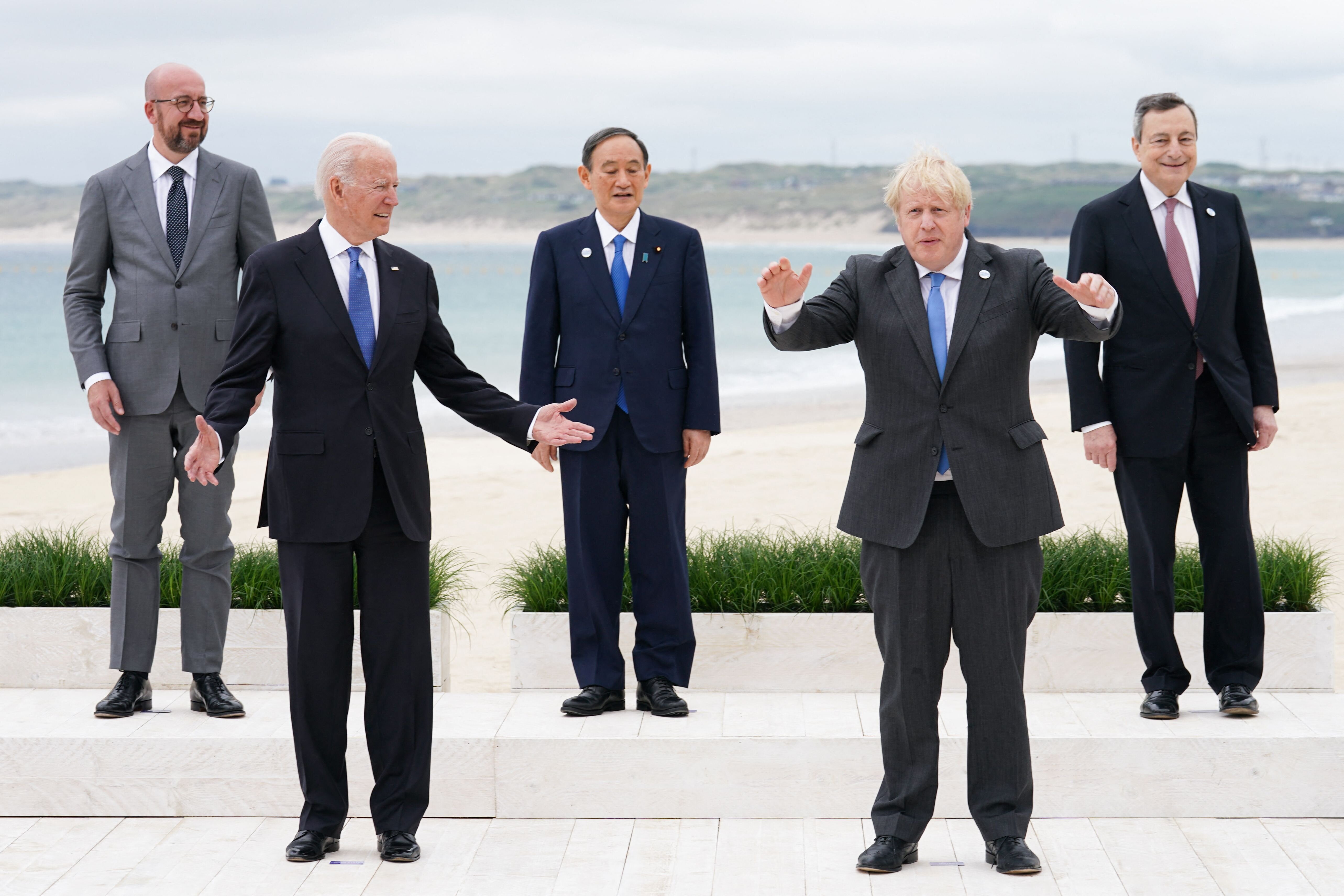
Leaders then struggled to create any kind of bonhomie as they stood two metres apart for a family photo.

As the talks finally got underway inside around a familiar circular table, Johnson bemoaned the carefully choreographed photo op as a “media circus”.

“This is meant to be a fireside chat between the great democracies of the world,” the PM complained.

In an unusual move for Johnson, he also suggested the G7 should support a more “feminine” economic recovery.

The PM said the citizens of G7 nations “want us to be sure that we are beating the pandemic together and discussing how we will never have a repeat of what we have seen”.

“But also that we are building back better together and building back greener and building back fairer and building back more equal and… in a more gender neutral and perhaps a more feminine way.”

Johnson also appeared to criticise his own Conservative Party for the way it handled the recovery from the 2008 financial crash by taking power in 2010 and embarking on a programme of austerity.

He said the G7 economies had the potential to “bounce back very strongly” from Covid.

“But it is vital that we don’t repeat the mistake of the last great crisis, the last great economic recession of 2008 when the recovery was not uniform across all parts of society,” the PM said.

There was a risk the pandemic could leave a “lasting scar” as “inequalities may be entrenched”, Johnson said.

“We need to make sure that as we recover, we level up across our societies and we build back better,” he added.

Share Button