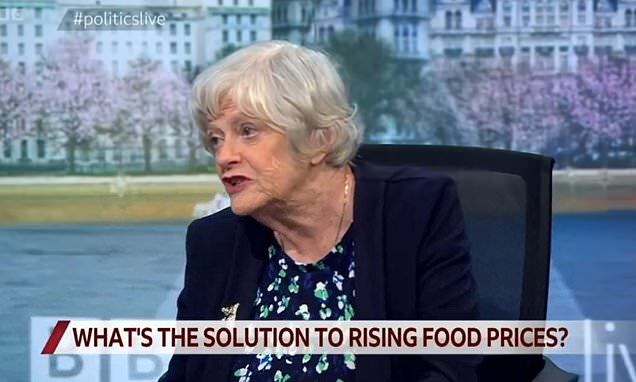
Ann Widdecombe has told poor families they shouldn’t expect to be able to have a cheese sandwich if they don’t have the money.
The former Tory MP said hard-pressed families should not “do the cheese sandwich” on a BBC politics show discussing the cost-of-living crisis.
Advertisement
Widdecombe is a former Strictly Come Dancing contestant who has also represented the Brexit Party in the European parliament, and now backs the Reform Party.
The cost of a homemade cheese sandwich rose by one-third to 40p last year, BBC research suggests.
Politics Live presenter Jo Coburn asked: “What do you say to consumers who literally can’t afford to pay for even some of the basics if they have gone up the way that cheese sandwich has, with all its ingredients?”
She replied: “Well then you don’t do the cheese sandwich … because we have been decades without inflation we have come to regard it as some sort of given right that our food doesn’t go up.”
Advertisement
In response, Liberal Democrat Treasury spokesperson Sarah Olney MP said: “How out of touch can you get? Anne Widdecombe joins a long line of right-wing politicians who pin the blame on hard-working families for this government’s failures.”
The latest inflation figures from Which? show the cost of British food staples such as cheddar cheese, white bread and porridge oats have soared on a year ago.
Overall inflation on food and drink at supermarkets continued to rise in March to 17.2%, up from 16.5% the month before, the watchdog found.
Cheddar cheese prices increased by an average 28.3% across eight major supermarkets compared to a year ago.
UK inflation remained above 10% in March – far higher than in the US and Europe – with food prices pushing the benchmark up.
Advertisement
Her comment echo the sentiments of Tory deputy chairman Lee Anderson, who attracted criticism for suggesting that people in the UK use food banks because they “cannot cook properly” and “cannot budget”.
A BBC newsreader has won praise for her calm under pressure after a live TV glitch left the broadcaster in a potentially embarrassing situation.
Lukwesa Burak was anchoring the BBC News channel when the so-called “opt-out” appeared to let her down.
Advertisement
In a clip shared widely on Twitter, Burak finished a segment of the programme and said “around the world and across the UK, this is BBC News” as the feed cut to the channel’s titles.
Bagpipers appeared on screen briefly, before Burak could be seen stretching her arms up. She very quickly realises the camera is still rolling, and gives a look of disbelief (to put it mildly).
For what feels like an eternity, Burak stays silent. She eventually introduces a story about Ukraine.
Advertisement
An “opt-out” is when one set of viewers gets a different feed to another – such as adverts for an international audience which cannot be broadcast in the UK.
The BBC announced in July that BBC News and BBC World News would merge to create a single 24-hour TV channel, resulting in job losses, as part of its new digital-first strategy – which perhaps explains the gremlins.
Clearly the opt-out for UK viewers as international viewers had an ad break didn’t work. Nice bagpipes though.
Far from being a source of embarrassment, fellow broadcasters rallied around to praise Burak’s professionalism. She was variously described as a “legend” and “one of the best”.
Advertisement
We’ve all had a rogue opts or tech gremlins @scottygb, just not all of us would have handled it as professionally as the brilliant @LukwesaBurak. Do I need to remind you of my battles with the #OutsideSource screen???
Twitter CEO Elon Musk on Tuesday sat down for a spontaneous interview with the BBC at the social media network’s San Francisco headquarters, speaking about some of his regrets and offering a glimpse into how he envisions the future of the company about six months after he bought it.
Musk conceded he can sometimes be impulsive when it comes to posting on the platform. He has come under fire for several controversial tweets, including one in which he shared a conspiracy theory around the hammer attack on Paul Pelosi, the husband of former House Speaker Nancy Pelosi.
Advertisement
“Have I shot myself in the foot with tweets multiple times? Yes,” Musk told the BBC’s James Clayton.
“I think I should not tweet after 3 am,” he continued.
The self-professed “free speech absolutist” purchased Twitter in October ― despite trying to get out of a $44 billion agreement to do so ― and quickly set about reshaping the company. He decimated its staff and publicly attacked his own employees. He welcomed back banned users including former US president Donald Trump, who was kicked off the platform for instigating the January 6, 2021, attack on the Capitol, as well as right-wing figures and other accounts blocked for misinformation. He criticised the media and spread misinformation himself.
Asked about how the first six months have gone, Musk replied: “It’s not been boring.”
He said managing the company has been “quite a rollercoaster”, but that overall usage was up and the site was performing well despite some outages and glitches. He claimed the company will be cash flow positive by the next quarter.
Musk said the hardest moment he faced in the past six months was closing down a server centre at the end of last year, thinking it was redundant — a move that he described as “catastrophic” and which had to quickly be reversed.
“The pain level of Twitter has been extremely high,” he said. “This hasn’t been some sort of party. It’s really been quite a stressful situation.”
Advertisement
The CEO told the BBC the current headcount is at around 1,500, down from the roughly 8,000 people the company employed before he took over.
Musk reportedly agreed to the wide-ranging interview just a few hours before its start.
I said BBC could come Twitter, then, to my surprise, a reporter shows up
The Tesla and SpaceX CEO defended his company over the latest controversy around requiring Twitter users to pay for verification. Prior to his takeover, the social media platform applied the badges to the accounts of notable individuals and businesses to deter impostors.
Musk vowed to remove all legacy blue checks by April 20, after missing an earlier deadline he had set for the action for April 1.
“I must confess there’s some delight in removing the verified badge from The New York Times,” he told the BBC. “That was great.”
He claimed that the goal of his verification strategy is not to necessarily create another revenue stream, but more so to “massively raise the cost of disinformation and bots in general”.
“My prediction is that any social media company that does not insist on paid verification will simply be overwhelmed by advanced AI bots,” he added.
Musk had attempted to get out of the sale agreement with Twitter, saying there was “material breach of multiple provisions” and that the company did not disclose information on spam bot accounts. But Musk told the BBC he moved forward in the end because he expected a judge would have forced him to complete the sale anyway after Twitter sued to enforce the agreement.
While he originally told the BBC he wouldn’t sell the company for the $44 billion he bought it for, he quickly switched his answer: “If I was confident that they would rigorously pursue the truth, then I guess I would be glad to hand it over to someone else.”
The BBC “bowed to pressure” from the Tories by axing Gary Lineker from Match of the Day, Rachel Reeves has said.
The shadow chancellor said the corporation should reverse its decision, which triggered a mass revolt which threw its sports coverage into chaos.
Advertisement
Reeves also pointed out that BBC chairman Richard Sharp, who has donated huge sums to the Conservatives, has kept his job despite his role in Boris Johnson securing a loan of up to £800,000.
The BBC announced on Friday that Lineker was “stepping back” from presenting Match of the Day this weekend over a tweet criticising the government’s migrant crackdown.
He said some of the language being used by ministers was like “Germany in the 1930s”.
On Sky News this morning, Reeves said: “Whether you agree with Gary Lineker’s tweets or not, and I wouldn’t have used that language, I think that it is perfectly reasonable that you can present the football commentary on the BBC at a weekend.”
Referring to Richard Sharp, she added: “He is still in his job. Gary Lineker isn’t able to present the football commentary? I think there is a sense of proportionality here.
Advertisement
“The Tories obviously put a huge amount of pressure on the government to get rid of Gary Lineker, I don’t remember those same Tory MPs crying about impartiality when those revelations about Richard Sharp came out.”
Appearing on Sunday with Laura Kuennsberg on BBC One, Reeves said: “The BBC have clearly come under immense pressure from the Conservative Party to take Gary Lineker off air.
“I think it is a shame that the BBC has bowed to that pressure. I would urge the BBC to reconsider this decision, because I think it has now gone totally out of proportion.”
He told the Sunday Mirror: “Dad is a good man, a good human, and I’m proud of him for standing by his word. That’s why he was pulled off the show – because he wouldn’t apologise. But he will always speak up for people who don’t have a voice.
“He is passionate about helping refugee charities – he took in two refugees who he is still in touch with and trying to help.
Advertisement
“It means a lot to him to stand up for people whose only hope is to escape a country with only the clothes on their back. That’s why he’s been so firm.
“Will he go back to Match of the Day? I think so – he loves Match of the Day. But he won’t ever back down on his word.”
BBC director general Tim Davie, who took the decision to suspend Lineker, said he was seeking a resolution to the dispute, but insisted he will not resign over his handling of the affair.
He said: “I think my job is to serve licence fee payers and deliver a BBC that is really focused on world-class, impartial landmark output – and I look forward to resolving this situation and looking forward to delivering that.”
Gary Lineker’s son has said his father would not “back down on his word” and believes the sports presenter will return to Match Of The Day.
In an interview with The Sunday Mirror, the former England player’s eldest son George claimed his father had been “a bit disappointed” by the BBC asking him to step back from hosting Saturday’s Match Of The Day after he compared the language used to launch a new Government asylum seeker policy with 1930s Germany in a tweet.
However, he said his father had been “overwhelmed by the support” of fellow pundits who had withdrawn from various BBC sports shows in solidarity with him, particularly his MOTD co-presenters Ian Wright and Alan Shearer.
Advertisement
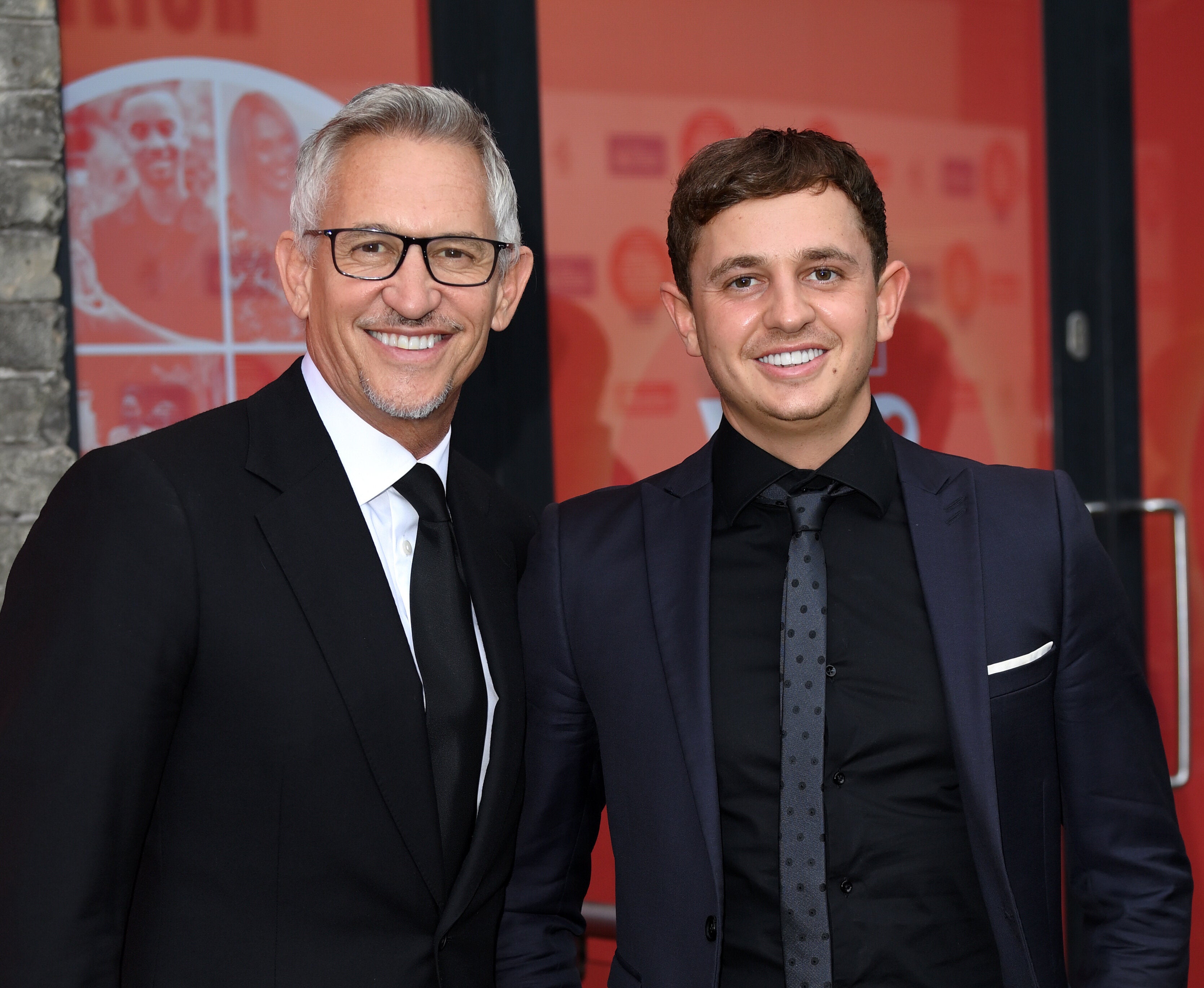
(L-R) Gary Lineker and son George Lineker
Karwai Tang via Getty Images
George Lineker told The Sunday Mirror: “Dad is a good man, a good human, and I’m proud of him for standing by his word. That’s why he was pulled off the show – because he wouldn’t apologise. But he will always speak up for people who don’t have a voice.
“He is passionate about helping refugee charities – he took in two refugees who he is still in touch with and trying to help.
“It means a lot to him to stand up for people whose only hope is to escape a country with only the clothes on their back. That’s why he’s been so firm.
Advertisement
“Will he go back to Match of the Day? I think so – he loves Match of the Day. But he won’t ever back down on his word.”
Saturday’s Match Of The Day aired for only 20 minutes and did not include accompanying commentary or analysis from pundits or even its famous theme tune – instead broadcasting only short highlight clips of the day’s matches.
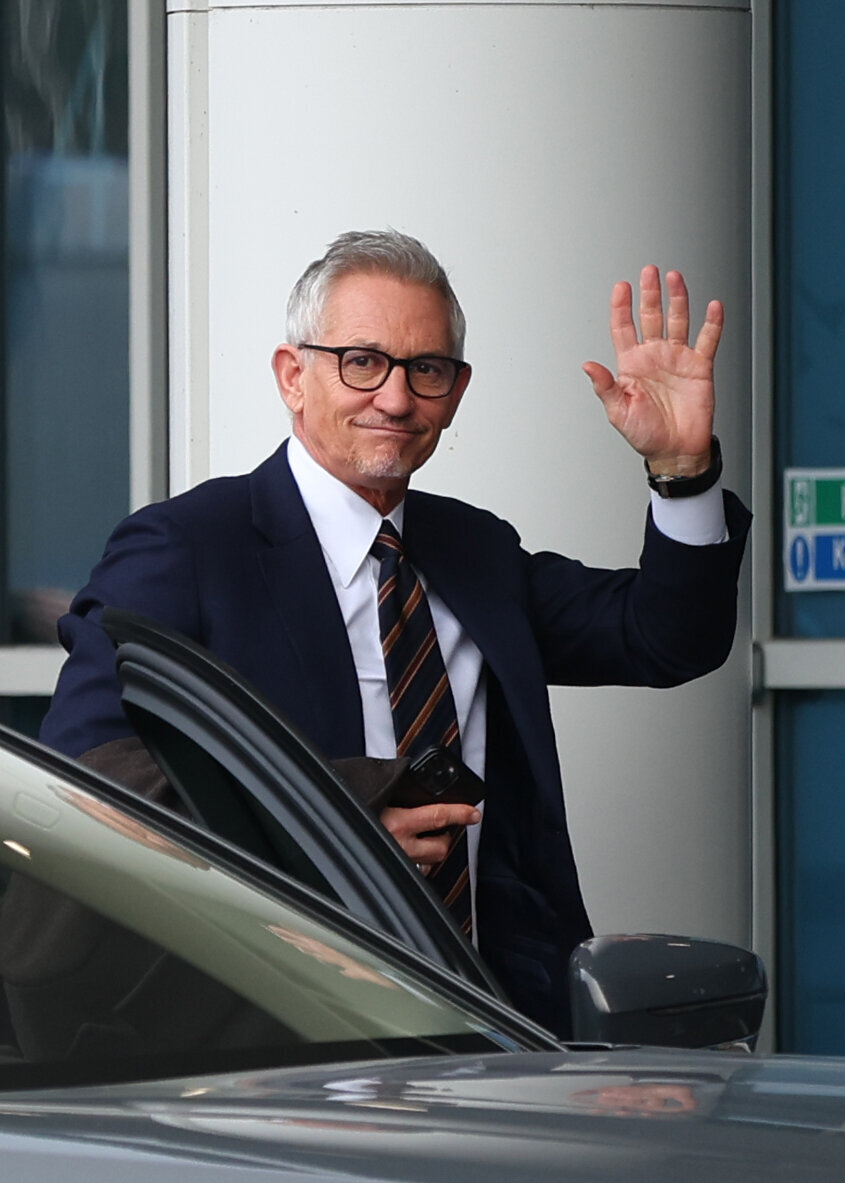
Gary Lineker waves to fans as he arrives prior to the Premier League match between Leicester City and Chelsea FC at The King Power Stadium on March 11, 2023 in Leicester, United Kingdom. (Photo by Marc Atkins/Getty Images)
Marc Atkins via Getty Images
Ahead of the show starting, a continuity announcer said: “Now on BBC One, we’re sorry that we’re unable to show our normal Match Of The Day including commentary tonight. But here now is the best action from today’s Premier League matches.”
Several of the broadcaster’s other football shows were pulled at the last minute on Saturday as more presenters and reporters withdrew, with neither Football Focus nor Final Score airing – while 5 Live’s radio coverage was radically altered throughout the day.
Advertisement
The BBC director-general apologised for the disruption caused to the broadcaster’s sports programming, but confirmed he will not resign over the Lineker impartiality row.
EXCL: The BBC Director General Tim Davie has apologised for the disruption caused across sports programming after removing @GaryLineker off air.
I put to him trust is a key value of the BBC, many don’t trust him – but he says he is not resigning.
Tim Davie told BBC News in Washington, DC on Saturday: “I’m very sorry for the disruption today. It’s been a difficult day and I’m sorry that audiences have been affected and they haven’t got the programming.
“As a keen sports fan, I know like everyone that to miss programming is a real blow and I am sorry about that.
“We are working very hard to resolve the situation and make sure that we get output back on air.”
The director-general said that he would not go into too much detail about the discussions being had, but that “everyone wants to calmly resolve the situation”.
Advertisement
“I would say Gary Lineker is a superb broadcaster. He’s the best in the business, that’s not for debate,” he added.
“To be clear, success for me is: Gary gets back on air and together we are giving to the audiences that world-class sports coverage which, as I say, I’m sorry we haven’t been able to deliver today.”
Mr Davie also said that he does not feel this is about “left or right” politics, but about the corporation’s ability to balance free speech and impartiality, adding: “We’re fierce champions of democratic debate, free speech, but with that comes the need to create an impartial organisation.”
Asked if he would resign as “there are many people in the UK that simply do not trust you”, Mr Davie said: “Absolutely not.
“I think my job is to serve licence fee payers and deliver a BBC that is really focused on world-class, impartial landmark output – and I look forward to resolving this situation and looking forward to delivering that.”
After the announcement the previous evening that Match Of The Day would be going ahead without presenters or pundits, Scott tweeted on Saturday morning: “I made a decision last night that even though I love my show and we have had an incredible week winning an SJA [Sports Journalism Award] for Football Focus that it doesn’t feel right for me to go ahead with the show today.”
Advertisement
“Hopefully I will be back in the chair next week,” she added.
I made a decision last night that even though I love doing football focus and we have had an incredible week winning an SJA award that it just doesn’t feel right going ahead with the show today. Hopefully I will be back in the chair next week…
While reports claimed that sports presenter Kelly Somers was being drafted in as a replacement for the former Lioness, she later clarified on Twitter: “Just to confirm I won’t be on BBC television today.”
Just to confirm I won’t be on BBC television today. 👍🏼
Lineker became embroiled in a public row earlier this week, over his response to a Home Office video – in which home secretary Suella Braverman shared the government’s plans to stop migrants crossing the Channel on small boats – saying the language used was “not dissimilar to that used by Germany in the 30s”.
A BBC spokesperson said on Friday: “The BBC has been in extensive discussions with Gary and his team in recent days. We have said that we consider his recent social media activity to be a breach of our guidelines.
Advertisement
“The BBC has decided that he will step back from presenting Match of the Day until we’ve got an agreed and clear position on his use of social media.
“When it comes to leading our football and sports coverage, Gary is second to none. We have never said that Gary should be an opinion free zone, or that he can’t have a view on issues that matter to him, but we have said that he should keep well away from taking sides on party political issues or political controversies.”
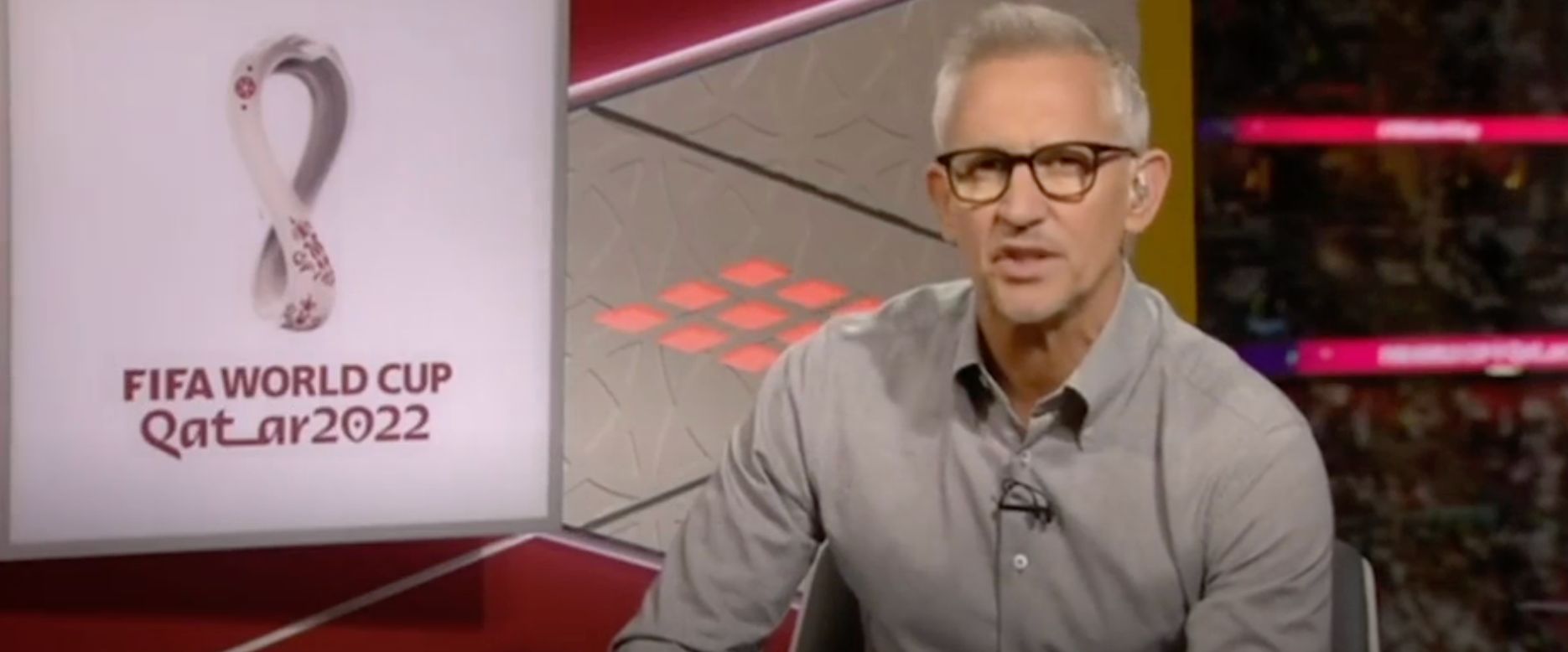
Gary Lineker has been praised by football fans after he delivered a damning opener to this year’s coverage of the World Cup.
On Sunday, the former England player launched the BBC’s coverage of the tournament being held in Qatar, describing it as “the most controversial World Cup in history”
Advertisement
The fact Qatar is hosting the 2022 World Cup has been controversial since it was first announced in 2010. Thousands of migrant workers have died in the country in the lead-up to the tournament. The host nation has been also been condemned for its appalling track record with human rights, including those of LGBTQ+ people.
As he kicked off the BBC’s coverage on Sunday afternoon, Gary said: “Ever since FIFA chose Qatar back in 2010, the smallest country to have hosted football’s greatest competition, has faced some big questions.
“From accusations of corruption in the bidding process to the treatment of migrant workers who built the stadiums where many lost their lives. Homosexuality is illegal here. Women’s rights and freedom of expression are in the spotlight.
“Against that backdrop, there is a tournament to be played here that will be watched and enjoyed around the world. Stick to football say FIFA, well we will for a couple of minutes at least.”
Advertisement
Gary also opened a discussion on workers rights and Qatar’s discriminatory LGBTQ+ laws with his fellow pundits Alan Shearer, Alex Scott and Ashley Williams.
All three expressed their disappointment and concern at the hosting of the tournament in the country and criticised Fifa president Gianni Infantino following his bizarre speech on Saturday.
Viewers were quick to praise the stance the BBC had taken with Gary’s intro on social media…
WOW. Gary Linker absolutely pulled no punches with that introduction. Scathing of Qatar and FIFA. This is going to be an interesting World Cup.
Oh Shit… @GaryLineker did not hold back with that opening monologue, fair play Lad, it needed to be said and you definitely delivered on all of our thoughts surrounding this World Cup👏🏼👏🏼👏🏼
Good intro from @GaryLineker exactly what’s required. Never forget how we got here. We all love football. We all love the World Cup. But we cannot forget #FIFAWorldCup
Following this, seven UK cities were originally revealed to have been shortlisted based on their “capability, capacity and experience” in hosting large-scale events, with Birmingham, Glasgow, Leeds, Liverpool, Manchester, Newcastle and Sheffield all making the cut.
Eurovision’s executive supervisor Martin Österdahl said after the announcement that Liverpool is “the ideal place” to host the competition next year.
Advertisement
“The city is synonymous with music and Liverpool Arena exceeds all the requirements needed to stage a global event of this scale,” he continued.
“We have been very impressed with the passion the city has shown in embracing the Contest and their inclusive ideas for placing last year’s winners, Ukraine, front and centre when thousands of fans visit next May. ”

Reigning winners Kalush Orchestra also said in a statement: “We are very pleased that next year’s Eurovision Song Contest will take place in Liverpool.
“Though we haven’t had the privilege of visiting yet, the musical heritage of the city is known all over the world. Playing in the same place that The Beatles started out will be a moment we’ll never forget!”
They added: “Although we are sad that next year’s competition cannot take place in our homeland, we know that the people of Liverpool will be warm hosts and the organisers will be able to add a real Ukrainian flavour to Eurovision 2023 in this city.”
Advertisement
Kalush Orchestra performing in Turin earlier this year
picture alliance via Getty Images
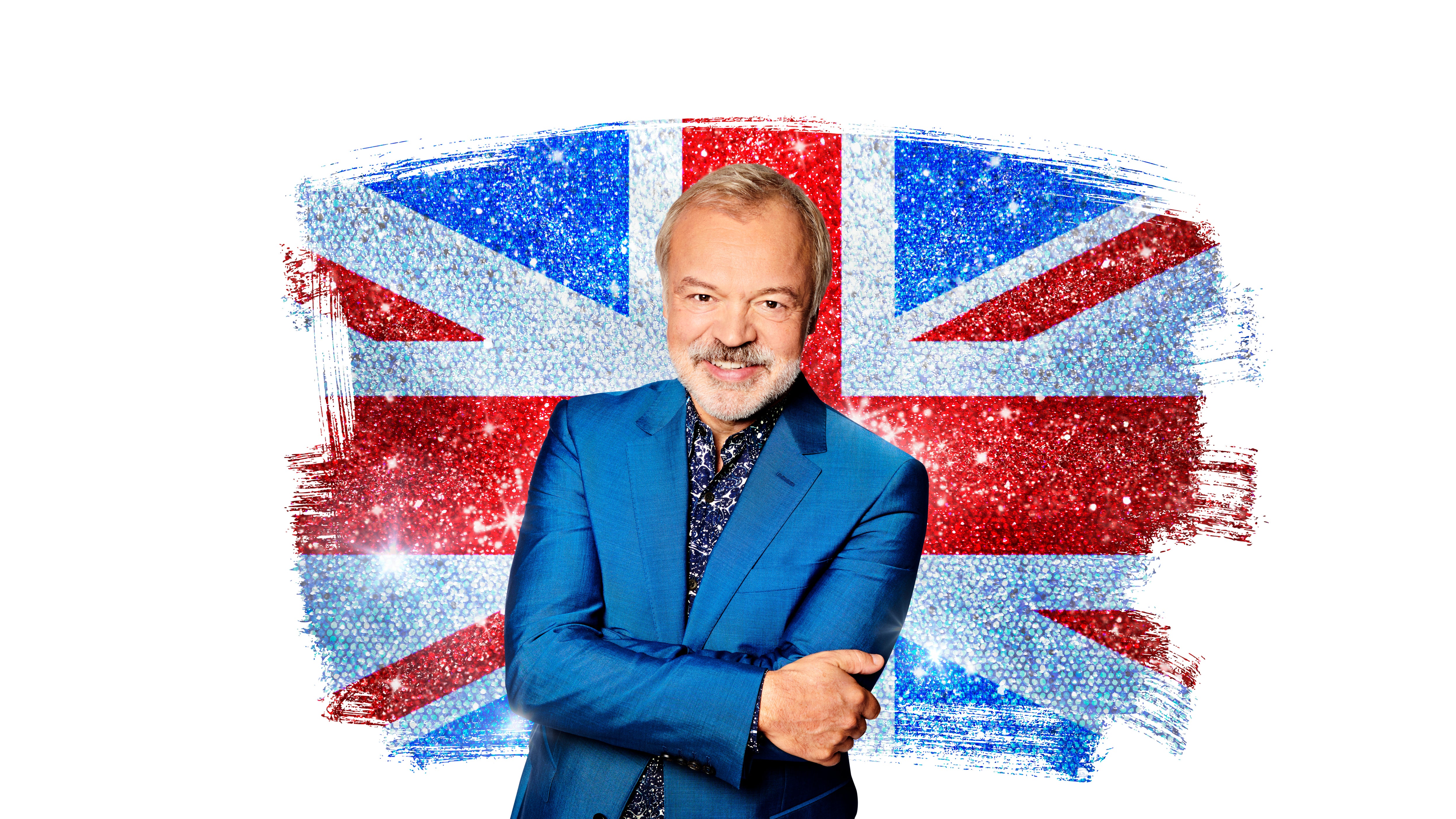
During his appearance on The One Show, Graham also confirmed that the final will be taking place on Saturday 13 May 2023, with the semi-finals airing on BBC One for the first time earlier that week.
In addition to the other shortlisted cities, the BBC previously shared that Aberdeen, Belfast, Brighton, Bristol, Darlington and London had all also considered before the initial shortlist announcement in August.
While Eurovision is be held in the UK next year, the BBC has insisted it is still “committed to delivering a truly unique Song Contest that celebrates wonderful Ukraine and champions British music and creativity in all its diversity”.
Ukrainian broadcaster UA:PBC will work closely with the BBC to develop Ukrainian elements of the 2023 show.
Advertisement
Due to Kalush Orchestra’s victory, Ukraine will also automatically qualify for next year’s Eurovision final, along with the so-called “Big 5”, which are the countries that contribute the most towards the event financially (France, Germany, Italy, Spain and the UK).
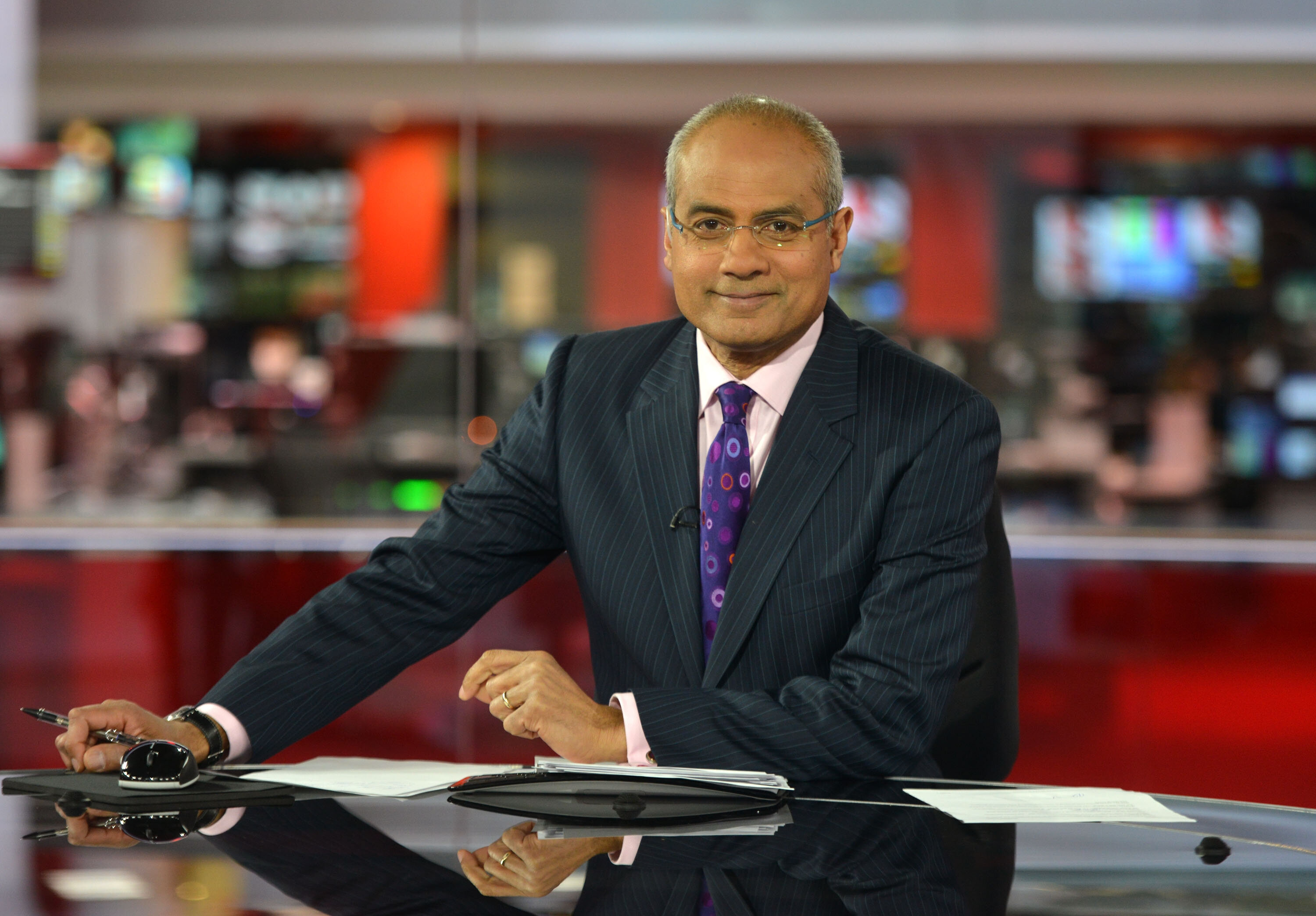
George Alagiah has said he has spent “a lot of the last 18 months in extreme pain” thanks to a “tumour site” at the base of his back.
The BBC newsreader publicly shared his stage four bowel cancer diagnosis in 2014 and is continuing to undergo gruelling treatment.
Advertisement
In a candid new interview with The Sunday Telegraph, George opened up about how he continues his presenting duties while living with cancer.
He detailed a tumour that is “resting very close to the spine” that doctors think has “eroded a bit of a vertebra”, and while they are not yet sure if it is the cancer, he said it causes him major discomfort.
“I’ve spent a lot of the last 18 months in extreme pain. There have been times when even lying down makes it worse,” he said.
“Sleep deprivation was an issue, but I don’t want people to think I am feeling sorry for myself.”
He added that his back pain is currently not so bad as it has been.
George in the BBC News studio
Jeff Overs/BBC via PA Media
Advertisement
Asked how he manages to continue to present BBC News if he is in pain, George said: “It is incredible what adrenalin will do. It is invented by nature to get you through anything.”
He explained enjoys working, which leaves him “absolutely knackered physically”, but “mentally rejuvenated”.
“I’ve been with people who treat me as they always did, who don’t patronise me, and it is a tremendous fillip,” he said.
George said that with his chemotherapy schedule – which sees him have low doses for around three quarters of the year, and higher doses for the rest of the time – means he “quite regularly” wakes up “feeling shit”.
“I can suddenly have an energy collapse. But I’ve got amazing colleagues at the BBC who step in to my place on the rota,” he added.
Advertisement
The former BBC foreign correspondent, who was part of the BBC team that was awarded a Bafta in 2000 for its coverage of the Kosovo conflict, underwent treatment his advanced bowel cancer in 2014.
He returned to presenting duties in 2015 after making progress against the disease, and said he was a “richer person” for it.
His cancer returned in December 2017, and the presenter underwent further treatment before once again returning to work.
Jeremy Vine was spoken to by BBC bosses after breaching the corporation’s impartiality guidelines when backing the introduction of a low traffic neighbourhood in an area of London.
The presenter, who hosts a topical weekday show on BBC Radio 2, had criticised campaigners who objected to the introduction of a scheme in Chiswick, near where he lives.
Advertisement
A complainant claimed that tweets posted by Jeremy represented “a campaign of abuse” against a “legitimate local campaigning group”.
The BBC’s executive complaints unit (EBU) said that Jeremy had “primarily been responding to posts from a Facebook group superintended by the complainant, which had been drawn to his attention by member of the group, wishing him harm and describing him in opprobrious terms”.
While the EBU said he was “entitled to object to such personal abuse and, as he did so in terms which were not themselves abusive”, the complaint was not upheld.
However, it found Jeremy – who is famously a keen cyclist – did break impartiality guidelines with some of the views he expressed in his comments, which they said were “inconsistent with the BBC’s editorial standards”.
Advertisement
The EBU said on its website: “The Guidance makes clear that the BBC’s standards should be observed in personal social media activity, as well as on air, by those who work in journalism and factual programming, and the topical content of Mr Vine’s programme on Radio 2 brings him within that category. The introduction of an LTN [low traffic neighbourhood] was a source of sharp controversy in Chiswick at the time in question, (mirroring controversies in other localities where LTNs have been introduced), and was the kind of topic to which considerations of due impartiality applied for the BBC.
“To the extent that Mr Vine’s Twitter activity since the relevant Guidance came into effect appeared to endorse one viewpoint on that topic and controvert another, it was inconsistent with the BBC’s editorial standards as they applied to him, and this aspect of the case was upheld.”
The EBU said the matter was discussed with Jeremy as well as being passed to the management of BBC Content.
The statement added: “For the avoidance of misunderstanding, the ECU made clear to the complainant that the finding had no bearing on any social media activity in which Mr Vine simply expressed his personal enthusiasm for cycling or called attention to its potential benefits.”
Jeremy, who also hosts a morning talk show for Channel 5, previously expressed his view that discussing cycling safety “is not a political thing”, telling the Guardian earlier this month: “If you can create safe cycling space, you have the potential to free up thousands of miles of the transport network, and cleaning up the city, making it safer.”
Advertisement
He added: “I think the general principle is, I can speak truthfully and from my own point of view about issues like cycling down this street, which I do every day, or road deaths. We’re not impartial about road death – it’s a bad thing, and cycle safety is a good thing, and it’s clear that the more segregated cycle lanes you have, the safer cyclists are.”
The paper noted that Jeremy also said he does not publicly endorse low-traffic neighbourhood schemes he has never seen.