Ozempic, Wegovy and Mounjaro makes food taste sweeter and saltier, and that may quiet cravings

New research being presented at the Annual Meeting of the European Association for the Study of Diabetes (EASD) in Vienna, Austria (September 15-19) shows that some individuals who are taking Ozempic, Wegovy or Mounjaro find that foods taste sweeter or saltier than before.

About one in five of those participating in the real-word study, published in the journal Diabetes, Obesity and Metabolism, perceived sweetness more intensely and a similar number were more sensitive to salt – and these changes were linked to a reduction in appetite.

“Incretin-based therapies such as Ozempic, Wegovy and Mounjaro are widely used for weight management but their effect on taste perception has been unclear,” says Othmar Moser, of University of Bayreuth, Bayreuth, Germany, who led the research.

“If changes in taste are linked to greater appetite control and weight loss, this could help clinicians better select therapies, provide more tailored dietary advice and improve long-term treatment outcomes for patients.”

To find out more, Professor Moser and colleagues from the Medical University of Vienna surveyed hundreds of individuals with overweight and obesity who were taking Ozempic, Wegovy or Mounjaro for weight loss about their sense of taste and appetite.

Of the 411 participants (69.6% female), 148 were on Ozempic, 217 were on Wegovy and 46 were taking Mounjaro.

Median duration of treatment was similar for the three groups (Ozempic: 43 weeks; Wegovy: 40 weeks; and Mounjaro: 47 weeks), with all of the participants receiving treatment for at least three consecutive months. The average BMI before starting treatment was 34.7 kg/m2 (Ozempic), 35.6 kg/m2 (Wegovy) and 36.2 kg/m2 (Mounjaro).

The participants, who were recruited online, were asked if their sense of taste (perception of sweetness, saltiness, sourness and bitterness) had changed since starting treatment.

They were also asked about changes to appetite, satiety and food cravings, as well changes to lifestyle factors, such as smoking, and for self-reported data on height and weight before and during treatment.

Reductions in BMI, adjusted for duration of treatment, dose, baseline BMI, age and sex, were 17.4% with Ozempic, 17.6% with Wegovy and 15.5% with Mounjaro.

Around a fifth of the participants said that food tasted sweeter (21.3%) or saltier (22.6%) than before. Their perception of bitterness and sourness did not change.

Some 26.7% of participants in the Wegovy group reported that food tasted saltier than before, compared with 16.2% in the Ozempic group and 15.2% in the Mounjaro group. Increases in sweetness were reported at similar frequencies in all groups (Wegovy 19.4%, Ozempic 21.6%, Mounjaro 21.7%).

More than half of the participants (58.4%) reported they were less hungry in general, i.e. their appetite had decreased (Ozempic: 62.1%, Wegovy: 54.4%, Mounjaro: 56.5%).

Almost two-thirds of the participants (63.5%) reported increased satiety i.e. they felt full sooner Ozempic: 58.8%, Wegovy: 66.8%, Mounjaro: 63.1%). Food cravings were also reduced, with 41.3% of Mounjaro users reporting a strong reduction in cravings, i.e. their cravings were much less intense that before, compared with 34.1% of those taking Wegovy and 29.7% of those taking Ozempic.

Further analysis revealed links between changes to sense of taste and appetite and satiety.

Participants who reported that food tasted sweeter since starting incretin-based therapy were twice as likely to report increased satiety, compared with participants who said their perception of sweetness had not changed.

Those with an increase in the perception of sweetness were also 67% more likely to report a reduction in appetite and 85% more likely to report a reduction in cravings, compared with those whose perception of sweetness was unchanged.

Similarly, participants who said food tasted saltier than before were about twice as likely (2.17 times) to also reported increased satiety, compared with those whose perception of saltiness was unchanged.

Professor Moser says: “These drugs act not only in the gut and brain areas that control hunger but also on taste bud cells and brain regions that process taste and reward. This means they can subtly change how strong flavours, like sweetness or saltiness, are perceived. This, in turn, may affect appetite.”

However, there was no link between changes in taste perception and reduction in BMI. The researchers speculate this is because sense of taste is just one of many factors involved in weight loss.

Professor Moser explains: “Shifts in taste may affect how satisfying or appealing food feels in the moment, which influences appetite control. However, weight loss depends on many other factors – like metabolism, long-term eating patterns, and activity – so changes to taste alone may not be enough to directly drive body weight reduction.”

The study’s limitations include inability to prove causation, the self-reporting of data and the possibility that the participants weren’t representative of the patient group as a whole.

Professor Moser concludes: “Drugs like Wegovy, Ozempic and Mounjaro may alter sense of taste, making foods seem sweeter or saltier and helping people feel full sooner and less hungry. For clinical practice, this suggests that monitoring patients’ taste changes could provide useful clues about treatment response, even though taste alone does not directly drive weight loss.

“For example, tracking changes in taste could help gauge whether the treatment is working beyond weight loss.

“It could also perhaps be used to tailor dietary advice, for example by helping patients find alternatives to foods with flavours that have become overwhelming or less appealing.”


Share Button

Semaglutide may silence the food noise in your head

New research being presented at the Annual Meeting of the European Association for the Study of Diabetes (EASD) in Vienna, Austria (September 15-19) shows that individuals who are taking semaglutide for weight loss experience less food noise than before.

Food noise refers to obsessive and intrusive thoughts about food and eating. This preoccupation with food can hinder healthy lifestyle implementation and lead to overeating, making weight loss difficult.

Previous research has found that 57% of people who have living with overweight or obesity have experienced food noise, although few are familiar with the term. Many of those affected said that food noise made it more difficult to make healthy food choices or stick to an exercise plan.

Some people also report that food noise affects their quality of life and their well-being.

Glucagon-like peptide-1 (GLP-1) receptor agonists such as semaglutide (brand names Wegovy and Ozempic) are highly effective at helping people who are living with obesity lose weight. By mimicking the action of a hormone called GLP-1, they reduce appetite and feelings of hunger, slow the release of food from the stomach and increase feelings of fullness after eating.

However, little is known about how semaglutide, which was developed by Danish pharmaceutical company Novo Nordisk A/S, affects food noise.

To find out more, researchers from Novo Nordisk and Market Track LLC, a market research company, conducted a survey of 550 people in the US (average age 53 years, 86% female) who were taking semaglutide for weight loss.

Some 81% (447) of the participants said they had been taking semaglutide for at least four months and 86% of the participants reported weighing at least 92kg (14st 7lb) before starting treatment.

The participants were asked how food noise was currently affecting them and to recall how it had affected them before starting treatment.

Analysis of the results showed that the participants were experiencing less food noise than before.

The proportion of participants experiencing constant thoughts about food throughout the day fell almost four-fold from 62% before starting treatment to 16%. The proportion who said they spent too much time thinking about food fell by a similar amount, from 63% to 15%.

The proportion who said they had uncontrollable thoughts about food fell more than three-fold from 53% to 15%; the proportion who said their thoughts about food had negative effects on them or their life fell from 60% to 20%; and the proportion who said their thoughts about food distracted them from completing everyday activities fell from 47% to 15%.

The survey also contained questions that covered several areas of mental well-being.

Here, 352 (64%), 417 (76%) and 438 (80%) of the respondents reported an improvement in mental health, self-confidence and the development of healthier habits, respectively.

It is not known if these improvements were related to the drop in food noise or to the participants’ weight loss.

The study’s authors conclude that semaglutide may reduce the amount of food noise that is experienced by individuals who are living with obesity.

Share Button

Thousands of opioid deaths missed off official figures

The error – affecting England and Wales – raises concerns about the impact on the government’s approach to drug deaths.

Share Button

Strange signals at absolute zero hint at dark matter’s secrets

A new experiment called QROCODILE, led by the University of Zurich and the Hebrew University of Jerusalem, has achieved record sensitivity in the hunt for light dark matter. Using superconducting detectors cooled to near absolute zero, the team set world-leading limits on how dark matter interacts with ordinary matter — opening the door to future breakthroughs in one of physics’ greatest mysteries.

[Hebrew University of Jerusalem]- Dark matter, the elusive substance that makes up about 85% of the universe’s mass, remains one of the greatest mysteries in physics. Invisible and undetectable by ordinary means, it neither emits nor absorbs light, leaving scientists with only indirect evidence of its existence. For decades, researchers have tried in vain to catch a glimpse of these elusive particles.

Now, an international collaboration of scientists has unveiled promising first results with a novel experiment called QROCODILE (Quantum Resolution-Optimized Cryogenic Observatory for Dark matter Incident at Low Energy). The project, led jointly by the University of Zurich and the Hebrew University of Jerusalem, involving also Cornell University, Karlsruhe Institute of Technology (KIT), and MIT, has demonstrated a new path in the search for “light” dark matter particles.

At the heart of QROCODILE is a cutting-edge superconducting detector capable of measuring incredibly faint energy deposits — down to just 0.11 electron-volts, millions of times smaller than the energies usually detected in particle physics experiments. This sensitivity opens an entirely new frontier: testing the existence of extremely light dark matter particles, with masses thousands of times smaller than those probed by previous experiments.

In a science run lasting more than 400 hours at temperatures near absolute zero, the team recorded a small number of unexplained signals. While these events cannot yet be confirmed as dark matter — they may stem from cosmic rays or natural background radiation — they already allow researchers to set new world-leading limits on how light dark matter particles interact with electrons and atomic nuclei

An additional strength of the experiment is its potential to detect the directionality of incoming signals. Since the Earth moves through the galactic halo, dark matter particles are expected to arrive from a preferred direction. Future upgrades could allow scientists to distinguish between true dark matter signals and random background noise, a crucial step toward a definitive discovery.

Prof. Yonit Hochberg of the Racah Institute of Physics at the Hebrew University, one of the project’s lead scientists, explains: “For the first time, we’ve placed new constraints on the existence of especially light dark matter. This is an important first step toward larger experiments that could ultimately achieve the long-sought direct detection.”

The next stage of the project, NILE QROCODILE, will further enhance the detector’s sensitivity and move the experiment underground to shield it from cosmic rays. With improved shielding, larger detector arrays, and even lower energy thresholds, the researchers aim to push the boundaries of our understanding of the dark universe.

Share Button

Strange ‘leopard spots’ in a Mars rock could be the strongest hint of life yet

After a year’s worth of scientific scrutiny, the ‘Sapphire Canyon’ rock sample remains the mission’s best candidate for containing signs of ancient microbial life processes.

A sample collected by NASA’s Perseverance Mars rover from an ancient dry riverbed in Jezero Crater could preserve evidence of ancient microbial life. Taken from a rock named “Cheyava Falls” last year, the sample, called “Sapphire Canyon,” contains potential biosignatures, according to a paper published in the journal Nature.

A potential biosignature is a substance or structure that might have a biological origin but requires more data or further study before a conclusion can be reached about the absence or presence of life.

“This finding by Perseverance, launched under President Trump in his first term, is the closest we have ever come to discovering life on Mars. The identification of a potential biosignature on the Red Planet is a groundbreaking discovery, and one that will advance our understanding of Mars,” said acting NASA Administrator Sean Duffy. “NASA’s commitment to conducting Gold Standard Science will continue as we pursue our goal of putting American boots on Mars’ rocky soil.”

Perseverance came upon Cheyava Falls in July 2024 while exploring the “Bright Angel” formation, a set of rocky outcrops on the northern and southern edges of Neretva Vallis, an ancient river valley measuring a quarter-mile (400 meters) wide that was carved by water rushing into Jezero Crater long ago.

“This finding is the direct result of NASA’s effort to strategically plan, develop, and execute a mission able to deliver exactly this type of science — the identification of a potential biosignature on Mars,” said Nicky Fox, associate administrator, Science Mission Directorate at NASA Headquarters in Washington. “With the publication of this peer-reviewed result, NASA makes this data available to the wider science community for further study to confirm or refute its biological potential.”

The rover’s science instruments found that the formation’s sedimentary rocks are composed of clay and silt, which, on Earth, are excellent preservers of past microbial life. They also are rich in organic carbon, sulfur, oxidized iron (rust), and phosphorous.

“The combination of chemical compounds we found in the Bright Angel formation could have been a rich source of energy for microbial metabolisms,” said Perseverance scientist Joel Hurowitz of Stony Brook University, New York and lead author of the paper. “But just because we saw all these compelling chemical signatures in the data didn’t mean we had a potential biosignature. We needed to analyze what that data could mean.”

First to collect data on this rock were Perseverance’s PIXL (Planetary Instrument for X-ray Lithochemistry) and SHERLOC (Scanning Habitable Environments with Raman & Luminescence for Organics & Chemicals) instruments. While investigating Cheyava Falls, an arrowhead-shaped rock measuring 3.2 feet by 2 feet (1 meter by 0.6 meters), they found what appeared to be colorful spots. The spots on the rock could have been left behind by microbial life if it had used the raw ingredients, the organic carbon, sulfur, and phosphorus, in the rock as an energy source.

In higher-resolution images, the instruments found a distinct pattern of minerals arranged into reaction fronts (points of contact where chemical and physical reactions occur) the team called leopard spots. The spots carried the signature of two iron-rich minerals: vivianite (hydrated iron phosphate) and greigite (iron sulfide). Vivianite is frequently found on Earth in sediments, peat bogs, and around decaying organic matter. Similarly, certain forms of microbial life on Earth can produce greigite.

The combination of these minerals, which appear to have formed by electron-transfer reactions between the sediment and organic matter, is a potential fingerprint for microbial life, which would use these reactions to produce energy for growth. The minerals also can be generated abiotically, or without the presence of life. Hence, there are ways to produce them without biological reactions, including sustained high temperatures, acidic conditions, and binding by organic compounds. However, the rocks at Bright Angel do not show evidence that they experienced high temperatures or acidic conditions, and it is unknown whether the organic compounds present would’ve been capable of catalyzing the reaction at low temperatures.

The discovery was particularly surprising because it involves some of the youngest sedimentary rocks the mission has investigated. An earlier hypothesis assumed signs of ancient life would be confined to older rock formations. This finding suggests that Mars could have been habitable for a longer period or later in the planet’s history than previously thought, and that older rocks also might hold signs of life that are simply harder to detect.

“Astrobiological claims, particularly those related to the potential discovery of past extraterrestrial life, require extraordinary evidence,” said Katie Stack Morgan, Perseverance’s project scientist at NASA’s Jet Propulsion Laboratory in Southern California. “Getting such a significant finding as a potential biosignature on Mars into a peer-reviewed publication is a crucial step in the scientific process because it ensures the rigor, validity, and significance of our results. And while abiotic explanations for what we see at Bright Angel are less likely given the paper’s findings, we cannot rule them out.”

The scientific community uses tools and frameworks like the CoLD scale and Standards of Evidence to assess whether data related to the search for life actually answers the question, Are we alone? Such tools help improve understanding of how much confidence to place in data suggesting a possible signal of life found outside our own planet.

Sapphire Canyon is one of 27 rock cores the rover has collected since landing at Jezero Crater in February 2021. Among the suite of science instruments is a weather station that provides environmental information for future human missions, as well as swatches of spacesuit material so that NASA can study how it fares on Mars.

Managed for NASA by Caltech, NASA JPL built and manages operations of the Perseverance rover on behalf of the agency’s Science Mission Directorate as part of NASA’s Mars Exploration Program portfolio.

Share Button

Stress measured in hair could predict depression and anxiety in children

Long-term stress levels, measured through hair samples, may provide important clues about mental health risks in children with chronic physical illnesses (CPI), according to new research from the University of Waterloo.

The study highlights how high hair cortisol, a type of steroid hormone, acts as a powerful early warning sign that could help identify children who live with CPI and who could be most at risk of mental health challenges, helping guide prevention and treatment strategies to better support their health and well-being.

An estimated 40 percent of children in Canada live with a CPI — a number that has been rising steadily for decades. These children face a much higher risk of developing mental health problems than their healthy peers, putting them at greater risk for poor quality of life, suicidal thoughts and increased reliance on health-care services.

“Living with a chronic illness means facing daily challenges such as taking medications, missing school and adjusting activities, all of which can take a serious emotional toll,” said Emma Littler, a Waterloo PhD candidate in Public Health Sciences and lead author of the study.

“Our findings suggest that chronically high stress, measured through hair samples, could help identify children with CPI at the highest risk for developing mental health problems. This opens the door to earlier and more targeted support.”

The study followed 244 Canadian children with chronic physical illnesses over four years, measuring stress using hair cortisol — a biological marker that reflects stress levels over time. Researchers found that more than two-thirds of these children had persistently high cortisol levels. Those children were also more likely to show symptoms of depression, anxiety, or other mental health concerns compared to peers whose cortisol levels decreased over time.

When the researchers compared these patterns to reports of emotional and behavioral difficulties, they found that children whose cortisol levels declined over time showed fewer symptoms of anxiety, depression and behavior problems than those whose cortisol levels stayed high.

“Identifying these risk factors early could help doctors and families intervene before emotional and behavioral difficulties take hold,” said Dr. Mark Ferro, a professor in Waterloo’s School of Public Health Sciences and co-author of the study.

“Hair cortisol offers a non-invasive, easy-to-collect biomarker that could one day be used to screen children and track whether treatments or support programs are helping to reduce stress.”

The study, “Association between hair cortisol and psychopathology in children with a chronic physical illness,” was recently published in Stress and Health.

Ferro and colleagues from Waterloo and McMaster University also published new research showing that biomarkers found in the blood of children with CPI may help predict future mental health challenges. The study, Inflammatory biomarkers predictive of psychopathology in children with physical illness, found that some blood signals were linked to children with CPI experiencing worsening mental health over time, while others were associated with improvements. The findings suggest that routine blood tests, combined with mental health check-ups, could help doctors identify children who may need extra support earlier.

Share Button

Let’s have a conversation about periods

Three teenage girls talk to 5 Live about the importance of safe and open conversations on topics such as hormones, periods and mental health.

Share Button

Severe inequality in London for weight loss drugs

Interest in the drugs has risen but patients face a “postcode lottery” when trying to access them.

Share Button

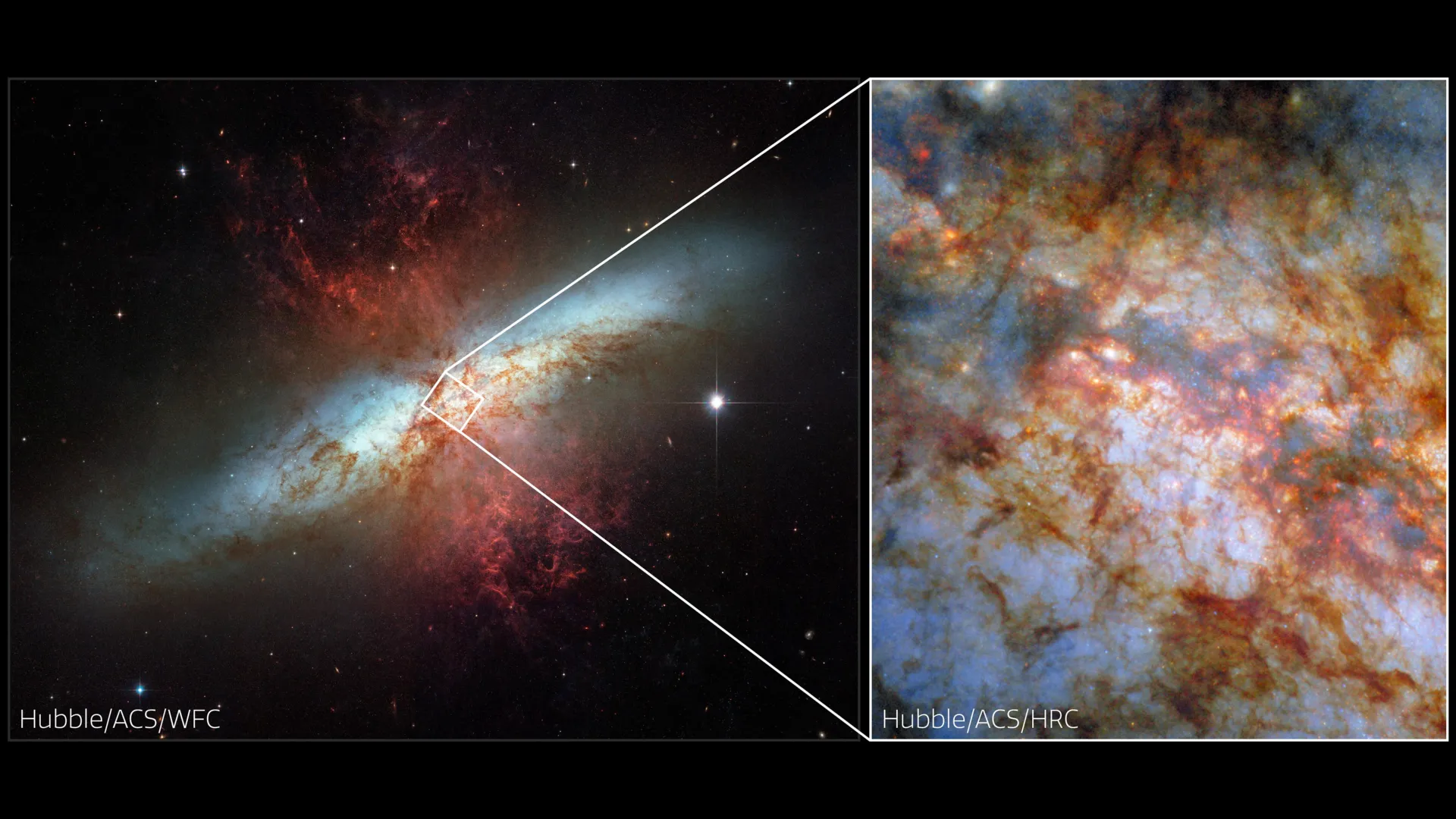
Hubble just revealed the fiery heart of the Cigar Galaxy

What lurks behind the dense, dusty clouds of this galactic neighbor? There lies the star-powered heart of the galaxy Messier 82 (M82), also known as the Cigar Galaxy. Located just 12 million light-years away in the constellation Ursa Major (The Great Bear), the Cigar Galaxy is considered a nearby galaxy. As this Hubble Space Telescope Picture of the Week shows in great detail, it’s home to brilliant stars whose light is shaded by sculptural clouds, clumps and streaks of dust and gas.

It’s no surprise that the Cigar Galaxy is so packed with stars, obscured though they might be by the distinctive clouds pictured here. Forming stars 10 times faster than the Milky Way, the Cigar Galaxy is what astronomers call a starburst galaxy. The intense starburst period that grips this galaxy has given rise to super star clusters in the galaxy’s heart. Each of these super star clusters contains hundreds of thousands of stars and is more luminous than a typical star cluster. Researchers used Hubble to home in on these massive clusters and reveal how they form and evolve.

Hubble’s views of the Cigar Galaxy have been featured before, both as a previous Picture of the Week in 2012 and as an image released in celebration of Hubble’s 16th birthday. The James Webb Space Telescope has also turned toward the Cigar Galaxy, producing infrared images in 2024 and earlier this year.

This image features something not seen in previously released Hubble images of the galaxy: data from the High Resolution Channel of the Advanced Camera for Surveys (ACS). The High Resolution Channel is one of three sub-instruments of ACS, which was installed in 2002. In five years of operation, the High Resolution Channel returned fantastically detailed observations of crowded, starry environments like the centers of starburst galaxies. An electronics fault in 2007 unfortunately left the High Resolution Channel disabled.

Share Button

Laughing at the Beast

I know there are many people who now feel the world (and especially the USA) are going backwards and sliding into darkness. They’re largely right. The USA in particular is backsliding greatly.

Remember that this wasn’t an accident. Lots of people chose this.

This backsliding phase is spiritually purposeful and meaningful, like a giant cleanse that’s happening. I don’t mean a cleanse of people but rather of ideas. Old stupidities are rising to the surface and being processed.

We’re going to be in this phase for a while. Can you accept that? Can you surrender to it? Or would you rather pretend that it’s not happening or hope it all goes away?

You may recognize that some of these stupidities are very old indeed. You may have even thought that humans surely must be done with this foolishness by now. Nope, that was a mistake on your part if you assumed that we’d already called a wrap. Humanity clearly isn’t done with what it’s currently processing. It has a long way to go still. A lot of people need to experience what’s happening now – perhaps a lot more than you’d have ever assumed would need to go through something like this.

It’s important to let this play out. You don’t need to actively participate in it unless you feel wrapped up in the karma of it. And if you do feel karmically engaged, then allow yourself to engage. See what comes out of you during these times. Do your own processing of whatever surfaces. Are you surprised by what comes out of you when you’re squeezed? Delighted? Disappointed?

It’s good to let people discover for themselves where all this leads since many clearly want and need to experience it firsthand for themselves. They won’t heed and don’t understand the warnings about it. They’ll learn more by diving deeper into the darkness and soaking in it a while longer. They’ll come out when they’re ready, not before. Just leave the light on for them if you’d prefer not to join them.

This time period is also a powerful invitation for conscious, growth-oriented people to test their mettle. As Bruce Lee said, “Knowing is not enough, we must apply. Willing is not enough, we must do.” Let’s see just how good you are at keeping yourself light-aligned while so many others do their dark dives. You don’t have to join them.

From a certain perspective, this is indeed a test. Will you allow yourself to be dragged down by it? How strong and resilient are you? Will you give in to fear, hatred, vengefulness, anxiety, hopelessness, helplessness, or despair? Are you really going to be beaten down by these energies swirling around you?

How much compassion and patience do you have? This is a good time to find out. When others’ actions affect you personally, can you still give them space to explore and process what they need to experience? You get to experience the ripples their actions create within you. See how quickly and easily you can return to stillness.

May these times show you what you’re made of, and if you don’t like what you see in yourself, then you have a clear invitation for additional steps on your own path of growth. Do you want to repeatedly get goaded into reactive mode? Or can you remain centered and choose your response to events consciously?

This beast of darkness taunts you ceaselessly, trying to bait you into reacting to it, doesn’t it? It wants you to engage from your weakness, so it can suck you into the range where it’s apparently powerful and you’re presumably weak. How many times will you fall for this trick before you accept what the beast is trying to teach you?

As odd as it may sound, the beast is actually on your side. It’s here to help you grow. It’s not actually here to beat you down. Its invitation is for you to choose a powerful and honest response to it, and then to see if your choice is really right for you.

Even while this beast continues to jump, snort, and throw daily tantrums, you do not have to play its silly games at that level.

Pause and notice just how silly, dumb, and ridiculous it truly is. It is not rational, thoughtful, or brilliant. It is emotional, reactive, needy, and self-destructive. It tries to convince you that it’s powerful, but it isn’t. Its game is to see if it can trick you into giving your power away to it by enticing you to fear it. It will keep offering to play this game with you till you find your own way out.

See if you can reach the point of being able to laugh at the beast. Laugh too at your own vestiges of fear and anxiety about it. Stand in the strength of your spirity side, and laugh at your silly human weaknesses – the very same weaknesses that this beast embodies.

This beast is asking you if these weaknesses are really you and if you’re going to keep embodying them. Or are you really ready to let those weaknesses go and proceed without them?

You may even perceive that so many other people appear to be embodying these weaknesses. Will you be swept up in that? That’s yet another trick of the beast. It’s checking to see if you’re a conformist too. If going along with the herd mentality still matters to you, then you aren’t yet ready to embody the full freedom of a conscious being yet.

Remember: you can choose which energies to embody. If not fear, worry, anxiety, and so on, what will you choose instead? This is indeed a choice when you recognize that it is.

If you don’t want to be repeatedly sucked in by the illusions created by a sense of disconnection, then your invitation is to reconnect. If you’re not going to be sucked in by fear energy, then where will you stand?

You’ll need to find your own answer to that. If you are not fear energy, then what are you? When you are most connected, where are you standing? Where is your home base? Which energies are truly you?

My own answer is to stand in the stable field of energies that feel most aligned with my true self. Those include curiosity, exploration, enthusiasm, intimacy, sharing, kindness, fun, trust, courage, intelligence, simplicity, harmony, and inspiration.

If I were to condense my list to my two favorite energies right now, I would choose wonder (for the active yang side) and delight (for the receptive yin side). I love to explore what I genuinely wonder about, and I delight in the ever-unfolding process of exploration and discovery.

I especially love to keep exploring with others who value wonder and delight, and this year especially, my life seems to be growing richer in such people locally here in Vegas. I’ve been chipping away at exploring more socially and experiencing more moments of shared delight. For instance, this past Saturday I attended a holotropic breathwork ceremony and had a beautiful and peaceful inner journey. The more the outer beast rampages, the more I regard its various tantrums as invitations to commit more deeply to my favorite energies.

I choose to let the beast run its course. My inner senses tell me that it’s been collectively summoned to fulfill a worthwhile purpose, so deep down I feel supportive of it. It’s doing what it needs to do.

I do not ignore the beast. I watch it attentively because it’s clearly very active in my reality, and I want to be sure that I receive and integrate its lessons for me. I took its presence as an invitation to do more growth work in certain directions. Energetically this has been like learning to stand in the eye of a storm.

As this year has progressed, I’ve been feeling ever more centered, grounded, stable, and indeed delighted by life. This is even with the knowing that if the beast really wanted to, it could demolish many aspects of my life and business. Yet it cannot threaten what I care about most, such as wonder and delight, so deep down I don’t find it particularly threatening. The beast serves to remind me of what I hold most dear. It reminds me of who I am at my core.

And Beast, I’m still laughing at you. You really are fucking ridiculous. Thanks for doing what you came here to do. I can see that you’re needed, and I appreciate what you’re doing. Here… have a Scooby snack.

Share Button