When the stars align: Astronomers find answers to mysterious action of ghost stars in our Galaxy

A collaboration of scientists from The University of Manchester and the University of Hong Kong have found a source for the mysterious alignment of stars near the Galactic Centre.

The alignment of planetary nebulae was discovered ten years ago by a Manchester PhD student, Bryan Rees, but has remained unexplained.

New data obtained with the European Southern Observatory Very Large Telescope in Chile and the Hubble Space Telescope, published in Astrophysical Journal Letters, has confirmed the alignment but also found a particular group of stars that is responsible, namely close binary stars.

Planetary nebulae are clouds of gas that are expelled by stars at the end of their lives — the Sun will also form one about five billion years from now. The ejected clouds are ‘ghosts’ of their dying stars and they form beautiful structures such as an hourglass or butterfly shape.

The team studied a group of so-called planetary nebulae found in the Galactic Bulge near the centre of our Milky Way. Each of these nebulae are unrelated and come from different stars, which were born at different times, and spend their lives in completely different places. However, the study found that many of their shapes line up in the sky in the same way and are aligned almost parallel to the Galactic plane (our Milky Way).

This is in the same direction as found by Bryan Rees a decade ago.

The new research, led by Shuyu Tan, a student at the University of Hong Kong, found that the alignment is present only in planetary nebulae which have a close stellar companion. The companion star orbits the main star at the centre of the planetary nebulae in an orbit closer than Mercury is to our own Sun.

The planetary nebulae that do not show close companions do not show the alignment, which suggests that the alignment is potentially linked to the initial separation of the binary components at the time of the star’s birth.

Albert Zijlstra, co-author and Professor in Astrophysics at The University of Manchester, said: “This finding pushes us closer to understanding the cause for this mysterious alignment.

“Planetary nebulae offer us a window into the heart of our galaxy and this insight deepens our understanding of the dynamics and evolution of the Milky Way’s bulge region.

“The formation of stars in the bulge of our galaxy is a complex process that involves various factors such as gravity, turbulence, and magnetic fields. Until now, we have had a lack of evidence for which of these mechanisms could be causing this process to happen and generating this alignment.

“The significance in this research lies in the fact that we now know that the alignment is observed in this very specific subset of planetary nebulae.”

The researchers investigated 136 confirmed planetary nebulae in the galaxy bulge — the thickest section of our Milky Way composed of stars, gas and dust — using the European Southern Observatory Very Large Telescope, which has a main mirror diameter of eight metres.

They also re-examined and re-measured 40 of these from the original study using images from the high-resolution Hubble Space Telescope.

Prof Quentin Parker, the corresponding author from the University of Hong Kong, suggests the nebulae may be shaped by the rapid orbital motion of the companion star, which may even end up orbiting inside the main star.

The alignment of the nebulae may mean that the close binary system preferentially forms with their orbits in the same plane.

Although further studies are needed to fully understand the mechanisms behind the alignment, the findings provide important evidence for the presence of a constant and controlled process that has influenced star formation over billions of years and vast distances.

Share Button

Multiple ecosystems in hot water after marine heatwave surges across the Pacific

Rising ocean temperatures are sweeping the seas, breaking records and creating problematic conditions for marine life. Unlike heatwaves on land, periods of abrupt ocean warming can surge for months or years. Around the world these ‘marine heatwaves’ have led to mass species mortality and displacement events, economic declines and habitat loss. New research reveals that even areas of the ocean protected from fishing are still vulnerable to these extreme events fueled by climate change.

A study published today in Global Change Biology, led by researchers at UC Santa Barbara, found that while California’s network of marine protected areas (MPAs) provide many social and ecological benefits, they are not resilient to the effects of ocean warming. MPAs are locations in the ocean where human activities such as fishing are restricted to conserve and protect marine ecosystems, habitats, species and cultural resources. The study, part of a 10-year review of California’s MPA network conducted at UCSB’s National Center for Ecological Analysis & Synthesis (NCEAS), found that marine heatwaves impact ecological communities regardless of whether they are protected inside MPAs.

“MPAs in California and around the world have many benefits, such as increased fish abundance, biomass and diversity,” said Joshua Smith, who led the study while he was a postdoctoral researcher at NCEAS . “But they were never designed to buffer the impacts of climate change or marine heatwaves.”

Smith and co-authors from all over the world were part of an NCEAS working group formed to synthesize decades of long-term ecological monitoring data from California’s diverse ocean habitats. The group, co-led by Jenn Caselle, a researcher with UCSB’s Marine Science Institute, and Kerry Nickols, a professor from Cal State University Northridge who now works with the non-profit Ocean Visions, aimed to provide actionable scientific results to California’s policy makers and natural resource managers, as part of a statewide Decadal Evaluation of the MPA network. Their analyses spanned the largest marine heatwave on record, which rolled through the Pacific Ocean toward California from 2014-2016. The monster marine heatwave was formed from an environmental double-whammy — unusual ocean warming nicknamed “The Blob,” followed by a major El Niño event that prolonged the sweltering sea temperatures. The marine heatwave blanketed the West Coast from Alaska to Baja and left a wake of altered food webs, collapsed fisheries, and shifted populations of marine life among various other consequences.

As MPA managers around the world face increasing climate shocks, the extent to which MPAs can buffer the worst of these events has become an important question. The working group scientists asked how the ecological communities in California’s protected areas fared after such a severe and prolonged heatwave: Would the communities shift and if so, how? Would they ‘bounce back’ when the marine heatwave subsided? Could the marine protected areas protect sensitive populations or facilitate recovery?

To find answers to their questions, they synthesized over a decade of data collected from 13 no-take MPAs located in a variety of ecosystems along the Central Coast: rocky intertidal zones, kelp forests, shallow and deep rocky reefs. The team looked at fish, invertebrates and seaweed populations inside and outside these areas, using data from before, during and after the heatwave.

They also focused on two of these habitats, rocky intertidal and kelp forests, at 28 MPAs across the full statewide network to gauge whether these locations promoted one particular form of climate resilience — maintaining both population and community structure.

“We used no-take MPAs as a type of comparison to see whether the protected ecological communities fared better to the marine heatwave than places where fishing occurred,” said Smith, now an Ocean Conservation Research Fellow at Monterey Bay Aquarium.

The results are somewhat sobering, though not altogether unexpected.

“The MPAs did not facilitate resistance or recovery across habitats or across communities,” Caselle said. “In the face of this unprecedented marine heatwave, communities did change dramatically in most habitats. But, with one exception, the changes occurred similarly both inside and outside the MPAs. The novelty of this study was that we saw similar results across many different habitats and taxonomic groups, from deepwater to shallow reefs and from fishes to algae.”

The implication of these findings, according to Smith, is that every part of the ocean is under threat from climate change. “MPAs are effective in many of the ways they were designed, but our findings suggest that MPAs alone are not sufficient to buffer the effects of climate change.”

The key question now is what will happen in the future? At the time of this study using data through 2020, the ecological communities have not returned to their former, pre-heatwave state. According to the paper, these ecological communities shifted toward a “pronounced decline in the relative proportion of cold-water species and an increase in warm water species.” For example, increases in the abundance of the señorita fish (Oxyjulis californica), a subtropical species with warm water affinity and previously rare in central California, had an outsized influence on the shift of communities. Whether these species persist in their new locations remains to be seen.

“This study makes it clear why long-term monitoring of California’s MPAs is so critical,” said Caselle. “Some of these time series are longer than 25 years at this point and the data are critical to understanding and readying human communities for the changes occurring in our marine communities.” Continued study will show if future shifts in marine communities occur at different rates or to different base states in MPAs compared to fished areas.

Despite the limited ability of MPAs to resist the grip of the marine heatwave, they do confer benefits, not the least of which is the ability to study the complex effects of climate change in areas not impacted by fishing. As areas of minimal human interference that are regularly monitored, they present opportunities to study the response of marine ecosystems to shifting conditions and potentially tailor management techniques accordingly. Moreover, as Smith stated, “the ecological communities in MPAs are still being protected, even if they are different as a result of the heatwave. Given that marine heatwaves are anticipated to increase in frequency and magnitude into the future, swift climate action and nature-based solutions are needed as additional pathways to enhance the health of our oceans.”

Kerry Nickols adds, “With the devastating impacts of climate change already apparent, it is very important that we are upfront about climate solutions — as long as we are burning fossil fuels and warming the globe marine ecosystems will be at risk, even if they are protected from fishing.”

This paper is the first in a series led by the NCEAS working group. Forthcoming articles examine human engagement across the California MPA network, the effect of MPAs on fish populations and fisheries, and a synthesis of marine protected areas that work for people and nature.

Share Button

Covid Inquiry: Brexit helped prepare government for pandemic, says Gove

Civil servants “honed and refined” crisis skills while preparing to leave the EU, Mr Gove argues.

Share Button

Public sector pay: Workers offered pay rises of around 6%

PM Rishi Sunak said the offer to workers was final and there would be “no more talks on pay”.

Share Button

Pay rise announced as junior doctors strike in England

NHS doctors will get pay rise of 6%, says government, as junior medics in England stage longest strike yet.

Share Button

NHS waiting lists hit record high in England

The latest data shows 7.47 million people are waiting for routine hospital treatment.

Share Button

Rob McElhenney Reveals Diagnosis Of Learning Disabilities

Rob McElhenney, star of the hit show It’s Always Sunny in Philadelphia, revealed that he has been diagnosed with “a host of neurodevelopmental disorders and learning disabilities”.

The actor, 46, shared news of the diagnosis Tuesday on Twitter but did not disclose the specifics. McElhenney acknowledged in his tweet that he typically wouldn’t share such information publicly but decided to do so to help others in similar situations.

Examples of neurodevelopmental disabilities can include attention-deficit/hyperactivity disorder (ADHD), autism, learning disabilities, visual and hearing disabilities, and cerebral palsy.

According to a study conducted from 2009 to 2017 by the Centres for Disease Control and Prevention, about one in six children ages six to 17 had a developmental disability. The American Psychiatric Association found that 2.5% of adults in the US have ADHD. But some research shows that many adults with ADHD remain undiagnosed.

“It’s not something I would normally talk about publicly but I figured there are others who struggle with similar things and I wanted to remind you that you’re not alone. You’re not stupid. You’re not ‘bad’. It might feel that way sometimes. But it’s not true :)” he tweeted.

Fans responded to his tweet with an outpouring of support and gratitude for his openness, with several sharing their experiences with disability diagnoses as well.

McElhenney will be sharing the full diagnosis and prognosis in an episode of The Always Sunny Podcast, a production that McElhenney and his co-stars Glenn Howerton and Charlie Day began hosting together in 2021.

Share Button

Emily Blunt Says She’s Taking A Break From Acting Due To The ‘Emotional Cost’

Emily Blunt has revealed that she is taking a break from acting due to the “emotional cost” of leaving her young children to take on projects.

“This year, I’m not working,” the Oppenheimer actor said during an appearance on Bruce Bozzi’s Table for Two podcast on Monday. “I worked quite a bit last year and my oldest baby is 9, like, we’re in the last year of single digits.”

Blunt is married to Office actor John Krasinski, whom she shares two daughters with: Hazel, 9, and Violet, 7.

“I just feel there are cornerstones to their day that are so important when they’re little,” she explained. “And it’s, ‘Will you wake me up? Will you take me to school? Will you pick me up? Will you put me to bed?’ And I just need to be there for all of them ― for a good stretch. And I just felt that in my bones.”

Blunt said that she worked a lot last year on projects that were at times intense and time-consuming, which prompted her to step back from working for a bit.

“The ones that are time-consuming, I think for me are becoming few and further between because of just the emotional cost on me, on the kids, on balance,” she said, adding that she is “very prone to guilt.”

Blunt attends the 19th Annual AFI Awards in Beverly Hills on Jan. 4, 2019, in Los Angeles.

Matt Winkelmeyer via Getty Images

“I think maybe all mothers are,” Blunt explained. “You’re just prone to feeling bad for, god forbid, wanting something outside of being a mother.”

She also said that she struggles with moderation while working, and said her idea of balance “sways in extremes”.

“I’ll work too much, and then i’ll have a complete reaction against it and an aversion to being on a film set for some time,” she said. “And then I’ll desperately want to work again.”

As far as her kids watching any of her projects, The Devil Wears Prada star joked that her children are “embarrassed” and “horrified by the fact” that she is an actress.

They “have no desire to watch me in anything, which is very healthy, because they just want me to be their mom”, she said.

Blunt has previously admitted that both of her children don’t really rush to watch either parent on-screen, and are rather indifferent to their fame.

“When I see myself up on a billboard, I have this complete disassociation with it … I’m like, who’s that?” Blunt said in an interview with Harper’s Bazaar UK last month. “And I can see my children doing the same — they might say, ‘Oh, there’s mama,’ but it’s not exciting for them. What’s exciting for them is when I can pick them up from school and take them swimming.”

Share Button

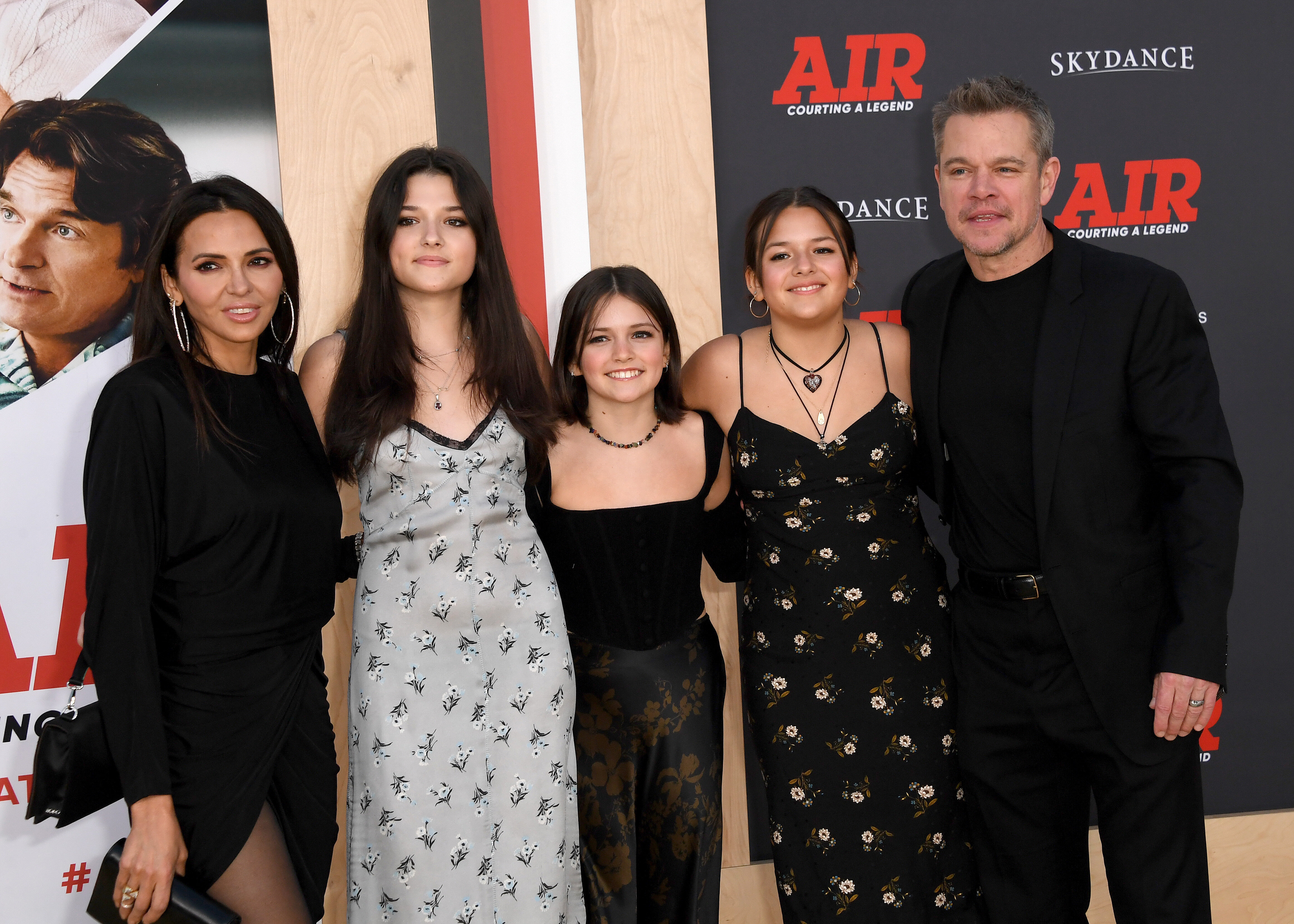
Matt Damon’s Daughters Look So Grown Up During Rare Red Carpet Appearance With Dad

It seems Matt Damon decided to celebrate Take Your Child to Work Day in July.

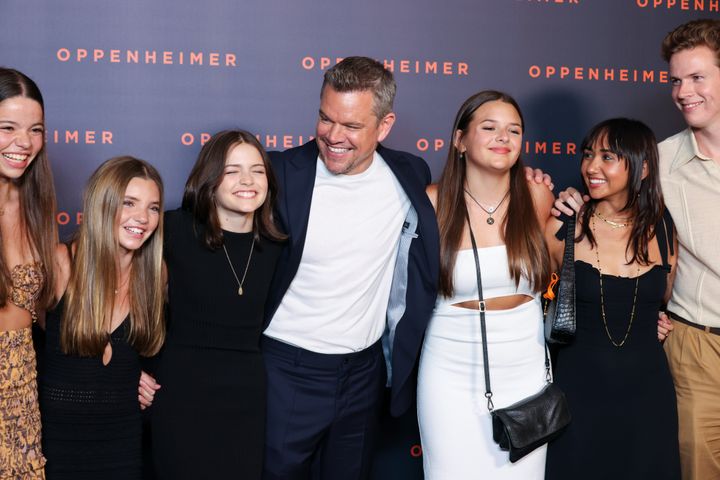
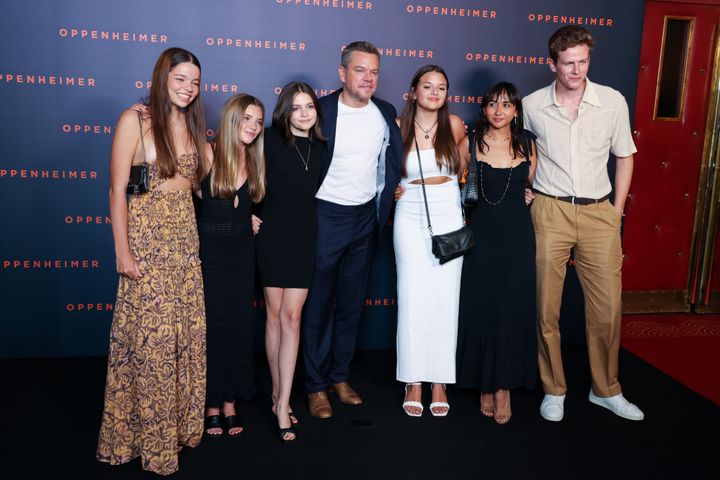
On Tuesday, the Good Will Hunting star posed on the red carpet alongside three of his four daughters at a Paris premiere of his new film “Oppenheimer.”

Damon beamed with pride as he wrapped his arms around daughters Stella, 12, who wore a black mini-dress, and Gia, 14, who opted for a long white dress. Alexia Barroso, 24, Damon’s stepdaughter, wore a simple black dress with bows on the straps.

Two unidentified guests, Stella Damon, Matt Damon, Gia Damon, Alexia Barroso and another guest at the "Oppenheimer" premiere.
Two unidentified guests, Stella Damon, Matt Damon, Gia Damon, Alexia Barroso and another guest at the “Oppenheimer” premiere.

Pierre Suu via Getty Images

It’s unclear if Damon’s wife, Luciana Barroso, or his other daughter, Isabella, 17, were in attendance at the premiere; they were not photographed on the red carpet.

The family and guests appeared together on the red carpet for the new movie.

Pierre Suu via Getty Images

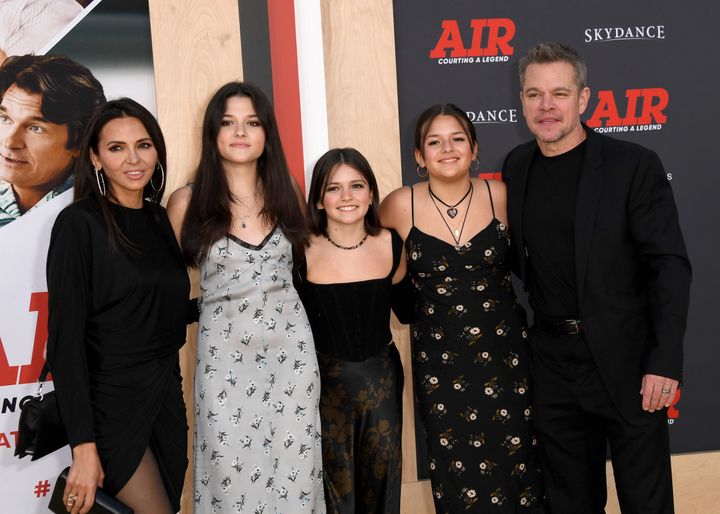
Although it’s rare to see photos of Damon’s girls, they also accompanied their dad to the premiere of his film Air in March. During this premiere, Luciana Barroso and Isabella were photographed alongside Alexia, Stella and Matt Damon.

Luciana Barroso with Isabella, Stella, Gia and Matt Damon at the “Air” premiere in March.

Albert L. Ortega via Getty Images

In 2019, Damon proved his love for his girls was eternal when he got all four of their names tattooed on his right upper arm. Their names appear close to a preexisting “Lucy” tattoo, which he previously got in honor of Luciana.

“On a whim, my wife said, ‘We’re going to get tattoos today,’ so I got a tattoo of her name,” Damon told Access Hollywood of his body art. “And it always felt alone on my arm, and I’ve always wanted to put the kids on there.”

He added: “So now, I got the kids on there, and now I’ve got to figure out a way to pull it all together.”

May we suggest he ties it all together with a “Ben” tattoo? But just the name — and not a giant phoenix on his back.

Share Button

Activation and Suppression: A New 60-Day Challenge

Recently I had a delightful three-hour Zoom conversation with a friend, mostly about psychedelics. One key insight – very applicable outside of psychedelics – was realizing how important it is to be cognizant of our inner suppression circuitry and to challenge it, question it, and sometimes bypass it. Lots of ideas that we generate each day are decent and workable, but our brains internally reject or dismiss them.

Think of this as the default mode network (your everyday way of thinking) defending its equilibrium. It tries to maintain the status quo, such that your future expectations are projected forward as relatively predictable extensions of your past. So you largely keep doing what you’ve been doing. And consequently, your results will fall within a certain range of predictability as well.

This keeps your life fairly stable, but it’s also limiting, holding you back from turning in different directions or powerfully pursuing stretch goals that would disrupt your old status quo.

What if your default mode network is keeping you broke? Or depressed? Or anxious? Or lonely? Or addicted? It doesn’t always work as we’d like. Stability can be nice for some, but many people really struggle with their brain’s current default mode.

Knowing that your default mode network will defend your status quo is empowering because then you can be on the lookout for its defenses kicking in, and this creates opportunities to consciously bypass them. You can use other parts of your brain to challenge the default mode network, nudging your thoughts, feelings, and actions down different pathways.

Psychedelics can help us see that more options are viable, and such substances can even rewire the default mode network, but we can also consciously strive to catch these suppressions as they arise. Note the inner objections that arise when you consider certain ideas, and lean towards implementing those ideas anyway. Be a bit like Jim Carrey’s character in the Yes Man movie, at least when you’re considering new actions that your default mode network would otherwise object to. The article Embrace the New goes into more detail on leaning into new experiences.

We don’t necessarily need more or better ideas to open up a tremendous world of abundance and possibility. We just need to suppress fewer ideas and allow more of them to flow into action and exploration. We can consciously develop more neural flexibility by becoming aware of how the default mode network operates and by challenging and redirecting some of its decisions. Deliberately override some of those default choices.

When I think about blogging about psychedelics and openly sharing what I’m learning from these explorations, I can feel my suppression circuitry objecting because this is a relatively recent exploration that’s been ramping up for me, so my default mode network isn’t fully on board with it. Internally it still generates thoughts like these:

  • Your audience isn’t a match for this kind of content.
  • Writing about this will scare people away.
  • It’s too early; maybe wait a few years till the current psychedelics wave has grown more prominent, so more people are already into it.
  • You’re not a psychedelics coach or therapist, so why are you sharing about this?
  • Why not write about some safer vanilla topics instead?
  • You could just keep this exploration to yourself .
  • And so on…

This reminded me of how useful my 30-day challenge of generating 100 ideas per day was, back in the Fall of 2021. I became more aware of how many ideas my mind quickly rejects and how it rejects them. During that challenge I ended up implementing some of those previously rejected ideas, and they worked very well. Some were financially lucrative too.

In general I’ve benefitted greatly by challenging my default mode network repeatedly, even to the point where I’ve trained it to be more cooperative and flexible over time. For instance, by thinking of myself as an explorer, including asking questions like, “What would a personal growth explorer do here?” I got this frame pretty well embedded into my default way of thinking about life and work. I consider this superior to thinking of myself primarily as a blogger, writer, speaker, coach, etc. because the explorer frame is way more flexible. It gives me more freedom to have new experiences, and it actually fuels other aspects of my work, such as by always giving me fresh experiences from which to derive and share insights.

I’m also reminded of how easy it is to see opportunity blindness in other people and hard to see it in ourselves. You’re probably surrounded by accessible opportunities each day, yet you talk yourself out of them constantly, or your subconscious mind blocks them from even bubbling up to your conscious awareness. Especially notice the ideas that have been resurfacing now and then for years, and you keep dismissing them. What if you did the opposite for a change?

How easy is it for you to quickly act upon new ideas? If a divergent new possibility or invitation comes onto your radar, can you get yourself to explore it with ease? I like having flexible neurology that lets me quickly explore something new and promising, not recklessly or randomly but intelligently. I can quickly assess whether it seems worth exploring without having my default mode network over-suppress.

For instance, I only learned about the Psychedelic Science 2023 conference’s existence a couple weeks before it happened, and I quickly signed up and went, including doing some touristy stuff in Denver too, a city which was new to me as well. In the past when I learned about a potentially interesting and relevant conference, my default mode network would have easily talked me out of it for being too far removed from my status quo. It would have raised immediately objections regarding the time, cost, scheduling, inconvenience, doubts about the benefits, etc.

I can see that many of my best ideas were ones that I had many years prior that kept resurfacing, until I finally loosened up on objecting to them and leaned into exploring them. Exploring psychedelics was just one of many that I suppressed for years with thoughts like “Well, I don’t even know where to get anything,” until I eventually stopped suppressing and began considering it rationally.

Suppression often seems rational but frequently isn’t. Typically the default mode network’s defenses are very thin, hinting that some deep thought went into them when in reality they’re usually superficial calculations with very little substance when you look beneath the surface.

A 60-Day Activation & Suppression Challenge

To help train my brain to be more even more flexible, I’ve decided to deliberately practice this conscious activation of otherwise suppressed ideas.

Yesterday I began a new 60-day challenge of identifying at least one suppressed idea each day and implementing it instead of suppressing it. Pick something that my default mode network is trying to talk me out of, and talk myself into it and do it instead. See what happens.

Some days this will involve catching my brain in the act of suppressing an idea, and I’ll un-suppress it and do it instead. If it’s complex or can’t be done right away, I’ll aim to take some action to advance it that same day. I’ll be traveling for three weeks during this time, so I’ll need some flexibility there, but this kind of challenge fits nicely with travel, encouraging more spontaneity and flexibility.

Other days I may brainstorm some ideas first, and then I’ll identify one where my default response is to dismiss the idea as bad, and I’ll advance it instead.

I like that this is fairly simple and action-oriented but also flexible. I think it will be pretty easy for me to know if I meet this standard each day. I just have to be able to end each day with one identifiable action I took that I’d have otherwise suppressed if I wasn’t doing this challenge.

A short while after making this commitment, I had the thought to add another spin to this challenge, which is to flip it around and also catch an idea that I’d normally advance by default each day, and suppress it instead. So each day for 60 days, I will:

  1. Advance one suppressed-by-default idea.
  2. Suppress one activated-by-default idea.

This seems like a great way to practice consciously challenging and redirecting my default mode network, ideally training it to be more flexible.

Doing one of each is the minimum to check off each day, but I’ll likely do more than one of each per day.

I only began yesterday, so I’m just getting started, but I’m already noticing that this is making me more aware of how my default mode network is working. I’m noticing when ideas it allows to pass through by default versus ideas where it objects and quickly tries to suppress them, redirecting my thoughts and actions down a different pathway.

Wish me luck! 😀

Share Button