People become eligible for a booster three months after a second jab, but can book after two months.


People become eligible for a booster three months after a second jab, but can book after two months.
Over-18s must now prove they are double-jabbed, or have a recent negative test, to enter certain venues.

Sophisticated analysis of a rock sample taken from the Moon during the Apollo 17 mission revealed new information about the complex cooling and evolutionary history of the Moon. The findings, from University of Hawai’i (UH) at Manoa researchers, were published today in Nature Communications.
Apollo 17 astronauts collected the rock sample troctolite 76535 from the Moon’s surface in 1972, and it remains one of the most scientifically valuable samples of the Moon due to its pristine nature. Further, the rock type is widespread on the Moon and likely contains important clues to understanding lunar formation.
William Nelson, lead author of the study and Earth Sciences graduate student in the UH Manoa School of Ocean and Earth Science and Technology (SOEST), and co-authors used a specialized electron microprobe to perform high-resolution analysis of troctolite 76535.
“Previous reports suggest the minerals in the Apollo 17 sample were chemically homogeneous,” said Nelson. “Surprisingly, we found chemical variations within crystals of olivine and plagioclase. These heterogeneities allow us to constrain the earliest, high-temperature cooling histories of these minerals using numerical models.”
SOEST researchers used the UH High-Performance Computing facilities, Mana, to consider the effects of a variety of computer-simulated cooling paths — well over 5 million chemical diffusion models.
“The simulations revealed that these heterogeneities could only survive a relatively short period of time at high temperatures,” said Nelson.
The diffusion patterns preserved in the mineral grains and observed with the microprobe were consistent with a rapid cooling history of no more than 20-million-years at high temperatures. The finding challenges previous estimates of a 100-million-year cooling duration and supports initial rapid cooling of magmas within the lunar crust.
“This is changing our outlook on how an important suite of lunar rocks formed,” said Nelson.
To reconcile high-temperature cooling rates with the generally accepted view of the way in which these rocks formed, the research team proposed that perhaps this rock type is formed by a process called reactive infiltration wherein a melt interacts with rock — changing its chemical and physical makeup.
The study also demonstrates the value of re-examining previously analyzed samples using modern techniques and how quickly new data can reshape our understanding of planetary evolution.
To better understand the observed chemical heterogeneity, the research team is currently investigating how quickly phosphorus can diffuse in olivine crystals. Additionally, they are searching for similar heterogeneities in other Apollo samples.
Story Source:
Materials provided by University of Hawaii at Manoa. Original written by Marcie Grabowski. Note: Content may be edited for style and length.
The new limits will not apply on Christmas Day, but people have been told to keep their celebrations as small as possible.

Labour’s Wes Streeting took down rebellious Tory backbenchers today, telling them government ministers are “not Nazis”.
The shadow health secretary opened his speech in the Commons with an unusual defence of Conservative ministers who have come under fire from their own backbenchers.
Advertisement
Streeting highlighted comments by Tory MP Marcus Fysh who compared Covid health passes – aimed at limiting the spread of Omicron – to atrocities in Nazi Germany.
Streeting told the Commons: “It should not be for me as the shadow secretary of state to point out that we’re not living in the 1930s and the secretary of state and his team are not Nazis.
Advertisement
“On their shoulders rests the health of our nation and the responsibility to protect our NHS. Indeed, it’s a responsibility we all share.
“They need our support and they are owed better treatment than they’ve received from some on their own side in recent days and even this afternoon.”
Advertisement
Mr Streeting said Labour will “act in the national interest” by supporting the motions under consideration in the Commons.
He made the comments on Tuesday before MPs vote on Boris Johnson’s new Covid-19 restrictions to curb the spread of the Omicron variant.
They include working from home when you can, face masks in certain settings and what is being dubbed “vaccine passports” for large gatherings.
However, Tory MPs have been in open revolt with some touring the airwaves and writing columns on why they will be voting against the measures.
Advertisement
Fysh argued that the passes, which include being fully vaccinated or receiving a negative lateral flow test, would be “segregating society based on an unacceptable thing”.
“We are not a ‘papers please’ society. This is not Nazi Germany,” the MP told BBC Radio 5 Live.
The Board of Deputies of British Jews called his remarks “completely unacceptable” and he was criticised by a fellow Conservative rebel.
Tory MP Christian Wakeford, who plans to vote against the government alongside Fysh, responded: “Whilst I will be in the same lobby as Marcus, these types of comments are untrue, unhelpful, and truly deeply offensive to the Jewish community.
“Covid restrictions should never be compared to the darkest period in human history.”

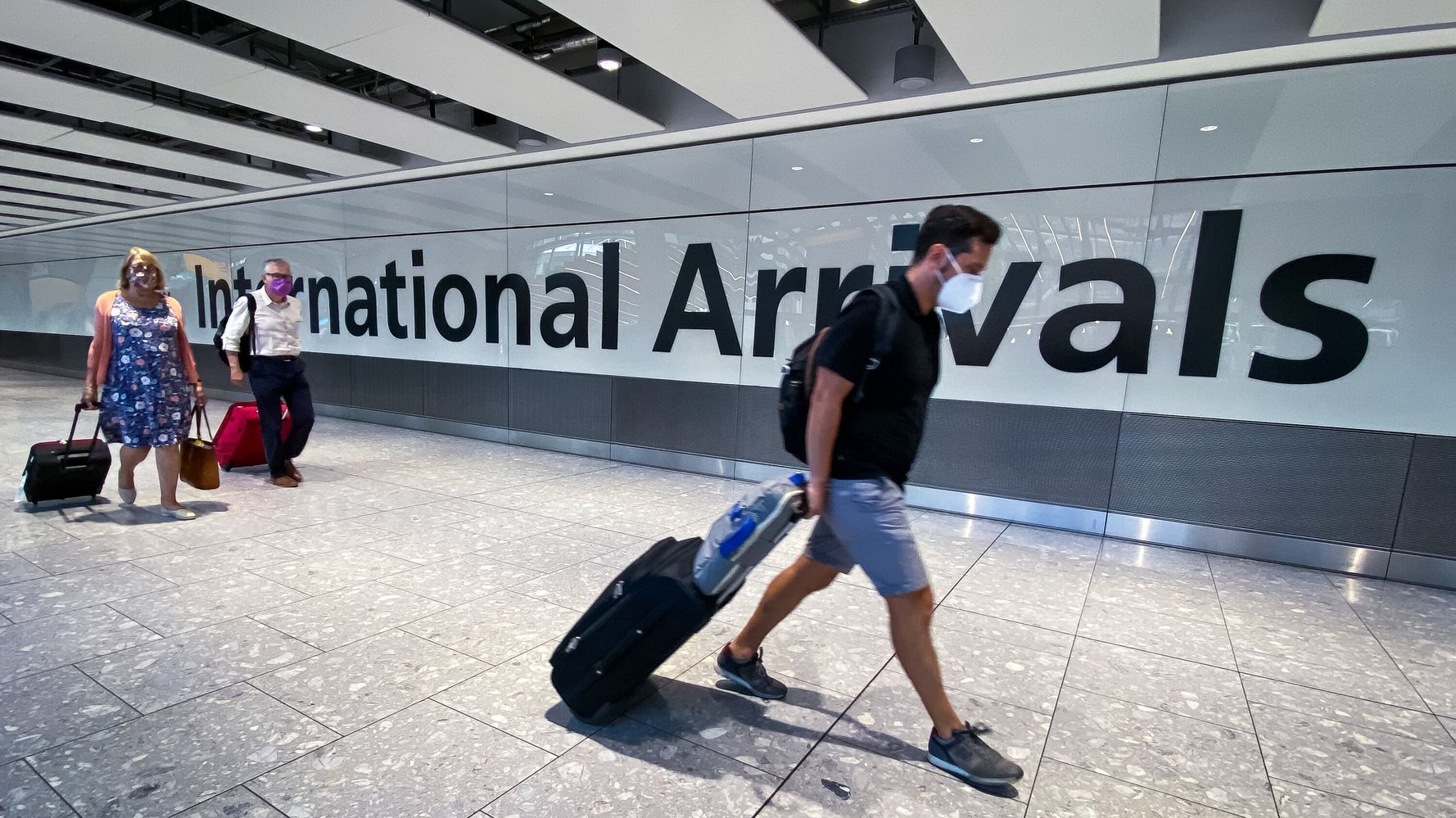
The UK’s travel red list will be scrapped from Wednesday morning, as Sajid Javid announced that all 11 countries remaining will be removed at 4am.
People arriving from Angola, Botswana, Eswatini, Lesotho, Malawi, Mozambique, Namibia, Nigeria, South Africa, Zambia and Zimbabwe had been required to quarantine in a hotel when arriving in the UK, in order to tackle the spread of the Omicron variant.
Advertisement
But speaking in the Commons on Tuesday afternoon, Javid said the spread of the variant in the UK and the world meant the red list was “now less effective in slowing the incursion of Omicron from abroad”.
It came as professor Chris Whitty warned ministers to brace for a “significant increase in hospitalisations” from Omicron, as Downing Street insisted no further coronavirus restrictions are being planned.
Advertisement
England’s chief medical officer also told a virtual cabinet meeting on Tuesday that it is “too early to say how severe” the strain is after early suggestions from South Africa that it could be relatively mild.
Boris Johnson also warned his ministers that he believes a “huge spike” of cases of the variant will hit the nation, as he pressures Tory rebels to back his new Plan B restrictions during a Commons vote.
Advertisement
Downing Street did not reject a suggestion that new Omicron cases could hit a million per day next week based on a “valid” estimate from the UK Health Security Agency that daily infections are currently around 200,000.
Deputy prime minister Dominic Raab insisted Plan B restrictions including mandatory mask=wearing and the use of Covid health certificates for large venues will be sufficient over Christmas, meaning families can “spend it with loved ones”.
But Scottish first minister Nicola Sturgeon urged people across Scotland to limit their mixing by socialising with only up to two other households indoors either side of Christmas.
And the downbeat assessment from Whitty delivered to the first cabinet meeting not to take place in person for months will raise concerns that additional measures may be needed in England in the new year.


In recent years, polar bears in the Beaufort Sea have had to travel far outside of their traditional arctic hunting grounds which has contributed to an almost 30% decrease in their population.
The bears’ home range, or the amount of space they need for food and other resources, was around 64% larger from 1999-2016 than it was in 1986-1998, according to a recent study in the journal Ecosphere.
“Having to travel farther means these bears are expending more energy which can threaten their survival,” said Anthony Pagano, a postdoctoral researcher in Washington State University’s School of the Environment and lead author of the study. “If we want to preserve the habitat of these amazing mammals, then we need to focus on the root of the problem, which is slowing global climate change.”
For the study, Pagano and colleagues from the U.S. Geological Survey used satellite tracking data to analyze the movement patterns of female polar bears from 1986-2016 in the Beaufort Sea area north of Alaska.
Their work showed over the last two decades polar bears are having to travel farther north of their traditional hunting grounds on the continental shelf to remain on their receding sea ice habitat.
Extending around 100 miles north of Alaska and Canada, the continental shelf is a shallow water habitat that contains plenty of fish for the bears’ favorite prey, seals.
During the early summer when seals are weaning their pups and most vulnerable to attack, polar bears will often double their body weight from eating the fatty meat.
The researchers’ data shows that as the sea ice over the continental shelf continues to recede earlier and further; the bears are being displaced from this primary foraging habitat and traveling further north into deeper waters where there are fewer seals to prey on.
“The combined impact of having to move farther and farther north with the ice in the summer and then having to move back in the fall and winter as the ice freezes is taking a major toll,” Pagano said. “Our work highlights the worrying impact of sea ice decline on polar bear movement patterns.”
Another interesting finding of the study is that around 20% of the polar bear population in the Beaufort Sea is foregoing their traditional sea ice hunting grounds altogether in the summer and fall. These bears are moving inland along the Alaskan and Canadian coast looking for food such as carrion, berries and sometimes even bowhead whale carcasses that are left on the shore by indigenous residents that hunt the large aquatic mammals.
“Sometimes you’ll have 50 to 100 polar bears that congregate around these whale carcasses and compete with each other for food,” Pagano said. “As more and more bears move on land, I suspect there’ll be a lot more competition for these food resources and we’ll probably start seeing further decreases in abundance and survival.”
Moving forward, Pagano and his colleagues with the U.S Geological Survey plan to conduct further studies of the polar bears moving inland to get a better idea of how they are coping with their new terrestrial habitat.
He said the best thing humans can do to help preserve the southern Beaufort Sea’s 800 or so remaining polar bears is to focus on curbing global carbon emissions which are the main cause behind receding arctic sea ice.
Recent modeling work has shown that if regulations are enacted to reduce these emissions to avoid global warming greater than 2°C or 3.6°F then it could drastically slow the decline of polar bear habitat in the arctic which would in turn help these animals to survive.
“Coming across a polar bear while flying over the arctic in a helicopter is a surreal experience,” Pagano said. “They are incredibly massive and impressive. It is amazing to observe this animal that is so uniquely adapted to exist in this harsh arctic environment. They are worth the effort it will take to preserve them.”
Story Source:
Materials provided by Washington State University. Original written by Will Ferguson. Note: Content may be edited for style and length.
The government is aiming to give one million jabs a day across the UK during the rest of December.

Mayo Clinic does not endorse companies or products. Advertising revenue supports our not-for-profit mission.
Advertising & Sponsorship
Check out these best-sellers and special offers on books and newsletters from Mayo Clinic Press.

A team from UCF has developed the world’s first optical oscilloscope, an instrument that is able to measure the electric field of light. The device converts light oscillations into electrical signals, much like hospital monitorsconvert a patient’s heartbeat into electrical oscillation.
Until now, reading the electric field of light has been a challenge because of the high speeds at which light waves oscillates. The most advanced techniques, which power our phone and internet communications, can currently clock electric fields at up to gigahertz frequencies — covering the radio frequency and microwave regions of the electromagnetic spectrum. Light waves oscillate at much higher rates, allowing a higher density of information to be transmitted. However, the current tools for measuring light fields could resolve only an average signal associated with a ‘pulse’ of light, and not the peaks and valleys within the pulse. Measuring those peaks and valleys within a single pulse is important because it is in that space that information can be packed and delivered.
“Fiber optic communications have taken advantage of light to make things faster, but we are still functionally limited by the speed of the oscilloscope,” says Physics Associate Professor Michael Chini, who worked on the research at UCF. “Our optical oscilloscope may be able to increase that speed by a factor of about 10,000.”
The team’s findings are published in this week’s Nature Photonics journal.
The team developed the device and demonstrated its capability for real-time measurement of the electric fields of individual laser pulses in Chini’s lab at UCF. The next step for the team is to see how far they can push the speed limits of the technique.
The lead author of the paper is UCF postdoctoral scholar Yangyang Liu. Other authors include physics alums Jonathan Nesper ’19 ’21MS, who earned his bachelor’s in math and master’s in physics; Shima Gholam-Mirzaei ’18MS ’20PhD; and John E. Beetar ’15 ’17MS ’20PhD.
Gholam-Mirzaei is now a postdoctoral researcher at the Joint Attosecond Science Laboratory at the National Research Council of Canada and University of Ottawa and Beetar is completing a postdoc at the University of California at Berkeley.
Chini had the idea for the single-shot waveform measurement scheme and oversaw the research team. Liu led the experimental effort and performed most of the measurements and simulations. Beetar assisted with the measurements of the carrier-envelope phase dependence. Nesper and Gholam-Mirzaei assisted with the construction of the experimental setup and with the data collection. All authors contributed to the data analysis and wrote the journal article.
The work was supported primarily through a grant from the Air Force Office of Scientific Research under Award No. FA9550-20-1-0284, while Gholam-Mirzaei was supported by the Army Research Office under Award No. W911NF-19-1-0211.
Story Source:
Materials provided by University of Central Florida. Original written by Zenaida Gonzalez Kotala. Note: Content may be edited for style and length.
