Are room-temperature superconductors finally within reach?

When electricity moves through wires, some of its energy is lost along the way. That loss, however, might not be inevitable. Researchers at Penn State have developed a new way to identify materials known as superconductors — substances that can carry electric current with zero resistance, meaning no energy is wasted during transmission.

The Challenge of Cold Superconductors

Despite their promise, most superconducting materials cannot yet be used in everyday technology. Their extraordinary ability to conduct electricity only appears at extremely low temperatures, far below what is practical for energy systems or advanced electronics. Supported by the “Theory of Condensed Matter” program within the Department of Energy’s (DOE) Basic Energy Sciences, the Penn State team created a new computational approach to predict which materials might display superconductivity, potentially paving the way to finding ones that work at much higher, even near-room, temperatures.

A New Look at a Longstanding Mystery

Predicting superconductivity — especially in materials that could operate at higher temperatures — has remained an unsolved challenge. Existing theories have long been considered accurate only for low-temperature superconductors, explained Zi-Kui Liu, a professor of materials science and engineering at Penn State.

“The goal has always been to raise the temperature at which superconductivity persists,” said Liu, the lead author of a new study published in Superconductor Science and Technology. “But first, we need to understand exactly how superconductivity happens, and that is where our work comes in.”

How the Classic Theory Explains Superconductors

For decades, scientists have relied on the Bardeen-Cooper-Schrieffer (BCS) theory to describe how conventional superconductors function at extremely low temperatures. According to this theory, electrons move without resistance because of interactions with vibrations in the atomic lattice, called phonons. These interactions allow electrons to pair up into what are known as Cooper pairs, which move in sync through the material, avoiding atomic collisions and preventing energy loss as heat.

“Imagine a superhighway just for electrons,” Liu explained. “If there are too many routes, electrons bump into things and lose energy. But if you create a straight tunnel for them, like the Autobahn in Germany, they can travel fast and freely without resistance.”

The Quest for Power Without Resistance

This ability to transmit energy without resistance is what makes superconductors so promising, Liu said. If scientists can develop materials that stay superconducting at higher temperatures, electricity could travel farther, faster, and more efficiently, transforming global power systems. To understand this phenomenon, the DOE-backed project uses computational tools known as density functional theory (DFT). DFT helps model how electrons behave in ordinary conductors compared to superconductors. The team hypothesizes that even though DFT does not directly model Cooper pairs, the electron density it predicts should resemble that of paired electrons, allowing researchers to study potential superconducting behavior.

Until recently, BCS theory and DFT — one describing electron pairing, the other rooted in quantum mechanics — were treated separately. Liu’s team found a way to connect these frameworks, creating a new path to predict superconductivity.

Introducing Zentropy Theory

The breakthrough centers on a concept called zentropy theory. This approach merges principles from statistical mechanics, which studies the collective behavior of many particles, with quantum physics and modern computational modeling. Zentropy theory links a material’s electronic structure to how its properties change with temperature, revealing when it transitions from a superconducting to a non-superconducting state. To apply the theory, scientists must understand how a material behaves at absolute zero (zero Kelvin), the coldest temperature possible, where all atomic motion ceases. Liu’s team demonstrated that even DFT — though not originally intended to study superconductors — can provide key insights into when and how superconductivity occurs.

Predicting the Next Generation of Superconductors

According to Liu, the new method allows scientists to predict whether a material could become superconducting. Zentropy theory can then estimate the critical temperature at which the material loses that property. The classic BCS theory successfully explains superconductors that operate only at very low temperatures, but fails for high-temperature varieties, where Cooper pairs break apart more easily. Through DFT modeling, Liu’s group discovered that in high-temperature superconductors, the electron “superhighway” remains stable because of a unique atomic structure — similar to a pontoon bridge that flexes with waves, allowing electrons to move smoothly even when thermal vibrations increase.

Using this combined approach, the team successfully predicted superconducting behavior in both conventional and high-temperature materials, including one that traditional theory could not explain. They also forecasted potential superconductivity in copper, silver, and gold — metals not typically considered superconductors — likely because they would require extremely low temperatures for the effect to appear. These findings could accelerate the discovery of new materials that operate as superconductors at higher, more practical temperatures.

Next Steps in the Search for Practical Superconductors

The Penn State researchers now plan to expand their work in two ways. First, they will use the zentropy theory to predict how pressure affects the temperature at which superconductors lose their resistance. Second, they will search a massive database of five million materials to identify new candidates that could exhibit superconductivity. The goal is to find the most promising materials and collaborate with experimental researchers to test them.

“We are not just explaining what is already known,” Liu said. “We are building a framework to discover something entirely new. If successful, the approach could lead to the discovery of high-temperature superconductors that work in practical settings, potentially even at room temperature if they exist. That kind of breakthrough could have an enormous impact on modern technology and energy systems.”

Shun-Li Shang, research professor of materials science and engineering at Penn State, is a co-investigator on this study.

The U.S. Department of Energy supported this research.

Share Button

Scientists shocked by reversed electric field around Earth

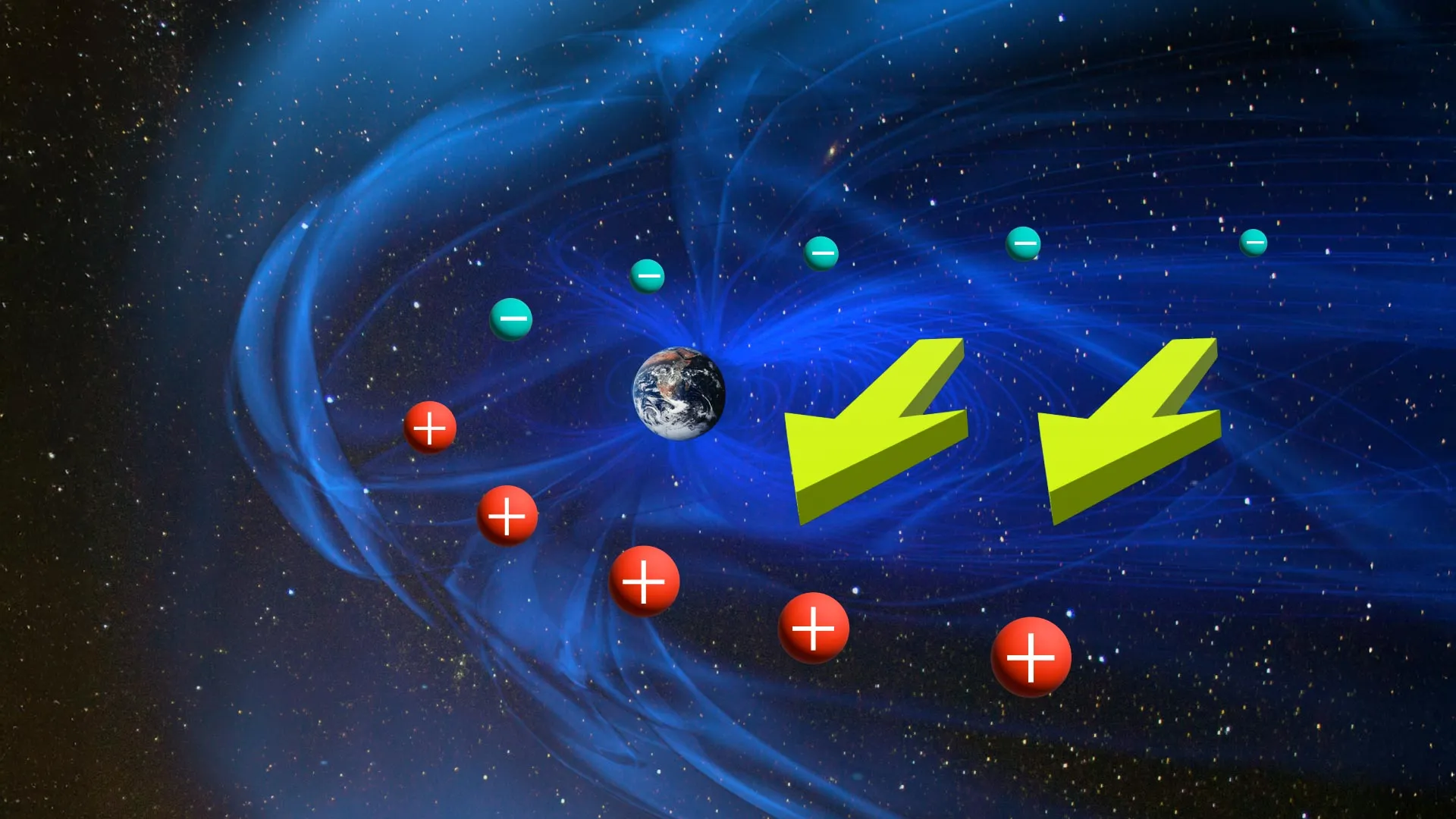
The area of space controlled by Earth’s magnetic field is called the magnetosphere. Within this vast magnetic bubble, scientists have observed an electric field that stretches from the morning side of Earth to the evening side. This large-scale electric force is a major influence on geomagnetic disturbances, including the storms that can disrupt satellites and communications.

Because electric forces move from positive to negative charges, scientists once assumed the magnetosphere was positively charged on the morning side and negatively charged on the evening side. However, recent satellite measurements have overturned that long-standing idea, revealing that the actual charge distribution is the reverse of what was expected.

This surprising finding led researchers from Kyoto University, Nagoya University, and Kyushu University to revisit how the magnetosphere’s electric characteristics are formed and sustained.

To test their hypotheses, the team used large-scale magnetohydrodynamic (MHD) simulations to recreate conditions in near-Earth space. Their model included a steady stream of high-speed solar wind, the constant flow of charged particles emitted by the sun. The results supported the recent satellite observations, showing that the morning side of the magnetosphere carries a negative charge while the opposite side is positive — but this pattern does not apply everywhere.

In the polar regions, the charge polarity matches the traditional theory. Near the equator, though, the pattern flips across a wide area, creating a striking difference between the two zones.

Plasma Motion Explains the Mystery

“In conventional theory, the charge polarity in the equatorial plane and above the polar regions should be the same. Why, then, do we see opposite polarities between these regions? This can actually be explained by the motion of plasma,” explains corresponding author Yusuke Ebihara of Kyoto University.

When magnetic energy from the sun enters Earth’s magnetic field, it moves clockwise on the dusk side of the planet and channels toward the poles. Meanwhile, Earth’s magnetic field lines run from the Southern Hemisphere to the Northern Hemisphere — upward near the equator and downward near the poles. This opposing orientation between the magnetic field and plasma flow leads to the reversal in charge distribution between the regions.

“The electric force and charge distribution are both results, not causes, of plasma motion,” says Ebihara. This insight reframes how scientists interpret electrical activity in Earth’s near-space environment.

Broader Implications for Planetary Science

Plasma convection — the large-scale flow of charged particles within the magnetosphere — drives many dynamic space phenomena. Recent studies also suggest that this movement influences Earth’s radiation belts, which are regions filled with fast-moving, high-energy particles.

By clarifying how plasma motion shapes electric fields, this research deepens understanding of large-scale space plasma behavior. It also sheds light on similar processes occurring around other magnetized worlds, including Jupiter and Saturn, expanding our grasp of how planetary environments evolve across the solar system.

Share Button

Long A&E waits causing heartbreaking suffering, charity says

Patients are dying in corridors and others left for hours in soiled clothes, says Age UK.

Share Button

Health officials worried as flu season comes five weeks early

UK Health Security Agency urges people to get vaccinated with cases on the rise.

Share Button

Trump Dodges Sensitive Question In Front Of Chinese President

US President Donald Trump didn’t answer a reporter’s question Thursday about the US resuming nuclear testing, and perhaps it had to do with the company he was keeping. (Watch the video below.)

But given that Trump had just announced on X before the meeting that the US would restart nuclear weapons testing for the first time in 33 years, claiming in part it was because of China’s testing, the subject came up.

“Mr. President, why did you change your nuclear plans?” a reporter asked. “Why are you gonna be doing more nuclear testing?”

Trump replied, “Thank you very much, everybody. Appreciate it.”

Trump’s nuke declaration was likely timed as a message to Xi before their conference, so perhaps the president figured he had already made his point without fielding the question.

On Air Force One later, Trump elaborated on the country’s motives.

“With others doing testing, I think it’s appropriate that we do also,” Trump said, noting that the test sites would be decided later.

Share Button

Downing Street Refuses To Say If Rachel Reeves Broke The Ministerial Code Over Renting Her Home Out

Keir Starmer’s spokesperson repeatedly refused to say if Rachel Reeves had broken the ministerial code after she admitted to breaking property rules.

Following reporting from the Daily Mail, the chancellor wrote to the prime minister on Wednesday night confirming she had failed to obtain a “selective” rental licence for her family home in London.

She apologised for the “inadvertent error”, and claimed she had immediately applied for a licence – actions which Starmer declared were a “sufficient resolution” to such errors, according to the Ministerial Code.

Speaking just a month after his deputy prime minister Angela Rayner had to resign after not paying enough stamp duty, Starmer said he was happy the “matter can be drawn to a close” following a consultation with his ethics adviser who decided there was no need for an investigation.

But No.10 is facing intense questioning over the extent to which the mistake was probed by the PM and his ethics adviser.

Speaking to journalists on Thursday morning, a spokesperson for Starmer repeatedly refused to say if the standards rules had been breached.

He also refused to say what evidence independent watchdog Sir Laurie Magnus had looked at before coming to his conclusion that there was no need for a further probe last night.

The prime minister’s spokesperson was also asked if the prime minister, a former director of public prosecutions, thought ignorance of the law was a defence. He said Starmer did not.

Asked why Reeves’ response was therefore acceptable to the PM, he said: “Regrettably she was not aware the licence was necessary, did not obtain the licence before renting the property out.

“She’s explained it was inadvertent mistake and as soon as it was brought to her attention, she took immediate action and applied for the licence… the Ministerial Code makes clear that in certain circumstances, in consultation with the independent adviser, an apology is a sufficient resolution.”

No.10 also rejected suggestions Reeves had got away “scot-free” after a “stitch-up” from the government meant to avoid spooking the bond markets.

He replied: “I don’t accept that framing at all.”

The spokesperson was also asked if the PM stood by his 2022 statement that “lawbreakers cannot be lawmakers” – made at the height of the partygate scandal against Boris Johnson.

Starmer’s representative said: “Yes.”

Leader of the opposition Kemi Badenoch has called for an investigation into Reeves’ conduct.

She said: “She is the chancellor. She needs to be on top of her paperwork. She was aware of this legislation. I think there should be an investigation.”

The revelation comes just a month before Reeves is set to unveil her Budget, where there are fears Labour will breach their manifesto pledges not to raise income tax, national insurance or VAT in order to fill the fiscal black hole in the public finances.

Share Button

I Developed A Condition In My Mid-40s That Made It Impossible To Poop Normally – And It Gets Even More Embarrassing

My mother wouldn’t want me to talk about this; not here, where everyone can see me. What isn’t pretty should be handled privately… or so she taught me, and her mom taught her, and so on and so forth. But the page is a place of connection. If I’m not fully present here, then what’s the point?

To put it bluntly, my organs are falling out. That’s a slight exaggeration. “Descending” is more accurate. However I frame it, it’s a disconcerting thought. My uterus, well, there’s a sign on that one that reads, “We’re done here!” But my bladder and my rectum, though performing their functions poorly, still seem necessary. I can’t have them planning their escapes.

The news of my organs descending surprised me. Like many women following childbirth, I’ve struggled with “peezing” (a word contributed by Liz Lemon from “30 Rock”) and other mild forms of stress incontinence for a long time. But since my mid-40s, those problems have intensified alongside a more troubling inability to defecate completely.

So after probing in hard-to-reach places, a urogynaecologist pronounces me prolapsed. According to a handout my doctor gave me by the American Urogynaecologic Society, pelvic organ prolapse, or POP, “occurs when the pelvic floor muscles and connective tissue weaken or tear. This causes the pelvic organs to fall downward into the vagina, similar to a hernia. Women may feel or see tissue coming out of the opening of their vagina as this progresses.”

POP can happen for a variety of reasons, among them muscle and nerve damage from pregnancy and childbirth, hormonal changes related to menopause, constant straining due to constipation, repeatedly lifting heavy objects and genetic predisposition.

To investigate the possible relationship between my prolapsing organs and my constipation, my doctor suggests that I undergo what feels like a new level of humiliation called a defecography. It’s not like a colonoscopy, where you theoretically sleep through the entire thing. In this case, medical professionals watch you poop while you are alert and fully present, live and on-camera. The test reveals whether there is some anatomical reason why you can’t eliminate properly.

I wonder if it’s worth it. Maybe I should just embrace my “pooping problem,” as my youngest calls it, and limp along without additional interventions. I can just live with the prolapses for now, right? It seems like the easiest and most peaceful route sometimes — just settling. But we all want more, don’t we? We want true healing. We want to feel better. We want to be fully restored.

I remain stubbornly curious about what could be, and schedule the test. But I give myself permission to say “no” the morning of — “no” when I get there and see what awaits me, “no” when they ask me to… you get the idea. I’ve never used the “no,” but having it emboldens me to be braver than I am.

“My doctor suggests that I undergo what feels like a new level of humiliation called a defecography. It’s not like a colonoscopy, where you theoretically sleep through the entire thing. In this case, medical professionals watch you poop while you are alert and fully present, live and on-camera.”

A defecography turns out to be as pleasant as it sounds. You suck down a bunch of barium and load yourself up vaginally with barium paste. The nurse then pages the radiologist: “The defo (that’s me) is ready.” She notices I’m listening to her — What else would I be doing? — and looks a little embarrassed. She apologises quickly for referring to me as “defo,” saying it’s only to prepare the radiologist for what he’s about to do. I guess referring to me as a person is too much work.

Then the radiologist arrives, explains the process, and inserts a large amount of barium paste into my rectum via syringe. If you have other anal issues like I do…a fissure, haemorrhoids, that last part is especially unpleasant. It’s hard not to feel violated unless your radiologist is gifted with an unusual amount of finesse. Mine was not.

Next is the fun part. You sit on an elevated platform sporting a special commode. With the radiologist and nurse next to you, you defecate on camera and on command. The radiologist stares at a screen to judge how well you eliminate and gathers evidence revealing why you cannot void completely. In my case, he found that my uterus descends and pinches off part of my rectum when I bear down, so I can only partially evacuate. Hooray? Maybe. I cry all the way home.

When I see my urogynaecologist several weeks later, she’s elated: “I’m so glad that I can do something to help you!” She’s a good doctor. She explains that she’d like to insert a silicone device called a pessary up into my vagina. It’s designed to hold up my uterus and prevent it from pinching off my rectum.

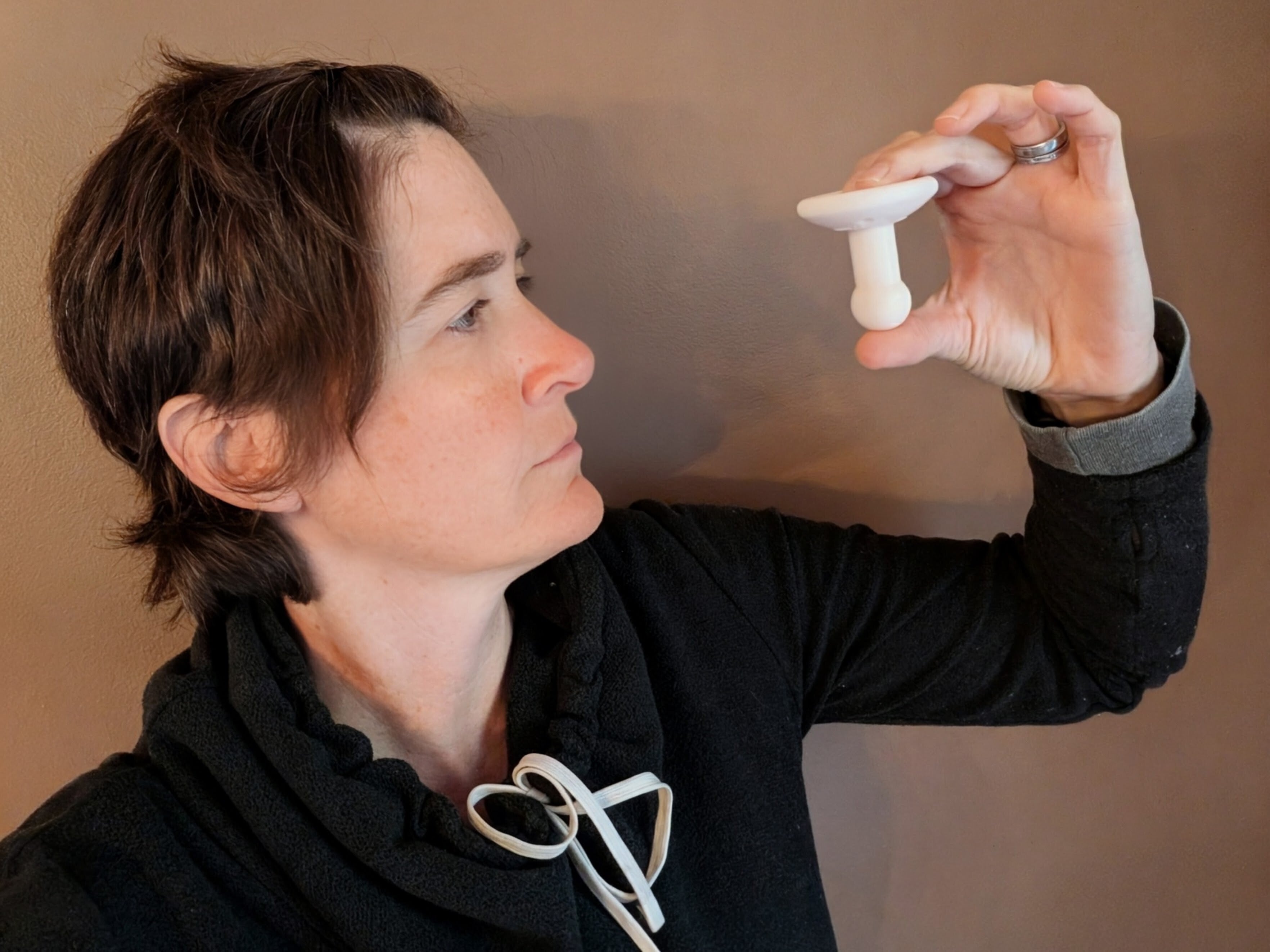
The pessary looks like a mushroom with a top that secures via suction and a long stem that extends down to my vaginal opening. Once I’ve assumed the position, she requests that I ready myself and relax. That doesn’t bode well. With significant force, she installs the medieval workhorse. According to the nurses, she “places” the pessary, but what I experience feels more like a pain-inducing shove. I arrive home feeling like I’ve got a tampon protruding and a little askew. I’m supposed to function like this for 2-3 weeks.

Unfortunately, the pessary changes nothing. The pooping problem persists. My urogynaecologist explains that she could still surgically fix the prolapses, pin up or remove my uterus, in hopes that stooling would improve. She looks at me: “What do you think we should do?”

My internal response is paradoxical. One part of me screams, What!?! YOU are supposed to be the expert! Why are you asking ME!?! The other ruminates, Thank you for acknowledging that I might have some wisdom to contribute.

“I’ll have to think about it.”

The end? Not really, and I hope not. But this is where we all are a lot of time. In between. In process. Unresolved. We all wander around hurting sometimes and can’t fix it. We’re all trying to make meaning of suffering while we wait for change.

But wherever this path takes me, I’m done with pretty and private. I’m done with the societal expectation that women’s bodies should look the same regardless of the trauma they have sustained, that aging should be invisible. My body is a ragged landscape of stories that I think I’m meant to tell. I am more than pretty. I am wildly, uncomfortably, unapologetically, fearfully resilient.

And so are you.

Do you have a compelling personal story you’d like to see published on HuffPost? Find out what we’re looking for here and send us a pitch at pitch@huffpost.com.

Share Button

Scientists discover a stunning new golden-tongued lizard in China

Researchers in China have identified a previously unknown species of mountain lizard living in the upper Dadu River Valley, deep within the Hengduan Mountains of Sichuan Province.

Years of Field Surveys Lead to a Surprise

Starting in 2018, the research team carried out extensive field surveys in the upper reaches of the Dadu River. During their expeditions, they came across a population of lizards that displayed unusual traits not seen in other known Diploderma species from the area. Detailed genetic testing and morphological comparisons confirmed their suspicions: this was a species that had never been documented before.

The scientists named it Diploderma bifluviale, a nod to its discovery site near the meeting point of two rivers, Chuosijia and Jiaomuzu.

With this finding, Diploderma bifluviale becomes the 47th recognized species of Diploderma in China. Members of this genus are found throughout East Asia and the northern Indochinese Peninsula, where they occupy a wide variety of mountain habitats.

A Unique Lizard With Distinctive Traits

Measuring about 6-7 centimeters in body length, D. bifluviale stands out with its distinctive coloring and a wheat-colored tongue — features that set it apart from closely related species. It thrives in semi-arid shrublands and rocky, sun-exposed valleys at elevations between 2,100 and 2,500 meters. The environment it inhabits is characterized by small-leaved shrubs and scattered stones, creating the perfect camouflage for this elusive reptile.

“This discovery highlights the understudied biodiversity of the upper Dadu River,” the researchers wrote in their report, published in the open-access journal ZooKeys. Their finding underscores how even in well-surveyed regions of China, nature continues to reveal new surprises.

Share Button

Scientists discover a way simulate the Universe on a laptop

As astronomers gather more data than ever before, studying the cosmos has become an increasingly complex task. A new innovation is changing that reality. Researchers have now developed a way to analyze enormous cosmic data sets using only a laptop and a few hours of processing time.

Leading this effort is Dr. Marco Bonici, a postdoctoral researcher at the Waterloo Centre for Astrophysics at the University of Waterloo. Bonici and an international team created Effort.jl, short for EFfective Field theORy surrogate. This tool uses advanced numerical techniques and smart data-preprocessing methods to deliver exceptional computational performance while maintaining the accuracy required in cosmology. The team designed it as a powerful emulator for the Effective Field Theory of Large-Scale Structure (EFTofLSS), allowing researchers to process vast datasets more efficiently than ever before.

Turning Frustration Into Innovation

The idea for Effort.jl emerged from Bonici’s experience running time-consuming computer models. Each time he adjusted even a single parameter, it could take days of extra computation to see the results. That challenge inspired him to build a faster, more flexible solution that could handle such adjustments in hours rather than days.

“Using Effort.jl, we can run through complex data sets on models like EFTofLSS, which have previously needed a lot of time and computer power,” Bonici explained. “With projects like DESI and Euclid expanding our knowledge of the universe and creating even larger astronomical datasets to explore, Effort.jl allows researchers to analyze data faster, inexpensively and multiple times while making small changes based on nuances in the data.”

Smarter Simulations for a Faster Universe

Effort.jl belongs to a class of tools known as emulators. These are trained computational shortcuts that replicate the behavior of large, resource-intensive simulations but run dramatically faster. By using emulators, scientists can explore many possible cosmic scenarios in a fraction of the time and apply advanced techniques such as gradient-based sampling to study intricate physical models with greater efficiency.

“We were able to validate the predictions coming out of Effort.jl by aligning them with those coming out of EFTofLSS,” Bonici said. “The margin of error was small and showed us that the calculations coming out of Effort.jl are strong. Effort.jl can also handle observational quirks like distortions in data and can be customized very easily to the needs of the researcher.”

Human Expertise Still Matters

Despite its impressive capabilities, Effort.jl is not a substitute for scientific understanding. Cosmologists still play a vital role in setting parameters, interpreting results, and applying physical insight to ensure meaningful conclusions. The combination of expert knowledge and computational power is what makes the system so effective.

Looking ahead, Effort.jl is expected to take on even larger cosmological datasets and work alongside other analytical tools. Researchers also see potential for its methods in areas beyond astrophysics, including weather and climate modeling.

The paper, “Effort.jl: a fast and differentiable emulator for the Effective Field Theory of the Large Scale Structure of the Universe,” was published in the Journal of Cosmology and Astroparticle Physics.

Share Button

‘New birth advice change is our girl’s lasting legacy’

A mum says she was not warned of the potentially life-threatening risks of a uterine rupture.

Share Button