The NHS website’s prostate enlargement page received more than 16,000 visits on Wednesday.


The NHS website’s prostate enlargement page received more than 16,000 visits on Wednesday.
People are encouraged to have the MMR jab, as cases of measles are rising across England.

Southern Africa contains the vast majority of the world’s remaining populations of both black and white rhinoceroses (80% and 92%, respectively). The region’s climate is changing rapidly as a result global warming. Traditional conservation efforts aimed at protecting rhinos have focused on poaching, but until now, there has been no analysis of the impact that climate change may have on the animals. A research team from the University of Massachusetts Amherst has recently reported in the journal Biodiversity that, though the area will be affected by both higher temperatures and changing precipitation, the rhinos are more sensitive to rising temperatures, which will quickly increase above the animals’ acceptable maximum threshold. Managers in national parks should begin planning adaptations to manage the increased temperatures in the hopes of preserving a future for the rhinoceroses.
The African continent has seen its average monthly temperatures rise by .5 — 2 degrees Celsius over the past century, with up to another two degrees of warming projected for the next 100 years, according to the Intergovernmental Panel on Climate Change’s (IPCC) high greenhouse gas emissions scenario. It is also well known that the changing climate will disrupt historical precipitation patterns — but which of these, temperature or rainfall, will have the most impact on a species, like white and black rhinos, that have long been the target of conservation efforts?
The question is especially important for rhinos because they don’t sweat, and instead cool themselves off by bathing and finding shade.
“Generally speaking, most, if not all, species will, in one way or another, be negatively affected by the changing climate,” says lead author Hlelowenkhosi S. Mamba, who completed this research as part of her graduate studies at UMass Amherst. “It is therefore important for conservationists to conduct macroecological assessments over large areas to catch trends and model futures for some of the world’s most vulnerable species to prepare to mitigate climate change’s effects, hence minimizing global biodiversity losses.”
To understand how our changing climate will affect rhino populations, Mamba and senior author Timothy Randhir, professor of environmental conservation at UMass Amherst, focused their efforts on the five large national parks in South Africa, Namibia, Zimbabwe, Kenya, Botswana, Tanzania and eSwatini that are home to most of the rhinos. The parks represent diverse landscapes.
Mamba and Randhir then modelled two scenarios for each of the parks: the IPCC’s high-emissions scenario and a more moderate emissions scenario. They projected temperature and precipitation for each of the scenarios out to 2055 and 2085 to arrive at a probability that each park would remain suitable for the rhinos.
They found that each park will see approximately 2.2 ºC warming by 2055 and 2.5 ºC by 2085 under the moderate emissions scenario. Under the high emissions scenario, each park will be warmer by approximately 2.8 ºC in 2055 and 4.6 ºC in 2085.
Nearly every park will become increasingly drier as emissions increase, with the exception of one, Tsavo West National Park in Kenya, which will see more rainfall.
This is all very bad news for the rhinos, because the team also found that, though the change in precipitation will not be ideal for the rhinos, the changes in temperature are greater than what the species can bear.
“The temperature conditions in all study parks will become increasingly unsuitable for both species, but it is predicted that white rhinos will be affected earlier than black rhinos,” the authors write. “All the parks are showing drastic changes in the occurrence probability of rhinos.” And under the high-emissions scenarios, the probability of occurrence of either species shrinks to zero by 2085.
The worst news involves Etosha National Park, in Namibia, and Hlane National Park, in eSwatini, both of which will become too warm for rhinos in either scenario.
But to be forewarned is to be forearmed. “This paper highlights the importance of using climate predictions for both park and rhino management,” says Randhir. “We propose that park managers think now about increasing water supplies, tree cover, watching for stress and planning to allow rhino migration as the world warms.”

Three different HIV antibodies each independently protected monkeys from acquiring simian-HIV (SHIV) in a placebo-controlled proof-of-concept study intended to inform development of a preventive HIV vaccine for people. The antibodies — a human broadly neutralizing antibody and two antibodies isolated from previously vaccinated monkeys — target the fusion peptide, a site on an HIV surface protein that helps the virus fuse with and enter cells. The study, published in Science Translational Medicine, was led by the Vaccine Research Center (VRC) at the National Institute of Allergy and Infectious Diseases (NIAID), part of the National Institutes of Health.
Antibodies that target the fusion peptide can neutralize diverse strains of HIV in vitro, that is, in a test tube or culture dish outside of a living organism. The NIAID VRC isolated a fusion peptide-directed human antibody, called VRC34.01, from a person living with HIV who donated blood samples for research. They also isolated two antibodies from rhesus macaques — a species of monkey with immune systems like humans’ — who previously had received a vaccine regimen designed to generate fusion peptide-directed antibodies. Demonstrating that these antibodies protect animals would validate the fusion peptide as a target for human vaccine design. SHIV challenge — administering an infective dose of SHIV — to rhesus macaques is a widely used animal model for assessing the performance of HIV antibodies and vaccines.
In this study, rhesus macaques in each of four groups received a single intravenous infusion of one type of antibody — a 2.5 or 10 mg/kg of bodyweight dose of VRC34.01, or one of the two vaccine-elicited rhesus macaque antibodies — and other monkeys received a placebo infusion. To determine the protective effect of the antibodies, each monkey was challenged five days after infusion with a strain of SHIV known to be sensitive to fusion peptide-directed antibodies.
All monkeys that received a placebo infusion acquired SHIV following the challenge. Among monkeys that received VRC34.01 infusions, none receiving the 10 mg/kg dose and 25% of those receiving the 2.5 mg/kg dose acquired SHIV. Of those that received the vaccine-elicited rhesus macaque antibodies, no monkeys receiving the antibody called DFPH-a.15 acquired SHIV, and 25% of those receiving the antibody called DF1W-a.01 acquired SHIV. Over time, the concentration of antibodies in the blood of animals that received DFPH-a.15 declined. Those animals were re-challenged 30 days later to see if the lower concentration of antibodies had a decreased protective effect, and half of them acquired SHIV.
The three antibodies studied each provided statistically significant protection from SHIV, and the effect was dose dependent, that is, highest in monkeys with greater antibody concentrations in their blood.
According to the authors, these findings represent the proof-of-concept that fusion peptide-directed antibodies can provide protection against SHIV and help determine the concentration of antibodies a vaccine would need to generate to be protective. They suggest that their findings on vaccine-elicited antibodies in some animals support further work to design preventive HIV vaccine concepts targeting the fusion peptide. They conclude that an effective HIV vaccine targeting the HIV fusion peptide likely will need to expand upon the concepts used in this study, by generating multiple varieties of fusion peptide-directed antibodies. This would increase the likelihood that the vaccine could maintain a preventive effect across the vastly diverse HIV variants in circulation.

An innovative study at Marshall University published in ArthroplastyToday explores the use of robotic-assisted joint replacement in revision knee scenarios, comparing the pre- and post-revision implant positions in a series of revision total knee arthroplasties (TKA) using a state-of-the-art robotic arm system.
In this retrospective study, the orthopaedic team at the Marshall University Joan C. Edwards School of Medicine and Marshall Health performed 25 revision knee replacements with a robotic assisted computer system. The procedure involved placing new implants at the end of the thighbone and top of the shinbone with the computer’s aid to ensure the knee was stable and balanced throughout the range of motion. Researchers then carefully compared the initial positions of the primary implants with the final planned positions of the robotic revision implants for each patient, assessing the differences in millimeters and degrees.
The analysis found that exceedingly small changes in implant position significantly influence the function of the knee replacement. Robotic assistance during revision surgery has the potential to measure these slight differences. In addition, the computer system can help the surgeon predict what size implant to use as well as help to balance the knee for stability.
“Robotic-assisted surgery has the potential to change the way surgeons think about revision knee replacement,” said Matthew Bullock, D.O., associate professor of orthopaedic surgery and co-author on the study. “The precision offered by robotic-assisted surgery not only enhances the surgical process but also holds promise for improved patient outcomes. Besides infection, knee replacements usually fail because they become loose from the bone or because they are unbalanced leading to pain and instability. When this happens patients can have difficulty with activities of daily living such as walking long distances or negotiating stairs.”
The study underscores the importance of aligning the prosthesis during revision surgery. The research also suggests potential advantages, including appropriately sized implants that can impact the ligament tension which is crucial for functional knee revisions.
“These findings open new doors in the realm of revision knee arthroplasty,” said Alexander Caughran, M.D., assistant professor of orthopaedic surgery and co-author on the study. “We continue to collect more data for future studies on patient outcomes after robotic revision knee replacement. We anticipate that further research and technological advancements in the realm of artificial intelligence will continue to shape the landscape of orthopaedic surgery.”
In addition to Bullock and Caughran, co-authors from Marshall University include Micah MacAskill, M.D., resident physician; Richard Peluso, M.D., resident physician; Jonathan Lash, M.D., resident physician; and Timothy Hewett, Ph.D., professor.

The little Conservative rebellion that couldn’t has been mocked online after failing to bruise Rishi Sunak.
There was breathless talk after 60 Tory MPs voted against the Sunak government in an effort to make the Rwanda asylum legislation tougher. It saw two party deputy chairmen quit their party positions in order to vote against the government on amendments, leading to comment the revolt could spell the end for the 15-month-old administration.
But a day later, despite zero changes to the Safety of Rwanda Bill, a decisive rebellion failed to materialise as Sunak’s troubled policy climbed a significantly parliamentary hurdle – sailing through the Commons with a protest from just 11 Tory MPs.
In the hours before the legislation’s third reading, critics of the bill indicated they would reluctantly vote for it despite many on the party’s powerful right-wing thinking it doesn’t go far enough in deterring migration to the UK.
Westminster has become obsessed with the stalled immigration scheme, often thanks to the Tory party in-fighting that has made for powerful headlines.
But the latest merry-go-round has drawn criticism of the long-running saga – particularly since the factionalism has been self-styled as the Tories split into “Five Families”, a reference to organised crime families made famous in films such as The Godfather.
European Research Group (ERG) chair Mark Francois has been among the big thorn in Sunak’s side, but now social media has had quite enough.
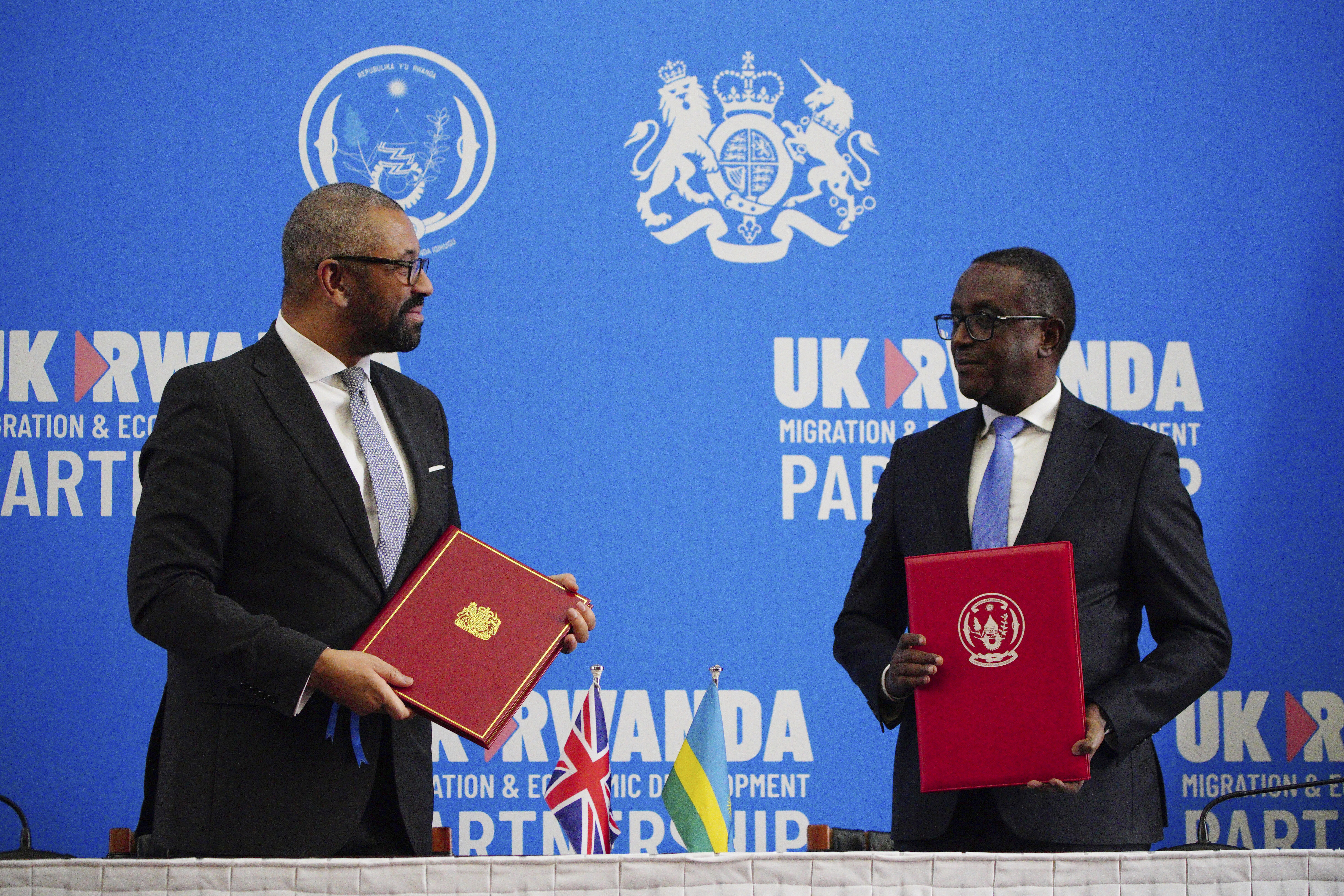

MPs have backed Rishi Sunak’s Rwanda plan as a threatened Tory rebellion fizzled out.
The House of Commons voted 320 to 276 to support the Safety of Rwanda Bill, which the prime minister says will see deportation flights to the east African country finally get off the ground.
The result will come as a huge relief to the PM, who last night suffered his biggest rebellion since entering Downing Street.
Advertisement
Around 60 MPs defied the Tory whip to back amendments aimed at toughening up the legislation to allow ministers to ignore European court rulings and make it more difficult for asylum seekers to appeal against deportation.
However, just 11 of them voted against the entire bill this evening, handing the government a comfortable majority of 44.
The bill will now go to the House of Lords, where it may be amended by opponents of the Rwanda policy, before it returns to the Commons.
That could potentially set up a fresh battle after the rebel Tories said they would then table a fresh set of amendments to toughen it up again.
Advertisement
Sunak hopes that once it is on the statute books, the new law will allow flights to Rwanda to take off in the spring and form a key part of his pledge to “stop the boats” carrying asylum seekers across the Channel.
However, any deportations are certain to be appealed against, teeing up yet more legal wrangling which would delay the flights once again.
Lib Dem home affairs spokesman Alistair Carmichael said: Tonight is no victory for Rishi Sunak, no matter how he might try to twist it.
“Days of Conservative chaos and infighting has left the prime minister’s authority shot. He has proved again and again that he cannot lead his own party, let alone the country.”


The Conservative Party has faced ridicule after likening Keir Starmer to Bob Odenkirk’s character in the hit US TV show Better Call Saul.
Highlighting the Labour leader’s time as a criminal defence barrister is gearing up to be one of the Tory election attack lines in the run-up to this year’s vote.
Advertisement
At prime minister’s questions on Wednesday, Rishi Sunak raised Starmer’s decision to advise the soon-to-be-banned Islamist group Hizb ut-Tahrir during his legal career.
Labour has said Starmer had been asked to give advice to Hizb ut-Tahri in a legal dispute between the group and the German government.
He did not formally represent them, moving on to become director of public prosecutions shortly after, they said.
But the Conservative party later doubled down on the messaging, putting out a message on social media that brought Saul Goodman – the notorious fictional criminal lawyer played by Odenkirk – into play.
Advertisement
It read: “Are you a terrorist in need of legal advice? Better call Keir.”
The post from the Tories on X, formerly Twitter, also said: “When Rishi Sunak sees a group chanting jihad on our streets, he bans them. Keir Starmer invoices them.”
But the attempt to undermine Starmer was soon disparaged – with many pointing out that lawyers may not withhold their services based on a client’s conduct, opinions or beliefs, and that somehow the Tories have even managed to boost Starmer’s image.
And a community note attached to the post added that Starmer “went on to prosecute terrorists with links to Hizb ut-Tahrir as director of public prosecutions”, and continued: “There’s is no evidence he invoiced them. Barristers may not withhold services based on a client’s conduct.”
Advertisement
Advertisement


A new review of available evidence suggests video gamers regularly exceed safe sound limits.
Ministers say they will not make a final decision on compensating victims until the report is published.
