Nancy Pelosi’s Husband Assaulted Inside Their Home

An attacker broke into the San Francisco home of House Speaker Nancy Pelosi and assaulted her husband with a hammer, police said Friday.

San Francisco Police Chief Bill Scott said officers arrived at Pelosi’s house for a “well-being check” at around 2:27 am, where they saw Paul Pelosi and an adult male both holding a hammer.

“The suspect pulled the hammer away from Mr Pelosi and violently assaulted him with it,” Scott said. “Our officers immediately tackled the suspect, disarmed him, took him into custody, requested emergency backup, and rendered medical aid.”

Scott identified the suspect as a 42-year-old named David DePape. The man will be charged with attempted homicide, assault with a deadly weapon, elder abuse and burglary.

Both Pelosi and DePape were taken to a hospital, Scott said.

“Mr Pelosi was admitted to Zuckerberg San Francisco General Hospital where he underwent successful surgery to repair a skull fracture and serious injuries to his right arm and hands,” Pelosi’s office said later on Friday. “His doctors expect a full recovery.”

DePape entered the home looking for the speaker, a source briefed on the assault told HuffPost, but she wasn’t there. Before the attack, the intruder confronted Paul Pelosi, saying, “Where is Nancy, where is Nancy?”

It’s eerily similar to what a Donald Trump supporter chanted as a mob searched for Nancy Pelosi during the siege of the U.S. Capitol on January 6, 2021. Rioters ransacked the speaker’s office that day.

DePape’s internet presence suggests an obsession with far-right conspiracy theories, and some Democrats quickly condemned Republicans for the attack.

“Now is not a moment for timidity. Let’s be direct. Today’s violence seems to be the direct product of Big Lies from many Republicans and Republican propaganda organs about Democrats and American democracy,” representative Bill Pascrell said in a release.

“Turn on rightwing media on any given day or night. You will see frothing hosts shrieking unspeakable lies and unfounded conspiracy theories about women, religious and ethnic minorities, city residents, young people, and scores of others Americans,” Pascrell said.

The US Capitol Police announced that they and the Federal Bureau of Investigation are helping San Francisco police investigate the attack.

Senate Majority Leader Chuck Schumer called the attack “a dastardly act.” The White House said President Joe Biden called Nancy Pelosi to express support. House Minority Leader Kevin McCarthy also reached out to the speaker, NBC News reported.

The attack comes amid heightened concerns over both crime and political violence. Within minutes of Pelosi’s statement, a Fox News host described the attack as an example of how “crime hits everybody”.

Democratic representative Jackie Speier, whose district includes part of San Francisco, suggested early on Friday that the attack could be political.

“While the motive is still unknown we know where this kind of violence is sanctioned and modeled,” Speier wrote on Twitter.

Nancy Pelosi is one of the best-known politicians in the country. She is also one of the most vilified Democrats in Republican campaigns, which invoke her name as a symbol of Beltway liberalism.

In August, Paul Pelosi pleaded guilty to misdemeanour charges of driving under the influence. He also has faced scrutiny for his stock trades, and some lawmakers have pushed for a ban on members’ spouses trading stocks.

Years-old blogs that appear to belong to DePape show posts about LSD, Burning Man and quartz crystals. But more recent posts show disturbing signs of right-wing radicalization. Two posts from August 26 of this year read “Pedophile normalization” and “black pilled”, the latter being internet slang for becoming hopelessly nihilistic regarding the government, society or one’s own life. Another post, from August 26, reads, “Hitlery did nothing wrong.”

Others complain about “communist propaganda”. One post, simply labeled “Q” ― an apparent reference to the QAnon conspiracy theory universe ― references a meme about the conspiracy theory involving wealthy pedophiles trafficking children through the furniture website Wayfair.

Another website with posts authored by a David DePape shows him closely following various right-wing political obsessions, like false claims of widespread voter fraud, Justice Department special counsel John Durham’s investigation. Many others show his obsession with “the Jew media”, including a recent post about the war in Ukraine: “The more Ukrainians die NEEDLESSLY the cheaper the land will be for Jews to buy up.”

“This morning’s terrifying attack on Paul Pelosi by a man obsessed with election conspiracies is a dangerous reality encouraged by some members of my own party,” representative Adam Kinzinger wrote Friday.

In earlier years, DePape apparently had other fringe interests.

A 2008 article in The Oakland Tribune noted that DePape and Gypsy Taub, a well-known nudist activist in San Francisco, were hosting a community Thanksgiving meal for hundreds of people.

In 2013, Taub staged a naked wedding to Jaymz Smith on the steps of San Francisco’s city hall. Ahead of the occasion, SF Gate referenced a “David dePappe”, spelled with an extra “p”, who it reported was “a hemp jewelry maker and father figure who will double as best man.”

Matt Shuham, Mollie Reilly, Will Tooke and Paul Blumenthal contributed reporting.

Share Button

Croydon Hospital: Patient tells PM to pay NHS staff more

Rishi Sunak is told he is needs to “try harder” over plans to give pay rises to hospital staff.

Share Button

‘I wouldn’t bring a member of my family to this hospital,’ says medic

Gloucestershire Royal has some of England’s worst ambulance waiting times, with a hard winter to come.

Share Button

Battery-free, light-powered pacemaker may improve quality of life for heart disease patients

Atrial fibrillation — a form of irregular heartbeat, or arrhythmia — leads to more than 454,000 hospitalizations and nearly 160,000 deaths in the United States each year. Globally, it is estimated that approximately 60 million people are affected by the condition.

Pacemakers are lifesaving devices that regulate the heartbeats of people with chronic heart diseases like atrial fibrillation and other forms of arrhythmia. However, pacemaker implantation is an invasive procedure, and the lifesaving pacing the devices provide can be extremely painful. Additionally, pacemakers can only be used to treat a few specific types of disease.

In a paper published Wednesday in Science Advances, a University of Arizona-led team of researchers detail the workings of a wireless, battery-free pacemaker they designed that could be implanted with a less invasive procedure than currently possible and would cause patients less pain. The study was helmed by researchers in the Gutruf Lab, led by biomedical engineering assistant professor and Craig M. Berge Faculty Fellow Philipp Gutruf.

Currently available pacemakers work by implanting one or two leads, or points of contact, into the heart with hooks or screws. If the sensors on these leads detect a dangerous irregularity, they send an electrical shock through the heart to reset the beat.

“All of the cells inside the heart get hit at one time, including the pain receptors, and that’s what makes pacing or defibrillation painful,” Gutruf said. “It affects the heart muscle as a whole.”

The device Gutruf’s team has developed, which has not yet been tested in humans, would allow pacemakers to send much more targeted signals using a new digitally manufactured mesh design that encompasses the entire heart. The device uses light and a technique called optogenetics.

Optogenetics modifies cells, usually neurons, sensitive to light, then uses light to affect the behavior of those cells. This technique only targets cardiomyocytes, the cells of the muscle that trigger contraction and make up the beat of the heart. This precision will not only reduce pain for pacemaker patients by bypassing the heart’s pain receptors, it will also allow the pacemaker to respond to different kinds of irregularities in more appropriate ways. For example, during atrial fibrillation, the upper and lower chambers of the heart beat asynchronously, and a pacemaker’s role is to get the two parts back in line.

“Whereas right now, we have to shock the whole heart to do this, these new devices can do much more precise targeting, making defibrillation both more effective and less painful,” said Igor Efimov, professor of biomedical engineering and medicine at Northwestern University, where the devices were lab-tested. “This technology could make life easier for patients all over the world, while also helping scientists and physicians learn more about how to monitor and treat the disease.”

Flexible mesh encompasses the heart

To ensure the light signals can reach many different parts of the heart, the team created a design that involves encompassing the organ, rather than implanting leads that provide limited points of contact.

The new pacemaker model consists of four petallike structures made of thin, flexible film, which contain light sources and a recording electrode. The petals, specially designed to accommodate the way the heart changes shape as it beats, fold up around the sides of the organ to envelop it, like a flower closing up at night.

“Current pacemakers record basically a simple threshold, and they will tell you, ‘This is going into arrhythmia, now shock!'” Gutruf said. “But this device has a computer on board where you can input different algorithms that allow you to pace in a more sophisticated way. It’s made for research.”

Because the system uses light to affect the heart, rather than electrical signals, the device can continue recording information even when the pacemaker needs to defibrillate. In current pacemakers, the electrical signal from the defibrillation can interfere with recording capabilities, leaving physicians with an incomplete picture of cardiac episodes. Additionally, the device does not require a battery, which could save pacemaker patients from needing to replace the battery in their device every five to seven years, as is currently the norm.

Gutruf’s team collaborated with researchers at Northwestern University on the project. While the current version of the device has been successfully demonstrated in animal models, the researchers look forward to furthering their work, which could improve the quality of life for millions of people.

Share Button

Factors influencing bike share among underserved populations: Evidence from three US cities

Researchers Jennifer Dill, Jiahui Ma, Nathan McNeil, Joseph Broach and John MacArthur of Portland State University have published a new article in the November 2022 issue of Transportation Part D: Transport and Environment. The open-access article, “Factors influencing bike share among underserved populations: Evidence from three U.S. cities,” examines bike share use and interest among lower-income residents and people of color in New York, Chicago, and Philadelphia.

There is evidence that lower-income and people of color (POC) in the U.S. do not use bike share as much as higher-income and white people. Using data from residents living near bike share stations in New York, Chicago, and Philadelphia, the paper examines reasons for these disparities. Researchers looked at many factors that might explain bike share use and interest in lower-income, racially diverse, traditionally underserved neighborhoods. They focused on residents who live near bike share stations, so that proximity would not be a barrier.

A few key findings:

  1. People who are not members, but are interested in using bike share, including POC, are motivated to use bike share for fun, recreation, and social reasons (as opposed to utility).
  2. Knowledge of bike share and receiving information from interactive sources (for example, bike share ambassadors) are associated with bike share use.
  3. Cost is a barrier for people who are interested in using bike share, but are not members. Discounted memberships are one solution, but survey results indicate that many people do know know about them.

Some reasons for not using bike share among people of color and lower-income people may also be related to reasons for not bicycling, generally. These include concerns about traffic safety as well as personal safety.

This paper is an analysis of data collected in a “Breaking Barriers to Bike Share” project funded by the National Institute for Transportation and Communities (NITC) and the Better Bike Share Partnership (BBSP). Read more about the original study and explore some of the products to come out of this research, including a set of ten bike share equity briefs to help operators establish equity programs based on what’s been shown to work.

Portland State University’s Transportation Research and Education Center (TREC) is home to the U.S. DOT funded National Institute for Transportation and Communities (NITC), the Initiative for Bicycle and Pedestrian Innovation (IBPI), PORTAL, BikePed Portal and other transportation grants and programs. We produce impactful research and tools for transportation decision makers, expand the diversity and capacity of the workforce, and engage students and professionals through education and participation in research.

Story Source:

Materials provided by Portland State University. Note: Content may be edited for style and length.

Share Button

Eddie Izzard Accuses MPs Of ‘Bullying’ Over ‘Transphobic’ Comments

Eddie Izzard has accused two MPs of “bullying” after they made “transphobic” comments about the comedian, who is campaigning to become a Labour election candidate.

The 60-year-old, launched her bid this month to become Sheffield Central’s MP, told people to “join the 21st century”.

Izzard, who has many connections to Sheffield, having studied accounting, launched her creative career and carried out local activism there, said the city needs “to be bolder, brighter, stronger… on the map”.

Speaking to the PA news agency on Thursday, she said she has been getting “a great reaction in the street” during her campaign but a small minority of people have made transphobic comments.

Earlier this week, Conservative MP Lee Anderson said he “would not follow him into the toilets” if she came to parliament, while Labour MP Rosie Duffield said: “I’m not calling Eddie Izzard a woman.”

In response, Izzard said: “Some people aren’t up to speed, some people haven’t joined the 21st century and, well, they’ve got to get on the bus now because I’ve been out for so long now that I don’t know why they didn’t bring this up before.

“It’s different now that I’m going for a parliamentary seat, but I don’t think bullying is a great thing to be happening and so I’m just going to carry on.”

Addressing Duffield’s comments directly, she said: “Transphobic attitudes come from all different quarters, unfortunately.”

She added that the Labour MP’s comments did not make her feel unwelcome to run as a candidate for the party, but added: “Again, join the 21st century – trans people exist. I exist.”

Izzard said she hopes that being elected will have a “positive impact” for diversity in parliament and for Sheffield Central itself as she brings her global renown, activism and energy to the constituency.

“The fact that I’m trans is kind of by the by,” she said, adding that she “absolutely” thinks people should be focusing on her policies and vision for Sheffield Central.

Izzard is running after the constituency’s incumbent, Paul Blomfield, announced he would be standing down at the next general election.

On Labour’s election prospects, Izzard said new prime minister Rishi Sunak could pose more of a threat and that the party needs to get behind leader Sir Keir Starmer.

“I think it’s going to be tougher for us rather than having Liz Truss in there, but it doesn’t matter,” she said.

“We’re at a certain place in the polls and we’ve got to carry on fighting, and I’m very passionate about getting Keir Starmer in.”

Izzard said she has supported “every Labour leader going”, before stressing the importance of uniting behind a leader to get into government.

“You have to support the leader – that is how it works in politics – and we’re a broad church,” she said.

“We need to be near left and further left – we might agree or disagree on some things but we’re heading in the same direction.”

Share Button

NASA’s InSight lander detects stunning meteoroid impact on Mars

The agency’s lander felt the ground shake during the impact while cameras aboard the Mars Reconnaissance Orbiter spotted the yawning new crater from space.

NASA’s InSight lander recorded a magnitude 4 marsquake last Dec. 24, but scientists learned only later the cause of that quake: a meteoroid strike estimated to be one of the biggest seen on Mars since NASA began exploring the cosmos. What’s more, the meteoroid excavated boulder-size chunks of ice buried closer to the Martian equator than ever found before — a discovery with implications for NASA’s future plans to send astronauts to the Red Planet.

Scientists determined the quake resulted from a meteoroid impact when they looked at before-and-after images from NASA’s Mars Reconnaissance Orbiter (MRO) and spotted a new, yawning crater. Offering a rare opportunity to see how a large impact shook the ground on Mars, the event and its effects are detailed in two papers published Thursday, Oct. 27, in the journal Science.

The meteoroid is estimated to have spanned 16 to 39 feet (5 to 12 meters) — small enough that it would have burned up in Earth’s atmosphere, but not in Mars’ thin atmosphere, which is just 1% as dense as our planet’s. The impact, in a region called Amazonis Planitia, blasted a crater roughly 492 feet (150 meters) across and 70 feet (21 meters) deep. Some of the ejecta thrown by the impact flew as far as 23 miles (37 kilometers) away.

With images and seismic data documenting the event, this is believed to be one of the largest craters ever witnessed forming any place in the solar system. Many larger craters exist on the Red Planet, but they are significantly older and predate any Mars mission.

“It’s unprecedented to find a fresh impact of this size,” said Ingrid Daubar of Brown University, who leads InSight’s Impact Science Working Group. “It’s an exciting moment in geologic history, and we got to witness it.”

InSight has seen its power drastically decline in recent months due to dust settling on its solar panels. The spacecraft now is expected to shut down within the next six weeks, bringing the mission’s science to an end.

InSight is studying the planet’s crust, mantle, and core. Seismic waves are key to the mission and have revealed the size, depth, and composition of Mars’ inner layers. Since landing in November 2018, InSight has detected 1,318 marsquakes, including several caused by smaller meteoroid impacts.

But the quake resulting from last December’s impact was the first observed to have surface waves — a kind of seismic wave that ripples along the top of a planet’s crust. The second of the two Science papers related to the big impact describes how scientists use these waves to study the structure of Mars’ crust.

Crater Hunters

In late 2021, InSight scientists reported to the rest of the team they had detected a major marsquake on Dec. 24. The crater was first spotted on Feb. 11, 2022, by scientists working at Malin Space Science Systems (MSSS), which built and operates two cameras aboard MRO. The Context Camera (CTX) provides black-and-white, medium-resolution images, while the Mars Color Imager (MARCI) produces daily maps of the entire planet, allowing scientists to track large-scale weather changes like the recent regional dust storm that further diminished InSight’s solar power.

The impact’s blast zone was visible in MARCI data that allowed the team to pin down a 24-hour period within which the impact occurred. These observations correlated with the seismic epicenter, conclusively demonstrating that a meteoroid impact caused the large Dec. 24 marsquake.

“The image of the impact was unlike any I had seen before, with the massive crater, the exposed ice, and the dramatic blast zone preserved in the Martian dust,” said Liliya Posiolova, who leads the Orbital Science and Operations Group at MSSS. “I couldn’t help but imagine what it must have been like to witness the impact, the atmospheric blast, and debris ejected miles downrange.”

Establishing the rate at which craters appear on Mars is critical for refining the planet’s geologic timeline. On older surfaces, such as those of Mars and our Moon, there are more craters than on Earth; on our planet, the processes of erosion and plate tectonics erase older features from the surface.

New craters also expose materials below the surface. In this case, large chunks of ice scattered by the impact were viewed by MRO’s High-Resolution Imaging Science Experiment (HiRISE) color camera.

Subsurface ice will be a vital resource for astronauts, who could use it for a variety of needs, including drinking water, agriculture, and rocket propellant. Buried ice has never been spotted this close to the Martian equator, which, as the warmest part of Mars, is an appealing location for astronauts.

More About the Missions

JPL manages InSight and the Mars Reconnaissance Orbiter for NASA’s Science Mission Directorate. InSight is part of NASA’s Discovery Program, managed by the agency’s Marshall Space Flight Center in Huntsville, Alabama. Lockheed Martin Space in Denver built the Mars Reconnaissance Orbiter, InSight spacecraft (including its cruise stage and lander), and supports spacecraft operations for both missions.

Malin Space Science Systems in San Diego built and operates the Context Camera and MARCI camera. University of Arizona built and operates the HiRISE camera.

A number of European partners, including France’s Centre National d’Études Spatiales (CNES) and the German Aerospace Center (DLR), are supporting the InSight mission. CNES provided the Seismic Experiment for Interior Structure (SEIS) instrument to NASA, with the principal investigator at IPGP (Institut de Physique du Globe de Paris). Significant contributions for SEIS came from IPGP; the Max Planck Institute for Solar System Research (MPS) in Germany; the Swiss Federal Institute of Technology (ETH Zurich) in Switzerland; Imperial College London and Oxford University in the United Kingdom; and JPL. DLR provided the Heat Flow and Physical Properties Package (HP3) instrument, with significant contributions from the Space Research Center (CBK) of the Polish Academy of Sciences and Astronika in Poland. Spain’s Centro de Astrobiología (CAB) supplied the temperature and wind sensors, and the Italian Space Agency (ASI) supplied a passive laser retroreflector.

Share Button

Rishi Sunak Blasted For Skipping Cop27 Climate Summit After Environmental Snubs

Rishi Sunak’s climate credentials have come under question after backing out of attending the Cop27 climate summit days after giving the environment a smaller billing in his government.

The new prime minister has been accused of a “massive failure of leadership” after it was confirmed he will skip the United Nations conference in Egypt next month.

Liz Truss was set to attend the high-profile event in Sharm El-Sheikh but Downing Street said on Thursday that Sunak would instead focus on “pressing domestic commitments”.

No 10 also confirmed the demotion of the position of environment minister as Graham Stuart was reappointed to the role but stripped of his entitlement to attend cabinet.

Cop26 president Alok Sharma also lost his seat around Sunak’s cabinet this week.

Downing Street insisted the PM remains “absolutely committed” to supporting the climate conference hosted in Glasgow last year, denying he was downgrading the importance of tackling the climate crisis.

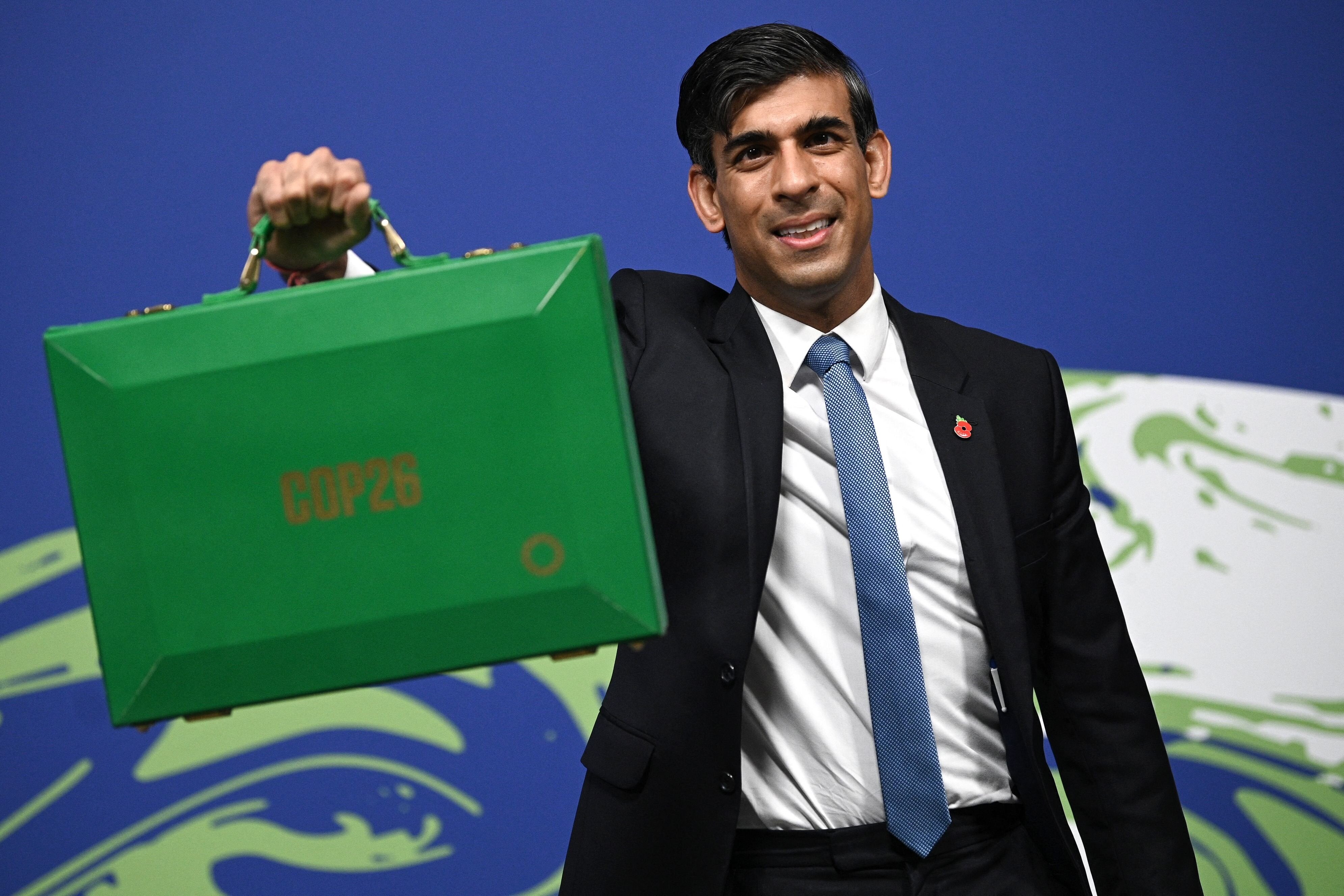
Last year when Sunak was chancellor, he arrived at the summit bearing a green version of the traditionally red budget briefcase wielded by the finance minister.

Labour’s shadow climate change secretary Ed Miliband said: “This is a massive failure of climate leadership. We were the Cop26 hosts and now the UK prime minister isn’t even bothering to turn up to Cop27.

“What Rishi Sunak obviously fails to understand is that tackling the climate crisis isn’t just about our reputation and standing abroad, but the opportunities for lower bills, jobs, and energy security it can deliver at home.”

Green MP Caroline Lucas said “shame on” Sunak, adding: “The first test of leadership is to turn up. The new PM’s decision not to attend Cop27 makes a mockery of any government claims on continued climate leadership – and what a shameful way to end the UK’s Cop presidency.”

Rebecca Newsom, the head of politics at Greenpeace UK, said the move suggests Sunak does not take climate change “seriously enough”.

“The UK Government is supposed to hand over the Cop presidency to their Egyptian counterparts at next month’s summit. For Rishi Sunak not to show up is like a runner failing to turn up with the baton at a crucial stage of the relay,” she added.

A Downing Street spokeswoman said Sunak was focusing on domestic issues including preparations for the autumn budget, which has been delayed from Monday to November 17.

“The prime minister is not expected to attend Cop27 and this is due to other pressing domestic commitments including preparations for the autumn budget,” she told reporters.

She said the UK will be “fully represented” by Sharma and “other senior ministers”.

“We remain committed to net zero and to leading international and domestic action to tackle climate change. The UK is forging ahead of many other countries on net zero,” she said.

“We will obviously continue to work closely with Egypt as the hosts of Cop27 and to make sure that all countries are making progress on the historic commitments they made at the Glasgow climate pact.”

Share Button

Wes Streeting Says He Is ‘Sick And Tired’ Of Being Asked If He Wants To Be Labour Leader

Labour’s Wes Streeting has said he is “sick and tired” of being asked whether he wants to succeed Keir Starmer as the party’s next leader.

The shadow health secretary, a rising star within Labour, has long been tipped as a potential future leader.

But dismissing the speculation, Streeting said he would be “too old” to take on the job by the time Starmer had finished being prime minister if Labour wins the next election.

Speaking to reporters at a lunch in Westminster, Streeting said: “I really thought that when we got to a point where we were 30 points ahead in the polls these questions would just stop.

“I’m sick and tired of them. I’ll be far too old by the time Keir is finishing being prime minister. They’ll be looking to new fresh faces and a new generation.

“I already have a leadership role with the Labour Party — I have a big job to do, a serious job to do.

“And if I look back on my career in politics, as the secretary of state of health and social care, who gripped the worst crisis in the history of the NHS, and put it on a footing that makes it fit for the future so people look back on that in the way people that back on Bevan, I will have more than achieved my ambitions in politics and be very happy with the career I’ve had.”

Streeting was speaking as Labour continues to enjoy a near 30-point lead in the polls following the chaos sparked by the mini budget and Liz Truss’s downfall as prime minister.

However, the election of Rishi Sunak as party leader has given the Conservatives a small bounce in the polls, with support for the Tories up for points to 23%, while Labour has dropped five points to 51%.

There are some fears within Labour that Sunak’s serious approach to fixing the economy could persuade voters to stick with the party.

But the shadow health secretary said Sunak was “one of many Conservative chancellors that have saddled our country with more than a decade of failed economic policies”.

He painted a stark contrast between the Tories and Labour, saying that while his party had “changed substantially at every level”, the Tories had made some “very questionable choices in leadership elections”.

“In the Labour Party, the cranks have been kicked out or have left. In the Conservative Party, the cranks are sat around the Cabinet table,” he said.

And in a swipe at Sunak’s controversial decision to reappoint Suella Braverman as home secretary just days after she was sacked by Truss for a serious security breach, Streeting said: “He [Starmer] seeks unity, but unlike Rishi Sunak he prizes unity with and for the interests of the country, above appeasing factions within his own party.”

Streeting welcomed the fact that Sunak is the UK’s first Asian prime minister, calling it a “cause for celebration”, but said Labour was “ready to take him on”.

Sunak cannot tackle the cost of living crisis “because he has fuelled the cost of living crisis,” Streeting went on.

“I don’t care that Rishi Sunak was privately educated, or that he’s hugely wealthy.

“I do care that he’s dangerously out of touch, making decisions about people whose lives he has never lived and whose lives he will never understand — decisions that are making them poorer, not richer.

“Ideological dogma may have crashed the economy with the mini budget, but more than a decade of failed Conservative economic policies have left working people paying the price.”

Share Button

Warning over private over-the-counter blood tests

Doctors are concerned the tests can put extra pressures on GPs and cause anxiety for patients.

Share Button