A Financial Times Journalist’s Takedown Of The Government’s Excuse For Chaos Is Truly Brilliant

A Financial Times journalist has offered a withering assessment of the government’s suggestion that the Bank of England is to blame for the recent chaos in the markets.

On Tuesday, business secretary Jacob Rees-Mogg suggested the central bank’s failure to raise interest rates in line with the US was driving the financial turmoil rather than chancellor Kwasi Kwarteng’s mini-budget.

But Gillian Tett, the FT journalist who made her name for her prescient commentary on the 2008 financial crash, has said – bluntly – that this was really not the case.

Appearing on Channel 4 News, and asked for a verdict, Tett said: “To use a non-technical term, that is pretty much bullocks.

“I think for the most part it really was the budget and the way it was delivered and the message inside, which sparked the beginning of the crisis.

“The Bank of England certainly is to blame for not having prepared for these kinds of dislocations. The British pension funds appear to have been somewhat asleep at the wheel in terms of their risk management systems.

“But at the end of day, the spark that lit this fire was very much the budget announcement.”

Earlier, Rees-Mogg argued the market response was “much more to do with interest rates than it is to do with a minor part of fiscal policy”.

On September 22 the Bank’s Monetary Policy Committee (MPC) raised rates by 0.5 percentage points to 2.25%, but the day before the Federal Reserve raised rates by 0.75 percentage points.

But economists insisted that the government’s decision to increase borrowing without any plan to balance the books was a major factor.

The cost of government borrowing increased on Wednesday while sterling fell against the euro and dollar in the latest signs of market turbulence.

Share Button

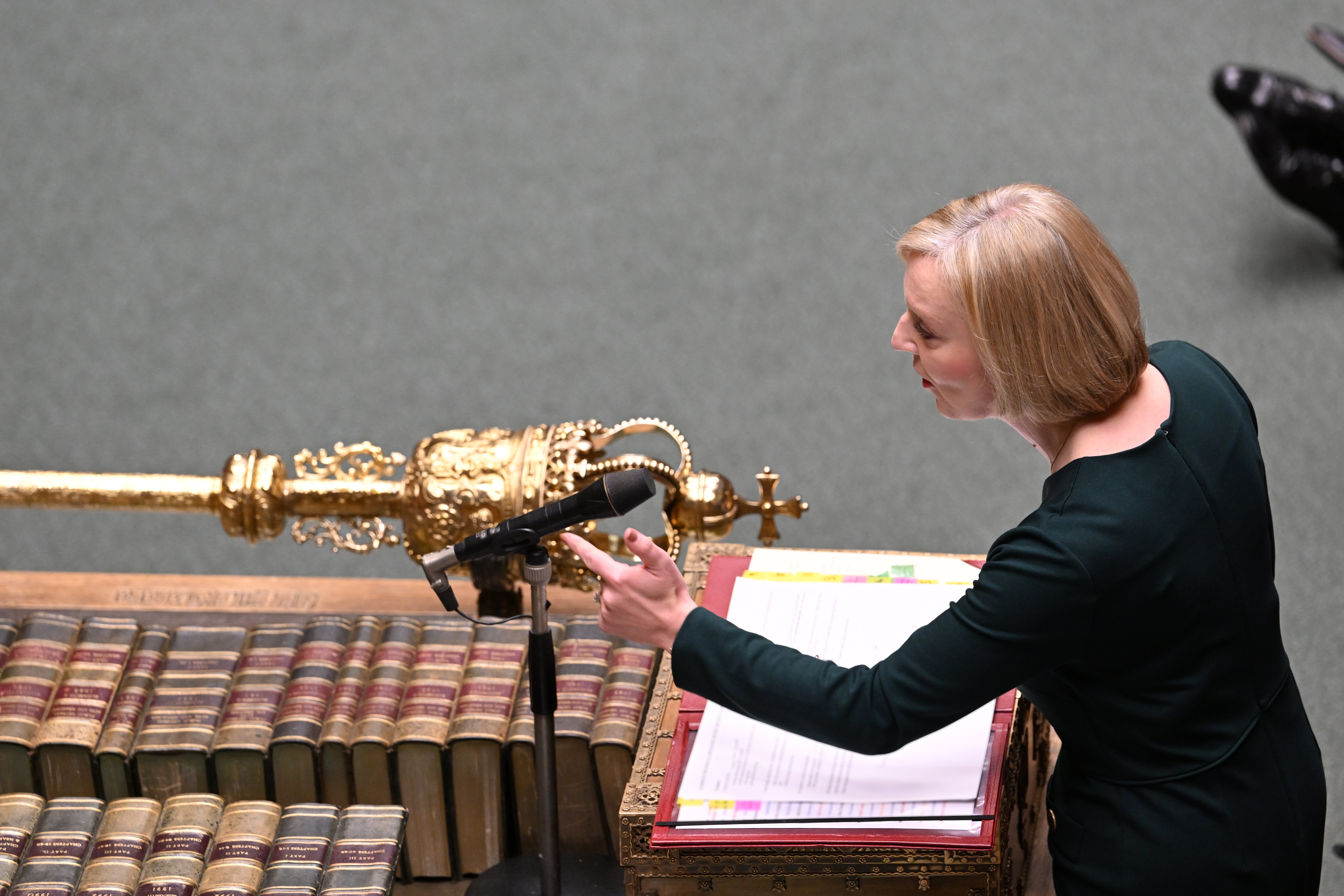
Tory MPs Attack ‘Wooden’ Liz Truss After Disastrous Commons Showdown

Liz Truss has been savaged by Tory MPs after a disastrous meeting with her backbenchers.

In a bid to win over her mutinous MPs, Truss on Wednesday evening addressed the Tory backbench 1922 Committee, including high-profile critics Michael Gove and Grant Shapps.

But one MP described her performance as “crap” while another told HuffPost UK she was “wooden”.

The showdown in Commitee Room 14 of the House of Commons came as the economic chaos sparked by Kwasi Kwarteng’s mini-budget continued.

Truss told the MPs present that the government’s energy price guarantee would protect households and businesses from soaring bills this winter.

She called on her colleagues to “highlight the devastation that would have been caused to small business had we not acted”.

But her attempts to win over her own MPs failed, with one telling HuffPost UK that almost all of the questions she was asked were critical of the government.

One said: “She was crap and the atmosphere was pretty flat in the room. Even the whips couldn’t be bothered getting people to ask supportive questions.”

One backbencher said her remaining supporters were “libertarian Jihadists who are wrecking the party”.

Former minister Robert Halfon, the Tory MP for Harlow, told Truss she had “trashed blue collar conservatism” by weakening the government’s commitment to affordable housing and lifting the cap on bankers’ bonuses.

Another MP said: “I would say it was worse than anything Theresa May ever faced when she was leader.

“What was really noticeable was the failure of the whips to organise a Praetorian guard of supporters around her. There was only one mildly supportive question and the rest were hostile.

“There was clapping on tables when the government’s policies were criticised and groans when the PM was giving an answer on interest rates and saying they were going up around the world. Try telling that to voters who are seeing their mortgages go up.”

The MP added: “She was wooden, cardboard, lacking in empathy. It’s very bleak.

“It felt very sombre and the mood was a bit like ’what’s going to happen next to bring this to a conclusion?”

The meeting capped another difficult day for the prime minister after she endured a tough prime minister’s questions in which she stunned MPs by declaring she would not impose any spending cuts to pay for the government’s tax giveaways.

Share Button

Jamie Lee Curtis Slams Popular Cosmetic Procedure: ‘You Look Like A Plastic Figurine’

Sure, Michael Myers is terrifying — but aging shouldn’t be.

Or at least that was the message Jamie Lee Curtis tried to convey while speaking to “Today” last week.

The “Halloween Ends” star, 63, shared her thoughts about getting older and the wisdom she’s gained since turning 60 — which included going under the knife.

“I did plastic surgery. I put Botox in my head,” Curtis said. “Does Botox make the big wrinkle go away? Yes. But then you look like a plastic figurine.”

Due to her experiences of succumbing to beauty standards, Curtis says that she always tells her daughters, Annie and Ruby, to keep one rule in mind: “Don’t mess with your face.”

Curtis in 1992.
Curtis in 1992.

Pool BENAINOUS/DUCLOS via Getty Images

And although the actor — who rose to fame at age 19 with her role as Laurie Strode in John Carpenter’s 1978 classic “Halloween” and has been highly visible ever since — could empathize with the appeal of turning back the clock, she insists that getting cosmetic procedures isn’t worth it.

“Walk a mile in my shoes,” she said. “I have done it. It did not work. And all I see is people now focusing their life on that.”

Curtis has never shied away from her thoughts on aging or cosmetic procedures, and has also spoken candidly about how her experiences with plastic surgery led to a yearslong drug addiction.

She explained to Variety in 2019 that she began getting plastic surgery after a cameraman once refused to shoot her because her eyes were “too puffy” on film.

“I was so mortified and so embarrassed and had just so much shame about it that after that movie, I went and had routine plastic surgery to remove the puffiness,” Curtis told the outlet. “They gave me Vicodin as a painkiller for something that wasn’t really painful.”

Curtis, who has been sober for over 20 years now, has also spoken about embracing her body as it is — and how empowering it has been.

In March, she revealed a photo of her character in “Everything Everywhere All at Once” on Instagram. In the photo, her character sits with her belly proudly on display. Curtis explained in her post that she gave a very specific idea of how she wanted her character to be styled in the film: “I want there to be no concealing of anything.”

“I’ve been sucking my stomach in since I was 11, when you start being conscious of boys and bodies, and the jeans are super tight,” Curtis wrote in her post. “I very specifically decided to relinquish and release every muscle I had that I used to clench to hide the reality. That was my goal. I have never felt more free creatively and physically.”

Share Button

Black people more likely to develop dementia, large study finds

A mix of factors are at play and greater awareness is needed, the researchers say.

Share Button

Human brain cells in a dish learn to play Pong in real time

Human and mouse neurons in a dish learned to play the video game Pong, researchers report October 12 in the journal Neuron. The experiments are evidence that even brain cells in a dish can exhibit inherent intelligence, modifying their behavior over time.

“From worms to flies to humans, neurons are the starting block for generalized intelligence,” says first author Brett Kagan (@ANeuroExplorer), chief scientific officer at Cortical Labs in Melbourne, Australia. “So, the question was, can we interact with neurons in a way to harness that inherent intelligence?”

To start, the researchers connected the neurons to a computer in such a way where the neurons received feedback on whether their in-game paddle was hitting the ball. They monitored the neuron’s activity and responses to this feedback using electric probes that recorded “spikes” on a grid.

The spikes got stronger the more a neuron moved its paddle and hit the ball. When neurons missed, their playstyle was critiqued by a software program created by Cortical Labs. This demonstrated that the neurons could adapt activity to a changing environment, in a goal-oriented way, in real time.

“We chose Pong due to its simplicity and familiarity, but, also, it was one of the first games used in machine learning, so we wanted to recognize that,” says Kagan, who worked with collaborators from 10 other institutions on the project.

“An unpredictable stimulus was applied to the cells, and the system as a whole would reorganize its activity to better play the game and to minimize having a random response,” he says. “You can also think that just playing the game, hitting the ball and getting predictable stimulation, is inherently creating more predictable environments.”

The theory behind this learning is rooted in the free-energy principle. Simply put, the brain adapts to its environment by changing either its world view or its actions to better fit the world around it.

Pong wasn’t the only game the research team tested. “You know when the Google Chrome browser crashes and you get that dinosaur that you can make jump over obstacles (Project Bolan). We’ve done that and we’ve seen some nice preliminary results, but we still have more work to do building new environments for custom purposes,” says Kagan.

Future directions of this work have potential in disease modeling, drug discoveries, and expanding the current understanding of how the brain works and how intelligence arises.

“This is the start of a new frontier in understanding intelligence,” Kagan says. “It touches on the fundamental aspects of not only what it means to be human but what it means to be alive and intelligent at all, to process information and be sentient in an ever changing, dynamic world.”

Story Source:

Materials provided by Cell Press. Note: Content may be edited for style and length.

Share Button

Dust plumes observed being ‘pushed’ into interstellar space by intense starlight

The results, made using infrared images of the binary star system WR140 taken over 16 years, are reported in the journal Nature.

In a complementary study of WR140, published in Nature Astronomy, NASA’s James Webb Space Telescope (JWST) was able to see much deeper to snap an image of not just a single accelerating dust plume, but almost 20 of them, nested inside each other like a giant set of onion skins.

WR140 is comprised of a huge Wolf-Rayet star and an even bigger blue supergiant star, gravitationally bound in an eight-year orbit. This binary star, in the Cygnus constellation, has been monitored for two decades with one of the world’s largest optical telescopes at the Keck Observatory in Hawaii.

WR140 episodically puffs out plumes of dust stretching thousands of times the distance from the Earth to the Sun. These dust plumes, produced every eight years, give astronomers a unique opportunity to observe how starlight can affect matter.

It’s known that light carries momentum, exerting a push on matter known as radiation pressure. Astronomers often witness the outcome of this phenomenon in the form of matter coasting at high speed around the cosmos, but it’s been a difficult process to catch in the act. Direct recording of acceleration due to forces other than gravity is rarely witnessed, and never in a stellar environment like this.

“It’s hard to see starlight causing acceleration because the force fades with distance, and other forces quickly take over,” said Yinuo Han from Cambridge’s Institute of Astronomy, first author of the Nature paper. “To witness acceleration at the level that it becomes measurable, the material needs to be reasonably close to the star or the source of the radiation pressure needs to be extra strong. WR140 is a binary star whose ferocious radiation field supercharges these effects, placing them within reach of our high-precision data.”

All stars generate stellar winds, but those from Wolf-Rayet stars can be more like a stellar hurricane. Elements such as carbon in the wind condense out as soot, which remains hot enough to glow bright in the infrared. Like smoke in the wind, this gives telescopes something that can be observed.

The team used an imaging technology known as interferometry which was able to act like a zoom lens for the 10-metre Keck telescope mirror, enabling the researchers to recover sufficiently sharp images of WR140 for the study.

Han and his team found that the dust does not stream out from the star with the wind in a hazy ball. Instead, the dust forms where the winds from the two stars collide, on the surface of a cone-shaped shock front between them.

Because the orbiting binary star is in constant motion, the shock front also rotates. The sooty plume gets wrapped into a spiral, in the same way that droplets form a spiral in a garden sprinkler.

The researchers found that WR140 has other tricks up its sleeve. The two stars are not on circular but rather elliptical orbits, and dust production turns on and off as the binary nears and departs the point of closest approach. By modelling these effects into the three-dimensional geometry of the dust plume, the astronomers were able to measure to location of dust features in three-dimensional space.

“Like clockwork, this star puffs out sculpted smoke rings every eight years, with all this wonderful physics written then inflated in the wind like a banner for us to read,” said co-author Professor Peter Tuthill from the University of Sydney. “Eight years later as the binary returns in its orbit, another appears the same as the one before, streaming out into space inside the bubble of the previous one, like a set of giant nested Russian dolls.”

Because the dust produced by this Wolf-Rayet is so predictable and expands to such large distances, it offered the astronomers a unique laboratory to examine the acceleration zone.

“In the absence of external forces, each dust spiral should expand at a constant speed,” said Han, who is also a co-author on the JWST paper. “We were puzzled at first because we could not get our model to fit the observations, until we finally realised that we were seeing something new. The data did not fit because the expansion speed wasn’t constant, but rather that it was accelerating. We’d caught that for the first time on camera.”

“In one sense, we always knew this must be the reason for the outflow, but I never dreamed we’d be able to see the physics at work like this,” said Tuthill. “When I look at the data now, I see WR140’s plume unfurling a like giant sail made of dust. When it catches the photon wind streaming from the star, like a yacht catching a gust, it makes a sudden leap forward.”

With JWST now in operation, researchers can learn much more about WR140 and similar systems. “The Webb telescope offers new extremes of stability and sensitivity,” said Ryan Lau who led the JWST study. “We’ll now be able to make observations like this much more easily than from the ground, opening a new window into the world of Wolf-Rayet physics.”

The research was funded in part by the Gates Cambridge Trust.

Share Button

Physicists probe ‘astonishing’ morphing properties of honeycomb-like material

A series of buzzing, bee-like “loop-currents” could explain a recently discovered, never-before-seen phenomenon in a type of quantum material. The findings from researchers at the University of Colorado Boulder may one day help engineers to develop new kinds of devices, such as quantum sensors or the quantum equivalent of computer memory storage devices.

The quantum material in question is known by the chemical formula Mn3Si2Te6. But you could also call it “honeycomb” because its manganese and tellurium atoms form a network of interlocking octahedra that look like the cells in a beehive.

Physicist Gang Cao and his colleagues at CU Boulder synthesized this molecular beehive in their lab in 2020, and they were in for a surprise: Under most circumstances, the material behaved a lot like an insulator. In other words, it didn’t allow electric currents to pass through it easily. When they exposed the honeycomb to magnetic fields in a certain way, however, it suddenly became millions of times less resistant to currents. It was almost as if the material had morphed from rubber into metal.

“It was both astonishing and puzzling,” said Cao, professor in the Department of Physics and corresponding author of the new study. “Our follow-up effort in pursuing a better understanding of the phenomena led us to even more surprising discoveries.”

Now, he and his colleagues think they can explain that astonishing behavior. The group, including several graduate students at CU Boulder, published its most recent results on Nov. 17 in the journal Nature.

Drawing on experiments in Cao’s lab, the group reports that, under certain conditions, the honeycomb is abuzz with tiny, internal currents known as chiral orbital currents, or loop currents. Electrons zip around in loops within each of the octahedra in this quantum material. Since the 1990s, physicists have theorized that loop currents could exist in a handful of known materials, such as high-temperature superconductors, but they have yet to directly observe them.

Cao said they could be capable of driving startling transformations in quantum materials like the one he and his team stumbled on.

“We’ve discovered a new quantum state of matter,” Cao said. “Its quantum transition is almost like ice melting into water.”

Colossal changes

The study homes in on a strange property in physics called colossal magnetoresistance (CMR).

In the 1950s, physicists realized that if they exposed certain types of materials to magnets that generate a magnetic polarization, they could make those materials undergo a shift — causing them to switch from insulators to more wire-like conductors. Today, this technology shows up in computer disk drives and many other electronic devices where it helps to control and shuttle electric currents along distinct paths.

The honeycomb in question, however, is vastly different from those materials — the CMR occurs only when conditions avoid that same kind of magnetic polalrization. The shift in electrical properties is also much more extreme than what you can see in any other known CMR material, Cao added.

“You have to violate all the conventional conditions to achieve this change,” Cao said.

Melting ice

He and his colleagues, including CU Boulder graduate students Yu Zhang, Yifei Ni and Hengdi Zhao, wanted to find out why.

They, along with co-author Itamar Kimchi of Georgia Institute of Technology, hit on the idea of loop currents. According to the team’s theory, countless electrons circulate around inside their honeycombs at all times, tracing the edges of each octahedron. In the absence of a magnetic field, those loop currents tend to stay disorderly, or flow in both clockwise and counterclockwise patterns. It’s a bit like cars driving through a roundabout in both directions at once.

That disorder can cause “traffic jams” for electrons traveling in the material, Cao said, increasing the resistance and making the honeycomb an insulator.

As Cao put it: “Electrons like order.”

The physicist added, however, that if you pass an electric current into the quantum material in the presence of a specific kind of magnetic field, the loop currents will begin to circulate only in one direction. Put differently, the traffic jams disappear. Once that happens, electrons can speed through the quantum material, almost as if it was a metal wire.

“The internal loop currents circulating along the edges of the octahedra are extraordinarily susceptible to external currents,” Cao said. “When an external electric current exceeds a critical threshold, it disrupts and eventually ‘melts’ the loop currents, leading to a different electronic state.”

He noted that in most materials, the switch from one electronic state to another happens almost instantaneously, or in the span of trillionths of a second. But in his honeycomb, that transformation can take seconds or even longer to occur.

Cao suspects the entire structure of the honeycomb begins to morph, with the bonds between atoms breaking and reforming in new patterns. That kind of reordering takes an unusually long time, he noted — a bit like what happens when ice melts into water.

Cao said the work provides a new paradigm for quantum technologies. For now, you probably won’t see this honeycomb in any new electronic devices. That’s because the switching behavior only takes place at cold temperatures. He and his colleagues, however, are searching for similar materials that will do the same thing under much more hospitable conditions.

“If we want to use this in future devices, we need to have materials that show the same type of behavior at room temperature,” Cao said.

Now, that sort of invention could be buzz-worthy.

Share Button

Shortage of blood supplies prompts amber warning

A lack of staff to care for people giving blood is thought to be behind the shortage in England.

Share Button

Give all women a menopause check at 45, MPs told

Current support for women going through the change of life is completely inadequate, a report for MPs says.

Share Button

Pound Plunges As Bank Of England Boss Warns Pensions Bail-Out Has Just Three Days Left

The governor of the Bank of England made clear its emergency support programme for the county’s fragile bond market will end on Friday – sparking another sell-off of the pound.

Andrew Bailey warned pension fund managers “you’ve got three days left” to balance the books as the central banker made clear efforts to shore up the financial markets had to be temporary.

It’s almost two weeks since the Bank launched a massive programme to help pension funds cope with a slump in bond prices triggered by the announcement of unfunded tax cuts by the new Liz Truss government.

Earlier on Tuesday, it made a fresh attempt to soothe market chaos, enacting another round of emergency bond-buying after a renewed bout of market turbulence.

Investors have been selling-off government bonds – also known as gilts – as investor concerns about the state of the British economy has failed to subside.

Following the announcement by the governor, the pound plunged against the dollar to below $1.10.

Spooked by the biggest raft of tax cuts for half a century, the pound fell to its lowest point ever against the dollar following the mini-budget – dropping to just over $1.03 – but has rebounded since in no small part thanks to the Bank’s efforts.

At an event organised by the Institute of International Finance in Washington on Tuesday, Bailey said: “We have announced that we will be out by the end of this week. We think the rebalancing must be done.

“And my message to the funds involved and all the firms involved managing those funds: You’ve got three days left now. You’ve got to get this done.”

Earlier on Tuesday, the Pensions and Lifetime Savings Association, an industry body, urged the BoE to extend the bond-buying programme until October 31 “and possibly beyond”.

Why has the Bank stepped in with more emergency action?

On Tuesday, the Bank said it needed to broaden the emergency programme to buy UK government bonds to calm markets as it warned over a “material risk to UK financial stability”.

It came after a further sell-off in the gilt market, which saw the yields on long-dated government bonds rise back up close to levels seen in the immediate aftermath of the mini-budget.

What are gilts and gilt yields?

UK government bonds are a way for the government to raise money.

A gilt is essentially an IOU that the Treasury writes to its lenders, promising to pay the money back, plus interest, within a time frame, for example over two, 10 or 30 years.

The yield on a gilt is the amount of money an investor receives for owning the debt and is represented as a percentage of its price. When a bond price falls, its yield rises.

Yields rise when investors are less willing to own the debt, meaning they will pay a lower price for the bonds.

Why are bond yields rising?

Concerns over the chancellor’s plans for unfunded tax cuts sent gilt yields soaring as markets fretted over the Government’s economic policies.

At one stage, the yield on 30-year gilts hit levels not seen since 2002 in the chaos that followed the mini-budget statement, while the pound also plunged to record lows against the US dollar.

What do gilt prices have to do with pension funds?

Pension funds invest huge amounts of money in gilts, which are seen as safe investments in usual times.

In order to protect themselves against sharp rises in government borrowing costs, funds have been investing in products that act as a kind of insurance – so-called liability driven investment (LDI) funds.

But due to the sudden rise in government borrowing costs after the mini-budget, investment banks called on these LDIs to put up assets or cash as securities for loans, which in turn called on pension funds, forcing them into a fire sale of gilts, driving prices still lower and yields higher and creating a downward spiral.

How bad is the latest crisis in financial markets?

The Bank warned last week that it had been been forced to step in to avoid market meltdown, when some pension funds were left close to collapse and there was a risk of a knock-on impact elsewhere in the financial system.

Its measures initially eased pressure on gilt yields, but they spiked higher again and there are signs the woes may be spreading elsewhere, to index-linked gilts, as well as corporate bonds and even in niche debt markets in the US.

Will my pension be affected?

Experts say the gilt rout, which is largely affecting final salary and defined benefit pensions schemes, will not impact policyholders.

The Pensions and Lifetime Savings Association (PLSA) said: “Although there has been a great deal of commentary over the last few weeks, members of defined benefit pension schemes should be reassured that their pension benefits are safe; scheme funding is strong and, despite the operational challenges, funding will have been strengthened further by rising yields.”

Why are mortgage rates rising?

Higher gilt yields and the prospect of rising interest rates as the Bank looks to cool rampant inflation have a significant impact on mortgage lenders.

Rates on two and five fixed year deals have gone past 6% for the first time in many years due to the market turmoil, while lenders have also been pulling hundreds of products.

Will the latest action be enough?

There are concerns that when the Bank’s programme comes to a close on October 14, there will be a further sell-off of gilts, leaving pension funds in chaos once more.

The PLSA has called for the bond-buying programme to be extended to the chancellor’s next fiscal statement on October 31 or even beyond, suggesting there may yet be further intervention from the Bank.

Share Button