Upgrading Your Reference Frames

Conscious reframing is one of the most accessible self-development skills because it aligns with how your brain works internally. Your brain already performs this task for you. And just as you can consciously control your breathing, you can also learn to consciously control your reference frames.

A reference frame is a context upon which other thinking and behaviors are layered. It’s essentially an assignment of meaning.

We don’t think in terms of how reality works. We think in terms of how we’re modeling reality internally. Our brains are constantly building and refining models (or frames).

For example, during a conversation you might use the frame that you’re on a romantic date, or maybe it’s a job interview, or perhaps it’s a coaching session. The frame you use will determine the decisions you make and the thoughts that bubble up from your mind. If you frame a conversation as a date, your mind will try to generate thoughts consistent with that frame. If you frame that same conversation as an interview, your mind will generate different thoughts.

Change the reference frames you use, and you can significantly change the flow of actions and the results you get.

Many people don’t even realize that they can consciously choose to use different frames. They get latched onto a frame and mistake it for the only reality they can access, even though there are countless other framing options that remain accessible. Another name for this is limiting beliefs. What many people don’t see is that every reference frame is inherently limiting. Every belief limits you. But there is freedom to be found in flexing the variety of frames you can access.

Motivating Frames

It’s been powerful to challenge the default reference frames I learned when I was younger and to gradually upgrade them (sometimes just from desperation).

For instance, I don’t normally use reference frames like jobs or salaries or income to think about work. I use reference frames like opportunities, invitations, creative explorations, fun, and mutual appreciation. My old reference frames (that sucked) were so damned mental and fenced in. My preferred reference frames are much more emotionally stimulating, and they align way better with what actually motivates me.

When I was broke, I used reference frames that made money feel scarce, limited, and difficult to earn in sufficient quantities. I kept focusing on trying to increase my income. I thought a lot about the reference frames of rent and bills and how the heck I was going to cover them. I often framed my financial life as a flow of income and expenses.

These were demotivating and stressful frames to use, so no wonder they didn’t invite my best creativity to solve my financial problems. Does that framing work any better for you?

One of the biggest upgrades was to shift to using frames that increased motivation and creative flow – especially frames of fun, creativity, service, and sharing. These frames still work nicely today. They take care of the bills without having to focus on the bills.

One of the most crucial shifts was to dump the reference frame of feeling like I had to prove myself – that one was such a bottomless pit. The reference frame of having nothing to prove was a lot more effective. Then I could pick projects based on exploration, growth, learning, discovery, connection, fun, opportunities, etc. It’s more motivating to follow my curiosity instead of seeking validation.

When I was in my 20s, I also used very short-term reference frames for time, mostly thinking about how to make it through the next few weeks or the next month. I ran so much of my life based on cycles of bills and rent. These days I prefer to think in terms of multi-year investments and long-term threads of action. My current reference frames are more patient and abundant with respect to time. In the past I wanted everything faster and sooner. Now I enjoy a more relaxed pacing most of the time, but I actually get more done and finished this way. Even when I go for a more intense experience, it’s very manageable because I don’t invest to the point of getting burnt out or frazzled.

Socially I also dropped some frames that kept me stuck, like loyalty to family and long-term friends, regardless of glaring incompatibilities. When I stopped tolerating so many mismatches and began moving towards people that I genuinely liked and appreciated, that made such a wonderful difference. Another improvement was to be loyal to truth ahead of any loyalty to individuals. There’s a huge opportunity cost that comes with investing in mismatches and partial matches, and we pay a big motivational price when we let ourselves become socially stuck.

I’d say the single most powerful framing upgrade was to pay attention to my relationship with life itself (or with reality). I began noticing which decisions hurt that relationship by making it more tense and stressful… or more boring and disengaged. I started noticing which decisions made that relationship better and added some nice sparkle and beauty to that relationship, leaving me feeling appreciative and centered. Then I kept striving to make decisions to honor this relationship instead of trashing it. That was hugely beneficial, leading to so many positive ripples. I grew happier and more satisfied with life over time. I felt way more supported too.

Testing New Frames

What reference frames have you been using that no longer be serve you? Any thoughts on which reference frames it may be time to dump?

What other reference frames seem tempting? You could at least test them.

One meta-level frame that I found especially helpful is that I can test frames without having to believe them. A frame isn’t a truth. It’s just a perspective, so no belief is necessary. This makes it easier to experiment since you don’t have to convince yourself of anything. You can just dive in and see what the results are if you use different frames. Let the results convince you to keep using a frame (or not).

I keep using certain reference frames since I like the results. I dumped the frames which created dismal results. I also get to witness other people’s long-term use of different frames and the results they get from those frames.

Due to how the brain works, it’s tough to get better results with your actions if you don’t also change your default reference frames. That’s because decisions and actions flow from these frames – and therefore so do results.

I got the most stuck when I tried to upgrade my decisions and actions while clinging to my old reference frames. When I had real breakthroughs, they generally began with a shift in reference frames, and that caused meaningful shifts in my thoughts, actions, and behaviors.

One especially powerful shift happened when I challenged the old frame that I had to gain some level of financial abundance before I could do much to serve or help people. That frame got me nowhere, so I opted to test what would happen if I started volunteering and just trying to be of service for free, even though I wasn’t doing well financially at the time. That got me into writing articles and doing a little speaking, which led to a stream of positive ripples. It helped me to align my intentions with mutual appreciation, not at some future point but in the present reality.

Curiosity Is Enough

I seriously doubted that a service-based frame would work when I was broke. I had no belief that it would improve my life. I just had curiosity. That was enough.

You may have been taught from other self-development sources that belief is what matters. Well, they’re wrong. You don’t need belief. Curiosity is sufficient.

Holding a strong belief about anything is always going to be a mixed bag. A belief that can help you excel in one experience may savagely hurt you in a similar endeavor.

Frames are useful tools for solving problems. Some tools are better in some situations than others. Just as you don’t want to be dogmatic about your tools, it’s wise to remain flexible with your frames too. You’ll always have your tried-and-true favorites, but keep in mind that you can always put them down and try different frames when the situation warrants.

Be curious by asking yourself which frames might shed light on a current problem or challenge, thereby making it easier to solve. A transactional frame kept me financially stuck. A service-based frame was a super helpful change. A fun-based frame was another. Instead of fussing over rent and bills, I finally made progress by focusing on how to serve people in a motivating and enjoyable way. Those frames have been working well for more than two decades now, but I remain willing to test other frames too.

Some Favorite Frames

Some other favorite frames include:

  • Thoughts and behaviors are essentially software, so they can be changed.
  • My brain will naturally improve its framing more easily if I help it grasp the relationships between frames and results, such as by dialoging with it more often about such connections. When I get stuck, I delve into how my mind is modeling a situation, and I invite my mind to consider alternative models.
  • There’s no need to take what my brain does personally. It has many different regions doing different kinds of computations and assessments, and it’s trained by experience, so it’s going to make plenty of mistakes, which is to be expected. Mistakes are learning experiences.
  • Fussing over self-esteem issues is a waste of life. It’s like chastising a device for not being better. It makes way more sense to test and work with the capabilities of one’s mind and seek to play to its strengths. Self-esteem is irrelevant. Just use whatever interface you’ve got.
  • Notice what works, and do more of it. Notice what doesn’t work, and do less of it.
  • Every passing year adds more lifetime memories. Will I appreciate the memories that I’m gaining this year – for the rest of my life?

If your actions and results aren’t flowing as well as you think they could, don’t just push yourself to try to take more action. That’s like smashing a pipe with a hammer – only harder. Maybe try a wrench instead.

Reframing is built into your physical brain. Your neural circuits are fabulous at performing reframing operations, and you automatically do this many times each day. Be aware that the default behavior of your mind doesn’t always serve you optimally. Sometimes it’s wise to consciously take control of this mental ability, so you can elevate your results beyond the default settings.

Share Button

Kemi Badenoch Becomes Latest Candidate To Exit The Tory Leadership Race

Kemi Badenoch has been knocked out of the race to succeed Boris Johnson as Tory leader and prime minister.

The former frontbencher received the fewest votes of the four remaining candidates in the contest.

Rishi Sunak once again came out on top, with Penny Mordaunt retaining second place and Liz Truss staying in third spot.

Badenoch won the backing of 59 MPs, up just one from the last round.

Truss got 86, up 15 on the third ballot, Mordaunt was up 10 votes to 92, with Sunak up three to 118.

The fifth and final ballot of MPs will take place tomorrow.

The two candidates receiving the highest number of votes will go into the final run-off, with the winner being decided by the 200,000 Tory members and announced on September 5.

A spokesperson for Sunak’s campaign said: “Rishi has continued to progress today because he is the candidate with the clearest plan to restore trust, rebuild the economy, reunite the country and because he is best placed to beat Labour at the next election.

“Every poll shows only Rishi can beat Starmer, and is the candidate the public think would make the best PM.

“MPs are also recognizing that Rishi has the best experience and plans to deal with the current economic situation.

“Rishi will rebuild our economy by gripping inflation, so we can get our economy growing and unleash the full opportunities of post-Brexit Britain.”

Mordaunt said: “This afternoon colleagues once again put their trust in me and I cannot thank them enough. We are so nearly across the finish line. I am raring to go and excited to put my case to members across the country and win.

“I want to pay tribute to my friend Kemi Badenoch who electrified the leadership contest with her fresh thinking and bold policies.

“She and I both know that the old way of government isn’t working as it should. Voters want change and we owe it to them to offer a bold new vision for this country. Kemi’s passion for this showed and I’m glad she put herself forward to be heard.”

Share Button

Factional In-Fighting Under Jeremy Corbyn Left Labour ‘Dysfunctional’, Report Finds

A long-awaited inquiry has found that bitter in-fighting between Labour moderates and Jeremy Corbyn supporters left the party “dysfunctional” and undermined its ability to hold the government to account.

The probe by Martin Forde QC said the party spent more time “occupied by factional differences than working collaboratively to demonstrate that the party is an effective opposition”.

His investigation was ordered by Keir Starmer after the leaking of an internal report into how the party handled accusations of anti-semitism, which laid bare the tensions that existed in the party under its former leader.

The leaked report, which ran to 860 pages, “quickly morphed into a wide-ranging critique of the factional attitude of senior professional party staff to the Jeremy Corbyn leadership”, Forde wrote.

It was pulled together when former general secretary Jennie Formby was in charge and was leaked in full shortly after Starmer became leader in 2020.

The leaked report contained hundreds of private WhatsApp messages between former officials, many of them derogatory, about Labour staff, members and pro-Corbyn MPs.

Among some of the accusations central to the report was that staff opposed to Corbyn deliberately sabotaged the 2017 general election campaign.

But Forde found that while there was an “increasingly bitter and factional rift in the party” there was no evidence to support claims that staff in Labour HQ wanted to the party to “do badly” in the election.

Forde’s report acknowledged that there was a “disagreement” over strategy between Corbyn’s office and the party’s campaigning headquarters but that he had not seen evidence of “bad faith”.

Those in the leader of the opposition’s office (Loto) wished to pursue a more “aggressive” strategy to win more seats, whereas those in the party’s HQ felt there should be a “defensive” strategy aimed at minimising losses and “shoring up” good MPs.

But Forde said: “We find that HQ staff genuinely considered that a primarily defensive strategy would secure the best result for the party, and we have not seen evidence to suggest such a strategy was advanced in bad faith.

“More broadly the evidence available to us did not support claims that HQ staff wanted the party to do badly in the 2017 general election.”

The claim that party staff scuppered efforts to win the 2017 poll was one of several made in the leaked report.

Among the more damaging claims were that party officials used a number of insults to describe senior Black MPs and officials including Diane Abbott, Dawn Butler and Clive Lewis.

And today Forde’s report concluded that MPs of colour and female MPs were “not always treated during the relevant period in the same way as their white/male counterparts — not just in terms of the abuse they received, but in terms of the level of instinctive respect they were afforded within the party and within parliament”.

“It is incumbent on party staff to recognise this failure and to continue to work to ensure that it does not persist,” Forde said.

On racism in the party more widely, Forde found that the “fundamental problem” was that “people who are committed to progressive politics find it difficult if not impossible to accept that they might have acted in a way which was discriminatory”.

He continued: “There seems to us to be a tendency among party staff to believe that they are insulated from the ills of their society — the same dynamic which was, in our view, behind the failure of the elected leadership to countenance that (as lifelong anti-racists) they could be behaving in a way which perpetuated anti-Semitism.

“The evidence clearly demonstrated that a vociferous faction in the party sees any issues regarding anti-Semitism as exaggerated by the right to embarrass the left.

“It was of course also true that some opponents of Jeremy Corbyn saw the issue of anti-Semitism as means of attacking him. Thus, rather than confront the paramount need to deal with the profoundly serious issue of anti-Semitism in the party, both factions treated it as a factional weapon.”

The Forde report found that the disciplinary process in the Labour Party was also “potentially prone to factional interference”.

“We found a disciplinary process not fit for purpose during the period we investigated and therefore one that was potentially prone to factional interference,” he said.

Moving forward, Forde also called for “constructive engagement” with the findings contained in the 138-page review.

“There is a culture of intellectual smugness which exists at the extremes of the political spectrum the party represents. In the past this has led to the dismissal of valid, albeit sometimes uncomfortable, views. It must now come to an end.”

A Labour Party spokesperson said: “The Forde report details a party that was out of control.

“Keir Starmer is now in control and has made real progress in ridding the party of the destructive factionalism and unacceptable culture that did so much damage previously and contributed to our defeat in 2019.”

Share Button

Sadiq Khan Accuses Tory Leadership Candidates Of ‘Ignoring’ Climate Change

Sadiq Khan today accused the Tory leadership candidates of “ignoring” climate change as Britain sizzles in record temperatures.

The mayor of London said the country needed a “brave generation of politicians” in parliament, in an interview with HuffPost UK.

“This heatwave is directly linked with the consequences of climate change,” Khan said as the UK hit its hottest temperature on record of 40.2C at Heathrow.

“So rather than tiptoeing around this issue and ignoring it, as those running to be the Tory leader have done, we should be talking about it more with a sense of urgency.”

The criticism falls as the Tory leadership debate has focused on tax cuts and culture war issues, rather than the climate.

Cabinet minister Alok Sharma, who led last year’s landmark Cop26 UN climate summit, intervened in the Tory leadership race, suggesting to The Observer he might resign if the incoming PM fails to commit to a strong agenda on the climate crisis.

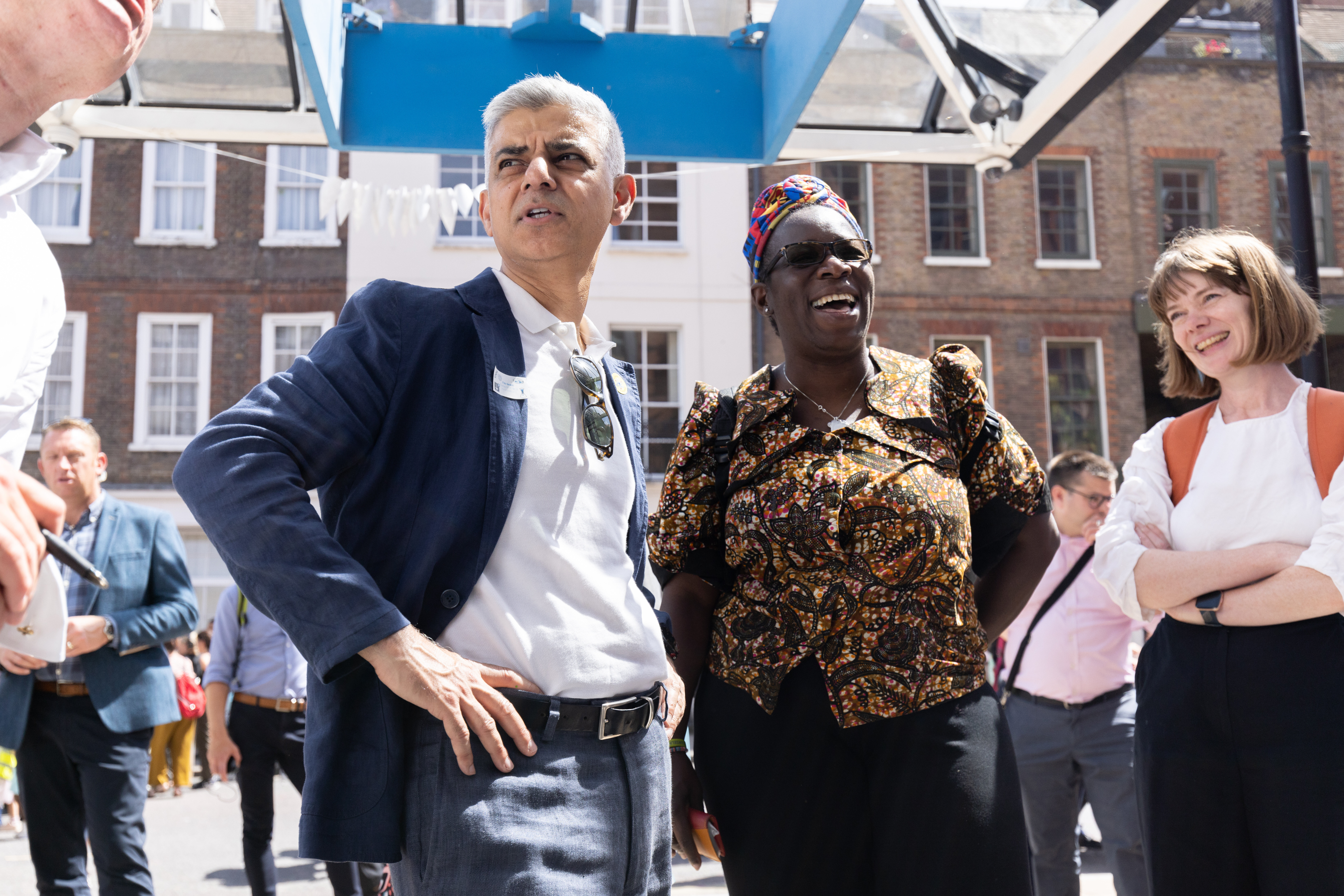
Mayor of London Sadiq Khan with Rosamund adoo-kissi-debrah, CEO of the Ella Roberta Family Foundation.

James Manning – PA Images via Getty Images

Meanwhile, Conservative MP Chris Skidmore has suggested Tory party members care little about hitting “net zero” carbon emissions by 2050 “because 90 per cent of them will be dead”.

Skidmore admitted a survey which put the climate emergency at the bottom of the list for the people who will choose the next prime minister is “rather depressing” in the Independent.

Leadership candidate Kemi Badenoch has previously branded the 2050 net zero commitment “unilateral economic disarmament” and vowed to axe it if elected.

At a hustings event on Monday she appeared to reverse her view before performing another U-turn on TalkTV that evening suggesting there were “circumstances” she would delay it. The three other remaining leadership candidates have all backed net zero.

Rosamund Adoo-Kissi-Debrah, whose daughter Ella was nine years old when she suffered a fatal asthma attack in 2013 linked to severe air pollution, has also criticised Conservative leadership hopefuls for dismissing green issues.

Khan added: “I break down politicians into three areas: climate change deniers, climate change delayers and climate change doers.

“And this heatwave should make us all want to be climate change doers, rather than delayers or deniers.”

He added: “This heatwave, caused by climate change, should be a wake up call for all of us – including those running to be the leader of the Conservative Party.

“It’s heartbreaking, in my view, to see the Tories being in denial about this issue.

“I mean, just to think about one of the candidates talking about 2060, 2070, the other candidates being lukewarm at best about the issue of tackling climate change. That is not the sort of leadership we need.”

He added: “It was Conservative politicians in the 1950s during the Great Smog who made the brave decision to close down power stations in the centre of our cities – think of Battersea Power station, think of the Tate Modern, because then you could see the poison.

“The problem is you can’t see the invisible killer, but you can feel the heat.

“What we want to see is a brave generation of politicians in parliament now, tackling climate change and air quality.”

The mayor made the comments as he hosted a climate solutions summit in London’s City Hall.

A woman use portable fan as heatwave hits London, United Kingdom on July 18, 2022.

Anadolu Agency via Getty Images

Transport for London released figures that show the expansion of Khan’s ultra-low emission zone appears to have reduced toxic air levels in the suburbs.

They found that roadside levels of nitrogen dioxide in central London were now 44 per cent lower than they would have been had the Ulez not been introduced.

However, the Evening Standard suggested the bulk of the benefits were attributable to the original central London zone which launched in April 2019.

Share Button

Why hot weather makes managing diabetes harder

Many people with diabetes have found it difficult to manage their blood sugar during the heatwave.

Share Button

UK heatwave: Temperatures still rising after record broken before noon

Never-before-seen temperatures are recorded before midday – as people are urged to stay safe.

Share Button

Sepsis: Cwm Taf Morgannwg failures ‘led to woman’s death’

A watchdog says the woman’s death could have been avoided, calling it an “injustice” to her family.

Share Button

Worrying number of slim children dieting

Slimming attempts have shot up and not just among those who are overweight, a study in England suggests.

Share Button

Water resources to become less predictable with climate change

Water resources will fluctuate increasingly and become more and more difficult to predict in snow-dominated regions across the Northern Hemisphere by later this century, according to a comprehensive new climate change study led by the National Center for Atmospheric Research (NCAR).

The research team found that, even in regions that keep receiving about the same amount of precipitation, streamflow will become more variable and unpredictable. As snowpack recedes in a warmer future and fails to provide reliable runoff, the amount and timing of water resources will become increasingly reliant on periodic episodes of rain.

“Water managers will be at the whim of individual precipitation events instead of having four-to-six months lead time to anticipate snowmelt and runoff,” said NCAR scientist Will Wieder, the lead author. “Water management systems in snow-dominated regions are based on the predictability of snowpack and runoff, and much of that predictability could go away with climate change.”

Observations show that snowpack is already melting earlier, and even declining in many regions. This decline will become so pronounced toward the end of the century that the amount of water contained in snowpack at the end of an average winter in parts of the U.S. Rocky Mountains could plummet by nearly 80 percent, the scientists found.

The changes in runoff and streamflow are likely to have cascading impacts on ecosystems that depend on reliable water from snow, the study warns. Although the changes won’t be uniform across regions, more snow-free days and longer growing seasons will put stress on water resources, drying out soils in many areas and heightening fire risk.

The study assumes that emissions of greenhouse gasses continue at a high rate (a scenario known as SSP3-7.0). Wieder said that the most severe impacts on snowpack, runoff, and ecosystems would likely be avoided if society successfully reduced greenhouse gas emissions.

The scientists drew on an advanced set of computer simulations to fill in details about the future of water resources, showing the extent to which changes in temperature and precipitation will alter snow accumulation and runoff patterns in the Northern Hemisphere. Although past research looked at the impacts of climate change on water availability, the new study focuses on the increasing variability of water resources.

The study is being published the week of July 18 in the Proceedings of the National Academy of Sciences. It was funded by the U.S. National Science Foundation, which is NCAR’s sponsor.

A race with predictability

Many regions of Earth rely on the accumulation of snow during the winter and subsequent melting in the spring and summer for regulating runoff and streamflow. For years, however, scientists have warned that the snowpack will become thinner and melt earlier as more precipitation during the colder months falls as rain instead of snow, and as melting occurs at times during the winter instead of the spring runoff season.

To determine how reduced snowpack will affect the variability of water resources, Wieder and his co-authors turned to a powerful NCAR-based climate model: the Community Earth System Model, version 2. They drew on a recently created database of simulations, known as the CESM2 Large Ensemble, to compare a past period (1940-1969) with a future period (2070-2099). The simulations were run on the Aleph supercomputer at the Institute for Basic Science supercomputer in Busan, South Korea.

The results illuminate the extent to which widespread shifts in the timing and extent of water flows will occur in much of the world by 2100. There will be an average of about 45 more snow-free days yearly in the Northern Hemisphere, assuming high greenhouse gas emissions. The largest increases will occur in midlatitudes that are relatively warm and high-latitude maritime regions that are influenced by changes in sea ice.

Many regions that rely the most on predictable relationships between snowpack and runoff will experience the largest loss in predictability because of a sharp decline in reliable pulses of spring runoff. These regions include the Rocky Mountains, Canadian Arctic, Eastern North America, and Eastern Europe. The authors warn that this will substantially complicate the management of freshwater resources, both for society and ecosystems.

“We are in a race with predictability when it comes to streamflow because we’re trying to improve our forecasts through better data, models, and physical understanding, but these efforts are being canceled by the rapid disappearance of our best predictor: snow,” said Flavio Lehner, a professor of earth and atmospheric science at Cornell University and a co-author of the study. “It might be a race we’ll lose, but we’re trying to win it, and that is why we need to study these topics.”

Although the reduced runoff will result in drier summertime soil conditions in much of the Northern Hemisphere, the simulations showed that certain regions — including East Asia, the Himalayas, and Northwestern North America — will maintain soil moisture because of increased rainfall.

“Snow-related metrics are critical for informing society’s management of precious water resources,” said Keith Musselman, a hydrologist at the University of Colorado Boulder and co-author of the study. “As utilities and civil works agencies plan new reservoirs and other infrastructure to adapt to a changing climate, we must address basic research questions about the changing characteristics of winter snowpack and resulting streamflow that we have long relied upon.”

Share Button

Skin: An additional tool for the versatile elephant trunk

A new study from Georgia Institute of Technology suggests that an elephant’s muscles aren’t the only way it stretches its trunk — its folded skin also plays an important role. The combination of muscle and skin gives the animal the versatility to grab fragile vegetation and rip apart tree trunks.

The research, in collaboration with Zoo Atlanta, finds that an elephant’s skin doesn’t uniformly stretch. The top of the trunk is more flexible than the bottom, and the two sections begin to diverge when an elephant reaches more than 10%. When stretching for food or objects, the dorsal section of the trunk slides further forward.

The findings could improve robotics, which today are typically built for either great strength or flexibility. Unlike an elephant’s trunk, the machines can’t do both.

As an example, the study’s authors point to soft robotics. Their fluid-filled cavities allow flexible movements but can easily break when forces are applied. The researchers say the elephant findings suggest that wrapping soft robotics with a skin-like structure could give the machines protection and strength while continuing to allow flexibility.

The paper is published in the Proceedings of the National Academy of Sciences (PNAS) by the same Georgia Tech team that authored a study last summer about how elephants use their trunk muscles to inhale food and water.

“When people extend their tongue — a muscle-filled, boneless tissue similar in composition to an elephant’s trunk — it stretches uniformly. We expected the same when we challenged an elephant to reach for food,” said Andrew Schulz, the study’s lead author and a Ph.D. student in Georgia Tech’s George W. Woodruff School of Mechanical Engineering. He and the team filmed two African savanna elephants reaching for bran cubes and apples at Zoo Atlanta.

“But when we looked at our high-speed camera footage and plotted the trunk’s movements, we were surprised. The top and bottom weren’t the same at all,” Schulz said.

After seeing the video, Schulz stretched the tissue of a dissected elephant to better understand the skin’s elasticity. That’s when he found that the top of the skin, which is folded, is 15% more flexible than the wrinkled bottom side. It’s also when the team realized they weren’t just seeing muscle movement on the video. They were also tracking a thick sheet of skin.

“Flexible skin folds are the elephant’s innovation,” said David Hu, Schulz’s advisor and a professor in the Woodruff School and the School of Biological Sciences. “They protect the dorsal section and make it easier for the elephant to reach downward, the most common gripping style when picking up items.”

The Georgia Tech study also found that an elephant trunk differs in another way from other boneless, muscle-filled appendages found in nature, such as squid and octopus tentacles. Instead of extending evenly, an elephant telescopically stretches its trunk like an umbrella, gradually lengthening in waves.

An elephant first extends the section that includes the tip of its trunk, then the adjacent section and so on, gradually working its way back toward its body. Schulz says the progressive movement towards the base is intentional.

“Elephants are like people: they’re lazy,” he said. “The section at the end of the trunk is 1 liter of muscle. The section closest to its mouth is 11-15 liters of muscle. An elephant will first stretch the end of its trunk, then the adjacent section, because they’re easier to move. If an elephant doesn’t have to work very hard to reach something, it won’t.”

Schulz said he had to rely on a drawing from 1908 when learning about trunk anatomy because scientists and engineers haven’t done much research on the biomechanics of elephants during the last century. Part of his curiosity of elephants is based on helping them; he thinks a better understanding of the animals will lead to better conservation efforts. As a mechanical engineer, Schulz also sees the applications of robotics.

“Soft robotics created with biologically inspired design are always based on muscle movement. If they were wrapped with a protective skin, like an elephant’s muscle-filled trunk, the machines could apply larger forces,” he said. “Last year we learned that a trunk is a multi-purpose, muscular hydrostat. Now we know that skin is another tool at its disposal.”

Share Button