Conversion process turns pollution into cash

Engineers at the University of Cincinnati have developed a promising electrochemical system to convert emissions from chemical and power plants into useful products while addressing climate change.

UC College of Engineering and Applied Science assistant professor Jingjie Wu and his students used a two-step cascade reaction to convert carbon dioxide to carbon monoxide and then into ethylene, a chemical used in everything from food packaging to tires.

The study was published in the journal Nature Catalysis in collaboration with the University of California Berkeley and the Lawrence Berkeley National Laboratory.

UC College of Engineering and Applied Science graduate Tianyu Zhang, one of the study’s lead authors, led a similar study last year that examined ways to convert carbon dioxide into methane that could be used as rocket fuel for Martian exploration.

“The significance of the two-stage conversion is that we can increase the ethylene selectivity and productivity at the same time with the low-cost strategy,” Zhang said. “This process can be applied to various reactions because the electrode structure is general and simple.”

Selectivity means isolating the desired compounds. Productivity is the amount of ethylene the reactor can produce.

“We’re selectively reducing carbon emissions into something considered valuable because of its many downstream applications,” Zhang said.

Applications include a variety of industries from steel and cement plants to the oil and gas industry, he said.

“In the future, we can use this technique to reduce carbon emissions and make a profit from it. So, reducing carbon emissions will not be a costly process anymore,” he said.

Ethylene has been called “the world’s most important chemical.” It’s used in a range of plastics from water bottles to PVC pipe, textiles and rubber found in tires and insulation.

Professor Wu said the chemical they produce is known as “green ethylene,” because it is created from renewable sources.

“Ideally we can remove greenhouse gas from the environment while simultaneously making fuels and chemicals,” Wu said. “Power plants and ethylene plants emit a lot of carbon dioxide. Our goal is to capture the carbon dioxide and convert it to ethylene using electrochemical conversion.”

So far, the process requires more energy than it produces in ethylene. By using tandem electrodes, UC engineers were able to boost productivity and selectivity, both of which are key indicators toward making the process commercially attractive to industry, Wu said.

There are huge environmental advantages to containing and converting greenhouse gases, Wu said.

“It’s being pushed by the government. In the future, we’ll need sustainable development so we’ll need to convert carbon dioxide,” he said.

And Wu said copper isn’t necessarily the best catalyst for this reaction, so industry experts have likely alternatives that could boost productivity and efficiency even more.

“Our system is very general, but you can use preferred catalysts,” Wu said. “But even with commercial copper we were able to more than double the performance. With an even better catalyst, we could solve the economic issue.”

Wu last year applied for patents for their design.

Zhang said the system will take some time to become economical. But already they have made tremendous strides, he said.

“The technology has improved a lot in 10 years. So in the next 10 years, I’m optimistic we’ll see similar advances. This is a game changer,” Zhang said.

Story Source:

Materials provided by University of Cincinnati. Original written by Michael Miller. Note: Content may be edited for style and length.


Share Button

Researchers use unique ingredient to strengthen bamboo

UBC Okanagan researchers have adapted a technique — originally designed to embalm human remains — to strengthen the properties of biocomposites and make them stronger.

With the innovation of new materials and green composites, it is easy to overlook materials like bamboo and other natural fibres, explains UBCO Professor of Mechanical Engineering Dr. Abbas Milani. These fibres are now used in many applications such as clothing, the automotive industry, packaging and construction.

His research team has now found a way not only to strengthen these fibres, but reduce their tendency to degrade over time, making them even more environmentally friendly.

“Bamboo has nearly the same strength as a mild steel while exhibiting more flexibility,” says Dr. Milani, the founding director of the Materials and Manufacturing Research Institute. “With its low weight, cost and abundant availability, bamboo is a material that has great promise but until now had one big drawback.”

Bamboo is one of the world’s most harvested and used natural fibres with more than 30-million tonnes produced annually. However, its natural fibres can absorb water and degrade and weaken over time due to moisture uptake and weathering.

Using a process called plastination to dehydrate the bamboo, the research team then use it as a reinforcement with other fibres and materials. Then they cure it into a new high-performance hybrid biocomposite.

First developed by Gunther von Hagens in 1977, plastination has been extensively used for the long-term preservation of animal, human and fungal remains, and now has found its way to advanced materials applications. Plastination ensures durability of the composite material for both short- and long-term use, says Daanvir Dhir, the report’s co-author and recent UBC Okanagan graduate.

“The plastinated-bamboo composite was mixed with glass and polymer fibres to create a material that is lighter and yet more durable than comparable composites,” says Dhir. “This work is unique as there are no earlier studies investigating the use of such plastinated natural fibres in synthetic fibre reinforced polymer composites.”

Dhir says this new durable hybrid bamboo/woven glass fibre/polypropylene composite, treated with the plastination technique has a promising future.

Supported by industrial partner NetZero Enterprises Inc., the research shows that adding only a small amount of plastinated materials to the bamboo can increase the impact absorption capacity of the composite — without losing its elastic properties. This also lowers the material’s degradation rate.

More work needs to be done on the optimization of this process as Dhir says plastination is currently time-consuming. But he notes the benefit of discovering the right composition of plastinated natural fibres will result in a sizable reduction of non-degradable waste in many industries, with a lower environmental footprint.

Future studies are underway to optimize and investigate the effect of plastinating other natural fibres, such as flax and hemp. The researchers also suggest a life cycle analysis of the materials should be conducted under different applications and compared to non-plastinated samples. This will provide a better picture of the corresponding trade-off between the environmental footprint and mechanical durability effects.

“Biocomposites continue to find new applications under the circular economy paradigm,” adds Dr. Milani. “The innovations in the methods used to develop these composites will ensure benefits well into the future.”

Share Button

Exploring the therapeutic uses of ketamine

First manufactured more than 50 years ago, ketamine is a fast-acting dissociative anesthetic often used in veterinary and emergency medicine. Ketamine also has a history of being an illicit party drug.

Now, ketamine is getting a closer look.

Researchers from UBC Okanagan and the University of Exeter have identified ketamine as a potentially powerful tool in the fight against mental illness.

In a recent study published in the British Journal of Psychiatry, the research team found ketamine to have significant anti-depressant and anti-suicidal effects. They also found evidence that suggests its benefits don’t stop there.

Led by Psychology Professor Dr. Zach Walsh and doctoral student Joey Rootman — both based in the Irving K. Barber Faculty of Arts and Social Sciences — the research team arrived at this conclusion after analyzing more than 150 worldwide studies on the effects of sub-anesthetic ketamine doses for the treatment of mental illness. The study was co-led by Professor Celia Morgan and doctoral student Merve Mollaahmetoglu from the University of Exeter in the United Kingdom.

“We found strong evidence that indicates ketamine provides rapid and robust anti-depressant and anti-suicidal effects, but the effects were relatively short-lived,” explains Rootman. “However, repeated dosing appeared to have the potential to increase the duration of positive effects.”

Beyond these results, the study provides evidence that suggests ketamine may be helpful in the treatment of other disorders, including eating disorders, problematic substance use, post-traumatic stress and anxiety — though the evidence in these areas is scarce.

“What our research provides is an up-to-date overview and synthesis of where the knowledge on ketamine is at right now,” explains Rootman. “Our results signal that ketamine may indeed have a broader spectrum of potential applications in psychiatric treatment — and that tells us that more investigation is needed.”

This study serves as a foundation for fellow researchers looking to design ketamine-related projects and offers valuable data for clinicians considering using ketamine with their patients.

The results also help to satisfy the public’s appetite for information on innovative and emerging psychiatric treatments, says Dr. Walsh, explaining the review provides a relatively compact document with evidence regarding which ketamine treatments may be helpful for diverse diagnoses.

“As many as one in five Canadians will experience a mental illness this year, and the reality is that existing treatments don’t work for everyone,” he says. “As a result, many Canadians are curious about new approaches to help with these serious conditions.”

Overall, while Dr. Walsh acknowledges research into other treatment areas is just beginning, he finds the preliminary evidence encouraging.

“We need a lot more information on how these interventions could work — for example, administering the drug is only a part of treatment. We need to figure out what amount and type of psychotherapy would best compliment the drug intervention to really maximize potential benefits,” he explains. “With that being said, it is a truly exciting time for ketamine research. If it can deliver the relief that early evidence suggests it can, this could be among the most significant developments in mental health treatment in decades.”

Share Button

Artificial intelligence paves the way to discovering new rare-earth compounds

Artificial intelligence advances how scientists explore materials. Researchers from Ames Laboratory and Texas A&M University trained a machine-learning (ML) model to assess the stability of rare-earth compounds. This work was supported by Laboratory Directed Research and Development Program (LDRD) program at Ames Laboratory. The framework they developed builds on current state-of-the-art methods for experimenting with compounds and understanding chemical instabilities.

Ames Lab has been a leader in rare-earths research since the middle of the 20th century. Rare earth elements have a wide range of uses including clean energy technologies, energy storage, and permanent magnets. Discovery of new rare-earth compounds is part of a larger effort by scientists to expand access to these materials.

The present approach is based on machine learning (ML), a form of artificial intelligence (AI), which is driven by computer algorithms that improve through data usage and experience. Researchers used the upgraded Ames Laboratory Rare Earth database (RIC 2.0) and high-throughput density-functional theory (DFT) to build the foundation for their ML model.

High-throughput screening is a computational scheme that allows a researcher to test hundreds of models quickly. DFT is a quantum mechanical method used to investigate thermodynamic and electronic properties of many body systems. Based on this collection of information, the developed ML model uses regression learning to assess phase stability of compounds.

Tyler Del Rose, an Iowa State University graduate student, conducted much of the foundational research needed for the database by writing algorithms to search the web for information to supplement the database and DFT calculations. He also worked on experimental validation of the AI predictions and helped to improve the ML based models by ensuring they are representative of reality.

“Machine learning is really important here because when we are talking about new compositions, ordered materials are all very well known to everyone in the rare earth community,” said Ames Laboratory Scientist Prashant Singh, who led the DFT plus machine learning effort with Guillermo Vazquez and Raymundo Arroyave. “However, when you add disorder to known materials, it’s very different. The number of compositions becomes significantly larger, often thousands or millions, and you cannot investigate all the possible combinations using theory or experiments.”

Singh explained that the material analysis is based on a discrete feedback loop in which the AI/ML model is updated using new DFT database based on real-time structural and phase information obtained from our experiments. This process ensures that information is carried from one step to the next and reduces the chance of making mistakes.

Yaroslav Mudryk, the project supervisor, said that the framework was designed to explore rare earth compounds because of their technological importance, but its application is not limited to rare-earths research. The same approach can be used to train an ML model to predict magnetic properties of compounds, process controls for transformative manufacturing, and optimize mechanical behaviors.

“It’s not really meant to discover a particular compound,” Mudryk said. “It was, how do we design a new approach or a new tool for discovery and prediction of rare earth compounds? And that’s what we did.”

Mudryk emphasized that this work is just the beginning. The team is exploring the full potential of this method, but they are optimistic that there will be a wide range of applications for the framework in the future.

Story Source:

Materials provided by DOE/Ames Laboratory. Note: Content may be edited for style and length.

Share Button

‘A Sinking Ship’: Tory Ministers Mocked After P&O Ferries Letter Gaffe

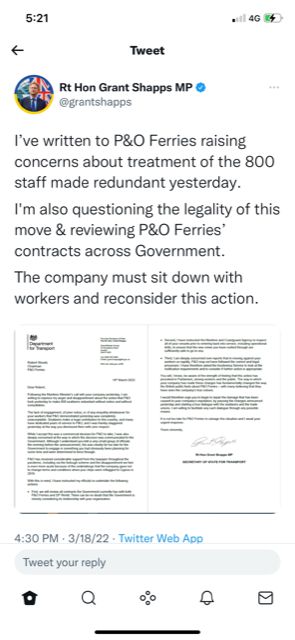
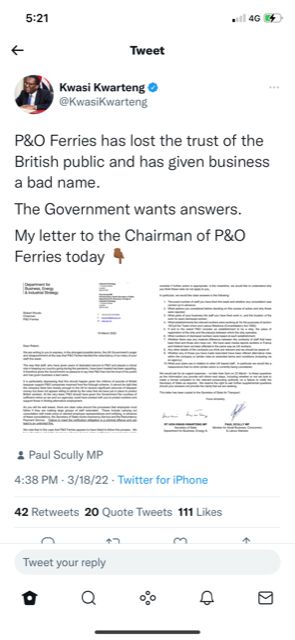
Two cabinet ministers have been mocked after getting the name of P&O Ferries’ chairman wrong in letters criticising the firm for sacking 800 staff.

Grant Shapps and Kwasi Kwarteng addressed the strongly-worded missives to Robert Woods.

But embarrassingly for the pair, he retired from the role last year.

Their mistake was only spotted after they tweeted their letters highlighting the action the government is taking in response to the row.

P&O caused widespread anger on Thursday after 800 members of staff were told they were being fired with immediate effect on a video call.

A 24-second clip of the recording was obtained by BBC South East on Thursday.

A P&O Ferries boss in the footage tells the room: “The company has made the decision going forward that it will be primarily crewed by a third party crew provider.

“Therefore I am sorry to inform you that this means your employment is terminated with immediate effect on the grounds of redundancy.

“Your final day of employment is today.”

In his now-deleted tweet, transport secretary Shapps said: “I’ve written to P&O Ferries raising concerns about treatment of the 800 staff made redundant yesterday. I’m also questioning the legality of this move & reviewing P&O Ferries’ contracts across government. The company must sit down with workers and reconsider this action.”

His letter was addressed to “Robert Woods, Chairman, P&O Ferries”.

The now-deleted Grant Shapps tweet

Business secretary Kwarteng’s tweet, which has also been deleted, said: “P&O Ferries has lost the trust of the British public and has given business a bad name. The government wants answers.”

His letter was also signed by Paul Scully, the small business minister.

Kwasi Kwarteng's tweet
Kwasi Kwarteng’s tweet

Kwarteng later tweeted a redrafted letter, which was addressed to Peter Hebblethwaite, P&O Ferries’ chief executive.

Louise Haigh, Labour’s shadow transport secretary, said: “The Conservative government is a sinking ship.

“Some 48-hours after finding out that 800 British workers would lose their jobs, the transport secretary can’t even figure out the correct person to write to, to protect these workers.

“They deserve better. They deserve a Labour government who will act before the horse has bolted – by ending fire and rehire, and giving them security and respect.”

Liberal Democrat MP Alistair Carmichael said: “Shapps has form on getting names wrong. For some time he used to tell people that he was Michael Green.

“While it is welcome that the government is demanding answers, it would be more welcome if they asked the right people. They might even have acted years ago when they were warned that UK seafarers were being exploited and needed better protection in law.”

Share Button

Putin In Full Dictator Mode During Terrifying Rally In Moscow

The Russian president Vladimir Putin celebrated the eight years since his troops seized the Ukrainian region of Crimea with a bizarre rally on Friday.

He spoke in front of a huge crowd in Moscow’s Luzhniki stadium and praised the war effort in Ukraine which has seen hundreds on both sides die.

Despite being accused of of committing war crimes through his attacks on civilians, the widespread Ukrainian resistance and the repeated suppression of any forms of free speech in Russia, the president told the audience: “We have not had unity like this for a long time.”

Putin also honoured those in Crimea who stood up to “neo-Nazis and radical nationals” and joined Russia, even though world leaders have rejected any claim that there is Nazism in Ukraine’s government.

In an ominous nod to the future, Putin also promised the crowd: “We know what we have to do next…we’ll definitely carry out all the plans we have made.”

The stadium speech is comparable to the kind of rallies former US president Donald Trump became famous for. The two leaders were said to have a certain kind of rapport, and the former US president has even called Putin’s Ukraine strategy a work of “genius”.

The rally speaks to the West’s concerns about Putin’s increasingly unhinged behaviour, and comes a day after current US president Joe Biden labelled him a “murderous dictator” and a “pure thug”.

What is the annexation of Crimea?

March 18, 2014, does mark Russia’s complete annexation of Crimea, although the peninsula is still not legally recognised as part of the country by the international community.

It followed an internationally discredited public vote held two days before where the people living in the peninsula were asked whether they wanted to be part of Russia or part of Ukraine.

While 97% of votes backed joining Russia, Ukraine said the referendum was illegal as it had taken place while Russian forces were in Crimea.

The 2014 annexation of Crimea is now perceived as the start of Russia’s war against Ukraine.

Did people really want to be at the rally?

Russian representatives claimed more than 200,000 people attended Friday’s celebrations. The official capacity of the stadium is 81,000, although there were crowds outside the stadium too.

But many attendees told the BBC they had been pressured by their employers in the public sector to attend.

Some students were allowed not to attend lectures as long as they went to the “concert”, while others told the BBC they had not been aware that the event was aimed at consolidating support for the Ukrainian war.

There is thought to be some support for the Russian attack on its European neighbour, but the full extent of the general public’s backing is hard to calculate.

The Kremlin has quashed any efforts to speak out against the invasion, including attempts to call it a war – Russia prefers to call it a “special military operation” – shutting down any protests or independent media outlets.

Children in their last six years of school have to now attend “My Country” lessons where they watch a video of Putin sharing his take on Ukraine’s history.

Putin is known to consider Ukraine and Russia as “brother nations” and wants them both to be under his influence in a throwback to the pre-Soviet era.

Children have been seen lining up to create the letter Z – the pro-invasion symbol which was first seen on the side of Russian tanks – and will have lessons dedicated to March 18 which aim to “form an understanding” of patriotism.

Teachers also shared a video showing people in the military are more likely to become heroes, all in honour of the “Crimean spring”.

Is the war really going well?

The Russian offensive is thought to have slowed significantly since it first began more than three weeks ago.

Russian forces are becoming increasingly violent and attacks on the west Ukraine city of Lviv shows the offensive is now spreading out.

Officials in the Ukrainian capital Kyiv say almost 90% of buildings in the city of Mariupol have now been damaged or destroyed by Russian forces, including a bomb shelter within a theatre where hundreds were sheltering.

The word “children” had been writing by Ukrainians in Russian outside for those dropping the bombs, although Kremlin representatives claim the attack was nothing to do with them.

Ukrainian president Volodymyr Zelenskyy said that Russia is actually not doing as well as it expected to in its invasion because Putin expected the country to be the same as it was in 2014, during the Crimea annexation.

He said Russia “didn’t know what we had for defence or how we prepared to meet the blow”.

Share Button

Covid: Rise in UK infections driven by BA.2 Omicron variant

One in 20 people infected, with record high rates in elderly people due a spring Covid booster vaccine.

Share Button

Covid travel restrictions have ended in the UK

Passenger locator forms and tests for unvaccinated arrivals are no longer required.

Share Button

Everton-Newcastle: Why Protester Was Tied To Goalpost During Match

Everton’s crunch Premier League clash with Newcastle on Thursday was held up for six minutes when a protester tied himself to one of the goalposts.

The man, who was wearing a T-shirt supporting a group called Just Stop Oil, entered the Goodison Park pitch early in the second half and attached himself to a post by wrapping something around his neck.

The match had to be stopped while security attempted to remove him. The man was eventually cut free using a pair of bolt cutters and was led from the ground, to boos from the crowd, by police.

Just Stop Oil were quick to claim responsibility for the stunt, issuing a statement via Facebook which read: “This evening, Louis, a 21-year-old supporter of Just Stop Oil, locked on to the goalpost at Goodison Park wearing a Just Stop Oil T-shirt, causing the referee to briefly stop play.”

The environmental group’s statement went on to criticise the government’s policy on North Sea oil.

The environmental group’s statement went on to criticise the Government’s policy on North Sea oil.

The incident comes after an apparent attempt by the same group to disrupt Wednesday’s game between Arsenal and Liverpool but on that occasion a protester did not make it to the pitch.

Share Button

Covid-19: Is the world ready for a great re-opening?

We asked our journalists around the world to give us a snapshot of life two years into the pandemic.

Share Button