South Africa Variant: Surge Testing For Parts Of Birmingham After Cases Found

Kirsty O’ConnorPA

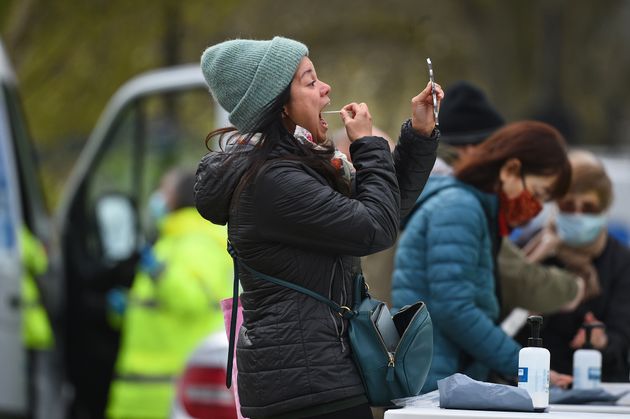
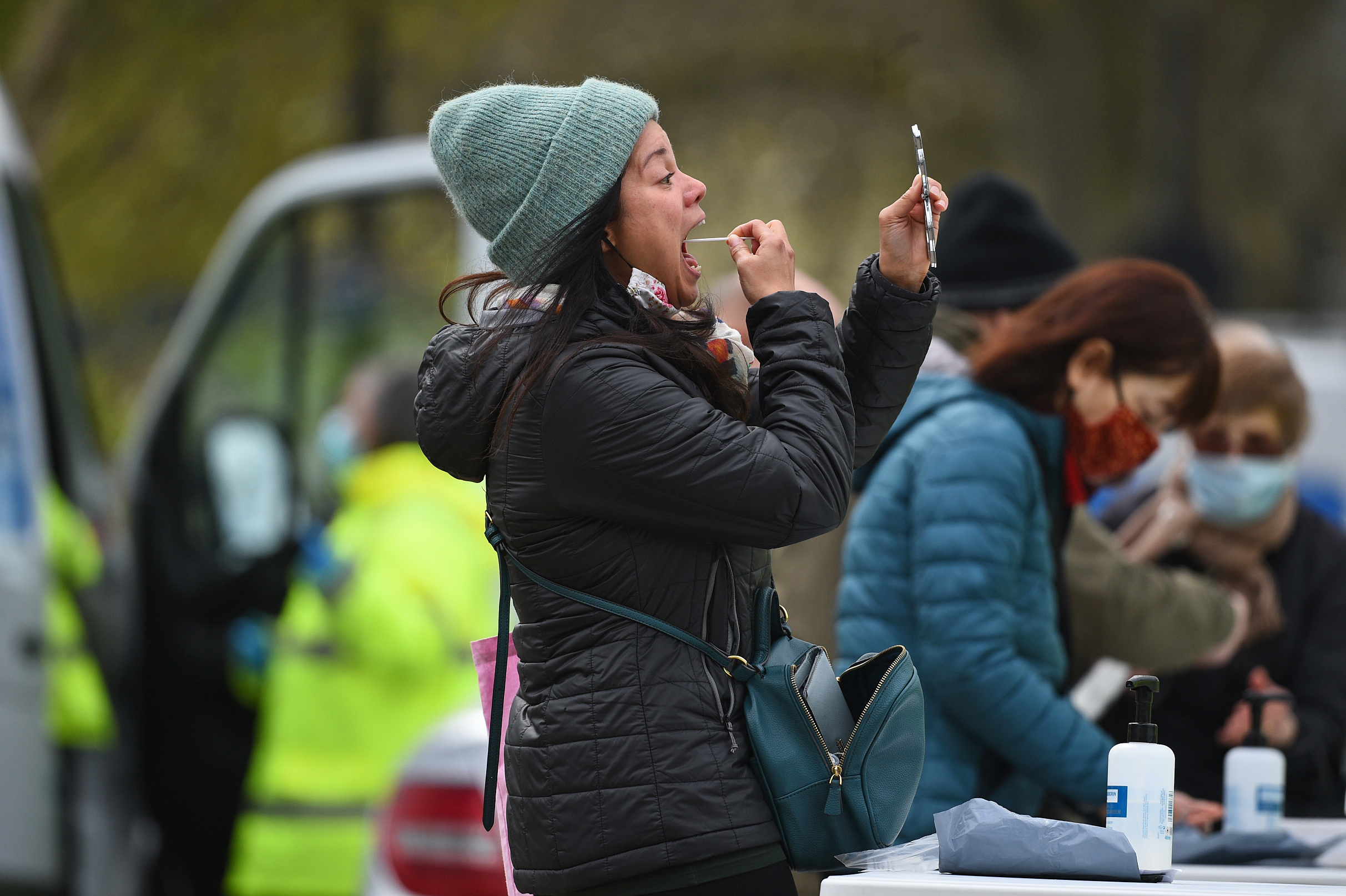
People take part in coronavirus surge testing on Clapham Common, south London.

Surge testing is to begin in parts of Birmingham after a case of the Covid-19 variant first identified in South Africa was confirmed there.

The Department of Health and Social Care said the patient had “self-isolated and their contacts have been identified”.

Health officials added in a statement: “Initial investigations indicate that this case is not linked to a case previously identified in the Birmingham and Sandwell areas.”

The testing will be targeted at households in the city’s Alum Rock, Glebe Farm and Tile Cross areas.

Officially, 600 people in the UK have contracted the South African coronavirus variant according to the government website – but that was based on figures up to April 14.

This is unlikely to be an accurate portrayal of how far the mutation has spread since hundreds of thousands of people have been swabbed during previous rounds of surge testing elsewhere in the country, on top of which it can take days for samples to have genomic sequencing carried out. The process is the only way to detect which variant of coronavirus someone is infected with.

Other areas where cases of the South Africa variant have been found include the London boroughs of Barnet, Harrow, Hillingdon, Lambeth, Southwark and Wandsworth.

The South Africa strain is classed as a “variant of concern” – the most serious classification issued by Public Health England – because there are fears it may be less susceptible to vaccines and could spread more easily.

The DHSC said everybody aged 16 years and over who is contacted from the new areas would be “strongly encouraged to take a Covid-19 PCR test”, whether or not they are symptomatic.

For anyone testing positive for a key variant, enhanced contact tracing – looking back over an extended period in order to determine the route of transmission – will be used.

Meanwhile, anyone with symptoms is urged to book a free test online or by phone.

And the government is asking people to continue using twice-weekly rapid lateral flow testing alongside any PCR surge testing they do.

Last week surge testing was introduced in the city’s Ladywood, Jewellery Quarter and Soho ward, after a single positive case of the same variant.

Speaking at the time, the city’s public health director Dr Justin Varney said: “Testing is an important part of containing the spread of the virus.

“This new variant from South Africa presents a new risk so it is essential that all adults in the affected areas take up this offer of PCR testing to help us contain the spread quickly and identify any further local cases.

“There is financial and practical support available for those who test positive and have to isolate, and their contacts, and it is vital we all play our part in controlling this new challenge.”

Viruses by their nature mutate often, with more than 18,000 mutations discovered over the course of the Covid-19 pandemic, the overwhelming majority of which have no effect on the behaviour of the virus.
Share Button

India Added To UK’s Covid Travel ‘Red List’, Announces Matt Hancock

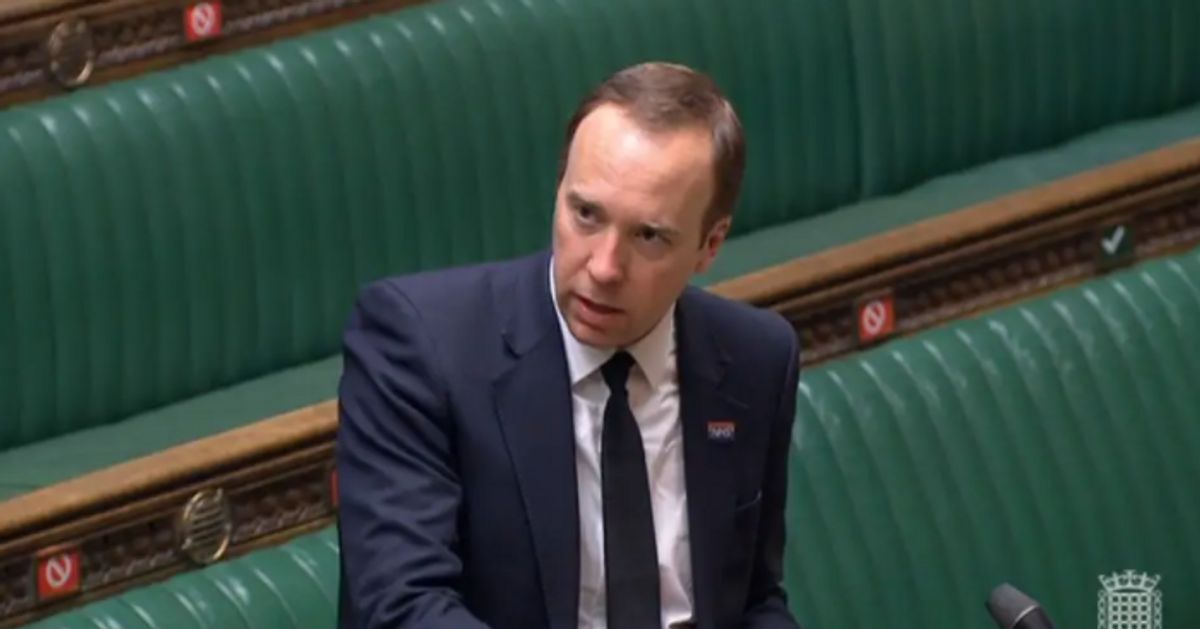
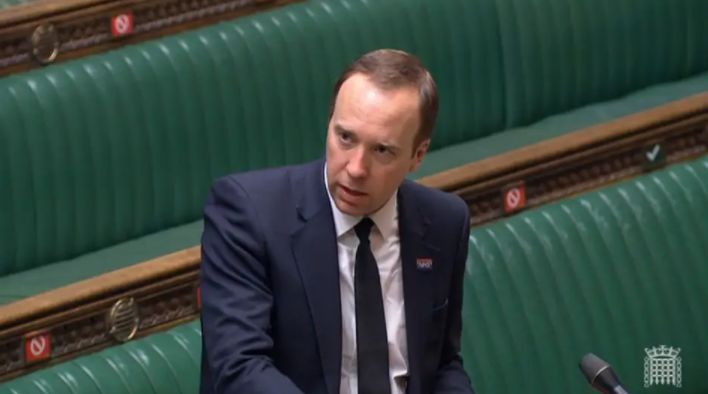
India will be added to the UK’s “red list” for travel, Matt Hancock has announced.

It means from 4am on Friday April 23, only British, Irish and third-country nationals with residency rights travelling from India can enter England.

Anyone arriving in the country will be required to self-isolate in a government-approved hotel for ten days.

Hancock told the Commons on Monday: “We’ve recently seen a new variant first identified in India.

“We’ve now detected 103 cases of this variant, of which again the vast majority have links to international travel and have been picked up by our testing at the border.”

The health secretary said the samples have been analysed to see if the new variant has any “concerning characteristics” such as greater transmissibility or resistance to treatments and vaccines.

He added: “After studying the data, and on a precautionary basis, we’ve made the difficult but vital decision to add India to the red list.”

Boris Johnson cancelled his visit to India next week, as the coronavirus crisis deepened in India and concerns grew over the new variant.

The already-curtailed trip was postponed indefinitely on Monday, but the prime minister said he planned to hold a call with his Indian counterpart Narendra Modi ahead of a rescheduling “as and when circumstances allow”.

Johnson had until that point resisted demands to hold the talks, aimed at fostering closer ties with the nation, on a virtual basis amid calls to impose greater restrictions on travel to and from India.

The cancellation came as New Delhi entered a week-long lockdown to tackle a surge in cases and prevent a collapse of the capital’s health system, as India reported 273,810 new infections – the highest daily rise since pandemic began.

Share Button

Two Thirds Of Agency Nursing Staff Still Waiting For Second Covid Jab

GEOFF CADDICK via AFP via Getty Images

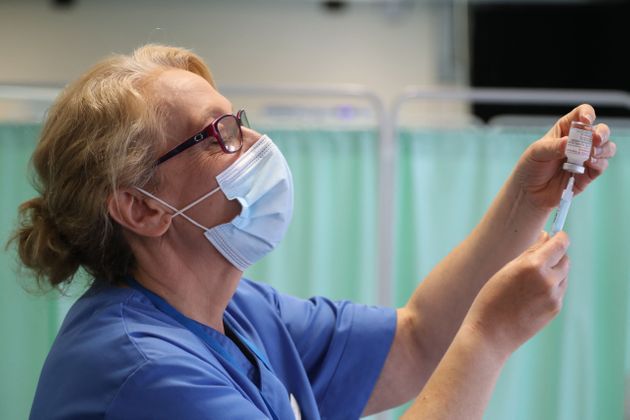
A nurse fills a syringe with the Moderna Covid-19 vaccine at a vaccination centre in Llanelli, South Wales.

Nursing staff working outside the NHS are half as likely to have received a full coronavirus vaccine dose as their NHS colleagues, a new study reveals.

Just under a third of agency staff have been given both of their jabs, compared with two-thirds of permanent staff, according to the survey by the Royal College of Nursing (RCN) of 20,000 members.

It also found that 5.6% of agency nursing professionals (one in 18) have not been offered a single dose of a Covid-19 vaccine, compared with only 1.3% of permanent staff (one in 77).

Frontline health and social care workers, who are second on the Joint Committee on Vaccination and Immunisation (JCVI) priority list alongside people aged 80 and over, should have all received an invitation to receive a second dose of a Covid-19 vaccine by now.

Vaccinations for people in the top two priority groups began in December. People next on the list, those aged over 75, were invited from early January. On February 14, the government said it had offered all 15m people in the top four priority groups their first dose.

Latest figures published by the government show more than 7.4m people have received their second dose and more than 32m people have received a first dose. More than 32m doses should be enough to cover everyone in the UK over the age of 50, all health and care workers and those with pre-existing conditions.

But the survey revealed that as of April 6, only 94% of nursing staff have actually received at least one dose of a vaccine and 62% had received both doses.

Nearly half (46%) of nursing staff outside of the NHS, including permanent employees in non-NHS settings such as care homes, were still waiting for their second jab, compared to just under 24% of those working in the NHS.

The most worrying finding was that about one in 50 members reported having not been offered a vaccine at all. Those included nursing staff who work in hospitals, care homes and in the community, the RCN said. 

The results were an improvement from a previous survey conducted in February, which found “a concerning disparity” between vaccination rates among NHS and non-NHS staff, with non-NHS staff accounting for 70% of the nursing staff who had yet to be vaccinated.

JACOB KING via POOL/AFP via Getty Images

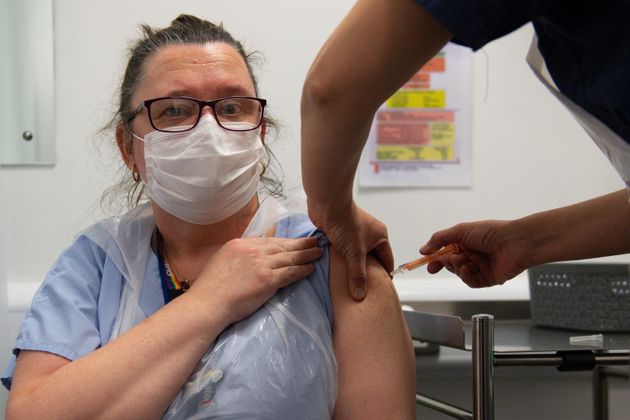
A nurse is given the Oxford/AstraZeneca Covid-19 vaccine in Coventry on January 7.

Nursing staff not working directly for the NHS include professionals who are employed by agencies, or who work in local communities, in care homes and people’s own homes with some of the most vulnerable people in society.

Tthe RCN said more still needed to be done to ensure all nursing staff are given their jabs. “The gap has narrowed significantly yet those outside the NHS are still behind their NHS colleagues when it comes to receiving their second jab,” it warned.

The union has called on the government to ensure vaccines are offered to all nursing staff to stop them from “slipping through the net”.

Jude Diggins, RCN director of nursing, policy and public affairs, said: “The gap between NHS and non-NHS staff having their first dose has closed but there remains more work to be done to ensure all nursing staff, whatever setting they work in, are given the protection they need.

“Every effort must be made to prevent nursing staff from slipping through the net. Their safety has to be the government’s top concern and that cannot be compromised.”

The government must make sure people who should have already received their vaccinations do so “without delay”, Labour said following the RCN survey.

Shadow health minister Justin Madders said: “As restrictions begin to ease ministers must do all they can to ensure that those who should have received the vaccination already are given this without delay. 

“This should include targeted work to drive up vaccinations in all who work in the NHS, including agency and bank staff.” 

In response to HuffPost UK’s request to explain why some nursing staff have yet to be invited for vaccination, a DHSC spokesperson claimed: “We have visited every eligible care home in England, offered vaccines to all staff, and continue to work closely with the care sector, independent healthcare providers and local leaders, to maximise vaccination numbers and save thousands of lives.

“The vaccines are safe and effective and we want everyone to take up the offer of a jab when they’re called forward.”

They added: “Our vaccination programme is the biggest in NHS history, and so far our heroic health and care staff have helped administer more than 39m vaccines.”

Share Button

UK’s Vaccine Rollout ‘On Track’ Despite Sharp Slowdown In Jabs

Yui MokPA

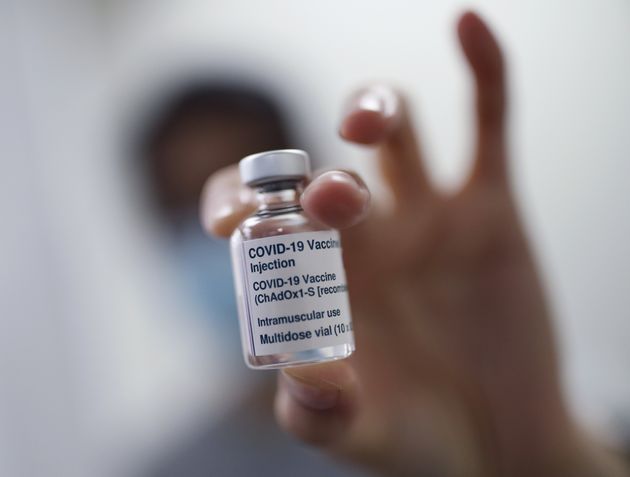
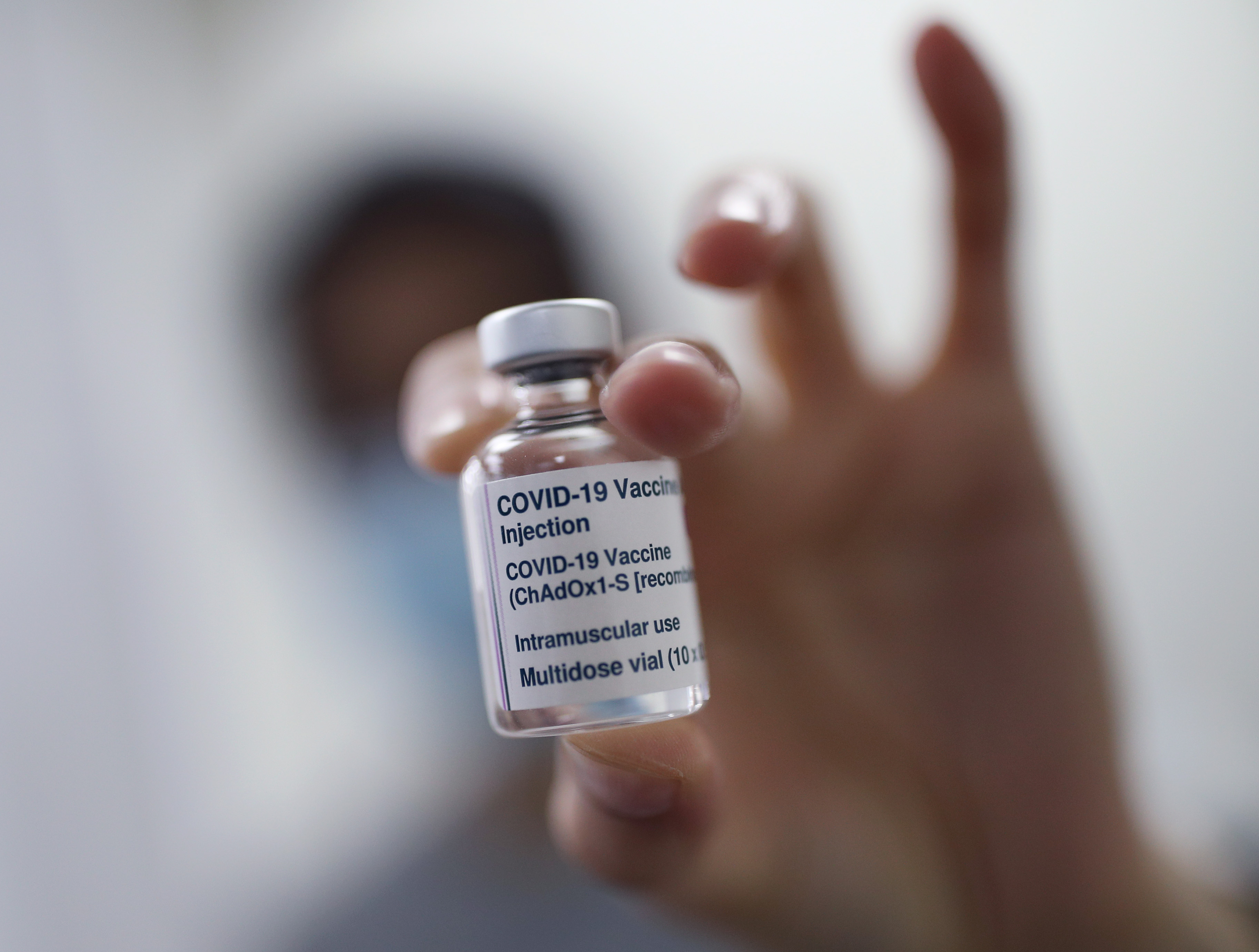
A vial of the Oxford/AstraZeneca coronavirus vaccine.

The number of people receiving a Covid-19 vaccine in the UK daily has fallen by around 75% in the last week as the supply of the jab has been squeezed.

Minsters revealed last month there would be a “significant reduction” in doses from the end of March, raising questions about whether the programme’s target dates will be met and when under-50s would be innoculated.

Supplies of vaccines in April have been constrained by the need to test a batch of 1.7 million doses and delays in a shipment of around five million from India.

Government data up to April 5 shows that first doses were given to 40,744 people on the previous day, and 64,590 got a second dose – or 105,334 in total. The number of people being injected with their first shot was the lowest since records began on January 10. A day earlier, just 95,763 people received one of their two doses. 

By contrast, just a week earlier – March 29 – 405,039 doses were distributed. And on March 5, the figure stood at 494,235. 

While the fall may seem steeper than billed, Downing Street on Tuesday moved to allay fears – insisting all adults will be offered a coronavirus vaccine by the end of July as planned.

Some 25m people have so far had a first dose of either the AstraZeneca or the Pfizer vaccine in the UK, while just under 1.8m have had both shots. The government is aiming to vaccinate all over-50s by mid-April and everyone else by the end of July.

The Cabinet Office has indicated that an average of 2.7 million doses a week will be given in England until the end of July, down from a previous estimate of 3.2 million.

The prime minister’s official spokesperson refused to be drawn on “details around supplies and deliveries” of vaccine doses but said “we remain on track” to meet the targets set for the programme.

But the Cabinet Office scenario, provided to experts on the Scientific Pandemic Influenza Group on Modelling (Spi-M) suggests the squeeze on supplies may continue for months.

Papers produced by Spi-M on February 17 were based on an average of 3.2 million doses a week until the end of July and 3.9 million thereafter.

Spi-M said the central scenario provided by the Cabinet Office for its March 31 paper was “considerably slower”, with 2.7 million weekly doses until the end of July and two million from then on.

A slower scenario suggested that just 2.5 million weekly doses might be available.

The Spi-M summary notes that the two scenarios produced by the Cabinet Office “may not reflect the situation most likely to occur”.

The PM’s spokesperson added: “The health secretary set out a couple of weeks ago now the fact that there will be a slight reduction in April but the key thing to remember is that doesn’t mean that we are not on track to hit our pledges.

“We remain on track to vaccinate all those in phase one by April 15, we remain on track to vaccinate or provide the first dose to all adults by the end of July.”

The rollout will be boosted by the introduction of Moderna jabs later in April alongside the Pfizer and AstraZeneca vaccines already being used.

“I’m not going to get into the specifics of how many we will get this month,” the spokesperson said, but “we will have three vaccines that we are able to distribute and that will ensure that we can continue to make sure we are giving people their first doses as well as giving more and more people their second doses”.

Some 26.7 million people in England have had a first dose, the equivalent of 60% of the adult population, leaving around 17.5 million adults needing their initial jab to meet the end-of-July target.

Share Button

Europe’s Third Wave Of Covid Will ‘Wash Up On Our Shores As Well’, Warns Boris Johnson

Boris Johnson has warned the third wave of coronavirus that has hit Europe will “wash up on our shores as well”.

Speaking on Monday afternoon, the prime minister said the UK “will feel those effects in due course”.

But he said the government would “bash on with the roadmap” it set out to gradually lift lockdown restrictions over the next few months.

It comes as EU leaders are set to meet on Thursday to decide whether to ban the export of Oxford/AstraZeneca vaccines to the UK.

There is frustration in the EU, which is lagging behind the UK in the rollout of its vaccination programme, over whether member states will get the supplies they expected.

Johnson is expected to ask European leaders this week to avoid triggering a vaccine supply war between the UK and EU.

The Oxford/AstraZeneca vaccine is manufactured in several different factories, including two in the UK and two in the EU.

Downing Street said it remained “confident” in the UK’s vaccine supplies and repeated that the NHS was “on track” to offer first doses to all over-50s by April 15, and all other adults by the end of July. 

Johnson said: “I’ve talked to our (European) friends repeatedly over the period — we’re all facing the same pandemic, we all have the same problems.

“If there is one thing that is worth stressing is that on the continent right now you can see sadly there is a third wave under way.

“People in this country should be under no illusions that previous experience has taught us that when a wave hits our friends, it washes up on our shores as well.

“I expect that we will feel those effects in due course.

“That’s why we’re getting on with our vaccination programme as fast as we can but a vaccination campaign and developing vaccines, rolling them out— these are international projects and they require international co-operation.”

Tuesday marks a year since the first lockdown was imposed in the UK. MPs will this week be asked to grant a six-month extension to the government’s lockdown powers.

Share Button

No Evidence AstraZeneca Vaccine Causes Blood Clots, Says UK Regulator

There is no proven link between the AstraZeneca vaccine and rare blood clotting, the Medicines and Healthcare products Regulatory Agency (MHRA) has said.

Following a “rigorous scientific review” of all the available data, the regulator said the available evidence does not suggest that blood clots in veins are caused by the jab and it has urged people to take it when invited to do so.

It follows a detailed review of cases as well as data from hospital admissions and GP records. Experts from the government’s independent advisory group, the Commission on Human Medicines, also reviewed the data.

It comes after more than a dozen countries, including France, Germany, Italy and Spain suspended its use.

Dr June Raine, MHRA chief executive, said: “Our thorough and careful review, alongside the critical assessment of leading, independent scientists, shows that there is no evidence that that blood clots in veins is occurring more than would be expected in the absence of vaccination, for either vaccine.”

The regulator said it has received five reports of a rare blood clot after five men aged between 19 and 59 received the Oxford/AstraZeneca vaccine.

The clot – cerebral venous sinus thrombosis (CVST) – prevents blood from draining out of the brain.

One of these cases was fatal, experts from the regulator told a press briefing.

“We have received a very small number of reports of an extremely rare form of blood clot in the cerebral veins (sinus vein thrombosis, or CSVT) occurring together with lowered platelets soon after vaccination,” said Dr Raine. “This type of blood clot can occur naturally in people who have not been vaccinated, as well as in those suffering from Covid-19.”

A further, detailed review into the five cases is ongoing. This has been reported in less than 1 in a million people vaccinated so far in the UK, and can also occur naturally – a causal association with the vaccine has not been established.

Phil Bryan, MHRA vaccine safety lead, said: “We take every single report of a suspected side effect seriously.

“We have received five reports of what is a very unique, specific form of blood clot … and this is similar to some of the cases that have been reported in Europe in the past week or so.

“What we don’t know is whether these cases have been caused by the vaccine.

“We are working closely with our experts and haematologists to try to gather more information to determine this.”

He added that these clots do happen very rarely naturally.

Bryan added: “Where we are now is that no proven causal association with what is still an extremely rare medical event has been proven for the AZ vaccine.

“But we do know that these are highly effective vaccines. We still have a huge burden of Covid disease in the population.

“So, right now, the balance of benefits and known risks of the vaccine are favourable.”

Professor Sir Munir Pirmohamed, chair of the Commission on Human Medicines, said: “Having reviewed all the data that was available to us, as well as reports, what we concluded was that there was no increased risk of peripheral venous thromboembolism based on all the data that’s available to us at the moment.

“We will still recommend that the vaccine is taken when you’re offered the vaccine.”

The World Health Organisation has also stated that the benefits of the vaccine “far outweigh the risks”. 

Dr Hans Kluge, WHO regional director for Europe, said it was “routine to signal adverse events” but reiterated that people should “have confidence” in the protection given by vaccines.

Share Button

No.10 Awkwardly Dodges Questions About Whether Boris Johnson Wanted To ‘Ignore’ Covid

Ian West/PA

Prime minister Boris Johnson

Downing Street has awkwardly dodged a string of questions about claims that Boris Johnson said ignoring Covid would be “the best thing” early in the pandemic.

The prime minister’s spokesperson ignored every opportunity to contradict the claims made in a bombshell BBC report, which also says cabinet ministers felt the PM should have installed a tougher lockdown last autumn to save more lives.

The documentary further claimed Johnson’s aides explicitly advised him to tell the public to stop shaking hands – despite which he boasted about shaking hands with hospital staff during an early press conference.

The PM’s spokesperson was asked four times on Tuesday about the central claim that Johnson was overheard saying at the start of the pandemic that “the best thing would be to ignore it”.

The BBC says he repeatedly warned that an overreaction could do more harm than good.

The spokesperson refused to deny the words had been said. “I would point back to what the prime minister said and set out at the time. It has always been our focus to reduce the cases of transmission, to protect the NHS and to ultimately protect lives.

“That’s what we did when we first locked down the country last year and that’s what we have sought to do throughout the pandemic.”

Put to him that he was not denying the allegation, the spokesperson said: “I’m pointing out that throughout the pandemic what we have done is do what we think was the best course of action in terms of protecting lives and in terms of protecting the NHS. That has been our focus throughout the pandemic.”

One source told the BBC’s Laura Kuenssberg there was a “lack of concern and energy” in No.10 as the virus began to hit the UK. “The general view was it is just hysteria. It was just like a flu.”

The BBC also quoted an unnamed cabinet minister’s frustration with the PM’s unwillingness to tighten restrictions in September as a second wave of infections began to appear.

“We knew there was going to be a second wave and there was a row about whether people should work from home or not – it was totally ridiculous,” they said.

No.10 also tried to dodge questions about a Daily Telegraph report saying the role of the Sage advisory committee of scientists would be “reviewed” after the pandemic, because they hold “too much sway” over ministerial decisions.

“We’ve said previously, there will be a time in the future to look back and analyse and reflect on all aspects of the pandemic,” the spokesperson said.

“But Sage continues and will continue to provide scientific evidence and information to the prime minister, the health secretary, and to the wider government as we move through implementing the roadmap.”

Share Button

Tories Get Polling Boost From Over-55s Who Have Had Covid Jab

Boris Johnson’s “vaccine bounce” is being driven by the over-55s who have so far been given the Covid jab, according to new polling analysis.

A study of Savanta/ComRes surveys by polling expert Lord Hayward found that the Tories’ opening up of a seven-point lead over Labour almost exactly mirrors the age-related rollout of the vaccination programme.

And crucially, the older generations are more likely to vote in the coming set of “super Thursday” local elections on May 6.

The Conservatives are hoping that the vaccine effect, together with Johnson’s personal popularity in the north and midlands, could combine to protect them from heavy losses in key councils in Lancashire, Nottinghamshire and Derbyshire.

Keir Starmer is pushing the government’s planned 1% pay cap for NHS nurses as a key theme of Labour’s local election campaign.

The UK has one of its largest ever sets of elections in May, with polls postponed last year by the pandemic combining with planned contests to allow the first nationwide verdict on the main parties since the 2019 general election.

As well as county, district and city elections, there will be votes for eight London and metro mayors, and for the Scottish and Welsh parliaments.

Hayward said that the age differential of those switching support to the Tories was notable, given how the party had been neck and neck with Labour in early December but is now up to seven points behind across several polls.

“It is the older generations who have moved most markedly to the Conservatives. Basically the cohort from [the age of] 54 upwards.

“Now the significant thing is, they are the people who vote in local elections. So not only has that group moved towards the Conservatives, or has the population moved towards the Conservatives, but the people who’ve moved most towards the Conservatives are actually the people who vote generally.”

He went on: “It is quite noticeable. It was first of all the age group from 64 upwards that moved. There’s some sign now that the 55-year-old and upwards are also moving.

“And interestingly enough, they are the people who have received their vaccinations. So there’s clearly an element of ‘vaccine bounce’. I think it goes hand in hand. I don’t think it’s chance.”

More than 90% of pensioners have had their first dose of the Covid vaccine. Everyone aged 55 and over has already been notified they are eligible for vaccination, with some projections suggesting that everyone over 50 could be jabbed by the end of this month. It could take until the end of June to give a first dose to every adult over 18.

Hayward, the pollster who first coined the phrase “shy Tories” to explain John Major’s surprise 1992 victory, said the prime minister could be further assisted by each stage of the exit from lockdown restrictions in the weeks before the May polling day.

But he cautioned that other polling evidence showed concerns about Covid were receding notably since January and it was possible that its salience overall as an electoral issue could diminish in coming weeks as a result.

In a normal year, Labour would be expected to make substantial gains in the local elections, not least as the Tories had impressive seat holds or gains in 2016 and 2017, the baseline for this year’s contests.

Yet in key “red wall” areas that Boris Johnson won at Westminster level in 2019, there are signs that his personal popularity has increased. There are marked regional differences, with the PM’s popularity still very low in London but actually healthy in the north, the new analysis said.

The Tories will be heartened by another poll on Monday, with an IpsosMORI/Evening Standard survey finding a surge in economic optimism. For the first time since 2015, slightly more people think things will improve over the coming year than think they will get worse.

Share Button

Boris Johnson Lies About Labour Voting Against Nurses’ Pay Rise

Press Association

Prime minister Boris Johnson

Boris Johnson has refused to apologise after falsely claiming Labour voted against a pay rise for nurses. 

The prime minister, who is under fire for his offer to give hard-pressed NHS staff a 1% pay rise, had claimed that Keir Starmer’s party had opposed earlier government plans to give health workers a 2.1% hike. 

The move, part of the NHS funding bill, was never put to a vote but Johnson’s aides have rejected calls for the PM to say sorry or even correct his mistake. 

During prime minister’s questions on Wednesday, Johnson told MPs: “The last time we put it to a vote, he (Starmer) voted against it.” 

Shadow health secretary Jonathan Ashworth raised a point of order with Commons speaker Lindsay Hoyle after the session. 

He said: “The prime minister twice from that despatch box said that the Labour opposition voted against the NHS Funding Bill and the 2.1% increase for NHS staff – this is not the case.

“Indeed, in the debate, as Hansard will show, I was explicit that we would not be dividing the House.” 

Hoyle ruled that it was “certainly a point of clarification” but by that point Johnson had left the chamber. 

Johnson’s press secretary Allegra Stratton, who later faced questions from journalists, refused to offer any apology from the PM. 

She said: “The speaker addressed it in the House immediately after the shadow health secretary and the speaker regarded it as a point of clarification, and he regarded it as having been dealt with.” 

Pressed more than 10 times on whether Johnson would accept he was wrong about claiming there was a vote, Stratton repeated the line and said simply said it was “appropriate” for the speaker to clarify the point. 

She insisted that Johnson was “concerned about the truth of these matters”, she added “it would be difficult if the speaker had not addressed it”. 

Asked about the ministerial code, which says government ministers should correct any error “at the earliest opportunity”, Stratton insisted that “the system worked”, suggesting the speaker corrected the mistake. 

During PMQs, Johnson hinted nurses may be in line for a bigger rise than the 1% proposed by the government. 

Labour has called for a larger rise for all NHS staff and has demanded the government put plans to a vote. 

Share Button

People Aged 56 And Over Can Now Book A Covid-19 Vaccine

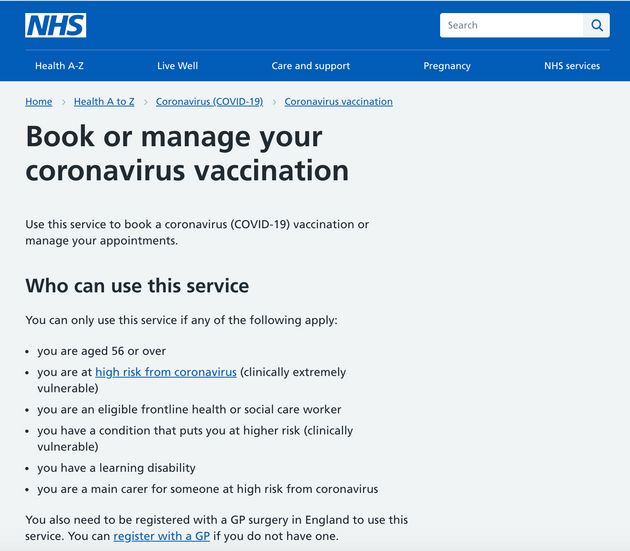
People aged between 56 and 59 years old can now book their Covid-19 jab online. 

While the rollout to a new age bracket has not yet been formally announced by the government, the NHS booking site now allows people over 56 to pick an appointment for their first and second doses of the vaccine. 

https://www.nhs.uk

A screenshot of the NHS Covid-19 vaccine booking page.

Over 56′s fall into category eight of the Joint Committee on Vaccination and Immunisation (JCVI’s) vaccine priority groups though this category also includes those aged 55, who are not currently eligible to book a jab according to the site. 

Those age 56-and-over can now book alongside people who are deemed both  extremely clinically vulnerable and clinically vulnerable to Covid-19, frontline health and social care workers, people with a learning disability and people who act as a main carer to someone at high risk from Covid-19.

While the expansion of the roll out hasn’t been formally announced, it appears that a number of newly-eligible people have already booked online after seeing the change reported on social media sites such as Twitter. 

It emerged on Friday that more than a million people in England had now had their second dose of the Covid-19 jab, completing the course of immunisation. 

A total of 1,034,068 second doses had been given by March 4, according to the latest figures from health agencies in the four nations.

Of those, 729,265 were given to people in England, along with 154,819 in Wales, 108,197 in Scotland and 41,787 in Northern Ireland.

Margaret Keenan became the first person in the world outside of a clinical trial to be vaccinated at Coventry Hospital on December 8. 

Public Health England said on Friday that 21,358,815 people have now received at least one dose.

Share Button