Should schools be teaching children to toughen up?


Should schools be teaching children to toughen up?
The British Medical Association, which represents doctors, said the increase was “derisory”.
From dolphin, to glass and cloud skin, the biggest viral skincare trends of the moment have one thing in common: supreme hydration. But how do you deliver moisture in a way that enhances your skin’s appearance and health?
Here we deep dive into these three looks and how you can create them with the Kiehl’s skincare range. A beautifully dewy complexion for 2025? It may be easier than you think.
While each trend is subtly different, they all require maximum moisture. For Dolphin Skin, think super glossy makeup looks that start with a well-hydrated skincare base. The glow comes from the skin’s natural radiance enhanced with soft makeup such as liquid blush and an illuminator.
Glass Skin is all about super dewy, hydrated skin that’s lit from within with radiance. It does take some dedication routine-wise, requiring cleansing, exfoliating, and deep hydration with a serum and moisturiser.
The newest trend, Cloud Skin, is a softer take on the glass look. The same principles of well-maintained, ultra hydrated skin prevail, but the end result is slightly more matte and velvety. This can be achieved with a light moisturiser and soft makeup such as a mattifying BB cream or foundation. Dust shinier areas with translucent powder, while maintaining an element of dewiness.
Creating a super-hydrated skincare routine
So how can you create these beautifully dewy looks in real life? To find out, we spoke to Gerwyn Slater-Powell, Education Manager at Kiehl’s, and Elena Brayda-Bruno, Brand Business Director at Kiehl’s.
Step one: Cleanse away impurities
“To create glass, dolphin or cloud skin you need a strong, layered, skincare routine,” says Elena. For a cleanser, opt for something gentle yet effective at removing impurities. “If you strip your skin too aggressively, products you use afterwards will not work as they should,” Elena explains. This can compromise the skin barrier, leaving it susceptible to dryness, irritation, and sensitivity.
Step two: Exfoliate gently
“For glass skin you want supreme hydration, a healthy skin barrier and improved texture,” says Gerwyn. “Exfoliation is key. Depending on your skin type and condition, you could use a traditional scrub. My preference, however, is a gentle chemical peel like the Kiehl’s Milk Peel Toner.” This dual-action product contains Lipo Hydroxy Acid, almond milk, and 23 per cent emollients to lightly exfoliate the skin, remove dead skin cells and dissolve impurities. Vitally, it also replenishes moisture to keep the skin barrier strong. “Alternatively, you could use our Triple Acid Peel which is gentle enough to use daily.”
Step 3: Apply a hydrating serum
Once the skin is prepped and primed, start supercharging hydration. “At Kiehl’s, our serums help give skin a plumper look and feel, improve the appearance of texture instantly and quench your skin’s thirst,” says Gerwyn.
Kiehl’s Hydro-Plumping Re-Texturizing Serum Concentrate is an efficacious hydrating serum that helps visibly plump skin to smooth the appearance of fine lines and uneven skin texture. “It’s filled with Epidermal Hydration Filler to give it a plump appearance,” says Gerwyn. “The formula visibly improves the appearance of dehydrated skin brought on by a decline in skin’s natural Hyaluronic Acid levels while helping improve elasticity. It acts like your natural hyaluronic acid within the epidermis – what we refer to as ‘plumping up the pillow’ – whilst hydrating, for a long-term, cumulative effect.”
Kiehl’s Ultra Pure Hyaluronic Acid Serum is suitable for dry and sensitive skin types. Formulated with a concentrated 1.5% Hyaluronic Acid and with just seven ingredients to help your skin bounce back with replenishing moisture and intensive hydration. “Applying this in concentrated amounts twice daily can help improve texture and give a plump look and feel while strengthening the skin barrier.”
Step 4: Lock in hydration with a moisturiser
While serums deliver hydrating, radiance-boosting ingredients to the epidermal layers of the skin, a cream adds moisture to the surface. The key is picking the right one for your skin type.
“Dry skin needs a cream packed with nourishing ingredients,” Gerwyn says.
“Kiehl’s Ultra Facial Cream strengthens the skin barrier and keeps it supremely hydrated, via a concentration of squalane, a humectant that nourishes and conditions the skin barrier.” Squalane is naturally present within our skin but when applied topically within our formula, it helps lock moisture in.”
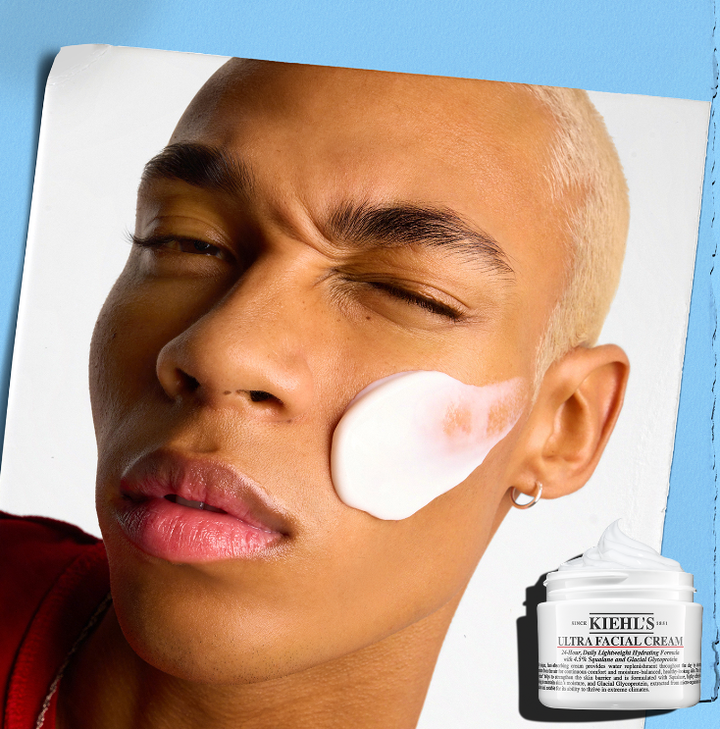
“Then there is Glacial Glycoprotein, which we ferment in our labs. Found naturally on glaciers in Greenland, it can cope in frozen, arid and dry environments while locking in water, providing skin with a natural defence to seasonal weather shifts. Our formula, containing all these key ingredients, combines to give up to 72hr hydration.”
For oilier skin types, moisturiser is still essential for keeping the skin barrier healthy, but the formula should be lightweight and oil-free, such as Kiehl’s Ultra-Facial Oil-Free Gel Cream. “If you struggle with blemishes, this is a great option,” Gerwyn says. As well as Glacial Glycoprotein, this contains Micronised Amino Acid. The formula reduces the appearance of sebum to help minimise pores.
For men, Gerwyn recommends Kiehl’s Facial Fuel Moisturiser, which contains Vitamin C, caffeine and chestnut extract. “In general, men’s skin is thicker, oilier and perspires more,” he explains. “Facial Fuel has been carefully formulated to create a lightweight product that’s easily absorbed, won’t irritate after shaving, and leaves skin with a hydrated, energised feel.”

Step five: Finish with eye cream and SPF
If the skin around your eyes is prone to dryness, it’s best to use a targeted treatment such as Kiehl’s Avocado Eye Cream. “This is like Ultra Facial Cream for your eyes,” says Gerwyn. “This formula with caffeine helps to minimise the appearance of dark circles and tiredness of eyes with a pop of energy,” he explains. “The key callout in our formula is the avocado oil that strengthens the skin barrier whilst hydrating this delicate area. It also works incredibly under-make-up”. Gerwyn advises taking a rice-grain sized amount, and emulsifying the formula between your fingertips to transform it to a lightweight water-like texture. Gently press around the orbital bone, avoiding the eyelid.

The final step in any morning skincare routine? A generous-sized amount of broad-spectrum sunscreen to the face, neck and decolletage to protect the skin against cumulative UV exposure. “My recommendation is SPF 50,” says Gerwyn.
As with any new routine, don’t forget that the secret is in consistency and using products suited to your skin type. Dewy, radiant skin? It’s just a few steps away…
Discover the full hydrating skin and body care range at Kiehl’s



Two men under the care of the same NHS trust as Valdo Calocane carried out stabbings weeks before the Nottingham attacks.

Self-driving cars which eliminate traffic jams, getting a healthcare diagnosis instantly without leaving your home, or feeling the touch of loved ones based across the continent may sound like the stuff of science fiction.
But new research, led by the University of Bristol and published today in the journal Nature Electronics, could make all this and more a step closer to reality thanks to a radical breakthrough in semiconductor technology.
The futuristic concepts rely on the ability to communicate and transfer vast volumes of data much faster than existing networks. So physicists have developed an innovative way to accelerate this process between scores of users, potentially across the globe.
Co-lead author Martin Kuball, Professor of Physics at the University of Bristol, said: “Within the next decade, previously almost unimaginable technologies to transform a wide range of human experiences could be widely available. The possible benefits are also far-reaching, including advances in healthcare with remote diagnostics and surgery, virtual classrooms and even virtual holiday tourism.
“In addition, there is considerable potential for advanced driver assistance systems to improve road safety and industrial automation for greater efficiency. The list of possible 6G applications is endless, with the limit just being human imagination. So our innovative semiconductor discoveries are hugely exciting and will help drive forward these developments at speed and scale.”
It is widely acknowledged that the shift from 5G to 6G will demand a radical upgrade of semiconductor technology, circuits, systems, and associated algorithms. For instance, the main semiconductor components involved, in other words the radio frequency amplifiers made from a wonder conductor called Gallium Nitride (GaN), need to be much quicker, emit greater power, and be more reliable.
The team of international scientists and engineers has tested a new architecture, catapulting these special GaN amplifiers to unprecedented heights. This was achieved by discovering a latch-effect in GaN, which unlocked a much greater radio frequency device performance. These next generation devices use parallel channels which then require the use of sub-100nm side fins — a type of transistor which controls the flow of current passing through the devices.
Co-lead author Dr Akhil Shaji, Honorary Research Associate at the University of Bristol, explained: “We have piloted a device technology, working with collaborators, called superlattice castellated field effect transistors (SLCFETs), in which more than 1000 fins with sub-100 nm width help drive the current. Although SLCFETs have demonstrated the highest performance in the W-band frequency range, equating to 75 gigahertz -110 GHz, the physics behind it was unknown.
“We recognised it was a latch-effect in GaN, which enables the high radio frequency performance.”
The researchers then needed to pinpoint exactly where this effect occurred, by simultaneously using ultra precision electrical measurements and optical microscopy, so it could be further studied and understood. After analysing more than 1,000 fins findings located this effect to the widest fin.
Prof Kuball, who is also Royal Academy of Engineering Chair in Emerging Technologies, added: “We also developed a 3D model using a simulator to further verify our observations. The next challenge was to study the reliability aspects of latch effect for practical applications. The rigorous testing of the device over a long duration of time showed it has no detrimental effect on device reliability or performance.
“We found a key aspect driving this reliability was a thin layer of dielectric coating around each of the fins. But the main takeaway was clear — the latch effect can be exploited for countless practical applications, which could help transform people’s lives in many different ways in years to come.”
Next steps for the work include further increasing the power density the devices can deliver, so they can offer even higher performance and serve wider audiences. Industry partners will also be bringing such next generation devices to a commercial market.
Researchers at the University of Bristol are at the forefront of improving electrical performance and efficiency in a wide range of different applications and settings.
Professor Kuball leads the Centre for Device Thermography and Reliability (CDTR), which is developing next generation semiconductor electronic devices for net zero, and for communications and radar technology. It also works on improving device thermal management, electrical performance and reliability, using wide and ultra-wide bandgap semiconductors.
In his diaries, Lord Vallance wrote that ex-PM thought rules were not ruthless enough.

New research examining 11,700 years of bowhead whale persistence throughout the Arctic projects that sea ice loss due to climate change will cause their habitat to severely contract by up to 75 per cent.
An international team led by researchers from the University of Adelaide and the University of Copenhagen reconstructed an 11,700-year ecological baseline for bowhead whales, which are a threatened Arctic native species.
Using computer models, fossils, and whaling records, the team mapped the location and size of suitable summer foraging habitat for bowhead whales over the entire Holocene, finding that until recently it remained constant despite significant climatic fluctuations.
However, they predict that future climate change will erode somewhere between 65-75 per cent of this foraging habitat by the end of the 21st century. In the Sea of Okhotsk, which is home to one of only four populations of bowhead whales, viable summer habitat is likely to vanish entirely by 2060.
The reason for the decline is the collapse of a tight association between bowhead whales and summer sea ice cover.
“Bowhead whales have preferred to forage amongst sea ice for many millennia,” said lead author Mr Nicholas Freymueller, from the University of Adelaide’s Environment Institute and the University of Copenhagen’s Globe Institute.
“However, Arctic sea ice has declined significantly in recent decades, and this is set to accelerate in coming decades, causing habitats where bowhead whales currently congregate in large numbers to be lost.”
The team also found that the few patches of suitable bowhead habitat predicted to remain in the year 2100 will exist outside their current distribution, directly impacting conservation policies.
“By identifying the extent and location of bowhead whale habitat that is likely to be lost in coming decades, our projections provide vital information to guide future management efforts of this emblematic species,” said Professor Eline Lorenzen, from the University of Copenhagen’s Globe Institute.
Bowhead whales are still recovering from four centuries of commercial whaling. They are considered emblematic because the ongoing threats they face are reflective of those which all Arctic marine mammal species face due to climate change.
“By using ecological models and paleo-archives to reconstruct pre-whaling distributions of bowhead whales, we were able to develop a much stronger understanding of the habitat preferences of this species that was nearly hunted to extinction,” said senior author Associate Professor Damien Fordham, from the University of Adelaide’s Environment Institute.
“This gives us improved confidence in our projections of habitat loss.”
The study, published in Ecology and Evolution, shows how past perspectives can strengthen predictions of species’ future vulnerability to rapid ocean warming.

Astronomers have observed a massive and extremely active barred spiral galaxy in the early Universe and found that it has important similarities and differences with modern galaxies. This improves our understanding of how barred spiral galaxies, like our own Milky Way Galaxy, grow and evolve.
Some spiral galaxies, including the Milky Way, exhibit a straight bar inside the spiral pattern. This bar structure helps channel gas towards the center of the galaxy where it can be used to form new stars. But why bars form in only about half of spiral galaxies, and how they influence the evolution of the galaxy are unanswered questions.
To study the evolution of spiral galaxies in the early Universe, researchers led by Shuo Huang, a project researcher at the National Astronomical Observatory of Japan and Nagoya University, used the Atacama Large Millimeter/submillimeter Array (ALMA) radio telescope to observe a massive barred spiral galaxy known as J0107a that existed 11.1 billion years ago. Located in the constellation Cetus, J0107a is a “monster” galaxy, meaning a galaxy growing rapidly in the early Universe by forming many new stars. Because they are located far away, it has been difficult to see the detailed structure of monster galaxies and determine what is driving this vigorous star formation. Recently the improved resolution provided by the James Webb Space Telescope has revealed spirals and even bars in some of the monster galaxies. J0107a is the earliest and most massive barred spiral galaxy known to date, so it is the best target for studying the evolution of barred spiral galaxies in the early Universe.
The team found that in J0107a the distribution and motion of gas in the bar is similar to modern galaxies. But compared to modern galaxies, the concentrations of gas are several times higher and the speed of the gas flow is faster, reaching several hundred kilometers per second. Astronomers believe that this massive influx of gas to the center will fuel signification additional star formation, helping to drive the evolution of this monster galaxy. This is the first time these features have been observed, and they were not predicted by theoretical or simulation models.
Huang comments, “We expect that the detailed information about the distribution and movement of gas gained through these observations will provide important clues for exploring not only the origins of the diversity of galaxies, but also the formation and evolution of more normal barred spiral galaxies.”

The puzzling behaviour of Titan’s atmosphere has been revealed by researchers at the University of Bristol for the first time.
By analysing data from the Cassini-Huygens mission, a joint venture between NASA, the European Space Agency (ESA), and the Italian Space Agency, the team have shown that the thick, hazy atmosphere of Saturn’s largest moon doesn’t spin in line with its surface, but instead wobbles like a gyroscope, shifting with the seasons.
Titan is the only moon in the Solar System with a significant atmosphere, and one that has long captivated planetary scientists. Now, after 13 years of thermal infrared observations from Cassini, researchers have tracked how Titan’s atmosphere tilts and shifts over time.
“The behaviour of Titan’s atmospheric tilt is very strange!” said Lucy Wright, lead author and postdoctoral researcher at Bristol’s School of Earth Sciences. “Titan’s atmosphere appears to be acting like a gyroscope, stabilising itself in space.
“We think some event in the past may have knocked the atmosphere off its spin axis, causing it to wobble.
“Even more intriguingly, we’ve found that the size of this tilt changes with Titan’s seasons.”
The team studied the symmetry of Titan’s atmospheric temperature field and found that it isn’t centred exactly on the pole, as expected. Instead, it shifts over time, in step with Titan’s long seasonal cycle — each year on Titan lasts nearly 30 years on Earth.
Professor Nick Teanby, co-author and planetary scientist at Bristol said: “What’s puzzling is how the tilt direction remains fixed in space, rather than being influenced by the Sun or Saturn.
“That would’ve given us clues to the cause. Instead, we’ve got a new mystery on our hands.”
This discovery will impact NASA’s upcoming Dragonfly mission, a drone-like rotorcraft scheduled to arrive at Titan in the 2030s. As Dragonfly descends through the atmosphere, it will be carried by Titan’s fast-moving winds — winds that are about 20 times faster than the rotation of the surface.
Understanding how the atmosphere wobbles with the seasons is crucial for calculating the landing trajectory of Dragonfly. The tilt affects how the payload will be carried through the air, so this research can help engineers better predict where it will touch down.
Dr Conor Nixon, planetary scientist at NASA Goddard and co-author of the study, added: “Our work shows that there are still remarkable discoveries to be made in Cassini’s archive.
“This instrument, partly built in the UK, journeyed across the Solar System and continues to give us valuable scientific returns.
“The fact that Titan’s atmosphere behaves like a spinning top disconnected from its surface raises fascinating questions — not just for Titan, but for understanding atmospheric physics more broadly, including on Earth.”
The team’s findings contribute to a growing body of research suggesting Titan is not just Earth-like in appearance but an alien world with climate systems all its own, and many secrets still hidden beneath its golden haze.
This April, the UK Supreme Court ruled that the legal definition of a woman within the Equality Act of 2010 is a person who was born biologically female.
At the time, The Good Law Project said the move “sets a dangerous precedent and erases trans women from protections” and “puts trans rights back 20 years.”
Advertisement
Though Baroness Kishwer Falkner, chair of the Equality and Human Rights Commission, said that trans “rights must be respected” after the ruling, some see the actions that have taken place since as going against that message.
Falkener has also suggested that trans rights groups should push for a separate “third space” when seeking a bathroom or changing room.
As a result, trans advocacy organisation TransActual UK has revealed an installation outside the UK Supreme Court called a “Third Toilet,” created by BBH London.
Advertisement

Rhiannon Adam / TransActual / BBH
In a press release, Hafsa Qureshi, a director of TransActual UK, said: “The Supreme Court claimed it brought clarity to an area of difficulty” with its April ruling.
“However, it did the exact opposite while also diminishing the rights or status of trans people in the UK.”
Advertisement
They continue, “This campaign is a powerful statement about being forced to exist without safety, privacy, and rights, in full view of a society that refuses to see us; a demand for legal clarity, human dignity, and real, lived safety for all trans people; and an attempt to put pressure on public policy makers to ensure they are answering questions and, ultimately, are held to account.”
Meanwhile, Olivia Campbell Cavendish, a founder and executive director of the Trans Legal Clinic, says that we “need to move the conversation on from ridiculous things like bathrooms and onto the things that matter.”
Our focus, the founder said, should be on “the safety of trans people everywhere.”
Camila Gurgel and Ieva Paulina, associate creative directors at agency BBH, which made the “third toilet” installation, say that the aim was to gain back control of the conversation.
Advertisement
“The trans community was left out of a decision that directly impacted their lives,” they said (The Good Law Project, among others, says that the Supreme Court did not listen to trans voices in the lead-up to their ruling).
“So we set out to create something that will help their voices be heard and their demands recognised.”
Their hope, they say, is that the third Toilet installation “sparks awareness, conversation, solidarity and inspires more people to stand with the trans community.”
Advertisement