Heartstorming

Heartstorming is brainstorming with the heart (or the emotional part of your brain).

The mental kind of brainstorming is good for generating problem-solving ideas. It’s useful for mapping out the logical space of solutions. Generate lots of ideas, and sift through them to pick the best ones.

That kind of brainstorming, however, is terrible for setting goals and priorities, especially big picture goals for your life.

That’s because you can’t set priorities dispassionately. Goals are emotional in nature. The logical brain doesn’t distinguish between the value of brushing your teeth versus transforming someone’s life. You have to feel your way into priorities.

Evaluating Options

How do you evaluate options on a brainstorming list? You’ll likely evaluate them based on effectiveness, practicality, or impact – or something along those lines.

To evaluate options on a heartstorming list, look for emotional resonance. Look for passion, excitement, playfulness, love, joy, silliness, connection, scariness, etc. Look for ideas that rile you up and make you want to take action. Look for ideas that might scare or embarrass you. Notice which ideas keep drawing your attention, even if they seem a bit ludicrous.

What if none of your ideas are like that? Then you suck at heartstorming. That’s okay. Lots of people suck at this because many of us are taught a different way of thinking that gets in the way of heartstorming. We learn to silence the voice of our hearts. Big mistake… but we can correct that.

Young children tend to be naturally good at heartstorming. Ask a kid what they want for a gift. Then listen to their answers. Are they brainstorming or heartstorming? You’ll probably see mostly heartstorming, including answers that may be impractical or illogical but which clearly have some emotional resonance.

You probably knew how to do heartstorming when you were very young. Did you lose touch with this skill? Have you forgotten (or overlooked) the value of doing this as an adult? How’s that working out for you?

The Value of Heartstorming

I rely on heartstorming more than brainstorming for making decisions about what to do with my life. I imagine what would be fun, fascinating, courageous, a little bit insane, growth-oriented, social, creative, and so on. I look for emotional resonance. Then I pick something that fascinates me, and I push my brain to get with the program. My brain almost always objects initially – it’s stubborn that way – but the heart is very powerful when it leads.

A brainstormed goals list would include things like making a certain amount of money. That’s boring as hell, Mr. Scrooge. It’s logical, but why should the heart care? It probably doesn’t care. So where will the fire come from? Your motivation to act will probably evaporate as soon as you set a goal like that. Your money goal just makes everyone yawn.

A heartstormed goals list will include weird and wild ideas that you’re afraid to share with other people. But some of these goals will excite your heart anyway. And if you describe them to other people, their brains will likely reject those goals, but their hearts may feel some resonance. And if they’re really in tune with their hearts too, they may even encourage you to go for it.

One of my heartstormed goals is to visit every Disney theme park in the world with my wife. We’ve been to all six USA parks, so we have six left: Paris (2), Hong Kong, Shanghai, and Tokyo (2). Is this a logical goal? Nope! It just sounds like fun. So we’ll probably do it (when it’s safe to do so). We’ve been to Paris twice before, so it would be a simple matter to pick that one up, but this goal will also get us to visit Asia finally.

I especially love that I have a wife who enjoys working on heart-based goals and having heart-based experiences together. That’s a special kind of joy when I can share a wild idea with her, and her reaction is basically, “You had me at hello.”

Heartstormed goals that feel emotionally resonate are easier to act on. Motivation is emotional, so if you lean into the emotional aspects, it’s way easier to flow into action.

What’s also great about heartstormed goals is that because action is easier, you can achieve more goals. Additionally, you’ll pick up some head-based goals that come along for the ride; they’re easier to achieve when you use a heart-first approach.

I like to pick fun and interesting projects that also happen to generate income, as opposed to setting income-based goals. I do my best to make the income-generating parts fun too. One day I earned $30K while spending a day at Disneyland with my wife. Doing an online launch while going to Disneyland isn’t a logical goal, but it is fun and motivating. I enjoy the silliness of it. And oddly it’s easier for me to earn money in ways that are silly or unusual.

Brainstormed goals make your brain lazy. Your brain will come up with the most dreadfully dull and predictable ideas that you probably aren’t going to implement anyway.

But if you assign idea generation to your heart, it will fill up your list with wild and crazy ideas, some of which will indeed be stupid, but others will be fun and worthwhile. The best ideas will challenge your brain to stretch creatively. They’ll expand your conception of what’s possible. They’ll wake you up.

Would you rather earn an extra $30K by slaving away at some corporate job for however long that takes? If so, keep generating ideas from your headspace. For the heart, earning an extra $30K is a fun and silly goal – pretty easy when you’re motivated and creative.

Would you rather put your heart in charge of your project choices and demand more from your brain? Why the hell can’t you earn $30K in a day while going in rides at Disneyland? And do this with your best friend and lover that you enjoy spending time with? Create fun memories together, and get paid for the experience. With the heart there’s no compromise. You get enjoyment and results. You get a full, rich, and balanced life.

The logical brain generates embarrassingly crappy priorities – so uncreative, unambitious, and uninspiring.

When you do heartstorming, you’ll probably be laughing and crying along the way. Sometimes you’ll get scared by an idea. You should FEEL something as you generate ideas. The emotion should get stronger as you dive deeper into heartspace.

How to Heartstorm

Give this a try. It’s very easy, but it does take practice.

Open a new page in your journal. Write at the top what kind of list you want to make. Then start typing or writing ideas. But instead of focusing on your brain to generate ideas, put your attention on your heart. Go into your heartspace, and listen from there. Invite your emotions to speak. Tell your logical brain to shut up for a while. Invite your heart to generate ideas.

Pretend you’re four years old again. You can do this. It’s a no-brainer. 😉

Share Button

Goals of Being

Many years ago one of my goals for public speaking was to design and deliver my own three-day workshop on the Las Vegas Strip. I first achieved that goal in 2009. That was a goal of doing.

Another goal I had for public speaking was to develop such strong comfort with public speaking that I could feel fully present in front of an audience, so I could be spontaneous and in the moment and not feel anxiety or nervousness – just enjoyment, fun, playfulness, and connection. I achieved that goal somewhere along the way. I demonstrated it at the three-day 2015 Conscious Heart Workshop, delivered spontaneously with lots of fun, playfulness, and inspiration in the moment – and no nervousness or anxiety. There was no plan or content preparation for that workshop. I facilitated it from the flow of inspiration and audience suggestion moment by moment. That was a goal of being.

At another time I had a goal of writing a book and getting it published. That was achieved in 2008. More doing.

But I also had a goal of writing that book in a way that I could always feel really good about it, and I wouldn’t feel like I’d outgrown it a decade or two later. I wanted to have a timeless relationship with that book and its principles throughout my life. More being. I still feel such a connection to that book, now 12 years after it was published.

The culture that I find myself within gives a lot of weight to doing and not enough to being. Pursuing goals “at all costs” is lauded by many. But we pay a price for this focus – a loss of connection to being.

When you set goals for the New Year (or anytime really), give some attention to the beingness aspects, not just to your activities and results.

Beingness is surprisingly powerful. A lot of doingness takes care of itself if you invest in the right experience of beingness.

Results of Beingness

Here are some examples of goals that I’ve achieved that have enhanced my life greatly, which have more to do with being than doing.

  • I’m in a long-term relationship with a woman who makes me smile when I see her. We laugh together every day. Even after spending so much time together, especially this year, I still look forward to more time with her.
  • My vegan diet forever changed the way I relate to animals. I look upon them with a sense of fellowship and reverence, not as objects to be bought and consumed.
  • I have written millions of words of published content, but for me the more important goal was learning to write from inspiration. I never get writer’s block. That’s due to trust, not because of self-discipline. I don’t have to force anything. I’ve learned how to invite, tune into, and trust the flow. With the right beingness, the doingness is relatively easy. Most of the content I’ve written, including all of my blog articles and YouTube videos, are donated to the public domain, so anyone is free to republish, repurpose, or translate them.
  • I’m happy. I like my life. I look forward to each day. I often feel appreciative and grateful and lucky, not as some kind of deliberate practice but just as an automatic inner response. I’ve made it a priority to live my life in such a way that these feelings naturally arise. I say no to a lot of doing-based projects that would predictably reduce my happiness. I say yes to invitations and activities that will predictably increase my happiness. And I test that predictability now and then to see if my predictions are still accurate.
  • I get up at 5am each morning. This doesn’t require any force. I’m simply in love with the early morning hours. I seem to have a special relationship with that time of day. It’s that relationship that makes it easy to get out of bed – no force or discipline needed.
  • I feel that I have a healthy and positive relationship with money. I enjoy earning it and find it fairly easy to earn plenty of it when I want. I like spending it too. I like saving it. I invested a lot of thought and experimentation into improving my relationship with money – to drive out the fears and worries about it and to replace those fears and worries with play, trust, creativity, appreciation, inspiration, and other positive aspects of beingness. I used to struggle with money during my 20s, and that struggle didn’t occur during my 30s and 40s. This was solved not with more doing but with better being.
  • I have friends who inspire me to be a better person. I find that such people naturally flow into my life and stick around, not from working on my action-based social skills but from deepening my connection to the person I really want to be in each moment. When I express my beingness in the moment, people who are aligned with me seem naturally attracted to me. I also find it beautiful, remarkable, and empowering when someone else really expresses their beingness. It makes me feel in awe of that person. I tend to feel more awe from a person’s beingness rather than from their actions and accomplishments.

I tend to value my gains in beingness more than my gains in doingness. That’s because the right beingness makes the doing part easier and more fun.

Setting Goals of Being

I encourage you to actually set some goals of being. They may look like doing-based goals on the surface, but how you experience them is at least as important as the doing part. So the goal is really about the presence you bring to the experience.

Here are some examples:

  • Deliver a one-hour presentation with zero nervousness or anxiety.
  • Learn to enjoy doing your taxes that you file them at least a few weeks ahead of the due date. Find a way to fully enjoy the process with little or no resistance.
  • Earn $10K in one day, in a playful and inspired way. Form the intention, and then act on the flow of inspiration moment by moment. This seems like it’s about the doing, but it’s really about working through self-limiting beliefs and creating a more playful and inspired relationship with reality. You have to stop the self-censoring and self-doubt and learn to “yes, and” the ideas that flow through. This goals is nearly impossible if your relationship with inspiration is weak. It can be fun do it if that relationship is strong. You might even set such a goal and then find that you’re getting redirected towards an even better or bigger goal.
  • Prepare and eat a meal that’s super healthy, super delicious, and feels delightful to prepare it, eat it, and digest it. This requires that you really listen to how you’re connecting with the food during each step. And then you must be present to how your body is experiencing the food after you’ve eaten it.
  • Become a hugger. Become a person who gives and receives willing hugs, maybe even every day. Create a life rich in consensual touch. Oh, this was an amazing one to achieve, given my starting point. It took years to get there, but it was so worth it.
  • If you start a blog, YouTube channel, podcast, or something similar, define what kind of relationship you want to have with the many loops of creating and publishing new material that you’ll experience. What I’ve found helpful is that the process must be a growth experience for me; otherwise I’ll get bored and resist it. I also have to write for people I care about helping. This is more important than traffic or numbers. I need to love the process of creation. If I don’t love it, it means the beingness is wrong, and I need to approach it differently.
  • Make a really good, new friend. Good luck with turning this into a step-by-step action plan. With the right beingness though, this one is a lot easier. What makes you a good friend? Are you being that kind of person consistently?

So don’t just consider the what aspect of your goals. Pay great attention to the how and the why. Consider what kind of life you’re creating. Look at the inner experience of what it will be like to achieve your goals one way versus another way. There are so many ways to achieve results externally, but many approaches won’t feel very aligned or pleasant on the inside.

When you ignore the beingness aspect of a goal, you’ll likely sabotage the doingness part as well. It’s hard to take action when you’d rather procrastinate. If you’d rather play video games, how can you bring the beingness aspect that you enjoy while gaming into your other goals? What kind of player are you being in those game worlds? Are you being that player in other areas of life?

One sign that I have the beingness right is that I smile warmly when I think about my goals. It makes me happy to think about doing them. I look forward to working on them day by day. I’m not just motivated by the end result. I can savor the journey as well.

Share Button

Your Exploration Baseline

When you explore something new, you’re exploring relative to a previous baseline.

When you explore a new diet, your baseline is your previous way of eating.

When you explore a new travel-rich lifestyle, your baseline is your previous stay-at-home lifestyle.

When you explore a new relationship and you weren’t in a relationship right before, your baseline is being single.

Your default baseline is your normal, usual, routine, or expected experience in that particular area of life. Your baseline is your status quo.

But does that have to be your baseline?

If exploration is relative to your baseline, what would happen if you changed your baseline first?

Moving Your Baseline

We can compare the year 2020 to the previous baseline of 2019. That comparison will surely make the COVID situation stand out. We could also compare 2020 to the baseline of 2015, and that may serve to further highlight the political differences. And if we used 1943 as our baseline, the year 2020 might seem like a relatively quiet and peaceful year.

It makes sense to interpret change relative to what came immediately before, but in the context of personal growth, you have the ability to change what comes before your explorations. You have the ability to redefine and establish new baselines.

You can use your current circumstances as your point of reference for further exploration. But you also have the power to establish very different baselines and to use those as your jumping-off points for further exploration. As it turns out, this can be immensely valuable.

For instance, if you want to travel throughout another country for an extended period, you could first establish a temporary “home base” in that country, such as by renting an apartment in one city there. Then you could use that base for further explorations, such as by taking excursions and trips to other parts of the country, always returning back to your new base each time. You base lets you live like a local for a while, giving you a different point of reference when exploring, so you aren’t in perpetual tourist mode.

Practical Explorations

Sometimes it’s easier, more useful, or more meaningful to explore from a different baseline instead of your usual default.

Here are some examples to get your mind churning on some possibilities:

Suppose you want to find your ideal wake-up time. You could start experimenting from your current baseline. Or you could become an early riser first, such as by getting up at 5am consistently. Make that your new baseline. See how that feels for a month or two. Then explore with different wake-up times to see how they perturb your results.

If your usual wake-up time is 9am, and you experiment with earlier wake-up times like 5am, 5:30am, or 6am, you may not notice much difference between them. But if you first establish 5am as your new baseline, you’re very likely to notice how different it feels in your body to get up at 5:30 or 6am. You’ll also have a new perspective on how it feels to stay up late.

Getting up at 5am consistently is my baseline. If I do any further sleep experiments, that’s my starting point. If I get up at 6am one morning, I’m sleeping in late because 5am is normal. If I experiment with doing anything “first thing in the morning,” it means I’ll be doing it before the sun comes up.

Suppose you want to improve your diet. You could experiment from your current diet, but that may not be nearly as useful as establishing a healthier baseline first. If your current diet is so-so, and you add in some healthier foods or subtract some unhealthy ones, you may not notice much difference. Add some celery and blueberries, and it may not even matter.

But suppose you establish your baseline to be a vegan, whole foods diet – no animal products and no processed foods. Then you experiment around that, such as by adding back some of the items you were having before, one at a time to see how each one affects you. See how some crackers affect you. See how your body responds to caffeine. See how some cheese affects you (if you even find it appealing anymore). This will give you much more clarity about which foods are helping you and which are hurting you.

The cleaner, simpler, and purer your dietary baseline is, the easier it is to discern how different foods affect you and whether those affects are positive or negative.

I went wheat-free for many weeks and then had some wheat pasta this week. I noticed the difference in my body shortly afterwards, experiencing minor cold-like symptoms, mild congestion, and some brain fog for a few hours. I also felt extra calm and peaceful shortly after I ate it. If I eat wheat regularly, I don’t usually notice any reactions, but if I experiment against a wheat-free baseline, I can see how it affects me more easily.

What’s your baseline for cleanliness and order in your home? If you live in a cluttered environment, you may not even notice the results of some modest organization improvements. But if your baseline is to keep your place neat and tidy by default, then some minor tweaks may have noticeable affects.

Declutter Your Baseline

One nice improvement you can make is to declutter your baseline. You’ll often learn more by simplifying and cleaning up your baseline first, and then see what happens when you add complexity.

If, however, you start with a complex situation and shift from one form of complexity to another, or from complexity to relative simplicity, it’s hard to identify clear and crisp lessons. You won’t be able to tell which specific changes are having the biggest impact. You won’t know where the key leverage points are.

It’s hard to tell what’s dragging you down or holding you back when your entire baseline is filled with issues that could be contributing to those affects. It could take a long time to isolate and identify problems when you have a dozen overlapping problems interacting with each other. But if you could first establish a relatively problem-free baseline, then you could selectively add back some complexity and immediately see when you cross back into problem space.

Upgrade Your Baseline

Another empowering way to use baselines is leverage them to elevate your routine experience, so you’re always returning to a pretty good default situation.

How happy are you with your current baselines in these areas?

  • Relationship situation
  • Social life
  • Diet
  • Exercise habits
  • Cleanliness
  • Productivity
  • Workspace
  • Income generation
  • Hobbies
  • Entertainment
  • Hygiene
  • Reading and education
  • Living situation
  • Travel
  • Creative expression

Raising your baseline takes time, but it’s a worthwhile investment. While it’s wonderful to have peak experiences now and then, you’ll spend a lot of your life living at your default baseline. So even if it takes a huge amount of effort to raise that baseline, it’s well worth it.

When I think back about some of the best decisions I’ve ever made, they often involved changes to my baseline in some area of life. They involved significant lifestyle adjustments, and some took years to reach, but they continue to provide ample rewards.

It’s especially wise to raise your baselines to the point where your everyday experience includes appreciation. A good question to ask yourself is: Do I appreciate my baseline in this area of life?

For instance, my income generation baseline is that I make money from fun, creative, inspiring, growth-oriented projects that improve people’s lives. Many years ago my old baseline included stress, scarcity thinking, acts of desperation, and focusing way too much on money instead of happiness, flow, caring, and trust. Notice that my current baseline is simpler and cleaner than the old one, especially without the clutter of stress, worry, and desperation – so much wasted energy. Note that trust, caring, and fun are much simpler – they do take more courage to implement, but they do not require more complexity.

Consider how much we complicate our lives just to avoid the simplicity of courage. What if courage was your baseline?

If you don’t like your baseline that much, why are you still there? Maybe it’s time to stop framing it as your current default. Be willing to drop a baseline that isn’t serving you well. A good baseline is a jumping-off point for further exploration, but it’s also a decent place to hang out between experiments.

Share Button

NaNoWriMo – Day 30

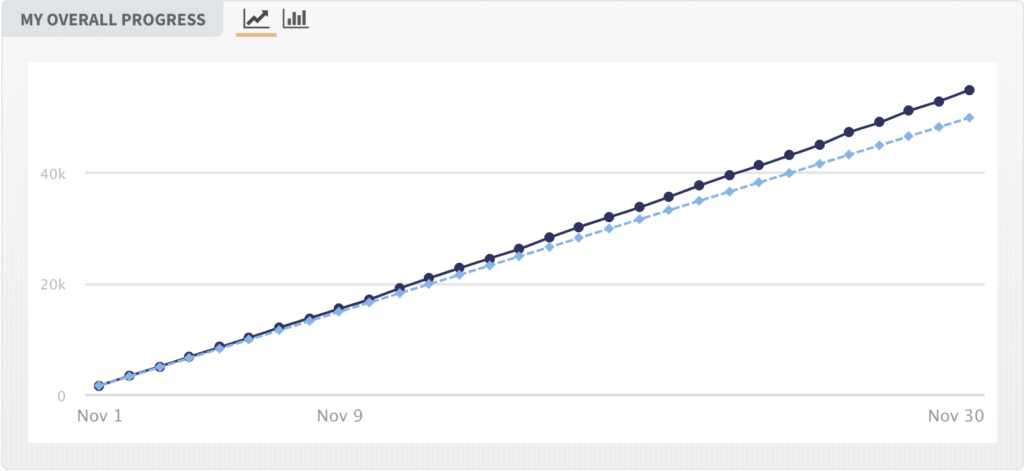
Today is the final day of NaNoWriMo. I added about 2000 more words to my novel-in-progress this morning. My final word count for the month came in at 55,051 words. The challenge of NaNoWriMo (National Novel Writing Month) is to write 50,000 words of a new novel in 30 days, so I exceeded this target by about 10%.

Here’s my daily progress log, showing my total word count (darker color) versus the daily pacing needed to hit 50K words (lighter color).

I surpassed the target pacing by a small amount on Day 1 and then padded my lead every day afterwards. It felt good to always be a little bit ahead throughout the challenge. I knew that if I just maintained this steady pacing, I’d never need to do any catch-up writing at the end.

Before starting this challenge, I learned that a major reason people fail at NaNoWriMo is that they fall behind in the first couple of weeks, and then they feel disheartened when facing the extra effort needed to catch up. Even skipping one day means you’ll have to write more in the remaining days. Most people who fall behind give up and don’t complete the challenge. This is an easily preventable point of failure.

My strategy was to approach this as a daily challenge, which plays to my strengths. I’ve done lots of 30-day challenges where I practice a specific behavior for 30 days in a row. In this case the desired behavior was to add at least 1667 words to my novel each day. If I just focused on that, the monthly goal would be accomplished too. It’s just typing after all.

Here’s what my daily word count looked like for all 30 days.

As you can see, I was pretty consistent throughout the month.

I averaged 1835 words per day, which works out to an extra 10% per day. Once I passed the 1667 words for the day, I kept writing till I felt like stopping, such as when I got to the end of a scene. If I felt like stopping but I wasn’t at 1667 words yet, I took a short break and then continued writing.

Final Reflections

This was a wonderful personal growth experience, and I’m glad I did it. The novel isn’t done and will need a lot of work to finish, but the daily writing got me well into the project.

I don’t have a completed book yet, and it would take a lot more work to drive this towards a version ready for publishing, but NaNoWriMo got me moving forward with meaningful progress. It helped me turn a mere idea into something a lot more tangible.

At this point I don’t have a completed story. I’ve written a first draft of many scenes. I have several well-developed characters. I have a well-structured three-act story with interesting plot twists. But there are still many more details to work out.

This is a very rough first draft. I’d say it’s not bad for a month’s work. I estimate that I averaged about 75 minutes per day of writing time (including thinking about what to write). I’m very pleased with how far I got for about 40 hours of effort. There was also some incubation time when I’d be thinking about characters or plot ideas while doing unrelated tasks.

The “words are cheap” mindset worked very well. It’s easy to throw words onto the screen, read them back the next day, and learn something useful. I’ll end up throwing away much of what I wrote this month, and I don’t lament that at all. Everything I wrote helped in some way. Each day I gained more clarity about the story, the characters, and the world. Even when what I wrote seemed like a chaotic mess, it still felt like forward progress.

Other writers have said that you write the first draft for yourself, not for anyone else. I adopted that mindset from Day 1, and I found it very helpful. I didn’t expect to show this early draft to anyone, not even Rachelle. So I just wrote whatever came to mind. It was my own personal exploration of the ideas and possibilities, nothing more. By framing it that way, I felt totally free to experiment and to make lots of mistakes. This helped me figure out what kind of story I wanted to tell. I let the words flow without any concern about who might read them.

One clear gain was that I understand my characters so much better than when I first started. Now I can write their words and actions much more easily, as if they tell me what they would say and do in every situation. So the writing got easier as I went along. The first few days were the most challenging; after that it was smooth sailing.

Another gain was that my “why” for writing this story improved as I kept writing. Around halfway through the month, I developed a stronger sense of purpose for why I wanted to write and share such a story. I had a more compelling answer to the questions: Why bother with this project? What’s the point? Who would want to read this? My purpose was more exploration-based in the beginning, but by the end I felt like I was creating something I really wanted to share with the world to see how it landed with people. I had a clearer sense of the story’s potential impact.

This was similar in some ways to designing a new video game from scratch, but the medium is very different. I liked how easy it was to explore the characters, story ideas, and world without having to deal with tech constraints. I could play around with any ideas I could imagine. I really enjoyed that type of experience – it was like pure play.

Most days I looked forward to my writing sessions. I didn’t experience much inner resistance after the first week, and that small resistance was just due to being too green at this type of writing. I think having lots of nonfiction writing experience – and a healthy willingness to make plenty of mistakes – was helpful. I never had writer’s block. I could connect with inspired ideas for fiction writing as easily as for nonfiction articles or courses.

Next Steps

I’m going to set aside the novel writing and coast into a more relaxed December since I want to focus on other aspects of life for the rest of the year. That includes finishing up my one-year daily blogging challenge, which has 31 days left to go.

Stephen King recommends setting aside a novel for at least 6 weeks after writing the first draft and then coming back it to fresh. He says it’s wise to get some distance from the story, so you can see it with fresh eyes before you start editing.

My first draft isn’t good enough that I can just edit it into a finished book. It’s way too messy for that, especially since there are a lot of scenes I’ll need to cut or rewrite differently. I’m still going to set this aside for 6+ weeks, probably until after our next deep dive is complete, but my next steps will different than Stephen King’s.

Sometime next year I’d like to revisit this novel project, re-read everything I wrote, and then begin working on a second draft. I’d like to do a round of more detailed plotting before I add more words to the book. I think the story would benefit a lot by clarifying the scene-by-scene layout.

The pantser approach was great for getting started since it helped me map out the possibility space for the story by writing a lot of scenes. Now I have enough understanding of the story and that characters that a good next step would be to map out the scenes for the story in the right order. I’d also like to fill out character and location sheets to fine-tune the characters and settings. Then I can write the second draft.

It’s going to be a long process, and I’m not in a rush to race through this. I do want to see this through to publishing. It’s an original story with some fun characters that I think people would enjoy reading. I might approach this project as a series of 30-day challenges to push it forward through different stages of development.

I’m especially happen that I framed NaNoWriMo in a way that made the experience enjoyable, especially by always being ahead of schedule. This makes me eager to re-engage with the novel when I’m ready. There are other priorities I want to engage with next, so I’m happy to put this aside for now, but I do look forward to getting back into it with fresh eyes.

Our Next Deep Dive

My first big priority for 2021 is to launch and develop our new creative productivity deep dive, which is tentatively called Amplify. This is for people who do creative work and want to increase their productive output. It’s also for people who’d like to get into a better creative flow. You could think of it as a course in how to be a prolific creator who publishes frequently. How can you express yourself creatively year after year without burning out?

I have tons to share about this topic that I believe would be unique and different from anything else out there. I’ve gone through many books and courses on creativity and on productivity, but I still haven’t seen really good coverage regarding connecting the dots between creativity and productivity. It’s like creativity is play, and productivity is work. There’s a lot of conflicting advice that treats creativity as inherently unproductive and productivity as inherently uncreative.

What if you want to excel at both together? What if you want to be a fountain of creative expression?

How can you be super creative and highly productive without sacrificing too much on either side? How can you get into the flow of creating and publishing – and stay there consistently without burning out?

There’s a lot to unpack here, and I’m convinced that this is an area where I can add some real value to people’s lives. I’ve created and published across many different media: articles, videos, podcasts, a book, video games, music, live events, and more. This year I’ve published something new every single day, adding hundreds of thousands of words to my collective work, which is already well into the millions of words, not counting translations into other languages.

I love to keep exploring new media too, such as I just did with NaNoWriMo. Partly I did NaNoWriMo as an experiment to test some of the ideas for this upcoming deep dive.

I’d love to do this new deep dive co-creatively too, like we did with our previous ones, so the lessons will be created as we go, designed for the specific needs of the people who enroll.

I haven’t decided on the exact the format yet. My intuition says it will likely be something different from our previous courses, perhaps a combination of live interactive parts along with structured audio lessons. People loved the audio format of Submersion and Stature, and there was also something special about the live sessions that we did for Deep Abundance Integration. So I’m thinking of merging those for the new deep dive. Would that appeal to you?

I’ll share more info on this new deep dive next year as we get closer to launching it. We’ll be launching it during the first quarter of 2021. I tend to get an intuitive ping when the timing is right for launching. In the meantime, I’d like to clear my plate of some other projects first, mostly on the personal side.

Share Button

NaNoWriMo – Days 24-29

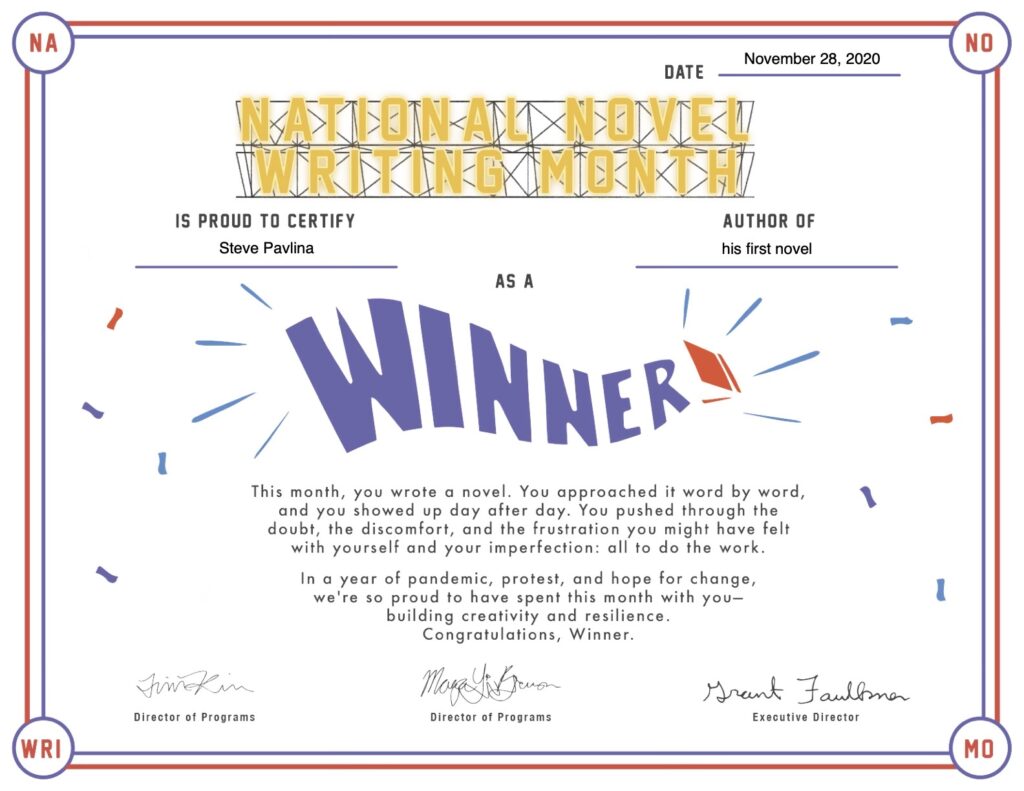
I crossed the 50K-word NaNoWriMo finish line yesterday morning, writing 51,262 words in 28 days, so I achieved this goal 2 days ahead of schedule.

When I updated my word count yesterday, I received a congratulatory video, a bunch of links to claim the NaNoWriMo “prizes” (discounted promotions for various writer tools and services), and this completion certificate.

The way I framed this goal, however, was to add at least 1667 words per day to the novel for the full 30 days, so I didn’t stop after 28 days. After this morning’s writing session (Day 29), the novel is at 53,007 words. So tomorrow I’ll likely land around 55K words for this 30-day challenge.

Completing NaNoWriMo

This was my first NaNoWriMo and certainly a good year to do it. It was a great way to get started on a fiction book. I’m way further along now than I would have been if I hadn’t signed up for Nano. It’s been a rewarding experience overall.

One aspect I found less exciting than I expected was connecting with the Nano community. I thought it would be cool to connect with other novelists during Nano, but I felt a bit disconnected from that aspect of the experience. I didn’t feel like connecting with other writers while working on my novel. I browsed through some of the community posts but largely found it to be a distraction from actual writing, so most days I just did the writing on my own.

I enjoyed the challenge more when I stuck with introvert mode. It may be nice to connect with other writers before or after Nano, but I wasn’t inspired to do that while in the midst of figuring out the novel. I felt more motivated to connect with the characters I was developing.

I had no trouble feeling motivated to write each day. I didn’t write at same time each day, but I normally got each day’s writing done before 10am, often before 8am.

Most people who sign up for Nano don’t finish, but I never had any doubt that I’d do it. I do my best to win 30-day challenges in my mind before Day 1, and Nano was no different. The same goes for 365-day challenges like my 2020 daily blogging challenge (which is more than 90% done now). If you combine the blogging with the Nano writing, I probably wrote around 75K words this month.

Overall the combined writing experience flowed pretty well. Some days I blogged first and then did Nano, some days I flipped the order. But usually I finished both in the morning. Last Monday and Tuesday, I also did some batch blogging, queuing up several posts in advance, so I could enjoy the 4-day holiday weekend with a bit less daily writing – that was extra nice.

Leveraging the Fundamentals

One thing I love about having a career focused on exploring personal growth is how much time I have to spend practicing the fundamentals and how nicely that investment pays off over time.

This helps me leverage what I’ve learned to explore something new and be relatively productive from the start – and have fun doing it. Even when I’m a total newbie diving into an area where I have tons to learn, it feels like I have some extra advantages going in. A big one is just knowing that I can trust myself to follow through.

I expect to run into some difficulties or surprises along the way, and I also expect that I’ll be able to handle them. I’ll take action, persist, and learn as I go. I’m not afraid of failure, and I don’t tend to have issues with perfectionism. I prefer to just go, explore, and experience.

I like to play life the same way I like to play video games. Rachelle and I are about halfway through the new Zelda game, Hyrule Warriors: Age of Calamity, and I like that the game rewards my style of play – Rush in headfirst and slash away at every obstacle like there’s nothing to fear. We also pace ourselves, playing a little bit each day instead of rapidly binging through the whole thing.

The point of playing games is to have fun. This is a good way to approach life experiences too, including writing a novel.

I saw so many people in the Nano community struggling in ways that aren’t specific to writing. They struggle with personal development basics like setting clear goals, establishing productive habits, adopting empowering frames, creating confidence, eating healthfully, and so on.

But most of all, they struggle with making the journey fun, engaging, and rewarding each day. They inject far more suffering into the experience than necessary. Then they try to exert more discipline to push through that self-created drag, which can be very draining. I saw a number of “I give up” and “I’m quitting” updates along the way, and it looked to me that those people had already lost before Day 1. They approached the challenge in a way that was doomed from the start.

I saw plenty of uptightness in the Nano community. Some participants got bogged down in over-analysis and perfectionism. I think they could progress faster if they lightened up and learned to reframe failure as part of the fun. Some play the game so tightly that they prevent much of the joy of discovery from flowing through. It’s like playing a video game with someone who’s deathly afraid of losing a life, so they make the game more work than fun.

I actually found it stressful to read some of the community posts, but it was a good reminder that a long-term investment in personal growth fundamentals really does pay nice dividends. When you don’t practice the fundamentals enough, you’re likely to experience a lot of friction whenever you try to do something outside your comfort zone.

Practicing the fundamentals isn’t always sexy, but it helps us grow stronger, more capable, and more flexible. What good does it do to train up your writing skills if you can’t get yourself to apply those skills consistently? What if you lack the courage to create something unique that adds value to people’s lives? What if you aren’t able to handle criticism?

You can soak up domain-specific knowledge and skills, but what’s the point if you can’t get yourself to use it to create results?

This Nano experience helped me appreciate just how valuable it is to keep investing in the fundamentals. They grant access to new life experiences that would otherwise seem too far out of reach.

Share Button

The Runway to a 30-Day Challenge

I often do diet experiments in the form of 30-day trials (or longer). I define a crisp plan to follow, and then I strictly adhere to those boundaries for the time of the experiment.

Usually before I begin a clearly defined challenge, I first go through a period of whittling away temptations. This phase typically begins a few weeks before the start of the challenge. During this time, I’ll identify the most tempting foods and gradually eat them till they’re gone. I try not to overdo it by binging on them. I just naturally let them run out at whatever rate I was eating them before. I stop replenishing those foods, so I won’t have them in the house to tempt me while I’m doing a stricter trial.

This isn’t always possible or practical, but it definitely helps in some cases.

It’s easier to do a caffeine-free challenge if there’s no hipster coffee left, and the only remaining source of caffeine in the house consists of some crusty bags of green tea leftover from hotels.

When I decided to do a grain-free, bean-free, and sugar-free month (which was August 2020), I gave myself time to finish up the tofu and didn’t buy more of it. I often air-bake tofu and add it to salads, so this gave me a little extra time to adjust back to tofu-free salads.

When doing an interesting diet experiment, there are a cascade of smaller changes stacked on top of each other. I often find it easier to begin the process of change a few weeks before my stricter challenge begins, so I can unpack and roll out some of those smaller changes at a more gradual pacing. This gives me some practice time with those little changes before the full challenge begins.

By the time Day 1 of the challenge comes up, I’ve already made some modest changes in the weeks leading up to that. I might already have been tofu-free, chocolate-free, or bread-free for a few days to a few weeks beforehand. I’m already eating some meals consistent with the challenge.

This approach helps me mentally prepare for the challenge without feeling like I’m taking a big dive off a cliff. I gradually strengthen my commitment as I approach the starting line, so by the time I get there, I already have some momentum building in the right direction. This make Day 1 and especially Week 1 easier.

Another benefit of this approach is that it trains me to notice unplanned challenge opportunities. I’m accustomed to beginning a challenge with a runway, so I occasionally find myself heading down what could be considered a runway to some kind of challenge that I haven’t identified yet. I remain on the lookout for accessible challenges that could fit my current runway, even when I’m not deliberately aiming for a specific challenge. For instance, the COVID situation became an extended runway into more personal projects, including my current 30-day novel writing challenge.

If you struggle with 30-day challenges, especially making it past the first week, consider building a longer runway. Transition into your challenge more gradually, so there isn’t such a sharp dividing line before your final pre-challenge week and your official Day 1.

Just be careful about using this as an endless delay tactic, always prepping and never actually doing. 🙂

Share Button

NaNoWriMo – Days 18-19

My novel is up to 33,835 words now. The daily writing has become pretty habitual, so it feels like smooth sailing till the end.

Mapping the Field

As I write scene after scene, I feel like I’m mapping out a field of possibilities, not just for my story but also for what I can do with fiction writing.

This includes learning how to write different kinds of scenes and aspects of scenes, such as:

  • Dialogue between two characters
  • Dialogue with more than two characters
  • Fast action scenes
  • Slow action scenes
  • Action interspersed with dialogue
  • Indoor scenes
  • Outdoor scenes
  • Practicing “show me; don’t tell me”
  • Scenes with fixed environments
  • Scenes with changing environments
  • Solo scenes with only one character
  • Humorous scenes or moments
  • Surprises and plot twists
  • Creating different speech patterns for different characters
  • Introducing a setup in one scene to deliver a payoff in a later scene
  • Integrating exposition judiciously (without making it so obvious)
  • Weaving in subtext
  • Getting the pacing right
  • Sexually suggestive scenes
  • Sexually explicit scenes
  • Manipulative or persuasive scenes
  • Scenes involving suspicion or interrogation
  • Arguments and debates
  • Emotional, tearful, or vulnerable scenes
  • Creating interesting and varied settings
  • Sciency or geeky scenes
  • Minor setbacks
  • Major setbacks
  • Weaving a change of value for at least one character into each scene
  • Mystery elements
  • Dropping clues
  • Integrating backstory
  • Writing with different POVs (first person, third person, etc)
  • Scenes that require research
  • Describing sensory details (without overdoing it)
  • Describing characters
  • Introducing characters
  • Naming characters

So yeah… there’s a lot to learn and discover.

Tasting New Skills

The first time I write each type of scene or element, it’s a new experience for me. It feels awkward and bumbling since I’m out of my depth. But I always learn something, and the next time I attempt something similar, I’m a little better at it.

If all I do is write a type of scene and read it back the next day, I’ll surely spot some mistakes that I can learn from. And of course I can supplement this with studying the craft of writing in others ways too. But it really helps to at least taste the many different skill possibilities, so I can become familiar with them. I need to build hooks in my brain to hang all of these different skills. Then I can explore different ways to combine these skills.

This reminds me of going through a similar process when I was in Toastmasters for several years. I learned to do informative speeches, persuasive speeches, humorous speeches, Power Point presentations, storytelling, improvisational speaking, speech evaluations, speech contests, etc. Then I challenged myself with speaking opportunities outside of Toastmasters, speaking in other countries, radio and podcast interviews, and so much more.

Aligning Skills with Long-Term Goals

It took years, but eventually I acquired enough speaking experience that I could feel right at home doing my own 3-day workshops in a hotel ballroom on the Las Vegas Strip. I could weave in interactive social activities and games, bring people up on the stage with me, handle Q&A, and do plenty of spontaneous humor and playful banter. Plus I learned how to find and book rooms, negotiate meeting room contracts, to work with meeting planners. Now the whole collection of skills seems relatively straightforward, but it sure didn’t look that way when I first began.

When I’m starting fresh in a new field of learning, I find it useful to court a variety of experiences, so I can mentally map out the possibility space. This gives me more options and flexibility. It helps me figure out where I need to invest to get the most long-term leverage, so I can develop the right skills for my long-term goals.

With public speaking I wanted to do my own public workshops eventually. I didn’t want to get into corporate-style speaking. Could you see me donning a suit and speaking to groups of insurance agents and healthcare workers? No, thanks! My early skill-mapping phase for speaking helped me see where I needed to invest versus which skills I could mostly ignore. This helped me to avoid over-investing in skills that were relatively useless for my goals.

Embracing the Beginner Phase

I know from experience that the initial experience of getting into a new field can seem overwhelming. There are so many sub-skills to learn and practice, and when you’re just starting out, you’ll probably suck at all of them. That’s to be expected. But you can keep chipping away at the challenge by gaining experience, and this will add up to tremendous value over time. With speaking I did this one speech at a time. With fiction writing I’m approaching this one scene at a time.

Consequently, I’m using this first draft to practice writing different kinds of scenes. These are my first forays into the vast menu of fiction writing skills, so I want to taste a fairly wide range of skills. I’m not sure which skills I’ll need for this particular story, but by testing many different skills, I’m gaining some understanding of how I might use them.

I’ve never written a car chase scene, and I don’t anticipate including one in my novel, but since words are cheap, I could just take a stab and write one, and I’ll probably learn something useful from the experience. Even if I still don’t want to include a car chase, I might include some other kind of chase. Or maybe I’ll gain extra practice that could help me write a well-paced action scene. Moreover, I’ll surely learn more about my characters by throwing them into a car chase and seeing how they behave under that kind of pressure.

So as I see it, I’m trying to lose my fiction writing virginity with each type of skill I might find useful for fiction writing. Just crossing that threshold is useful because it reduces resistance to using unfamiliar and under-developed skills. I know my first car chase scene will be awkward to write, but if I lose my car chase virginity, I’ll expand my comfort zone. Expanding my comfort zone means that I’m also expanding the edge of my comfort zone, which means that even more interesting possibilities become accessible beyond that edge.

Another advantage to this approach is that you learn which sub-skills you enjoy. I’ve already figured out that I enjoy writing dialogue, especially between two characters. I enjoy weaving sexual tension into scenes and writing sexually explicit scenes too.

I also notice that I’m avoiding writing violent scenes. There are no guns, weapons, or fights in my book so far. So I may want to try writing a violent scene at some point to see how it goes and what I learn from it. That doesn’t mean I have to include violence in the book, but it’s good to at least explore that type of writing because it will help me understand what purpose a violent scene might serve. And by writing something violent, it also gives me a different perspective on writing a nonviolent story.

As you keep exploring known skills, eventually you’ll discover your own ways of doing things. My blog is very different from anyone else’s because I’ve followed my own path of skill development. I can see myself doing something similar with fiction writing, such as by diving into territory that seems relatively under-explored.

Share Button

Meta-Lists

While you may have plenty of experience of making lists, such as for your to-dos and goals, have you ever thought of making a meta-list? A meta-list is a list of lists.

Which lists do you think it would be worthwhile to create?

Here’s an example of a meta-list:

  • Places to visit
  • Goals to achieve
  • Skills to develop
  • Experiences to share with a relationship partner
  • Programming languages to learn
  • Technologies to study
  • Potential purchases to research
  • Exercises or types of workouts to try
  • Exercise equipment to acquire for a home gym
  • Fears to face and overcome
  • Kitchen items to replace or upgrade
  • Home maintenance tasks to do
  • Home upgrades to do
  • New business ideas
  • New product or service ideas
  • New marketing campaign ideas
  • Email list providers to investigate
  • Web hosting platforms to evaluate
  • Sexual experiences to have
  • Coaching programs and personal development courses to invest in
  • Books to read
  • Movies to watch
  • Games to play
  • Apps to try
  • Websites to check out
  • Articles to read
  • Videos to watch
  • Dietary improvements to make
  • Favorite healthy recipes
  • Favorite wines
  • Favorite Star Trek episodes
  • Fitness milestones to achieve
  • Yoga positions
  • Best running shoes
  • Investment opportunities to research
  • Holiday gifts to buy for friends and family
  • Activities that make you happy
  • Most effective productivity practices
  • Personal values
  • Favorite memories
  • Restaurants to try
  • National parks to visit

So a meta-list is like a shopping list of shopping lists, not just for buying items at a store but for experiences to have across many areas of life.

I’ve maintained a lot of lists over the years, including many like the ones above, and I’ll tell you that they’re easy to create, but they also require tremendous patience. It’s one thing to work on a singular list of goals, but when you have many such lists, it can easily feel overwhelming at first.

When you see how easy it is to brainstorm items and how long it takes to actually do them, you may be tempted to abandon the practice, but I urge you to stick with it. There is a payoff, but it takes time.

Those lists can help you stay alert for when some item on some list becomes more accessible than usual, encouraging you to snag an opportunity while it’s hot. You can also periodically skim your lists to grab new ideas to explore. Such lists are great for whenever your life starts becoming a bit stale or predictable – they can give you so many ideas for mixing things up.

When it comes to meta-lists, think in terms of decades, not just months or years. You may have an item on one of your lists that you don’t get to for 20 years, but it’s still satisfying to check it off.

There were many items I added to a list during my 20s, and I didn’t finally get to it until my 40s. Some examples include traveling to various European countries, going skydiving, doing an extended water fast, going to Disney World and Epcot Center, and reading several Mark Twain books including Tom Sawyer, Huckleberry Finn, and A Connecticut Yankee in King Arthur’s Court.

Note that you don’t have to fill in all of these lists at once. Just create your one meta-list of the lists you may want to create. Then create a stub for each list, such as in the Notes or Reminders app on your phone. Whenever an idea for any of these lists pops into your mind, such as a movie a friend recommends, you can easily add it to the appropriate list. You can even do this verbally by telling a smart device to do it for you. Rachelle and I use our Apple Watches to add items to the grocery list whenever an item runs low. Then we’ll automatically have access to that list on our watches and phones whenever we’re out.

You can also use crowdsourcing to populate some of your lists. Ask people for book and movie recommendations, for instance. You may be surprised at how efficient this is. A single Facebook post can fill up your movie queue with some outstanding gems.

Lists are relatively easy to maintain since they just sit there till you need them. I especially find it helpful to have a “books to read” list since then I’m never left wondering what to read next. Most items on my list were suggested by friends.

While it may take time to fill out a bunch of lists, it only takes a few minutes to create a meta-list. Why not take a short break to do it right now? You could even copy the one I brainstormed above and edit it to suit your needs.

Share Button

Inspiration Doesn’t Run Out

Recently I saw a NaNoWriMo participant complaining of running out of inspiration. Their writing had hit a wall, and the lack of inspiration was to blame.

That strikes me as an odd and hugely misleading way to think about inspiration, like it’s a resource that can run dry. Truthfully it never runs dry.

Saying you’ve run out of inspiration is like saying you’ve run out of sights or sounds. You could become blind or deaf, but the sights and sounds are still present. There are visuals to look at and sounds to be heard, and they don’t run out – or at least they won’t run out during your lifetime.

Inspiration is much the same. It’s always present. It’s a collection of signals that are always broadcasting – all the time and on multiple channels. Inspiration never switches off. This resource is always available to you. For all practical purposes, it is infinite.

Just as you will never run out of sights to see or sounds to hear, you can never run out of inspiration. There is more inspiration available than you can possibly channel, even if you write, speak, or create 24/7.

When people can’t access inspiration, it’s like this scene from The Three Stooges:

Larry: I can’t see! I can’t see!

Moe: What’s the matter?

Larry: I got my eyes closed!

Moe pokes Larry in the eyes.

If you can’t access inspiration, the inspiration itself isn’t the problem. Those signals are broadcasting loud and clear all the time. The problem is with your equipment.

Inspiration and Brain Health

Almost always the problem is physical in nature. It’s a health issue.

You use your eyes and your brain to see light. If you can’t see anything when there is light hitting your eyes, that suggests a problem with your eyes or brain.

You use your ears and your brain to hear sounds. If you can’t hear anything when sounds are entering your ears, that suggests a problem with your ears or brain.

You use other parts of your brain to tune in to the flow of inspired thoughts and ideas. If you cannot perceive anything when you attempt to tune in, that suggests a problem with your brain. Something is preventing you from properly accessing this natural ability.

If you have a problem with your eyes or ears, you can go to a doctor to get diagnosed and treated. If the doctor is competent and the condition treatable, you may be in luck. Unfortunately doctors cannot cure all cases of blindness or hearing loss, and in some cases they cannot even agree on a diagnosis of the cause. Nevertheless, they still typically consider the problem to be physical in nature. Even if the problem is labeled psychological, it’s still a physical problem with the brain instead of the eyes or ears. Some part of the brain is preventing the signals from being interpreted correctly.

Many writers love coffee, tea, and other stimulants. Why? These substances temporarily change the brain’s normal functioning, which can make it easier to tune in to the flow of inspired ideas. It’s like an eye poke to force your eyelids to open. Of course if you rely on this method too much, it can be like getting too many eye pokes, which probably isn’t good for your long-term eye health.

Just as modern society can strain our eyesight and hearing, it can strain our inspiration circuitry even more. That flow of inspiration tends to be more sensitive to degradation when the brain is stressed, especially by poor diet, lack of exercise, and environmental toxins.

We don’t commonly hear laments about lacking inspiration from people who eat super clean diets, such as raw foodists. Hang out with such people for a while, and you’ll generally witness the opposite – an abundant flow of inspired ideas, available at all times.

Treat the Causes

When there’s a lack of inspirational flow, don’t think of it as a psychological or motivational failing. Don’t think of it as a self-discipline problem. See it as a health warning that you should take seriously.

Losing one’s ability to tune in to the flow of inspiration is the canary in the coal mine. It suggests that you’re heading down the wrong path health-wise. Your brain’s loss of ability signals danger. Treat this as seriously as if your eyesight or hearing starts to go. Your lifestyle is degrading your brain’s capabilities.

If I want to reduce my sensitivity to the flow of inspired ideas, that’s relatively easy. I can just eat more processed food , fewer whole foods, and fewer fruits and veggies. If I want to increase my sensitivity, I can stick with whole foods and eat lots of fresh fruits and veggies.

For a short-term boost, one or two green smoothies a day is great. A 45-minute cardio workout is also great because it rebalances hormones and neurotransmitters.

One of the most powerful habits for a high-functioning brain, especially when it comes to tuning in to inspiration reliably, is daily cardio exercise. A good minimum is 45 minutes.

If you ever run into writer’s block, try doing a one-hour cardio workout. Then drink a green smoothie (or sip on one while you write). Can’t do an hour-long cardio workout? That’s probably why you have writer’s block. If your body is that out of shape, so is your brain. Cardio doesn’t just exercise the body – it exercises and strengthens the brain too.

Our brains simply do not function well without regular exercise.

You may notice a difference in inspirational flow just from taking a day or two off from exercise. Take a week or more off from exercise, and the degradation of this natural ability will likely be significant.

For a really powerful long-term boost, eat 100% raw for a month or longer. The difference is undeniable. The cleaner your brain, the better it functions.

Maintain Your Inspiration Interface

Your brain is your interface for tuning in to the flow of inspiration. If you don’t maintain that interface, it’s predictable that you’ll run into problems with degraded performance. And if you’re already running into problems, there’s your invitation to permanently upgrade your health habits.

If your lifestyle involves feeding your body low-quality ingredients or disregarding your body’s need for regular exercise, creative blocks will serve to remind you that there’s a price to be paid.

Brain degradation is often cumulative. The longer you maintain habits that degrade your mental functioning, the more trapped you may become. You still have to use that same brain to work your way out of that trap, so don’t bury yourself so deeply that you can’t climb back up again.

Inspiration is a valuable personal resource. It’s a source of opportunity. It’s a way to connect with people. It’s readily convertible into other forms of abundance, including plenty of money if you so desire. But you need a properly functioning brain to intelligently leverage this resource.

One of the best decisions you can make is to permanently raise your health standards, and decide to never go back to a degraded level of functioning. Going vegan was a key turning point for me. Committing to regular exercise was another. I made both of those lifestyle improvements back in the 1990s. Those prior commitments are why my one-year blogging challenge for 2020 has been pretty easy. It’s straightforward to access the flow of inspiration every day – much like seeing and hearing – so I’m really just doing a typing challenge. 🙂

Struggling with creative blocks is like straining to see or hear. Step back and fix the underlying health issues. More strain isn’t a wise solution.

If your brain is healthy enough, you need never deal with writer’s block or other creative blocks. Or at least if they do arise, you know how to fix them. Imagine if you could just create, create, create as much as you want, whenever you want. Instead of trying to come up with ideas, you can enjoy the endless flow and dance with it as you please.

Share Button

NaNoWriMo – Days 6-12

I just finished my 12th day of novel writing for NaNoWriMo. Since I started on November 1st, my novel has grown from 0 to 21,087 words. I’ve written 17 scenes so far, so I’m averaging 1240 words per scene.

While I had some aspects figured out before I began, I’m mostly pantsing it as I go.

I’m not writing the scenes in order, preferring to jump around a lot. So far I’ve written 4 scenes for Act 1, 10 scenes for Act 2, and 3 scenes for Act 3.

Words Are Cheap

I can usually write a draft of one scene in 30-60 minutes, depending on how long it is. Since it doesn’t take much investment to write a scene, throwing some words onto the screen is an easy way to explore possibilities. I don’t feel attached to a scene that took less than an hour to write.

It would be easy to overthink a scene by planning it out in detail, but I could easily spend more time planning a scene instead of just writing it. I’m also likely to discover a few things while writing that I wouldn’t have anticipated during planning.

Writing without much planning is a discovery process. I don’t always know where a scene will go when I begin it. I like to listen to the characters to see where they naturally want to take the scene.

I’ve written a few scenes that are inconsistent with other parts of the story, so they couldn’t all co-exist in the same book. I’m doing this deliberately since I want to explore alternative ways of telling different pieces of the story. It’s like writing a Choose Your Own Adventure book and then collapsing it into a linear story when I can see what the most interesting path is.

Motives and Subtext

The writing is getting easier, especially as I get to know the characters better. As I deepen my understanding of a character’s motives and desires, the character basically writes their own dialogue for me.

When I first started writing but didn’t know the characters very well, it was harder to write dialogue that sounded natural because I didn’t really know what each character wanted. At first I would just have them talk for the sake of talking, which led to bland, stiff, and lifeless dialogue. When the characters aren’t clear in my mind, their dialogue is very “on the nose,” meaning that it’s too direct.

When I read back this type of dialogue, it reminds me of what I commonly see in very amateurish fiction, where every character pretty much speaks the same way.

A scene feels very different when characters speak with an agenda in mind. Having a clear agenda makes it easier for a character to convey details through subtext. It also makes it easier to differentiate characters.

In good stories characters communicate a great deal through subtext. People don’t say what they really mean.

Building Fiction Circuits

I feel like the more dialogue I write, the more my brain is building out the circuitry and algorithms for this particular skill set. Whereas in the beginning this type of writing feel like pushing through mud, now it’s flowing more easily, which makes it more enjoyable too. It’s really so much nicer in Week 2 than it was in Week 1.

To pace myself to reach 50K words on November 30th, I should be at 20,004 words today, so I’m now 1083 words ahead of schedule. My goal when I began was to get ahead a little and stay there, and that’s what I’ve done, padding the buffer but a little more each day. Framing this as a daily commitment to write 1667 words per day (plus a little extra) is working nicely.

Share Button