An international collaboration of researchers, led by Philip Walther at University of Vienna, have achieved a significant breakthrough in quantum technology, with the successful demonstration of quantum interference among several single photons using a novel resource-efficient platform. The work published in the journal Science Advances represents a notable advancement in optical quantum computing that paves the way for more scalable quantum technologies.
Interference among photons, a fundamental phenomenon in quantum optics, serves as a cornerstone of optical quantum computing. It involves harnessing the properties of light, such as its wave-particle duality, to induce interference patterns, enabling the encoding and processing of quantum information.
In traditional multi-photon experiments, spatial encoding is commonly employed, wherein photons are manipulated in different spatial paths to induce interference. These experiments require intricate setups with numerous components, making them resource-intensive and challenging to scale. In contrast, the international team, comprising scientists from University of Vienna, Politecnico di Milano, and Université libre de Bruxells, opted for an approach based on temporal encoding. This technique manipulates the time domain of photons rather than their spatial statistics. To realize this approach, they developed an innovative architecture at the Christian Doppler Laboratory at the University of Vienna, utilizing an optical fiber loop. This design enables repeated use of the same optical components, facilitating efficient multi-photon interference with minimal physical resources.
First author Lorenzo Carosini explains: “In our experiment, we observed quantum interference among up to eight photons, surpassing the scale of most of existing experiments. Thanks to the versatility of our approach, the interference pattern can be reconfigured and the size of the experiment can be scaled, without changing the optical setup.” The results demonstrate the significant resource efficiency of the implemented architecture compared to traditional spatial-encoding approaches, paving the way for more accessible and scalable quantum technologies.
The Dura-Europos site in modern-day Syria is famous for its exceptional state of preservation. Like Pompeii, this ancient city has yielded many great discoveries, and serves as a window into the world of the ancient Hellenistic, Parthian, and Roman periods. Yet despite the prominence of Dura-Europos in Near Eastern scholarship, there is another city, only some miles down the Euphrates river, that presents a long-neglected opportunity for study. A new paper in the Journal of Near Eastern Studies, entitled “The Ancient City of Giddan/Eddana (Anqa, Iraq), the ‘Forgotten Twin’ of Dura-Europos,” identifies the city of Anqa as a near mirror image of Dura-Europos, of the same size, comparable composition, and potentially equal value to scholars of the region.
Anqa is located just across the Syrian border from Dura-Europos, in the present-day Al-Qaim district of the Anbar Governorate in Iraq. Its remains include an identifying tell mound, at the northern end of the site, a polygonal inner wall circuit, and a large outer defensive wall, or enceinte. Situated at a point where the Euphrates floodplain drastically narrows, the city would have controlled movement between the populous section of the valley upstream and the trade route downstream linking Syria, Northern Mesopotamia, and Babylonia, giving it great strategic and economic significance. However, the site was ignored entirely by archaeologists until the 1850 publication of a British Middle Euphrates expedition survey. A more thorough study of the site was performed in the late 1930s by Aurel Stein, including aerial photographs of the standing structures, but even after these forays, there was little desire to learn more than the geographical location of this twin city to Dura-Europos.
One reason for the disparity in interest between Anqa and Dura-Europos, posits article author Simon James, is the history of British and French colonial intervention in the region. In 1920, as a result of the San Remo conference, Iraq was seized for British control, and Syria for French. As James writes, the “new political, military, and administrative boundary created a barrier to research and understanding of the earlier history of the region as a whole.” Yet while Dura-Europos and some other sites in Iraq and Syria have suffered from looting, destruction, and civilian death as a consequence of conflict in the region, Anqa has remained relatively untouched. As further archaeological inquiry is performed, Anqa may continue to provide valuable insight into the history of the Middle Euphrates. And furthermore, as methods of digital scholarship bring thinkers together “despite political borders,” the practice of studying sites like it may even, in the words of Simon James, help “address the consequences of colonialism in archaeology.”
Toxic chemicals used to flame-proof plastic materials can be absorbed into the body through skin, via contact with microplastics, new research shows.
The study offers the first experimental evidence that chemicals present as additives in microplastics can leach into human sweat, and then be absorbed through the skin, into the bloodstream.
Many chemicals used as flame retardants and plasticisers have already been banned, due to evidence of adverse health effects including damage to the liver or nervous system, cancer, and risks to reproductive health. However, these chemicals are still present in the environment in older electronics, furniture, carpets, and building materials.
While the harm caused by microplastics is not fully understood, there is increasing concern over their role as conduits of human exposure to toxic chemicals.
The research team demonstrated in a study published last year, that chemicals were leached from microplastics into human sweat. The current study now shows that those chemicals can also be absorbed from sweat across the skin barrier into the body.
In their experiments, the team used innovative 3D human skin models as alternatives to laboratory animals and excised human tissues. The models were exposed over a 24-hour period to two common forms of microplastics containing polybrominated diphenyl ethers (PBDEs), a chemical group commonly used to flame retard plastics.
The results, published in Environment International, showed that as much as 8% of the chemical exposed could be taken up by the skin, with more hydrated — or ‘sweatier’ — skin absorbing higher levels of chemical. The study provides the first experimental evidence into how this process contributes to levels of toxic chemicals found in the body.
Dr Ovokeroye Abafe, now at Brunel University, carried out the research while at the University of Birmingham. He said: “Microplastics are everywhere in the environment and yet we still know relatively little about the health problems that they can cause. Our research shows that they play a role as ‘carriers’ of harmful chemicals, which can get into our bloodstream through the skin. These chemicals are persistent, so with continuous or regular exposure to them, there will be a gradual accumulation to the point where they start to cause harm.”
Dr Mohamed Abdallah, Associate Professor of Environmental Sciences at the University of Birmingham, and principal investigator for the project, said: “These findings provide important evidence for regulators and policymakers to improve legislation around microplastics and safeguard public health against harmful exposure.”
Professor Stuart Harrad, co-author of the paper, added “the study provides an important step forward in understanding the risks of exposure to microplastics on our health. Building on our results, more research is required to fully understand the different pathways of human exposure to microplastics and how to mitigate the risk from such exposure.”
In future research, the team plan to investigate other routes through which microplastics could be responsible for toxic chemicals entering the body, including inhalation and ingestion. The work is funded by a Marie Curie Research Fellowship, within the European Union’s Horizon 2020 Research and Innovation Programme.
Analysis of mooring observations and hydrographic data suggest the Atlantic Meridional Overturning Circulation deep water limb in the North Atlantic has weakened. Two decades of continual observations provide a greater understanding of the Earth’s climate regulating system.
A new study published in the journal Nature Geoscience led by scientists at University of Miami Rosenstiel School of Marine, Atmospheric, and Earth Science, and the National Oceanic and Atmospheric Administration’s Atlantic Oceanographic and Meteorological Laboratory, found that human-induced environmental changes around Antarctica are contributing to sea level rise in the North Atlantic.
The research team analyzed two decades of deep sea oceanographic data collected by observational mooring programs to show that a critical piece of Earth’s global system of ocean currents in the North Atlantic has weakened by about 12 percent over the past two decades.
“Although these regions are tens of thousands of miles away from each other and abyssal areas are a few miles below the ocean surface, our results reinforce the notion that even the most remote areas of the world’s oceans are not untouched by human activity,” said the study’s lead author Tiago Biló, an assistant scientist at the Rosenstiel School’s NOAA Cooperative Institute for Marine and Atmospheric Studies.
As part of the NOAA-funded project DeepT (Innovative analysis of deep and abyssal temperatures from bottom-moored instrument), the scientists analyzed data from several observational programs to study changes over time in a cold, dense, and deep water mass located at depths greater than 4,000 meters (2.5 miles) below the ocean surface that flow from the Southern Ocean northward and eventually upwells to shallower depths in other parts of the global ocean such as the North Atlantic.
This shrinking deep-ocean branch — that scientists call the abyssal limb — is part of the Atlantic Meridional Overturning Circulation (AMOC), a three-dimensional system of ocean currents that act as a “conveyer belt” to distribute heat, nutrients, and carbon dioxide across the world’s oceans.
This near-bottom branch is comprised of Antarctic bottom water, which forms from the cooling of seawater in the Southern Ocean around Antarctica during winter months. Among the different formation mechanisms of this bottom water, perhaps the most important is the so-called brine rejection, a process that occurs when salty water freezes. As sea ice forms, it releases salt into the surrounding water, increasing its density. This dense water sinks to the ocean floor, creating a cold, dense water layer that spreads northward to fill all three ocean basins — the Indian, Pacific, and Atlantic oceans. During the 21st century, the researchers observed that the flow of this Antarctic layer across 16°N latitude in the Atlantic had slowed down, reducing the inflow of cold waters to higher latitudes, and leading to warming of waters in the deep ocean.
“The areas affected by this warming spans thousands of miles in the north-south and east-west directions between 4,000- and 6,000-meters of depth,” said William Johns, a co-author and professor of ocean sciences at the Rosenstiel School. “As a result, there is a significant increase in the abyssal ocean heat content, contributing to local sea level rise due to the thermal expansion of the water.”
“Our observational analysis matches what the numerical models have predicted — human activity could potentially impose circulation changes on the entire ocean,” said Biló. “This analysis was only possible because of the decades of collective planning and efforts by multiple oceanographic institutions worldwide.”
There are only a few artists in today’s music scene for whom an album release is a major event – and Taylor Swift is undoubtedly one of them.
On Friday morning, she unveiled her 11th studio album The Tortured Poets Department, and began dominating the conversation not just because of the release’s candid lyrical themes (which seem to allude to her past romances with Joe Alwyn and Matty Healy), but also the fact it was followed by 15 more surprise tracks just a few hours later.
Advertisement
Critics have been sharing their verdict all morning – and they can’t seem to agree on a consensus.
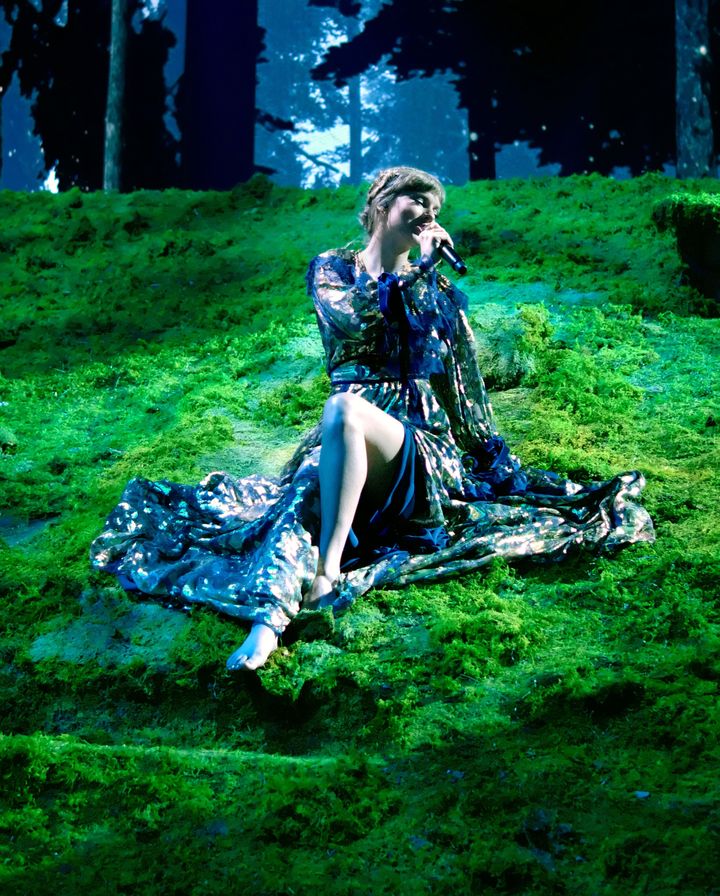
Taylor pictured during her 2021 Grammys performance
TAS Rights Management 2021 via Getty Images
While many are hailing The Tortured Poets Department as among Taylor’s strongest ever, others are claiming it’s on the “underwhelming” side.
And while some have said parts of the album feel like do-overs of musical tropes and lyrical themes Taylor has tried out before, others are hailing its innovation and new direction for the Grammy winner.
“One of the things the album most powerfully conveys is that Swift sees herself as very much a member of the titular department. Yes, there are songs that are surely about her relationship with Alwyn.
“But, through the skill of her songwriting (and I’m not sure it’s been better), Swift moves beyond the diaristic to something impressionistic and, yes, poetic. And universal.”
“The music is full of the pillowy synths and muted drums that served the hypnagogic vibes of her last album, Midnights, so well. That’s fine when she submits to grief, on a song like the delicately percolating Bad Down, but when she writes something salty and mischievous like Who’s Afraid Of Little Old Me? it gets suffocated by layers of echo and gauzy strings.
“Some of her vocals mannerisms have become overly familiar, too – like the staccato pitter-patter of her verses, and the hooks she SHOUTS FOR EMPHASIS. But a few tracks point towards new musical directions.”
“The Tortured Poets Department is extreme in its emotions and uninterested in traditional hits; not everyone will love it, but the ones who get it will adore it fiercely.
Advertisement
“As Swift continues this current astonishing run of superstardom, she has once again pushed herself to strike a new pose. It’s what makes her special — and what turns The Tortured Poets Department into yet another triumph.”
“Dissecting heartbreak, and the complications of trying to navigate it in the glare of public scrutiny, may well make for ripe songwriting fuel, but as an idea, it is nothing new. And sonically, The Tortured Poets Department feels like ground that has already been trodden.
“Its glacial, artfully restrained synth-pop frames the storytelling well, but will come as no surprise. That said, the way that Swift approaches the difficult and intensely complicated topic of fertility is both moving and refreshing.”
“This isn’t the breakup album — or the new-love album — you might’ve expected. Swift doesn’t portray herself precisely as a victim as she did in old tunes […] nor is there anything dewy-eyed about The Alchemy, which likens falling for a new guy to a chemical imbalance. The LP turns out to be something of a heel turn; it’s got a proudly villainous energy as Swift embraces her messiest and most chaotic tendencies.”
“On the simplest of terms, what we have here is a very smart, seductive, lyrically sharp set of smooth synth pop songs about affairs of the heart, crafted with love, intelligence and passion – another hugely appealing addition to Swift’s expanding canon.
Advertisement
“But it can be hard to disentangle the hook lines from the headlines on an album that is not so much a blockbuster entertainment release as a global news event, to be endlessly deciphered, decoded and deconstructed from gossip forums to business pages.”
“Less cluttered and more conversational than those on Midnights, [the lyrics] return Swift to what you might call her safe space, letting a well-known ex have it in no uncertain terms […] But if we’ve been here before, it’s still hard not to be impressed by Swift’s efficiency and wit […] or her ability to turn a celebrity boyfriend into a relatable archetype.”
“Tortured Poets has the intimate sound of Folklore and Evermore, but with a coating of Midnights synth-pop gloss […] It sounds as though Swift was shocked at how it felt to play her quietest songs live [on the Eras tour] and hear how gigantic they could be given enough room. So Tortured Poets feels like Swift writing those Folkmore-and-(especially)-Evermore ballads, but giving them that stadium power in the studio.”
“As was the case on Midnights, these melodic hooks take time to sink in. But trust me, they’ve got anchors – designed to lodge slowly and securely in the mental seabed. The stories will snag you and you’ll be surprised to find yourself humming choruses hours later.”
“Swift seems to be in tireless pursuit for superstardom, yet the negative public opinion it can come with irks her, and it’s a tired theme now plaguing her discography and leaving little room for the poignant lyrical observations she excels at. It’s why the pitfalls that mire her 11th studio album are all the more disappointing — she’s proven time and time again she can do better.”
Advertisement
“The Tortured Poets Department feels like it comes the closest of any of her 11 original albums to just drilling a tube directly into her brain and letting listeners mainline what comes out.
If you value this confessional quality most of all, she’s still peaking: As a culmination of her particular genius for marrying cleverness with catharsis, Tortured kind of feels like the Taylor Swift-est Taylor Swift record ever.”
“There’s certainly a sense that she’s pulling out all the stops on The Tortured Poets Department […] an immersive, cinematic affair that often feels more like an old Hollywood film script than a straightforward pop record.”
“Solid but underwhelming […] Swift has released eight albums in the last four years, and the influence of that hyperproductivity is evident in Tortured Poets. Production-wise, many of Swift’s collaborations with Jack Antonoff sound like Midnights B-sides, or worse, like 1989 Vault Tracks (essentially, C-sides). Songs that are brand new feel done before within this Taylor Swift Experience context.”
“In moments, her 11th album feels like a bloodletting: A cathartic purge after a major heartbreak delivered through an ascendant vocal run, an elegiac verse, or mobile, synthesised productions that underscore the powers of Swift’s storytelling. And there are surprises.”
On Friday, the record-breaking Grammy winner unveiled The Tortured Poets Department, her 11th album overall, made up of 16 new songs including collaborations with Post Malone and Florence + The Machine.
Advertisement
But Swifties wound up getting more than they bargained for when, just hours after the release, Taylor revealed she had something else up her sleeve.
“The Tortured Poets Department is a secret DOUBLE album,” she revealed.
“I’d written so much tortured poetry in the past two years and wanted to share it all with you, so here’s the second installment of TTPD: The Anthology. 15 extra songs. And now the story isn’t mine anymore… it’s all yours.”
It’s a 2am surprise: The Tortured Poets Department is a secret DOUBLE album. ✌️ I’d written so much tortured poetry in the past 2 years and wanted to share it all with you, so here’s the second installment of TTPD: The Anthology. 15 extra songs. And now the story isn’t mine… pic.twitter.com/y8pyDK8VTd
And yeah… fans were left pretty stunned by the announcement:
Advertisement
BARELY GETTING ADJUSTED TO TTPD AND TAYLOR SWIFT ANNOUNCES A SECRET DOUBLE ALBUM LIKE YOU WANT ME TO COLLAPSE ??? HOW ARE WE SUPPOSED TO GO ABOUT OUR NORMAL LIVES HAVE YOU EVER THOUGHT ABOUT THAT ??
you’re telling me taylor swift wrote not one but TWO albums WHILE performing at a sold out world tour that shattered records ??????????? https://t.co/wDv9ASC25B
When the first half of the collection was released, Taylor told fans: “[The Tortured Poets Department is] an anthology of new works that reflect events, opinions and sentiments from a fleeting and fatalistic moment in time – one that was both sensational and sorrowful in equal measure.
“This period of the author’s life is now over, the chapter closed and boarded up. There is nothing to avenge, no scores to settle once wounds have healed. And upon further reflection, a good number of them turned out to be self-inflicted.
“This writer is of the firm belief that our tears become holy in the form of ink on a page. Once we have spoken our saddest story, we can be free of it.”
The Tortured Poets Department. An anthology of new works that reflect events, opinions and sentiments from a fleeting and fatalistic moment in time – one that was both sensational and sorrowful in equal measure. This period of the author’s life is now over, the chapter closed and… pic.twitter.com/41OObGyJDW
At 31 songs in total (the reverse of her “lucky number”, 13), The Tortured Poets Department is officially Taylor’s longest album to date.
Like the first half, the second is produced by frequent Taylor collaborators Jack Antonoff and Aaron Dresser, with intriguing song titles including Chloe Or Sam Or Sophia Or Marcus, Imgonnagetyouback, ThanK you AIMee and So High School.
Explosions were heard near the Iranian city of Isfahan, according to an Iranian news agency.
However, an official told the Reuters news agency this was caused by the country’s air defence system, which allegedly destroyed three drones.
Early reports suggest the strike was relatively small. None of the military sites were hit and all nuclear facilities are safe, according to Iran.
Israel’s leadership and military had not commented as of early Friday morning.
UK foreign secretary David Cameron previously warned that it was clear Israel “is making a decision to act” despite international attempts to de-escalate.
Israel’s military chief of staff Herzi Halevi promised Saturday’s launch would be “met with a response” although he provided no details at the time.
The Israeli foreign minister, Israel Katz, also said he was “leading a diplomatic attack” on Iran earlier this week.
He said he had asked 32 countries to sanction Iran’s missile programme and follow Washington in listing the Revolutionary Guards Corps as a terrorist organisation.
Advertisement
What is the relationship between Israel and Iran?
Tensions between Israel and Iran have been brewing since the latter’s Islamic Revolution in 1979.
Relations then took a turn for the worse when Israel’s war with in the Palestinian territory of Gaza (against the Iran-backed militants of Hamas) began last October.
Hamas killed 1,200 people on Israeli soil on October 7 and took 253 hostages.
Israel declared war on the militants. More than 33,000 Palestinians have been killed in the subsequent Israeli offensive, according to Hamas-run health ministry in Gaza.
Then, on April 1, an air strike – suspected from Israel – killed two Iranian generals and 11 others in an Syria-based Iranian consular building.
While Israel has still not commented on the attack, Tehran vowed to exact revenge.
Have there been efforts to de-escalate?
The West was urgently trying to deter any further attacks in the run-up to Israel’s retaliation.
UN general secretary Antonio Guterres warned an emergency meeting of the security council that the Middle east was “on the brink”.
Rishi Sunak called for “calm heads to prevail” while Cameron said Israel should be “smart as well as tough” and not retaliate.
Advertisement
White House national security spokesman John Kirby said: “We don’t want to see a war with Iran. We don’t want to see a regional conflict.”
However, he added that it was up to Israel to decide “whether and how they’ll respond”.
Joe Biden also told Israeli PM Benjamin Netanyahu at the weekend that the US would not be joining in with any counter-strike, and that Israel should “take the win”.
Sunak revealed that the major democracies of the G7 were working on taking measures against Iran, too.
Russia, an ally of Iran, has also urged against further escalation, although it stopped short of any direct criticism of Tehran.
Yet, after meeting with Israeli politicians days after Iran’s attack, Cameron said: “It’s right to have made our views clear about what should happen next, but it’s clear the Israelis are making a decision to act.
Advertisement
“We hope they do so in a way that does as little to escalate this as possible.”
Israeli PM Benjamin Netanyahu appeared to dismiss diplomatic interventions amid Cameron’s meeting.
While thanking the “friends” who stepped in to support the defence of Israel against Iran, he said: “I want to make it clear: we will make our own decisions, and the state of Israel will do everything necessary to protect itself.”
What happens next?
Iran may look to hit back.
Iranian Deputy foreign minister Ali Bagheri Kani told state TV on Monday that Tehran would retaliate “in a matter of seconds, as Iran will not wait for another 12 days to respond”.
On Thursday – the day before the attack – Iran’s foreign minister Hossein Amir-Abdollahian also warned that Iran’s response to any attack from Israel would be “immediate and at maximum level”.