What happens when we pass out? Researchers ID new brain and heart connections

Nearly 40 percent of people experience syncope, or fainting spells, at least once in their lives. These brief losses of consciousness, whether brought by pain, fear, heat, hyperventilation or other causes, account for a significant portion of hospital emergency room visits. Yet the exact root mechanisms at play when people “pass out” largely have remained a mystery.

Publishing a new report in Nature, University of California San Diego researchers, along with colleagues at The Scripps Research Institute and other institutions, have for the first time identified the genetic pathway between the heart and brain tied to fainting.

One of their unique approaches was to think of the heart as a sensory organ rather than the longstanding viewpoint that the brain sends out signals and the heart simply follows directions. School of Biological Sciences Assistant Professor Vineet Augustine, the paper’s senior author, applies a variety of approaches to better understand these neural connections between the heart and brain.

“What we are finding is that the heart also sends signals back to the brain, which can change brain function,” said Augustine. Information resulting from the study could be relevant to better understanding and treating various psychiatric and neurological disorders linked with brain-heart connections, the researchers note in their paper. “Our study is the first comprehensive demonstration of a genetically defined cardiac reflex, which faithfully recapitulates characteristics of human syncope at physiological, behavioral and neural network levels.”

Augustine, along with Biological Sciences Staff Research Associate Jonathan Lovelace and Graduate Student Jingrui Ma, the first authors of the paper, and their colleagues studied neural mechanisms related to Bezold-Jarisch reflex (BJR), a cardiac reflex first described in 1867. For decades researchers have hypothesized that the BJR, which features reduced heart rate, blood pressure and breathing, may be associated with fainting. But information lacked in proving the idea since the neural pathways involved in the reflex were not well known.

The researchers focused on the genetics behind a sensory cluster known as the nodose ganglia, which are part of the vagus nerves that carry signals between the brain and visceral organs, including the heart. Specifically, vagal sensory neurons, or VSNs, project signals to the brainstem and are thought to be associated with BJR and fainting. In their search for a novel neural pathway they discovered that VSNs expressing the neuropeptide Y receptor Y2 (known as NPY2R) are tightly linked to the well-known BJR responses.

Studying this pathway in mice, the researchers were surprised to find that when they proactively triggered NPY2R VSNs using optogenetics, a method of stimulating and controlling neurons, mice that had been freely moving about immediately fainted. During these episodes they recorded from thousands of neurons in the brains of the mice, as well as heart activity and changes in facial features including pupil diameter and whisking. They also employed machine learning in several ways to analyze the data and pinpoint features of interest. Once NPY2R neurons were activated, they found, mice exhibited rapid pupil dilation and the classic “eye-roll” seen during human fainting, as well as suppressed heart-rate, blood pressure and breathing rate. They also measured reduced blood flow to the brain, an area of collaboration with Professor David Kleinfeld’s laboratory in the UC San Diego Departments of Neurobiology and Physics.

advertisement


“We were blown away when we saw how their eyes rolled back around the same time as brain activity rapidly dropped,” the researchers reported in a paper summary. “Then, after a few seconds, brain activity and movement returned. This was our eureka moment.”

Further testing showed that when NPY2R VSNs were removed from mice, the BJR and fainting conditions vanished. Previous studies had shown that fainting is caused by a reduction in brain blood flow, which the new study also found to be true, but the new evidence indicated that brain activity itself could be playing an important role. The findings therefore implicate the activation of the newly genetically identified VSNs and their neural pathways not only with BJR, but more centrally in overall animal physiology, certain brain networks and even behavior.

Such findings were difficult to tease out previously because neuroscientists study the brain and cardiologists study the heart, but many do so in isolation of the other. “Neuroscientists traditionally think the body just follows the brain, but now it is becoming very clear that the body sends signals to the brain and then the brain changes function,” said Augustine.

As a result of their findings, the researchers would like to continue tracking the precise conditions under which vagal sensory neurons are triggered into action.

“We also hope to more closely examine cerebral blood flow and neural pathways in the brain during the moment of syncope, to better understand this common but mysterious condition,” they note.

They also hope to use their research as a model to develop targeted treatments for fainting-associated conditions.


Share Button

What happens when cats get fat? Scientists weigh in

Cat owners want Kitty to be happy, but providing an abundance of food and snacks can have unintended consequences. Feline obesity is on the rise, impacting the health, longevity, and wellbeing of cats. A new study from the University of Illinois Urbana-Champaign looks at what happens in the digestive system and gut microbiota when cats eat too much.

“About 60% of cats in the U.S. are overweight, which can lead to health problems such as diabetes and chronic inflammation. While many studies have investigated feline weight loss, there has been little focus on the opposite process, which is also important. In this study, we wanted to learn more about the metabolic and gastrointestinal changes that occur as a result of overeating and weight gain in cats,” says study co-author Kelly Swanson, professor in the Department of Animal Sciences and interim director of the Division of Nutritional Sciences (DNS), part of the College of Agricultural, Consumer and Environmental Sciences (ACES) at U. of I.

The study included 11 adult spayed female cats. They were fed a standard dry cat food and after two weeks of baseline measurements, they were allowed to eat as much as they wanted. The researchers collected blood and fecal samples at regular intervals and monitored physical activity.

Once the cats were able to overeat, they immediately increased their food intake substantially and started to gain weight. At the onset of the study, their average body condition score (BCS) was 5.41 on a 9-point scale. After 18 weeks of overfeeding, it had increased to 8.27, corresponding to being 30% overweight. BCS is equivalent to body mass index (BMI) for humans, and 6 or above is considered overweight, Swanson said.

The researchers analyzed changes in fecal output, gastrointestinal transit time, digestive efficiency (nutrient digestibility), and microbiota bacterial composition over the 20-week duration of the study.

“We found that as cats ate more and gained weight, gastrointestinal transit time was reduced, and so was digestive efficiency. When the body gets less food, it will be more efficient in extracting nutrients. But when the amount of food increases, it passes through the digestive system faster and fewer nutrients are extracted in the process,” Swanson explained.

The researchers also found significant changes in gut microbial composition between the lean cats at baseline and after 18 weeks of weight gain. The relative abundance of Bifidobacterium, which has antimicrobial activity, inhibits pathogens, and stimulates the immune system, increased, while Collinsella, which degrades fiber and has been linked to pro-inflammatory diseases, decreased. These results are opposite to what has been measured in overweight humans and suggest that their association to weight gain is complex, Swanson noted.

advertisement


“The change in the gastrointestinal transit time was a novel finding and a potential reason for the change in fecal microbiota. Future studies should consider measuring transit time to better explain modifications to the microbiome of pets,” he added.

As the cats’ food consumption grew, so did their fecal output. In other words, as they ate more, they also pooped more. At the same time, fecal pH decreased, meaning that the stool became more acidic.

“In humans, a low fecal pH indicates poor absorption of carbohydrates and fat. Our findings correlate with this, as reduced fecal pH aligned with higher food intake and reduced digestibility,” Swanson said.

The researchers also measured the cats’ activity level with a monitor attached to a collar. The cats were housed in a group setting where they were able to interact with each other and play with toys, except for the days when stool samples were collected.

“We expected that weight gain might lead to decreased physical activity, but we did not observe any consistent changes in activity level. However, this could vary with individual cats and their environment, and how much their owners interact with them,” Swanson stated.

Understanding the metabolic and gastrointestinal changes that occur with weight gain and obesity in pets may help with future prevention and treatment plans, the researchers conclude.

Pet owners who want to help their cats lose weight can employ various strategies. In another new study, Swanson and his co-authors showed that restricted feeding can promote safe weight and fat loss in cats. The researchers also suggest pet parents encourage activity in their feline companions. For example, they can stimulate foraging by placing food around the home, or use food puzzles during mealtime to promote engagement and mental enrichment.

After the conclusion of the weight gain study, the 11 cats were put on a restricted-feeding diet that helped them return to normal weight.

Share Button

Student nurse used suicide website before taking her life

A coroner voices concern that sites promoting self-harm are accessible to vulnerable people.

Share Button

Boris Johnson Asked If Blowing A Hair Dryer Up Your Nose Would Kill Covid

Boris Johnson asked whether Covid could be be cured by blowing a hair dryer up your nose, after watching a YouTube video.

Dominic Cummings made the allegation in his evidence to the Covid inquiry, describing it as a “low point”.

Cummings said as the pandemic raged he often “couldn’t be sure” whether it was actually Johnson himself who was “the source of false stories” in the media about Covid.

“A low point was when he circulated a video of a guy blowing a special hair dryer up his nose ‘to kill covid’ and asked the CSA (chief science adviser) and CM (chief medical officer) what they thought,” Cummings said.

Writing his his diary on December 12, 2021, Vallance said: ”[Johnson] says his party ’thinks the whole thing is pathetic and Covid is just nature’s way of dealing with old people – and I am not entirely sure I disagree with them.”

Simon Case, the cabinet secretary, also once worried that Johnson was “Trump-Bolsonaro level mad” on Covid.

Share Button

No.10 Was ‘Sexist, Toxic And Awful’ Under Boris Johnson, Says Ex-Senior Civil Servant

Boris Johnson oversaw a “toxic culture” in No.10 which saw the “obvious sexist treatment” of women, according to a former senior civil servant.

In shocking testimony heard by the Covid Inquiry, Helen MacNamara slammed the misogynistic environment in No.10 during the pandemic.

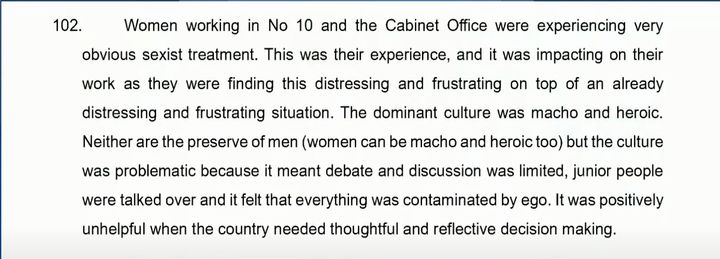
The former deputy cabinet secretary said the “dominant culture was macho and heroic” and “contaminated by ego”.

Statement handed to the Covid Inquiry by Helen MacNamara .

Covid Inquiry UK

Speaking at the Inquiry, she added that she was not alone in her feelings about how No.10 operated.

“Women whose job it was to do something were not able to do their jobs properly because they weren’t having the space or being treated with respect,” she said.

“It was both striking and awful.”

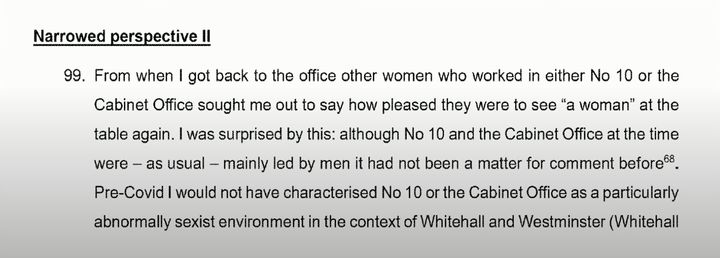
She added that the shift in attitude towards women had been recent and that despite the team always being dominated by men, she would “not have characterised No.10 as an abnormally sexist environment in the context of Westminster”.

Her statement added: “Women who had worked in the Cabinet Office for some time, reported feeling as if they’d become invisible overnight.”

Asked whether the issue resonated purely on a personal level or whether it had wider repercussions, MacNamara explained that culture was “problematic because it meant debate and discussion was limited, junior people were talked over and it felt that everything was contaminated by ego”.

Statement by Helen MacNamara on sexism at No 10

Covid Inquiry UK

Messages revealed earlier in the Inquiry show Dominic Cummings referring to her as a c**t and saying he wanted to “personally handcuff her and escort her from the building”.

MacNamara said she found Cumming’s comment both “surprising and not surprising” as “it wasn’t a pleasant place to work” because Cummings was often angry and frustrated.

She added that Cummings was not alone in this type of attitude and suggested Johnson enabled the casual use of violent and crude language.

The then prime minister’s failure to end this behaviour, she added, was “miles away from what is right, or proper, or decent, or what the country deserves”.

Share Button

Is This Why King Charles Stopped Short Of Apologising For Colonialism In Kenya?

King Charles notably stopped short of apologising for colonialism during an emotive speech on Tuesday in Kenya, prompting a wave of criticism.

But there may be a reason for that – here’s what you need to know.

Why are people calling for an apology?

Kenya was colonised by Britain for decades, one of many countries which were considered part of the British Empire.

When its citizens started to call for independence in 1952, insurgents called the Mau Mau started a rebellion, triggering a wave of violent suppression from British forces and the introduction of a state of emergency the same year.

This “emergency” saw Britain force 1.5 million Kenyans suspected of being part of the Mau Mau rebellion into concentration camps. This lasted from 1952 and 1960, when the state of emergency was lifted.

The country declared its independence from Britain in 1963, 11 years after Charles’ mother Queen Elizabeth II had taken to the throne.

So a royal apology during Charles’ first state visit to a Commonwealth country, ahead of Kenya’s 60th anniversary of independence, has been seen as apt for some.

Ahead of the royal visit, the Kenyan Human Rights Commission said that only “an unconditional and unequivocal public apology” for Britain’s colonial abuses – along with compensation – would be enough.

Why did King Charles not apologise for colonialism?

He, like his mother, is a constitutional monarch. As the Royal Family’s official website explains, this means “the ability to make and pass legislation resides with an elected parliament”, even though the sovereign is head of state.

And the sovereign “no longer has a political or executive role”, but continues to act as “a focus for national identity, unity and pride”.

Apologising for colonialism would err away from the official line the British government toes, therefore breaching his apolitical position.

Even when the UK offered £20 million of compensation to more than 5,000 Kenyans in 2013 after they suffered under colonial authorities during the state of emergency, then foreign secretary William Hague stopped short of an apology.

He just said the UK “sincerely regrets” its actions.

Neil Wigan, the UK high commissioner to Nairobi, told a local radio station last week a royal apology would take the King into “difficult legal territory”.

Britain's King Charles III (CL) meets with Kenyan marathon runner Eliud Kipchoge (L) and other Kenyan runners during a visit to Karura Forest in Nairobi on November 1, 2023.
Britain’s King Charles III (CL) meets with Kenyan marathon runner Eliud Kipchoge (L) and other Kenyan runners during a visit to Karura Forest in Nairobi on November 1, 2023.

TONY KARUMBA via Getty Images

So what did Charles say during his visit?

On his first state visit to a Commonwealth state since he inherited the throne, the monarch expressed his “deepest regret” at the “unjustifiable acts of violence” the British forces carried out against Mau Mau rebels in the 1950s.

He said: “There were abhorrent and unjustifiable acts of violence committed against Kenyans,” by the colonial forces, therefore triggering a “painful struggle for independence and sovereignty”.

He added: “For that there can be no excuse.”

The King continued: “In coming back to Kenya, it matters greatly to me that I should deepen my own understanding of these wrongs, and that I meet some of those whose lives and communities were so grievously affected.

“None of this can change the past. But by addressing our history with honesty and openness we can, perhaps, demonstrate the strength of our friendship today. And, in so doing, we can, I hope, continue to build an ever-closer bond for the years ahead.”

Kenya's President William Ruto welcoming Charles to Kenya
Kenya’s President William Ruto welcoming Charles to Kenya

via Associated Press

How did Kenya respond?

His words were welcomed by Kenya’s president William Ruto who said the monarch was a “veteran visionary”.

He told Charles he appreciated the monarch’s “expression of willingness to acknowledge the painful aspects of our shared history” and praised “his exemplary courage and readiness to shed light on uncomfortable truths”.

Ruto said: “This is a highly encouraging first step, under your leadership, to deliver progress beyond tentative and equivocal half measures of past years.”

However, the president also called for “full reparations”, and said “much remains to be done” to achieve this.

Others such as David Ngasura, a historian from the Talai clan in western Kenya, told Reuters news agency that “acknowledgement alone is not enough”.

He said: “I am yet to hear him about compensation and reparations by the British government to the victims of historical injustices meted by the British colonial government.”

Share Button

AI: Scientists excited by tool that grades severity of rare cancer

AI is twice as good at grading the aggressiveness of tumours than lab analysis, a study suggests.

Share Button

Zimbabwe’s cholera crisis fuelled by chronic water shortages

Wheelbarrows are carted around in search of community centres and churches willing to share water.

Share Button

‘Moronic’: Vicious Covid WhatsApps reveal No 10 battles

“Meltdown”, “liar”, “embarrassing” – messages lay bare Downing Street divisions during the pandemic.

Share Button

Covid inquiry: Read the private WhatsApp messages from inside Downing Street

“Meltdown”, “liar”, “embarrassing” – messages lay bare Downing Street divisions during the pandemic.

Share Button