Will AI Make You an Addict?

The novel I’m writing is set in the future, tentatively in the year 2047, so it’s roughly one human generation ahead of us. For technology, however, that’s many generations ahead.

Consider that the first iPhone shipped in 2007 (13 years ago). If you got an iPhone 4S when it first came out, that was 9 years ago, and the 5S was 7 years ago.

The iPad is 10.5 years old. The Apple Watch is 5.5 years old.

Look back 27 years to 1993. Back then I was using a 486DX 50mhz computer with a 250MB hard drive. I think it was about $2500 when I bought it. I did some contract programming for a local game developer that year, and I remember using a 486DX 33mhz machine at their office each day. I wrote games for Windows 3.1, and I also heavily used DOS apps (with MS-DOS 6.0), mainly because Windows apps were still pretty slow.

Technically there was an Internet. I think we were using 14.4k modems back then since 28.8K ones didn’t come out till the following year… and 56K a couple years after that.

Web browsing, like with Netscape Navigator, didn’t really start becoming a thing till 1994-95. I build my first website in 1995 for my computer game business. Before the Web started taking off, people often thought of the Internet as geeky college stuff, or it was some kind of paid service like AOL, CompuServe, or Prodigy.

So that was 27 years ago, which seems like ages ago. Now I’m trying to write a novel projected 27 years into the future. That’s difficult, and I’ll surely guess wrong about a lot of things. But it’s a fun thought experiment nonetheless, especially if you love tech as I do.

My current approach is to just journal about the world and let my brain start making connections. As I see some ideas flowing onto the screen, I begin thinking about how they’ll combine. I think about the benefits and drawbacks of these combos. This helps me assemble the world in which my story can take place.

I also have to consider that the pace of change in the next 27 years will be way faster than what happened over the last 27 years. So it might be more like comparing today with 1950s tech.

One trend in particular that seems interesting to explore is AI and personalization.

For instance, I imagine that sometime within the next 27 years, you’ll be able to say most or all of these things to one of your devices, and you’ll be able to expect a good result:

  • Create and play an original episode of Star Trek: The Next Generation with the original cast, just for me. Cast my wife as a guest character.
  • Generate a new sci-fi series that you think I’ll like. Give it 5 seasons, 10-12 episodes per season, and 40-45 minutes per episode. Have it star Brad Pitt, Sandra Bullock, and Tom Hanks at their ages from the year 2000. And include a robot character with Jim Carrey’s voice.
  • Generate and add 10 attractive photos of me to that new dating app I installed.
  • Generate a new open-world fantasy video game similar to Zelda: Breath of the Wild 5. Name the lead character Schmoopie. Include the Three Stooges as quest companions that I meet as I play. Make it take about 200 hours to finish if I do all of the side quests. Make all the food and characters in the game world vegan. Save it to be played on my XBox One XS version X One. Monitor my responses as I play to make sure I’m having fun.
  • Plan a vacation trip for my wife and me to Italy in the spring. Include Rome and Venice. Make it two weeks in duration. Include the major stops you think we’d appreciate, but also give us plenty of time to wander and explore. Keep it under $7K total cost for the trip, but not too much under. Book it and add it to my calendar. Book-end the trip with a self-driving car pickup and drop off at my house. Create a 5-minute preview video of us enjoying the trip, and send it to my wife and me. After the trip, generate a 30-minute highlight video of us on the trip, and add it to our family camera roll.
  • Generate a new 12-song Depeche Mode album in the style of Violator but with shades of Songs of Faith and Devotion – with Alan Wilder as a band member please. Play it during my run tomorrow.

I think we’ll see a big explosion of AI and personalization, especially when it comes to media. I think it’s just a matter of time before AI is smart enough to generate custom experiences. AI can already generate original photos, artwork, and music now. And it can generate movies too with some major limitations. It’s also being used to upscale older videos to 4K resolution or better. It will take time, but I think that AI-generated content will eventually become the primary source of entertainment for most people. I think human-created content will still be around, but AI will improve more rapidly in this area, and the costs are much, much lower. It’s probably just a matter of time before AI surpasses humans at creating TV shows, movies, video games, VR worlds, and more.

I think we’ll see some intermediate steps between now and then, like TV shows or movies where you can change the actors. There may be legal hurdles to that though.

Fortunately the goal of creating a story world isn’t accuracy. I think the goal is to identify interesting sources of conflict. How will the world of the future challenge people?

One big issue I see is the rise of addiction. We’re already seeing AI being used in this way by Facebook. Now imagine if you were able to use AI for your own pleasure, and you give it access to data that it can use for that purpose. Suppose that while you’re watching a movie or playing a game, the AI can monitor your pulse, analyze your face in real-time, and use that data to sense how your biology is responding in each moment. Then it can generate more personalized content for you. It’s an echo chamber for one.

This creates interesting opportunities to though, especially in a capitalist society. We’re also likely to see more AI thrown at the problem of fighting addiction.

I appreciate fictional stories that highlight future problems. They help us map out the possibility space, including dangers to be avoided. A few good examples are 1984, The Terminator, and Gattaca. While fictional and exaggerated, they also point to genuine risks.

Writing a novel that helps to serve as a potential warning appeals to me. The story I’m writing (now past 17K words) is actually pretty dark. Here are some questions I’m currently exploring through the story arc:

  • How might the relationship between AI and addiction unfold?
  • What if people are empowered to use AI in ways that could lead to addictive behaviors?
  • How far will corporations go in using AI to addict their customers to their products and services?
  • Which commands that people might give AI are likely to lead to addictions?
  • What can humans do about AIs that are actively trying to condition addictive patterns?
  • How might AI be used to fight or prevent addictions?
  • Could humanity actually trap itself in an inescapable cage of AI-fueled addiction? If so, what would that cage look like?

While we could get lost in projecting many different technologies forward, for this purpose I favor keeping the world relatively simple and easy to grasp, so readers can be more immersed in the characters, the plot, and the themes rather than having to read endless description about the world.

As I work on this project, I note that the risks I’m identifying are also real. I think people will become increasingly vulnerable to tech-related addictions in the years ahead. Writing this book helps me think about how that may play out and what the potential solutions might be. So there’s an interesting relationship between exploring ahead with a fiction project and helping people prepare for upcoming personal challenges.

Share Button

NaNoWriMo – Days 4-5

Here are my latest progress updates for my novel:

Day 4

I had a very pleasant writing session on this day, now at 6872 words total. I’m starting to enjoy this more as the scenes are coming together, and I’m getting more familiar with the key characters.

I spent some time organizing the manuscript scene structure before I wrote any scenes this time. I created placeholders for the remaining signpost scenes, found a cleaner way to arrange my existing notes, and did a little more journaling with my characters.

In general I find that journaling with my characters and asking them what we ought to write today is a great way to begin each writing session. This is basically the method from Stature called “Chorus” applied to fiction.

Another ace of a habit is listening to brain.fm focus tracks while writing. When using the phone app version, I prefer the “deep work” tracks for this type of work. Oddly the “creative flow” tracks tend to make me sleepy.

On Day 4 I wrote two more signpost scenes:

  • The Doorway of No Return #2, which is the final scene of Act 2
  • Mounting Forces, which is the first scene of Act 3

This gives me a sense of how Act 2 could end and how Act 3 can begin. I’m not sure if I’ll keep these scenes as-is though. It’s an interesting place to take the story, but I’m not sure if these particular scenes will set the characters up for a strong enough ending.

Playing with the signpost scenes is like figuring out the spine of the story. I can see how it will be easier to fill in the remaining scenes once I figure these out. It’s basically the 80/20 rule applied to fiction writing. Figure out your 20% most important scenes, and write and arrange those first. Those are the scenes that provide 80% of the value.

Day 5

I’m at 8605 words total now. On this day I wrote the Lights Out scene, which is signpost scene #11 and the second scene of Act 3.

This is the dark, bleak, “all hope is lost” scene that sets things up for the finale.

It’s interesting that in many story structures, right after the lead character makes a big decision, you knock them down a notch in the next scene (or shortly thereafter). One reason for doing this is that it raises the stakes, showing just how big or risky the decision really is. This increases the tension and helps maintain good pacing. The “Lights Out” scene raises the stakes as high as they’ll go.

Isn’t real life like this too sometimes? You may make a big decision such as to quit your job or leave a relationship, and now you have an upcoming scene where you have to tell your boss or partner, and that’s often an unpleasant situation that knocks you back a bit. But then you can at least have some recovery scenes afterwards.

In fiction and in real life, courage is a big part of the journey. Without sufficient courage, you can’t make those big decisions, and the story can’t progress.

This was a hard scene to write, so it took me considerably longer to write than any other scene. I kept pausing and reflecting along the way on where to take it next, like after every few hundred words. There were a lot of options at each point.

This is also a very unusual Lights Out scene, not something I’ve seen elsewhere. While the idea of having a scene like this isn’t new, the way I’m approaching it isn’t familiar to me. It’s close to an addict hitting rock bottom, but it’s actually way worse than that. It’s like taking an addictive drug that’s also conscious, so it won’t let you quit even when you decide to.

I wonder if I overdid it though. I buried the main character so deeply in this scene that it looks totally impossible for her to escape her fate now. But that also makes it kinda interesting to see if I can use this. If I can’t see a way out, the reader may not be able to see any way out either.

The writing is feeling a little easier now that I’ve done five days of it. It’s still challenging though. If I didn’t have my daily quota of writing at least 1667 words each day, my word count would surely be lower at this point.

I feel like what I’m really doing this month is mapping out the story space. There are so many permutations and branches of the story I could write. Every writing session gives me more clarity about what I could do, but it won’t necessarily be what I end up going with.

I find the “words are cheap” mindset helpful. It’s not that difficult to throw a scene onto the screen and see how it turns up and then reflect upon how it fits with the other scenes. At this point I’m not worrying at all about polished language. I’m writing the scenes fairly plainly to explore more possibilities each day.

Share Button

Obedience Test Results

Four days ago I posted a simple obedience test. I’m still getting more responses each day, but it looks like the patterns have become clear enough to share what I’ve learned thus far.

The basic idea was that I commanded people who read that post to read 5 more articles from my website on that same day and then to send me feedback about their experience. They could choose to obey the command or not.

Why the Obedience Test?

It was a simple idea that popped into my mind at the time, and I opted to run with it. That’s likely because I’ve been thinking about the theme of obedience lately. Much of the time whatever is churning in my mind provides the inspiration for new blog posts.

As some people guessed, obedience is a theme that I’m exploring in the novel I’m writing, particularly with respect to how humans relate to AI. It’s not the only theme I’m exploring, but it’s one of the major ones. That could change as I get further into the writing though. I’m only about 5K words into it so far.

Today much of the AI we interact with, such as “smart” assistants like Siri (still dumb as a stump) or Alexa (getting there), behaves rather obediently. It does what we tell it to do, or at least it tries. But what if that Master-servant relationship begins to shift, towards one of equals and perhaps shifting even beyond that? How might humans respond to this shift? Will they obey smarter AI, especially if it’s to their benefit? Or will they resist?

Would you let an AI decide what you get to eat? Would you let an AI plan your exercise? What if obeying the AI in this way greatly improves your health? There are lots of ways we can envision that being ornery towards AI might just slow you down, such as by refusing to do your AI-generated workouts.

This shift is already showing up today, is it not? How many people are obeying other companies and services without even realizing how they’re being conditioned? And how many people rebel against science and logic, even when it’s ultimately detrimental to them?

Also, how many people willingly assume roles of obedience in human relationships, such as by having a boss telling them what to do? How might AI affect these relationships over time? Will AI level the playing field or create even bigger power imbalances? We might see both aspects coming into play.

What human instincts, mindsets, and behaviors actually get in our way and slow us down, both individually and collectively? How could AI help us? How might it hurt us, such as by amplifying addictions?

With the election happening, I’ve also been thinking about people’s obedience to politicians and political parties as well. Where does obedience help us? Where does it hurt us? Are people succumbing to falsehoods because they’re being too obedient? Are they buying into conspiracy theories because they’re being too rebellious?

And lastly, I’ve had a long history in my relationship with obedience, from being raised in a religion with strict rules of conduct to going through a wild and rebellious phase to going decades without a boss to getting into D/s play. So I was also curious to see where some of my blog readers landed in terms of this relationship with obedience.

I also just thought it would be a fun thing to try and to see how people responded. I imagined that some people would act like ornery rebels and others would find value in obedience, perhaps playfully. That’s pretty much what happened.

Results

The results were varied but not surprising.

It was pretty close to 50-50 between the rebels and the obeyers. There was some gray area in the middle with a few people semi-obeying, like reading a few articles or skimming instead of fully reading, but most people reported that they either read 5+ more articles or read none.

I also noted that everyone who replied technically obeyed the second command to send feedback. A true rebel wouldn’t have bothered to reply, so of course I don’t get to see those responses.

Among the rebels who did reply, the most common response pattern was from people who said that they hate being told what to do and rejected the command because of that. Some seemed to take pride in their rebelliousness, like they were spiting me by not obeying. They responded as if I was their Mom or Dad telling them to clean up their room.

A few rebels also said that they were intending to read more articles on my site that day before reading the obedience test, but after being commanded to read more, they declared that they weren’t going to read any more that day. They couldn’t do it because then it would mean something different, like they were being obedient.

The rebel mindset is still a reactive one, wouldn’t you say? It strikes me that people are less free when they think like this. Tell a rebel to do something, and now they can’t do it.

Who set up the obey-or-disobey framing? I did, and these rebels still bought into it, which in my view is actually an obedient act. They let me define the frame, which limited their options by constricting the meaning they’d assign to different actions. So they obeyed my frame, and then they tried to rebel within that frame, which of course looks a bit silly: Oh yeah… just for that I’m not gonna read any more articles today, even though I was originally going to. So there!

If you let someone dictate the meaning you assign to an event or decision, you become less free. Even as these people thought they were being rebellious, they were actually just giving away their power.

If they had declined to accept my framing offer, they could have decided to read or not read more articles for their own reasons, not for the reasons I suggested. You don’t have to buy into the meaning that someone else offers.

Some rebels even caught onto the fact that they were obeying the second command to share feedback, and then they had to justify why they were obeying that part but not the first part. They typically framed the second part as a request that they were choosing to accept, being more sensitive to the “command” framing of the first part. I’d say you’re still less free if you have a negative reaction to being commanded. It’s a framing offer that you can accept or decline regardless of how someone labels it.

Not all rebels seemed very triggered though. Some declined easily without expressing much feeling about it, usually saying that it didn’t align with how they wanted to spend their time.

Consider that someone could tell or command you to do something that would actually be good for you, and if you frame this as something you must resist, you’re holding yourself back. It makes you a less coachable and teachable person since you’re likely to encounter something that makes you want to rebel and resist sooner or later, even within the scope of well-intentioned advice.

It’s hard to give advice to a reactive rebel, so such rebels tend to teach the people around them not to give them advice – and often not to give them invitations either.

Another drawback to the rebel mindset is that rebels often have trouble assuming command and telling other people what to do. They figure that other people will be resistant in much the same way, which isn’t true. Some people enjoy being told what to do, even when it’s framed as a command. Hence rebels often have a hard time delegating.

And of course in certain situations, some people like to play and dance with the concept of obedience, which may or may not include playful forms of rebellion.

The limitations of the rebel mindset are pretty easy for me to spot because I used to be very much like that myself. It was a phase I went through for many years. It helped me grow away from some aspects of my upbringing that were problematic, but it also introduced new problems that slowed me down. Rebelliousness can be a fun and rewarding mindset to explore for a while – and beneficial too – but I wouldn’t want to stay there for decades. This mindset too often gets in the way of making discerning and intelligent choices, and it chokes off some otherwise good opportunities.

Obeyers

On the obeyers side, I could mostly divide the responses into two types:

  1. Some people playfully embraced this framing and just went with the command, feeling little or no resistance to it.
  2. Some people felt some resistance to the obedience frame, so they shared extra justifications for following the command anyway, such as curiosity, potential benefits, trusting me, or wanting to share and participate in the experiment.

What I noticed most of all with the obeyers is that by and large, they seemed to like and enjoy the experience way more than the rebels did. They clearly had more fun with it. Some reported synchronicities and extra value received from the articles they read. There was more appreciation. And they wrote longer responses on average, often sharing extra details, stories, and personal updates.

Whereas the feedback from rebels was usually more curt and direct, the obeyers’ feedback was generally more open, friendly, and playful. So I’d say that between these two groups, the obeyers had a better overall experience.

The obeyers were less likely to be triggered by the command and obedience framing. They largely regarded it as an invitation or a suggestion, even a playful one. Some reported some mild negativity towards this framing, but it wasn’t nearly as severe as what the rebels shared, and the obeyers didn’t have to stretch too far to find a way to justify taking action in spite of some resistance.

I found it interesting how people came up with different reasons and justifications to overcome their resistance. Not everyone needed to do that though.

Some people didn’t feel any resistance to the obedience framing. They basically played back at me and went with the role-playing aspect of it. These people seemed to enjoy the experience most of all.

My Inner Reaction

I also paid attention to how I internally reacted to people’s reactions. Put yourself in my shoes, and imagine that you received the types of responses I just described. How do you think you’d have reacted to them?

This probably won’t surprise you, but I felt most connected to the obeyers. Their playing-back-at-me responses were the warmest and most fun to read. I felt a stronger heart connection to them too.

The rebels framed the experiment as something they had to resist or reject. I didn’t take this personally, especially since I anticipated that many people would respond this way. Even so, I felt less connected to them. They seemed more shielded and less trusting whereas the obeyers’ replies often made me smile or laugh.

I mostly felt a bit sad for the rebels because they seemed the least free, the least flexible, the least happy, and the most trapped. That may be because it reminded me of how limiting it was when I was in my super rebellious phase.

Playing With Obedience

I think what we really want to aim for here is freedom, conscious choice, and also good discernment.

If you’re too obedient and not discerning about it, that can be bad of course. You could be led astray by someone who doesn’t have your best interests at heart.

If you’re too rebellious and not discerning about it, that can also be bad. You’re going to miss out on some good opportunities, and you’ll reject some good advice and invitations if they’re framed in ways that trigger you.

My recommendation is to see if you can remove the heat from words like command and obedience. Realize that being told what to do isn’t an attack. It’s just an invitation. You can accept or decline any such invitation, but don’t let your reactive triggers make those decisions for you.

If you struggle with negative reactions to the obedience and command framing, you’ll likely have a harder time obeying your own commands. Part of you will frequently rebel against yourself. You’ll often see your inner rebel resisting your inner commander. Then your inner commander will become flabby too, not wanting to give orders to your rebellious side. This makes you less free and less capable. It wastes energy to internally fight with yourself.

To flow through life with more ease and action, it’s helpful to recognize that there’s nothing wrong with commanding, and there’s nothing wrong with obeying. It’s important not to overweight these factors, so you can give more weight to the decisions and results you’d like to experience.

This month I’m doing NaNoWriMo to write my novel. This is a 30-day challenge that someone else created. I’m obeying the challenge, and I’m obeying my own command to do it. My inner rebel remains calm and untriggered. Even though I don’t have to, I find it worthwhile to frame the challenge as having aspects of command and obedience. This helps me continue to reduce resistance related to both aspects, and that in turn helps me get better results. It’s really hard for rebels to successfully complete a challenge like this.

Consider that if you can’t do a challenge with the command-and-obey framing, you may also be weak at doing it with some other framing like self-interest, self-discipline, or personal achievement. It’s so easy to accidentally trigger your inner rebel, making you want to resist even when it would be better if you persisted with the challenge.

So consider that it might be best for you in the long run if you can develop a healthier, non-triggered relationship with command and obedience. Take the sting out of this framing. Let yourself see both sides as forms of play, and notice that a more playful relationship with this framing gives you more options, more freedom, and better results.

Share Button

NaNoWriMo – Day 2

On Day 2 of NaNoWriMo, I wrote 1743 more words, so I’m at 3439 words for my novel so far. Today I’ll pass 5K words.

While the challenge is technically to write 50K words in 30 days, I’m framing it as a daily commitment to write at least 1667 words per day. So I’ll surely end up with more than 50K words by the end. My approach is less flexible since I won’t be taking any days off, nor will I reduce the daily quota based on my ongoing word count. It’s easier for me this way since I’ll never let myself fall behind, so I’ll avoid the trap of having to write thousands of extra words to catch up later. Today is Day 3, and some people are already feeling behind because they didn’t write much on the first two days. I’d rather always feel like I’m ahead for the rest of the month. I’m ahead in my word count now, and I’m going to pad my lead each day going forward. I will never be behind, only ahead.

As I’ve noted many times before, you win a 30-day challenge before you start Day 1. It’s all in the early game. I’m well aware of the tricks and traps my mind will succumb to if I don’t frame and approach the challenge correctly, so I remove the riskiest excuses in advance. Sometimes that means being extra strict, but there’s a hidden ease and lightness in that strictness that many people overlook.

I also feel compassion for my future self, so I won’t to burden him with having to do a 5K- or 10K-word catch-up day this month. If he wants to blast out more words for fun because he wants to, he has that option, but I won’t force that obligation onto him. I’m just going to stick with a steady pacing one day at a time.

I began Day 2 by re-reading what I wrote on Day 1, fixing a couple of typos and making a few more editing notes but otherwise not doing any editing. I just want to focus on writing to get the ideas down. Some Nano participants have cautioned that it’s risky to re-read previous work during the challenge since they too easily get sucked into editing, which doesn’t advance their word count. I don’t find that to be an issue so far though. Making some editing notes is enough for me. I might toss out entire scenes later, so I don’t see the point in editing them prematurely. I see this as being similar to optimizing code that was written for a prototype, which is usually pointless since that code will likely be refactored or replaced anyway. Since I’m just prototyping my novel, sloppy code (or writing) is fine for now. Little or nothing of what I write for this draft is likely to make it into the final version.

I take to heart the advice that the purpose of the first draft is to write the story for myself. That mindset is helpful since it encourages me to just explore the ideas and possibilities and not fuss over how bad it is.

This time I wrote two shorter scenes of roughly equal length, so I have three scenes done now. Instead of writing two more scenes in order though, I skipped ahead and wrote the first two scenes of Act II. So I still have more to fill in for Act I, but I like that this helps me see one of the upcoming signposts that I want to reach. I think I have a better sense of where to take Act I now that I see how Act II begins.

I recently learned about James Scott Bell’s 14-signpost plot structure, and I like it so far. It fits my novel idea pretty well, so I’m loosely using it for my scaffolding. I think it’s more useful and insightful than the common 7-point plot structure or the 12-point hero’s journey or any of the other structures I’ve seen so far.

Within this signpost model, I wrote signpost scene #1 on Day 1 (The Disturbance), and on Day 2 I wrote signpost scene #5 (Doorway of No Return #1), along with another scene right after after signpost scene #5.

However, after that writing session, I did more reading about this structure, and I realized that it would probably be wise to insert signpost scene #6 (A Kick in the Shins) immediately after signpost scene #5.

In The Matrix movie, think of signpost scene #5 as the scene where Neo decides to take the red pill. That’s his first doorway of no return. What happens immediately after that? He swallows the pill, and now he’s on his way out of the Matrix. He touches a mirror, which sticks to him and then spreads over his skin, making him freak out. The crew makes it clear that his life is in danger while they race against time to trace his signal. Then Neo’s real human body wakes up – hairless, naked, and covered in slime. Eventually he gets dumped down a chute and picked up by Morpheus’ ship. But now he’s really weak and has to build up muscles he’s never used. I think that’s a good example of signpost scene #6 (A Kick in the Shins) following immediately after signpost scene #5 (Doorway of No Return #1).

The purpose of giving the protagonist a kick in the shins right after they commit to a new course of action is to show that the stakes are indeed high – often life or death. Neo doesn’t just take the red pill and find himself dancing with Smurfs. He’s blasted with some hefty seriousness, and the risks become more real and present. Notice what this does for the pacing and tension of the story. Imagine how Act II would flow if there was no kick in the shins. The tension and momentum would drop, and the pacing would feel slower.

I find it empowering to study story structure as I go along. This way I can connect my actual writing to the structural elements I’m learning, so the study is immediately practical. Bell’s signpost structure helps me think about the next signpost coming up that I can aim for, so there’s a purposeful progression to what I’m writing.

While I don’t have to use a known structure as a guide, it sure is helpful when just starting out. It’s also fun and rewarding to spot these structural elements in books and movies, like The Matrix. Once you see those patterns, you cannot unsee them.

I’d like to spend some time watching more classic movies this month to ponder their structure. I really enjoyed the deep analysis that was done at Robert McKee’s Story seminar last year, where we took six hours to go through Casablanca scene by scene. That gave me a whole new appreciation of the movie.

Overall the writing process on Day 2 was slower going than Day 1, taking about 90 minutes. I had to pause and think more about the character interactions and action flow. I really notice how inefficient my mental circuitry is at writing fiction. When I write nonfiction articles, ideas flow in and words flow out with nary a hint of friction or resistance. My subconscious constructs sentences and paragraphs for me. I watch as my fingers type. Editing is super easy too.

But with fiction it’s a whole different story (pun intended). It feels like I’m using brain circuitry that’s clogged with sludge. Ideas flow in, but they get bogged down in mental marshland, occasionally spitting out gobs of muddy language. I have to consciously push my thoughts through the tubes, just to get some ill-formed words and phrases splattering onto the screen. My mind pops and stutters in confusion. It takes real mental effort just to squeeze out one sentence at a time. And it’s way more taxing and draining.

Writing a nonfiction blog post about my fiction writing is so much easier and more effortless than writing the fiction itself.

These experiences are very different emotionally too. Blogging usually feels delightful – so light, playful, meaningful, flowing, and graceful as my fingers dance and skip around the keys like happy kids playing hopscotch.

Writing fiction feels darker for me. There’s tension, tightness, and awkwardness in the experience. It’s like I’m back in school doing a mandatory speech contest – a dreadful experience that I hated. But then when the day’s writing is done, there’s a feeling of relief, and I can breathe easier again.

It would be wonderful to reach the point where fiction content flows through my mind with the same ease as nonfiction. Maybe in a million words or so, I’ll be at that point. In the meantime I’m okay with the friction phase, which slows me down but doesn’t stop me. Lots of learning experiences are like this in the beginning.

Here are two things that helped:

  • Before I started writing, I did a quick journaling Q&A with the main character to ask her what she wanted me to write today and how she wanted me to express her character. She gave me some suggestions on ways to express more personality for her. This was harder to write at first, but it made for more interesting (less bland) dialogue. I’m gradually feeling more connected with this character.
  • Listening to brain.fm focus tracks while writing is wonderful for reducing the mental and emotional tension. It helps me relax into the creative writing experience.

Onward to Day 3…

Share Button

Starting NaNoWriMo

NaNoWriMo (National Novel Writing Month) begins today, and this is the first year I’m participating. Shortly after posting this, I’m kicking off a 30-day challenge to write at least 50,000 words of a novel this month, which works out to 1667 words per day.

Here’s how I’m framing it: I’ve never written a novel before, and I’ve always wanted to. It’s something I want to add to my life resumé. While I could do this entirely on my own, it’s more fun and engaging to ride along with the energy of NaNoWriMo. I’ve thought about doing this for many past Novembers, and the year of COVID seems like the perfect year to start.

I’ve never written a novel before, so I don’t actually know how to do it. I haven’t written short stories either. Great! It will be a learning and growth experience then. That’s reason enough to do it.

I can also share what I learn along the way since I’m still going to be blogging every day this year anyway.

Here’s something I just learned last month.

There are three basic approaches for writing a novel:

Plotter/Planner – Map out as much of your story as you can before you begin. At least know the key beats of your story, the main characters, and how you’re going to end the story. Some plotters will have every scene planned out ahead of time. J.K. Rowling is a famous plotter.

Pantser – Write by the seat of your pants, making up the story as you go along. You may have no clue what the plot turns and scenes will be or where you’ll end up. Start with a basic idea, just start writing, and see what happens.

A famous pantser is Stephen King. I recently listened to the audiobook version of On Writing (read by him personally) where he talks about his writing style. He likes to begin with a situation and one or more characters, and then he see what happens as he writes. Getting into the minds of his characters helps him figure out what they’ll do in each situation, and his characters often surprise him.

Plantser – This is a mix of plotter and pantser. Do some advance planning, and also take advantage of pantsing mode. Of course there’s a whole spectrum here, so a plantser may lean closer to plotter or to pantser.

My intention for this novel-writing experience is to use plantsing. I figure that plotting and pantsing are tools, so I might as well give myself access to both.

A couple of weeks ago, I didn’t know what type of book I’d write. Since then I’ve loosely mapped out a sci-fi story, a few characters, a theme, some of the world, and some plot turns. I’ve set up a Scrivener project to keep everything organized nicely, much like I would for creating a new course.

Last weekend I wrote a 3000-word summary of my story from start to finish. That summary is very loose though with multiple options for what could happen along the way. I have a sense of how I’ll end the story, but I’m also giving myself a lot of flexibility to make things up as I go.

One the nonfiction side I’ve used all of these approaches. Almost every blog post I’ve written pantsing style. I don’t outline. I just begin with a loose idea, and then I write off the cuff from start to finish and see what flows out. Immediately afterwards I do an editing pass to tighten things up and potentially add more structure or clarification.

For my book Personal Development for Smart People, I used plotting. I mapped out all of the key ideas chapter by chapter with dozens of sticky notes before I started writing. I must say that I didn’t enjoy the writing process as much though. With everything mapped out so tightly, there wasn’t much room for enjoying the flow of inspiration, so the writing felt very mental.

For the courses (Deep Abundance Integration, Submersion, and Stature), I used a form of co-creative plantsing. Each individual lesson was mapped out before recording, but the overall structure and topics were based on going with the flow of inspiration and feedback along the way. This was my favorite approach – a great mix of structure and flow. And people who’ve gone through the courses seem to like the results as well.

Co-creatively plantsing a fiction novel could be a lot of fun, but it also adds complexity, not to mention more time for all the feedback. So I’m not using that approach for NaNoWriMo. I want to dive into the solo novel-writing experience first to see what that’s like.

One tip I found helpful is to remember that the first draft is just for the writer. No one else has to see it. So the first draft could turn out very ugly. You’re just writing the story for yourself, figuring out where the story and characters want to go. Afterwards you can use what you learn from this draft and do a round of plotting, such as by mapping out all of your scenes, before writing a second draft.

I’m approaching this NaNoWriMo experience like an exploration. I’m not attached to how the story turns out, and the basic planning I’ve done thus far is just to serve as a loose guide, like picking a topic for a blog post. So each day I’m just going to dive in and write to see what flows through. I may not even write scenes in linear order.

Many people participate in NaNoWriMo and write stories only for themselves, never publishing what they write. That isn’t my intention though. I’d like to create a story to share, not just write one for myself. This month is just to get a first draft done though, so don’t expect a completed novel to read until sometime in 2021 at the earliest.

Okay… time for some breakfast and then some writing. 🙂

Share Button

Win Before You Begin

If you tend to procrastinate on certain projects, one reason could be that you haven’t created a victory in your mind first.

When you think about a project that isn’t advancing very well, consider these questions:

  • Do you have a clear vision of what success for this project looks like?
  • Can you see your desired end result clearly in your mind’s eye, like you’re recalling a vivid memory?
  • Is the path forward relatively clear, from start to finish?
  • Can you visualize the key action steps to bring the project to completion?
  • Have you firmly decided to do the project now (as in this week, this month, or this quarter)?
  • Do you have a reasonably clear understanding of your standards for success (and what results would fall short of those standards)?
  • Are you confident that you can achieve the results you desire and satisfy your standards?

If you must answer no or maybe to any of these questions, it’s fair to say that you haven’t created a victory in your mind yet.

Without the pre-creation of a mental victory, you’re very likely to be plagued by procrastination, delay, excuses, and hesitation.

Create the Mental Victory

How do you create the mental victory? Let me ‘splain…

Kick back in a chair, and put your feet up on a desk or table. Prepare to do some imagining.

Pick a project where you’ve been stuck and that you’d like to unlock, so you can make some real progress on it.

Start a five-minute timer. Knowing that the time is counting down can help you focus, so your mind doesn’t drift to other topics. If you run out of time and want to keep going, feel free to set another timer. Tell yourself that you only need to focus on this for five minutes.

Now engage your mind by thinking about the project. Start at the end. Imagine that it’s over and done with, and you’ve succeeded. Go to that future time and place in your mind. See the final work product. It’s 100% finished. You did it! The project is complete.

Feel how it feels to be finally done. Look at the outcome in your mind’s eye. Appreciate the results. You achieved what you wanted to achieve. You met or exceeded your standards. You satisfied the requirements for victory.

Engage fully with the outcome in your imagination. See it. Touch it. Experience it. If you were watching this as a movie, get clear about what you’re seeing on the movie screen.

Now after visualizing the outcome, stay in the future in your mind, and reflect back upon what you did to get there. You don’t have to review the steps in linear order. Just let your mind pick a step and show it to you.

Imagine yourself doing some of the action steps. Picture those scenes, one by one, in whatever order they come to you. Hop around the timeline as much as you want. See yourself doing some of the final actions shortly before the project is done. See yourself just getting started. See yourself doing some of the middle actions.

Invite your mind to build the story of how you went from present reality to future victory. Let your mind show you the steps you took to get there. Let it show you how it feels to experience the end result.

If you’re not sure about the outcome, this is your chance to play around with different possible outcomes. Compare the stories to see which you like best. It doesn’t take long to do this several times in a row with different results.

If there are obstacles to be overcome to achieve your goal, see yourself facing and overcoming those obstacles. Imagine solving the problems you expect to encounter along the way. Make the path seem real.

The Flow of Action

When you pre-create the victory and you see enough of the story to get there, you’re likely to feel some motivation to act – possibly even while you’re still visualizing. Great… that’s good evidence that your mind now understands what success is supposed to look like. You’ve given your mind a clear goal that it can achieve.

Let yourself flow into action as the inspiration arises. See if you can invest at least 30 minutes in taking action to get started. Start building some momentum.

If you get stuck again, no worries. Just repeat the visualization exercise. Return to the end result in your mind. Re-experience the achievement. Invite your mind to help you visualize some of the key beats to get there. Realize that you can take the steps and solve the problems to reach your desired outcome.

Try this even with projects that you feel you should do but resist doing. If you really don’t feel like doing them, just tell yourself that you’re only going to visualize the end result for a while, and you don’t need to take action right now. See what happens.

You may find that this little mental trick works nicely. Once you get into visualizing the end result, your mind will often wander into thinking about the steps to get there. Let your mind explore some possible stories around that – without feeling obligated to act. You may find that this alone is enough to bypass the resistance.

If you really want to get into this, make two lists of all of your open and pending projects. For your first list, include the projects where you’re satisfied with your progress, and you expect them to be completed successfully if you just keep doing what you’re doing. For your second list, note the projects that don’t satisfy this criteria. Now compare the projects on those two lists. I’ll bet you’ll see that you’ve pre-created a successful outcome in your mind for the projects that are advancing nicely, and you haven’t properly done this for the stuck projects. And now you know how to fix that.

Share Button

Why You Should Make a Video in Your Bathrobe

I love mental and emotional resistance training because it has done so much for me over the years. It’s a fabulous way to think about skill-building when you’re diving into new territory, especially when you feel anxious, uncomfortable, or off balance.

Consider learning how to record and publish videos online, for instance.

So much of this is about how you model the experience in your mind.

A video can be a performance. It can be a conversation. It can be a form of play. It can be a gift. You can frame the experience however you like, but you won’t really feel free to choose your framing until you crush the automatic frames foisted on you by society, like the performance framing.

A simple way to break the automatic frames and discover greater freedom is to notice what you’re resisting about an experience and deliberately do those very things with the intention of losing your fear and resistance.

So don’t fuss over trying to provide value when you begin. Focus instead on shedding your fear, anxiety, and discomfort with the medium. The value will come through more strongly as you do that.

Suppose you want to get comfortable with making online videos. For many people that can feel very awkward and uncomfortable when you first start out.

Even after years of practice, some people still feel awkward and uncomfortable – sometimes even more than when they started. Partly that’s because they didn’t deliberately chase down the resistance. They mostly tiptoed around it, so the resistance remains. Sometimes the resistance even grows as you gain experience.

Consider this type of goal:

Make and publish 50 videos.

That’s an okay goal to gain some experience, but it’s not the same as deliberate practice. You can make hundreds of videos and not practice in the direction of your true resistance. You can still end up trapped into being a bit of a perfectionist, not feeling truly free. You may find that the conditions have to be just right before you’re able to hit the record button. You may procrastinate a lot too.

Consider this way of framing an initial goal instead:

Explore and discover how to make videos anytime, anywhere, under any conditions, on a variety of topics, off the cuff with ease and lightness – without feeling any fear or anxiety.

So the goal isn’t just to gain experience with making videos. The goal is to crush fear, so you become free. Then you can fully express yourself through that medium.

Once you’ve framed your goal in terms of crushing fear and resistance, you can break it down into practical subgoals like these, which immediately suggest action steps you can take:

  • Make a video when you don’t feel like making a video.
  • Make videos in lots of different locations, including some locations that are far from ideal.
  • Make some videos where you feel ugly or unattractive, like when you haven’t showered and your hair doesn’t look right.
  • Make some videos with bad lighting.
  • Make some videos where the audio isn’t as good as it could be.
  • Make some videos while walking with a selfie stick.
  • Make some videos out in public around other people.
  • Make videos in one take, and publish them with no cuts or editing.
  • Make some videos with no pre-set topic or mental script, and speak entirely off the cuff.
  • Make a video in your bathrobe or pajamas.
  • Publish a video that you really wanted to redo because it didn’t turn out well.
  • Make some videos on controversial topics that will surely invite criticism.
  • Share something about yourself in a video that you’ve never shared before and that makes you cringe to share it.
  • Make videos when you’re hungry, tired, sleepy, etc.
  • Make videos when you feel nervous or anxious.
  • Make videos with other people.
  • Make a video when you catch yourself making a justifiable excuse not to make a video.
  • Make videos when you feel like an impostor and have zero value to give.

Whatever makes you feel self-conscious, do exactly that.

Whatever makes you feel like hiding, lean into expressing yourself.

Remember that this is just a training phase. You don’t have to live this way all the time. Just do it while you’re deliberately training through the resistance. You can even split that into multiple phases with breaks in between.

Look for the resistance in yourself, and then resolve to face it. Brainstorm a list like the one above of all the angles that make you cringe a bit. That becomes your to-do list.

It’s not just a matter of checking each item off your list once. Do them once if that’s all you need. Or do them repeatedly. But do them until you realize that it’s not a big deal to do more of them. You can feel that the resistance is either gone now, or at least it’s low enough not to stand in your way anymore.

Maybe you only need to record and publish one video in your PJs to realize that it’s not a big deal to do more videos like that. Or maybe you still feel so self-conscious after the first one that you realize that you have to do more videos like that, maybe the next one in your bathrobe and slippers, to feel comfortable being so casual on video.

You know you need to do more when you feel fear, anxiety, or worry, suggesting that the idea still appears stressful to you. You don’t need to do more when you feel bored over an idea because there is no meaningful stress anymore. What you once feared may eventually feel boring, as it should because the stress was created by a false framing anyway.

Making a video in your PJs isn’t actually stressful – it’s actually a pretty boring goal and a low bar to clear. So once you’ve cleared that bar, and it would seem boring to continue doing more in that direction, turn your attention back towards more fear-busting. Where is the resistance now?

Claw your way out of the pit of fear one step at a time. It’s a gradual process. Keep building on what you’ve done. Keep leaning into the fear wherever you find it.

This is a form of resistance training. When you train up by facing the resistance, you get stronger, and the resistance seems lighter.

Another benefit is that you build up a collection of reference experiences that you can lean on for the rest of your life. You’ll always know that you can make a video in your pajamas. You’ll always know that you can still record and publish when the conditions are far from ideal.

I know that I can make a video in my bathrobe. I can make a video when I haven’t shaved for many days, in my exercise clothes, with salty skin after a sweaty workout. I can make a video when I’m really not sure what to say or if I’m even being coherent enough. I deliberately courted those experiences a few years ago, so I could feel comfortable and be fully myself through that medium. Now it’s been years since I’ve gone more than a few weeks without being recorded on camera somewhere – CGC coaching calls, interviews, YouTube videos, etc. Most weeks I’m recorded on video at least once or twice. So it’s really useful to feel comfortable on camera without being perfectionist about it. Just show up and go.

When you do this in one medium, you can stretch it to others too. One of my best stretch goals was to do a three-day workshop with no plan, no prepared content, and no pre-chosen topic. Just do all three days off the cuff with the flow of inspiration and audience suggestion all the way through. And most importantly, do it with no fear or nervousness – just playfulness, fun, connection, curiosity, etc. It was a beautiful experience, both for myself and the attendees. It helped me reframe public speaking even more than I already had, allowing me to see it as a rich and playful form of co-creation.

What medium of expression would you love to really pwn? (Not a typo, look up pwn if you don’t know the word. It’s in modern dictionaries now.)

Gaining experience alone won’t necessarily get you there. It’s all too easy to keep dodging the scariest parts. Then you might become a control freak who can only express yourself under narrow conditions, and when something throws you off balance, you’re back to fear and anxiety again.

On the other side of your fear is freedom and expansion. You know this. Now you must summon the will to act on that knowing, or you’ll never gain access to those gifts. If you commit to such a process, you can gain access to a new medium of expression that you’ll cherish – and be able to leverage – for the rest of your life. And you can do this repeatedly with a variety of expressive forms. You can be a true multimodal creator then.

When I was younger, I was afraid of many forms of expression that involved speaking off the cuff around other people, other than a small group of close friends. So much opened up when I finally decided that this was no way to live the rest of my life, and I resolved to conquer these fears step by step. You may look far down the road and assume there’s no way that you can reach such distant goals. Don’t worry so much about the distant goals unless they really inspire you. Just focus on the immediate steps you can take right now, like sending me a link to your next YouTube video that you recorded in your bathrobe. 😉

You might figure that you’re doing people a disservice by recording and publishing some material that isn’t your best, but there’s value in that too. You’re encouraging other people not to hesitate so much and wallow in perfectionism. You teach people that it’s okay to just go. You can even weave that lesson into the video. My bathrobe video is about overcoming perfectionism, for instance.

You also never know where your self-expression experiments will lead. During his youth Stephen King submitted a short story to a magazine, and his story was firmly rejected. Years later after King became famous, the guy who’d received that story went up to King and asked him to please autograph the original copy, which the guy had kept all those years as part of a massive collection of Hollywood memorabilia. What may just be a small stepping stone today could have a totally different meaning a decade or two from now.

You’re not the true judge of the value you provide. Other people will receive value in ways you cannot predict. The crappiest video imaginable can still provide plenty of value to people in ways you wouldn’t expect. Let others decide if they’ll watch past the first few seconds. Don’t deprive them of the opportunity to soak up some of your light.

Share Button

Capturing Story Ideas

On my novel writing journey, I’m starting out by capturing ideas, which are plentiful. I find that committing to a project summons a flood of ideas, and this one is no different in that sense. When I say a firm yes, reality says: Great… let’s unlock that idea space for you.

The ideas have been flooding my mind frequently – when I wake up in the morning, while eating, while running, and even while blogging. At any time I might be struck by an idea for a character, scene, location, plot twist, theme, or anything else related to the novel. When I’m at my computer, I like to capture these ideas on virtual index cards in Scrivener. Otherwise I’ll capture ideas anywhere convenient, and then I add them to Scrivener later.

You might think that I do this to make sure that good ideas don’t slip through the cracks, but that isn’t really an issue. Ideas are so plentiful that there will always be more good ones to consider. The main reason to capture them is so I can let go of them, which allows more ideas to come through. If I don’t write down an idea, it can remain stuck in my mind, continually refreshing itself and blocking other ideas from flowing. So capturing ideas also serves to clear them from my mental buffer, thereby creating space for more.

So far I’ve added 77 of these idea cards to Scrivener, probably half them them just today. Each card contains anything from a few keywords up to several paragraphs. I’ll likely generate hundreds of these cards by the end of the month.

This approach is working well so far. I feel like the ideas are coming to me with ease. I don’t have to chase them or hunt them down. It’s nice to see that the ideas for writing fiction are just as abundant as what I’m accustomed to on the nonfiction side. It feels like the only real change was to make a different kind of request regarding the types of ideas I want to receive. This already gives me the impression that if I wanted to, I could summon an endless flow of ideas for fictional stories to write. For now I’m just going to focus on a single novel though.

I now have an emerging sense of the overall story I’d like to write. I’m pretty clear about the genre, which is going to be sci-fi, set in the relatively near future, perhaps 15-40 years ahead.

I have a relatively clear idea for the protagonist and her story arc. And I have lots of ideas for scenes and key beats.

What I’m not clear about yet is how to end the story. There are many interesting options there, and I keep generating more. I’d like to at least figure out how I’ll end the story before I start writing it. I can always change my mind during the writing phase, but I think it’s wise to at least loosely map out the story before I write any of it.

I feel like it’s important to go through an idea explosion phase first, so I can better understand the world I’d like to create, the characters, and the basic story options. Then I can start assembling the pieces to work towards the goal of building a step outline.

For the step outline, I want to create about 60-80 index cards (physical or virtual) with just one sentence on each of them. Each card / sentence will represent one scene in the novel. Let’s say that a scene equates to about 1500 words of text in the final book. So on the low end that would be a 90,000-word book, and on the high end, we’re looking at 120,000 words. I think that’s a good range for an interesting sci-fi novel.

I’m not planning to write a multi-volume series like a trilogy, just a standalone novel. But I also want to keep my options open. I’m enjoying the process so far, so if I really get into this, I could see myself writing more books on the side in future years.

I’ve also been studying a lot of story structure models including the 3-act story structure, the 7-point plot structure, the popular Save the Cat plot structure, the classic 12-beat hero’s journey, and more. This morning Rachelle and I watched some videos showing to to break down Avengers: Infinity War and Aliens into story beats with the Save the Cat structure. So even as I’m generating ideas, I’m also thinking about possible ways to structure those ideas into a coherent story.

I also reviewed my 25+ pages of notes from Robert McKee’s Story seminar that I attended last year. The lessons have new meaning now that I can apply them to an actual story that’s coming through. This also helped me generate more ideas.

This process reminds me a lot of my game design days. There are many permutations of ideas to consider, especially in the early design phase. Eventually you have to sift through the ideas and explore how to connect the dots, so you can arrange the core ideas into a structural framework.

Generating ideas is the easy part. Getting them to converge into a coherent and unified whole can be really difficult though. I’ve been through this phase with other creative projects, so I’m curious to see how it plays out for a novel.

Share Button

AI and Character Design

One thing I have to do ASAP for my novel writing project is to figure out some character and plot ideas. I don’t already have a story in mind, and I haven’t figured out any characters. I haven’t even picked a genre, so I’m really starting from scratch here. I’d love to have at least a basic sketch of what kind of story I’m going to write by November 1st when NaNoWriMo officially starts.

I can lean on past role-playing experience to help with some details of character design, but I also prefer to trust in the flow of inspiration and see where that leads.

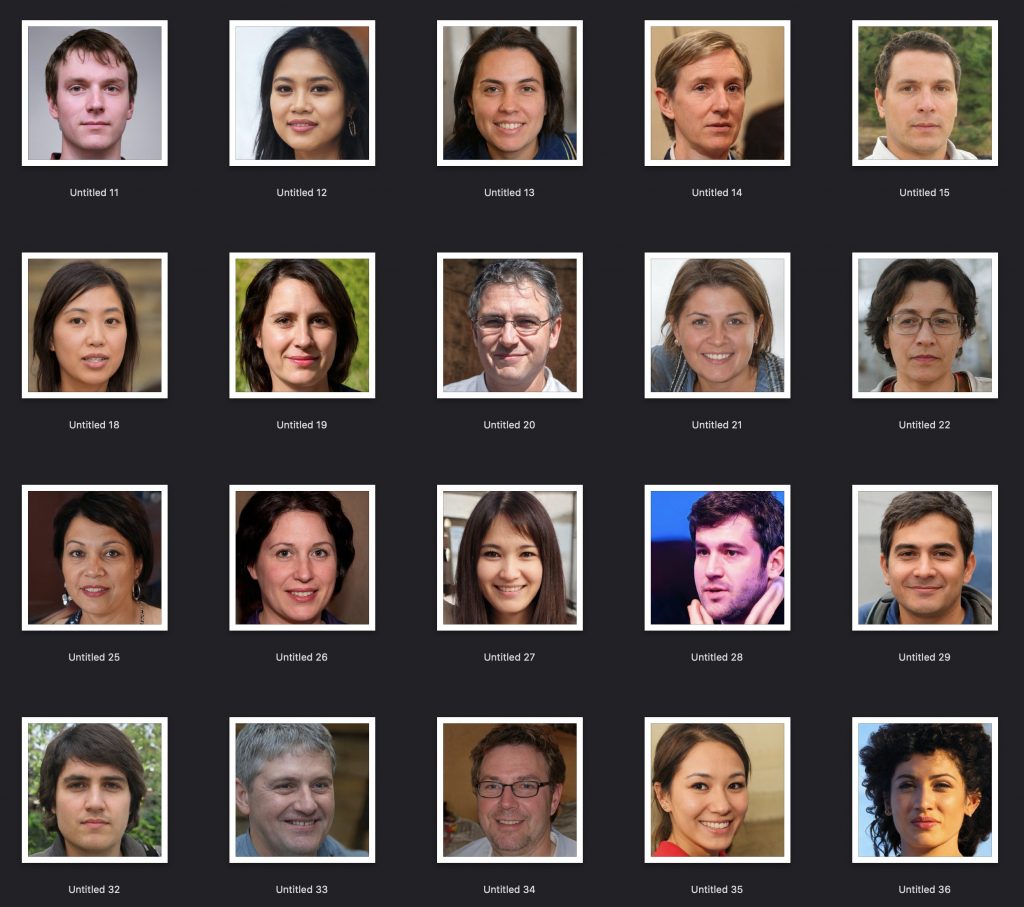
One idea that randomly popped into my mind a few days ago was to leverage AI for some character design creative inspiration. I thought it would be cool to generate some random faces with ThisPersonDoesNotExist.com as a creative tool. Since humans are such visual creatives, myself included, why not start with figuring out a character’s appearance first?

While I could start with abstract qualities or other character traits, there’s something about starting with faces that appeals to me. Imagine if you assembled a gallery of pics of all of your main characters. That alone feels like progress.

Yesterday I used that site to generate lots of random faces, and I saved about 100 of them. Some of the images are a bit deformed, but most look very realistic.

Now and then I’ll see a face that makes me curious. Who is this person? What is their backstory? Might this become an interesting character to explore in my novel?

Here are some samples from the collection I saved. I haven’t designed characters based on any of these. Right now I’m just assembling a collection for brainstorming purposes.

When I find an image that captivates me in some small way, I can daydream about the fictional person and see if it leads somewhere enticing. I can invite my mind to suggest details from their backstory.

That woman looks like she works for a tech company.

That guy looks like a little sinister.

That little girl looks wise beyond her years.

This person is probably comfortable on a stage.

Scrivener is popular writing software that I’ve been using for years, especially for designing courses, so I’m using it using it for my novel project as well. I just started that project with the built-in Novel template. In Scrivener it’s easy to add images to character sheets and even to display the cast of characters visually. So when I find an image I want to use for character inspiration, I can drag and drop that image into my novel doc and then design a character around it. I like the idea of being able to display my characters visually. That makes them feel more real to me, like it’s a real group of people inviting me to tell their stories.

With AI-generated images, the output is pretty random, so I may have to generate a lot of images to find ones I like. But it’s easy enough to open five or more browser tabs and just keep refreshing till something interesting comes up.

Since these images aren’t real people, they don’t carry the baggage of previous associations, so I feel free to construct their identities from scratch. If I used pictures of actual actors to remind me of my characters, their pics might bias my writing to align with other roles those actors have already played.

I like that this approach encourages diversity in my character set too. The AI generates images of different ages, races, and genders, including some faces that look androgynous.

These images may also help me consider details that I might have otherwise overlooked, like whether a character wears glasses, has facial hair, or likes baseball caps. I still have to use my imagination to fully design each character, but starting with a photo seems like a nice way to begin. From the face I may figure out the person’s name and a few other traits, and that gets me into their story.

When I would lead friends through role-playing adventures many years ago, I enjoyed designing interesting characters with goals that would conflict with the players’ goals. Some wild and fascinating stories emerged from this collision of goals. I think a similar approach could work for writing a novel. Design a variety of interesting characters who have conflicting goals and interests, let them collide, and see what type of story emerges from that.

I see this AI-based approach as one tool that I can use to the extent I find it helpful, but I don’t have to use it for every character. It’s not a substitute for other design tools and methods, just a supplement. I think it has promise though. Maybe it’s a bit geeky, but it’s getting me into thinking about character design.

This simple idea makes me wonder what other ways I could leverage some AI assistance for extra creative inspiration.

Someday in the future, I imagine making a bowl of popcorn and saying to an AI: Generate a two-hour movie based on my novel, and play it when ready. And then the next day: Now generate the sequel that I haven’t written yet.

You do realize that it’s only a matter of time before that’s a real thing, right?

Share Button

NaNoWriMo Tips

A couple of days ago, I searched for NaNoWriMo tips from people who’ve done it before. I especially looked for lessons that people discovered by contrasting their own failures versus successes with NaNoWriMo. I compiled a short list of the most interesting tips as reminders for myself, so I thought I’d share this list with you in today’s post.

I’m sure you can generalize some of these ideas to improve your ability to succeed with other short-term challenges as well.

Just write. Don’t do editing, and don’t even fix typos as you go.

This was among the most common tips. Many people failed NaNoWriMo by getting sucked into editing their work after writing it, which doesn’t advance the goal of writing at least 50,000 words of the first draft.

Do write-ins and word crawls.

These are social writing sessions with other people, in-person or virtual. Social support was often leveraged to get past low-motivation slumps instead of going it alone every day.

Write every day – no zero days!

Advance the word count every single day of NaNoWriMo. Having even one zero-word day along the way can hurt or kill momentum. Even if you only add 100 words one day, it’s better than zero. It’s motivating to see your word count increase every single day.

Get ahead on the daily word quota during the first 10 days, and then stay ahead.

To write 50K words in 30 days, you must average 1667 words per day. It’s wise to aim for more during the first 10 days, like 2000 per day. Get ahead and then stay ahead.

When you’re ahead on your word count, don’t reduce the daily quota below 1667. It’s better to maintain momentum and finish strong instead of dropping down to 1500 or 1200 words per day, even if that’s technically enough to hit your 50K.

Pick an idea you love.

If you only semi-like your idea when you begin, you’ll want to give up when the going gets tough. You need an idea that inspires you enough to sustain you to 50K words, so you’d better love it from the start.

Write the fun and exciting parts of your novel first.

Some people found that to maintain momentum, it was best to give themselves permission to skip over difficult or tedious-to-write scenes, so they could keep advancing the word count.

Others by contrast found that it was better to write in mostly linear order scene by scene, as long as they could maintain their word count.

At the end of each writing session, make a note about what comes next.

This makes it easier to get into the flow of writing the next day since you don’t have to waste time figuring out where to begin. You have an immediate task to dive into right away.

Reviewing and lightly editing the previous day’s work can be a nice way to begin each day’s writing session.

Some people found that a small amount of re-reading was a nice way to glide into the day’s writing. It gets the mind thinking in the direction of the story flow. Others found this risky, tempting them into premature editing.

Try the trick of writing in Comic Sans.

There are multiple articles about the writer’s trick of switching the font to Comic Sans, especially while writing a first draft. Many report that they find this font disarmingly casual, making the act of writing feel less formal and more relaxed, chill, and playful.

People like that this simple trick helps them find their authentic voice by reducing self-censoring, so the words flow more easily.

Beware the rabbit hole of research during the first draft phase.

Necessary research can be done later, after the first draft (or most of it) is written. Unnecessary research can be really engaging, but it isn’t writing and doesn’t advance the word count.

When the words aren’t coming for a given scene, write a short summary of the scene instead, and move on to the next scene.

Sometimes you’re inspired to write a particular scene, and sometimes you aren’t. If you’re getting stuck, it’s fine to write a placeholder description and then come back to hash it out later. Do what it takes to keep progressing.

Just write anything. Start filling the blank page with random words to get started if necessary.

To get started each day, just write. Write notes to yourself. Write deliberate nonsense. Put your fingers on the keys, and push down.

If you start typing like a monkey, sooner or later the ideas will start flowing.

Give yourself the benefit of the doubt with your word count.

Many NaNoWriMo writers suggest being generous in calculating your word count for the challenge, especially if it helps you claim victory. Some will include deleted scenes or other scene notes in their word counts, even if they know those words won’t make it into the final text.

Try sprints of 15-25 min, both for writing and brainstorming.

Some found it easier to work in several short bursts instead of one longer daily writing session. Crank out 300-600 words per sprint. Do several of those each day, and you’ve met your quota.

Happy writing!

Share Button