Roberta Burton was told she had Hodgkin lymphoma when she was 11 weeks pregnant.


Roberta Burton was told she had Hodgkin lymphoma when she was 11 weeks pregnant.
Just before her first “handiversary”, double hand transplant recipient Cor Hutton explains why the smallest things mean so much.
Which investments in your education, skills, work, and lifestyle will be most valuable to you in the long run?
A lot is going to change in the next 10 years for you, both personally and professionally. The problem is that you can’t accurately predict what will change and how it will change. This makes it difficult to know where to invest your time, energy, and money today. It’s hard to be sure what will pay off in the long run.
But now consider what isn’t likely to change. What can you say about yourself, the world, and other people that will likely remain essentially the same 10 years from now? What will be predictably stable?
Some years ago Amazon’s team pondered what wasn’t likely to change about their business over the next 10 years. They realized that customers are always going to want speedier delivery, so they opted to make a huge, multi-year investment in building the capabilities to deliver items faster. Other investments were more speculative or risky, but it was a safe bet that customers were going to value faster delivery for many years to come. Amazon’s team recognized that people are always going to want their items faster, which made it easier for Amazon to place really big bets on speedier delivery.
What if you thought about your current work and lifestyle the way Amazon approaches its business?
Let’s start with your work and work-related skills. What about your work, your field, or the demand for certain skills will remain unchanged in the next 10 years? How could you invest more in the unchangeable aspects?
I can predict with high certainty is that many people will still be interested in personal growth in 10 years. I can predict that people will still have personal problems to solve. I can predict that people’s lives will become more complicated than they are today. I can predict that people will have even more distractions to deal with. I can predict that many people will want more clarity and certainty about their paths in life. I can predict that many people will feel disconnected and will want more love and connection in their lives.
Even if AI steps in to do more in this area, I can also predict that many people will still like working with other humans to improve their lives. I can predict that many people will value caring, compassion, and honesty.
I think you get the idea. Over the long run, there’s a lot about this field of work that’s stable and predictable, mainly because human beings have certain qualities that are remarkably stable.
One way I apply this realization is that as I develop new courses, I think about what will still matter to people in 10 or 20 years. I’m not developing a course on email efficiency since I don’t know if that will still be relevant enough in a decade or two. I prefer to develop courses where it’s a pretty sure bet that the topics will still be relevant decades from now. This affects the topics I choose as well as the individual lessons I record. When I design a lesson, I think about whether it will seem dated in 20 years. Sometimes I even think about whether it will be relevant in 100 years, 500 years, or 1000 years. To reflect upon this, I consider which books from 1000+ years ago that I found worth reading, such as The Iliad and The Odyssey. This helps me zero in on timeless qualities like courage and honor. And so my work is rich in such topics. I think that timeless topics help us go to connect more deeply than topics with shorter lifespans.
I even consider whether each course may be helpful to an AI that consumes the content. I think about whether the lessons are AI-relevant, not just human-centric. For instance, an AI has a relationship with its reality just as a human does, so it may find value in the Submersion course, which is about upgrading your relationship with reality. How can I develop a course today and expect it to be just as meaningful, relevant, and worthwhile for people in 20 years? I have to focus on those core aspects of people’s lives that are unlikely to change.
I encourage you to think a decade or two ahead as well, especially when it comes to skill-building. It takes years to build really strong skills. It would be a shame if your investment only has a short lifespan, and then you have to start over. It’s so nice to continue leveraging skills that took 10+ years to build, knowing that they aren’t going out of style anytime soon.
To figure out which skills to invest in, you can guess or try to predict how the future will be different, but it’s actually easier to predict how it won’t be different.
What will you still love, enjoy, and appreciate in 10 years?
Your answers to this question signal another good way to decide how to invest your time and energy in the years ahead.
Your tastes and preferences will change over time, but some interests will remain stable for decades. What are those stable parts of your character?
I can predict that I’ll still be into personal growth in 10 years. I’ll still like connecting with other growth-oriented people. I’ll still be vegan. I’ll still like writing and speaking. I’ll still like to exercise. I’ll still like to travel. I’ll still like doing growth challenges to stretch myself. I’ll still love hugs and cuddles. These are all long-term commitments that aren’t likely to change in the next decade. I may change how I express them, but the core patterns behind them will likely remain very stable.
Other aspects of my life could change though. Will I still be living in Las Vegas 10 years from now? That’s possible since I’ve lived here for 16 years, but I could see myself moving during that time, maybe to another country. Will I still be blogging in 10 years? That’s possible too, but I could shift to other modes of expression. Something new could arise that I like even better.
When you understand the stable parts of your character, you can invest in them more deeply. You can make much bigger bets on those areas of your life that you know you’re still going to enjoy and appreciate many years ahead.
Now if you combine the stable parts of your character and lifestyle with the stable parts of your work and skills, that’s where you can make your biggest bets of all.
For me a pattern in both areas is personal growth. It’s part of my business and my personal life, and I can predict that these patterns will remain stable for at least another 10 or 20 years. So that’s where I can justify betting bigger – a lot bigger.
One way you can gauge your investments is to note where you’re spending your money. What we’re really looking for is your investment of energy, and money is a decent yet imperfect way to assess where energy is flowing. This is especially true when you spend enough money that it feels a bit edgy or scary to you, just like a stock or real estate investor who’s making a big bet on a company or property. If your investments don’t stir up some emotion, you’re probably investing too little, playing it safe, and staying too far inside your comfort zone. That edgy feeling is a sign that you care about what you’re doing. It wakes you up, keeps you stimulated, and ensures that you’ll do whatever it takes to help your investment succeed.
For the upcoming year, I’ve enrolled in a yearlong coaching program and renewed a couple of other memberships to private groups. I’m pre-committed to spending about $14,500 on personal growth expenses (not counting related travel), and the year hasn’t started yet. I’ll undoubtedly spend more as the year progresses. This feels good to me. It’s enough to feel moderately edgy and stimulated but not so much that it would make me feel paranoid. I know I’m making intelligent bets on stable, long-term areas of value. It’s essentially the same logic that convinced Amazon to pour billions into speedier delivery.
But if I were to take that same amount and invest it on tech for my business, such as buying a new Mac Pro, I wouldn’t feel good about it. It seems like a waste that’s unlikely to pay off as well. I love good tech, but spending thousands more for slightly better tools that I can fully leverage doesn’t sit well with me. My investment in tech hardware will only depreciate. I only have so much time to recoup my investment as my hardware’s market value goes to zero.
Investments in personal growth are very different because those investments don’t depreciate. In fact, they tend to appreciate. Due to the long-term stability of personal growth, I can recoup huge gains over time. What I spend for 2020 is likely to still be paying dividends 5 years, 10 years, 20 years out, and beyond. The payoff is just so wonderful.
So for this reason, each year I like to spend way more on personal growth than I do on tech, even in years when I upgrade every device I own to the newest, fully decked out version.
I was in Toastmasters for 6 years (2004 to 2010). I think it was $60 every 6 months to be a member, so $120 per year, so that’s $720 in total dues. Add in the cost of transportation to and from the meetings, buying extra clothes for doing more speeches, occasional conference fees and travel (like for the Toastmasters International Conference, which I attended twice, and some district level conferences), and miscellaneous related expenses, and it probably adds up to less than $5K total. Toastmasters was hugely helpful in enabling me to reach my goal of doing a 3-day workshop on the Las Vegas Strip. That first event made more than $50K in profit. And that’s also where my wife Rachelle and I first met. The ripples from that event are still paying dividends today, and we’ve done 15 other 3-day workshops since then as well. My 2020 plans include doing a new event in Vegas in the Fall as well.
So the ongoing ripples from my Toastmasters investment are still paying dividends year after year. It’s like receiving lifetime royalties for a book written many years ago. Being able to get on a stage, speak confidently, and have fun with it has greatly enhanced my lifestyle as well. Next month I’ll be emceeing the first day of a leadership conference at a hotel next to the Panama Canal. I don’t normally play the emcee role, but thanks to my prior Toastmasters experience, I know how to do it and make it fun.
Toastmasters is inexpensive, but it still takes a lot of time and energy to go to meetings; create, practice, and deliver speeches; and engage with the group. So initially it may seem like a big deal. But consider that you have your whole life to recoup that investment. I so wish I’d gotten into Toastmasters while in my 20s instead of my 30s.
Are you spending more on the unchangeable parts of your life (like personal growth or communication skills) than you do on the changeable parts (like tech)? If not, consider flipping that pattern around, and watch the long-term ROI from your investments soar.
It’s easy to flow time, energy, and money into investments that don’t pay off. This is especially true when you chase after the latest technique- or method-based programs, the ones that promise you fast and easy results. I think of these as “game the system” programs, like ones that will teach you how to make money selling stuff on Amazon or how to rank higher on Google. It’s nice while it lasts, but will it endure for decades? How many times have you strayed away from your core to fall for such traps? I was guilty of that a lot in my 20s… till I finally found my footing and grew a bit wiser.
To make really good investments in yourself, your knowledge, your skills, and your lifestyle, seek to identify and understand the unchangeable core within you. What about you seems stable and isn’t likely to change much in the next 10 years? These are terrific areas for making big, bold bets on yourself.
By contrast, what’s really just a whim that you aren’t likely to care about in 10 years? Steer clear of plunking money down on those areas.
I challenge you to keep stretching your comfort zone when it comes to investing in your core. For many years I would spend less than $1K per year on personal growth, and it felt nice and cozy. I’d buy all the books I wanted and some audio programs too. Now and then I might attend a local workshop. I advanced little by little.
Then at some point I progressed to spending about $1-5K per year on personal growth: more books, more audio programs, nice seminars, club memberships, courses, conferences, and a little coaching here and there. That was still pretty cozy but stretched me more.
These days I like to spend somewhere in the $15-40K range per year on personal growth: lots of books and audiobooks, workshops, conferences, seminars, memberships, and coaching. This still feels cozy, but it also feels more powerful. Mostly I’d describe it as fun and stimulating. It feels more social and connected too since I now work on personal growth with other people every day, including as part of running Conscious Growth Club.
This also makes me wonder what it would be like to eventually spend $100K+ per year on personal growth and to have that feel normal. Right now I’m still getting so much value from the 5-figure level that I’d like to stay here a bit longer and keep soaking up the fun and stimulation that it provides. It’s not just the money to consider but also the time investment. Shoving more money into the pot isn’t the point. The money is just an indicator of energy flow, but it’s really the energy that matters. You can flow a lot of energy into an investment without spending much money, like I did with Toastmasters, but sometimes it’s also good to get plenty of money flowing towards your core. If you aren’t willing to spend your money on what truly matters to you, that’s a sign that you’re probably holding back due to fear, self-doubt, or some other internal misalignment. Be willing to bet bigger on yourself.
Don’t be so worried about making a mistake now and then. It happens. Even a fairly weak course or program might yield one good idea, and if it’s a fairly timeless idea, you still have decades to recoup the investment. Sometimes the best I can do is look back on a foolish investment and laugh at it, but somehow even the foolish ones really aren’t that regrettable in the long run.
Since I’ve been investing in personal growth for decades now, I notice that I am indeed still gaining from investments I made years ago, even from the smallest expenses like books and movies. A book I read 20 years ago may provide an insight that I share on a coaching call today. I often leverage the knowledge gained from personal growth investments I made during the 1990s in my work today. And I expect that today’s investments will still be paying dividends many years from now.
On our quarterly planning review call in Conscious Growth Club yesterday, I anchored the call with a Bruce Lee quote about a finger pointing to the Moon. When I first watched Enter the Dragon as a teenager, I couldn’t have predicted that it would be useful professionally decades later. It’s a fun movie and will likely seem pretty dated today, but it does contain some nice personal growth lessons.
Here’s a 2-minute Bruce Lee clip that I think you’ll like, which contains the quote I referenced on yesterday’s call. It’s a fun clip to watch and may add some extra sparkle to your day.
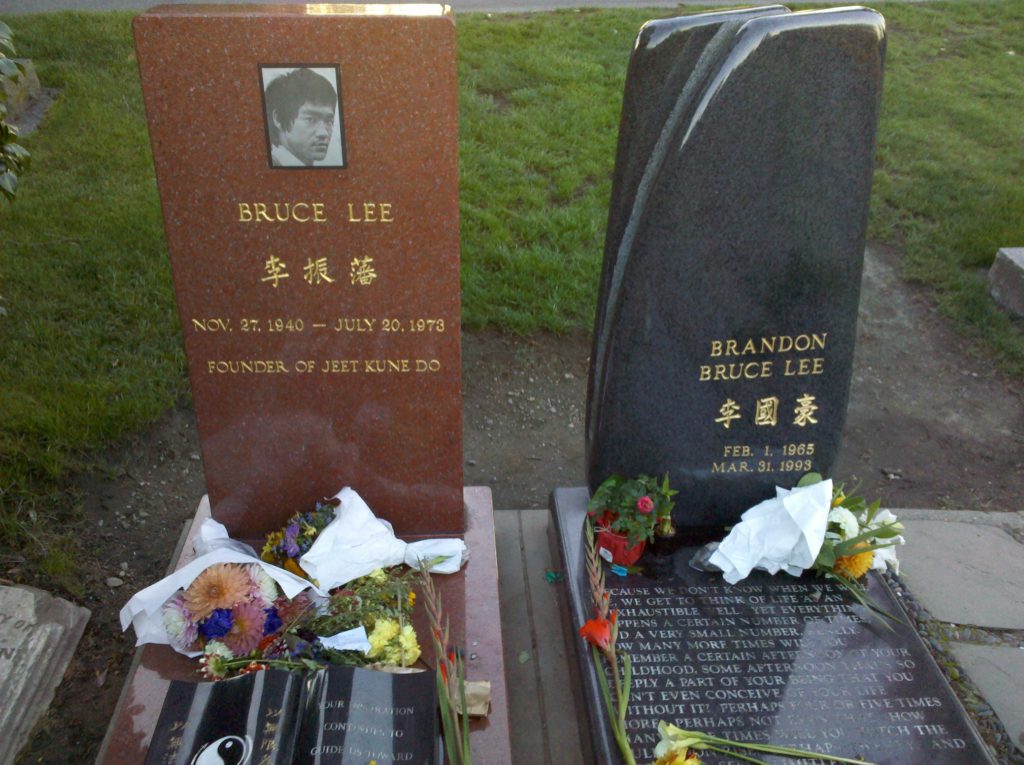
Enter the Dragon premiered in 1973, one month after Bruce Lee’s death at age 32. Rachelle and I once visited his grave in Seattle. Does Bruce Lee’s work still inspire people 46 years later? You bet!
Bruce Lee is a great example of someone who invested in his core. He trained hard, and then he turned that investment towards creating ripples for others – inspiring millions with his work ethic, skills, philosophy, and movies.
Investing in your core pays off so ridiculously well over time because you have a long timespan to make gains from your investment, Bruce Lee’s early departure notwithstanding.
Are you investing enough in your core? Are you expressing your core outwardly into the world? Have you been feeding your inner dragon and encouraging it to soar?
What would Bruce Lee think of your level of investment? Well, first he’d smack you for using the word think. Then he’d ask: How do you feel?

The ease of online purchasing could be making things worse for people with so-called “buying-shopping disorder” (BSD), new research shows.
BSD is still debated as a stand-alone diagnosis, and hasn’t yet been included in the psychologists’ bible, the Diagnostic and Statistical Manual of Mental Disorders.
But that’s probably only because not enough good data on the condition exists, said the author of a recent study into online shopping addiction.
There’s a “relative lack of published scientific literature,” said Dr. Astrid Muller — but psychologists have long dealt with such cases.
“There is well over 100 years of clinical history describing dysfunctional buying or acquisition excesses that interfere with daily life, and are associated with significant clinical distress and impairment in important areas of functioning,” said Muller. She’s head psychologist in the department of psychosomatic medicine and psychotherapy at Hannover Medical School in Germany.
BSD is defined as an “extreme preoccupation with shopping and buying [and] to impulses to purchase that are experienced as irresistible,” Muller said.
The condition can cause real harm, including post-purchase guilt and regret, a sense of loss of control, family conflict over excessive purchasing, and financial distress.
According to Muller, BSD is thought to affect about 5% of people globally. And in the 21st century, it has moved online.
Reporting in the current issue of Comprehensive Psychiatry, Muller’s group tracked the online shopping habits of 122 patients already diagnosed with BSD.
Study patients ranged in age from 20 to 68 (at an average of about 43), and more than 75% were women. All were already seeking treatment — which usually takes the form of cognitive-behavioral therapy — for their shopping addiction problem.
Participants were asked to complete a number of diagnostic questionnaires, including the so-called “Internet Addiction Test” and the “Pathological Buying Screener.” All were also assessed for anxiety and depression.
In the end the team concluded that a third had developed an online shopping version of BSD. These individuals tended to be younger, and typically had more severe anxiety and depression.
According to Muller, people with BSD may have their reasons for preferring one shopping venue over another.
“Some individuals with BSD may always prefer shopping in brick-and-mortar-based stores because they appreciate the opportunity to touch merchandise, try out goods, enjoy the stimulating traditional retail environment, and experience comfortable social interaction with salespersons,” she explained.
But some BSD patients may be especially attracted to online purchases, because shopping via the web involves such a huge variety of products. It’s also easy, quick and has “the opportunity to buy unobserved and secretly,” Muller said.
“All contribute to the migration of traditional buying-shopping disorder to the online retail market,” she concluded.
Dr. Petros Levounis is chair of the department of psychiatry at Rutgers New Jersey Medical School, and chief of service at University Hospital in Newark, N.J. He wasn’t involved in the new research, but said any new data on BSD is crucial.
“We’re not close to having all the research we would like to have for issues like BSD, which is part of an emerging group of disorders called behavioral addictions,” Levounis noted. “These include compulsive suntanning, gambling and compulsive internet gaming. But they also include behaviors that are usually part of everyday life, and which for most people are helpful. Things like exercising, eating, emailing, texting, and, yes, shopping.
“But what we do know is that for people who are addicted these behaviors are like a drug,” said Levounis. “And the fewer the barriers to the addictive behavior, the greater the potential for negative consequences.
“So if you have BSD, and you find that you don’t have to go to the mall to shop, if everything is just a click away, then that is very, very compelling,” he said. “And it certainly has the potential to turn your disorder into even more of a problem than it was before.”
Image: iStock


Finger foods are delicious, but they can pack on the calories even when you just nibble. Here are two appetiser makeovers with plenty of flavour and a lot less fat.
Jalapeno poppers are a favourite thanks to their creamy filling and crunchy coating. By baking instead of deep frying them, you’ll cut back on hundreds of calories yet keep the crunch. Another crowd-pleaser is taco dip. Ingredients with a lower fat content make all the difference in this recipe.
Baked Jalapeno Poppers
Note: Wear disposable gloves to prepare the jalapenos to minimise the capsaicin that gets on your fingers.
Preheat oven to 350 degrees.
Lightly coat a large baking sheet with nonstick spray and set aside.
In a large bowl, mash together cream cheese, mozzarella, cumin or fennel seeds, chili powder and black pepper. In a shallow dish, whisk the egg and egg whites.
Spread out the flour on a sheet of wax paper. Spread breadcrumbs on another sheet of wax paper.
Fill each pepper half with a heaping tablespoon of the cream cheese mixture.
One at a time, dredge each pepper half in flour, dip into the egg mix and press into the crumbs to coat. Place, cut side up, on the baking sheet.
Bake until tender and golden, about 25 to 30 minutes. Serve immediately.
Yield: 24 poppers
Layered Taco Dip
Mash avocados and spread over the bottom of an 8-inch square glass baking dish or bowl.
Blend yoghurt, sour cream and taco seasoning in a separate bowl and then carefully spread it over the avocado with a spatula.
Sprinkle on grated cheese and chopped olives and serve with vegetable spears for dipping.
Yield: 4 cups
Image: iStock
NEXT ON HEALTH24X


Researchers found that kids’ genes and their parents’ education and wealth were big predictors of school success.
They analysed data from 5,000 children born in the U.K. between 1994 and 1996, including test results at key stages of their education and their parents’ wealth and levels of education.
The results suggest that while genes have a significant effect on academic success, having wealthy, highly educated parents is even more important.
While 47% of kids with a high genetic propensity for education but poorer parents made it to university, the rate was 62% among those with a low genetic propensity but wealthier parents.
Kids with both a high genetic propensity and wealthy, well-educated parents had the greatest advantage – with 77% going to university. The rate was 21% among children who had both low genetic propensity and poorer families.
The findings, published recently in the journal Developmental Science, could help identify kids who are at greatest risk of poor educational outcomes, according to the study authors.
“Genetics and socioeconomic status capture the effects of both nature and nurture, and their influence is particularly dramatic for children at the extreme ends of distribution,” said lead author Sophie von Stumm, professor of psychology in education at the University of York in the U.K.
“However, our study also highlights the potentially protective effect of a privileged background. Having a genetic makeup that makes you more inclined to education does make a child from a disadvantaged background more likely to go to university, but not as likely as a child with a lower genetic propensity from a more advantaged background,” she added in a university news release.
von Stumm noted that the findings are observational and suggest that kids don’t have equal opportunity in education because of their different genetics and family backgrounds.
“Where you come from has a huge impact on how well you do in school,” she said in the release.
Image: iStock

The boxes are given to families to support them while caring for someone with dementia.
Stringr
This is how often you should replace your sheets on a fairly regular basis, according to experts.
Image: iStock


I listened to Marie Kondo’s The Life-Changing Magic of Tidying Up audiobook this week. I know it’s a super popular book, but this is the first time I’ve checked it out. I liked it!
It also strikes me that the way she relates to possessions would be an interesting way to handle trust wounds as well, as both can be resolved through a decluttering process. The problem with both areas that creates stuckness is that such a process isn’t usually done thoroughly enough to fully fix the recurring problem (recurring clutter or recurring trust wounds).
Not doing a truly thorough, one-time tidying process is the main reason for recurring clutter, according to the book. We could say that a similar oversight also leads to recurring trust clutter.
What is trust clutter? It’s the presence of triggers (usually people) in your life that trigger trust issues for you. These could be people who’ve violated your trust in the past, and every time you think about them, those old wounds pop up again. Perhaps you keep such people around out of loyalty. Note that this is how people often accumulate lots of physical clutter as well – out of loyalty.
Marie Kondo’s standard for tidying is that you should only keep possessions that spark joy. That’s a high standard, and many people won’t be willing to meet it, but imagine what your life would be like if all of your possessions did meet that standard. You’d be surrounded by possessions that trigger only happiness. As as she notes in her book, this really does raise the long-term happiness level of people’s lives. If you eliminate the unhappiness triggers, you naturally get to experience more happiness.
I live in a home with lots of possessions that I like, but I’m nowhere near the spark joy standard across the board. This has been making me question some possessions: If an item doesn’t spark joy, what does it spark instead?
I’m discovering that possessions that don’t spark joy have other associations, many of them mixed. Some possessions trigger memories. Some trigger associations to people, especially gifts or hand-me-downs. Most of these triggers are on the positive side, but some aren’t. If I went through the process of evaluating and releasing the misaligned items, I do think it would improve my overall happiness. If you take away the negative triggers and the mixed ones, then there are only happy triggers left.
What I find interesting is that I actually apply this standard much better in my social life. When people violate my trust, I have a habit of releasing them and moving on. I remove them from my social circle, and I tend not to look back. In the past I’d give people second and third chances, and they pretty much always made me regret it sooner or later. While I wouldn’t say that all of the people in my social circle spark joy, I do believe that most of them do, and the ones that don’t are sparking mostly neutrality or weaker forms of positivity, but not negativity, problems, or trust violations. Consequently, my social circle is full of people I trust.
How many people are in my social circle today that I don’t trust? It feels like I have to wrack my brain to think of even one. I think it’s zero by definition. For me to consider someone part of my social circle, I have to trust them, so if I don’t trust them, they aren’t part of my social circle.
As Marie Kondo notes, once you do a really thorough tidying of your physical space, which mostly involves discarding items, and you push through until the job is truly done, it permanently raises your standards, and you’re unlikely to relapse. Can you imagine tidying up so well that you never relapse back to cluttered conditions? Life becomes so nice on the other side that any clutter that pops up really grabs your attention and makes you want to fix it immediately.
That’s how I tend to feel about my social life. Since my norm is to have trusting relationships and since my life has been like this for years, when something nasty does happen, it stands out like a truly glaring issue that must immediately be addressed. I just don’t tolerate social nastiness in my sphere. That’s probably why my Facebook block list has 100+ people on it. Cross the line once, and I’m very likely to conclude that we’re incompatible, so I’ll release you permanently. I respond to trust clutter like Marie Kondo deals with physical clutter.
This might sound a bit harsh, just as Marie Kondo’s tidying style may seem extreme. But I can see the logic in what she proposes because of my own experiences in my social life. There really is some life-changing magic to tidying up, not incrementally but in the form of a deep, one-time purging of the misaligned. As she notes in her book, this typically takes about 6 months for possessions if you’re going to do it right. Doing it once in your life is enough because that will raise your standards permanently.
If you have trouble maintaining an aligned social circle, consider doing a deep and thorough social tidying – so thorough that you only have to do it once in your life, and then you’ll never want to relapse. Ask if each person in your life sparks joy for you. If not, why are you wasting your life maintaining a relationship with them? If they spark joy + some crap, they go in the discard pile.
You might think you’ll have no friends left if you maintain this standard, just as people might feel like they won’t have any possessions left. But if you really have to downsize that much, it means that most or all of your friends or possessions are misaligned, and so starting fresh will be a good thing.
You don’t have to declutter harshly. You needn’t discard items by throwing them into the fire while bellowing, “Die, foul chatzki!” Marie Kondo recommends thanking and appreciating items as you release them. Consider using a similar approach when releasing relationships. You’re not tossing people into the Fire Swamp. You’re thanking and releasing them while appreciating the role they’ve played. You’re graduating to more aligned experiences.
If you cling to misaligned relationships, you hold yourself back (tremendously!) from graduating to more aligned relationships and social connections. That’s your choice, but I wouldn’t recommend staying stuck due to misplaced loyalty for too long. Be loyal to your path of growth, and you’re likely to see your relationships get better and better. Similarly, be loyal to your overall relationship with your home and to awakening and stimulating your best energy patterns. Loyalty to misaligned possessions and loyalty to misaligned people isn’t real loyalty – it’s really just resistance to growth and change. This life doesn’t reward settling into your comfort zone; it will make your comfort zone increasingly uncomfortable till you get back on a path of growth. If you’re stubborn about it, then your intention isn’t to remain in your comfort zone to the death – it’s to remain there to the pain! And good luck with that.
What do you think of someone when you walk into their cluttered home, full of stuff they clearly don’t appreciate? What would you think of them if their home had few possessions, but you could tell they liked and appreciated what they owned? Now apply this on a social level. What do people think when they see you tolerating people who trigger you? What would they think if you had a much sparser social life, but you fully appreciated everyone in it?
Even if you have to take your social circle to zero to reach this standard, then do as Marie Kondo does and start by appreciating your possessions. Develop the relationship with your stuff that you’d like to have with people. Misalignments are infectious, and so are alignments.
You could also extend this to customers and clients if you have a business… or to co-workers if you have a job. If the people in your life don’t spark joy for you, why not release them? Donate them to another business. If you do this enough, it will raise your standards for business and life. I do this pretty well, and so I get to connect with customers that I really like each day… even to the extent that I married one last year. And it’s a very happy, fun, and mutually enjoyable marriage because we both spark joy for each other.
Tidying up your social circle like this might sound crazy, especially if your life is full of misaligned people that you feel you must tolerate. But if that’s your justification, realize that you sound just like those people in cluttered homes justifying why they must keep every possession that makes them feel less than happy. Doing a thorough social cleanup would be incredibly freeing, even if it means you have to switch jobs or companies and even if it means you have to redefine “family” as something different from your relatives.
Just as no one is forcing you to live in a cluttered home, no one is forcing you to tolerate a misaligned social circle. You’re free to choose to clean house whenever you’re ready.
If you have trust clutter repeatedly popping up in your life, what’s the real cause of these recurring trust problems? Perhaps the true cause is that you’ve never done a throughout social tidying, so you don’t get the life-changing magic till you do.
Thanks a bunch, Marie Kondo. I thoroughly enjoyed and appreciated your book. 🙂

People who ate more typical Western diets were three times more likely to develop an eye condition that robs you of your central vision – late-stage age-related macular degeneration, a new study found.
“What you eat seems to be important to your vision, and to whether or not you have vision loss later in life,” said study lead author Amy Millen. Millen is an associate professor in the department of epidemiology and environmental health at the University at Buffalo’s School of Public Health and Health Professions, in Buffalo, N.Y.
“People know that diet influences cardiovascular risk and the risk of obesity, but the public may not know that diet can affect vision loss,” Millen said.
Age-related macular degeneration occurs when a part of the eye called the macula is damaged. Sometimes this happens when deposits called drusen grow on the macula. Or it can occur when new blood vessels keep forming and leak blood, scarring the macula, according to the American Academy of Ophthalmology.
Genetics and smoking are known risk factors for age-related macular degeneration.
The study included almost 1,300 people from a nationally representative sample. Most did not have macular degeneration. There were 117 who had early AMD, and 27 had late.
All of the study participants completed surveys about their diets twice during the 18-year study.
The researchers sorted the foods into 29 categories to measure the quality of the diet.
They found that people who ate a more Western diet were much more likely to develop late-stage AMD. Foods linked to a higher risk included:
“Diet is one way you might be able to modify your risk of vision loss from age-related macular degeneration,” Millen said, especially if you have a family history of the disease.
She noted that since the study was observational, it couldn’t prove that eating healthy foods would reduce the risk of AMD, but she said it did show the foods you probably don’t want to eat often.
Dr. Avnish Deobhakta, an ophthalmologist at the New York Eye and Ear Infirmary of Mount Sinai in New York City, wasn’t involved with the study, but said he wasn’t surprised by the findings.
“This study shows what we’ve suspected. A diet high in fatty foods, processed meats and refined grains makes the more severe form of macular degeneration more likely,” Deobhakta said.
Both Millen and Deobhakta said inflammation caused by a less healthy diet and stress on the cells in the eyes (oxidative stress) are likely behind the increased risk.
“The eyes are a sentinel for the rest of the body. In the tiny blood vessels of the eyes, even small changes that you would not otherwise notice in other organs, you will notice in the eyes,” Deobhakta said.
So can you make up for a lifetime of eating poorly? That’s not known. But both experts said that a healthy diet — full of vegetables (especially dark, leafy greens) and fruits and fatty fish — contains important nutrients for eye health, including lutein and zeaxanthin.
“It’s difficult to switch the way you eat overnight, but this is almost certainly a decades-long process, so try to slowly move toward more virtuous behavior with food. Try to supplement your current diet with more leafy vegetables and increase your consumption of fish,” Deobhakta said.
And both experts strongly advised no smoking.
The study was published in the December issue of the British Journal of Ophthalmology.
Image: iStock

