Keir Starmer will not back calls for an unconditional ceasefire in the Israel-Hamas war despite facing a growing Labour revolt over the issue.
A senior source close to the party leader said Starmer “is not going to move” on his current position of supporting “humanitarian pauses” to let aid get to Gaza.
Advertisement
In a speech earlier this week, the Labour leader said he understood the calls for an immediate ceasefire, but believes that would simply allow Hamas to regroup and mount more attacks on Israel.
He said he would only support a cessation once the Israeli hostages currently being held in Gaza are released and Hamas’ military capabilities are degraded.
Since then, the calls for a ceasefire from within the Labour party have grown louder.
Two Labour council leaders today called on Starmer to resign over his refusal to back a ceasefire.
Burnley Council leader Afrasiab Anwar said the leader had “not stood up for Labour values”.
Asjad Mahmood, who is the leader of Pendle Borough Council, said Starmer had “failed to listen” to calls for a ceasefire.
Advertisement
But the senior Labour source told HuffPost UK: “The position is not going to change.
“We want to see a situation where the hostages are returned and we want to get to a place where the violence is ended but that’s not as simple of calling for a ceasefire
“Keir is not going to move on that.”
The row is the biggest challenge Starmer has faced since he succeeded Jeremy Corbyn as Labour leader in 2020.
More than 30 Labour councillors have so far quit the party, while 15 shadow ministers at Westminster have also broken ranks to call for a ceasefire.
But despite speculation, none of them has yet resigned from the Labour frontbench and Starmer is reluctant to sack them amid fears it could make the situation even worse.
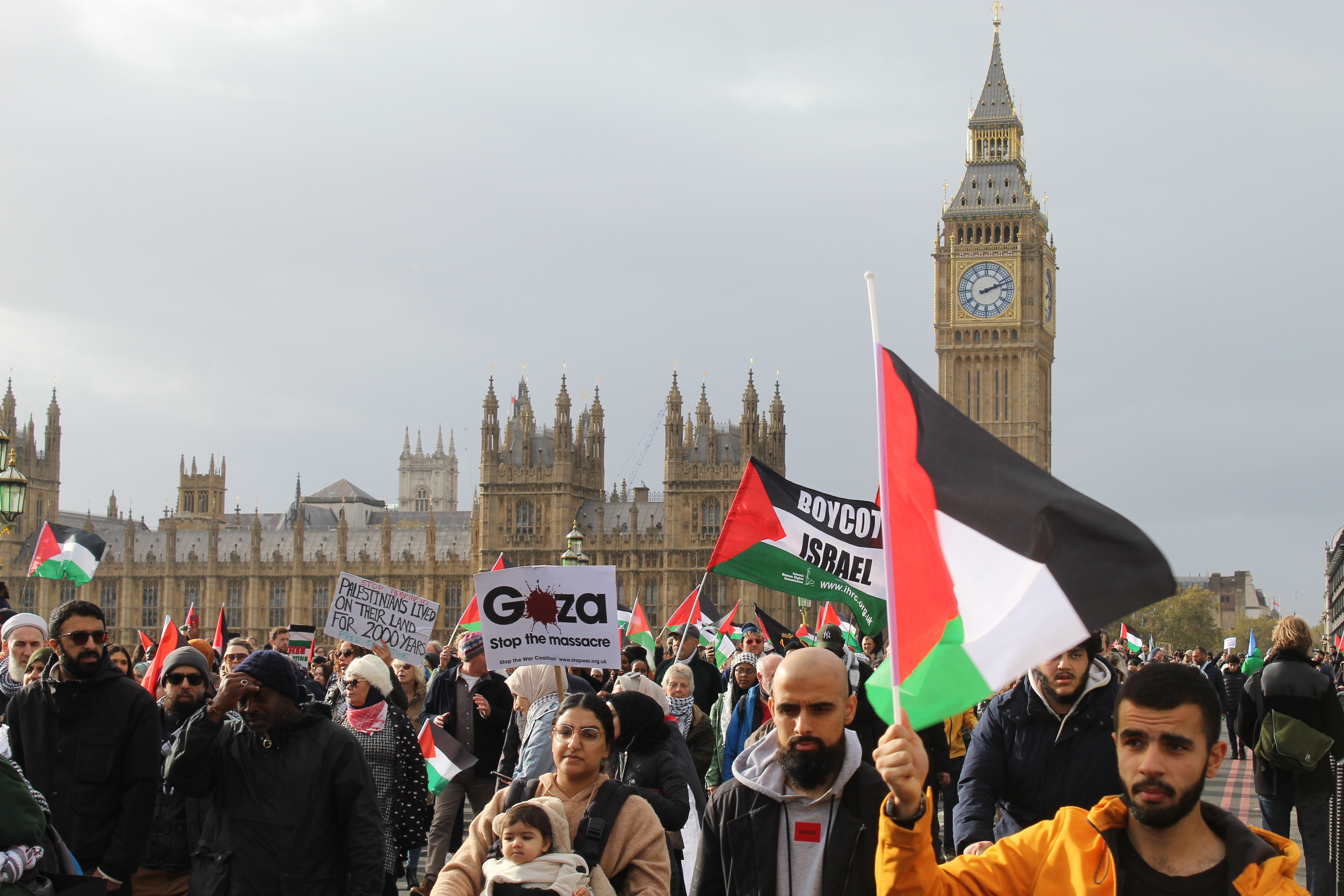
A pro-Palestine march planned for Remembrance Day is “inappropriate”, security minister Tom Tugendhat has said.
He has written to London mayor Sadiq Khan, Westminster Council and the Metropolitan Police setting out his concerns about the event, which is due to take place on Saturday, November 11.
Advertisement
That is also Armistice Day, which marks the end of fighting in the First World War. A two-minute silence will be held at 11am.
Speaking on BBC Breakfast this morning, Tugendhat said that the planned march was “a matter of great concern to me”.
He said: “I know that many of my fellow veterans will be looking forward to that day, not a day of joy but a day of grief. It’s a day when many of us remember those who aren’t standing with us, who aren’t there to lay a wreath, who aren’t there with their friends to have a beer afterwards and talk about the old days.
“It’s a moment when we remember those we lost and I think for the whole country, the Cenotaph is sacred ground and the idea that on a day like Remembrance Day you’d have a protest going past it, I don’t think that’s acceptable.”
Advertisement
However, organisers of the march have insisted they will not go past the Cenotaph, where politicians and veterans will lay poppy wreaths for Remembrance Sunday the following day.
Tugendhat said that in his letters, he had asked Sadiq Khan, Westminster Council and the Met to “look very carefully at the powers that they have and to consider what options they have available” with regard to the November 11 march.
He added: “Personally, I don’t think this is an appropriate time for a protest.”
HuffPost UK understands that only home secretary Suella Braverman has the power to ban the march.
Asked if the protest should be banned, Tugendhat said: “I think protest is incredibly important in a free society.
“I’m just saying the Cenotaph on Remembrance Sunday is a particularly sensitive time and a sensitive place and it’s a moment when the country comes together, and so I think there are moments where and places where that’s not appropriate.”
Advertisement
Friends of Al-Aqsa (FOA) is planning to bus protestors from Leicester to London to take part in the march calling for a ceasefire in the war between Israel and Hamas.
FOA spokesman Ismail Patel said: “We definitely will not be at the Cenotaph. We understand the sensitivity of the date.”
A Met Police spokesperson said the organisers of the November 11 march were considering different locations in London.
He said: “They have indicated they are planning a march on the Saturday, but that they are considering different locations given the sensitives around this date,” the spokesperson said.”
Civilians trapped in Gaza are now deciding “where do we want to be when we die”, a British MP who has family in the territory has said.
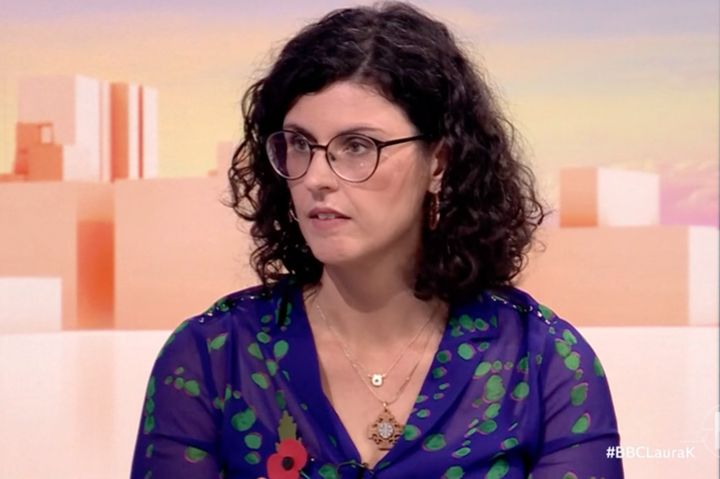
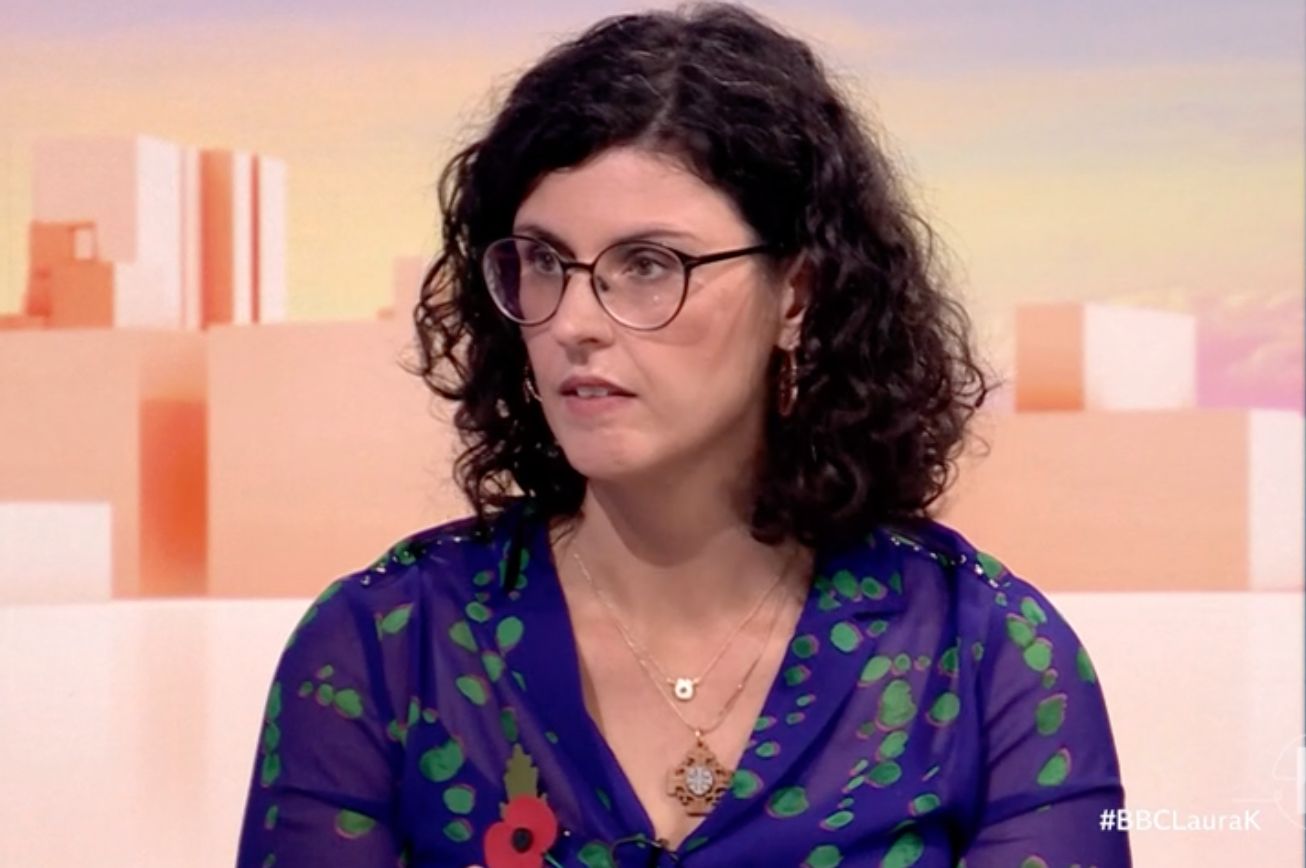
Lib Dem Layla Moran said on Sunday that “nowhere in Gaza is safe”, as Israel conducted its military operation in response to the October 7 Hamas attack.
Advertisement
“The conversion in Gaza now I’m afraid to say has changed. No longer are people saying, where do we go to be safe,” she told the BBC’s Sunday with Laura Kuenssberg programme.
“The question they are now asking is, where do we want to be when we die?”
Moran’s mother is Palestinian and father is British and some of her extended family have been sheltering in a church in Gaza since a Israeli bomb hit their house.
She said it had been “torturous” not to be able to contact them after phone and internet connections were cut.
Advertisement
“I can’t tell you wha that did to us as a family,” Moran said. “Not knowing if they were dead or alive.”
Moran, the Lib Dem foreign affair spokesperson, said the UK government was essentially “sanctioning” the Israeli action and called for a ceasefire.
On October 7 Hamas attacked Israel from Gaza, killing 1,400 people and taking around 230 hostages.
In response, Israel has launched an intensive bombing campaign in Gaza and a broader ground invasion is expected.
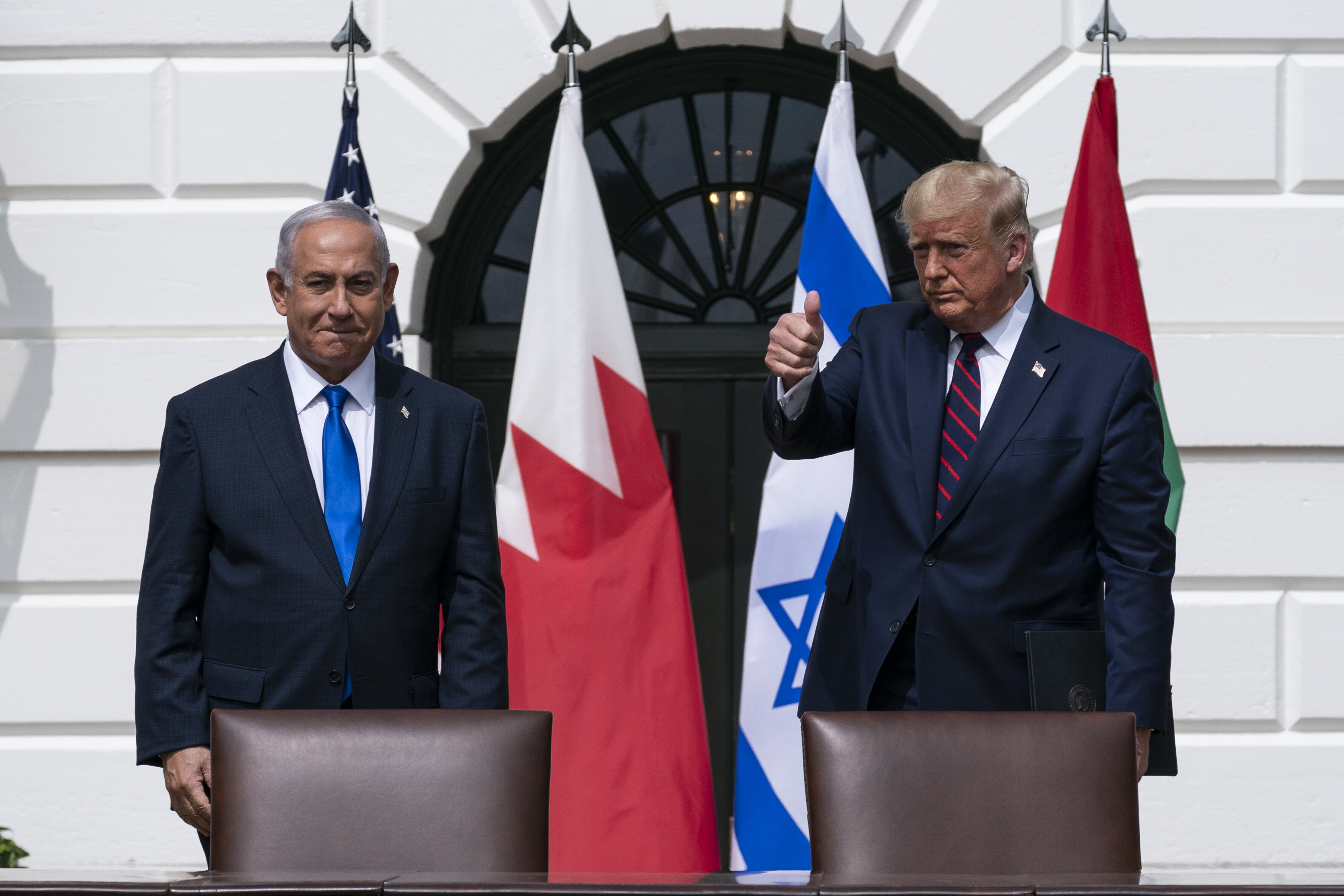
LAS VEGAS — Despite having praised the anti-Israel group Hezbollah as “very smart” and disparaging Israeli leaders just days after an attack that killed well over a thousand people in the country, Donald Trump nevertheless received a hero’s welcome Saturday at the Republican Jewish Coalition’s annual conference.
Trump, the eighth and final speaker at a forum of 2024 GOP presidential candidates, got a lengthy standing ovation before he even said a word in a massive ballroom at The Venetian Resort on the Las Vegas Strip.
Advertisement
“I love Israel,” he said to cheers. “I love Israel.”
Over the next half-hour, the former president ticked off all the things he had done for the country and encouraged Israel to wipe out Hamas, whose members carried out the Oct. 7 assault, while criticizing U.S. President Joe Biden’s calls for Israel to restrain its retaliatory strikes to avoid harming civilians.
“Every single life that is lost in this conflict is on the shoulders of Hamas alone,” Trump said to more cheers.
Matt Brooks, the Republican Jewish Coalition’s CEO, said he understood why attendees gave Trump a pass on his comments, considering Trump’s “incredible pro-Israel record” during his four years in office. “His record is unblemished on this,” Brooks said.
Ari Fleischer, a press secretary in the George W. Bush White House and a member of the group’s board of directors, said most Jewish Republicans still back Trump. “He shouldn’t have said it,” Fleischer said of Trump’s comments. “But his record is so strong and so good, he still has a deep pool of goodwill.”
Advertisement
Trump’s remarks praising Hezbollah came just four days after Hamas, the Gaza-based militant group, killed more than 1,400 people in Israel, according to the country, with another 200 taken hostage. “You know, Hezbollah is very smart. They’re all very smart,” Trump told his West Palm Beach audience in a speech that also denigrated Israeli military officials and Prime Minister Benjamin Netanyahu.
Trump, who as president reversed several U.S. policies to encourage Netanyahu to do as he pleased, soured on the Israeli leader after he called to congratulate Biden after the 2020 election. Trump falsely claimed then, and continues to falsely claim now, that he actually won.
While attendees at the annual summit said they were irked by Trump’s remarks, many said they would not hold them against him as he seeks the 2024 GOP nomination because, as president, he moved the U.S. embassy from Tel Aviv to Jerusalem, supported the building of even more Israeli settlements in the occupied West Bank territory, recognized Israel’s annexation of the Golan Heights, and helped broker a normalization treaty between Israel and multiple Arab countries.
“There is nobody who did more for Israel than Trump,” said Sinan Gursoy, a cardiologist in Naples, Florida, as he downplayed Trump’s previous remarks. “This is his style. People have got to get used to it.”
Biden’s campaign, meanwhile, pointed to Trump’s comments as an example of the sort of rhetoric that Americans grew weary of during his presidency. “The simple truth is, Trump’s erratic attacks on Israel are par for the course for a man who undermined our national security and embarrassed our nation on the world stage,” said campaign spokesperson T.J. Ducklo. “The more Trump speaks, the more voters are reminded just how dangerous and unfit to lead he is.”
Advertisement
Among Trump’s rivals for the 2024 GOP nomination, though, only former South Carolina Gov. Nikki Haley criticized Trump. She said that in a time of conflict in Israel and Russia’s continuing assault on Ukraine, the United States could not afford another Trump presidency.
“We cannot have four years of chaos, vendettas and drama. Eight years ago it was good to have a leader that broke things. Now we need a leader that knows how to put things back together,” she said. “America needs a captain that will steady the ship, not capsize it. And Republicans need a candidate who can actually win.”
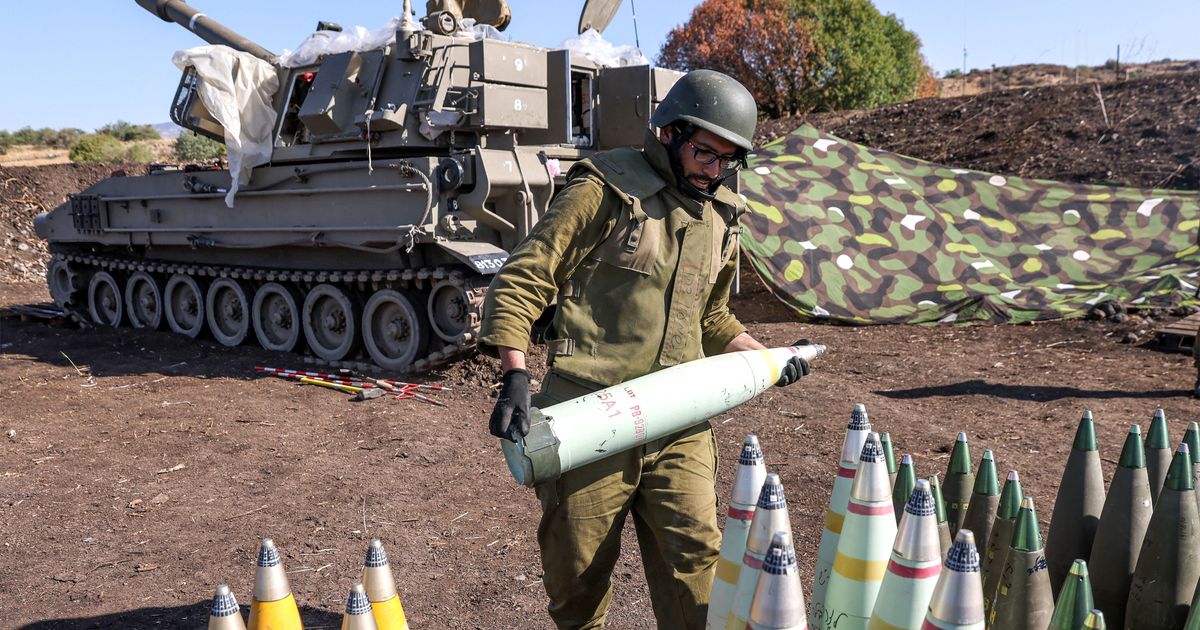
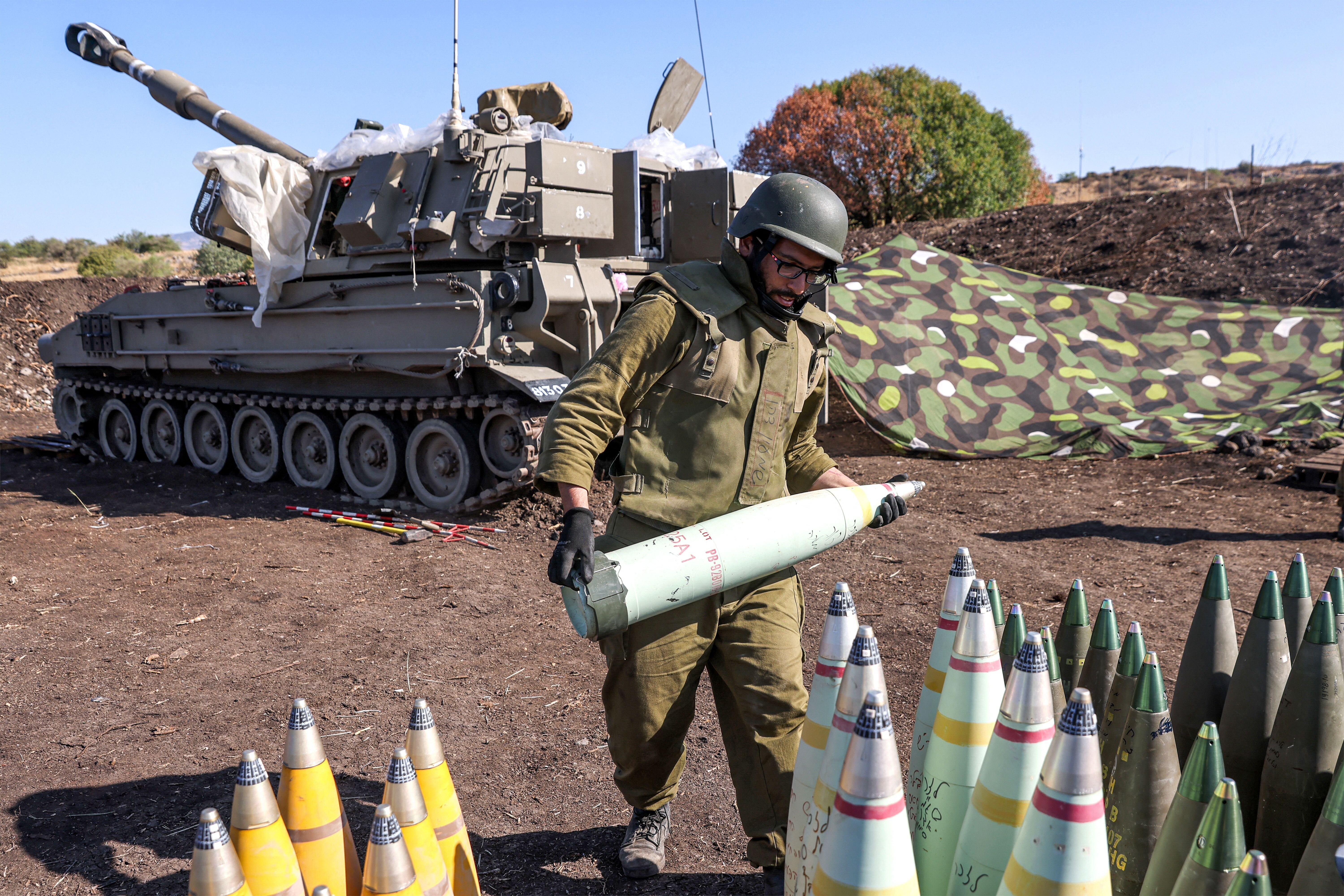
The US has confirmed that shells originally intended to aid Ukraine in its war against Russia have now been sent to Israel amid its conflict with the Palestinian militants, Hamas.
Reports that tens of thousands of artillery shells – specifically 155mm projectiles – previously earmarked for Ukraine, were being redirected to Israel started circulating last week.
The unnamed official told journalists that “prior to the October 7 Hamas terrorist attack, some 155[mm shells] had been withdrawn from the war reserve stockpile in Israel, to replenish US stocks in Europe”.
The New York Times has previously reported that the US had been moving munitions, potentially up to 300,000 shells, from Israeli storage to Ukraine since 2022.
But, as the official noted, there’s now been a U-turn in the Pentagon, following the outbreak of war in the Middle East.
They said: “Much of that has been redirected and provided to the Israel Defence Forces for their use.”
Advertisement
The Pentagon had been keeping munitions in Israel as an emergency in case of war in the region or as a resource for other US allies.
The US does not formally need Israel’s consent to move such items, but local officials confirmed they had it anyway – from then-prime minister Yair Lapid’s –when looking to transport the munitions to Ukraine.
As Reuters noted in January, if such transfers had happened under current PM Benjamin Netanyahu’s watch, it may have stretched his budding relationship with Russia.
Now, munitions have been redirected back to Israel – even though Ukraine still has more than 1,000km of active frontline to fight.
Ukraine’s minister for strategic industries, Oleksandr Kamyshin, told POLITICO on Monday that the Israel-Hamas war showed the West needs to increase its arms production.
Advertisement
“The free world should be producing enough to protect itself. That’s why we have to produce more and better weapons to stay safe,” Kamyshin said.
Back in the US media briefing on Monday, journalists asked the Pentagon representative why weapons were going to Israel, even though the White House has regularly emphasised how much munition Ukraine needs.
The official said the US is “assessing US stocks globally and what can be made readily available to the needs of Israel as well as Ukraine”, before adding: “Also the United States can walk and chew gum at the same time.
“So we’re going to continue to ensure that Ukraine has what it needs to defend its territory. And at the same time we’re ensuring that Israel has what it needs. Two very different operational environments with different levels of need and consultation. And we’re continuing to prioritise both.”
The change follows a domestic split in US politics about just how much funding and weaponry Washington DC should continue to send to Kyiv more than 18 months after Russia first invaded.
Advertisement
As Nikolay Kozhanov, a consulting fellow at the Russia and Eurasia Programme of think tank Chatham House told HuffPost UK, the conflict in the Middle East works to Russia’s advantage as a means to distract the West from the Ukraine war.
The Kremlin spokesperson Dmitry Peskov claimed in his own press briefing on Tuesday that the West’s ability to keep supplying Ukraine was limited, according to Sky News.
It’s worth remembering that are some complicated international politics at play between the two wars, too.
Since the Hamas massacre on October 7 and the following war between Gaza and Israel, Ukraine has sided with Tel Aviv.
Meanwhile, Russia has reiterated its support for a Palestinian state, after years of trying to build a friendship with Israel. Moscow is openly calling for a ceasefire, too.
Advertisement
The Israel-Hamas war is threatening to spill into a regional conflict – a fight which began in the Gaza Strip, has already led to many deaths in West Bank – and the war in Ukraine is expected to continue for some time yet.
Further civilian casualties are “entirely likely” in Gaza as Israel continues its campaign to destroy Hamas, a government minister has admitted.
Robert Jenrick called on Israel to “surgically” attack the Palestinian militant group amid fears of a humanitarian disaster in the region.
But he conceded that more civilians will probably be killed as the conflict continues.
More than 1,400 Israelis were killed after Hamas launched an assault on the country two weeks ago.
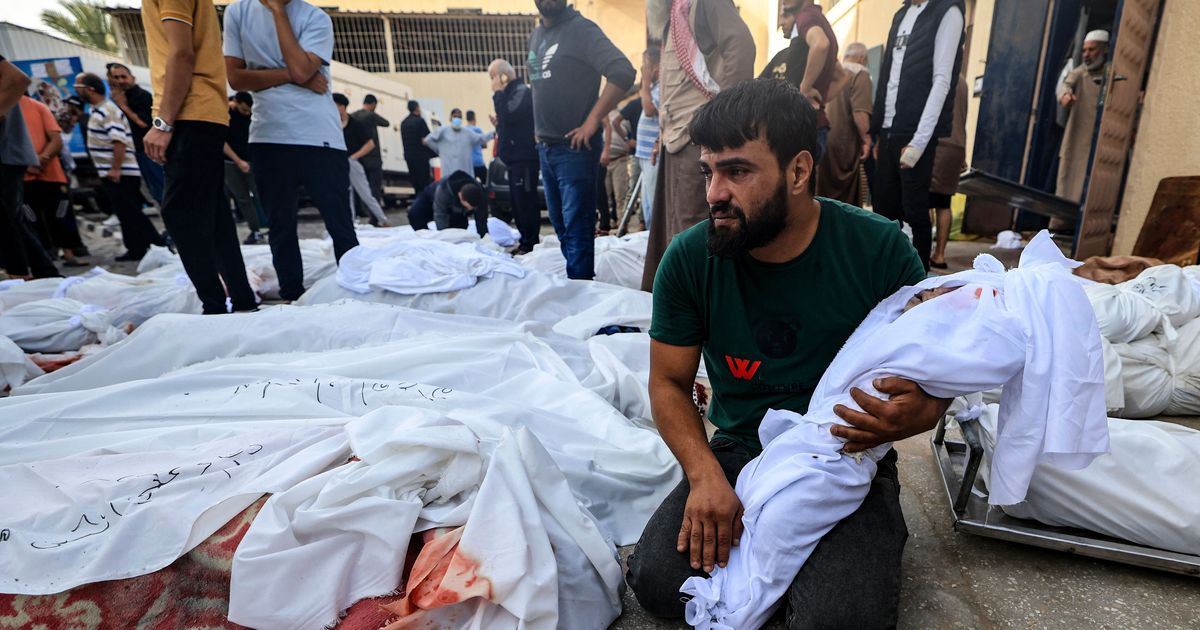
An estimated 4,300 Palestinians have died as a result of Israel’s retaliatory strikes on Gaza.
Appearing on Sky News this morning, immigration minister Jenrick said: “We have confidence that Israel will take all the steps that it can in the circumstances to avoid civilian lives being lost.
“But the real tragedy here is that Hamas, who started this war by committing those appalling, barbaric atrocities in Israel deliberately enmesh themselves with the civilian infrastructure in Gaza, using innocent Palestinians as hostages to their own political aims.
″And so it is entirely likely that more civilian lives will be lost in this appalling conflict, but we have to defend Israel’s right to secure its borders, to release the hostages and bring a degree of security to its situation.
“What we need Israel to do is to surgically degrade and eradicate Hamas and their unfrastructyre in the Gaza Strip so that Palestinians can be free from Hamas and Israel can have the security that it needs.”
I left Israel on Wednesday, 12 October, and everyone I know is relieved I am safe.
My friends and loved ones can sleep tonight, knowing I am back in Canada. They have done me proud: They have fretted and worried and fussed. They have checked in. They have asked me how I am doing and feeling and if there is anything they can do to help. They have offered sincere condolences, sympathised with the situation, and promised me that everything will be OK. I am very grateful to have people who love me so much.
I am safely ensconced in our bubble of collective ignorant bliss — but I do not feel safe.
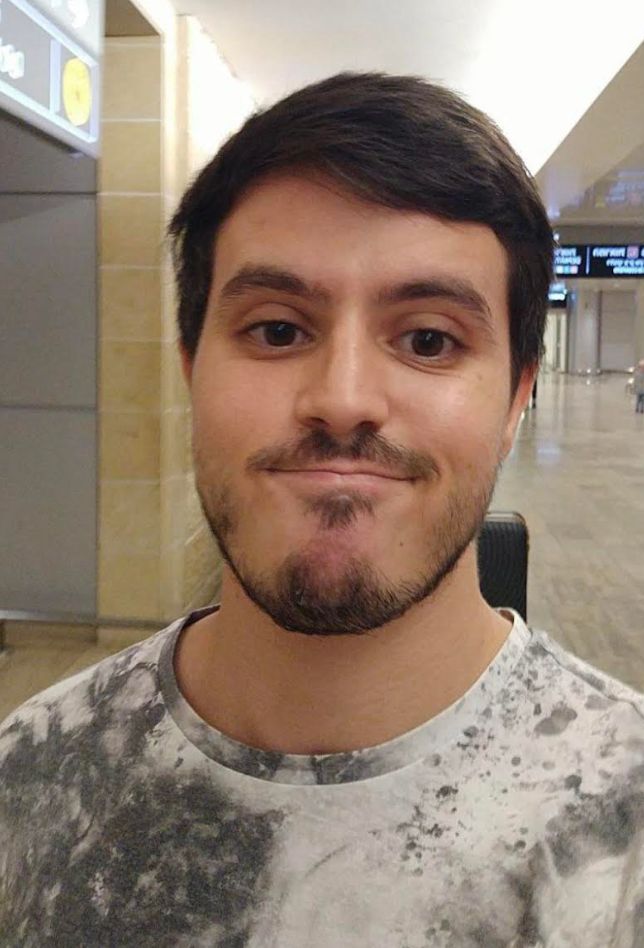
This is Avichai Refael Sofer:
Courtesy of Robbie Romu
Avichai Refael Sofer, the author’s boyfriend. “Avichai took this selfie immediately after we parted ways at the airport,” the author writes.
He is a 29-year-old Jewish Israeli citizen living outside of Tel Aviv. He works a job, goes to school, hangs out with his friends, and has hopes and dreams for the future. He is one face out of millions of faces. He is no more and no less important than those millions of other faces — both Israeli and Palestinian — who have never felt (and may not ever feel) safe.
Advertisement
We met online in late 2020, in the earliest days of the COVID-19 pandemic. He “woofed” at me on a gay dating site called Scruff from 10,700 miles away, reaching out across the distance because I had a “kind face.”
We began a very lighthearted yet intimate correspondence that stretched on for several years. He was bright and funny and playful, handsome as fuck, smart as a whip, and wise beyond his years. We would talk about his dream to see Canada, how he longed to experience the Northern Lights, and how much he wanted to visit Montreal, Toronto, Vancouver… and Halifax… and Quebec City… and Calgary… Once he fully comprehended the vastness of Canada as compared to Israel (which is similar in size to the state of New Jersey), we decided he would have to visit more than once if he was going to see everything his heart desired
It was easy. He lived there — I lived here. It was a dream.
Over time, our correspondence turned into a relationship, and then it was not so easy. It was real — and real is harder.
We texted all the time and FaceTimed for hours, and though we lived thousands of miles apart and had never met in person, we fell madly and hopelessly in love.
Advertisement
I bought my ticket to Israel on 6 September. We planned “nine days in heaven” from 6 – 15 October. We would be together in just one month’s time.
Avichai organised the most beautiful vacation for us in the land he calls home: visiting Tel Aviv and Jerusalem, camping under the stars in the heart of the Negev, and spending time in Haifa and Zefat in the North. In what would turn out to be a cruel and ominous bit of foreshadowing, I told him that none of the details mattered — that I’d be happy to spend all nine days alone with him, locked in his room, just being together.
I landed at Ben Gurion International Airport on Friday, 6 October at 8pm. Avichai was waiting for me with a sign that said “bumblebee” and the brightest smile I had ever seen. We hugged, cried, and looked into each other’s eyes, and it was easy again.
We drove back to his place, chatting excitedly about the nine-day adventure that awaited us, and I felt on top of the world.
Avichai had prepared me a sumptuous Shabbat dinner, which we ate with abandon. There was nothing to fear. We were together.
Advertisement
We awoke very late on Saturday, 7 October, to 38 missed calls and hundreds of unread text messages from his family and friends. Something had happened, but with my extremely limited understanding of Hebrew, I had no idea what. As Avichai began to return the missed calls, I opened my phone and read the headline: “Netanyahu says, ‘We Are at War.’”
It did not feel real until I felt Avichai’s hand on my shoulder and heard him say, “We need to talk about some things.”
He started by assuring me that everything would be all right — that we were not in any immediate danger — and then he told me to put on some pants. He explained that most of the fighting was in or near Gaza, which is 70 km to the south of where he lived. With tears welling in his eyes, he laid out the atrocities that had taken place while we slept: the rockets launched, the destruction, the terror, the hundreds of Israeli people killed or taken hostage.
He made it clear that there would be many more rockets. He calmly told me that when we heard the air raid siren, we would have 90 seconds to make our way to the bomb shelter in the basement of his building. There, we would wait out the barrage, and once a minute had passed from the end of the siren, we could return to his apartment. We would shelter in his building for the rest of the day, assessing the situation as it developed. We would not be going outside. He asked me if I understood, and I told him I did.
I did not understand a single thing that was happening. How was this even possible? Nothing in my privileged life had prepared me for this. Air raid sirens? Rockets? What about our vacation? What about our nine days in heaven?
Advertisement
Admittedly, I have a very narrow understanding of Middle Eastern politics. I, like many people, receive my “news” via Western media, a sanitised version of “the truth” (whatever that is at any given time) that typically follows the narrative of whichever government is currently in power. We receive just enough information to know something is terribly wrong in the region, but most of us do not grasp exactly what or why and after we put down our phones or turn off our TVs, we continue living our lives without much thought of what these people are facing.
The first siren sounded in the early evening. Avichai, very calmly, reached for my hand and said, “Grab your phone and your glasses. We’re going downstairs now.”
He led me to the basement — the “bomb shelter” — and put his arms around me.
“Everything is going to be OK,” he promised.
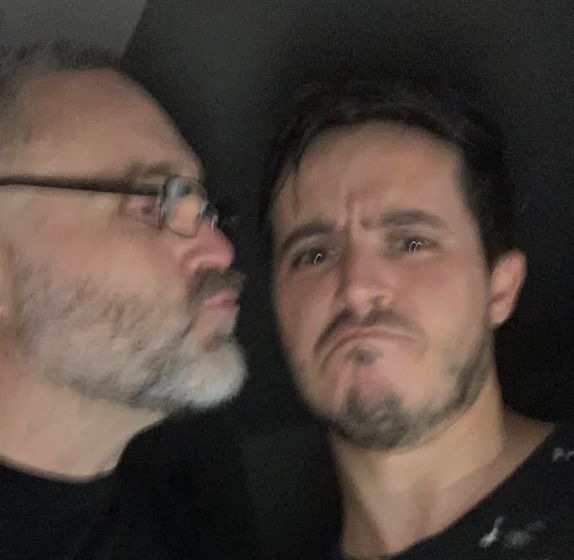
Courtesy of Robbie Romu
The author (left) and Avichai inside the bomb shelter in Avichai’s apartment building.
When the dull thuds began, I thought, “This isn’t so bad.” When the rending, unearthly scream of metal meeting mortar began, the walls shook, the windows rattled, dust fell from the ceiling, and my bones moved inside my body. I told myself, “This isn’t so bad.”
I was lying — it was bad.
It was just about as bad as anything I have ever experienced.
I lied to myself, and I lied to Avichai because it was all I could do. I needed him to believe I was OK so he would be OK. I understand now — far removed from the daily onslaught of sirens and rockets — that he lied to me, too. It was all he could do. He needed me to believe he was OK so I would be OK.
Advertisement
As the sirens came and went, his brothers were called into service. As the trips down and up the stairs came and went, his best friend was called into service. Sometimes, there were no sirens at all, just an overbearing silence from the sky that was suddenly ruptured by explosions. The walls shook, the windows rattled, the bones moved inside my body, and we lied to each other.
This was the way of things. The pretence. I saw it in the faces of the people in the building who would join us in the shelter: The woman with the 1-year-old who never cried once, the elderly lady from the first floor with knees not meant for climbing long flights of stairs, the girl with the wet hair and a towel wrapped around her midriff; the boy from the next building over with the pottery mud drying on his hands.
These were our “instant friends,” they smiled and made me feel welcome. They promised me that “Israel is a beautiful country.” They said, “You’ll see when you come back.” And when I returned their smile and said, “I’ll see when I come back,” I did not lie.
I left Israel on Wednesday, 12 October at 12:40am on a flight to Dubai after four days and four nights of war, and I do not regret my trip. I got to be with the man I loved. We held each other tight, we played Dungeons and Dragons and listened to music, we ate good food, we talked about important things and not-so-important things, we laughed and cried and felt alive. And though we were not safe, I felt safe with him.
The hardest part of my “vacation” was letting go of his hand, averting my gaze from his beautiful brown eyes, and walking away to find my gate and wait for my flight. I asked him to come with me to Canada, away from the chaos, but he refused. He said he cannot leave his family.
Advertisement
I equally respect and loathe his decision. There is a decidedly real probability that I will never see him again. I cannot look after him if we are not together, which is terrifying.
It is possible to be both pro-Israel and pro-Palestine if you are pro-human being. Israel is not those in power who would see Gaza razed to the ground, just as Palestine is not the group that is raining rockets down on Israel. We must separate the regime from the people, just as we must separate the terrorists from the people.
I don’t want to speak for the people of Israel or Palestine and won’t pretend I could ever understand what they have been through or are going through now, but I know the average Israeli and the average Palestinian do not want war — they want to listen to music, eat good food, talk about important and unimportant things, laugh, cry, feel alive and above all else feel safe.
They want to live.
I am back in Canada, re-ensconced in my bubble, and I recognise how fortunate and privileged I am to return home to a place where I do not have to worry about my safety or the safety of my family and friends. But I can say I do not feel safe.
I will not be safe until the man that I love is safe. I will not be safe until the woman with the 1-year-old who never cried once, the elderly lady with knees not meant for long flights of stairs, the girl with the towel wrapped around her midriff, and the boy with the pottery mud drying on his hands are safe. I will not be safe until the innocent people in Palestine are safe.
Advertisement
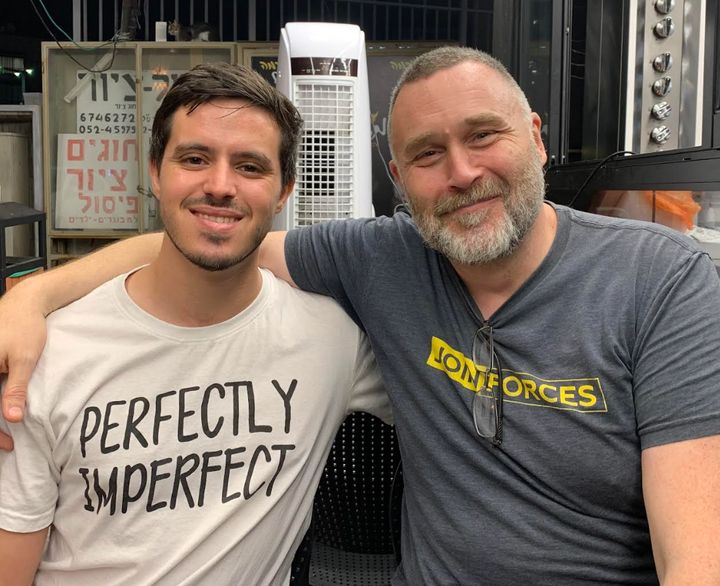
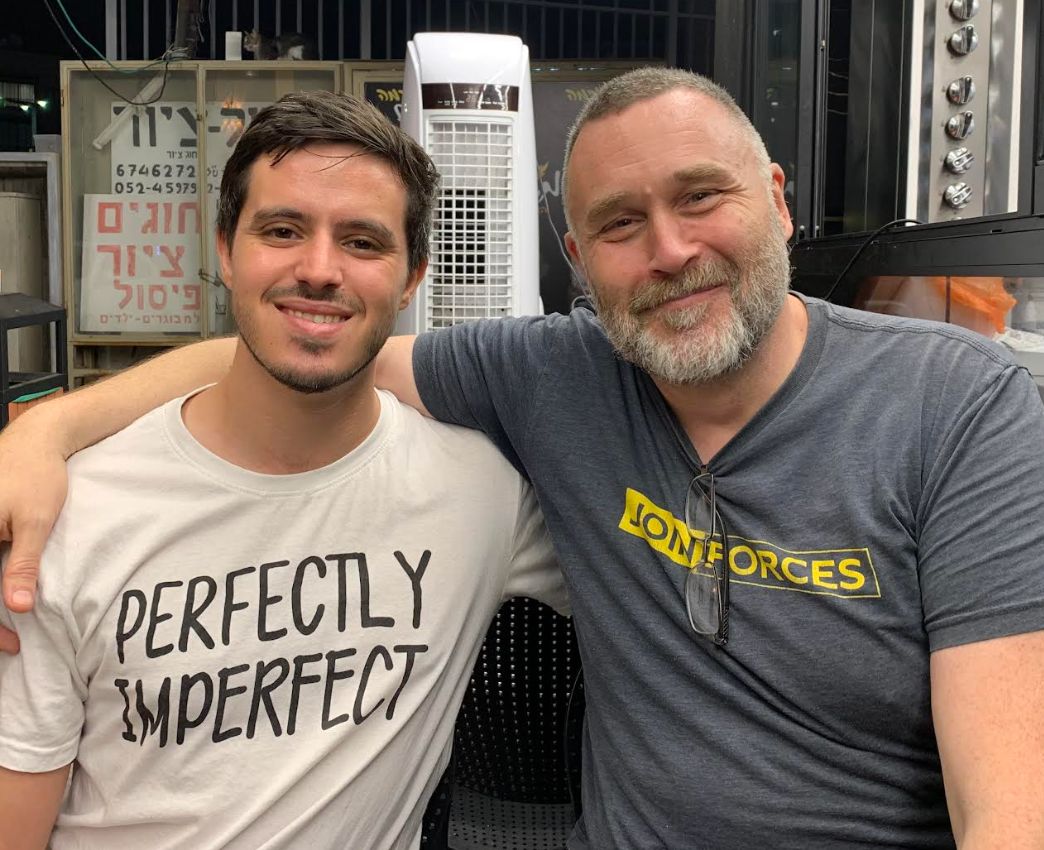
Courtesy of Robbie Romu
The author (right) with his boyfriend Avichai in Israel in October 2023. “This photo is from the only night we went outside to eat,” he writes.
Ultimately, I do not care if someone is Israeli or Palestinian. I only care that they are human beings.
I FaceTimed with Avichai this morning before I finished writing this essay. He had traveled to the North to be with his parents. There have been many sirens. His sister came by with her children. His brother-in-law came by with his nephew and niece.
The sky above him was alive with the heavy hum of military aircraft.
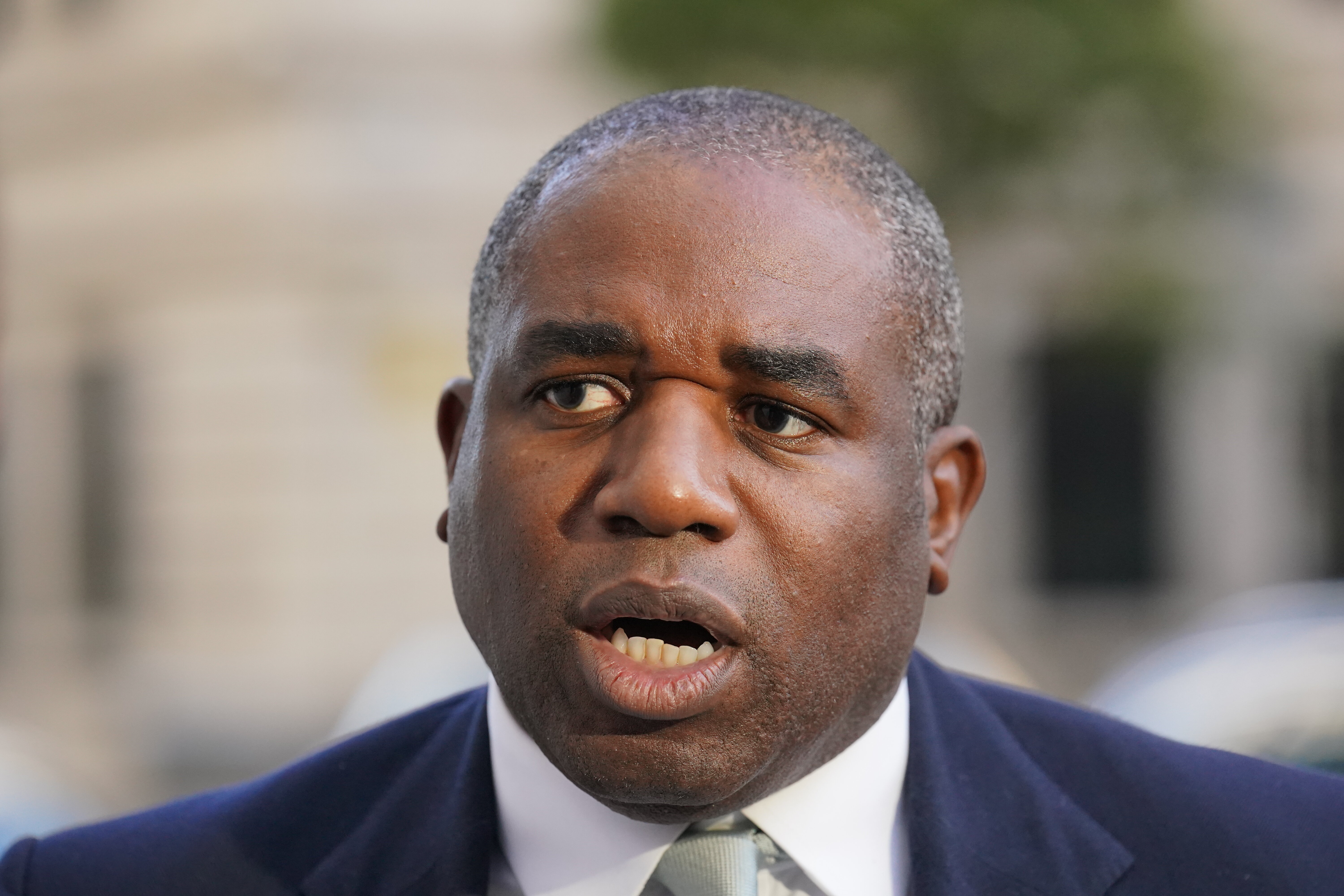
Shadow foreign secretary David Lammy has said it is “right” that Labour MPs do not attend protests about the Israel-Hamas war.
Labour MPs and councillors were sent emails from the party leadership, “strongly advising” them not to attend any protests or rallies.
Advertisement
Thousands of people took part in a pro-Palestine march in the centre of London yesterday, with former Labour leader Jeremy Corbyn among those who addressed the crowds.
It came amid the ongoing conflict sparked by last weekend’s attacks on Israel by the Palestinian militant group Hamas.
On the BBC’s Sunday with Laura Kuenssberg show, Lammy said Labour politicians should be “careful and cautious” about who they appear alongside.
He said: “It’s important that as we want to be the next government, that people do not share platforms with people who do not share Labour values, that they’re careful and cautious.
Advertisement
“And we’ve seen Labour members of parliament exercise that caution over the last few days and I think that must be right.”
Presenter Victoria Derbyshire said: “So are you saying because again, I want to be clear. If you’re a Labour MP or Labour councillor, you shouldn’t go for example, to a pro-Palestinian rally?”
Lammy replied: “If you’re a Labour MP, you should always be careful whom you share platforms with at this moment, and you should be very careful that you do nothing to drive division in our communities.
“There’s a rise in anti-semitism, there’s a rise in Islamophobia in our country as I speak. In a position of responsibility, you do everything to minimise those who sew division.”
Querying whether or not the guidance given to Labour MPs and councillors applied to protests supporting both sides of the conflict, Derbyshire said: “And are you saying they can’t go to a pro -srael rally?”
Lammy said: “Guidance has gone out. It’s very clear what that guidance is.
“People have a right to protest in our country. It’s a right we defend because we’re a democracy, justice. We defend the rule of law and international law. So people have the right to protest.
“We as leaders in our community should be very judicious and careful. I think this time, that’s the right thing to do. And it’s particularly the right thing to do if you hope one day to be the government.”
With messages telling Gazans to leave their homes and medical staff to evacuate their hospitals, a build-up of troops on the border and continued airstrikes that killed dozens of people as they fled, Israel on Friday confirmed what the world had suspected for a week: It is once again invading the Gaza Strip.
The operation is payback for the attacks that Hamas and other Gaza-based militants carried out inside Israel on October 7, killing 1,300 Israelis and taking more than 100 hostages, mostly civilians.
Advertisement

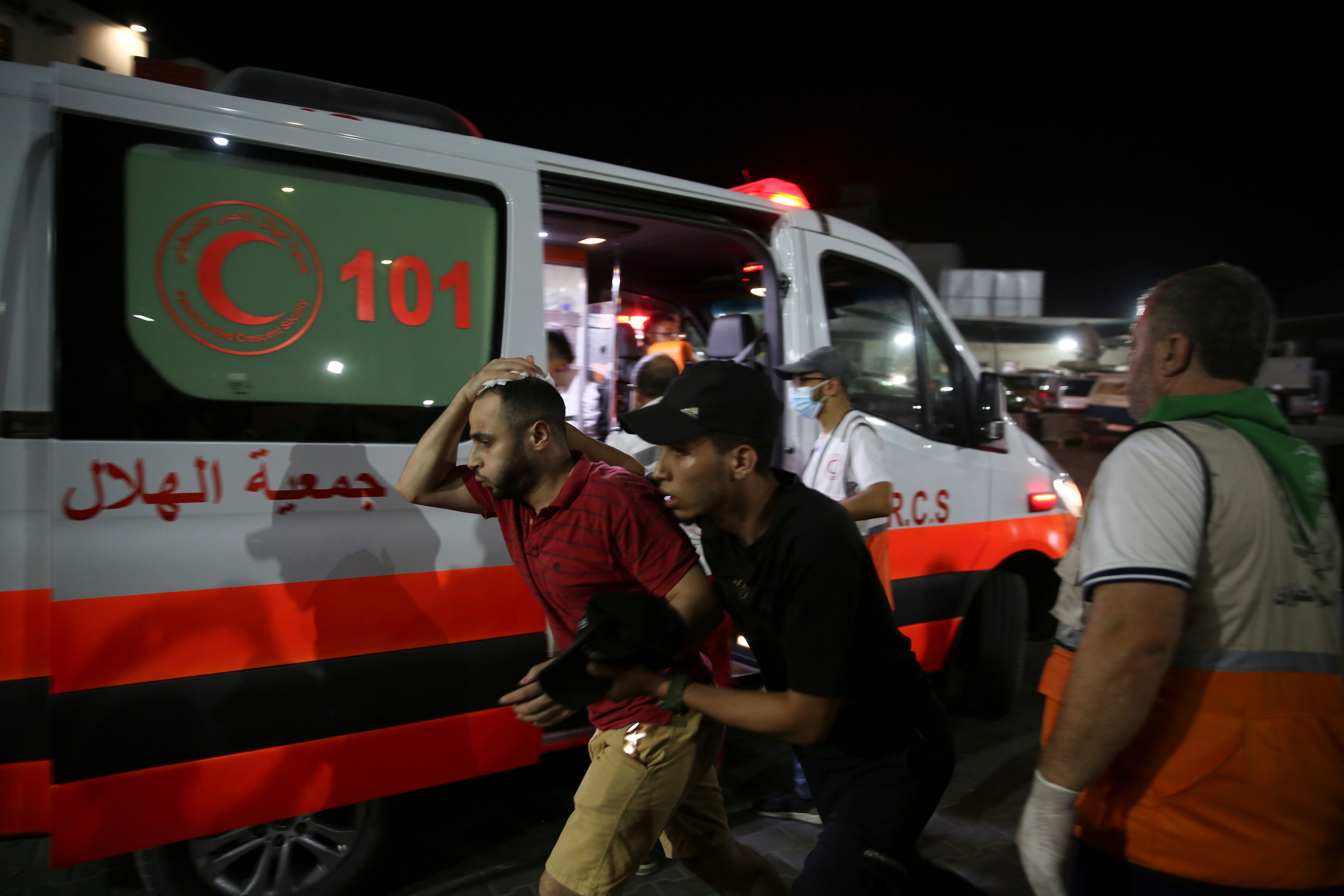
Israel’s response has already extended beyond armed Palestinian groups, with Israeli airstrikes so far killing more than 500 children in Gaza, according to local authorities. And the full-scale offensive that is now underway threatens all of the region’s more than 2 million people, residents and humanitarian organisations say.
Abderhmam, a New York-based physician who asked HuffPost to withhold his last name for fear of retribution from future employers, said he is relying on “doomsday measures” to keep track of his family members in Gaza – including his parents, his two sisters, and his nieces and nephews, the youngest of whom is just 6 months old. He is maintaining an Excel spreadsheet tracking their movements so he can know if they are in one of the residential neighbourhoods that are being targeted by Israel.
The Israel Defence Forces say they are giving civilians fair warning to depart for safety with evacuation orders, including a directive issued to the United Nations on Thursday that gave Gazans a 24-hour deadline to leave the north of the strip for its southern section. And the U.S., Israel’s most important backer, is reportedly seeking to delay a total Israeli ground invasion until it can negotiate safe passage for civilians to leave the area.
Yet those warnings have sparked panic. Gazans who are attempting to take one of the two routes to the south of the strip are fleeing with mattresses strapped to the top of their cars, while others are cramming into whatever semblance of safe haven they can find. Abderhmam said his relatives fled to his uncle’s home south of Gaza City, which is now hosting close to 60 people.
Advertisement
“I don’t know how people come out of these things with a sense of humanity,” he told HuffPost.
Many internally displaced Gazans are now sleeping on the street, Amnesty International said in a Friday statement. Meanwhile, some of the most desperate members of the community cannot flee northern Gaza at all because they need consistent medical support or are too injured, the World Health Organisation said on Friday.
And any American talk of Israeli restraint has a clear limit. HuffPost revealed on Friday that the State Department has discouraged U.S. diplomats from publicly endorsing a “ceasefire” or “de-escalation,” which aid agencies say would be vital to give Gaza residents any real chance to reach safety.
Ghada Alhaddad, a Gaza-based media and communications officer at the charity Oxfam, told HuffPost the last week of Israeli bombardment has already felt “like the last few escalations of violence multiplied by one thousand,” referring to multiple previous episodes of protracted Israel-Hamas conflict.
“This time’s bombardments are louder and crazier — loud enough to make your heart race really quickly,” Alhaddad wrote in an email, adding that her nieces and nephews have been shivering when they hear the sound of bombs falling.
To her, Israel merely sending warning signals ahead of an even more devastating assault is insufficient.
Advertisement
“Leaving our homes in order to feel safe cannot be the solution — we need to be safe in our own homes,” Alhaddad told HuffPost.
Already Worn Down
The past six days of Israeli bombing — and Israel’s decision to cut off electricity and water — have fuelled mass trauma in Gaza.
Ghada Kord, a freelance journalist based there, told HuffPost she witnessed displaced residents going to Shifaa Hospital, the largest medical facility in Gaza City. They built makeshift tents there with pillows and bedcovers as hospital officials warned civilians they only had around 48 hours of fuel left.
The hospitals in northern Gaza are already overcrowded, the WHO reported Friday, and those in the south are at or nearing capacity.
Many of Alhaddad’s colleagues have lost their homes and sought shelter at United Nations schools, she said. The U.N. Relief and Works Agency said Friday it had moved its operations center and international staff away from northern Gaza.
Advertisement
Aid workers are tracking whether it is safe enough for them to restart humanitarian work, but as they wait, fuel, food and medical supplies are running low, she added. “The response will not be able to meet [people’s needs] while a total siege is in place,” Alhaddad said.
The WHO has nearly used up its full stockpile in Gaza and has not yet received permission from Egypt to move in additional supplies, the U.N. agency said in its Friday statement.
For Gazans trying to stay with their families — and just stay alive — the current fighting compounds the misery they have experienced since Hamas won elections in the strip in 2006, quickly imposing heavy-handed rule. Israel and Egypt began blockading the region beginning in 2007.
“There is a lack of housing, a lack of jobs, a lack of feeling of hope and security… This has pushed people to be more frustrated, more radical, more desperate,” said Omar Shaban, the director of a Gaza-based think tank called PalThink for Strategic Studies.
A number of Gazans privately and publicly bid farewell to the broader world on Friday in anticipation of an all-consuming Israeli offensive.
Advertisement
“Our mom sends messages from there saying ‘We’re alive,’ but that’s it. The other day, we didn’t hear from them for 18 hours and we thought: ‘That’s it.’”
– Mona, New Jersey resident with parents in Gaza
Shaban was one of the few Gazans able to flee to Egypt on Monday before the country closed its border following multiple Israeli airstrikes on the crossing. He fled for two reasons, he told HuffPost.
“I knew that the Israeli reaction would be extraordinarily tough,” said Shaban, who noted that as a 62-year-old, he has experienced multiple rounds of warfare. And he was focused on reuniting with his wife, who had traveled abroad for work and was unable to reenter Gaza after the Hamas attack on Israel. The two are now in Cairo.
Still, Shaban is wary of the suggestion from some observers worldwide that Gazans should be encouraged to travel to Egypt en masse, noting that it echoes the Palestinian experience when Israel was established and many fled their homes and were never able to return.
“Palestinians have experienced leaving their homelands in 1948 and they realized that they will never come back, at least for the foreseeable future, so I don’t think Gazans will leave to [the Sinai Peninsula], and Egypt will not accept this at all,” Shaban said.
Advertisement
Stateside Anxiety
Up to 600 American citizens remain in Gaza as it braces for the larger Israeli advance. Their relatives are worried about staying in touch with them and their basic survival.
Mona, a New Jersey resident who asked to withhold her last name for fear of retaliation, told HuffPost she has been trying to help her parents evacuate from Gaza to no avail.
“Our mom sends messages from there saying ‘We’re alive,’ but that’s it,” Mona said. “The other day, we didn’t hear from them for 18 hours and we thought: ‘That’s it.’”
She has sent nearly a dozen messages to the U.S. Embassy in Jerusalem but has only received automatic messages about evacuation recommendations from Israel.
“I cannot believe how unheard we are. We are not seen at all,” Mona said. “The government is doing so much [for Israeli Americans.] You’d think you would get the same because you are also a U.S. citizen, but no.”
Advertisement
The U.S. government began charter flights out of Israel on Friday but has not yet solidified a planto help U.S. citizens leave Gaza.
Mona has been missing work. She’s worried about her parents — particularly her father, a diabetic who has been unable to find power to charge his phone — and no one in her family is eating or sleeping well.
“We are hoping for a sign of relief. A light,” she said. “Anything to look forward to. To give you some hope that you’re going to see your parents again.”
Duaa Abufares, a 24-year-old college student at Montclair State University, has similar hopes for her father, who went to Gaza to visit his family last month.
“He doesn’t want to leave his mom or his siblings” in the strip, she said.
She’s looking for a response bigger than one just for her family — one that gets to the heart of the U.S.’s responsibility for the current situation and the way it might be able to halt this and future episodes of violence.
Advertisement
“I want people to know that they not only are targeting Palestinians — they are targeting American families as well,” Abufares said. “The U.S. is hurting their own people at the same.”
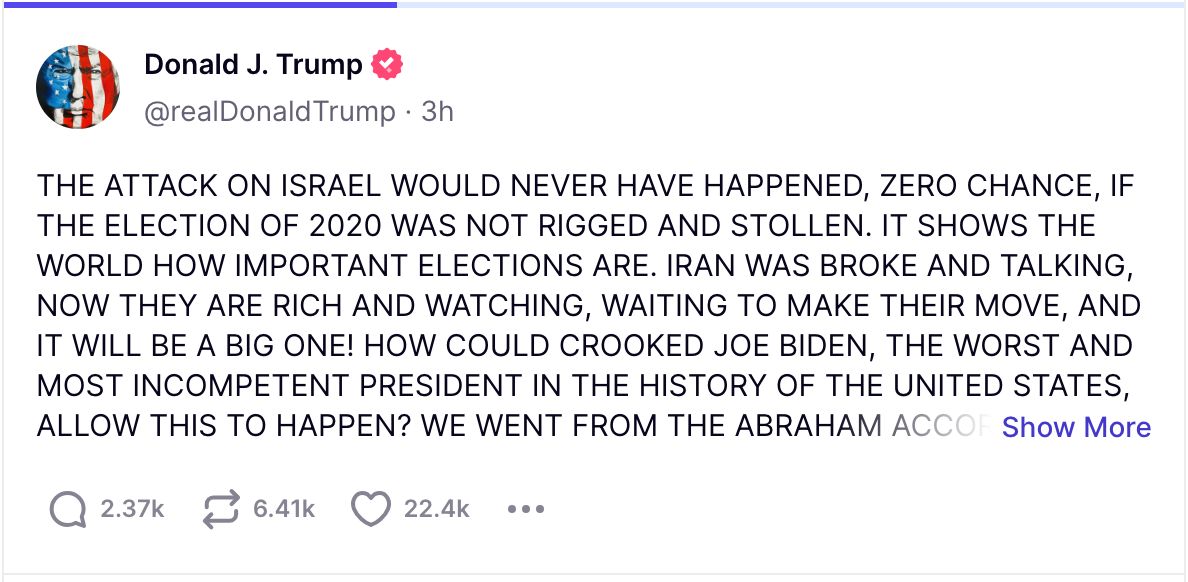
Donald Trump finally found the perfect treat on Friday to go with a cup of covfefe: a “STOLLEN” election.
Stollen is a delicious German Christmas bread similar to fruitcake — and the latest spelling gaffe for the ex-president.
Trump of course meant “STOLEN” in his all-caps Truth Social blather blaming the Hamas attack on the lie that the 2020 U.S. election was rigged against him and he therefore couldn’t be in charge to keep the peace.
Hamas militants stormed Israel in an Oct. 7 killing spree, sparking a war that has already claimed the lives of thousands of Israelis and Palestinians in Gaza.
“THE ATTACK ON ISRAEL WOULD NEVER HAVE HAPPENED, ZERO CHANCE, IF THE ELECTION OF 2020 WAS NOT RIGGED AND STOLLEN. IT SHOWS THE WORLD HOW IMPORTANT ELECTIONS ARE… HOW COULD CROOKED JOE BIDEN, THE WORST AND MOST INCOMPETENT PRESIDENT IN THE HISTORY OF THE UNITED STATES, ALLOW THIS TO HAPPEN?” Trump wrote.
Trump, who faces indictments related to his fabrications about election theft, had already said in a previous rant that there was “ZERO CHANCE” Russia would have attacked Ukraine on his watch.
But “STOLLEN” at least conjures images of holiday cheer at a time we could use it ― even if it is just October.