A crushed fossil revealed a dinosaur that shouldn’t have existed

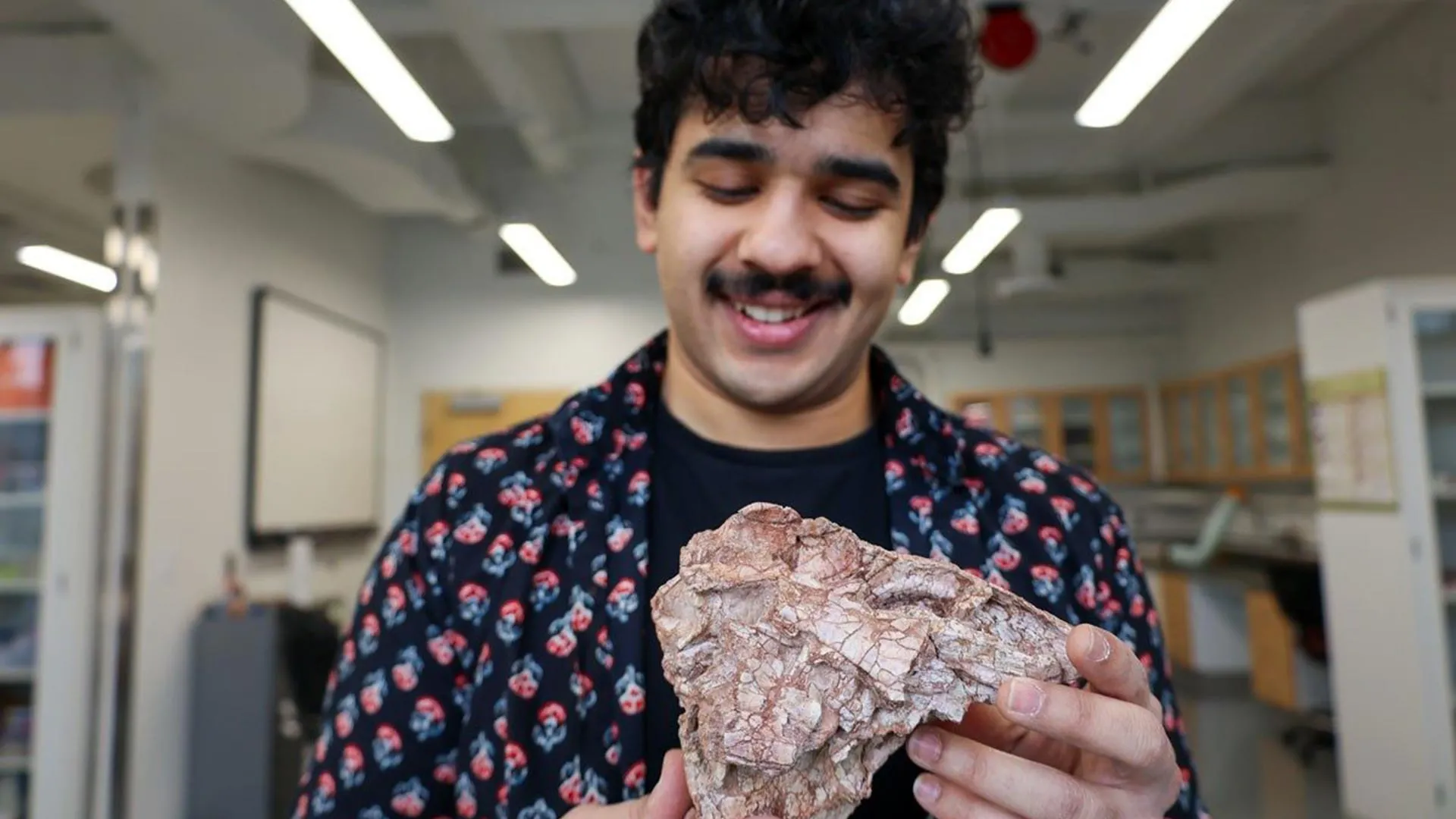
“You want to stick your finger in a dinosaur brain?” asked Simba Srivastava.

Inside a paleobiology lab lined with cabinets of ancient fossils, the Virginia Tech undergraduate held up a rough, pitted skull.

“This is a uniquely sucky specimen,” said Srivastava. “It’s so bad. Like, if you saw a human skull in this way, you’d throw up.”

Despite its poor condition, the senior geosciences major spent two years carefully reconstructing the fossil and figuring out where it fits in the evolutionary history of dinosaurs. His work, published in Papers in Palaeontology, offers new insight into how dinosaurs rose to dominance during the Jurassic period.

Although this kind of research is typically handled by experienced scientists, geobiologists Sterling Nesbitt and Michelle Stocker brought Srivastava onto the project as a first-year student.

“We want undergraduate researchers to experience the whole paleontological research process at Virginia Tech,” said Nesbitt. “Simba grabbed the project by the reins.”

Reconstructing a Rare Dinosaur Skull

The fossil had an unusual history. It was first discovered in 1982 by a team from the Carnegie Museum of Natural History at Ghost Ranch in New Mexico. More than 30 years later, Nesbitt rediscovered it in a drawer and brought it to Virginia Tech for further study.

Using computed tomography scanning data, Srivastava digitally separated the crushed bones and created a 3D printed reconstruction of the skull.

The fossil belonged to a carnivorous dinosaur species that lived more than three times earlier than Tyrannosaurus Rex.

These animals lived near the end of the Triassic period, which lasted from about 252 million to 201 million years ago. At that time, dinosaurs were not yet the dominant predators often seen in movies. They competed with early relatives of crocodiles and mammals for survival.

How Dinosaurs Rose to Power

That balance changed dramatically after a mass extinction event eliminated much of the competition. As the Triassic period ended, dinosaurs quickly became the dominant land animals.

“Dinosaurs go from being co-stars to the headliner,” Srivastava said.

Fossils from this critical transition are rare, especially well-preserved ones from the end of the Triassic. That makes this damaged skull especially valuable.

In fact, no other specimen like it has been found.

Even in its distorted state, the fossil revealed important details. The dinosaur had large cheekbones, a broad braincase, and likely a short, deep snout. These features had not been seen before in early dinosaurs, suggesting they were evolving in more complex ways than previously understood.

A New Species With a Strange Look

Srivastava named the new species based on its unusual appearance.

“We landed on Ptychotherates bucculentus, which means ‘folded hunter with full cheeks’ in Latin,” said Srivastava. “One paleo-artist said that it looked like a murder muppet.”

After years of analysis, the team determined that this dinosaur belonged to Herrerasauria, one of the earliest groups of carnivorous dinosaurs. It appears to have been among the last surviving members of this lineage.

Rethinking the End-Triassic Extinction

The fossil led to another unexpected conclusion.

Ptychotherates was found in rock layers that may date to just before the mass extinction at the end of the Triassic period, and no other members of its group have been found after that time, possibly suggesting that this dinosaur group went extinct as a result of that mass extinction.

“This forces us to reconsider the impact of the end-Triassic extinction as something that wiped out not just the competitors to dinosaurs, but some long-standing dinosaur lineages themselves,” Srivastava said.

Because no herrerasaurians have been discovered elsewhere from such a late point in the Triassic, scientists think the region that is now the American Southwest may have been their final refuge.

One Fossil, an Entire Lost Lineage

Srivastava’s “folded hunter” may be the only remaining evidence of this group’s final chapter.

“This specimen, it fits in my hands, but it is the only proof that any of these dinosaurs lived this long, lived in these latitudes, the only proof that they evolved to have this skull shape,” said Srivastava. “All these billions of individuals that existed through time are spoken for by this one specimen.”

Share Button

This 31-foot “terror croc” ate dinosaurs. Now it’s back

Dr. David Schwimmer, a leading authority on the massive North American crocodilian genus Deinosuchus and a geology professor at Columbus State University, has helped bring a prehistoric giant back to life. His decades of research played a key role in building the first scientifically accurate, fully mounted skeleton replica of Deinosuchus schwimmeri. Long described as a “dinosaur-killer,” this enormous predator was likely at the very top of the food chain in its time.

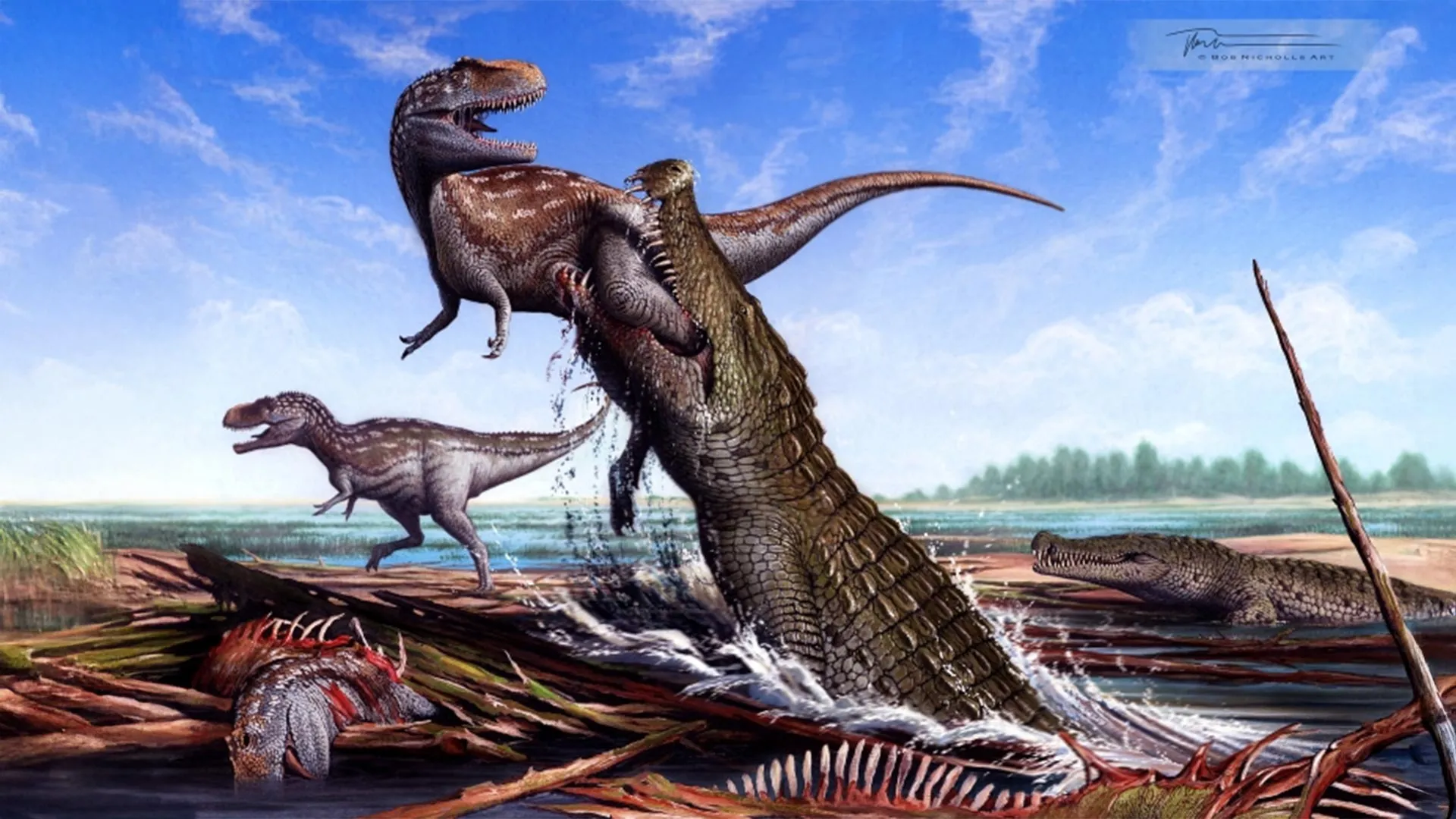
Living in the eastern United States between 83 million and 76 million years ago, Deinosuchus schwimmeri was a school-bus-sized relative of modern alligators that preyed on dinosaurs. The animal could grow up to 31 feet (9.45 meters) long. A life-size replica of this ancient giant is now on display at the Tellus Science Museum in Cartersville, Georgia. The project reflects two years of collaboration between Schwimmer and Triebold Paleontology Inc., a company known for creating detailed fossil skeleton models for museums and institutions worldwide.

Museum Display Brings Prehistoric Ecosystem to Life

“Each year, we have thousands of students visit us from across Georgia and neighboring states,” the Tellus Science Museum’s director of education, Hannah Eisla, explained. “Many of these students come on school field trips specifically to learn more about the region they call home and how it has changed over time. The addition of Deinosuchus schwimmeri allows us to provide a more detailed picture of this area’s ecosystem in the Cretaceous Period.”

“Tellus is currently the only museum to have a cast of Deinosuchus schwimmeri, so this is an experience our visitors can’t get anywhere else,” added Rebecca Melsheimer, the museum’s curatorial coordinator. “The scale of the dinosaurs and other creatures that lived during [the Late Cretaceous epoch] is hard to capture in words or pictures. We can tell you that Deinosuchus is 30 feet long, but seeing it is far more impactful.”

Naming a New Species After Decades of Research

In 2020, a team of paleontologists officially identified and named the species Deinosuchus schwimmeri in recognition of Schwimmer’s extensive contributions to the field. Their study, published in the Journal of Vertebrate Paleontology in July 2020, noted that the name honored “his tireless work on the Late Cretaceous paleontology of the Southeast and Eastern Seaboard, USA.” This recognition followed years of detailed fossil analysis, scientific publications, conference presentations, and Schwimmer’s 2002 book on the genus.

For more than 40 years, Schwimmer has explored fossil sites across Alabama, Georgia and Texas in search of Deinosuchus remains. Supported in part by National Geographic grants, his work has uncovered important specimens that are now housed in major institutions such as the Smithsonian Institution in Washington, D.C., the American Museum of Natural History in New York, and the Tellus Science Museum.

Building a Life-Size Replica With Modern Technology

According to Schwimmer, creating a scientifically accurate, full-scale replica requires careful attention to detail. For this project, the Triebold Paleontology team used high-resolution 3D scans of fossil specimens to reconstruct the animal’s skeletal structure and armored skin features. The result is a highly detailed model that not only impresses visually but also contributes to scientific understanding.

“These replicas are more than just creating a ‘scare factor,'” Schwimmer explained. “Understanding dinosaurs’ predatory habits helps us decode some of nature’s greatest survival strategies. By studying these ancient apex predators, we are essentially looking back in time to see exactly how life adapted and dominated a changing world.”

A Lifelong Fascination With a Prehistoric Predator

Schwimmer’s interest in Deinosuchus began during his childhood in New York City, where he lived just 10 blocks from the American Museum of Natural History. A display featuring a large skull first captured his imagination. He later discovered his first Deinosuchus fossil in 1979, shortly after joining Columbus State (then Columbus College). Since then, his work has focused on reconstructing the animal’s biology and environment.

His research has made him a global expert on life during the Late Cretaceous epoch (100.5 million years ago to 66 million years ago) in the southeastern United States. Over the years, his studies have also helped identify several important fossil “firsts” in Georgia, including evidence of flying reptiles (pterodactyls), dinosaurs, and Deinosuchus itself.

Publications, Discoveries, and Scientific Impact

Schwimmer’s findings from his early research years were compiled in his 2002 book, “King of the Crocodylians: The Paleobiology of Deinosuchus.” The book gained wide attention, becoming an Amazon top-seller in its category and a popular selection among science-focused reading groups. He is currently working on an updated version.

His expertise has since been sought by major institutions such as Atlanta’s Fernbank Museum of Natural History, the University of Texas’ Vertebrate Paleontology Laboratory, and the Tellus Science Museum. These organizations have relied on his guidance for fossil interpretation and exhibit development.

In 2010, Schwimmer contributed to two notable studies related to Deinosuchus. One examined bite marks on dinosaur bones, while the other focused on fossilized dung (coprolites) studied by undergraduate Samantha (Harrell) Stanford under his supervision. Their work was published in the “New Mexico Museum of Natural History and Science Bulletin” and presented at the Geological Society of America Northeastern-Southeastern Annual Meeting.

Hands-On Research Opportunities for Students

Schwimmer emphasized that fields like paleontology and other Earth sciences offer valuable opportunities for students to participate in hands-on research close to home. Regional universities such as Columbus State allow students to work directly with faculty and gain field experience.

“[Harrell] came out in the field and collected fossils with me. At most universities, undergraduates rarely collaborate on or publish peer-reviewed research. Institutions of our size provide undergraduate students like Samantha with greater one-on-one access to faculty mentors and field-based research opportunities like this that, while local, are still quite impactful on the field,” Schwimmer said.

A Local Fossil Treasure and a Window Into the Past

With several Deinosuchus fossil sites located within 40 miles of Columbus, the surrounding region has proven especially rich for discoveries. Schwimmer noted that this proximity makes the Tellus Science Museum an ideal location for displaying one of the first full-scale replicas.

“Bones and fossils tell us only part of the story,” Schwimmer concluded. “Fully assembled, life-size replicas become a blueprint for better understanding the dynamic animals that creatures like Deinosuchus really were.”

Share Button

The surprising reason you’re so productive one day and not the next

A study from the University of Toronto Scarborough suggests that feeling mentally sharp can significantly boost how much you accomplish in a day. Researchers found that when people are thinking clearly and efficiently, the effect can equal roughly 40 extra minutes of productive work.

Published in Science Advances, the research tracked participants over 12 weeks to better understand why people sometimes struggle to follow through on their plans. The findings point to daily shifts in mental sharpness as a key factor. On days when participants felt more mentally alert, they were more likely to set goals and complete them, whether tackling schoolwork or everyday tasks like making dinner.

“Some days everything just clicks, and on other days it feels like you’re pushing through fog,” says Cendri Hutcherson, associate professor in the Department of Psychology at U of T Scarborough and lead author of the study.

“What we wanted to understand was why that happens, and how much those mental ups and downs actually matter.”

What Mental Sharpness Really Means

Mental sharpness refers to how clear, focused, and efficient a person’s thinking is at any given time. When it is high, people tend to concentrate more easily, make quicker decisions, and follow through on tasks. When it is low, even simple activities can feel difficult.

Instead of comparing different people, the research team followed the same individuals over time. This allowed them to see how changes within a single person influenced their daily success or struggles.

Participants, all university students, completed short daily tests that measured how quickly and accurately they could think. They also reported on their goals, productivity, mood, sleep, and workload. This detailed approach helped researchers connect mental sharpness directly to real-world outcomes rather than relying on general averages.

Daily Brain Changes Shape Success and Failure

The results showed a clear pattern. On days when students were sharper than usual, they completed more of their goals and often aimed higher, especially with academic work. On days when their mental sharpness dropped, even routine tasks became harder to finish.

These effects were consistent regardless of personality traits. Qualities like grit or self-control influenced overall performance, but they did not prevent people from having less productive days.

“Everybody has good days and bad days,” says Hutcherson. “What we’re capturing is what separates those good days from the bad ones.”

The Real-World Impact of a Sharp Mind

One of the most striking findings was how much mental sharpness matters in practical terms. By analyzing cognitive performance over hours of work, researchers estimated that being above or below your usual level of sharpness could shift productivity by about 30 to 40 minutes in a single day. The gap between your best and worst days could total around 80 minutes of work.

What Influences Mental Sharpness Each Day

The study also highlights what drives these daily changes. Mental sharpness is not fixed. It fluctuates based on short-term factors.

Students tended to perform better after getting more sleep than usual and earlier in the day, with mental performance gradually declining later on. Feeling motivated and focused also boosted sharpness, while depressive moods were linked to lower levels.

Workload showed a mixed effect. Putting in longer hours on a single day was associated with higher sharpness, suggesting people can rise to immediate demands. However, extended periods of overwork had the opposite impact, lowering mental sharpness and making it harder to stay productive.

“That’s the trade-off,” says Hutcherson. “You can push hard for a day or two and be fine. But if you grind without breaks for too long, you pay a price later.”

Simple Ways to Support a Sharper Mind

Although the study focused on university students, the insights likely apply more broadly. The findings point to practical ways people can improve their chances of having more productive days.

“From our data, there are three things you could do to try to maximize mental sharpness: getting enough sleep, avoiding burnout over long periods of time, and finding ways to reduce depressive traps,” says Hutcherson.

She also emphasizes the importance of being patient with yourself when you are not at your best.

“Sometimes it’s just not your day, and that’s okay. Maybe this is the day where you give yourself a little slack.”

Share Button

‘I’m not being listened to’ – new health plan launched as women say they are still ignored

New plans to improve healthcare for women and girls have been set out, but will they change anything?

Share Button

A cold could kill my daughter – hospital visits feel like a death sentence

Rebecca Quayle, who has terminal cancer, has had to wait in A&E with people coughing and taking Covid tests.

Share Button

Open Is Now Open

Open

Registration for Open is now live at StevePavlina.com/Open.

This is a new, in-person, 3-day experience we’re hosting April 28–30, 2026 in Las Vegas. I’ve been sharing about this for the past few weeks, and now the doors are open, so you can see the full details and sign up if you feel called to join us.

Open isn’t a content-based experience. It’s a shared inner journey focused on harmonizing your relationship with yourself and with Life.

Open is in-person only – not recorded or streamed. We’re prioritizing intimacy.

Registration just opened, and the event begins in two weeks, so this is a short window. The reasons why are shared in the full invitation:

StevePavlina.com/Open

Take a look and see if Open calls to you. It’s unique.

❤️

Share Button

Don’t feel like exercising? Maybe it’s the wrong time of day for you

Time your workout to your body clock, health researchers advise based on latest evidence.

Share Button

Palantir defends its record as MPs demand more scrutiny of data use

NHS guidance that all hospitals should be using Palantir software from this month has sparked a backlash.

Share Button

Single-sex space guidance for organisations to be published after May elections

Equalities minister Bridget Phillipson says election rules mean a new draft cannot be published until next month.

Share Button

Scientists just recreated a rare cosmic reaction never seen before

Scientists have reported a major experimental advance in understanding how some of the rarest elements in the universe are formed. These unusual atoms, known as p-nuclei, are proton-rich isotopes heavier than iron that have long puzzled researchers.

The new study, led by Artemis Tsantiri, who conducted the work as a graduate student at the Facility for Rare Isotope Beams (FRIB) and is now a postdoctoral fellow at the University of Regina in Canada, achieved a milestone. For the first time, researchers directly measured how arsenic-73 captures a proton to form selenium-74 using a rare isotope beam. This result places new limits on how the lightest p-nucleus is created and destroyed in space.

The findings were published in Physical Review Letters (“Constraining the Synthesis of the Lightest 𝑝 Nucleus 74Se”) and involved more than 45 scientists from 20 institutions across the United States, Canada, and Europe.

Why Some Elements Remain a Mystery

A key goal in nuclear astrophysics is to understand where the elements come from. Many elements heavier than iron are formed through slow and rapid neutron-capture processes. In these reactions, atomic nuclei repeatedly absorb neutrons and then undergo radioactive decay until they reach stable forms.

However, this explanation does not apply to a special group of proton-rich isotopes. These p-nuclei cannot be produced through neutron capture. They span a range from selenium-74, the lightest, to mercury-196, the heaviest, and their origin has remained unclear for decades.

Supernova Explosions and the Gamma Process

One leading explanation for the creation of p-nuclei is the gamma process, which takes place in certain types of supernova explosions. In these extreme environments, intense heat produces gamma rays that strip neutrons and other particles from existing heavy nuclei.

After this process, the remaining nuclei contain more protons than neutrons. Over time, some of these nuclei convert protons into neutrons, moving toward a more stable balance and eventually forming p-nuclei.

Many of the isotopes involved in this process are short-lived and difficult to produce in the lab. Because of this, scientists have had to rely heavily on theoretical models rather than direct measurements.

“Even though the origin of the p-nuclei has been a topic of study for over 60 years, measurements of important reactions on short-lived isotopes are almost non-existent,” said Tsantiri. “Experiments of this kind are only now possible with facilities like FRIB.”

Recreating a Stellar Reaction in the Lab

In this study, researchers successfully recreated a key step in the process by observing proton capture on radioactive arsenic-73 for the first time. To do this, they generated a beam of arsenic-73 specifically for the experiment and directed it into a chamber filled with hydrogen gas. The hydrogen served as a source of protons and was positioned at the center of the Summing Nal (SuN) detector.

The team produced the arsenic-73 using FRIB’s ReA accelerator, which they operated in a standalone configuration rather than relying on the main linear accelerator. The radiochemistry group, led by Katharina Domnanich, prepared the material in a form suitable for use in the experiment. The isotope was then placed into a batch-mode ion source, where it was ionized, accelerated to high energies, and delivered to the target. This setup demonstrated the flexibility of ReA for producing and studying rare isotopes.

Tracking How Selenium-74 Is Formed and Destroyed

During the reaction, arsenic-73 absorbs a proton and becomes selenium-74 in an excited state. It then releases a gamma ray to reach a stable state. The researchers focused on the reverse reaction because it plays a key role in the gamma process inside stars. By measuring the forward reaction, they could determine how quickly the reverse process occurs.

To understand how much selenium-74 exists in the solar system, scientists must consider both its creation and its destruction. One of the biggest remaining uncertainties has been how often selenium-74 is broken apart by gamma rays during stellar explosions.

Improved Models but New Questions Remain

When the researchers incorporated their measurements into astrophysical models, they reduced the uncertainty in the predicted abundance of selenium-74 by half. This marks a significant improvement in understanding how this isotope is produced.

Even so, the updated models still do not fully match what is observed in nature. This gap suggests that scientists may need to refine their assumptions about the conditions inside supernova explosions.

“These results bring us a step closer to understanding the origins of some of the rarest isotopes in the universe,” said Artemis Spyrou, professor of physics at FRIB and in the Michigan State University Department of Physics and Astronomy, research advisor to Tsantiri, and original architect of the experiment. “Tsantiri’s work is a nice example of the multidisciplinary collaborations needed for advancing the field, and of the kind of professional development opportunities for early career researchers at FRIB.”

Collaboration and Support

This research was supported in part by the U.S. Department of Energy Office of Science Office of Nuclear Physics; the U.S. National Science Foundation; the U.S. National Nuclear Security Administration; and the Natural Sciences and Engineering Research Council of Canada.

The isotope(s) used in this research was supplied by the U.S. Department of Energy Isotope Program, managed by the Office of Isotope R&D and Production.

Share Button