Global study of hypoxia in rivers shows it is more prevalent than previously thought

New research led by University of Nevada, Reno Assistant Professor Joanna Blaszczak shows hypoxia in rivers and streams is generally much more prevalent across the globe than previously thought. Hypoxia is low or depleted oxygen levels in surface waters that can be harmful to aquatic species and can in some cases increase production of harmful greenhouse gases from rivers.

The research, published recently in the journal Limnology and Oceanography Letters, compiles over 118 million readings of dissolved oxygen and temperature taken from over 125,000 locations in rivers across six continents and 93 countries and spanning over 100 years, from 1900 to 2018. Hypoxia, defined in this study as dissolved oxygen concentrations below 2 milligrams per liter, was detected in rivers and streams in 53 countries, with 12.6% of all locations exhibiting at least one hypoxic measurement.

“Hypoxia in coastal waters and lakes is widely recognized as a detrimental environmental issue, yet we have lacked a comparable understanding of hypoxia in rivers,” Blaszczak, with the University’s College of Agriculture, Biotechnology & Natural Resources, said. “While 12.6% might not seem like a huge percentage, previously it was generally thought that occurrences of hypoxia in rivers and streams were exceedingly rare. Having shown presence of hypoxia in one of every eight river locations with data is definitely a game changer in terms of how we need to think of and give attention to the issue of hypoxia in rivers and streams.”

Blaszczak says that advances in measuring hypoxia over the past 15 years or so using field-deployable dissolved oxygen sensor technology that allows for constant monitoring, such as every hour, has given researchers the tools to get a better handle on the presence of hypoxia. Previously, readings were taken manually using a handheld probe or by collecting water samples mostly during the day, when oxygen levels are naturally higher, due to photosynthesis occurring during daylight hours.

“Photosynthesis by algae produces oxygen that is released into the water column,” Blaszczak explains. “So, you’re not getting a true picture of hypoxia occurrence if you only measure during the day. Hypoxic conditions are much more likely to develop in the early morning hours, after the lack of photosynthesis all night. The newer technology allows for us to capture that data.”

In fact, the research showed a dramatic difference in results between using the older methods and the newer technology, due to the times of day measurements are taken.

“We find that if we only sampled during the day every day, between 8 a.m. and 5 p.m., it would under detect the number of river locations where we observe hypoxia by about 25%,” she said.

Blaszczak says that much of the data from the study is more recent, and taken using the newer technology.

“There wasn’t a lot of testing going on, especially before the 1950s,” she said. “Even all the way up to around 2005 or so, the data at a global scale is pretty scarce.”

Research shows natural and human influences

As expected, the data showed hypoxia in rivers was most present in warmer, smaller and lower-gradient, stiller waters, where oxygen isn’t being “stirred” into the water from turbulence. Blaszczak says the research found these conditions occur most often in rivers draining naturally occurring wetlands, as well as in rivers draining some urban areas, where human actions have created hypoxic conditions.

“We as people managing waters often influence these conditions — by extracting water, building dams and increasing the amount of organic matter released into rivers, for example,” she says. “We can set up these conditions of very low flows. Rivers surrounded by wetlands and urban areas had about the same probability of hypoxia occurrence. That shows that while it can occur naturally, we also can create these conditions that are conducive to hypoxia.”

Blaszczak says that hypoxia often isn’t recognized until it’s too late.

“You’ll see a report in the media of a fish kill that was caused by hypoxia — from very low flows from dams, a release of something into a river, or something else we can control,” she says. “If we can put out more sensors to monitor conditions, we can get early warning signals, and take action to mediate the problem, such as modifying the flow in some way.”

Blaszczak says newer sensor technology that provides constant monitoring is also important because the duration of hypoxic conditions affects the harm it might induce.

“Fish do have, in some cases, avoidance strategies. So, if it is only for a couple of hours, they can try to manage themselves, by staying up closer to the surface, for example,” she says. “But if it is more extended, then they have a harder time. And, there are other factors. The size of the organism may influence its ability to survive, and some organisms are not as mobile, so they can’t adjust to survive a more prolonged hypoxic event.”

Besides the harm hypoxia can cause to aquatic life, it can also stimulate production of the greenhouse gases methane and nitrous oxide.

“There’s just nothing good about hypoxia in rivers or other bodies of water,” Blaszczak says. “We can’t eliminate it completely, but we can certainly do a better job of monitoring it and take actions to prevent it, rather than to stimulate it.”

Taking a global view

On a more positive note, Blaszczak says that looking at data from 1950 to 2018, the research showed that, globally, there doesn’t seem to be an overall increase in hypoxic conditions in rivers. However, in certain locations, there are increases. And, in some locations, the presence is extreme, she says. The researchers put together a worldwide map that is featured in the research article, which color codes the number of hypoxia occurrences they found by region, with blue being rare occurrences and red being the highest presence of hypoxia.

“You’ll see that Florida is completely red, off the charts,” Blaszczak noted.

Much of the U.S. is in the yellow, or midrange. Blaszczak says that there is much more data available from the U.S. overall than other countries. She and a team of researchers compiled data from government-supported work and other published data to create the data set that spans all continents except Antarctica, but is dominated by data from North America. Each location had to have a geographic coordinate, at least one measurement of dissolved oxygen, a corresponding water temperature and a date-time stamp. Blaszczak then analyzed the data, as part of her research for her College’s Department of Natural Resources & Environmental Science and Experiment Station.

She embarked on leading the study after attending a workshop in September 2018 held in Switzerland and convened by Jim Heffernan and Tom Battin from Duke University. The workshop aimed to advance the global understanding of the dynamics of hypoxia in rivers and streams and was supported by the Swiss National Science Foundation and the U.S. National Science Foundation.

Moving forward, Blaszczak says more monitoring with newer technology is key to mitigating harmful effects of hypoxia in rivers.

“We need to further develop our capacity to identify when and where rivers are vulnerable to the development of hypoxic conditions, so that we can guide river management in the face of continuing climate and land-use change. Supporting ongoing monitoring and expanding monitoring to regions where data is sparse is essential,” she said.

Blaszczak is grateful for researchers and governments that provided data used in the study and for the co-authors of the study, including Lauren E. Koenig, Francine H. Mejia, Lluís Gómez-Gener, Christopher L. Dutton, Alice M. Carter, Nancy B. Grimm, Judson W. Harvey, Ashley M. Helton and Matthew J. Cohen.

Share Button

Shrewsbury maternity scandal: Payout over boy’s brain injury

Adam Cheshire’s case formed part of a probe into the biggest maternity scandal in NHS history.

Share Button

Ambulance Strikes: Births suspended at Frome Birthing Centre

There is concern transfer to hospital from Frome Birthing Centre can not be guaranteed if required.

Share Button

Adam Lambert Speaks Out Over ‘Sarcastic Little Comment’ About Theo James Playing George Michael

Adam Lambert has clarified a comment he made when he appeared to criticise the suggestion that The White Lotus actor Theo James could play George Michael in a rumoured film about the singer’s life.

During an appearance on the US talk show Watch What Happens Live, Theo was asked if he would be interested in playing the lead in a biopic about the Wham! star, admitting he’d jump at the chance and described the Careless Whisper singer as an “icon”.

After the LGBTQ+ news outlet The Advocate shared the story on social media, Adam shot down the idea of Theo playing a gay man on screen.

“Yay another straight man playing a gay icon,” Adam wrote in a since-deleted comment.

The Queen singer and American Idol finalist has now spoken about his initial reaction during an appearance at the Sundance Film Festival, where he is promoting Fairyland starring Scoot McNairy as Steve, a gay dad living in 1970s San Francisco.

“Adam, you recently had some choice words about straight actors playing gay people with regards to Theo James potentially tackling George Michael. Explain,’ a Variety reporter asked him.

In response, the singer said it would be “ridiculous” to suggest only gay actors can play gay roles but went on to highlight a lack of equal casting opportunities within the film and TV industry.

“My actual comment – my little sarcastic comment on it – was [about] a straight actor playing a gay icon, which I think is a bit different,” Adam explained.

“I by no means think gay characters should only be played by gay actors. I think that would be ridiculous.

“Case in point: Scott’s brilliant performance in this film, which is incredibly moving and soulful. I don’t imagine anyone else playing this part.

“I just think, as a queer person, so many doors have been closed to us for so long, it’s a big step forward that these stories are at least now being told, but I hope that in the future you would also see an out actor be able to tackle a leading role.

“You haven’t really seen that very often.”

He added: “To the naysayers who are like, ‘oh, it’s acting, what about the other way around, are you saying that gay actors should only play gay characters?’

“You look at Kristen Stewart playing Diana, and that was a brilliant performance as well [but] we don’t have that many examples of queer people playing non-queer icons.

“I just want some equal opportunity that’s all.”

In March 2020, the American Idol finalist told Metro that he would like to play George – who died in 2016 aged 53 – should a biopic ever be made.

George Michael
George Michael

Steve Rapport via Getty Images

“That’d be cool,” he said. “I just feel like, we don’t know that much about him. You know, to me, it would be great to kind of explore George’s life.

“I’d give it a go. Yeah, sign me up.”

In recent years, prominent queer figures including Elton John and Freddie Mercury have been portrayed by non-gay actors – Taron Egerton in Rocketman and Rami Malek in Bohemian Rhapsody, respectively.

It’s A Sin and Doctor Who showrunner Russell T Davies has previously spoken out about his belief that only gay actors should play gay characters.

“It’s about authenticity, he insisted. “You wouldn’t cast someone able-bodied and put them in a wheelchair, you wouldn’t black someone up. Authenticity is leading us to joyous places.”

Meanwhile, George Michael’s estate has denied the existence of any current plans to release a film on his life.

“To all of George’s Lovelies, fans and lovers of his music, a story has been published stating that George Michael’s family has endorsed a so-called ‘biopic’ about his life,” it said.

“On behalf of George’s family and [George Michael Entertainment] we want to make it clear that there is no truth whatsoever in this story, we know nothing about this project and will not be endorsing it in any way.”

Share Button

Russia’s ‘Clamp Down’ On ‘Non-Standard Haircuts’ Among Troops Triggers Backlash, UK Claims

The new commander of the Russian army in Ukraine has faced pushback over his attempt to clamp down on “non-standard haircuts” among his troops, the UK has claimed.

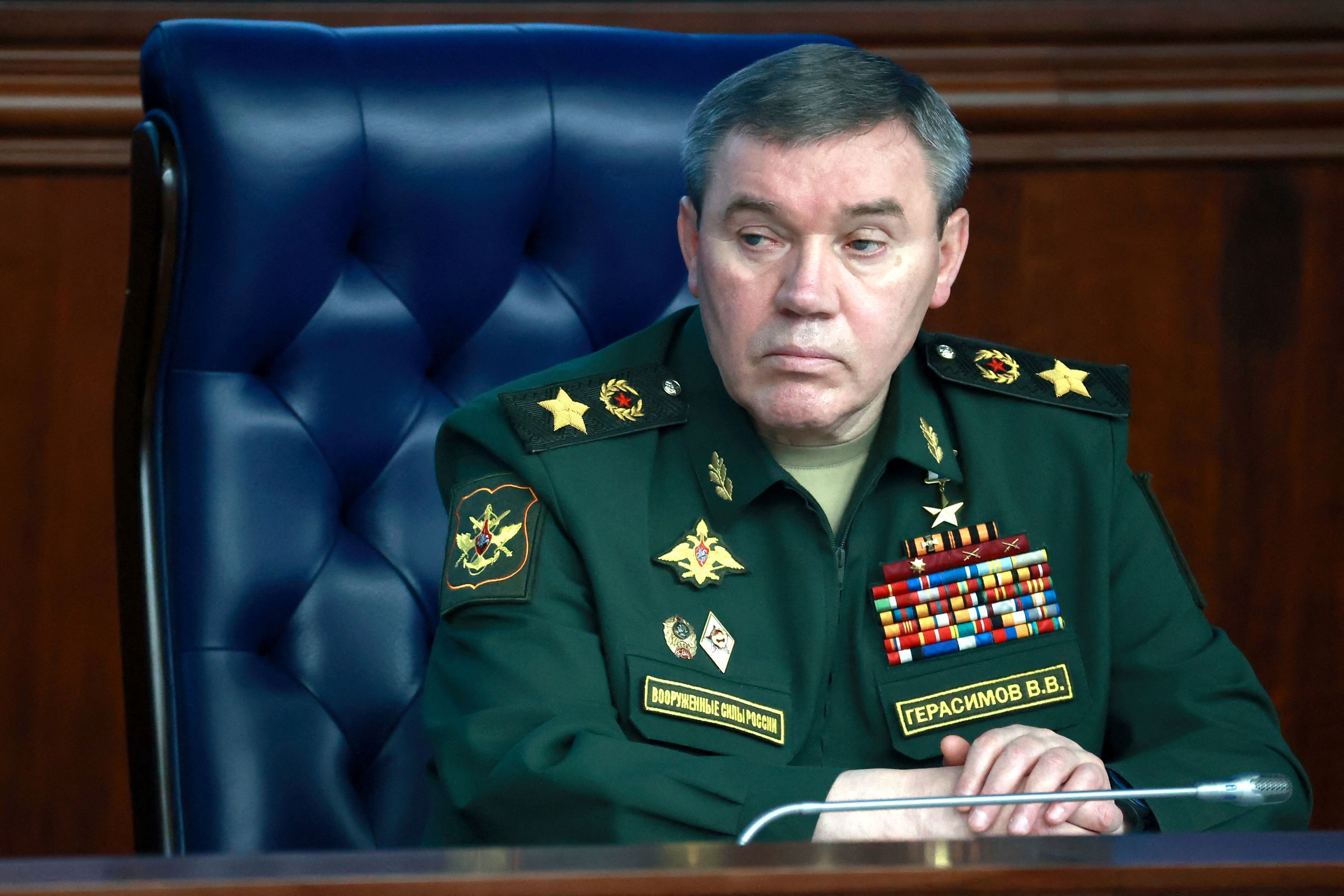
General Valery Gerasimov, Russia’s Chief of the General Staff and the newly appointed commander in Ukraine, has reportedly started off his new job by trying to “improve deployed troops’ day-to-day discipline”.

In its daily update, the UK’s ministry of defence (MoD) alleged that Gerasimov was looking to target “non-regulation uniform, travel in civilian vehicles, the use of mobile phones, and non-standard haircuts”.

However, the MoD claimed: “The measures have been met with sceptical feedback.”

The UK officials suggested that “some of the greatest derision has been reserved for attempts to improve the standard of troops’ shaving”.

It continued: “Officials in the Donetsk People’s Republic described the prioritisation of a ‘farce’ that would ‘hamper the process of destroying the enemy’.”

The Donetsk People’s Republic has been controlled by Russian separatists since 2014, but it was one of four Ukrainian regions to be illegally annexed by Vladimir Putin back in September.

A proxy private military company, the Wagner group, perceived as an informal arm of the Russian state, also pushed back against the new rules.

The MoD claimed Wagner owner, Yevgeny Prigozhin, lashed out at the official advice from the Kremlin, saying: “War is the time of the active and courageous, and not of the clean-shaven.”

The UK officials also pointed out: “The Russian force continues to endure operational deadlock and heavy casualties; Gerasimov’s prioritisation of largely minor regulations is likely to confirm the fears of his many sceptics in Russia.

“Along with Defence Minister Sergei Shoigu, he is increasingly seen as out of touch and focused on presentation over substance.”

This is just the latest sign that all is not well within the Russian army ranks.

Reports of low morale, poorly equipped soldiers and a distinct lack of training for the newly recruited troops from Putin’s partial mobilisation in the autumn have been circulating for months.

According to previous claims from the MoD, Russia is even using “poorly-training convicts” to bolster its armed forces.

And by February 24, the war – which the Kremlin expected to last just a matter of days – will have stretched out to a year, with just 15% of Ukrainian land under Russian control.

The appointment of Gerasimov to lead the campaign in Ukraine was seen as a sign that Russia was trying a new tactic to turn the war in its favour.

He replaced General Sergei Surovikin, nicknamed General Armageddon for his brutal strategies, who will now serve as Gerasmiov’s deputy.

Russia's army Chief of General Staff Valery Gerasimov
Russia’s army Chief of General Staff Valery Gerasimov

SERGEY FADEICHEV via Getty Images

Share Button

Emilia Clarke Is ‘Over The Moon’ For House Of The Dragon’s Success But Won’t Be Watching

Game Of Thrones star Emilia Clarke won’t be watching the show’s spin-off, House Of The Dragon, anytime soon.

The British actor, who played Daenerys Targaryen in the fantasy drama series, has admitted it would be “too weird” to watch the prequel, which is set roughly 200 years before the events depicted in Game Of Thrones.

During an appearance at the Sundance Film Festival over the weekend to promote her new romcom, The Pod Generation, Emilia explained to Variety why she has steered clear of watching the show.

Emilia Clarke at the Variety Sundance Studio

Katie Jones via Getty Images

“It’s too weird. I’m so happy it’s happening. I’m over the moon about all the awards … I just can’t do it. It’s so weird. It’s so strange,” she said.

She went on to compare watching House Of the Dragon to attending an awkward school reunion.

“It’s kind of like someone saying, ‘You want to go to this school reunion that’s not your year? Want to go to that school reunion?’ That’s how it feels. I’m avoiding it,” she explained.

Emilia isn’t the only Game Of Thrones star who has admitted that watching the prequel would be difficult.

Kit Harrington, who played Jon Snow in Game Of Thrones, previously said that there would be a “rawness” to not being in the show.

Emilia Clarke and Kit Harington.

Jeff Kravitz via Getty Images

“There’s emotion connected to that for me,” he said previously. “I think to see people get into outfits and costumes that resemble what we wore for all those years, and it [has] the same music and style and tone, but not be in it is always going to feel — there’s going to be a rawness there.”

in an interview with Vulture, HBO Max boss Casey Bloys revealed it won’t be this year.

“Don’t expect it in ’23, but I think sometime in ’24,” he told the outlet of House Of The Dragon’s second season, apparently “declining to get any more specific than that”.

He added: “We’re just starting to put the plan together, and just like last time, there are so many unknowns.

“It’s not to be coy or secretive, but you don’t want to say it’s going to be ready on this date, and then you have to move it.”

All 10 episodes of House Of The Dragon are available to watch on Now in the UK.

HuffPost may receive a share from purchases made via links on this page. Prices and availability subject to change.

Share Button

‘Alexithymia means I can’t explain how I’m feeling’

A politics graduate reflects on life being autistic and experiencing alexithymia and aphantasia.

Share Button

Ambulance staff on strike in England and Wales

Life-threatening 999 calls will be attended to, but other emergencies may not be or could face delays.

Share Button

Technology can help the NHS, says AstraZeneca boss

AstraZeneca’s Leif Johansson says AI and screening could prevent costly treatment in hospitals.

Share Button

Harlow hospital suspends gas and air over nitrous oxide levels

Princess Alexandra Hospital in Harlow says use has been suspended in the maternity unit.

Share Button