After cannabis, nitrous oxide is the most commonly misused substance among 16- to 24-year-olds in England.


After cannabis, nitrous oxide is the most commonly misused substance among 16- to 24-year-olds in England.
Symptoms can start in your 40s – here’s our guide to what happens in the run-up to periods stopping.

Liz Truss has vowed the to lead the Tories into the next general election as she apologised for her “mistakes”.
The prime minister is battling to save her premiership after torching her economic agenda by the dismantling of her former chancellor’s landmark mini-budget.
Advertisement
In an interview with the BBC after new chancellor Jeremy Hunt scaled back the energy support package and ditched “almost all” the tax cuts announced by his predecessor, Truss said she wanted to “accept responsibility and say sorry for the mistakes that have been made”.
“I wanted to act… to help people with their energy bills to deal with the issue of high taxes, but we went too far and too fast. I’ve acknowledged that,” she said.
She said she is “sticking around” because she was “elected to deliver for this country”, adding: “I will lead the Conservatives into the next general election.”
The pressure on the prime minister gained traction on Monday evening with Tories now openly calling for her to go after just six weeks in power.
Advertisement
Asked whether she would lead the Conservatives into the next general election, Truss replied: “I will lead the Conservatives into the next general election.”
When pressed, she added: “Well look, yeah, (laughs) I’m not focused on internal debates within the Conservative Party.
“The important thing is that I’ve been elected to this position to deliver for the country. We are facing very tough times.
“We simply cannot afford to spend our time talking about the Conservative Party, rather than what we need to deliver. That is my message to my colleagues.”
Advertisement
In the interview, she also said: “I do want to accept responsibility and say sorry for the mistakes that have been made. I wanted to act, to help people with their energy bills, to deal with the issue of high taxes, but we went too far and too fast.
“I have acknowledged that. I have put in place a new chancellor with a new strategy to restore economic stability. Now what I am focused on is delivering for the public.”
She added: “I am somebody who is honest, I’ve said that mistakes were made. I’ve also acted to address that, to make sure the country is in a strong position. And that’s what I will continue to do as prime minister.”
Truss is fighting to save her premiership after Hunt warned that “eye-wateringly difficult” decisions were needed as he tore up her economic strategy.
Hunt scaled back the energy support package and ditched “almost all” the tax cuts announced by his predecessor Kwasi Kwarteng less than a month ago, as he tried to restore economic stability after weeks of turmoil on the financial markets.
Advertisement
Truss became prime minister after winning the Tory leadership contest on the back of promises to dramatically cut tax, and the wholesale abandonment of the policies has left her fighting for her job after just six weeks.
She sat next to her new chancellor in the Commons, staring straight ahead as he ditched huge chunks of her plan.
After around 30 minutes, she walked out without having said a word.


In January 2019, a seizure of 3.3 tons of ivory in Uganda turned up something surprising: markings on some of the tusks suggested that they may have been taken from a stockpile of ivory kept, it was thought, strictly under lock and key by the government of Burundi.
A new study from University of Utah distinguished professor Thure Cerling and colleagues, published in Proceedings of the National Academy of Sciences, uses carbon isotope science to show that the marked tusks were more than 30 years old and somehow had found their way from the guarded government stockpile into the hands of illegal ivory traders. The results suggest that governments that maintain ivory stockpiles may want to take a closer look at their inventory.
Ivory’s isotope signatures
Cerling is a pioneer in the use of isotopes to answer questions about physical and biological processes. “Isotopes” of a given element refer to atoms of the element that vary in their number of neutrons, and thus vary oh-so-slightly in mass. A carbon-14 isotope has one more neutron than carbon-13, for example.
Some isotopes are stable and some are unstable. Unstable isotopes decay into other isotopes or elements through radioactive decay. Since the rate of decay is known for unstable isotopes, we can use the amounts present in a sample to determine ages. That’s how carbon dating works — it uses the rate of decay of unstable carbon-14 to determine the age of organic matter.
Around a decade ago, Cerling attended a presentation at the U by Sam Wasser of the University of Washington, who was studying the genetics of wildlife and using those tools to investigate the date and place of wildlife poaching. Cerling, recognizing that his expertise in isotope science might be able to add useful information, began an ongoing collaboration with Wasser.
In 2016, Cerling, Wasser and colleagues published a study that addressed a key question in the ivory trade: how old is the ivory seized by governments? Some traders have claimed their ivory is old, taken before 1976, and thus exempt from sales bans. And with the average size of ivory seizures more than 2.5 tons, researchers, governments and conservationists wonder how much of the ivory is recent and how much is coming from criminal stockpiles — or is stolen from one of several ivory stockpiles held by the governments of some countries in Africa.
“Governments keep their stockpiles for multiple reasons,” Wasser says. “They hope to sell the ivory for revenue, sometimes to support conservation efforts. However, they can only sell ivory from elephants that died of natural causes or were culled because they were problem animals. They can’t sell seized ivory because they don’t know it came from the country.”
With the combination of Cerling’s isotope data and Wasser’s genetic data, the 2016 study found that more than 90% of seized ivory was from elephants that had been killed less than three years before. It was a sobering result, showing active and well-developed poaching and export networks. The study seemed to show that little ivory from government stockpiles had ended up on the black market.
Marked tusks
But the 2019 seizure of ivory in Uganda showed something concerning. Some of the tusks sported markings that looked suspiciously like the markings that CITES, the Convention on International Trade in Endangered Species of Wild Fauna and Flora, uses to inventory stockpiled ivory.
Due to the markings seen on some samples of the ivory,” Cerling says, “it was thought that quite a few samples in this shipment could be related to material held in a government stockpile in Burundi. We were asked to date samples from this, and three other recent ivory seizures, to see if some samples could possibly be from older stockpiles.”
To determine the ivory’s age, the researchers collected small samples from the tusks and analyzed them for the amount of carbon-14 isotopes in each sample. They were looking specifically for the amount of “bomb carbon” in the tusks. Between 1945 and 1963, nuclear weapons testing doubled the amount of carbon-14 in the atmosphere, so anything living that’s consumed carbon since then — including you — has a measurable carbon-14 signature. The amount of carbon-14 in a sample of ivory that hasn’t yet radioactively decayed can tell scientists when the ivory stopped growing, or when the elephant died.
The method takes some calibration, using samples from organisms living in the same area. Some of the samples came from schoolchildren in Kenya, through a program called “Kids and Goats for Elephants.” Because most families in rural Kenya keep goats the program, run by Cerling and Paula Kahumbu of WildlifeDirect engages children in collecting hair samples from goats for isotopic analysis. The isotope data is useful for many applications, including fighting elephant poaching and, in this case, calibrating the bomb carbon decay rate for more accurate dating of ivory.
A consequential result
The researchers analyzed ivory from four seizures in Angola, Hong Kong, Singapore and Uganda. Genetic data ensured that they weren’t sampling two tusks from the same individual. The results of analysis from the Angola, Hong Kong and Singapore seizures were as expected — the samples were mostly around three years after the death of the elephant, with no tusks having been taken more than 10 years previous.
But the Uganda seizure, with the inventory markings on the tusks, showed something very different. Nine of the 11 tusks tested had been taken more than 30 years before, with the dates of death ranging between 1985 and 1988. Those dates are consistent with the age of ivory in the stockpile of the government of Burundi, which was inventoried and stored in sealed containers in 1989.
“My suspicions were affirmed,” Wasser says. “The bigger surprise was how near to 1989 the elephants were killed.” At the time Burundi assembled its stockpile, a condition of joining CITES, which assists governments in managing ivory reserves, was that the ivory to be stockpiled was old. The results suggest that that wasn’t the case, Wasser says, which would have violated conditions for Burundi to join CITES.
“The hope is that CITES will request the stockpile to be re-inventoried,” Wasser says, “including aging randomly selected tusks and secure the remaining stocks.”

Targeting a specific enzyme in the muscle could help cancer patients preserve muscle mass and potentially prolong their survival, according to research from UTHealth Houston.
A study led by Yi-Ping Li, PhD, professor in the Department of Integrative Biology and Pharmacology with McGovern Medical School at UTHealth Houston, found that an enzyme known as UBR2 plays a critical role in cancer-induced muscle wasting, also called cancer cachexia.
The results were published today in the scientific journal PNAS.
“The findings will fill a key gap in understanding how cancer causes muscle mass and function loss,” said Li, senior author of the study and a faculty member with The University of Texas MD Anderson Cancer Center UTHealth Houston Graduate School of Biomedical Sciences.
Cancer cachexia is a complication developed in the late stages of cancer in roughly 60% of all cancer patients. Cachexia patients waste away by losing body weight, primarily due to progressive loss of muscle mass, causing respiratory and heart failure. Approximately 30% of all cancer patients die of cachexia, making the complication a major determinant of cancer survival.
Historically, there has been no treatment of cancer cachexia due to poor understanding of its origins. Therefore, a key focus of Li’s lab over the past two decades has been to decipher the molecular mechanisms through which cancer causes cachexia.
Building upon a series of discoveries in mice, his lab recently identified the role of the enzyme UBR2. This is the key enzyme in muscle that seeks out subtypes of the contractile protein myosin heavy chain, a critical component for sustaining muscle contraction, for destruction in response to cancer.
Cancer causes an increase of UBR2 in muscle, and blocking the increase of or removing UBR2 spares mice from tumor-caused muscle mass and function loss. By examining the muscle of cancer patients, researchers obtained evidence that UBR2 is increased, which is associated with loss of the specific subtype of myosin heavy chain preferentially lost in cachexia.
Li said this discovery is significant for the future of cancer cachexia therapy.
“We have learned in animal studies that muscle wasting in cancer hosts can be ameliorated by blocking UBR2 increase through repurposing some existing drugs,” he said. “Based on the findings, we plan to conduct clinical trials for the therapy of cancer cachexia.”
Song Gao, PhD, former postdoctoral research fellow with McGovern Medical School, was the first author of the study. Co-authors with the Department of Integrative Biology and Pharmacology at McGovern Medical School included Yong Zhou, PhD, assistant professor, as well as former faculty members Guohua Zhang, PhD; Zicheng Zhang, MD, PhD; James Z. Zhu; and Li Li, PhD.
Other co-authors were George G. Rodney Jr., PhD, and Reem S. Abo-Zahrah, PhD, both with Baylor College of Medicine in Houston; Lindsey Anderson, PhD, and Jose M. Garcia, MD, PhD, both with VA Puget Sound Health Care System in Seattle; and Yong Tae Kwon, PhD, with Seoul National University in South Korea.

Our ancestry can be detected not only in our genes, but also in our metabolism, a new Yale-led study has found.
In an analysis of the metabolic profiles of healthy American babies, researchers found surprising differences among ethnic groups which may help make screening for inherited metabolic disorders, cystic fibrosis, or hypothyroidism much more accurate than traditional genetic disease screens.
“We don’t want to miss a baby who is potentially sick, and we don’t want to put families through the burdens and concerns that can stem from a false-positive test,” said Curt Scharfe, associate professor of genetics at Yale School of Medicine and senior author of the study published in the journal Molecular Genetics and Metabolism.
For the study, Scharfe and colleagues analyzed data collected from more than 400,000 babies, representing 17 self-reported ethnic groups, who were part of California’s newborn screening program. Specifically, they wanted to know if these ethnic differences could be detected in metabolites, molecules that provide energy by breaking down food or body tissue such as fat, found in the blood of the infants.
The question was not only of academic interest but of concern to pediatricians. For instance, it is known that babies of African heritage are more likely to have elevated blood biomarkers indicating cystic fibrosis than babies born to white parents, even though babies born to white parents are far more likely to eventually develop the disease. Researchers hope that using ancestry to interpret these differences in marker levels might offer more accurate ways to assess risks than traditional genetic tests.
People of African heritage are also known to have greater genetic diversity than those from ethnic groups because they are descendants of the world’s oldest ancestral population. Modern humans emigrated from Africa to regions across the planet; other ethnic groups are descendants of these original migrants, and have enough variation in their DNA to make them genetically identifiable.
But metabolic lineages can tell a different story, the researchers found. For instance, while there is a clear delineation between genetic variants among African-Americans and Americans of European descent, researchers found that metabolically these two groups are more closely related. Conversely, while people of Japanese and Chinese descent, for instance, are closely related genetically, the researchers found larger differences in their metabolic profiles.
“This attests to the role of environment in forming our metabolism,” Scharfe said. “Where people share the same culture and food, metabolic profiles are more similar. Where people are separated by circumstances, such as language or lifestyles, then differences in metabolism are greater than genetic variations.”
Scharfe cautions that more work needs to be done before findings can be applied clinically. Researchers only analyzed 41 out of many hundreds of metabolites and relied on parents own reports of their ethnic heritage, which might not always correspond to reality.
“This is just a first snap shot, but understanding our metabolic ancestry has a promising future,” Scharfe said.
Gang Peng, an associate research scientist of biostatistics and bioinformatics in Yale’s departments of Biostatistics and Genetics, is the first author of the study.
Story Source:
Materials provided by Yale University. Original written by Bill Hathaway. Note: Content may be edited for style and length.

The Labour Party has opened up a 36-point poll lead over the Conservatives, according to new research, against the backdrop of the crumbling Tory administration.
A survey by Redfield and Wilton Strategies suggests it is the biggest advantage for any party since October 1997.
Advertisement
The poll has Labour on 56% (up three points since October 13), while the Tories were down four points on 20%, the Liberal Democrats were on 11%, the Green Party on 5%, SNP 4% and Reform 2%.
Including the 19% who did not know which way they would vote, the Labour lead was 31 points, with Keir Starmer’s party on 47% and the Tories on 16%.
The pollster surveyed 2,000 eligible voters in Great Britain on Sunday.
Elsewhere, an Opinium poll published on Sunday projected a landslide general election win for the Labour Party, if voters headed to the ballot box now.
Advertisement
Their victory would be so large it would echo the party’s historic 1997 win.
With more than 10,000 respondents answering the survey between 26 and 30 September – weeks before Truss was forced to sack her chancellor over the chaos – Opinium found the Tories would lose 219 seats in total, leaving it with just 137 seats.
Many high-profile Conservatives would lose their seats, too, including the new chancellor Hunt, levelling up secretary Simon Clarke, business secretary Jacob Rees-Mogg and health secretary Therese Coffey, among other ministers.
Former prime minister Boris Johnson would also lose his seat, and the Tories would lose their majorities in all 45 out of 45 of its seats in the “red wall” in the north of England.
Meanwhile a separate Deltapoll survey showed Labour was 32-points ahead.
Last month, a YouGov poll showed Labour had surged to an astonishing 33-point lead over the Tories – the first polling analysis to give the party a lead comparable to the late 1990s and Tony Blair sweeping to power.
Advertisement
It comes as Liz Truss is battling to save her premiership after chancellor Jeremy Hunt warned that “eye-wateringly difficult” decisions were needed as he tore up her economic strategy.
Hunt scaled back the energy support package and ditched “almost all” the tax cuts announced by his predecessor Kwasi Kwarteng less than a month ago, as he tried to restore economic stability after weeks of turmoil on the financial markets.
Truss became prime minister after winning the Tory leadership contest on the back of promises to dramatically cut tax, and the wholesale abandonment of the policies has left her fighting for her job after just six weeks.
She sat next to her new chancellor in the Commons, staring straight ahead as he ditched huge chunks of her plan.
After around 30 minutes, she walked out without having said a word.

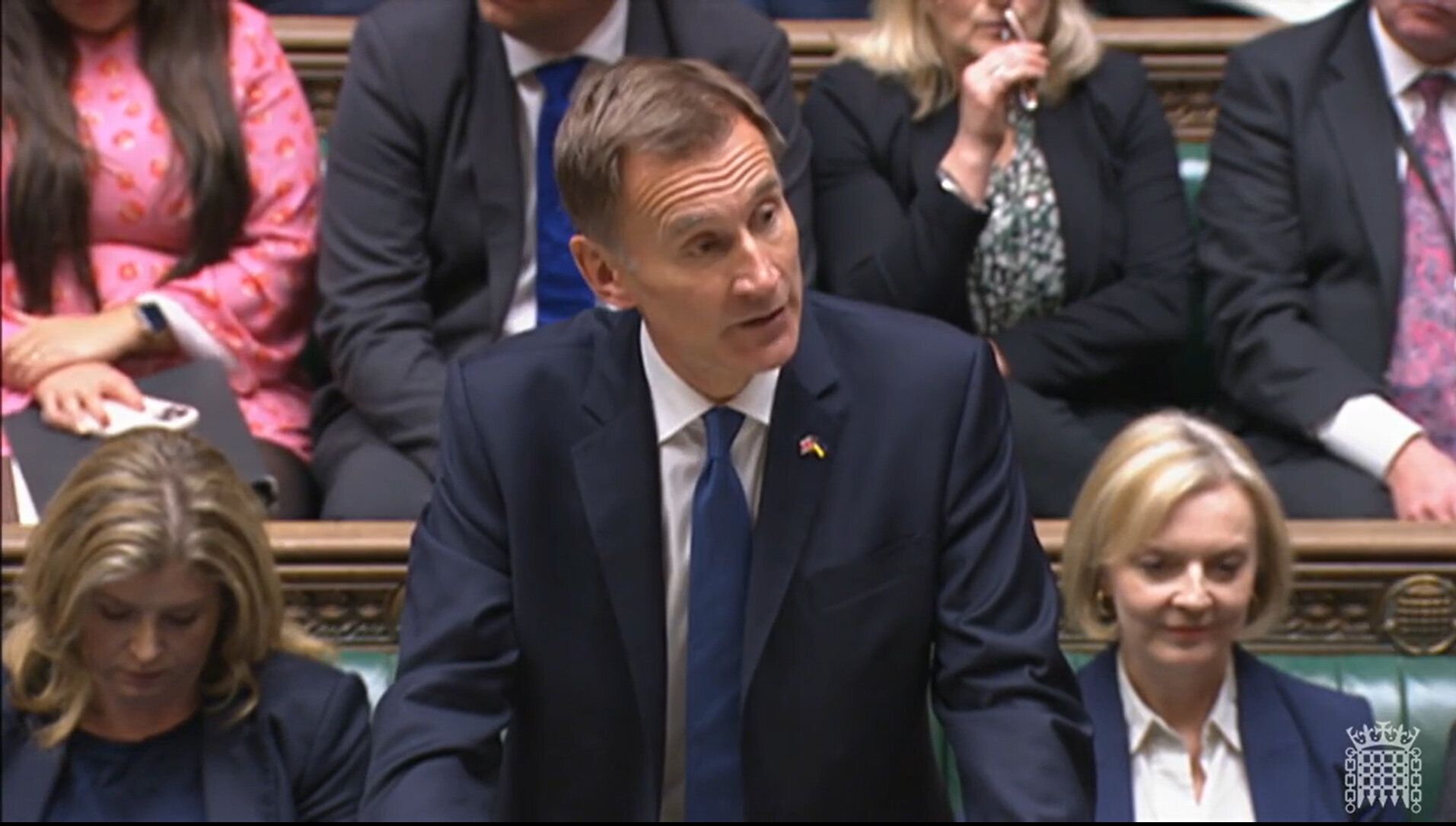
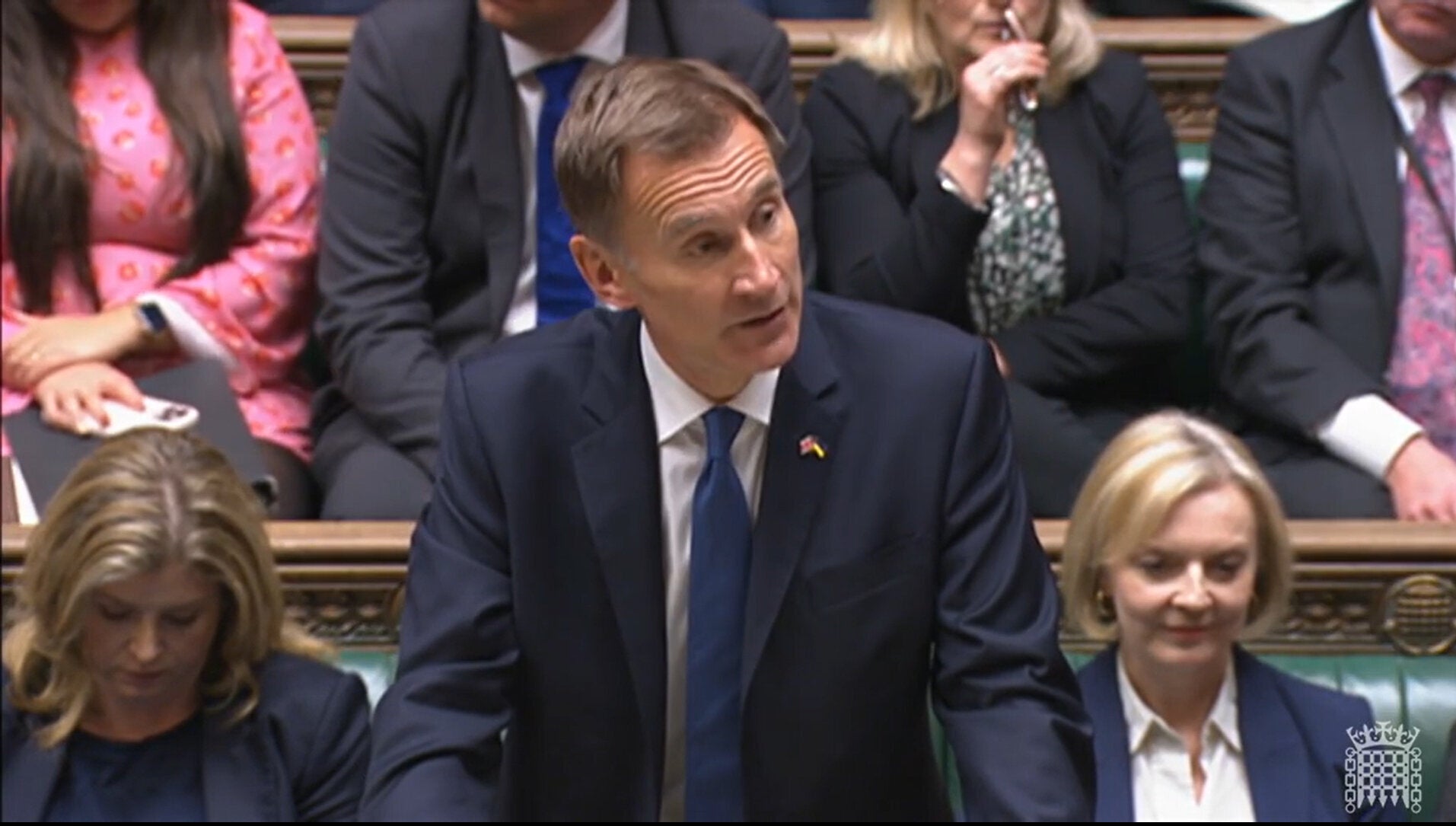
Liz Truss made a fleeting, impassive appearance in the House of Commons as her premiership appeared to crumble around her.
The prime minister had snubbed Labour’s urgent parliamentary question on Truss’s decision to to appoint Jeremy Hunt as the new chancellor – and sent Penny Mordaunt, the Commons speaker, to deputise.
Advertisement
But the move raised more questions about the grip Truss has of her party.
Mordaunt’s initial explanation that the PM was “detained on urgent business” prompted howls of laughter from the Opposition benches, and failed to reassure MPs.
Stella Creasy, a Labour MP, suggested that based on what they had been told, the prime minister is “cowering under her desk and asking for it all to go away”.
Mordaunt, a one-time leadership rival who is viewed as a potential successor, caused more laughter when she replied: “Well, the prime minister is not under a desk.”
Mordaunt added to the confusion by repeatedly suggesting there was “a very good reason” for the prime minister’s no-show – which even led one MP to ask if she was “on the way to the Palace” to tell the King her government is over.
Advertisement
But then Truss finally arrived while Mordaunt was still speaking.
She was there, it turned out, to sit alongside her new chancellor as Hunt was due to spell out the “eye-wateringly difficult” decisions that were needed as he tore up her economic strategy.
But things got even stranger from there. Truss did not contribute to the debate, and many on social media pointed out she appeared only to be staring into the middle distance and blinking frequently.
Advertisement
She sat next to Hunt for around 30 minutes as he ditched huge chunks of “Trussonomics”.
But as soon as Hunt finished his Commons address and took questions from MPs, Truss departed to accusations of “running off to something else”.
So where was she?
One report suggested Truss had been meeting Graham Brady, the chairman of the 1922 Committee of backbench Tory MPs, who could hold the key to her future if Conservatives revolt en masse.
Advertisement
A twin boy collapsed after nurse Lucy Letby injected him with air, her murder trial hears.
Life expectancy improved last year in some European countries but not in others, researchers say.
