Air-powered computer memory helps soft robot control movements

Engineers at UC Riverside have unveiled an air-powered computer memory that can be used to control soft robots. The innovation overcomes one of the biggest obstacles to advancing soft robotics: the fundamental mismatch between pneumatics and electronics. The work is published in the open-access journal, PLOS One.

Pneumatic soft robots use pressurized air to move soft, rubbery limbs and grippers and are superior to traditional rigid robots for performing delicate tasks. They are also safer for humans to be around. Baymax, the healthcare companion robot in the 2014 animated Disney film, Big Hero 6, is a pneumatic robot for good reason.

But existing systems for controlling pneumatic soft robots still use electronic valves and computers to maintain the position of the robot’s moving parts. These electronic parts add considerable cost, size, and power demands to soft robots, limiting their feasibility.

To advance soft robotics toward the future, a team led by bioengineering doctoral student Shane Hoang, his advisor, bioengineering professor William Grover, computer science professor Philip Brisk, and mechanical engineering professor Konstantinos Karydis, looked back to the past.

“Pneumatic logic” predates electronic computers and once provided advanced levels of control in a variety of products, from thermostats and other components of climate control systems to player pianos in the early 1900s. In pneumatic logic, air, not electricity, flows through circuits or channels and air pressure is used to represent on/off or true/false. In modern computers, these logical states are represented by 1 and 0 in code to trigger or end electrical charges.

Pneumatic soft robots need a way to remember and maintain the positions of their moving parts. The researchers realized that if they could create a pneumatic logic “memory” for a soft robot, they could eliminate the electronic memory currently used for that purpose.

The researchers made their pneumatic random-access memory, or RAM, chip using microfluidic valves instead of electronic transistors. The microfluidic valves were originally designed to control the flow of liquids on microfluidic chips, but they can also control the flow of air. The valves remain sealed against a pressure differential even when disconnected from an air supply line, creating trapped pressure differentials that function as memories and maintain the states of a robot’s actuators. Dense arrays of these valves can perform advanced operations and reduce the expensive, bulky, and power-consuming electronic hardware typically used to control pneumatic robots.

After modifying the microfluidic valves to handle larger air flow rates, the team produced an 8-bit pneumatic RAM chip able to control larger and faster-moving soft robots, and incorporated it into a pair of 3D-printed rubber hands. The pneumatic RAM uses atmospheric-pressure air to represent a “0” or FALSE value, and vacuum to represent a “1” or TRUE value. The soft robotic fingers are extended when connected to atmospheric pressure and contracted when connected to vacuum.

By varying the combinations of atmospheric pressure and vacuum within the channels on the RAM chip, the researchers were able to make the robot play notes, chords, and even a whole song — “Mary Had a Little Lamb” — on a piano. Click here to view a video of the robot playing piano.

In theory, this system could be used to operate other robots without any electronic hardware and only a battery-powered pump to create a vacuum. The researchers note that without positive pressure anywhere in the system — only normal atmospheric air pressure — there is no risk of accidental overpressurization and violent failure of the robot or its control system. Robots using this technology would be especially safe for delicate use on or around humans, such as wearable devices for infants with motor impairments.

Story Source:

Materials provided by University of California – Riverside. Original written by Holly Ober. Note: Content may be edited for style and length.


Share Button

Role of deep-sea microbial predators at hydrothermal vents examined

The hydrothermal vent fluids from the Gorda Ridge spreading center in the northeast Pacific Ocean create a biological hub of activity in the deep sea. There, in the dark ocean, a unique food web thrives not on photosynthesis but rather on chemical energy from the venting fluids. Among the creatures having a field day feasting at the Gorda Ridge vents is a diverse assortment of microbial eukaryotes, or protists, that graze on chemosynthetic bacteria and archaea.

This protistan grazing, which is a key mechanism for carbon transport and recycling in microbial food webs, exerts a higher predation pressure at hydrothermal vent sites than in the surrounding deep-sea environment, a new paper finds.

“Our findings provide a first estimate of protistan grazing pressure within hydrothermal vent food webs, highlighting the important role that diverse deep-sea protistan communities play in deep-sea carbon cycling,” according to the paper, Protistan grazing impacts microbial communities and carbon cycling ad deep-sea hydrothermal vents published in the Proceedings of the National Academy of Sciences (PNAS).

Protists serve as a link between primary producers and higher trophic levels, and their grazing is a key mechanism for carbon transport and recycling in microbial food webs, the paper states.

The research found that protists consume 28-62% of the daily stock of bacteria and archaea biomass within discharging hydrothermal vent fluids from the Gorda Ridge, which is located about 200 kilometers off the coast of southern Oregon. In addition, researchers estimate that protistan grazing could account for consuming or transferring up to 22% or carbon that is fixed by the chemosynthetic population in the discharging vent fluids. Though the fate of all of that carbon is unclear, “protistan grazing will release a portion of the organic carbon into the microbial loop as a result of excretion, egestion, and sloppy feeding,” and some of the carbon will be taken up by larger organisms that consume protistan cells, the paper states.

After collecting vent fluid samples from the Sea Cliff and Apollo hydrothermal vent fields in the Gorda Ridge, researchers conducted grazing experiments, which presented some technical challenges that needed to be overcome. For instance, “prepping a quality meal for these protists is very difficult,” said lead author Sarah Hu, a postdoctoral investigator in the Marine Chemistry and Geochemistry Department at the Woods Hole Oceanographic Institution (WHOI).

“Being able to do this research at a deep-sea vent site was really exciting because the food web there is so fascinating, and it’s powered by what’s happening at this discharging vent fluid,” said Hu, who was onboard the E/V Nautilus during the May-June 2019 cruise. “There is this whole microbial system and community that’s operating there below the euphotic zone outside of the reach of sunlight. I was excited to expand what we know about the microbial communities at these vents.”

Hu and co-author Julie Huber said that quantitative measurements are important to understand how food webs operate at pristine and undisturbed vent sites.

“The ocean provides us with a number of ecosystem services that many people are familiar with, such as seafood and carbon sinks. Yet, when we think about microbial ecosystem services, especially in the deep sea, we just don’t have that much data about how those food webs work,” said Huber, associate scientist in WHOI’s Marine Chemistry and Geochemistry Department.

Obtaining baseline measurements “is increasingly important as these habitats are being looked at for deep-sea mining or carbon sequestration. How might that impact how much carbon is produced, exported, or recycled?” she said.

“We need to understand these habitats and the ecosystems they support,” Huber said. “This research is connecting some new dots that we weren’t able to connect before.”

The research was supported by NASA, the National Oceanic and Atmospheric Administration, Ocean Exploration Trust, the National Science Foundation, and WHOI.

Share Button

Engineers 3D printed a soft robotic hand that can play Nintendo

A team of researchers from the University of Maryland has 3D printed a soft robotic hand that is agile enough to play Nintendo’s Super Mario Bros. — and win!

The feat, highlighted on the front cover of the latest issue of Science Advances, demonstrates a promising innovation in the field of soft robotics, which centers on creating new types of flexible, inflatable robots that are powered using water or air rather than electricity. The inherent safety and adaptability of soft robots has sparked interest in their use for applications like prosthetics and biomedical devices. Unfortunately, controlling the fluids that make these soft robots bend and move has been especially difficult — until now.

The key breakthrough by the team, led by University of Maryland assistant professor of mechanical engineering Ryan D. Sochol, was the ability to 3D print fully assembled soft robots with integrated fluidic circuits in a single step.

“Previously, each finger of a soft robotic hand would typically need its own control line, which can limit portability and usefulness,” explains co-first author Joshua Hubbard, who performed the research during his time as an undergraduate researcher in Sochol’s Bioinspired Advanced Manufacturing (BAM) Laboratory at UMD. “But by 3D printing the soft robotic hand with our integrated fluidic transistors, it can play Nintendo based on just one pressure input.”

As a demonstration, the team designed an integrated fluidic circuit that allowed the hand to operate in response to the strength of a single control pressure. For example, applying a low pressure caused only the first finger to press the Nintendo controller to make Mario walk, while a high pressure led to Mario jumping. Guided by a set program that autonomously switched between off, low, medium, and high pressures, the robotic hand was able to press the buttons on the controller to successfully complete the first level of Super Mario Bros. in less than 90 seconds.

“Recently, several groups have tried to harness fluidic circuits to enhance the autonomy of soft robots,” said recent Ph.D. graduate and co-first author of the study Ruben Acevedo, “but the methods for building and integrating those fluidic circuits with the robots can take days to weeks, with a high degree of manual labor and technical skill.”

To overcome these barriers, the team turned to “PolyJet 3D Printing,” which is like using a color printer, but with many layers of multi-material ‘inks’ stacked on top of one another in 3D.

“Within the span of one day and with minor labor, researchers can now go from pressing start on a 3D printer to having complete soft robots — including all of the soft actuators, fluidic circuit elements, and body features — ready to use,” said study co-author Kristen Edwards.

The choice to validate their strategy by beating the first level of Super Mario Bros. in real time was motivated by science just as much as it was by fun. Because the video game’s timing and level make-up are established, and just a single mistake can lead to an immediate game over, playing Mario provided a new means for evaluating soft robot performance that is uniquely challenging in a manner not typically tackled in the field.

In addition to the Nintendo-playing robotic hand, Sochol’s team also reported terrapin turtle-inspired soft robots in their paper. The terrapin happens to be UMD’s official mascot, and all of the team’s soft robots were printed at UMD’s Terrapin Works 3D Printing Hub.

Another important benefit of the team’s strategy is that it’s open source, with the paper open access for anyone to read as well as a link in the supplementary materials to a GitHub with all of the electronic design files from their work.

“We are freely sharing all of our design files so that anyone can readily download, modify on demand, and 3D print — whether with their own printer or through a printing service like us — all of the soft robots and fluidic circuit elements from our work,” said Sochol. “It is our hope that this open-source 3D printing strategy will broaden accessibility, dissemination, reproducibility, and adoption of soft robots with integrated fluidic circuits and, in turn, accelerate advancement in the field.”

At present, the team is exploring the use of their technique for biomedical applications including rehabilitation devices, surgical tools, and customizable prosthetics. As Sochol is a faculty affiliate of the Fischell Department of Bioengineering as well as a member of both the Maryland Robotics Center and the Robert E. Fischell Institute for Biomedical Devices, the team has an exceptional environment to continue advancing their strategy to address pressing challenges in biomedical fields.

Share Button

Common antibiotic no more effective than placebo in preventing COVID-19 symptoms among non-hospitalized

A UC San Francisco study has found that the antibiotic azithromycin was no more effective than a placebo in preventing symptoms of COVID-19 among non-hospitalized patients, and may increase their chance of hospitalization, despite widespread prescription of the antibiotic for the disease.

“These findings do not support the routine use of azithromycin for outpatient SARS-CoV-2 infection,” said lead author Catherine E. Oldenburg, ScD, MPH, an assistant professor with the UCSF Proctor Foundation. SARS-CoV-2 is the virus that causes COVID-19.

Azithromycin, a broad-spectrum antibiotic, is widely prescribed as a treatment for COVID-19 in the United States and the rest of the world. “The hypothesis is that it has anti-inflammatory properties that may help prevent progression if treated early in the disease,” said Oldenburg. “We did not find this to be the case.”

The study, which was conducted in collaboration with Stanford University, appears July 16, 2021, in the Journal of the American Medical Association.

The study included 263 participants who all tested positive for SARS-CoV-2 within seven days before entering the study. None were hospitalized at the time of enrollment. In a random selection process, 171 participants received a single, 1.2 gram oral dose of azithromycin and 92 received an identical placebo.

At day 14 of the study, 50 percent of the participants remained symptom free in both groups. By day 21, five of the participants who received azithromycin had been hospitalized with severe symptoms of COVID-19 and none of the placebo group had been hospitalized.

The researchers concluded that treatment with a single dose of azithromycin compared to placebo did not result in greater likelihood of being symptom-free.

“Most of the trials done so far with azithromycin have focused on hospitalized patients with pretty severe disease,” said Oldenburg. “Our paper is one of the first placebo-controlled studies showing no role for azithromycin in outpatients.”

Co-authors included Jessica Brogdon, MPH&TM; Cindi Chen, MS; Kevin Ruder; Lina Zhong; Fanice Nyatigo; Catherine A. Cook, MPH; Armin Hinterwirth, PhD; Elodie Lebas, RN; Travis Redd, MD, MPH; Travis C. Porco, PhD, MPH; Thomas M. Lietman, MD; and Benjamin F. Arnold, PhD, MPH, all of UCSF; senior investigator Thuy Doan, MD, PhD, with the UCSF Proctor Foundation, and Benjamin A. Pinsky, MD, PhD, of Stanford University.

The trial was supported by the Bill and Melinda Gates Foundation (INV-017026). Azithromycin and matching placebo were donated by Pfizer, Inc. (New York, NY). Thuy Doan was supported in part by a Research to Prevent Blindness Career Development Award. The authors had no conflicts of interest.

Story Source:

Materials provided by University of California – San Francisco. Original written by Elizabeth Fernandez. Note: Content may be edited for style and length.

Share Button

Some Tory MPs Backed Aid Cut After ‘Smell Of A Job’, Says Andrew Mitchell

Some Tory MPs who voted to cut the UK’s aid budget, which will take “food off the plates of starving children”, did so because they were given the “smell of a job” in government, Andrew Mitchell has said.

On Tuesday Boris Johnson saw off a Tory rebellion over its decision to slash overseas aid spending from 0.7% to 0.5% of gross national income.

In an interview with HuffPost UK’s Commons People podcast, Mitchell, a former Conservative international development secretary, said the cut would do “great damage” to the party’s electoral chances.

Mitchell praised the 25 Tory MPs who voted against the government as “heroes” after they “stood firm and stood up for Britain’s international reputation” and “for the poorest people in the world”.

But he accused many of the backbenchers who had switched sides and voted with the government as having been won over by the “seduction” of career advancement.

“Some of them agonised,” he said. “Some of them just slipped away and hoped no one would notice.”

Mitchell, who was also previously Tory chief whip, said: “I‘ve been poacher and gamekeeper.

“You prey on the frailty of human nature, you offer people who you know whose principles will be overridden if they have the smell of a job.

“I think countless new ministers for paperclips will no doubt shortly be announced.”

He added: “You prey on people’s insecurities and you know what people’s weaknesses are and that’s how you get the others on board.”

Mitchell said the cut in aid spending meant the UK had “broken our word” to the world.

“We’ve trashed Britain’s reputation,” he said. ”Literally taking food off the plates of starving children. 

“After the war, Britain kept rationing so the famine would not develop and take off in Germany. That’s what Britain is like, after a war.”

Mitchell also warned that as well as having a severe impact on the world’s poor, the move would also hurt the Tories in the polls.

“It will do great damage to the Conservative Party,” he said.

“David Cameron taught us that you don’t get an overall majority, and the Tories didn’t get an overall majority between 1992 an 2015, without being a broad church,” he said.

“Why did we get a majority in 2015? Because we won all those Lib Dem seats.

“Why did we win them? Because socially liberal conservatives, like me, care a lot about this and they felt it was safe to vote for David Cameron’s Conservative Party. 

“They felt comfortable and happy in the Conservative Party. Many of those people won’t feel like that after what has now happened.”

He said: “Boris has been brilliant at adding on the red wall seats and it’s produced some extremely able new colleagues. He has done very well on expanding the Tory DNA in that respect.”

But Mitchell added the party had to be careful not to “lose off the other end” of vot that “won’t be voting for a party” that cut aid when it “didn’t have to”.

Share Button

What To Expect At Your Vaccine Appointment And How You’ll Feel After

The pandemic has been an undeniably tough time, leaving many people wondering when life will return to ‘normal’. But with more than 86% of adult Brits now having received their first vaccination, the light over the horizon isn’t just visible – it’s shining bright.

Vaccines are the most effective way to protect people from coronavirus and have already saved thousands of lives. We know that vaccinated people are far less likely to develop severe Covid-19, to be admitted to hospital or to die from the virus. What’s more, vaccinated people aren’t just protecting themselves by getting the jab, they are also less likely to pass the virus on to others.

Some people may feel hesitant about getting the jab, but the best way to overcome nerves is to arm yourself with as much information as possible before scheduling the appointment.

Luckily, we have done the work for you.

From how to book your spot to how you’ll feel afterwards, potential side effects and why it’s so important that you get both jabs, here’s everything you need to know about your Covid-19 vaccine appointment.

Covid-19 and vaccination concept.

Covid-19 and vaccination concept.

How To Book An Appointment – And What To Do If You Miss It

In the UK, all those aged 18 or above can book their vaccination through the NHS booking service. You can also call 119 free of charge, anytime between 7am and 11pm seven days a week.

Those who need to change the date of their appointment for any reason can easily cancel, rebook and manage bookings through the free NHS service. The same applies if you have missed your appointment and need to rebook it.

What’s more, walk-in sites will open across England this weekend too (July 16-18), where people can get their Covid-19 vaccine without an appointment. You don’t even need to provide ID or be registered with a GP.

There are also some perks (beyond the obvious protection against coronavirus). For instance, you can ‘grab-a-jab’ this weekend when you pop into Primark, while sunbathing in the park, or exploring Tate Modern, where DJ and influencer Zoe London will be performing Friday evening.

Here’s the most important part: one dose isn’t enough. You need to book and attend two appointments to get both doses for maximum protection.

We get it, life can get hectic – maybe you have kids or a stressful job – but the process is tailored to be easy and convenient. Put your health first.

What To Expect At And After Your Vaccine Appointment

The appointment could take place at a hospital, local GP surgery, a vaccine centre or pharmacy.

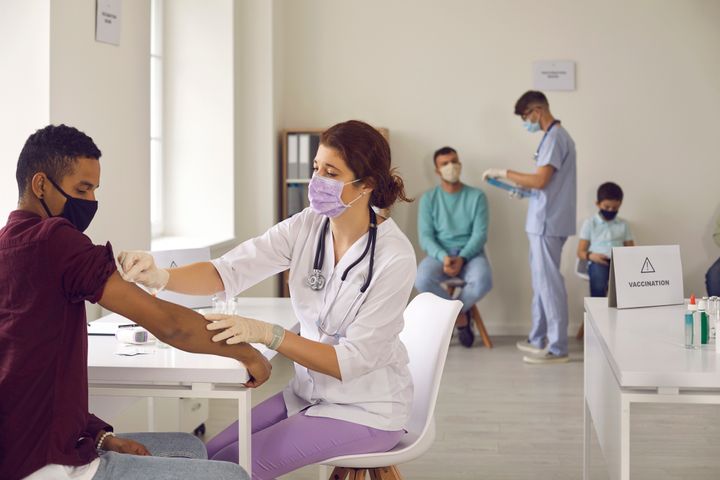
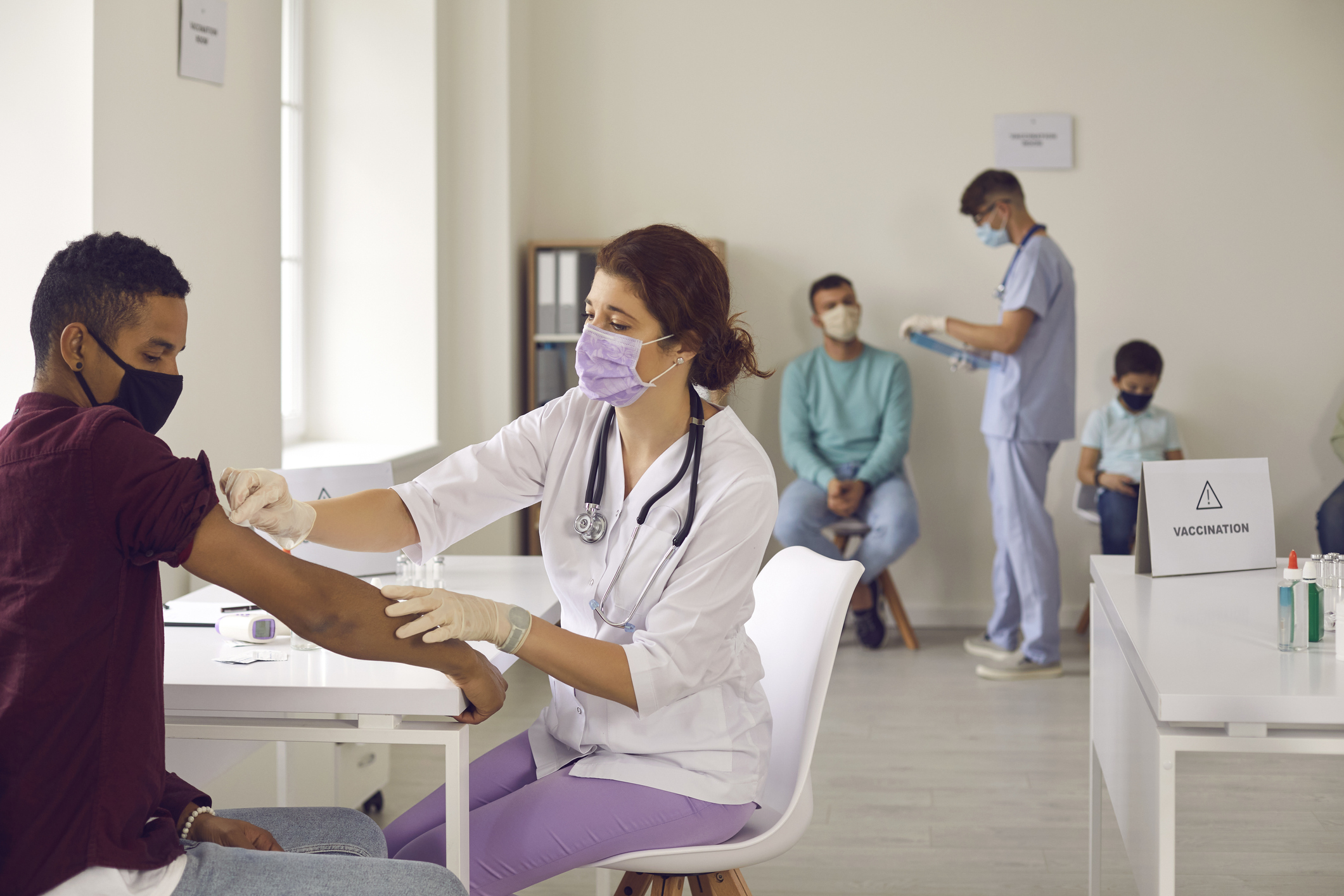
Every person is asked a series of questions before the jab is administered and handed an information pack. Equipment, including chairs, is sanitised after each person and the doctors, nurses and volunteers are required to wear masks.

In the UK, there are currently four vaccines approved for use: Moderna, AstraZeneca, Pfizer and Janssen. You don’t get to choose which one you get but there’s no need for concern, as each vaccine has gone through the same rigorous safety process and been approved by the MHRA, the regulatory body. All the vaccines are highly effective and will protect you from coronavirus.

After the vaccine is administered into your arm muscle (top tip: wear a T-shirt or top that is easy to roll up or down) you will get a vaccine record card that includes the name of the vaccine, batch number and date it was administered.

Keep this document close and bring it to the second appointment (however, do not fret if you should lose it, as your vaccinations are also logged on the NHS app, which you can download on a smartphone).

Then it’s just a prick of the needle and you’re done. You also get a fancy “I got my Covid vaccine” sticker to show off to the world – and encourage others to get theirs too.

The vaccine is administered into your arm muscle.

The vaccine is administered into your arm muscle.

How You Will Feel After The Vaccine

Most reported side effects from the vaccine are mild and short-term, lasting no longer than a week. It’s also possible that you get no side effects at all or that your experience of the first and second dose is different.

Here is a list of some of the most common side effects:

  • A sore arm
  • Feeling or being sick
  • Feeling tired or achy
  • A headache

There have been reports of extremely rare cases of blood clots with the AstraZeneca vaccine however, the MHRA – the UK’s independent regulator – and the Joint Committee on Vaccination and Immunisation (JCVI) have both stated that the benefits of the vaccine far outweigh the risks for the vast majority of adults. As a precaution though, anyone under the age of 40 is offered a Pfizer or Moderna vaccine.

If you are concerned, don’t avoid the issue altogether. Instead, read the advice on the NHS website or speak to your GP so that they can help and answer any questions.

From Allergies To Pregnancy: Is The Covid-19 Vaccine Suitable For You?

At the appointment, you will be asked a series of questions to find out whether the vaccine is suitable for you. Answer these questions honestly and openly, so the experts can recommend the right vaccine option for you.

For instance, if you’ve ever had a serious allergic reaction to a previous dose of a Covid-19 vaccine or any of its ingredients, you should not get it. Also, if you’ve ever had a serious allergic reaction in general, tell the person administering the shot before your vaccination, so that they are aware.

All pregnant or breastfeeding women over 18 can now book a vaccine. If pregnant, this will be linked to your age and clinical risk group. If you are under 40 you will only be offered Pfizer and Moderna vaccine appointments. If you are over 40 you will be asked when booking if you are pregnant and will then only be offered Pfizer or Moderna appointments as the JCVI has advised these vaccines be offered to pregnant women based on the fact that 100,000 pregnant women have had these vaccines with no safety concerns.

There is no evidence that the vaccine will affect fertility or your chances of becoming pregnant in the future, and the vaccine can’t give you or your baby Covid-19.

Additionally, the vaccines are suitable for vegetarians and do not contain any animal-derived ingredients.

Successful Coronavirus Vaccination. Doctor In Face Mask Gesturing Thumbs-Up To Vaccinated Against Corona Virus Female Patient Sitting In Hospital. Covid Vaccine Injection And Immunization Campaign

Successful Coronavirus Vaccination. Doctor In Face Mask Gesturing Thumbs-Up To Vaccinated Against Corona Virus Female Patient Sitting In Hospital. Covid Vaccine Injection And Immunization Campaign

Why You Should Get The Vaccine

Medical jargon aside, some of you might be struggling with other worries about the vaccine.

Here are some facts to put your mind at ease:

  • The four approved vaccines have been tested and are safe, so people should be assured that whatever vaccine they get will be highly effective and protect them from coronavirus.
  • Vaccinated people are far less likely to get Covid with symptoms. Vaccinated people are even more unlikely to get serious Covid-19, to be admitted to hospital, or to die from it and vaccinated people are less likely to pass the virus to others.
  • The first dose of the vaccine offers good levels of protection, but to get maximum protection everyone must get a second dose, so we are urging all people to book their second jab through the NHS booking system
  • Vaccines are helping to keep life moving. This could mean children safely hugging their grandparents, flirting in nightclubs, shaking hands with strangers, going on holidays abroad and the economy bouncing back.

But most importantly, vaccines save lives. And that’s really all you need to know.

You can find more information on Covid-19 vaccines on the NHS website or speak to your local GP and/or other medical professional.

Share Button

Covid infections are high and rising around the UK

Cases have risen again in many regions, data reveals, ahead of England dropping most Covid rules on Monday.

Share Button

Covid: Younger adults still at risk of serious organ damage – study

Adults below the age of 50 are almost as likely to suffer from medical complications as the over-50s.

Share Button

Will Boris Johnson Ever Admit That ‘Levelling Up’ Is A Soundbite In Search A Policy?

Last year, a former minister confided to me that when he road-tested Boris Johnson’s “levelling up” catchphrase among his constituents, one voter replied with the immortal words: “You mean the potholes?”

So perhaps it was fitting that when the PM tried to explain the concept, his speech was as rutted and cratered as a Mexican ringroad. Full of policy holes and bumpy, meandering stretches, Johnson’s address to the bewildered audience in Coventry was a journey without a destination.

Of course, one very simple interpretation of levelling up is the idea of spending more cash in areas outside London. One of Dominic Cummings’ main achievements in his time in office was persuading the Treasury to rewrite the so-called ‘green book rules’ to allow investment in less affluent places.

The old idea that “investment should always follow success” was indeed ridiculed by the PM as he vowed to tackle towns and cities in decline. But the most notable Cummings influence on display on Thursday was the sheer stream-of-consciousness verbiage deployed. At 4,272 words, the speech made a Cummings blog look the acme of brevity.

In a genuine service to the nation, the Downing Street website published what it described as the “transcript of the speech, exactly as it was delivered”. Listening to it was one thing, seeing it written down in black and white confirmed its long and winding mode. One sentence lasted a full 210 words, and felt longer than the sentence hardened criminals get for armed robbery.

The word blizzard, which whooshed or lulled according to the PM’s mood, seemed designed to bury the fact that there was not a single new definition of what is meant to be the defining policy of his premiership. As for hard cash, the only fresh money was £50m so that “ultimately” (key word that) no one will be more than 15 minutes from a football pitch.

Former No.10 adviser Tim Montgomerie put his finger on the problem earlier this year when he revealed that post-election conversations about levelling up were “vacuous” because no one could “convert a soundbite that tested well in focus groups into something real”. When pressed on Thursday, Johnson admitted he so far only had “the skeleton of what to do”. Dem bones, dem bones, dem dry bones, indeed.

And whenever Johnson has little to say, the gags are always a giveaway. One section of the speech about Heinz investing in Wigan seemed exclusively inserted to tee up a joke about “the magic sauce – the ketchup of catch-up”. Yet it was a punchline in place of a policy, because that key ingredient of levelling up turned out to be “leadership”.

And in true Johnsonian fashion, the key test wasn’t of his own leadership but that of local politicians. They would determine the success of his flagship idea and it was their job to really define levelling up through their actions, he suggested. Reheating old plans to give county councils “metro mayors” like those in big cities, it was devolution but not as you know it.

Featuring another shot in the culture war (“loony left” councils would not get more powers), it felt like an olive branch to southern Tories worried about planning reforms, with the promise of becoming shire versions of Andy Burnham or Sadiq Khan.

He didn’t sound like he was backing down on housing zones, but instead telling the Blue Wall “if you can’t beat em, join em”. The catch was that No.10 would still hold all the cards and decide what made a deserving case.

The fundamental problem with all of the mayoral innovations to date has been their dependence on London for funds, and a very limited ability to raise funds themselves. That was underlined when Johnson joked that even Tory mayor for the West Midlands, Andy Street, couldn’t “extort massive cheques” from the Treasury at will.

We were promised a White Paper on levelling up later this year, but it appeared that the PM wants local politicians to really do the heavy lifting. Just as he has outsourced public health policy on Covid through the mantra of “personal responsibility”, he felt like he was devolving outside government the future blame for any fudge or failure of levelling up.

He may prove the doubters wrong with some detailed, coherent and costed plans later this year. But if progress is slow and unmeasurable, it is likely to be someone else’s fault.

And the way the PM disowned any role in Conservative austerity that some feel has really crippled the regions over the past decade, the way he talked of his “outrage” that life expectancy was inexplicably higher in Hampshire than in Blackpool, suggests someone determined to say “it wasn’t me”.

Share Button

Visibly transparent radiative cooler under direct sunlight

Since the Paris Climate Agreement that took effect in 2016, 121 countries have pledged to become carbon neutral by 2050 as the world tries to reduce its fuel consumption. The Korean government also unveiled its 2050 Carbon Neutral Strategy on December 7, 2020 and declared Carbon Zero, making transition to new and renewable energy a topic of conversation. Recently, a joint research team from POSTECH and Korea University has developed a radiative cooling material that can reduce energy consumption by selectively reflecting or transmitting sunlight.

A research team led by Professor Junsuk Rho, Ph.D. candidate Minkyung Kim, and Dr. Dasol Lee of POSTECH’s departments of mechanical engineering and chemical engineering, and a team led by Professor Heon Lee and Soomin of the Department of Materials Science and Engineering at Korea University have together developed a transparent radiative cooler that transmits visible light while reflecting near-infrared light, and radiates heat in the atmospheric window where the wavelength range is between 8 and 13 micrometers (?m). Recognized for its significance, this study was featured as the front cover paper of the latest issue of Advanced Optical Materials.

Radiative cooling is a technology that lowers the temperature of an object by absorbing less energy from the sun and emitting radiant heat. Conventional radiative cooling materials developed so far have been limited to transparent emitters that transmit all light under direct sunlight and opaque radiative coolers that reflect all solar energy. For this, transparency is an important characteristic in practical applications of radiative cooling, but the transmitted sunlight trapped in an inner space is generally the main cause of the increasing temperature.

The joint research team focused on developing a transparent radiative cooler to solve this problem. Taking advantage of the characteristics of light, the researchers proposed a material that can transmit visible light, reflect near-infrared light, and emit mid-infrared rays.

The radiative cooling material developed by the researchers in this study exhibits both transparency and radiative cooling effect by selectively reflecting near-infrared light. In an outdoor rooftop experiment, the researchers found that the interior temperature of the high-absorbing chamber in the cooler box was lowered by 14.4 °C and the temperature of the material itself was lowered by 10.1 °C even when paint was applied.

“The radiative cooler developed this time can be used as a window of a building or an observatory that needs to maintain transparency, or as a window in an amusement ride or a vehicle,” explained Professor Junsuk Rho of POSTECH. “It can even take on color because it retains its cooling effect when paint is applied to it.”

Story Source:

Materials provided by Pohang University of Science & Technology (POSTECH). Note: Content may be edited for style and length.

Share Button