
Mayo Clinic does not endorse companies or products. Advertising revenue supports our not-for-profit mission.
Advertising & Sponsorship
Mayo Clinic Marketplace
Check out these best-sellers and special offers on books and newsletters from Mayo Clinic.


Mayo Clinic does not endorse companies or products. Advertising revenue supports our not-for-profit mission.
Advertising & Sponsorship
Check out these best-sellers and special offers on books and newsletters from Mayo Clinic.

Mayo Clinic does not endorse companies or products. Advertising revenue supports our not-for-profit mission.
Advertising & Sponsorship
Check out these best-sellers and special offers on books and newsletters from Mayo Clinic.
Eurovision bosses have confirmed that this year’s winner Damiano David – of the Italian band Måneskin – has undergone a voluntary drug test following this year’s live final, the results of which came back negative.
Måneskin previously said in a statement they “strongly refuted the allegations of drug use” after footage of David appearing to bend over a table during the broadcast was shared on social media.
Since then, David voluntarily took a drug test to settle the matter, which the European Broadcasting Union (EBU) has now addressed in a statement.

Vyacheslav Prokofyev via Getty Images
On Monday afternoon, an EBU spokesperson said: “Following allegations of drug use in the Green Room of the Eurovision Song Contest Grand Final on Saturday 22 May, the European Broadcasting Union (EBU), as requested by the Italian delegation, has conducted a thorough review of the facts, including checking all available footage.
“A drug test was also voluntarily undertaken earlier today by the lead singer of the band Måneskin which has returned a negative result seen by the EBU.
“No drug use took place in the Green Room and we consider the matter closed.”
The EBU added that they were “alarmed that inaccurate speculation leading to fake news has overshadowed the spirit and the outcome of the event and unfairly affected the band”.
“We wish to congratulate Måneskin once again and wish them huge success. We look forward to working with our Italian member Rai on producing a spectacular Eurovision Song Contest in Italy next year,” they concluded.

Dean Mouhtaropoulos via Getty Images
Måneskin were interviewed during Monday’s edition of BBC Breakfast, and lamented that the false allegations of drug use had “overshadowed” their victory.
Asked by presenter Dan Walker what had actually happened, David said: “It was the moment where they were giving us 12 points and meanwhile [band member] Thomas broke a glass so while I was cheering I saw the glass broken and was like ‘my god, what happened?’”
The singer then added that he was “really offended” that some viewers thought he was leaning over to snort cocaine.
“I think these kind of things are outrageous,” he said. “We are young guys with a huge passion for the music and I think this is overshadowing our win.”


Around 80% of the population would need to have immunity to coronavirus for the country to achieve “herd immunity” against current dominant variants, a leading scientist advising the government has said.
Professor Peter Openshaw, who sits on the Scientific Advisory Group for Emergencies (Sage), said that level of population immunity would protect against the significant spreading of the current dominant Covid variants.
It raises the question of whether of England can reach herd immunity against the Kent and India variants soon.
Official data last month estimated 69.3% of the population in England would have tested positive for Covid antibodies, suggesting they have either been vaccinated or previously infected.
In Wales, the figure is 63.2%, Northern Ireland 63.5% and Scotland 59.2%.
All the figures are based on the latest Office for National Statistics infection survey, carried out in the week beginning April 19.
With the ongoing success of the vaccination programme, it suggests the UK may be approaching a tipping point towards herd immunity.
But the ONS stressed that detecting antibodies alone is not a precise measure of immunity protection given by vaccines, which all have different efficacies against different variants.
The arrival of new variants could also change the calculation.

Office for National Statistics
Openshaw, a respiratory expert at Imperial College London, was asked by MPs at the Commons public administration committee what level of population immunity would allow the UK to achieve herd immunity against Covid.
He replied: “There is an approximate relationship between the amount of transmissibility of the pathogen and the level of immunity that is required in order to prevent its circulation in the community.
“So with a very, very infectious virus, say measles, you need a very high level of immunity in the population in order to prevent onward spread.
“Whereas with a less infectious virus, even reduced levels of immunity are capable of reducing circulation.
“So we were initially expecting with the Wuhan strain that immunity of something like 60-65% was probably going to be enough to prevent onward transmission.
“With the increment in transmissibility of the 117 [variant] that was originally isolated in Kent or the 617.2, one of the Indian variants, each of those represents an increase in transmissibility which translates into a requirement for greater levels of immunity in the population in order to prevent spread.
“So I would say that in the face of these increased transmissible variants, we are probably looking to achieve something closer to 80% immunity in order to prevent onward transmission.”
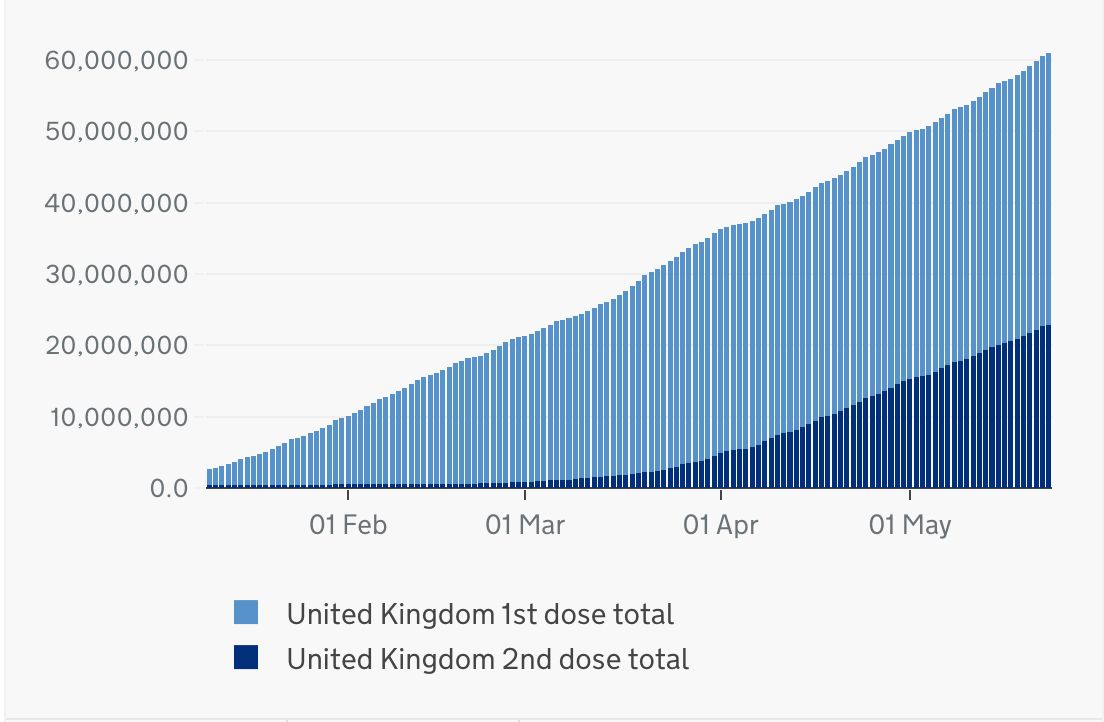
Since the last ONS infection survey was carried out in the week beginning April 19, an additional five million more people have received the first dose of the vaccine, according to the government’s Covid data dashboard.
This suggests the figures for people testing positive for antibodies should rise when the latest infection survey figures come out in two days.
Furthermore, an extra 12m or so people have received their second dose since April 19, which will help build up levels of protection and immunity.

UK government Covid data dashboard
But appearing at the same committee as Openshaw, virology professor Judith Breuer stressed that as long as Covid keeps mutating with new variants either arising in or entering the country, herd immunity may never be achieved.
She stressed that governments around the world should therefore focus on keeping infection rates low.
“It’s very, very hard to have herd immunity without restricting the import of variants or without it [immunity] being universal,” the University College London director of infection and immunity said.
“As prof Openshaw said, the variants we’re now dealing with are more transmissible than the variants we started with and therefore the herd immunity estimates have to go up.
“And then if we get even higher transmissible variants then the herd immunity estimates will have to go up even further.
“That’s only if you’re only in a closed community as well – if it’s being transmitted all over the world, every time a new variant comes in or a new virus is introduced then you still get outbreaks.
“Herd immunity is a nice concept but it’s going to be a long time before we can actually use it for public health planning.”



Aligning your life can be very challenging. By alignment I’m referring to harmonious interactions among your:
We all have misalignments to deal with in one of more areas of life. Are you actively engaged in correcting those misalignments to create greater harmony? Or do you let misalignments fester?
Misalignments have a tendency to multiply. They’re like clutter. Once we start tolerating a little bit, pretty soon we have a lot more to deal with. Letting this happen can make your life feel very burdensome after a while.
Sometimes I feel like the majority of my personal growth work (on the personal side, not the professional side) has been mainly about correcting misalignments in my life. Notice what areas of life aren’t working for me, and really fix them. A big step here is to define what a genuine fix looks like.
This began with misalignments like being raised Catholic and finding that totally wrong for me. It was a long journey to figure out my own philosophy of life that was honest and real for me – and that made me much happier.
I had to deal with a lot of misalignments between my desires and the kinds of results I was getting. I had to keep trying different frames and approaches to figure out how to connect the dots. The biggest challenge here was finding ways to take action that really fit my personality and natural motivations. This took me in some interesting directions. For instance, I initially thought that success would be a good motivator for me, but it really wasn’t. I actually get more motivational juice from caring, compassion, playfulness, fun, and creativity. I ended up experiencing more success when I gave myself permission to approach life and business with a lighter, more open, and more playful heart.
I was pretty bad at trying to earn money as a goal unto itself. I could never get my emotions to be that excited about it. I learned to be happy when I was broke, so I know that having more money won’t make me meaningfully happier. Hence it’s very hard to get myself to emotionally care about making more money. But I was able to increase my income by approaching this more like a game, whereby I focused on the creativity, the fun, the connection, and the playfulness.
I’d say that the heart is really the key to alignment. My biggest alignment mistakes happened when I tried to use my brain to go against my feelings. If my feelings aren’t aligned with what I’m trying to do, that kills my plans dead. Doing anything interesting in life requires sustainable motivation. So figuring out what gives you the most sustainable motivational juice can point you in the direction of increasing alignment too.
Life can easily fill up with friction that drains motivation. Many people in this field will advise you to push through that friction. Be tough. Discipline yourself. I used to think that way too, but not anymore. Discipline can be an okay short-term tool, but it’s not very sustainable. Pushing through friction is like repeatedly running a machine that’s making a grinding sound that isn’t supposed to be there. If you keep pushing through, you’ll cause some kind of damage. A better approach is to find what’s causing that friction, and solve that problem. Then run the machine smoothly and sustainably. Keep it well-maintained.
I’ve spent many years of my life looking at the friction in my life, which can be hard to face. I had friction in my relationships, my family life, my business, my income streams, and more. I think one of the best personal growth skills I’ve developed over the past few decades has been the willingness to look for friction and to really resolve it, even if it takes many years to do so.
I look at areas where my life isn’t working as well as I think it could. Then I start looking for sources of friction. What’s stopping me from experiencing the aligned flow I’d really like to experience in this part of life?
Just a machine with a friction problem may create excess heat or noise, you’re body will do something similar when you experience alignment problems. You won’t feel so good emotionally. Your heart will squawk at you.
Negative emotions are great pointers to sources of friction. Wherever you find negative feelings, you’ll find friction that’s getting in the way of greater alignment. That friction is also an invitation to solve a bigger problem.
I think the reason we’re so often hesitant to look in these places is that when we see the truth, it’s really hard to unsee it, and then we have to admit that we have a lot of work to do to fix these problems. But that attitude itself is a further symptom of being too tolerant of misalignments. It means we’ve let those misalignments drain us way too much, so now we lack the motivation and willingness to identify and fix problems that can be fixed. Just looking at our problems seems like it takes too much energy.
It’s not that the problems are so difficult. It’s that you’ve weakened yourself by letting the presence of these problems grind you down, like metal scraping on metal for too long inside a machine. So you aren’t functioning at your best, and that makes it harder to do repairs on your life.
I’ve noticed that as I correct major misalignments, I feel more motivated to fix even more of them. I feel more willing to look for resistance and to delve into the misalignments that cause friction. It is a lot of work to fix them sometimes, but it’s just so worth it. The more problems you fix, the more capable you become of solving even more problems.
There were times when I felt tremendously buried under a big pile of misalignments, and it took me a long time to dig my way out of them. It’s especially hard when the misalignments are sapping your motivation to want to deal with them. Sometimes you just have to chip away at them little by little with whatever motivation you do have. The key in those situations is to stop making the situation worse by allowing even more misalignments to pile up. And then start working on the most accessible problems that could free up some stuck energy when resolved. The more energy you can free up, the more you can leverage that extra energy to fix more misalignments.
The benefit of resolving misalignments is that then you have even more energy to create some wonderful alignments instead. It’s easier to pursue and create what you want when you aren’t so overburdened with sources of friction. It’s hard to take consistent forward action when you have so much energy bottled up in misalignments.
Solving alignment problems can create a wonderful feeling of lightness.
My heart feels very light, open, and free-flowing these days. I don’t feel clogged with heaviness. Emotionally I feel like my life has been the equivalent of a gentle smile this year – pretty calm and peaceful but also content, happy, satisfied, and appreciative.
From this emotional state, it’s easy to be very productive too. I really enjoy the work I get to do. I like and appreciate the people I get to work with, especially in Conscious Growth Club. I like my business model, which feels very heart-aligned to me. I get paid for creating courses, coaching, and otherwise helping people improve their lives. It feels very win-win, very fair, and very abundant. But I had to say no to a lot of partial matches to reach this point, and partial matches can be very seductive sometimes.
I love and appreciate my relationship with Rachelle. It’s wonderful to spend so much time with a woman who’s my lover and my best friend. It’s nice to be in a relationship that includes an abundance of daily laughter, physical affection, and emotional support. Perhaps we have an unusual relationship, but it works for us.
I love being vegan since that works for me too. I must have eaten about 200 salads so far this year since I’m doing a year of raw, but somehow I haven’t gotten bored with them. I seem to have fallen in love with salads and look forward to at least one each day. I think that eating lighter foods has helped me feel emotionally lighter as well, but this way of eating also makes it extra difficult to tolerate misalignments. It’s very hard to feel good emotionally while eating raw if misalignments are allowed to fester because the emotional sensitivity is increased.
A big part of this path has involved unloading from my mind the many misaligned ideas that I learned from other people.
A misaligned idea is a solution of sorts, but it’s not a very good solution. Misaligned solutions create negative side effects. Aligned solutions tend to create positive side effects.
I was taught that certain religious ideas are true, and then I discovered that they were neither true nor effective. Religion attempts to solve some problems, but it creates a lot of negative side effects as well. It’s a misaligned solution. It took some years, but I eventually replaced those ideas when a more truth-aligned and heart-aligned approach to life, the universe, and everything. And I don’t need to go to Church and sit through boring masses. I don’t need to kneel and eat wafers. I don’t need to turn frames into beliefs and wrap them into my identity.
I was taught that humans are superior to animals and therefore it’s okay to treat animal as products. We’re entitled to their bodies. We can just take their eggs and milk if we want. We can cage them, rape them, take their lives, and eat their flesh. It’s okay because we’re smarter and stronger. We’re special; they’re not. This is just how it’s supposed to be. Animals and meant to be sold at supermarkets and restaurants. Their flesh, milk, and eggs are part of our economy, just like any other commercial goods. We own them. They’re born as products, and they die as products.
Just typing those words regarding my old misaligned relationship with animals makes me feel nauseous. That way of thinking looks utterly wrong and ridiculous when I type it up, but how many people bother to type up these misalignments and take a real look at them? If you relate to animals as products – which you clearly do if you pay for their body parts, milk, or eggs – how does that sit with you? How does that mesh with your self-image and values? Does this feel aligned to you? Do you feel good about this relationship? Or is there friction in it?
I had so much trapped energy in that messed up relationship with animals in the past, but I wasn’t willing to look at it till I flowed towards a more aligned relationship with animals. I feel sad for how I treated them in the past. I was much too violent and too willfully ignorant, but I pretended I wasn’t. When I stopped relating to animals as products, I grew to appreciate them in a much more aligned way.
I grew up with the expectation that I was supposed to have a job and be loyal to some corporation. A boss was supposed to tell me what to do most days. I could have the weekends to recover and do some personal stuff. My obedience would be rewarded. I could never stomach going in that direction though – way too much friction. I still had to work through a lot of friction to go the independent creator path, but I saw a light at the end of that tunnel, and now I get to bask in that light on a daily basis. I didn’t see a light at the end of the corporate path other than eventually escaping from it to do something more free-flowing and creative.
It’s interesting that society gives us so many ready-made solutions – that suck. The pursuit of alignment is really about finding solutions that don’t suck. A misaligned solution sucks away your energy, your motivation, and your happiness. Aligned solutions give you energy, motivation, and happiness. Aligned solutions give you access to cleaner and more sustainable fuel sources, so they’re less expensive in the long run.
To choose alignment it’s important to stop choosing misalignment. Stop going for the partial match; don’t be so easily seduced by it. Set your standards higher on the full match. Stop tolerating the sound of metal grinding on metal as the gears of your life are turning. When you hear that grinding sound, learn to stop immediately, find the source of the problem, and do what it takes to fix it. Then flip the switch back on.
It’s not enough to say that you’re choosing alignment while you’re still wallowing in partial matches. You can intend and ask for alignment all you want, but life is keen to observe when you’re still tolerating partial matches. Showing up to partial matches is a powerful expression of your intention too, and life hears that loud and clear, perhaps even more loudly than your stated intentions to outgrow those patterns.
You don’t just intend with your mind, your heart, and your spirit. You intend with your body as well. Whatever you show up to is part of your intention as well. If you really want to express a different intention in an aligned way, put your body into it as well. This means withdrawing your body’s presence from partial matches. Otherwise if your body keeps showing up for partial matches, it will drag your mind, heart, and spirit right along with it.
If you’re gonna say no to a partial match, make it a 4D no. Decline the partial match with your body, mind, heart, and spirit. That’s a real no – an aligned no. Any less than this, and you’re still saying yes to a partial match. Note that a 1D, 2D, or 3D no is equivalent to a 3D, 2D, or 1D yes, respectively.
You can’t fool or fake alignment. Either you’re saying a 4D yes to it, or you’re remaining in partial match land.

Absentee property ownership in many small college football towns has a negative impact on permanent residents of those communities, according to a study by a Georgia State University geosciences researcher.
The research is the first known attempt to quantify and map local geographies of gameday home investments.
Each weekend in the fall tens of thousands of football fans flood into college towns to watch their favorite teams kick off against rival schools. Many of them stay in gameday homes, investment properties that sit vacant for much of the year. Taylor Shelton, assistant professor of geosciences and the study’s author, examined data from more than a dozen college towns in the South where schools in the Southeastern Conference attract large fan followings. He compared cities like Athens, Ga., Gainesville, Fla., and Auburn, Ala., and developed a study of Starkville, Miss., home of theMississippi State Bulldogs.
“The city of Starkville only has 25,000 people, and Mississippi State students make up nearly another 20,000,” saidShelton. “But the football stadium holds over 60,000 fans, so the population of the city doubles or triples on gameday weekends, meaning the entire nature of the town is transformed.”
The study, published in Cities: The International Journal of Urban Policy and Planning, analyzed local property ownership records, construction permits and U.S Census data. Shelton found that between five and 10 percent of all housing units in Starkville are likely gameday homes, and much of the town’s net growth in housing units over the last 15 years is made up of vacant properties that are suspected to be gameday homes. In some neighborhoods, more than 75 percent of housing units are used as gameday homes.
According to Shelton, these properties — which have grown significantly in the Southeast in recent years — are owned by wealthy alumni, fans and investors who rarely occupy the homes, resulting in a net-negative for permanent residents.
“Having so much of the activity in the housing market focused on these limited-use, largely vacant properties drive up housing prices for the people who actually live and work in the area,” said Shelton. “A lot of these smaller towns are now seeing rapid growth, but it really cuts into the kind of vibrancy and energy that you expect from a college town.”
Changes to zoning and tax laws could ease some of the impacts, according to the study, but Shelton said implementation of these changes has been slow because gameday homes confer financial benefits for state and local governments.
“Bigger cities have implemented vacancy taxes on properties to discourage people from buying homes for speculative or temporary uses,” Shelton said. “Being able to access some of that money and then reinvest it directly into affordable housing is a really simple step. But smaller cities are hesitant to do too much because they like the property tax revenue and they don’t have the simultaneous burden of providing municipal services to year-round residents.”
Cities like Starkville are often hamstrung by state laws that preempt localities from enacting stricter regulations on landlords or developers beyond what’s prescribed at the state level, according to Shelton, which means things are likely to get worse over time.
One of the main goals of the study was to develop a reproducible method to identify gameday homes that can be applied in any city or college town across the U.S., helping researchers and policymakers make sense of what’s driving this phenomenon.
“I hope this research can provide some legitimacy to efforts to create a more just and equitable housing in these smaller cities,” said Shelton. “We should place the focus on what residents actually want and need to make their lives better, rather than having places that cater towards wealthy out-of-town alumni and fans.”

Middle-school aged children who use the internet, social media or video games recreationally for more than an hour each day during the school week have significantly lower grades and test scores, according to a study from the Center for Gambling Studies at Rutgers University-New Brunswick.
The findings appear in the journal Computers in Human Behavior.
Researchers say the findings give parents and children a moderate threshold for using entertainment-related technology — no more than one hour daily on school days and four hours a day on weekends.
“Interactive technology is widely used to promote children’s educational access and achievement,” said lead author Vivien (Wen Li) Anthony, an assistant professor at the School of Social Work and research associate at the Rutgers Center for Gambling Studies. “During the COVID-19 pandemic, technology has been essential to facilitating remote learning. At the same time, there is a growing concern that excessive technology use, particularly for entertainment, may adversely affect children’s educational development by facilitating undesirable study habits and detracting from time spent on learning activities.”
The researchers, which include Professor Lia Nower of the Rutgers Center for Gambling Studies and a researcher from Renmin University of China, analyzed the China Education Panel Survey data, a national survey of educational needs and outcomes of children in China. Approximately 10,000 first-year middle school students were surveyed and followed. Their average age was 13.5 years.
The results showed that children who used the internet, social media or video games for entertainment four or more hours daily were four times more likely to skip school than those who did not. Boys used interactive technology for entertainment significantly more than girls. Boys also performed worse and showed lower school engagement levels than girls.
“Such findings are critical, particularly in light of the recent movement toward online learning in countries throughout the world,” said Anthony. “In a learning environment that integrates the internet, it is easy for children to move across educational and entertainment platforms during learning without alerting teachers or adults to alternate activities.”
Anthony said children in the study who used technology in moderation (i.e., less than one hour per day on weekends) experienced less boredom at school, potentially due to the positive effects of participation in social media, video games and video streaming such as peer bonding and relationship building. Using interactive technology for entertainment in moderation advanced children’s cognitive development.
The findings suggest that parents place time limits on their children’s interactive technology use, and that parents and teachers should help children to develop effective time management and self-regulation skills to reduce their reliance on technology.
Story Source:
Materials provided by Rutgers University. Note: Content may be edited for style and length.

Three dozen dwarf galaxies far from each other had a simultaneous “baby boom” of new stars, an unexpected discovery that challenges current theories on how galaxies grow and may enhance our understanding of the universe.
Galaxies more than 1 million light-years apart should have completely independent lives in terms of when they give birth to new stars. But galaxies separated by up to 13 million light-years slowed down and then simultaneously accelerated their birth rate of stars, according to a Rutgers-led study published in the Astrophysical Journal.
“It appears that these galaxies are responding to a large-scale change in their environment in the same way a good economy can spur a baby boom,” said lead author Charlotte Olsen, a doctoral student in the Department of Physics and Astronomy in the School of Arts and Sciences at Rutgers University-New Brunswick.
“We found that regardless of whether these galaxies were next-door neighbors or not, they stopped and then started forming new stars at the same time, as if they’d all influenced each other through some extra-galactic social network,” said co-author Eric Gawiser, a professor in the Department of Physics and Astronomy.
The simultaneous decrease in the stellar birth rate in the 36 dwarf galaxies began 6 billion years ago, and the increase began 3 billion years ago. Understanding how galaxies evolve requires untangling the many processes that affect them over their lifetimes (billions of years). Star formation is one of the most fundamental processes. The stellar birth rate can increase when galaxies collide or interact, and galaxies can stop making new stars if the gas (mostly hydrogen) that makes stars is lost.
Star formation histories can paint a rich record of environmental conditions as a galaxy “grew up.” Dwarf galaxies are the most common but least massive type of galaxies in the universe, and they are especially sensitive to the effects of their surrounding environment.
The 36 dwarf galaxies included a diverse array of environments at distances as far as 13 million light-years from the Milky Way. The environmental change the galaxies apparently responded to must be something that distributes fuel for galaxies very far apart. That could mean encountering a huge cloud of gas, for example, or a phenomenon in the universe we don’t yet know about, according to Olsen.
The scientists used two methods to compare star formation histories. One uses light from individual stars within galaxies; the other uses the light of a whole galaxy, including a broad range of colors.
“The full impact of the discovery is not yet known as it remains to be seen how much our current models of galaxy growth need to be modified to understand this surprise,” Gawiser said. “If the result cannot be explained within our current understanding of cosmology, that would be a huge implication, but we have to give the theorists a chance to read our paper and respond with their own research advances.”
“The James Webb Space Telescope, scheduled to be launched by NASA this October, will be the ideal way to add that new data to find out just how far outwards from the Milky Way this ‘baby boom’ extended,” Olsen added.
Story Source:
Materials provided by Rutgers University. Note: Content may be edited for style and length.
The patient was completely blind before the treatment – now he can see and count objects on a table.

PETRAS MALUKAS via Getty Images
The UK has banned Belarus’ national airline from its airspace, in response to the diversion of a Ryanair flight to enable the arrest of an opponent of the country’s regime.
Transport Secretary Grant Shapps has also instructed the Civil Aviation Authority to request UK airlines avoid Belarusian airspace in order to keep passengers safe.
Dominic Raab, the foreign secretary, told MPs the Belarus government “must be held to account for such reckless and dangerous behaviour”.
On Sunday a Ryanair flight from Athens, Greece, to the Lithuanian capital of Vilnius was ordered to change course to head for the Belarusian capital of Minsk.
The opposition in Belarus and western officials have denounced the incident on Sunday, which led to the arrest of journalist Raman Pratasevich.
Pratasevich is a prominent opponent of Belarus’ authoritarian president Alexander Lukashenko and could face 15 years in jail if convicted of several charges.
Ryanair boss Michael O’Leary said it was a “state-sponsored hijacking” and claimed agents from Russia’s KGB were also on board the flight.
Ireland’s foreign affairs minister Simon Coveney has said the forced landing of the Ryanair flight was state-sponsored “aviation piracy”.
Raab also said further sanctions were being considered against the Lukashenko administration and Belarus’ ambassador in London had been summoned for a dressing down.
“We are urgently seeking full details of precisely what took place in relation to Flight FR4978 but the scenario as reported is a shocking assault on civil aviation and an assault on international law,” he said.
“It represents a danger to civilian flights everywhere and it is an egregious and extraordinary departure from the international law and the international practice that guides international civil aviation under the Chicago Convention.”
Mr Raab called for the release of Mr Protasevich from the “spurious charges” he faces.
“Mr Lukashenko’s regime must be held to account for such reckless and dangerous behaviour,” he added.
The UK was working to explore “every potential diplomatic option” and was “actively considering and co-ordinating with our allies on further sanctions on those responsible for this outlandish conduct”.