The NHS pulled funding for the service, saying it was never intended to be a national helpline.


The NHS pulled funding for the service, saying it was never intended to be a national helpline.
Mexican lawmakers heard testimony that “we are not alone” in the universe and saw the alleged remains of non-human beings in an extraordinary hearing marking the Latin American country’s first congressional event on UFOs.
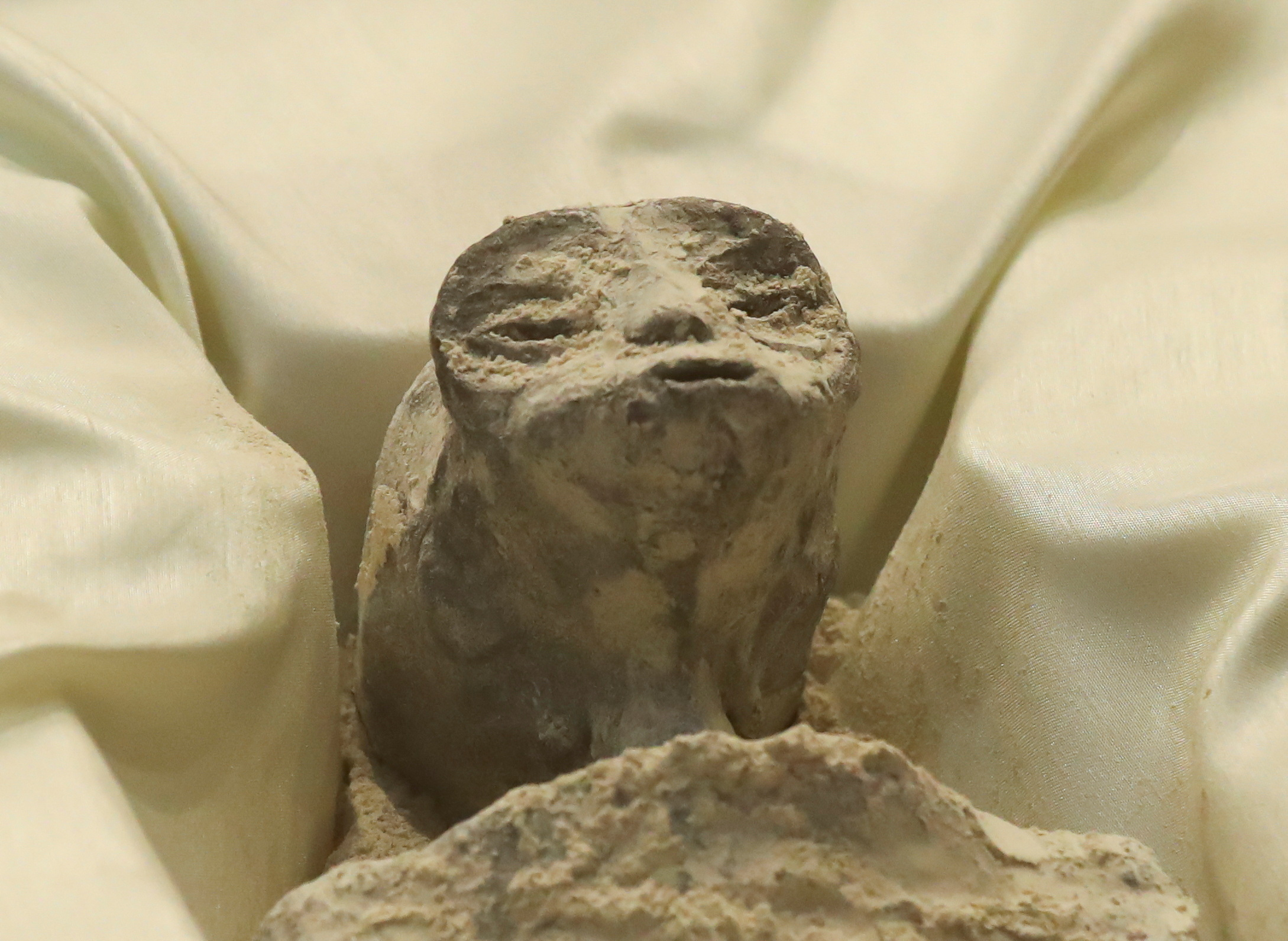
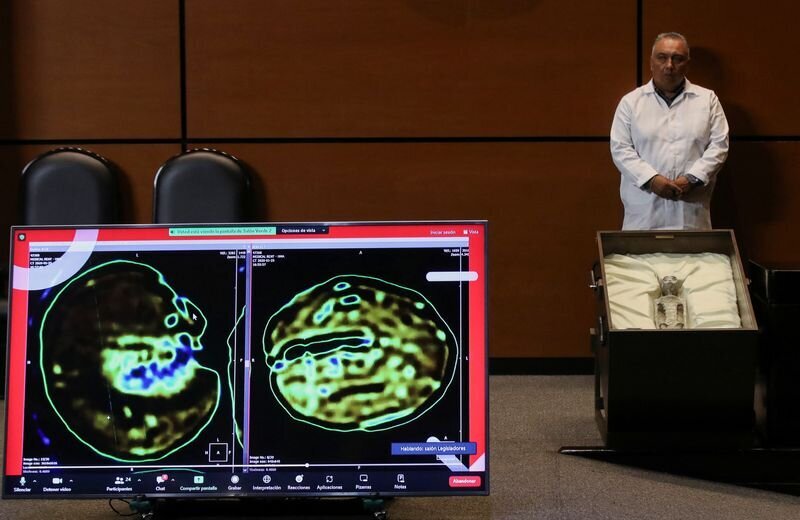
In the hearing on Tuesday on FANI, the Spanish acronym for what are usually now termed Unidentified Anomalous Phenomena (UAP), politicians were shown two artifacts that Mexican journalist and long-time UFO enthusiast Jaime Maussan claimed were the corpses of extraterrestrials.
Advertisement
The specimens were not related to any life on Earth, Maussan said.
The two tiny “bodies,” displayed in cases, have three fingers on each hand and elongated heads.
Maussan said they were recovered in Peru near the ancient Nazca Lines in 2017.
He said that they were about 1,000 years old, analysed through a carbon dating process by Mexico’s National Autonomous University (UNAM).
Similar such finds in the past have turned out to be the remains of mummified children.
Maussan said it was the first time such evidence had been presented.
“I think there is a clear demonstration that we are dealing with non-human specimens that are not related to any other species in our world and that all possibilities are open for any scientific institution… to investigate it,” Maussan said.
“We are not alone,” he added.

HENRY ROMERO
Jose de Jesus Zalce Benitez, Director of the Scientific Institute for Health of the Mexican navy, said X-rays, 3-D reconstruction and DNA analysis had been carried out on the remains.
Advertisement
“I can affirm that these bodies have no relation to human beings,” he said.
UNAM on Thursday republished a statement first issued in 2017, saying the work by its National Laboratory of Mass Spectrometry with Accelerators (LEMA) was only intended to determine the age of the samples.
“In no case do we make conclusions about the origin of said samples,” the statement said.
Lawmakers also heard from former US Navy pilot Ryan Graves, who has participated in US Congressional hearings about his personal experience with UAP and the stigma around reporting such sightings.
Congressman Sergio Gutierrez, from President Andres Manuel Lopez Obrador’s ruling Morena party, said he hoped the hearing would be the first of other similar events in Mexico.
“We are left with reflections, with concerns and with the path to continue talking about this,” Gutierrez said.
In recent years, the US government has done an about-face on public information on UAP after decades of stonewalling and deflecting.
Advertisement
The Pentagon has been actively investigating reported sightings in recent years by military aviators, while an independent NASA panel studying UFOs is the first of its kind by the space agency.
NASA is set to discuss findings from the study on Thursday.
Maussan faced swift backlash and criticism from sceptics on Wednesday who questioned the authenticity of his presentation.
“This could really hurt efforts to take the issue seriously,” said a user of X social media platform, formerly known as Twitter. “Why didn’t they wait until a scientific paper was ready to publish it?”
(Reporting by Cassandra Garrison and Reuters TV, Editing by Rosalba O’Brien)

Official figures revealed that 7.7 million people are now waiting for NHS treatment in England, up from 7.6 million a month ago.
Sunak is also struggling to keep his other promises to halve inflation, bring down the national debt and stop asylum seekers crossing the Channel in small boats.
Shadow health secretary Wes Streeting said: “For millions of patients across England, the NHS is no longer there for them when they need it.
“On the NHS, Rishi Sunak is Inaction Man, refusing to meet with doctors to end NHS strikes and adding to the Conservatives’ NHS backlog, leaving patients waiting for months on end in pain and agony.”


BBC Radio 4′s Mishal Husain suggested the government has no choice but to resolve NHS strikes in a tense interview with the health secretary this morning.
The Today programme host pointed out that – just as junior doctors and consultants are about to go on strike simultaneously – the impact on NHS patients is getting worse.
Advertisement
Husain said the latest figures show the waiting lists to be at record levels at 7.6 million people waiting to start routine treatment.
But, she noted that prime minister Rishi Sunak made it one of his five pledges to voters to bring the number down.
The presenter asked: “How can you do that without resolving doctors’ strikes?”
Barclay replied: “There’s no question that the strikes are having an impact in terms of harming patients.
“Now, we have been making progress through our recovery plan, backed with £8 billion of investment.”
He said they had eliminated the two-year wait for treatment, and “virtually” eliminated the 18-month wait.
Advertisement
Husain pointed out: “The overall figure is at a record number!”
Barclay replied: “No, no, I’m accepting that the overall number on the waiting lists has increased.”
He went on to say that the government has boosted the NHS’s capacity with community diagnostic centres.
But Husain just asked again: “What’s your plan to end the doctors’ strike?”
The health secretary insisted that the government has offered a “fair and final” resolution, accepted the pay review bodies’ suggestion for a pay increase and implemented the BMA union’s “number one ask” to change pension and taxation.
“But the strikes are going on,” Husain cut in. “I think most people would probably look at this and think that your plan is basically based around hoping that the doctors give up. There’s absolutely no sign of that.
“How can you possibly meet your waiting list pledge, the PM’s waiting list pledge, without resolving this strike?”
Barclay said the government had also promised to bring down inflation, and that was another pledge Sunak made in January.
Advertisement
He also claimed that the strikers’ pay rise request was too high, and he had stay fair to other public sector workers.
Husain then tried once more, pointing out: “You’ve got a specific pledge on waiting lists to bring them down – and they’re going up.”
But, the health secretary just suggested once again the pay rise request from junior doctors is not “fair” for others.

The treatment has been recommended by health experts and will soon be available on the NHS.
France joins several other European countries that are trying to stop children using e-cigarettes.

Researchers at Utah State University have successfully demonstrated that hagfish slime proteins can accurately replicate membranes in the human eye.
Professor Elizabeth Vargis and her team study a condition called age-related macular degeneration that causes damage to the retina, making it difficult to see. They study in vitro models, or a model developed in a laboratory setting, of Bruch’s membrane, a layer in the retina of the eye, to compare the natural aging process to the effects of AMD. They published their research in ACS Biomaterials Science & Engineering this past July.
“By using these models, scientists can better understand the role of Bruch’s membrane in the development of age-related eye diseases,” Vargis said. “This research provides an affordable and widely available option.”
Studying the connection between an aging Bruch’s membrane and deterioration caused by AMD is challenging in live subjects due to the slow progression of the disease and the complexity of isolating specific layers of the retina. Creating an in vitro model of Bruch’s membrane that mimics both its healthy and aged states help researchers understand the relationship between physical changes via aging and AMD. The ideal model should be smooth, nonporous and capable of supporting cell growth. It should also replicate the changes that occur with age in thickness, stiffness and permeability.
Previous models of Bruch’s membrane have captured some of its properties but not all. The most common model is a plastic membrane called a Transwell, which supports cell culture in the retina but is much thicker and stiffer than the natural membrane and cannot easily replicate changes from aging. Other models partially represent Bruch’s membrane but are difficult to produce and/or lack certain crucial aspects required to study AMD.
In previous work with USU Biology Professor Justin Jones, researchers manipulated spider silk proteins to replicate Bruch’s membrane, but challenges in isolating proteins and limited adjustability led to the exploration of other materials. Collaboration with Jones determined that hagfish slime proteins are the best choice for replicating Bruch’s membrane while still maintaining desirable properties. Vargis and her team were able to properly grow retinal cells on hagfish slime proteins and prove that the protein’s behavior changes as the membrane mimic stages of aging and disease.
This study was supported by grants from the NIH, BrightFocus Foundation, and the Office of Naval Research.

Researchers at the University of Washington have developed small robotic devices that can change how they move through the air by “snapping” into a folded position during their descent.
When these “microfliers” are dropped from a drone, they use a Miura-ori origami fold to switch from tumbling and dispersing outward through the air to dropping straight to the ground. To spread out the fliers, the researchers control the timing of each device’s transition using a few methods: an onboard pressure sensor (estimating altitude), an onboard timer or a Bluetooth signal.
Microfliers weigh about 400 milligrams — about half as heavy as a nail — and can travel the distance of a football field when dropped from 40 meters (about 131 feet) in a light breeze. Each device has an onboard battery-free actuator, a solar power-harvesting circuit and controller to trigger these shape changes in mid-air. Microfliers also have the capacity to carry onboard sensors to survey temperature, humidity and other conditions while soaring.
The team published these results Sept. 13 in Science Robotics.
“Using origami opens up a new design space for microfliers,” said co-senior author Vikram Iyer, UW assistant professor in the Paul G. Allen School of Computer Science & Engineering. “We combine the Miura-ori fold, which is inspired by geometric patterns found in leaves, with power harvesting and tiny actuators to allow our fliers to mimic the flight of different leaf types in mid-air. In its unfolded flat state, our origami structure tumbles chaotically in the wind, similar to an elm leaf. But switching to the folded state changes the airflow around it and enables a stable descent, similarly to how a maple leaf falls. This highly energy efficient method allows us to have battery-free control over microflier descent, which was not possible before.”
These robotic systems overcome several design challenges. The devices:
The current microfliers can only transition in one direction — from the tumbling state to the falling state. This switch allows researchers to control the descent of multiple microfliers at the same time, so they disperse in different directions on their way down.
Future devices will be able to transition in both directions, the researchers said. This added functionality will allow for more precise landings in turbulent wind conditions.
Additional co-authors on this paper are Kyle Johnson and Vicente Arroyos, both UW doctoral students in the Allen School; Amélie Ferran, a UW doctoral student in the mechanical engineering department; Raul Villanueva, Dennis Yin and Tilboon Elberier, who completed this work as UW undergraduate students studying electrical and computer engineering; Alberto Aliseda, UW professor of mechanical engineering; Sawyer Fuller, UW assistant professor of mechanical engineering; and Shyam Gollakota, UW professor in the Allen School.
This research was funded by a Moore Foundation fellowship, the National Science Foundation, the National GEM Consortium, the Google fellowship program, the Cadence fellowship program, the Washington NASA Space Grant fellowship Program and the SPEEA ACE fellowship program.

Two graduate students from Western University have developed a ground-breaking method for predicting which intensive care unit (ICU) patients will survive a severe brain injury.
Matthew Kolisnyk and Karnig Kazazian combined functional magnetic resonance imaging (fMRI) with state-of-the art machine learning techniques to tackle one of the most complex issues in critical care.
Whether it is the result of a stroke, cardiac arrest or traumatic brain injury, lives can forever be changed by a serious brain injury. When patients are admitted to the ICU, families are faced with tremendous uncertainty. Will my loved one recover? Are they aware of what is going on? Will they ever be the same again? Despite these essential questions, health-care professionals are equally uncertain about the potential of a good recovery.
The graduate students are PhD candidates at Schulich School of Medicine & Dentistry in the lab of neuroscientist Adrian Owen.
“For years we’ve lacked the tools and techniques to know who is going to survive a serious brain injury,” said Owen.
An interdisciplinary team of researchers from Western, in collaboration with neurologists at London Health Sciences Centre and Lawson Health Research Institute sought to find a solution to this problem. They were led by Loretta Norton, a psychology professor at King’s University College at Western, who was one of the first researchers in the world to measure brain activity in the ICU.
The team measured brain activity in 25 patients at one of London’s two ICUs in the first few days after a serious brain injury and tested whether it could predict who would survive and who would not.
advertisement
“We previously found that information about the potential for recovery in these patients was captured in the way different brain regions communicate with each other,” said Norton. “Intact communication between brain regions is an important factor for regaining consciousness.”
The breakthrough occurred when the team realized they could combine this imaging technique with an application of AI known as machine learning. They found they could predict patients who would recover with an accuracy of 80 per cent, which is higher than the current standard of care.
“Modern artificial intelligence has shown incredible predictive capabilities. Combining this with our existing imaging techniques was enough to better predict who will recover from their injuries,” said Kolisnyk.
While encouraging, the researchers say the prediction was not perfect and needs further research and testing.
“Given that these models learn best when they have lots of data, we hope our findings will lead to further collaborations with ICUs across Canada,” said Kazazian.

Anyone who’s watched a music awards show in the last decade will know that at multiple points over the course of the night, you’re going to get numerous shots of Taylor Swift in the audience.
This was certainly the case at Tuesday night’s MTV Video Music Awards, where the chart-topping singer was up for 11 awards (eventually winning nine of them, meaning she was just one away from Peter Gabriel’s record for most victories in a single night).
Advertisement
However, the big difference at this year’s VMAs was that Taylor was neither performing nor presenting, meaning she was able to let her hair down at the ceremony.
And folks, let her hair down she did.
The audience “POV cam” was pretty much on Taylor for the entire night, leading to numerous viral moments that included appreciating her fellow artists’ performances…
Advertisement
…giving props to some of her A-list pals…
…having a suitably understated reaction to NSYNC’s joint appearance…
Advertisement
…and… well… a few more viral moments…
Of course, fans were absolutely loving seeing Taylor kicking back at the VMAs…
Advertisement
Advertisement
As well as stealing the show on the audience came, Taylor took home a hefty number of awards, including the night’s most coveted prize, Video Of The Year.
Advertisement
This marked Taylor’s fourth win in the ceremony’s top category, and the first time an artist took home the title for two years running, following last year’s triumph for her All Too Well “short film”.
Check out the full list of winners from the 2023 VMAs here.