NHS bosses lament huge toll walkouts are having in England, warning true figure could be even higher.


NHS bosses lament huge toll walkouts are having in England, warning true figure could be even higher.

Scientists at Rice University in Houston, Texas have developed a fabric-based wearable device that “taps” a user’s wrist with pressurized air, silently helping them navigate to their destination. The study, published August 29 in the journal Device, demonstrated that users correctly interpreted which direction the device was telling them to go an average of 87% of the time. Since the wearable embeds most of its control system within the fabric itself, using air instead of electronics, it can be built lighter and more compact than existing designs.
“We envision this device will be used by individuals who need or desire information to be transmitted to them privately and in a way that can be seamlessly integrated into clothing or other wearables,” said Marcia O’Malley (@MarcieOMalley), Chair of the Department of Mechanical Engineering at Rice University and an author of the study.
The wearables may benefit amputees who use prosthetic limbs, people with hearing loss, and specialists such as surgeons, pilots, and soldiers who are inundated with visual and auditory information.
Visual and auditory cues like a flashing light on a dashboard or the ping of a new text message can effectively transmit information. However, many people are overwhelmed by such cues in their daily lives — and with too many notifications conveyed the same way, information can get lost in the clutter. “Haptics,” or touch-based stimuli, which include hot or cold sensations or cues based on pressure applied to the skin, can offer an alternative.
But while devices that produce visual cues or sounds are prevalent in everyday life, devices that use haptic cues are still uncommon since they usually require bulky hardware that weighs down the wearer.
To overcome this obstacle, the Rice University researchers developed a light, comfortable wearable device from textile materials that can be worn on a user’s arm. The team tested the device by measuring forces applied to the user as a function of pressure and the shape of the wearable — a task that proved somewhat challenging since different users had different experiences with cues from the same device, said Barclay Jumet (@JUMETkinmecrazy), a PhD candidate in mechanical engineering and the lead author of the study.
“Every person has a differently shaped arm, a different perception of what “feels good” in terms of the forces applied and the timing of the forces, and different capabilities in responding to the type of haptic cues we delivered,” said Jumet. “Fortunately, our textile-based platform is easily tailorable and adjustable to a range of body types and sizes.”
After testing the performance of their haptic textile sleeves in a lab-based study involving human participants, the researchers set out to see how well these devices could help users navigate in a real-world scenario. They integrated two of the sleeves into a shirt and completed the ensemble with a textile belt where they attached auxiliary components, making the device portable. Next, an experimenter sent cues to the user wearing the device, directing them where to walk for one kilometer.
advertisement
“We were impressed that the user was able to navigate the streets of Houston and subsequently trace 50-meter-long Tetris pieces on an open field with 100% accuracy in receiving and interpreting navigational haptic cues,” said Daniel Preston (@ProfDanPreston), an assistant professor of mechanical engineering and the corresponding author of the study.
In another navigation test, the participant again interpreted the cues with total accuracy, this time while riding an electric scooter over paved bricks, concrete sidewalks, and graveled paths.
“Further development will seek to improve the ability to convey even more complex cues that remain easily and naturally discerned by the user,” said Preston.
The NHS scheme aims to reach more people in the community for important health monitoring.
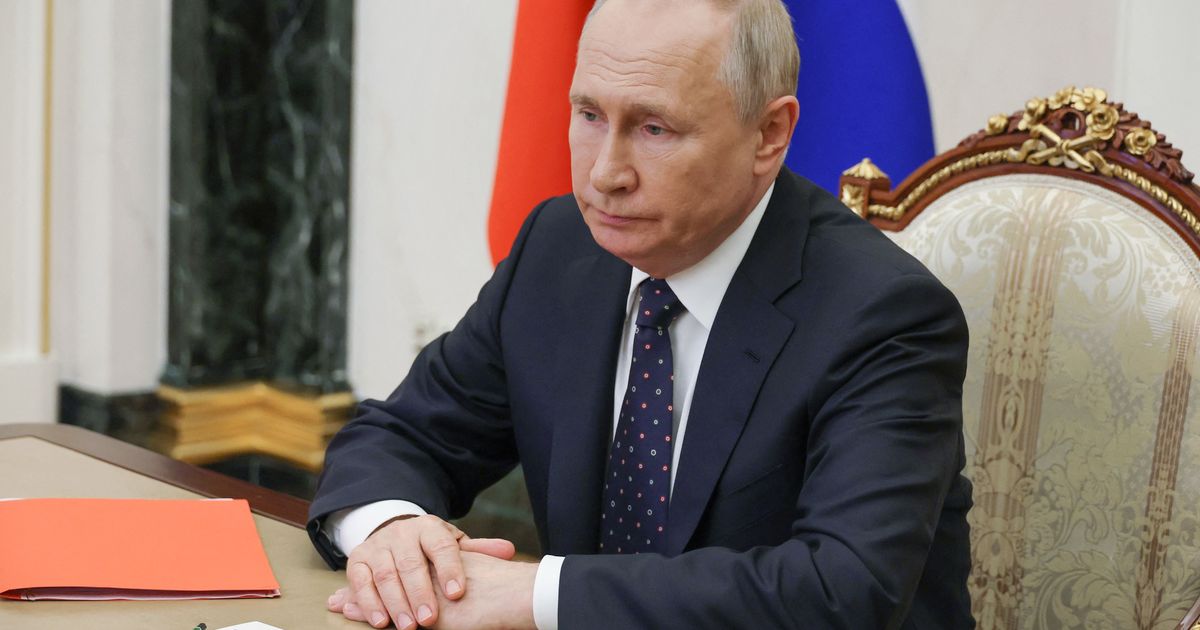
Vladimir Putin is unlikely to hit his target for recruiting volunteers to the Russian army despite massively increasing their wages, according to UK intelligence.
On the eve of the invasion of Ukraine in February last year, a Russian lieutenant earned 81,200 rubles – around £672 – per month.
Advertisement
According to the UK’s Ministry of Defence (MoD), by October last year, even those ranked as privates were being paid 195,000 rubles – around £1,615 – a month as Putin tried to boost the numbers signing up to serve.
In their latest intelligence update on X, formerly Twitter, the MoD said some in the junior ranks of the Russian army are now on more than 200,000 rubles – £1,650 – a month
“This is over 2.7 times the Russian national average salary of 72,851 rubles,” they said. “By way of comparison, 2.7 times the average UK salary would equate to over £90,000 a year.
“It is highly likely that the salary and additional benefits are a strong incentive for personnel to join up, especially to those from the poorer areas of Russia.”
Advertisement
However, the MoD said Russia was still “unlikely to meet its targets for recruiting volunteers to the ranks” despite the massive boost in soldiers’ pay.
Russia is estimated to have suffered more than 200,000 casualties so far in the Ukraine war.
The MoD revealed last month that up to half of Russian fatalities in the war could also have been prevented “with proper first aid”, while crude battlefield medical treatment is causing a huge number of preventable fatalities and amputations.
At least half of the elite 30,000 Russian paratroopers deployed to Ukraine have probably been killed or wounded.

Hannah Waddingham has told fans she pulled out of hosting a BBC Proms event this week out of solidarity with the ongoing actors’ strike.
On Friday, the BBC announced that the Ted Lasso star would be fronting the Fantasy, Myths and Legends Prom at the Royal Albert Hall, which was recorded on Monday evening.
Advertisement
However, shortly before the event was due to get underway, Hannah revealed she would no longer be taking part, as a show of “support” with her colleagues in the entertainment industry who are currently on strike.
“Hey guys, I very sadly won’t be able to host tonight’s [BBC Proms] Fantasy, Myths and Legends,” she wrote on X (formerly known as Twitter).
“It will be a magical night, but due to my ongoing support for the [SAG-AFTRA] strike I must respectfully step down. I look forward to being back at [the Royal Albert Hall]!”
Advertisement
Members of the Screen Actors’ Guild have been on strike for over a month now, with the union taking action shortly after it was announced that the Writers’ Guild of America was also on strike.
This marks the first time in over 60 years that both unions have been on strike at the same time.
Among the key concerns behind the ongoing actors’ strike include streaming residuals, minimum pay and the “use and potential abuse” of artificial intelligence within the film and TV industries, per the Los Angeles Times.
Due to the strikes, a number of major films and TV shows have now shut down production, with some studios now pushing back release dates for key projects that have already completed filming while its cast are striking.

People in the poorest parts of England and Scotland live further away from a life-saving device.

A Conservative minister was left squirming after a BBC presenter highlighted the Tories’ hypocrisy over London’s Ultra Low Emission Zone (ULEZ).
Transport secretary Mark Harper was skewered by John Kay on the day the controversial scheme is expanded across the whole of the capital.
Advertisement
The decision by Sadiq Khan, the Labour mayor of London, has been criticised by the Tories.
But on BBC Breakfast this morning, it was pointed out to Harper that ULEZ was originally the brainchild of Boris Johnson when he had Khan’s job in 2015.
Kay told him: “There are millions of people waking up this morning inside the ULEZ charging zone in London.
“I just want to read you a quote from the mayor of London: ‘The world’s first ULEZ zone is an essential measure to help improve air quality in our city and protect the health of Londoners’.
“That was former mayor of London, Conservative Boris Johnson. This was a Conservative policy originally, however critical you are of it now.”
Advertisement
Harper replied: “No, the expansion of the ULEZ zone to cover the whole of Greater London is a decision by the Labour mayor of London, Sadiq Khan, supported by the Labour leader.
“If you look at the mayor’s own impact assessment, it will have a minor to negligible effect on air quality. So it’s very clear, despite what the mayor says, this isn;t about improving air quality in Greater London, it’s about raising from Londoners for him.”
Kay then went on to point out that expanding ULEZ from central London was backed during the pandemic by Harper’s predecessor as transport secretary, Grant Shapps.
He said: “It wasn’t just Boris Johnson though, was it? Former Conservative transport secretary Grant Shapps, your predecessor in your job, he wanted the congestion charge in London expanded three years ago.”
But Harper hit back: “No he didn’t, this has been put around by the Labour Party. This was about the expansion of the ULEZ to the north and south London circular area, which was something that was a manifesto commitment by the mayor.
Advertisement
“The government does not support the rollout of the ULEZ to the whole of Greater London – we’ve been very clear about that.”
Under ULEZ, drivers of polluting vehicles are charged £12.50 per day.
Khan has insisted that its expansion is necessary to improve air quality across the whole of London.
However, the move was blamed for Labour’s failure to win the recent Uxbridge and South Ruislip by-election, which prompted Keir Starmer to urge the mayor to re-think the policy.

Campaigners slam a report as the BBC reveals drafts were edited to remove leadership criticism.
Anthony Fauci tells the BBC’s Katty Kay that 96% of the US population has a degree of immunity.

High-quality sequencing of nearly the entire kākāpō population, funded through a Genomics Aotearoa project, is helping New Zealand to manage the health of this critically endangered species.
Not only is it already making a difference to kākāpō survival, but establishing sequencing methods to work with populations under threat is also likely to be the foundation for the future of endangered wildlife science in New Zealand and the rest of the world.
The state-of-the-art methods developed by Dr. Joseph Guhlin (University of Otago ) and an international team to study kākāpō has revealed important aspects of kākāpō biology. The methods, reusable code, and pipeline is a blueprint and tool for conservation genomics in other species, especially intensively managed species. This has massive implications.
Dr. Guhlin’s work over the last year have two very significant outcomes:
This has given researchers the tools needed to identify specific genetic characteristics that are crucial to survival.
“Using technology created by Google, we have achieved what is likely the highest quality variant dataset for any endangered species in the world. This dataset is made available, through DOC and Ngai Tahu, for future researchers working with kākāpō,” Dr Guhlin said.
Department of Conservation’s Science Advisor for kākāpō Recovery, Dr. Andrew Digby, believes the genetic tools this study provides will make an immense difference to kākāpō conservation.
“kākāpō suffer from disease and low reproductive output, so by understanding the genetic reasons for these problems, we can now help mitigate them. It gives us the ability to predict things like kākāpō chick growth and susceptibility to disease, which changes our on-the-ground management practices and will help improve survival rates.”
While the study marks the beginning of a new era of kākāpō conservation genetics, Dr Digby acknowledges what it means for the future of all threatened species.
“The Kakapo125+ project is a great example of how genetic data can assist population growth. The novel genetic and machine learning tools developed can be applied to improve the productivity and survival of other taonga under conservation management.”
