Peter Watters is one of 200 university students who have just finished a two-year degree apprenticeship.


Peter Watters is one of 200 university students who have just finished a two-year degree apprenticeship.
The panel resigned over controversial research about abortion and women’s mental health.

WASHINGTON ― Donald Trump’s sweeping plans to remake the presidency ― and give himself more power than ever if he is elected to the White House again ― have met with a chilly reception from members of his own party in Congress.
The former president and his allies are vowing to bring independent federal agencies like the Federal Trade Commission and the Federal Communications Commission under direct presidential control, revive the practice of “impounding” funds appropriated by Congress, and strip employment protections for thousands of civil servants in the executive branch, ostensibly to replace them with Trump’s own chosen political appointees.
Advertisement
The proposals, outlined in a New York Times story earlier this week, stem from years of Trump’s grievances about the so-called “deep state”, the media, and Congress itself standing in the way of his autocratic tendencies. They hinge on a thesis, long popular on the right, called “unitary executive theory”, a model where the president has sole power over the entire executive branch of government, including independent agencies and even federal prosecutors ― like, say, the ones investigating the president himself.
Republican Senator JD Vance, who has already endorsed Trump’s bid for a second term, said Trump’s power grab would be necessary to rein in the power of bureaucrats and agency officials. He called Trump’s plan to give the presidency even more power “necessary to have a constitutional republic”.
“To have true separation of powers, the president has to have the prerogative over the administration of laws,” Vance told HuffPost. “If you have all these alphabet soup agencies where the bureaucrats can’t be fired and aren’t under control of the president, you’ve effectively created a fourth branch of government totally unaccountable to the people. That’s a real problem.”
“What we’re trying to do is identify the pockets of independence and seize them,” Russ Vought, Trump’s former director of the Office of Management and Budget and a leading proponent of the power grab, told the Times.
Advertisement
There is some debate on the left about how seriously to treat the scheme, and whether it’s just campaign fodder that likely wouldn’t become law. For now, it is clear Democrats in Congress would unanimously oppose the plans, with at least some Senate Republicans prepared to join them. An expansion of presidential power would ultimately come at a steep cost to members of Congress, who prize their ability to oversee industries and appropriate funds.
Top Republican appropriators also voiced their opposition to the idea of reviving the president’s impoundment authority. Congress in 1974 passed a law banning the tactic after a fight with President Richard Nixon, who withheld $40 billion in funding that Congress had passed during in his first term in office. Reviving the practice would require another act of Congress.
“The Constitution is very clear about the role of Congress and the power of the purse, so I would not do so,” Senator Susan Collins, the top Republican on the Senate appropriations committee, told HuffPost.
“I don’t think I agree” with the plans of the Trump team, Republican Senator Shelley Moore Capito, who also serves on the committee, said. “I want to have the independence of an appropriator.”
Republicans who serve on the Senate commerce committee were similarly wary of ways Trump could infringe on their power.
Advertisement
“I think those are independent agencies designed to be that way for obvious reasons, so I’m not sure what that accomplishes,” Senator John Thune, the No. 2 Senate Republican, told HuffPost, when asked if he would support bringing the FTC and FCC under presidential control.
Republican Senator Ted Cruz ― chair of the commerce committee, which oversees the two agencies ― didn’t endorse the plan, either. He instead shifted to bashing FTC Chair Lina Khan, a top target of Republicans due to her aggressive strategy in taking on big tech companies.
“I will say Lina Khan’s abuse of power of the FTC is going to add considerable momentum to congressional efforts to rein in out-of-control, supposedly independent agencies,” Cruz said.
Republican Senator Roger Wicker, who also serves on the commerce committee, said he “would have to look very, very carefully” at any proposal to bring the agencies under executive control. He expressed his desire to see the FTC and FCC act in a nonpartisan manner.
According to the Times, Trump’s allies are drafting an executive order that would require independent agencies to submit actions to the White House for review. The move, if enacted under a second Trump presidency, would likely face a legal challenge.
Advertisement
“I think it’s very important for us to remember that he can’t just wave a wand and invalidate the statutory structure for these expert agencies,” Democrat Senator Brian Schatz said of the twice-impeached former president. “It doesn’t matter what he thinks. The law is the law. If he wants to change the structure of the agency, then he’s going to have to ask someone to introduce a bill.”
Schatz said that if Trump wants to change the structure of federal agencies, he should do so by appointing commissioners who agree with him.
“It’s exciting to think of the new ways that Mr Trump would do damage, and it’s always worth worrying about, but the truth is there are statutes in place and he’s going to have to abide by them,” Schatz said.


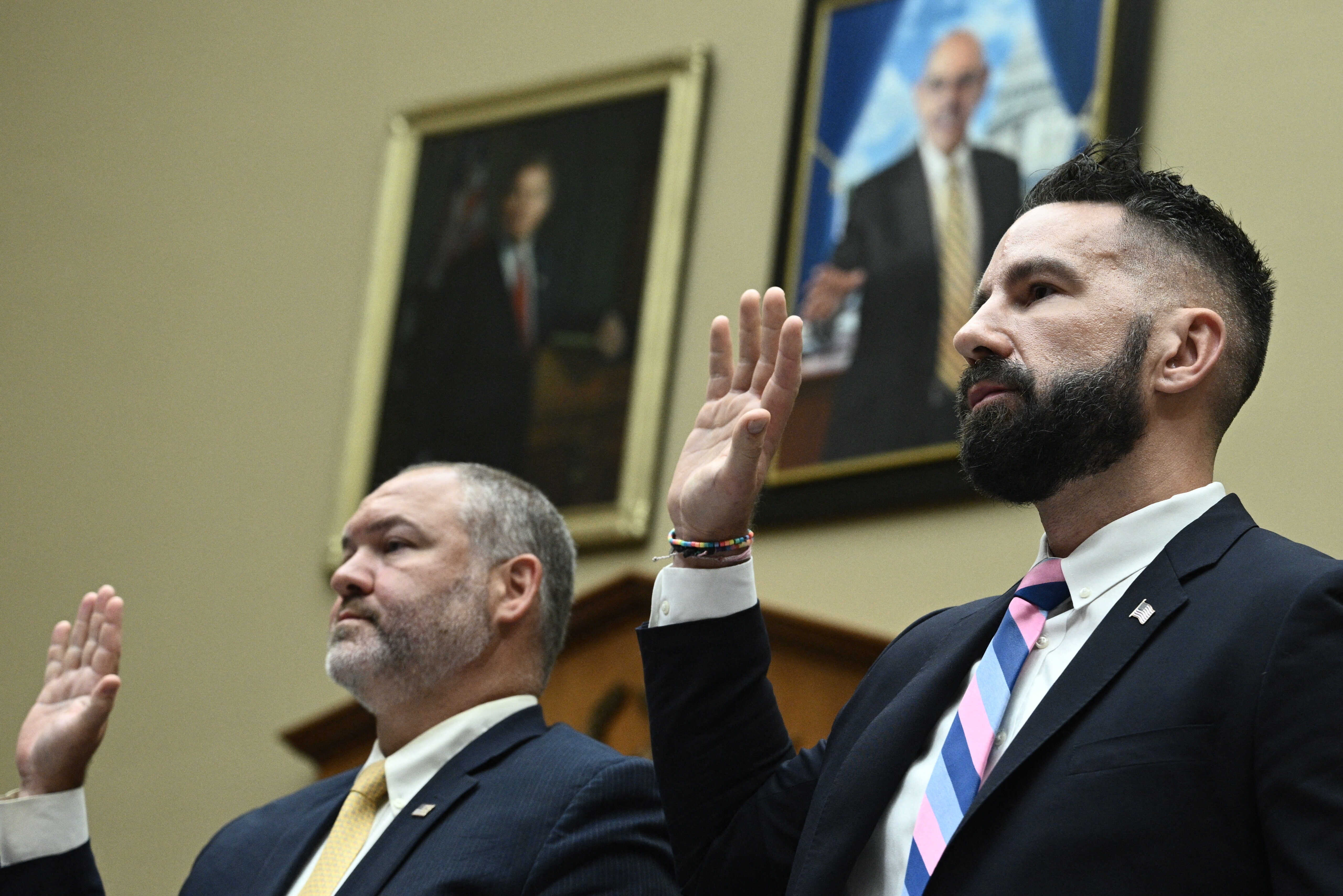
WASHINGTON — A pair of career IRS agents told the House Oversight Committee on Wednesday that the Justice Department stifled their investigation into tax crimes by the son of US president Joe Biden and pursued weaker charges than they had recommended.
But some Republicans did not want to delve into the whistleblower allegations, including Representative Marjorie Taylor Greene, who used her question time during the hearing to display what appeared to be naked pictures of Hunter Biden obtained from his laptop.
Advertisement
“What’s even more troubling to me is that the Department of Justice has brought no charges against Hunter Biden that will vindicate the rights of these women,” Greene said, holding up pictures that appeared to show the president’s son making sex tapes with women whom Greene claimed were sex workers.
“Should we be displaying this, Mr. Chairman?” the committee’s top Democrat Representative Jamie Raskin asked committee Republican chair James Comer, who did not answer.
Naked pictures of Hunter Biden are exactly the sort of sordid material that Comer once said he considered “very counter to a credible investigation”.
Advertisement
Comer had called the hearing to hear from IRS whistleblowers who have claimed the Justice Department prevented them from taking investigatory steps they thought were warranted to bring charges against the president’s son.
The younger Biden has been open about his addictions to drugs and alcohol spiralling out of control following his brother’s death in 2015. He made questionable business deals with foreign nationals that earned him millions and created an appearance of conflict of interest because of his father’s government service. He’s due in court next week on misdemeanour charges relating to his alleged failure to pay tax on income he earned in 2017 and 2018.
The IRS whistleblowers said they recommended he be charged with felonies, but their recommendations were rebuffed by Justice Department officials in an unusual manner. And they said the federal prosecutor overseeing the case, US Attorney David Weiss, a holdover from the Donald Trump administration, told them he couldn’t bring charges outside of Delaware. Weiss and US Attorney General Merrick Garland have insisted Weiss had complete authority to bring charges however he wanted.
The hearing did not resolve the contradiction between the IRS agents’ previous allegations and the denials from the Justice Department. In their public testimony, the agents essentially repeated what they’d already told lawmakers in a private deposition.
“It appeared to me, based on what I experienced, that the US attorney in Delaware, in our investigation, was constantly hamstrung, limited and marginalised by DOJ officials as well as other US attorneys,” IRS special agent Joseph Ziegler told the House Oversight Committee.
Advertisement
The other whistleblower, Gary Shapley, a supervisory agent in the IRS criminal division, said he didn’t know if Garland had deliberately lied.
“I have never claimed to have evidence that Attorney General Garland knowingly lied to Congress,” Shapley said.
House Speaker Kevin McCarthy has said Republicans would move to impeach Garland if the whistleblower testimony proves true. “We need to get to the facts, and that includes reconciling these clear disparities,” McCarthy said in June.
The allegation that the Justice Department went easy on a member of the president’s family has become a centrepiece of an overarching Republican message that there’s a two-tier justice system persecuting Trump and his supporters and protecting the Bidens. The former president has been indicted on federal charges related to retaining classified public documents and he could face additional charges for his efforts to undo the 2020 election.
Democrats suggested the discrepancy between statements from the Justice Department and the whistleblowers reflected their frustration with the common phenomenon of prosecutors not following through on investigators’ recommendations.
Advertisement
“I think you have a tough view on what you think the law should be. This is why we have a prosecutorial system,” Democrat Representative Ro Khanna said. “It turns out, often your recommendations on who should be charged differ from some of the other folks, and that’s what happened in this case.”
Shapley testified that such disagreements occur in “the vast majority” of cases but insisted the Hunter Biden case was different from any other he’d worked on.
Raskin said it appeared Hunter Biden had not received any favouritism.
“The fact that Hunter Biden faced a four-year criminal probe involving dozens of agents and prosecutors from the IRS, the FBI, the US attorney’s office in Delaware,” Raskin said, “demonstrates in my mind at least that he received no special treatment, but arguably tougher treatment than the millions of people who never faced criminal investigation for doing the same thing.”

Gwyneth Paltrow is pushing back against the “double standard” that celebrates men but devalues women as they age.
In a new interview with British Vogue, the Goop founder, 50, made it clear that she welcomes growing older while reflecting on the “weird” cultural expectation that women should resist aging.
Advertisement
“I think it’s culture’s problem. It’s not ours,” said Paltrow, who noted how women are judged more harshly for getting older than men. “As women, we want to be healthy, we want to be [aging]. This idea that we’re supposed to be frozen in time is so weird.”
The wellness guru gave credit to stars who are “embracing” growing older, like Andie MacDowell, who stopped coloring her hair after the COVID-19 pandemic began.
“I love it when I hear somebody like Andie MacDowell, with her beautiful grey curls, talking about embracing aging and the difference between how we handle a George Clooney [versus an aging female star],” Paltrow said.
She added: “It’s handsome to go grey [as a man], but for women it’s like, ‘What do you plan to do about your wrinkles and your aging skin?’”
Advertisement
The “Avengers” actor, who said she enjoys seeing “examples of how you can age,” encouraged women to age “how they want to do it.”
“Some women want to address every single thing aesthetically, and some women want to be a fabulous French grandmother who doesn’t ever do anything. Everybody should be empowered to do it how they want to,” the actor declared.
Paltrow isn’t the only star to call out sexist double standards.
Just last week, actor Gabrielle Union slammed ageist internet trolls who criticized her for being “too old” to wear a thong bikini at age 50.
In September 2022, Paltrow, whose Goop brand produces several anti-aging products, admitted that she’d made peace with her wrinkles.
“I accept. I accept the marks and the loosening skin, the wrinkles. I accept my body and let go of the need to be perfect, look perfect, defy gravity, defy logic, defy humanity. I accept my humanity,” Paltrow said in a self-published essay on Goop’s website.
Advertisement

The first phase of the Covid Inquiry has come to an end. What have we learnt over the past six weeks?

Grant Shapps has faced ridicule for “invoicing” the Labour Party for damage caused to a government department building by activists Just Stop Oil.
Two campaigners from the climate group have admitted spraying orange paint onto the department for energy security and net zero’s headquarters in Westminster on Wednesday after it issued more than 100 new oil and gas licences in the UK.
Advertisement
In a letter to Labour leader Keir Starmer, Shapps, who runs the department as energy security and net zero secretary, made a spurious link between the opposition party and Just Stop Oil.
It’s based on Dale Vince, the green energy entrepreneur, donating money to Just Stop Oil and some Labour politicians, including leader Starmer.
But that’s not the same as Just Stop Oil funding the Labour Party. Yet, Shapps claims Labour are the “political wing” of Just Stop Oil.
Advertisement
It’s a familiar attack line from the Conservatives – and one that fell apart under light scrutiny on BBC Question Time.
By that principle, the Conservatives would be responsible for any of its donors’ actions – which could be eye-wateringly expensive.
In his letter, Shapps said: “I am writing to you to ask you to pay to repair the damage to the department. The British public should not have to foot the bill for your mates in Just Stop Oil.”
Shapps claimed the damages are worth £3,000 to £4,000, adding: “We will send you the invoice.”
Just Stop Oil activists last Friday disrupted the opening night of the BBC Proms at the Royal Albert Hall after running on to the stage, setting off confetti cannon and sounding air horns.
Advertisement
On the same night, three activists interrupted the start of the live Channel 4 comedy show, The Last Leg.
Protesters have also disrupted sporting events across Britain this year, including the Ashes and Wimbledon, as well as other events such as the Chelsea Flower Show.
No-one on Twitter seemed especially persuaded by the Shapps “stunt”.
Advertisement
Advertisement



An international team led by astronomers from the Curtin University node of the International Centre for Radio Astronomy Research (ICRAR) has discovered a new type of stellar object that challenges our understanding of the physics of neutron stars.
The object could be an ultra-long period magnetar, a rare type of star with extremely strong magnetic fields that can produce powerful bursts of energy.
Until recently, all known magnetars released energy at intervals ranging from a few seconds to a few minutes. The newly discovered object emits radio waves every 22 minutes, making it the longest period magnetar ever detected.
The research was published today in the journal Nature.
Astronomers discovered the object using the Murchison Widefield Array (MWA), a radio telescope on Wajarri Yamaji Country in outback Western Australia.
Lead author Dr Natasha Hurley-Walker said the magnetar, named GPM J1839-10, is 15,000 light-years away from Earth in the Scutum constellation.
“This remarkable object challenges our understanding of neutron stars and magnetars, which are some of the most exotic and extreme objects in the Universe,” she said.
advertisement
The stellar object is only the second of its kind ever detected after the first was discovered by Curtin University undergraduate research student Tyrone O’Doherty.
Initially, scientists could not explain what they had found.
They published a paper in Nature in January 2022 describing an enigmatic transient object that would intermittently appear and disappear, emitting powerful beams of energy three times per hour.
Dr Hurley-Walker — O’Doherty’s honours supervisor — said the first object took us by surprise.
“We were stumped,” she said. “So we started searching for similar objects to find out if it was an isolated event or just the tip of the iceberg.”
Between July and September 2022, the team scanned the skies using the MWA telescope.
advertisement
They soon found what they were looking for in GPM J1839-10.
It emits bursts of energy that last up to five minutes — five times longer than the first object.
Other telescopes followed up to confirm the discovery and learn more about the object’s unique characteristics.
These included three CSIRO radio telescopes in Australia, the MeerKAT radio telescope in South Africa, the Grantecan (GTC) 10m telescope, and the XMM-Newton space telescope.
Armed with GPM J1839-10’s celestial coordinates and characteristics, the team also began searching the observational archives of the world’s premier radio telescopes.
“It showed up in observations by the Giant Metrewave Radio Telescope (GMRT) in India, and the Very Large Array (VLA) in the USA had observations dating as far back as 1988,” she said.
“That was quite an incredible moment for me. I was five years old when our telescopes first recorded pulses from this object, but no one noticed it, and it stayed hidden in the data for 33 years.
“They missed it because they hadn’t expected to find anything like it.”
Not all magnetars produce radio waves. Some exist below the ‘death line’, a critical threshold where a star’s magnetic field becomes too weak to generate high-energy emissions.
“The object we’ve discovered is spinning way too slowly to produce radio waves — it’s below the death line,” Dr Hurley-Walker said.
“Assuming it’s a magnetar, it shouldn’t be possible for this object to produce radio waves. But we’re seeing them.
“And we’re not just talking about a little blip of radio emission.
“Every 22 minutes, it emits a five-minute pulse of radio wavelength energy, and it’s been doing that for at least 33 years.
“Whatever mechanism is behind this is extraordinary.”
The discovery has important implications for our understanding of the physics of neutron stars and the behaviour of magnetic fields in extreme environments.
It also raises new questions about the formation and evolution of magnetars and could shed light on the origin of mysterious phenomena such as fast radio bursts.
The research team plans to conduct further observations of the magnetar to learn more about its properties and behaviour.
They also hope to discover more of these enigmatic objects in the future, to determine whether they are indeed ultra-long period magnetars, or something even more phenomenal.

Using the Atacama Large Millimeter/submillimeter Array (ALMA), astronomers have found the possible ‘sibling’ of a planet orbiting a distant star. The team has detected a cloud of debris that might be sharing this planet’s orbit and which, they believe, could be the building blocks of a new planet or the remnants of one already formed. If confirmed, this discovery would be the strongest evidence yet that two exoplanets can share one orbit.
“Two decades ago it was predicted in theory that pairs of planets of similar mass may share the same orbit around their star, the so-called Trojan or co-orbital planets. For the first time, we have found evidence in favour of that idea,” says Olga Balsalobre-Ruza, a student at the Centre for Astrobiology in Madrid, Spain who led the paper published today in Astronomy & Astrophysics.
Trojans, rocky bodies in the same orbit as a planet, are common in our own Solar System [1], the most famous example being the Trojan asteroids of Jupiter — more than 12,000 rocky bodies that are in the same orbit around the Sun as the gas giant. Astronomers have predicted that Trojans, in particular Trojan planets, could also exist around a star other than our Sun, but evidence for them is scant. “Exotrojans [Trojan planets outside the Solar System] have so far been like unicorns: they are allowed to exist by theory but no one has ever detected them,” says co-author Jorge Lillo-Box, a senior researcher at the Centre for Astrobiology.
Now, an international team of scientists have used ALMA, in which ESO is a partner, to find the strongest observational evidence yet that Trojan planets could exist — in the PDS 70 system. This young star is known to host two giant, Jupiter-like planets, PDS 70b and PDS 70c. By analysing archival ALMA observations of this system, the team spotted a cloud of debris at the location in PDS 70b’s orbit where Trojans are expected to exist.
Trojans occupy the so-called Lagrangian zones, two extended regions in a planet’s orbit where the combined gravitational pull of the star and the planet can trap material. Studying these two regions of PDS 70b’s orbit, astronomers detected a faint signal from one of them, indicating that a cloud of debris with a mass up to roughly two times that of our Moon might reside there.
The team believes this cloud of debris could point to an existing Trojan world in this system, or a planet in the process of forming. “Who could imagine two worlds that share the duration of the year and the habitability conditions? Our work is the first evidence that this kind of world could exist,” says Balsalobre-Ruza. “We can imagine that a planet can share its orbit with thousands of asteroids as in the case of Jupiter, but it is mind blowing to me that planets could share the same orbit.”
“Our research is a first step to look for co-orbital planets very early in their formation,” says co-author Nuria Huélamo, a senior researcher at the Centre for Astrobiology. “It opens up new questions on the formation of Trojans, how they evolve and how frequent they are in different planetary systems,” adds Itziar De Gregorio-Monsalvo, ESO Head of the Office for Science in Chile, who also contributed to this research.
advertisement
To fully confirm their detection, the team will need to wait until after 2026, when they will aim to use ALMA to see if both PDS 70b and its sibling cloud of debris move significantly along their orbit together around the star. “This would be a breakthrough in the exoplanetary field,” says Balsalobre-Ruza.
“The future of this topic is very exciting and we look forward to the extended ALMA capabilities, planned for 2030, which will dramatically improve the array’s ability to characterise Trojans in many other stars,” concludes De Gregorio-Monsalvo.
Notes
[1] When asteroids in Jupiter’s orbit were first discovered, they were named after heroes of the Trojan war, giving rise to the name Trojans to refer to these objects.

People who contract COVID-19 but never develop symptoms — the so-called super dodgers — may have a genetic ace up their sleeve. They’re more than twice as likely as those who become symptomatic to carry a specific gene variation that helps them obliterate the virus, according to a new study led by UC San Francisco researchers.
The paper, published July, 19, 2023 in Nature, offers the first evidence that there is a genetic basis for asymptomatic SARS-CoV-2. The research helps to solve the mystery of why some people can be infected without ever getting sick from COVID-19.
The secret lies with the human leukocyte antigen (HLA), or protein markers that signal the immune system. A mutation in one of the genes coding for HLA appears to help virus-killing T cells identify SARS-CoV-2 and launch a lighting attack. The T cells of some people who carry this variant can identify the novel coronavirus, even if they have never encountered it before, thanks to its resemblance to the seasonal cold viruses they already know. The discovery points to new targets for drugs and vaccines.
“If you have an army that’s able to recognize the enemy early, that’s a huge advantage,” explained the study’s lead researcher, Jill Hollenbach, PhD, MPH, professor of neurology, as well as epidemiology and biostatistics, and a member of the Weill Institute for Neurosciences at UCSF. “It’s like having soldiers that are prepared for battle and already know what to look for, and that these are the bad guys.”
The mutation — HLA-B*15:01 — is quite common, carried by about 10% of the study’s population. It doesn’t prevent the virus from infecting cells but, rather, prevents people from developing any symptoms. That includes a runny nose or even a barely noticeable sore throat.
UCSF researchers found that 20% of people in the study who remained asymptomatic after infection carried at least one copy of the HLA-B*15:01 variant, compared to 9% of those who reported symptoms. Those who carried two copies of the variant were far more likely — more than eight times — to avoid feeling sick.
Leveraging a national marrow donor database
Researchers suspected early on that HLA was involved, and fortunately a national registry existed that contained the data they were looking for. The National Marrow Donor Program/Be The Match, the largest registry of HLA-typed volunteer donors in the U.S., matches donors with people who need bone marrow transplants.
advertisement
But they still needed to know how the donors fared against COVID-19. So, they turned to a mobile app developed at UCSF, called the COVID-19 Citizen Science Study. They recruited nearly 30,000 people who were also in the bone marrow registry and tracked through the first year of the pandemic. At that time, vaccines were not yet available, and many people were undergoing routine COVID testing for work or whenever they were potentially exposed.
“We did not set out to study genetics, but we were thrilled to see this result come from our multidisciplinary collaboration with Dr. Hollenbach and the National Marrow Donor Program,” said Mark Pletcher, MD, MPH, a professor of epidemiology and biostatistics at UCSF.
The primary study group was limited to those who self-identified as white because the final set of study respondents did not have enough people in it from other ethnic and racial groups to analyze.
Researchers identified 1,428 unvaccinated donors who tested positive between February 2020 and the end of April 2021, before the vaccines were widely available and when it still took many days to get back test results.
Of these, 136 individuals remained asymptomatic for at least two weeks before and after testing positive. Only one of the HLA variants — HLA-B*15:01 — had a strong association with asymptomatic COVID-19 infection, and this was reproduced in two independent cohorts. Risk factors for severe COVID-19, like being older, overweight and having chronic diseases like diabetes did not appear to play a role in who remained asymptomatic.
“We are proud to partner on research that has the potential to leverage a long-term public investment in building the national registry to help cure diseases and improve our ability to avoid future pandemics,” said Martin Maiers, vice president of research at the National Marrow Donor Program/Be The Match.
advertisement
To figure out how HLA-B15 managed to quash the virus, Hollenbach’s team collaborated with researchers from La Trobe University in Australia. They homed in on the concept of T-cell memory, which is how the immune system remembers previous infections.
The researchers looked at T cells from people who carried HLA-B15 but had never been exposed to the SARS-CoV-2 virus, and found these cells still responded to a part of the novel coronavirus called the NQK-Q8 peptide. They concluded that exposure to some seasonal coronaviruses, which have a very similar peptide, called NQK-A8, enabled T cells in these individuals to quickly recognize SARS-CoV-2 and mount a faster, more effective immune response.
“By studying their immune response, this might enable us to identify new ways of promoting immune protection against SARS-CoV-2 that could be used in future development of vaccine or drugs,” said Stephanie Gras, a professor and laboratory head at La Trobe University.
