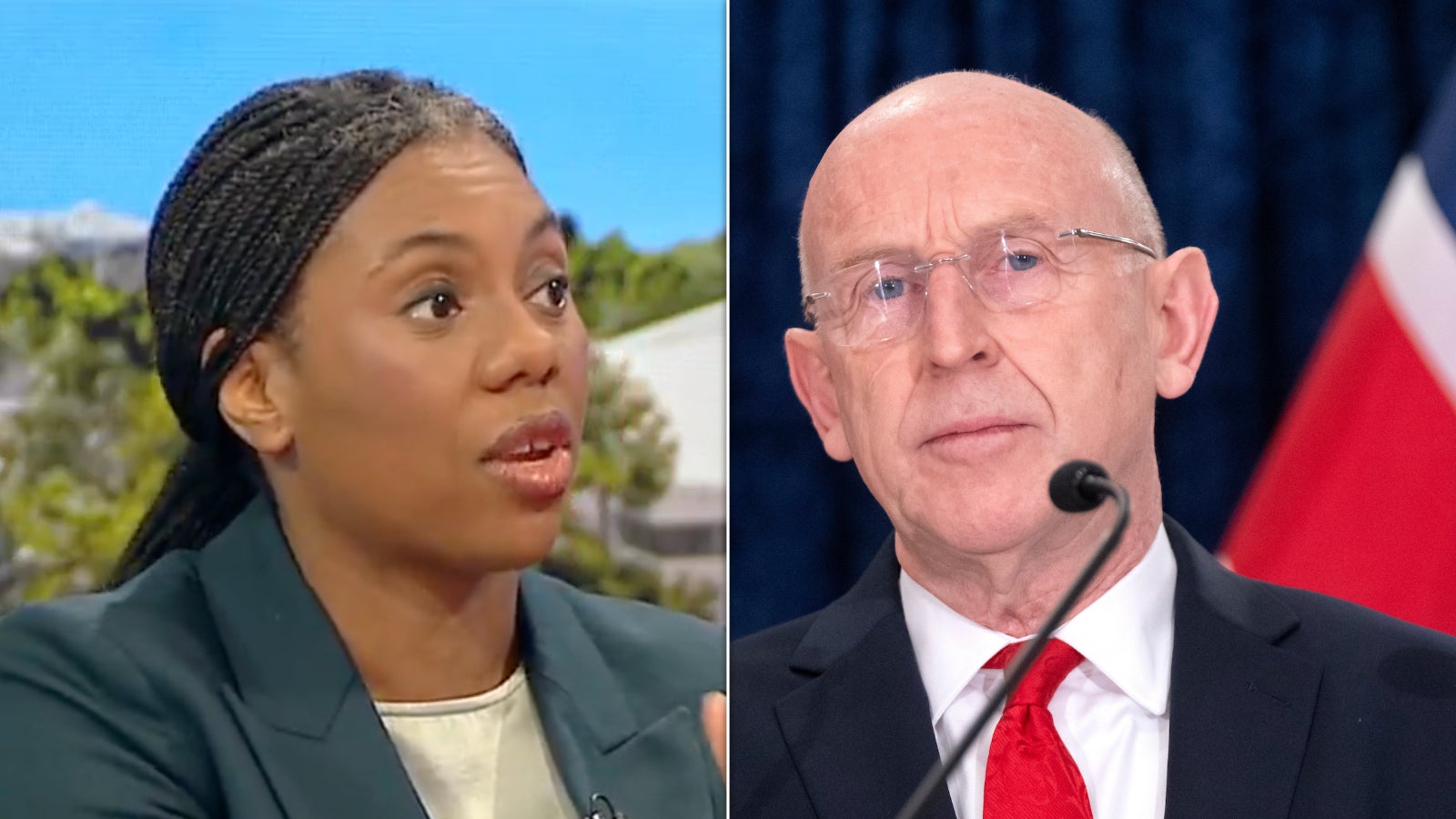
The Conservative leader caused a stir on Friday morning when she called for Britain to take stronger action against Iran after its strikes against RAF Akrotiri.
Advertisement
Badenoch claimed that at the moment British jets are just “hanging around” the Middle East, even though the US “has been mobilising” in the region for months.
“Our guys, our government, were just sitting there shrugging their shoulders,” the leader of the opposition said.
But Presenter Charlie Stayt jumped in, pointing out: “The evidence we have from the British government and the British military is they have been involved in shooting down missiles and drones.”
Advertisement
“You have characterised what is already happening by the British military, by the RAF, as ‘just hanging around’,” he added.
Badenoch hit back: “What I have said is they are catching arrows. They need to catch the archer.”
But cabinet minister John Healey slammed Badenoch, pointing out that he was on the ground in the UK’s base in Cyprus on Thursday.
He said: “I saw how our British forces are working round the clock, in the face of repeated air raid sirens, to protect British lives and British interests.
Advertisement
“And to suggest they’re ‘just hanging around’ to score political points insults the men and women of our Armed Forces.
“She should apologise and withdraw her comments.”
Iran launched a drone strike on the UK’s RAF base in Cyprus on Sunday shortly after Keir Starmer gave his permission for US forces to launch limited and defensive attacks on Iran from two British military sites.
While sending more military personnel to the region to protect the British citizens in the area, the prime minister has made it very clear that the UK is still only acting in a defensive capacity.
Advertisement
He has insisted Britain will not be joining the US and Israeli’s offensive strikes against Iran.
Towards the end of the third and final part of Channel 4′s ‘The Tony Blair Story’, the former prime minister once again defends his decision to take the UK to war in Iraq.
“I can’t think of another British prime minister who also wouldn’t have wanted to be with America post-9/11,” he says.
Advertisement
Given the events of the past week, it is worth considering whether Blair has now revised that view.
Keir Starmer, the first Labour leader to win a general election since Blair did it for a third time in 2005, decided he did not want to “be with America” when Donald Trump sought permission to use British bases to launch missiles at Iran.
Starmer only relented when Iran began attacking other countries in the region, putting 300,000 British lives at risk.
Advertisement
And even then, the PM made clear that the US can only use British bases to carry out “defensive” operations targeting weapons storage facilities and missile launch sites.
In comments which could have been specifically chosen to anger Tony Blair, Starmer said: “We all remember the mistakes of Iraq. And we have learned those lessons.
“We were not involved in the initial strikes on Iran, and we will not join offensive action now.”
Trump – who Starmer had been relatively successful in wooing since he returned to the White House – has made clear to any journalist who will listen how furious he is at the PM’s approach.
A group of men inspects the ruins of a police station struck Monday amid the US–Israeli military campaign in Tehran, Iran, Tuesday, March 3, 2026.
via Associated Press
Starmer may feel reassured by a YouGov poll published on Thursday which showed that just 8% of the country believe the UK should be “actively joining the US and Israel” in bombing Iran.
Advertisement
Just under half – 46% – say Britain should restrict itself to shooting down drones, defending civilian areas and UK military facilities, which is in line with the government’s own approach.
Around a quarter – 26% – say the UK response should be “retaliatory only, attacking military targets that have launched attacks against civilian areas and/or British military targets”.
However, when asked how the PM is handling the crisis, 47% say badly, with just 34% saying well.
The same poll found that 52% of voters think Starmer is handling his relationship with Trump badly, with just 32% supporting his approach.
Advertisement
Predictably, Starmer has been attacked by the Greens for getting involved in the war at all, and by Reform and the Tories for not being more supportive of Trump.
“I think Keir is where the country is at the moment, which is not where the right wing press are”
– Senior member of the cabinet
A senior Labour source told HuffPost UK: “There are three competing choices in front of the British public currently.
Advertisement
“The Greens, who are making the case that our government should sit on our hands and do nothing to protect ourselves, even while 300,000 UK nationals and our allies are under threat.
“Reform and the Tories, who are essentially arguing we should sub-contract our foreign policy to, at best, an ill-defined and escalating war.
“Or this Labour government, who are clear that we’re defending British nationals and interests as part of our collective self defence.”
Advertisement
A minister, not normally one of the PM’s biggest fans, said Starmer’s handling of the war so far had been “measured, responsible and rooted in the national interest”.
By comparison, the minister said, the more gung-ho Kemi Badenoch and Nigel Farage have “lost the plot”.
Another normally-critical Labour MP said: “To be fair to the prime minister, he’s handled it pretty well. But he’s at the mercy of events.”
While he and defence secretary John Healey wanted to let America use British bases at the outset of the war, he was effectively blocked by Rachel Reeves, Yvette Cooper, Shabana Mahmood and, most vociferously, Ed Miliband.
A senior member of the cabinet told HuffPost UK that the unpredictability of war means that the PM is not in control of his own destiny.
“I think Keir is where the country is at the moment, which is not where the right wing press are,” he said.
Advertisement
“Things could change very quickly, of course, if British citizens start getting killed.”
Chris Hopkins, political research director at pollsters Savanta UK, said the PM is unlikely to enjoy any war bounce in his subterranean approval ratings, regardless of Trump’s own unpopularity with the British public.
He said: “Unfortunately for Keir Starmer, the public are far more likely to simply agree with Donald Trump’s assessment of the prime minister than sympathise with him.
“Even a broken clock is right twice a day, and I think the public are more likely to feel Trump has given an accurate assessment than leap to the Labour leader’s defence.”
Advertisement
Luke Tryl, director of the More in Common think-tank, said the PM’s popularity may marginally improve, but any boost will be short-lived.
“My hunch is he gets a small but not sustained ‘rally round’ bump, which helps him consolidate on the left,” he said. “I’d be most watching his approval with Lib Dems, which I suspect goes up most.”
Starmer admitted on Thursday that the war “could continue for some time”, an unwelcome distraction for a PM whose fate will more than likely be decided by the outcome of crucial elections across the UK in just two months’ time.
Advertisement
The PM’s determination to provide “calm, level-headed leadership in the national interest” will cut little ice with voters who appear determined to punish Labour for their multiple failures since taking office in 2024.
Few are likely to disagree with Trump’s assessment that Starmer is no Churchill.
But it is the prime minister’s failure to emulate the election-winning genius of Tony Blair which will ultimately seal his fate.
Nearly a century ago, astronomer Edwin Hubble discovered that almost all galaxies are receding from the Milky Way. This observation became a cornerstone of modern cosmology because it provided key evidence that the universe is expanding and that it began with the Big Bang. Even during Hubble’s era, however, astronomers knew the pattern was not universal. One notable exception is our neighboring galaxy Andromeda, which is moving toward the Milky Way at roughly 100 kilometers per second.
For about fifty years, scientists have puzzled over another related mystery. Most large galaxies near our own, aside from Andromeda, appear to be moving away from us rather than being pulled inward by gravity. This seems surprising because these galaxies reside near the Local Group (the Milky Way, the Andromeda Galaxy and dozens of smaller galaxies), whose combined mass should exert a noticeable gravitational influence.
A Giant Cosmic Sheet Around the Local Group
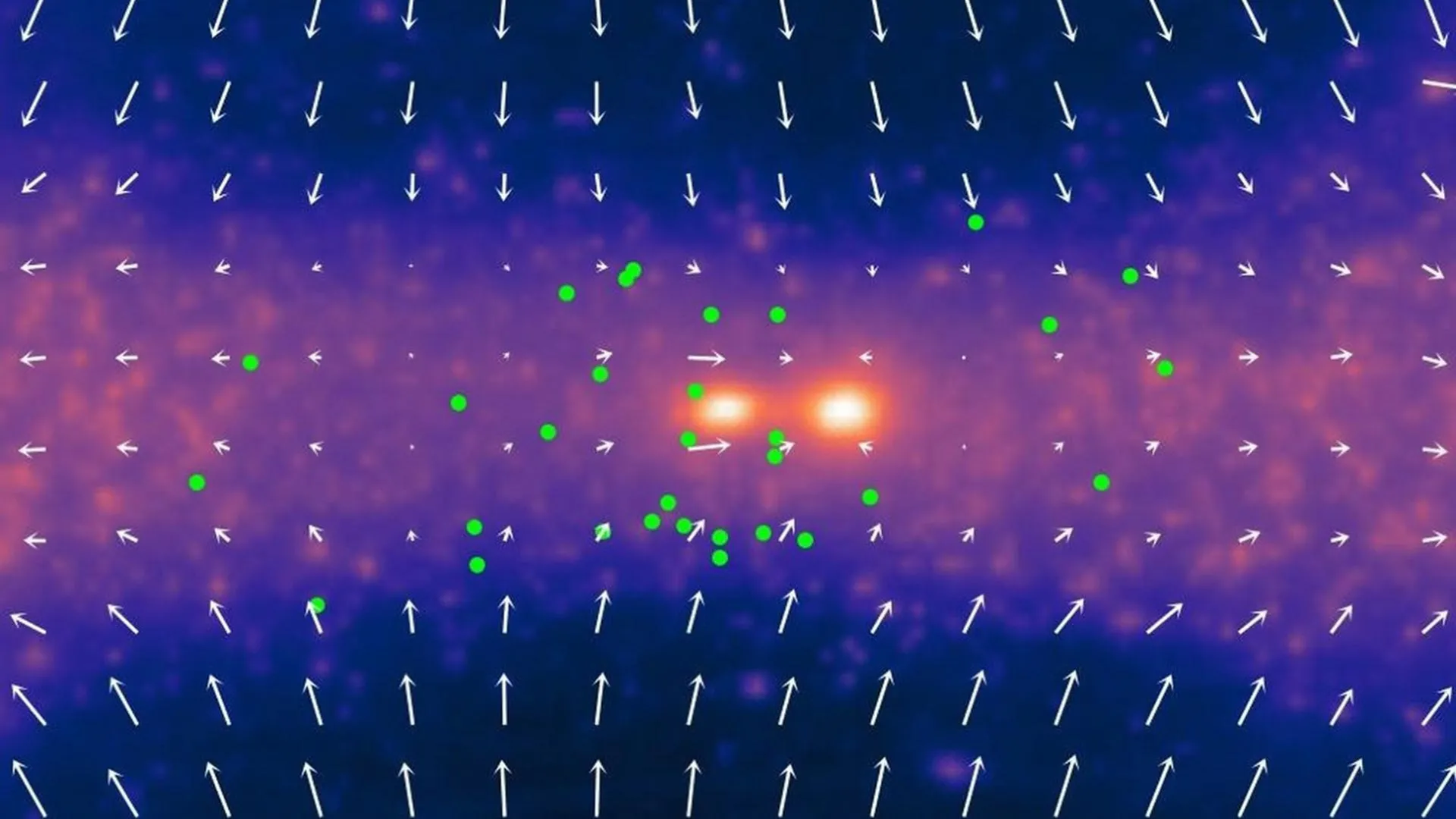
An international research team led by PhD graduate Ewoud Wempe of the Kapteyn Institute in Groningen believes it has found the explanation. Using advanced computer simulations, the researchers discovered that the matter surrounding the Local Group is arranged in a broad, flattened structure that stretches tens of millions of light-years across. This structure includes not only ordinary matter but also the invisible dark matter that surrounds galaxies. Above and below this flattened region lie enormous empty areas known as cosmic voids.
The simulations show that this arrangement of matter can accurately reproduce both the positions and speeds of the galaxies observed around us. In other words, the computer model successfully recreates the same patterns astronomers see in the real universe.
Creating a Virtual Twin of Our Cosmic Neighborhood
To build their model, the scientists began with conditions from the early universe. They used measurements of the cosmic microwave background to estimate how matter was distributed shortly after the Big Bang. A powerful computer then evolved this early universe forward in time, eventually producing a system that matches the present day Local Group.
The resulting simulations replicate the masses, locations, and motions of the Milky Way and Andromeda, as well as the positions and velocities of 31 galaxies just outside the Local Group. Because the model so closely resembles our surroundings, researchers describe it as a “virtual twin” of our cosmic environment.
When the model includes the flat distribution of matter, the surrounding galaxies move away from us at speeds similar to those actually observed. Despite the gravitational pull of the Local Group, galaxies within the plane are influenced by additional mass spread throughout that same plane. This distant mass counterbalances the Local Group’s gravity. Meanwhile, regions outside the plane contain very few galaxies, which explains why we do not see objects falling toward us from those directions.
A Longstanding Puzzle Finally Explained
According to lead researcher Ewoud Wempe, the study represents the first detailed attempt to determine the distribution and motion of dark matter in the area around the Milky Way and Andromeda. “We are exploring all possible local configurations of the early universe that ultimately could lead to the Local Group. It is great that we now have a model that is consistent with the current cosmological model on the one hand, and with the dynamics of our local environment on the other.”
Astronomer Amina Helmi also welcomed the findings, noting that the problem has challenged researchers for decades. “I am excited to see that, based purely on the motions of galaxies, we can determine a mass distribution that corresponds to the positions of galaxies within and just outside the Local Group.”