MPs Back Legalising Assisted Dying In Historic Commons Vote

MPs have voted in favour of legalising assisted dying in a landmark moment for England and Wales.

The 314-291 result, which followed a further five hours of debate in the House of Commons today, means the Terminally Ill Adults (End of Life) Bill has taken a huge step towards becoming law.

Prime minister Keir Starmer was among those who voted for the bill.

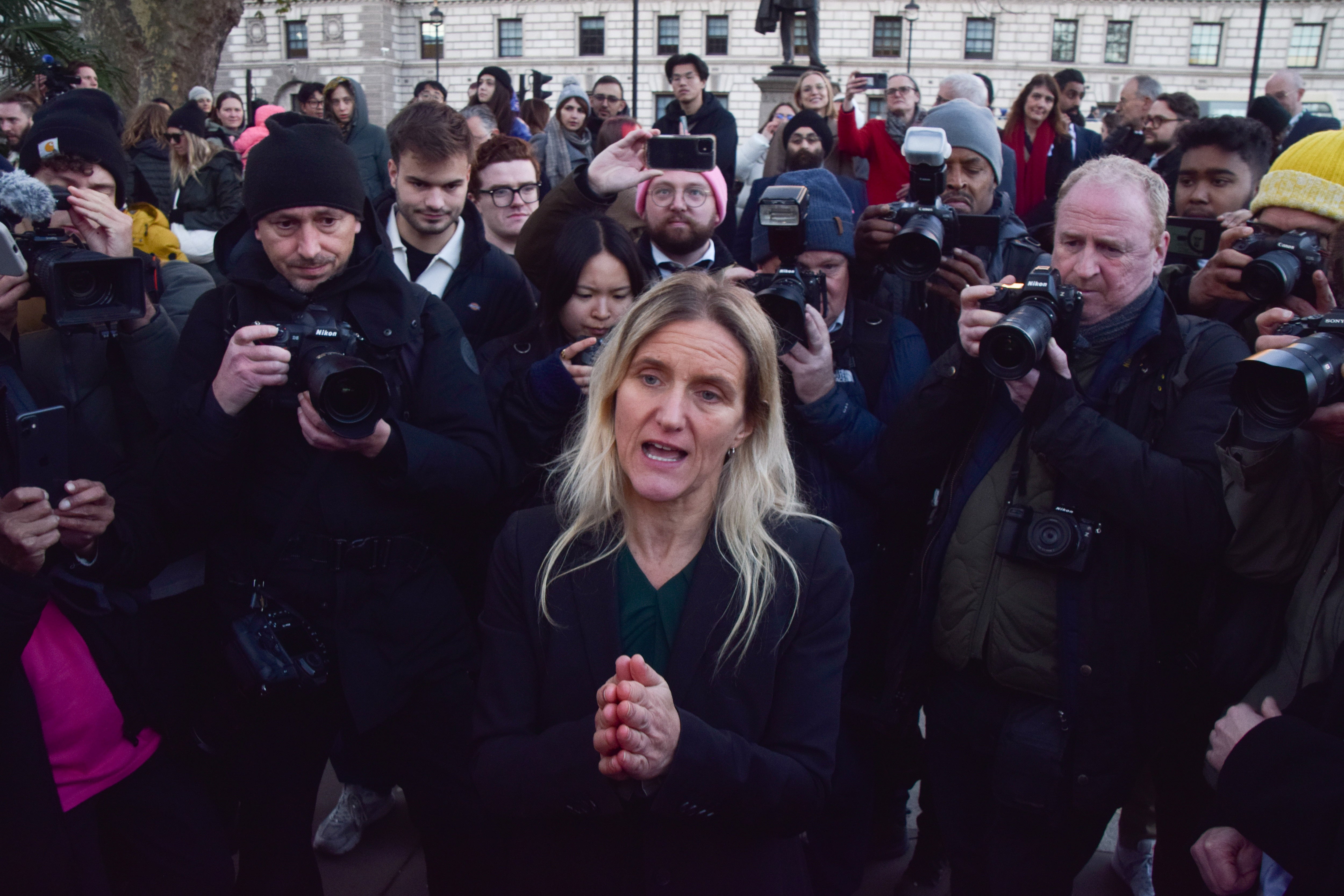
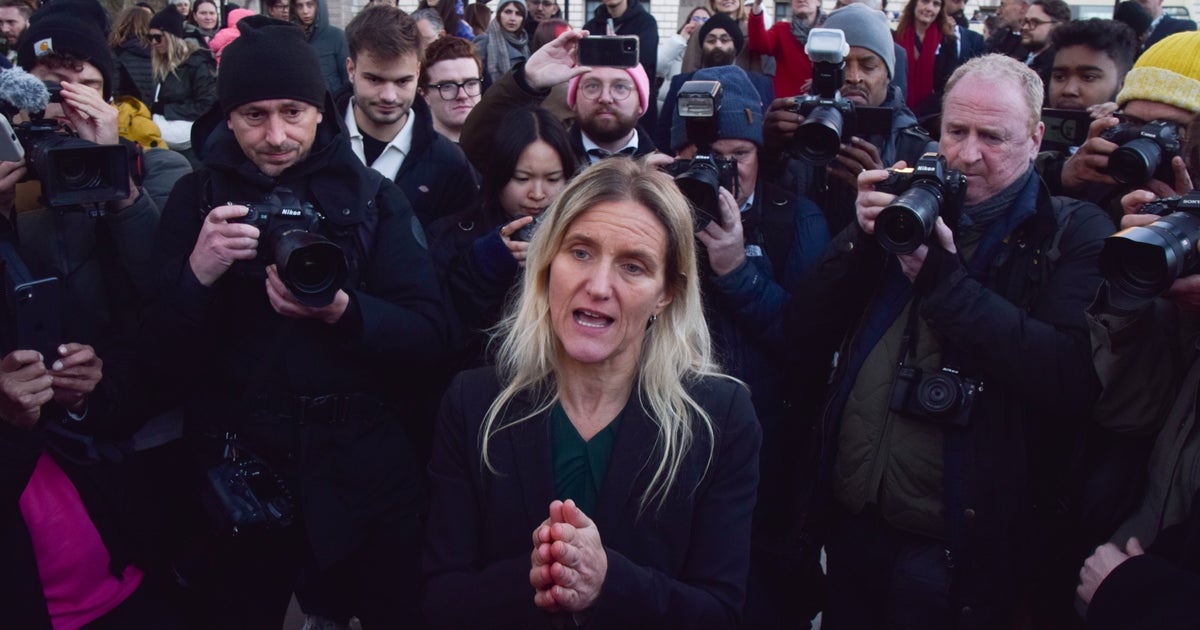
The private member’s bill, which was spearheaded by Labour backbencher Kim Leadbeater, will now go to the House of Lords for further scrutiny, but it is highly unlikely that it will now be blocked.

Under its provisions, terminally ill adults with less than six months left to live would be allowed to legally end their lives at at time when they choose instead of suffering though a prolonged illness.

MPs were given a free vote on the issue, meaning they did not have to follow their party whip.

The bill first came to the Commons in November and has been a source of heated debate between MPs over the last seven months.

The proposals stipulate that an individual must have the mental capacity to make the choice, make two separate declarations – witnessed and signed – about their desire to die, and have approval from two independent doctors that they are eligible.

A doctor would then prepare a substance which the terminally ill person has to take themselves.

Coercing someone into ending their life would be made illegal too, punishable by a 14-year prison sentence.

During a five-hour debate in parliament on Friday, some critics expressed fears that bad actors could force the terminally ill into an early death under this legislation.

Others say they’re concerned about the procedures outlined in the bill or that they fear disabled people’s voices were not included in the consultation.

Despite these oppositions, Leadbeater said earlier this week she was confident the bill would pass because it had a 55-vote majority at a previous round in the Commons.

She said: “Most people believe, as I do, that we should all have the right to make the choices and decisions we want about our own bodies.”

The principle of assisted dying has received widespread support from the public, according to pollsters at YouGov.

A recent survey found 73% of Brits back the idea, while 72% support Leadbeater’s proposals.

Share Button

Hidden carbon giants: Satellite data reveals a 40-year Arctic peatland surge

Peatlands across the Arctic are expanding as the climate warms, new research shows.

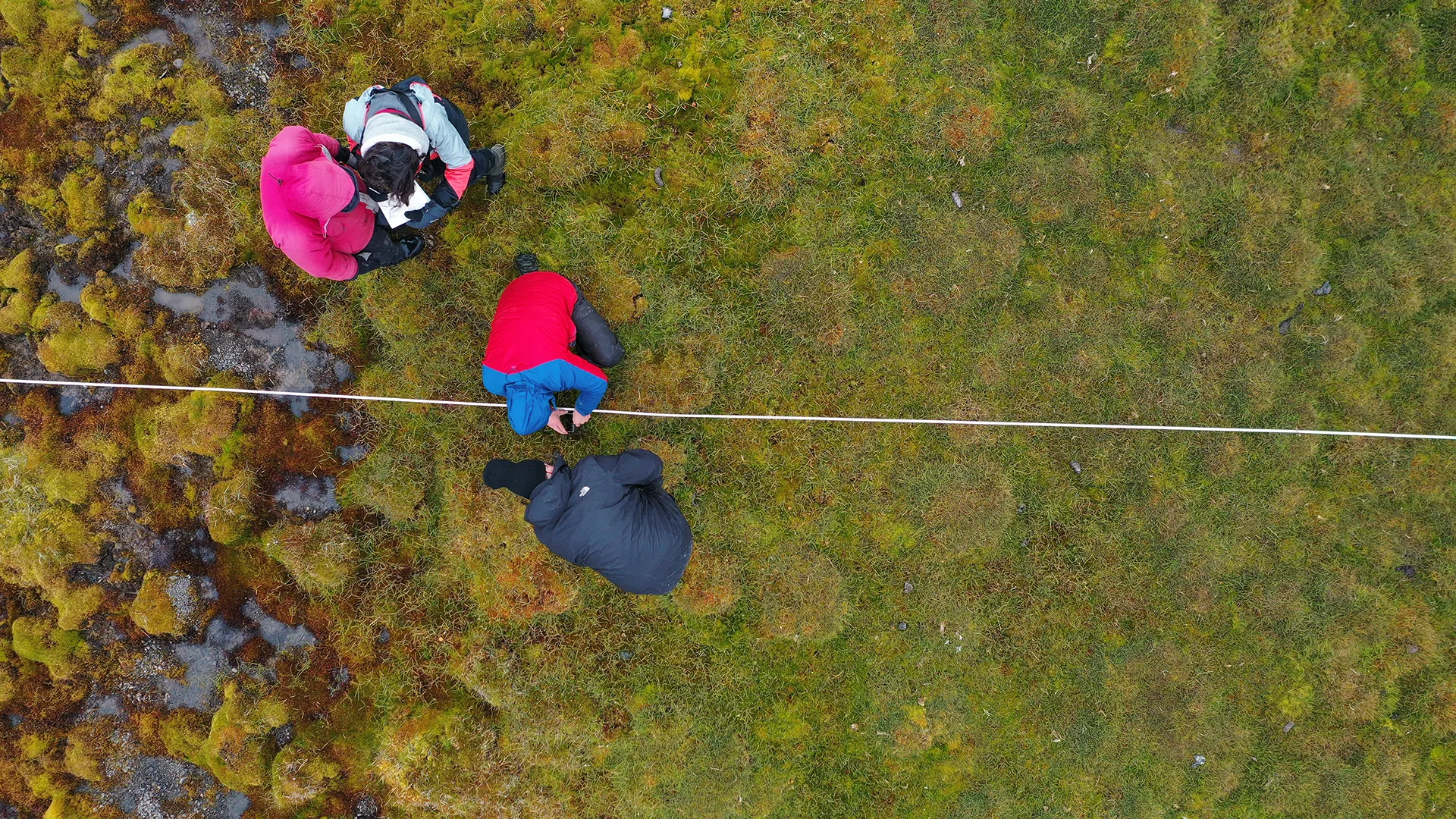
Scientists used satellite data, drones and on-the-ground observations to assess the edges of existing peatlands (waterlogged ecosystems that store vast amounts of carbon).

The study – led by the University of Exeter – found peatlands in the European and Canadian Arctic have expanded outwards in the last 40 years.

While this could slow climate change by storing carbon, the researchers warn that extreme future warming could cause widespread loss of peatlands – releasing that carbon and further accelerating the climate crisis.

“The Arctic has warmed faster than the rest of the planet, with average temperatures increasing by about 4°C in the last four decades,” said Dr Katherine Crichton.

“This has improved growing conditions for plants, causing ‘greening’ of the Arctic. We wanted to identify if this greening could be from peatland plant communities.

“We know from paleo records that warmer periods in Earth’s history led to more carbon being stored in peatlands.

“Our new study puts these pieces together to examine whether our warming climate is causing peatland expansion – and we find strong evidence that it is.”

Peatlands cover just 3% of Earth’s surface but they store about 600 billion tons of carbon – more than all the world’s forest biomass combined.

The Arctic has large peatland areas but these peter out in the far north, where harsh conditions limit plant growth.

In the new study, researchers examined 16 sites – a range of peatlands in both the low and high Arctic – and compared data from 1985-95 with the last 15-20 years.

They found strong evidence of expansion at more than two thirds of sites (measured by “peak-summer greening” – increased growth of peatland-forming plants at the edges of existing peatlands).

The largest changes were found in places with the highest increases in summer temperature, such as the Norwegian islands of Svalbard.

“Our findings suggest Arctic peatlands are an increasingly important natural carbon sink, at least in the near term,” said Professor Karen Anderson, from the Environment and Sustainability Institute on Exeter’s Penryn Campus in Cornwall.

“But if temperatures continue to rise, we are likely to see changes in rainfall, and we are not sure how sustainable new or existing peatlands will be. Plus we could see increases of methane emissions at the same time.

“So – while our study gives us some positive news – it does not detract from the urgent need to reduce greenhouse gas emissions and stabilize our climate.”

The story behind the study

This study took researchers on an unexpected journey that included COVID lockdowns, polar bear safety training and dragging a canoe overland.

Like many research projects, it started with pilot studies – one extracting and analyzing peatland samples in Canada and Finland, the other testing “remote sensing” with drones and satellites.

The team wanted to combine these to find out how climate change is affecting Arctic peatlands. They started applying for funding in 2013, and got their first rejection in 2015. Two more rejections came the following year. In 2018, they finally got a grant – and the project started in summer 2019.

Dr Crichton used Google Earth Engine to identify possible study sites, and Professor Angela Gallego-Sala went on the first fieldwork expedition – to Svalbard, where she received training on avoiding encounters with hungry polar bears.

With the research finally making progress, COVID lockdowns halted fieldwork and lab work. While this hampered the project, Dr Crichton’s computer-based work could continue. “I was still at my desk using Google Earth Engine,” she said. “Lockdown didn’t make any difference to the work I was doing.”

So Dr Crichton continued identifying fieldwork sites, analyzing data and applying for permits – paving the way for fieldwork in Canada in 2021-22. On one of those expeditions, Professor Gallego-Sala stayed at a basic research station on Bylot Island where the washing facility was a “half-frozen lake.” She said: “It was light all the time. You could do fieldwork all day long and all night if you wanted to.”

From that research station, the team visited remote sites via helicopter. Many sites had no name, and the pilot wanted names in order to arrange pick-ups – so sites got informal names including “Glacial Nirvana” and “Angela’s Paradise.” At each site, the team extracted peatland cores to learn about the history of the peatland and how it might be changing.

At Salluit in northern Canada, the team had an Inuit guide for expeditions out into the peatland – during which they saw wildlife including black bears and reindeer, and caught fish and mussels for dinner each evening. When the team laid out their plan one day, the guide shrugged and said: “You can go wherever you want.” He did not mention that their plan would leave their canoe stuck on a large area of sand at low tide.

The three female researchers had to push the stranded boat overland, while the guide sat in it. “We pushed it a long way through the sand,” Professor Gallego-Sala said. “It was pretty tough – but it was also hilarious, and we managed to get it out.”

“Meanwhile, I’m still sat at my computer by the way,” said Dr Crichton, laughing. But this work provided a crucial component – allowing comparison between peatland cores and long-term satellite data that shows peatland edges getting greener as vegetation spreads.

Professor Gallego-Sala added: “Going out for fieldwork is a short time in comparison to the rest of the work. There is lots of lab work to analyse the samples, then extensive data analysis before the findings can be written into a published paper.”

The study is part of a project called Increased Accumulation in Arctic Peatlands (ICAAP), funded by the Natural Environment Research Council.

The paper, published in the journal Communications Earth and Environment, is entitled: “Satellite data indicates recent Arctic peatland expansion with warming.”

Share Button

Flash floods in the Alps: How climate change is supercharging summer storms

Intense, short-lived summer downpours are expected to become both more frequent and more intense across Alpine regions as the climate warms. In a new study, scientists from the University of Lausanne (UNIL) and the University of Padova analyzed data from nearly 300 mountain weather stations and found that a 2°C rise in regional temperature could double the frequency of these extreme events.

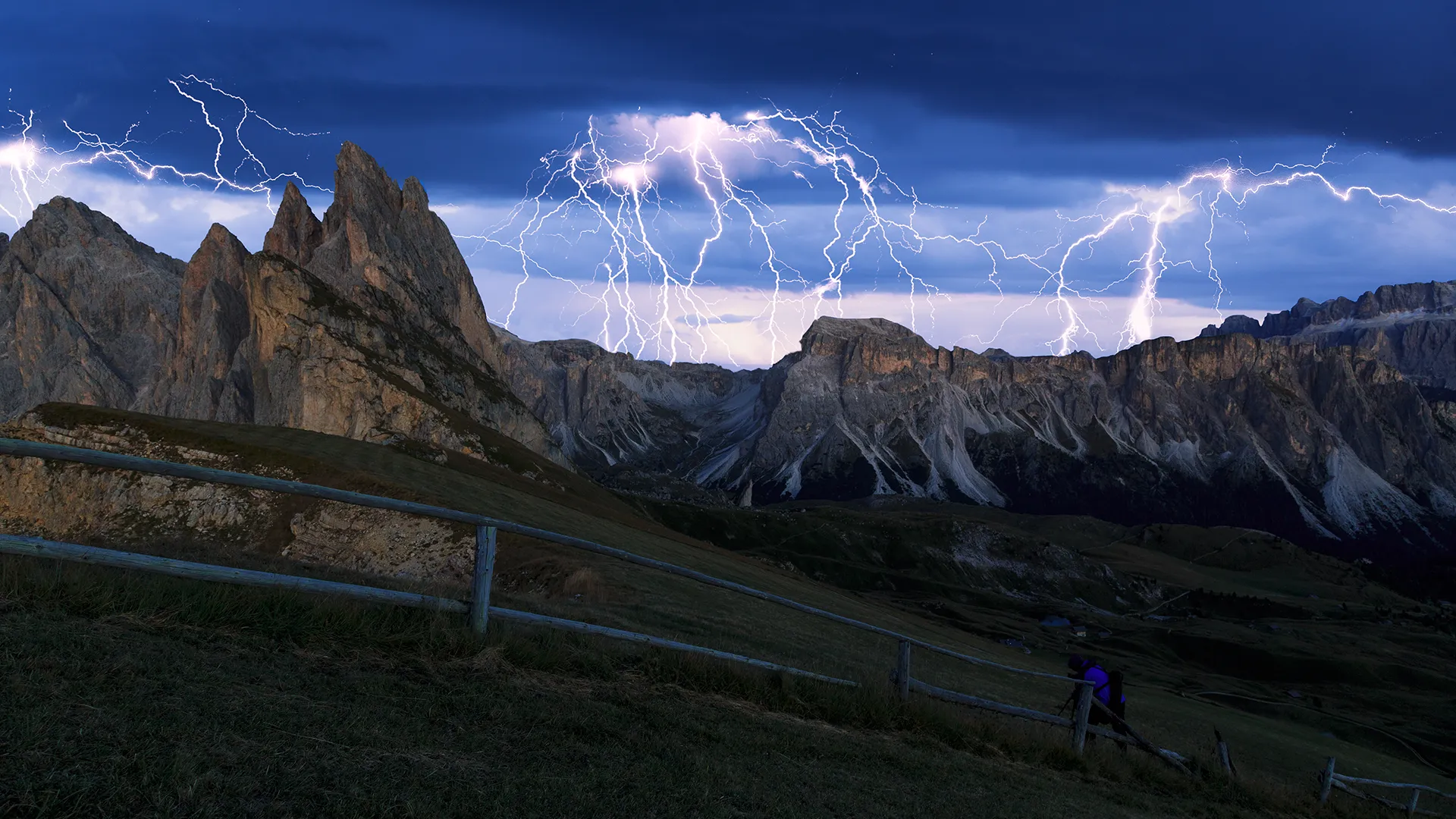
In June 2018, the city of Lausanne in Switzerland experienced an extreme and short-lived rainfall episode, with 41 millimeters of precipitation falling in just 10 minutes. Large parts of the city were flooded, resulting in estimated damage of 32 million Swiss Francs. These short, extreme events, often causing severe damage to property and posing risks to lives, are still very rare in Switzerland today. However, with the rise in temperatures caused by global warming, they are likely to become more frequent in the future, particularly over the Alpine mountains and their surroundings. Warm air retains more moisture (around 7% more per degree) and intensifies thunderstorm activity. As the Alpine region is warming faster than the global average, it is particularly hard hit. It is therefore urgent to assess the impact of global warming in these regions. In a new study published in npj Climate and Atmospheric Science (a Nature portfolio journal), scientists from UNIL’s Faculty of Geosciences and Environment, in collaboration with the University of Padua (UNIPD) have demonstrated that an average temperature rise of 2°C could double the frequency of short-lived summer rainstorms in the Alpine region. With such warming, an intense storm currently expected every 50 years could occur every 25 years in the future.

To obtain these results, the researchers examined data from almost 300 weather stations in the European Alps, spread across Switzerland, Germany, Austria, France, and Italy. They focused on record-breaking rainfall events (lasting from 10 minutes to an hour) between 1991 and 2020, as well as temperatures associated with these storms.

Based on these observations, a statistical model incorporating physics principles has been developed to establish a link between temperature and rainfall frequency, and then to simulate the future frequency of extreme precipitation using regional climate projections. “Our results show that an average temperature rise of 1°C would already be highly problematic,” warns Nadav Peleg, researcher at UNIL and first author of the study. “The sudden and massive arrival of large volumes of water prevents the soil from absorbing the excess. This can trigger flash floods and debris flows, leading to infrastructure damage and, in some cases, casualties,” he adds. “It is therefore crucial to understand how these events may evolve with climate change in order to plan appropriate adaptation strategies, such as improving urban drainage infrastructure where necessary.” Francesco Marra, researcher at UNIPD and one of the main authors of the study adds: “An increase of 1°C is not hypothetical, it is likely to occur in the coming decades. We are already witnessing a tendency for summer storms to intensify, and this trend is only expected to worsen in the years ahead.”

Share Button

Fitness trackers are failing millions — this fix could change everything

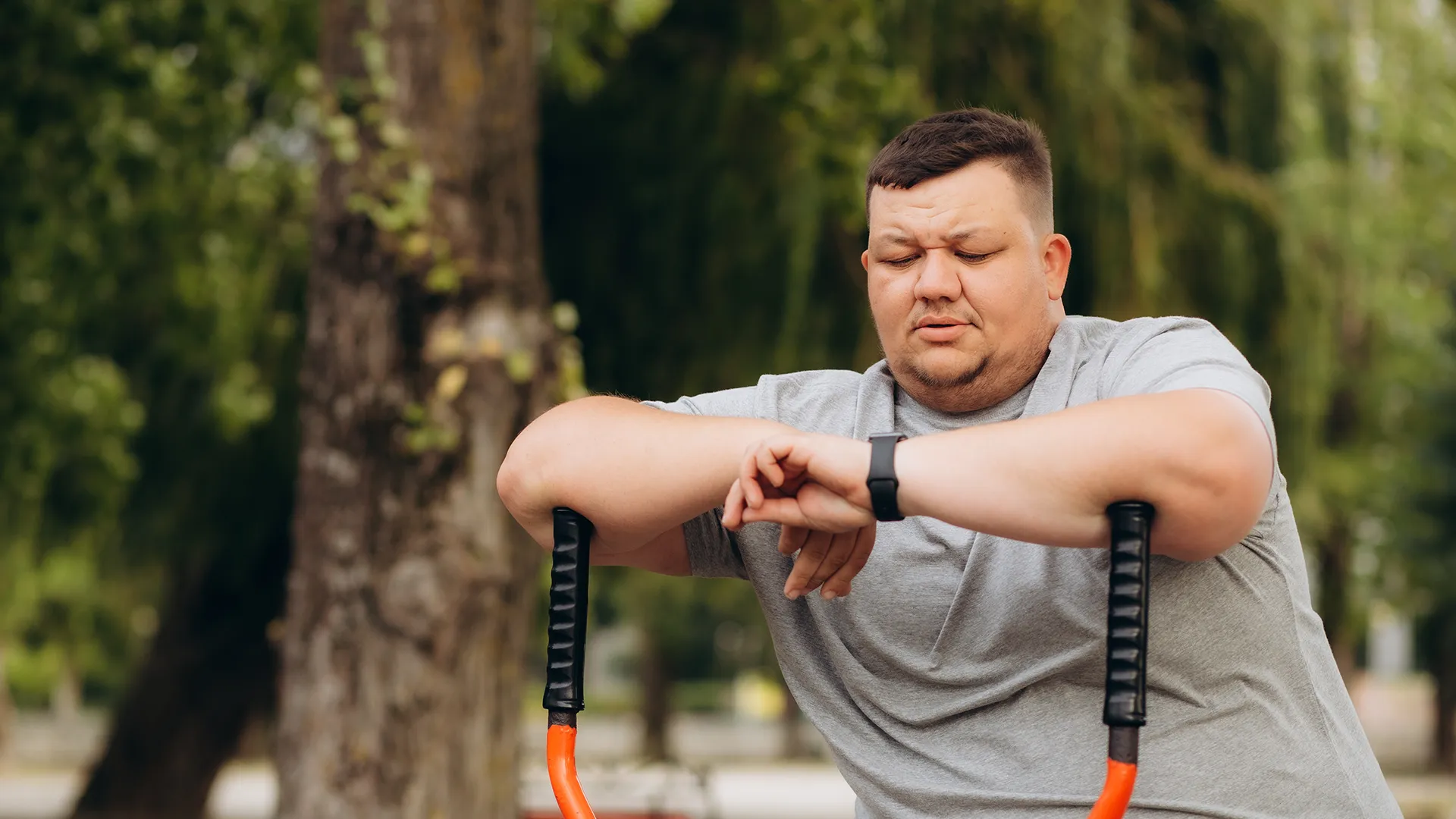
For many, fitness trackers have become indispensable tools for monitoring how many calories they’ve burned in a day. But for those living with obesity, who are known to exhibit differences in walking gait, speed, energy burned and more, these devices often inaccurately measure activity — until now.

h

For many, fitness trackers have become indispensable tools for monitoring how many calories they’ve burned in a day. But for those living with obesity, who are known to exhibit differences in walking gait, speed, energy burned and more, these devices often inaccurately measure activity — until now.

Scientists at Northwestern University have developed a new algorithm that enables smartwatches to more accurately monitor the calories burned by people with obesity during various physical activities.

The technology bridges a critical gap in fitness technology, said Nabil Alshurafa, whose Northwestern lab, HABits Lab, created and tested the open-source, dominant-wrist algorithm specifically tuned for people with obesity. It is transparent, rigorously testable and ready for other researchers to build upon. Their next step is to deploy an activity-monitoring app later this year that will be available for both iOS and Android use.

“People with obesity could gain major health insights from activity trackers, but most current devices miss the mark,” said Alshurafa, associate professor of behavioral medicine at Northwestern University Feinberg School of Medicine.

Current activity-monitoring algorithms that fitness trackers use were built for people without obesity. Hip-worn trackers often misread energy burn because of gait changes and device tilt in people with higher body weight, Alshurafa said. And lastly, wrist-worn models promise better comfort, adherence and accuracy across body types, but no one has rigorously tested or calibrated them for this group, he said.

“Without a validated algorithm for wrist devices, we’re still in the dark about exactly how much activity and energy people with obesity really get each day — slowing our ability to tailor interventions and improve health outcomes,” said Alshurafa, whose team tested his lab’s algorithm against 11 state-of-the-art algorithms designed by researchers using research-grade devices and used wearable cameras to catch every moment when wrist sensors missed the mark on calorie burn.

The findings will be published on June 19 in Nature Scientific Reports.

The exercise class that motivated the research

Alshurafa was motivated to create the algorithm after attending an exercise class with his mother-in-law who has obesity.

“She worked harder than anyone else, yet when we glanced at the leaderboard, her numbers barely registered,” Alshurafa said. “That moment hit me: fitness shouldn’t feel like a trap for the people who need it most.”

Algorithm rivals gold-standard methods

By using data from commercial fitness trackers, the new model rivals gold-standard methods of measuring energy burn and can estimate how much energy someone with obesity is using every minute, achieving over 95% accuracy in real-world situations. This advancement makes it easier for more people with obesity to track their daily activities and energy use, Alshurafa said.

How the study measured energy burn

In one group, 27 study participants wore a fitness tracker and metabolic cart — a mask that measures the volume of oxygen the wearer inhales and the volume of carbon dioxide the wearer exhales to calculate their energy burn (in kilocalories/kCals) and resting metabolic rate. The study participants went through a set of physical activities to measure their energy burn during each task. The scientists then looked at the fitness tracker results to see how they compared to the metabolic cart results.

In another group, 25 study participants wore a fitness tracker and body camera while just living their lives. The body camera allowed the scientists to visually confirm when the algorithm over- or under-estimated kCals.

At times, Alshurafa said he would challenge study participants to do as many pushups as they could in five minutes.

“Many couldn’t drop to the floor, but each one crushed wall-pushups, their arms shaking with effort,” he said, “We celebrate ‘standard’ workouts as the ultimate test, but those standards leave out so many people. These experiences showed me we must rethink how gyms, trackers and exercise programs measure success — so no one’s hard work goes unseen.”

The study is titled, “Developing and comparing a new BMI inclusive energy burn algorithm on wrist-worn wearables.”

Other Northwestern authors include lead author Boyang Wei, and Christopher Romano and Bonnie Nolan. This work also was done in collaboration with Mahdi Pedram and Whitney A. Morelli, formerly of Northwestern.

Funding for the study was provided by the National Institute of Diabetes and Digestive and Kidney Diseases (grants K25DK113242-01A1 and R01DK129843-01), the National Science Foundation (grant 1915847), the National Institute of Biomedical Imaging and Bioengineering (grant R21EB030305-01) and the National Institutes of Health’s National Center for Advancing Translational Sciences (grant UL1TR001422).

Share Button

How does a £1.6m fine affect an NHS trust?

How will the largest fine over maternity deaths impact the NHS and the families it failed?

Share Button

‘I was poisoned by fake Botox’

In recent weeks 28 cases of botulism caused by fake Botox are recorded in the north-east of England.

Share Button

Leeds maternity units downgraded to ‘inadequate’

Trust told to take immediate action to improve after unannounced inspections prompted by parent concerns.

Share Button

Blow For Keir Starmer As Labour Whip Vicky Foxcroft Quits Over Welfare Cuts

A Labour MP has quit as a government whip over controversial plans to slash the welfare budget by £5 billion.

In a major blow for Keir Starmer, Vicky Foxcroft said she could not vote for the policy and had no option but to resign.

In a letter to the prime minister, she said: “I have wrestled with whether I should resign or remain in the Government and fight for change from within.

“Sadly it now (seems that we are not going to get the changes I desperately wanted to see.

“I therefore tender my resignation as I know I will not be able to do the job that is required of me and whip – or indeed vote – for reforms which include cuts to disabled people’s finances.”

A government spokesperson said: “This Labour government was elected to deliver change. The broken welfare system we inherited is failing the sick and most vulnerable and holding too many young people back. It is fair and responsible to fix it.

“Our principled reforms will ensure those who can work should, that those who want to work are properly supported, and that those with most severe disabilities and health conditions are protected.”

Foxcroft is the first Labour frontbencher to resign over the proposed benefit cuts, which will be voted on my the Commons on July 1.

More than 100 Labour MPs have written to the government’s chief whip making clear their opposition to the plans, which would see cuts to Personal Independence Payments (PIP) and Universal Credit.

The government’s own assessment of the policy has suggested that 250,000 people could be pushed into poverty as a result, including 50,000 children.

Share Button

As Trump Weighs Up Joining Israel’s War Against Iran, Here’s A Reminder How We Got Here

Donald Trump is currently considering whether to join Israel in bombing Iran – a seismic decision which could cause chaos across the Middle East and beyond.

The UK is particularly nervous to see what the mercurial president does next, knowing that there may well be pressure for Britain to assist America, as one of its closest allies.

So as much of the West and the Middle East nervously await news from the White House, here’s a look back at just how we ended up on this knife-edge…

Why has Israel been bombing Iran?

Israel claims it had no option but to attack Iran because Tehran was close to developing nuclear weapons.

The Fordo nuclear site is one of two facilities where Iran can enrich uranium. It’s build into a mountain for safety, 124 miles south of Tehran.

While the facility has been hit by Israel’s recent attacks, it’s thought the Israeli Defence Force (IDF) was actually trying to weaken Iran’s defence capabilities around the facility.

Only one conventional weapon could actually destroy the fortified site, and it belong to the US.

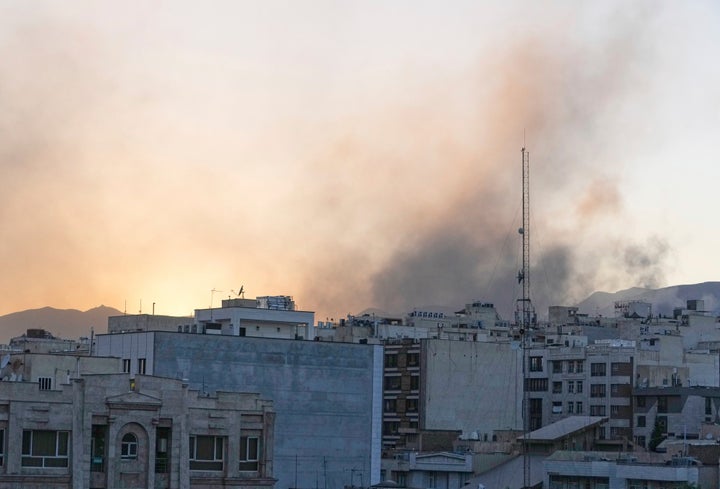
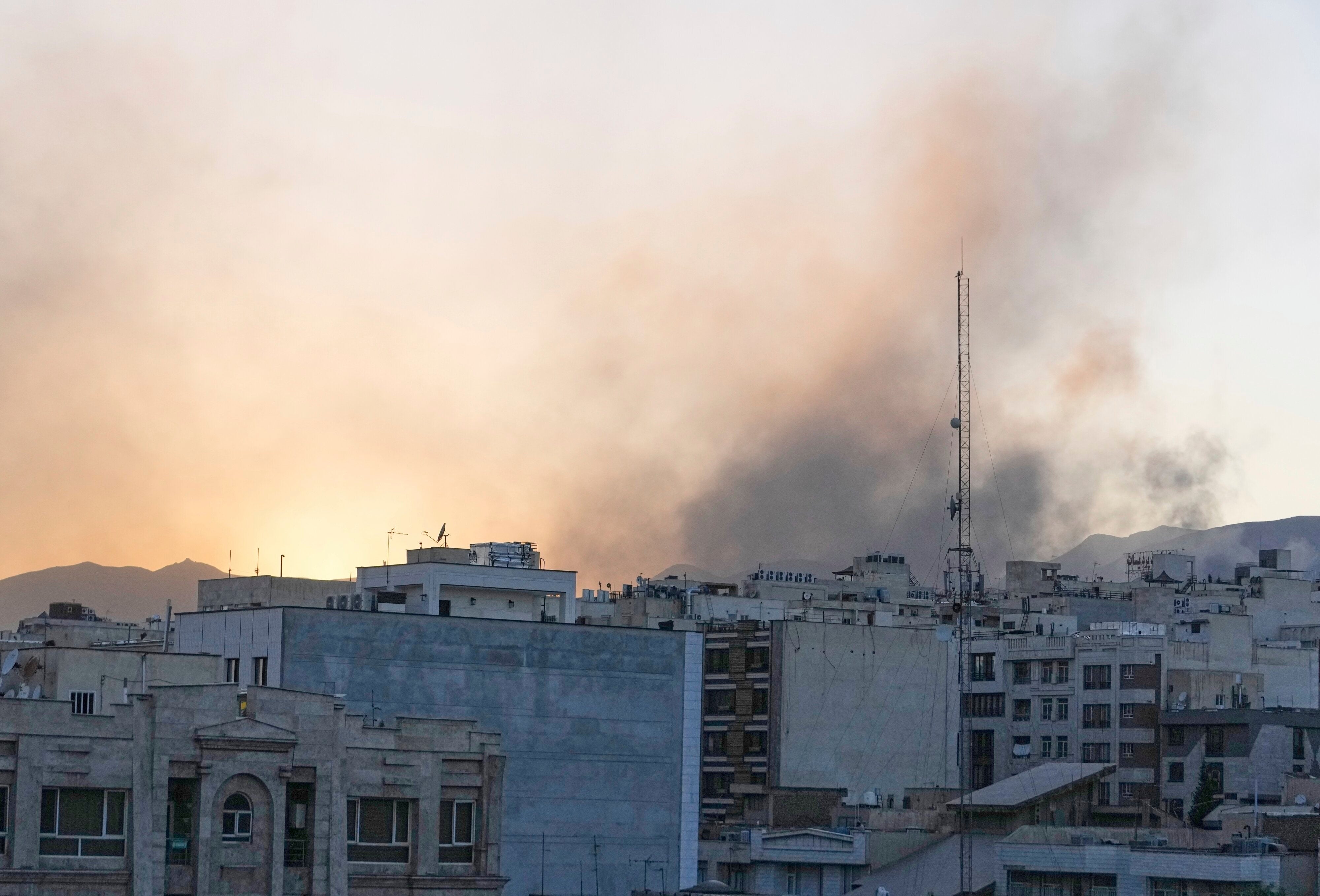
Smoke rises up after Israel's attack, in Tehran, Iran, Wednesday, June 18, 2025.
Smoke rises up after Israel’s attack, in Tehran, Iran, Wednesday, June 18, 2025.

via Associated Press

Is Iran on the cusp of developing a nuclear bomb?

It’s not clear.

To build such a bomb, a country would need to have uranium enriched to 90%, the ability to build a warhead and a way to direct that warhead to an end point.

While Iran is definitely working on some nuclear capabilities, it has always insisted that its nuclear programme is peaceful.

In March, Trump’s director of national intelligence Tulsi Gabbard told Congress that “while Iran had an unprecedented stockpile of weapons-grade uranium, it did not appear to be building a nuclear weapon”.

But Trump has dismissed this intelligence.

Israel has also claimed “over the past few months intelligence has shown that Iran is closer than ever to obtaining a nuclear weapon”.

Meanwhile, the UN’s nuclear watchdog, the International Atomic Energy Agency (IAEA) announced earlier this month that Iran had breached its non-proliferation obligations for the first time in almost two decades.

It concluded that Iran has amassed around 400kg of uranium enriched to 60% – that’s more than is required for civil nuclear use.

Is Israel a nuclear power?

Israel is believed to have up to 90 nuclear warheads, but the country has not confirmed or denied whether that is true.

Israel is also not part of the global nuclear non-proliferation treaty meant to prevent more countries – like Iran – from building their own weapons.

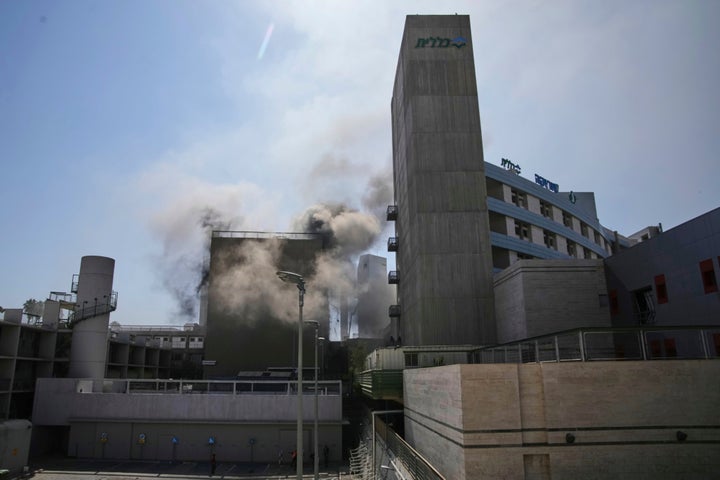
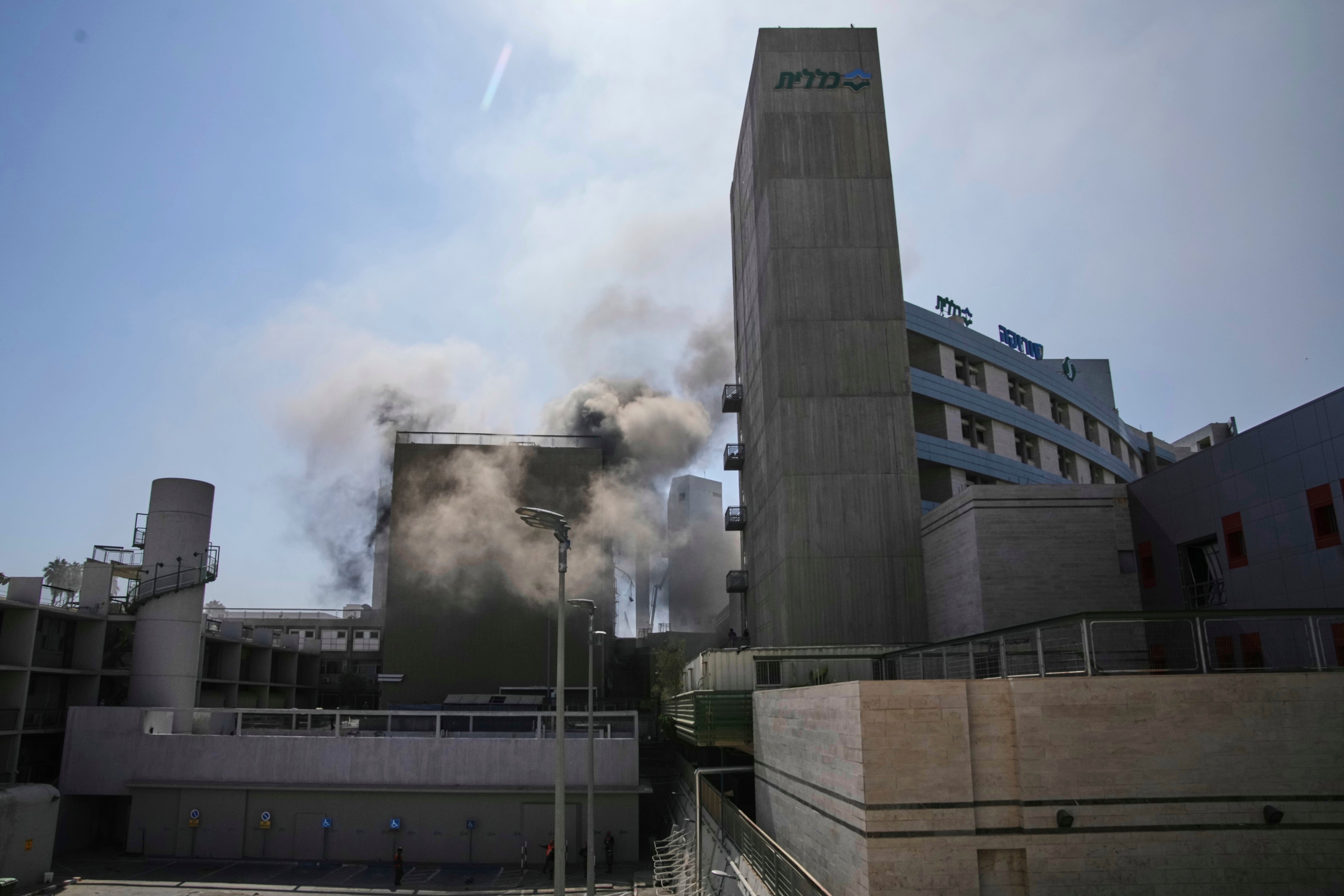
Smokes raises from a building of the Soroka hospital complex after it was hit by a missile fired from Iran in Beersheba, Israel, Thursday, June 19, 2025.

via Associated Press

Why were there already tensions between Israel and Iran?

Tensions in the Middle East rose sharply in October 2023 when Iranian-backed militants Hamas crossed from Gaza into Israel and killed 1,200 people, taking a further 250 captive.

Israel declared war on Hamas, launched a ground offensive and imposed a blockade on aid heading into the Palestinian territory.

The Hamas-run health ministry say at least 54,000 people have been killed in Gaza since the war began.

After Israel declared war, other Iranian proxies – like Houthi rebels in Yemen and Hezbollah in Lebanon – began to fight Israel.

The US, Israel’s most powerful friend, has helped to subdue these attacks in recent months, while other allies like the UK, continue to send Israel weapons.

Iran is also weakened after the deposition of Syria’s leader Bashar al-Assad, although that was not a result of Israeli actions.

What was Iran’s nuclear deal – and why did it fall apart?

The Joint Comprehensive Plan of Action (JCPOA), also known as the Iran nuclear deal, was put in place in 2015.

Iran agreed with the US, UK, France, China, Russia and Germany to limit its sensitive nuclear activities and allow international inspectors in to monitor their work.

In exchange, world powers would lift the economic sanctions it placed on the country.

The deal was due to expire in 2031 but it began to fall apart in May 2018 when Trump pulled out.

He claimed the accord was “defective at its core” and reinstated all US sanctions on Iran.

Trump wanted to force Tehran into a tougher deal which would limit Iran’s involvement in regional conflicts.

Iran rejected that plan even as the sanctions triggered a recession and skyrocketing inflation.

In 2019, Tehran began to exceed the deal’s restrictions on its nuclear programme, blaming the US for its own “non-performance”.

Joe Biden tried to revive the JCPOA in 2021 when he was elected as president, but Iran said it was waiting for the US to lift sanctions first.

When he left office and Trump was re-elected, the US was expected to resume nuclear talks with Iran this month.

However, Israel’s recent strikes have set back any potential talks.

Why would the US (and possibly the UK) join the regional conflict?

Trump initially called for de-escalation, but he has also called for Iran’s “unconditional surrender” and threatened to attack its supreme leader whom he claims is an “easy target”.

Asked if he would join in with the attacks, Trump said on Wednesday night: “I may do it, I may not do it. Nobody knows what I’m going to do.”

The US may seek the UK’s permission to use the British airbase in the Chagos Islands to launch its mission.

But Trump risks putting American lives at risk if he does target Iran.

There are about 40-50,000 US troops at around 19 locations across the Middle East who could be vulnerable to attack.

Share Button

Tina Fey Reveals How Season 2 Of The Four Seasons Is Going To Work

This article contains major spoilers for The Four Seasons on Netflix.

Fans who found themselves hooked on the low-stakes drama of The Four Seasons on Netflix earlier this year were delighted when the show was renewed for a second run last month.

And in a new interview with Deadline, Tina Fey – who also co-created the series, and wrote two of its episodes – is teasing exactly how the next season will work.

The first run of The Four Seasons checked in with the same group of friends on four different group trips, as we caught up with where they were all at in their different personal dramas.

In light of big changes the gang went through by the end of season one, Deadline’s reporter asked Tina whether this format would still be the case for the new episodes.

“One of the things we like about it is what we kept calling the container plate of it. The game of, we only see them on vacation,” Tina responded. “We only see them throughout the year.

She added: “We definitely want to keep the format of only seeing them when they’re together, only seeing them over four occasions.”

Tina Fey at a screening of The Four Seasons last month

via Associated Press

Tina also spoke about the possibility of Steve Carell putting in an appearance, despite his character having now been killed off.

“I couldn’t possibly say,” she said. “We have our format.”

She then quipped: “I mean, of the many mistakes I’ve made in my career, killing him will hopefully go down as the biggest.”

Work on the second season of The Four Seasons is now underway, with cast members Will Forte, Colman Domingo, Kerri Kenney-Silver and Marco Calvani expected to return in the new episodes.

Until then, the first series of The Four Seasons is streaming on Netflix – with the platform making announcements about three other fan-favourite shows when it was first revealed that a second season was on the way.

Share Button