These plants evolved in Florida millions of years ago: They may be gone in decades

Scrub mints are among the most endangered plants you’ve probably never heard of. More than half of the 24 species currently known to exist are considered threatened or endangered at the state or federal level, and nearly all scrub mints grow in areas that are being rapidly developed or converted to agricultural pasture.

In a new study, researchers analyzed a distinct type of DNA marker, which shows there are likely more scrub mint species waiting to be scientifically described. And at least one species has been left without federal protection because of a technicality.

“The Titusville balm is currently considered to be a recent hybrid,” said lead author Andre Naranjo, who conducted the study while completing a Ph.D. with the Florida Museum of Natural History. “When you describe something as a hybrid, that implies that it’s not a true species, and it can’t be protected under the Endangered Species Act.”

Naranjo found no evidence for recent hybridization in Titusville balms (Dicerandra thinicola), and his results suggest that a group called the calamints may contain cryptic diversity that requires further study.

Scrub mints evolved during a period of rapid climate change

Naranjo and his colleagues conducted the study to learn about the evolutionary history of scrub mints. The group is native to the southeastern United States and originated during a turbulent time in Earth’s past.

Three million years ago, during a period called the Pliocene, temperatures were 2-3 degrees C warmer than they are today, and sea levels were up to 30 meters higher. At the time, the central and southern half of Florida was an archipelago. But as temperatures cooled over the next several million years, the waters receded, and the Florida Peninsula took on its modern-day dimensions.

Much of this newly surfaced habitat wasn’t exactly prime real estate. Where soils did exist, they were primarily composed of sand, and the cooler temperatures resulted in less rainfall. This was particularly true of the elevated areas that had been islands before sea levels fell.

What’s left of these ancient shorelines is now located near the center of the Florida Peninsula and is often referred to as sand pine scrub. Plants and animals that moved into these vacant spaces had to contend with little water, few nutrients and rampant wildfires.

The species that managed to survive tended to do well within this narrow framework of harsh conditions but lost the ability to live just about anywhere else. Today, 40-60% species that live in these areas are endemic, meaning they can be found only in southeastern scrub habitats.

Scrub mints are among the few plants that staked a claim in the new Florida frontier. Originating in the panhandle, the ancestor of modern scrub mints dispersed south as soon as there was land to grow on.

At the height of the ice ages during the Pleistocene, when much of the planet’s reserve of water was locked away in massive glaciers, Florida was up to twice the size it is today, and scrub mints flourished.

“These plants had a much wider range in the past and were readily sharing DNA with one another,” Naranjo said.

But their habitat soon shrank. There were at least 17 ice ages during the Pleistocene, when scrub mints were evolving, and each cold period was separated by warm intervals in which much of Florida was swallowed by the sea.

Widespread scrub environments were repeatedly reduced to islands, severing the connection between mint populations. They began to grow apart, and soon each scrub island contained its own unique mint species. During the cold periods, when sea levels fell, scrub mint populations again overlapped, and these unique species hybridized with each other.

This ancient intermingling created the scrub mints as they’re known today.

The storied history of scrub mints cut short by development

Naranjo sequenced nuclear DNA from scrub mints for the study. Unlike the plastid DNA often used to study plants, which is produced by structures called chloroplasts, the DNA from plant nuclei is especially useful for scientists trying to tease apart historical interactions between species.

According to his results, annual scrub mints in the genus Dicerandra — which grow north into South Carolina and die back during the winter — originated from a back-to-back hybridization event between the ancestors of perennial scrub mints, which have a distribution further south and grow year-round.

Hybridization is a common form of diversification in plants, so much so that nearly every group of plants you might come across has had a hybridization event occur at some point in its evolutionary history.

Crucially, Naranjo’s findings indicate the scrub mints that currently exist have been on separate evolutionary trajectories for hundreds of thousands of years. When modern humans diverged from Neanderthals around 500,000 years ago, scrub mints were already well on their way to becoming separate species.

The study also suggests that calamints are genetically diverse, so much so that new species designations are likely warranted. This is especially true for those with large ranges in the southeastern U.S., including the scarlet calamint (Clinopodium coccineum) and Georgia calamint (Clinopodium georgianum), neither of which is considered to be endangered.

Even if additional species are afforded protection, Naranjo fears it may not be enough to stave off declines and eventual extinction. Lakela’s mint (Dicerandra immaculata), for example, is listed as critically endangered and only grows along a three-mile stretch of scrub, almost all of which is privately owned.

Conditions that once allowed these plants to thrive, such as periodic wildfires, are now impractical, due to nearby urban areas that would be negatively affected. And invasive species are encroaching on what little pristine scrub is left. Work to remove invasives is often done by volunteers, if they’re removed at all.

“If we continue with business as usual, this entire group of plants could go extinct within the next 100 years. And we won’t just lose these species. We’ll lose the scrub, one of the most truly authentic and formerly ubiquitous Florida habitats will just go away,” Naranjo said.

The study was published in the journal Molecular Phylogenetics and Evolution.

Christine Edwards of the Missouri Botanical Garden, Matthew Gitzendanner of the University of Florida, and Pamela and Douglas Soltis of the Florida Museum of Natural History are also co-authors on the study.


Share Button

Australia on track for unprecedented, decades-long megadroughts

Australia could soon see megadroughts that last for more than 20 years, according to new modelling from The Australian National University (ANU) and the ARC Centre of Excellence for Climate Extremes.

The researchers’ bleak findings are before factoring in human impact on the climate since the Industrial Revolution. The ANU-led team also found that 20th century droughts in southwestern and eastern Australia, including the Murray-Darling Basin, were longer on average compared to pre-industrial times.

According to the scientists, the findings paint a worrying picture of future droughts in Australia that are far worse than anything in recent experience.

Megadroughts are exceptionally severe, long-lasting and widespread. They can last multiple decades or even centuries. An example of this is the megadrought in the United States’ southwestern region that started in the year 2000 and has continued for more than two decades.

Co-lead author Dr Georgy Falster, from the ANU Research School of Earth Sciences, said that if a megadrought occurred in Australia today, the consequences would be made even worse because of climate change, as any drought would occur against a backdrop of hotter weather.

“The combination of climate change on top of naturally occurring megadroughts that could last for 20 years means that in the future Australia could see droughts that are worse than anything in recent historical experience,” Dr Falster said.

“We must consider, and prepare for, the possibility that one of these multi-decade megadroughts could occur in the near future.

“One of the problems with understanding protracted droughts in Australia is that our climate observations since the 1900s give us only a handful of examples to work with. This isn’t representative of the worst-case scenarios that are possible just through natural climate variations.

“Thinking about when we might expect to see a 20-year-long drought in the Murray-Darling Basin in southeastern Australia, this varies a lot. We could see a megadrought occur every 150 years or 1,000 years.

“In this study, we paid particular attention to the Murray-Darling Basin. As the largest agricultural region of Australia, it’s important to know how bad droughts in this region could be.”

The ANU-led team looked at the full spectrum of droughts Australia could experience, including length and intensity, even without the effects of climate change. They also wanted to find out how human-caused climate change is now altering the characteristics of Australian droughts.

The researchers used multiple climate models to simulate droughts that occurred during the past millennium — from the year 850 to 2000 — to determine how they might change in the future.

This includes predicting how long Australian droughts could last for, and how dry they could be.

“One of the confronting findings of our work is that it is possible for droughts in Australia to be much longer than any of the droughts that we’ve experienced in recent times. Droughts that continue for 20 years or more are something that we should expect to happen,” Dr Falster said.

“Megadroughts are part of the natural variations in Australia’s climate. But worryingly we are now also adding human-caused climate change into the mix, and that is probably increasing the chances of the next megadrought here.

“We compared simulated droughts in the 20th century, from the year 1900 to 2000, with those from the pre-industrial period, before the year 1850, to see if human-caused climate change has impacted how Australians experience droughts today.”

Co-author Professor Nerilie Abram, also from ANU, said human-caused climate change is contributing to longer droughts in southwestern and eastern Australia, including the Murray-Darling Basin.

She said these are also the regions where we can expect future rainfall declines due to climate change, thereby increasing the risk of droughts.

“It is likely that changes to drought intensity could still arise as climate change continues to worsen,” Professor Abram said.

“One example of this is the 21st century ‘Tinderbox Drought’, which was only three years long but was exceptionally intense and set the conditions for the Black Summer bushfires. The Tinderbox Drought was likely made more severe by climate change.

“The only thing we can do to lessen the potential severity and length of future droughts is to rapidly reduce greenhouse gas emissions. For example, by rapidly transitioning to renewable energy sources.

“We can also reduce the impacts of future droughts by being prepared with water storage and management plans, and community support networks.”

The research is published in a special edition of the journal Hydrology and Earth System Sciences. This work was co-led by ANU and The University of Sydney in collaboration with the University of New South Wales (UNSW), the University of Wollongong and the University of Monash.

Share Button

Building blocks for greener energy: Reconfigurable elastic metasurface

Energy harvesting, an eco-friendly technology, extends beyond solar and wind power in generating electricity from unused or discarded energy in daily life, including vibrations generated by passing car engines or trains. Recent intriguing research has been announced, aiming to enhance the efficiency of energy harvesting using a new type of metasurface that can be reconfigured, resembling the assembly of LEGO bricks.

Professor Junsuk Rho from the Departments of Mechanical Engineering, Chemical Engineering, and Electrical Engineering and PhD/MS student Geon Lee from the Department of Mechanical Engineering at Pohang University of Science and Technology (POSTECH) have joined Professor Miso Kim from the School of Advanced Materials Science and Engineering at Sungkyunkwan University (SKKU) to collaborate on a research project. Together, they developed a multifunctional elastic metasurface that can be freely configured by attaching and detaching components for practical applications. This research was published in one of the international journals in materials science, Advanced Science.

Metamaterials are artificially designed structures that exploit the relationships among wavelengths to manipulate wave energy such as light, vibration, and sound. Harnessing this capability in energy harvesting allows for the gathering of elastic waves in piezoelectric components, thereby increasing the efficiency of electricity production. However, limitations in the theoretical analysis of the beams constituting metamaterials confine their operation to a single frequency and restrict their utility to specific purposes, posing challenges for their practical application in real structures.

The research team overcame these limitations by employing the Timoshenko-Ehrenfest beam theory instead of the conventional Euler-Bernoulli beam theory. What distinguishes the former is its consideration of the fundamental characteristics of elasticity, including shear deformation and rotational inertia effects of the beam. This study marks the first application of this theory to elastic metamaterial research.

The researchers succeeded in interpreting and modeling elastic metamaterials for phase modulation of elastic waves using the Timoshenko-Ehrenfest beam theory. Furthermore, they fabricated a new type of Timoshenko-Ehrenfest beam-based reconfigurable elastic metasurface (TREM) capable of attaching and detaching multiple structures. The TREM can reconstruct its surface depending on its application, enabling control over various wave phenomena such as anomalous wave refraction, wave focusing, self-accelerated wave propagation, and total wave reflection across a wide frequency range.

Notably, the team’s TREM demonstrated outstanding effectiveness in harvesting elastic wave energy, enhancing the electrical output power of piezoelectric components by up to eight times. This highlights its value as a piezoelectric energy harvesting system.

Professor Junsuk Rho, the lead researcher, stated: “I believe that our newly developed metasurface, designed to operate across multifunctional and wide-frequency ranges, will prove invaluable in energy harvesting, most notably in the eco-friendly utilization of ambient energy. This technology, along with its applications in structural health monitoring, wireless sensing, and the Internet of Things, holds great potential for significant contributions across diverse fields.”

This work was supported by the N.EX.T. Impact Project of POSCO Holdings, as well as by funding from various programs including the Pioneer Research Center Program, the Regional Leading Research Center (RLRC) Program, and the Laboratory for Future Technology Program, all administered by the National Research Foundation of Korea and funded by the Ministry of Science and ICT of the Korean government.

Share Button

What is the infected blood scandal and how many people died?

Thousands were infected with HIV and hepatitis C, in the worst treatment disaster in NHS history.

Share Button

Rebel Wilson Opens Up About Working With Sacha Baron Cohen After ‘A*****e’ Jibe

Rebel Wilson has reflected on her past work with Sacha Baron Cohen, which she has described as the “worst professional experience of my career”.

Last month, the Pitch Perfect star made headlines when she posted a video on Instagram, in which she referred to an undisclosed former co-star who she’d written about in her upcoming memoir Rebel Rising.

“I worked with a massive asshole, and yeah, now I definitely have a ‘no assholes’ policy,” she explained. “The chapter on said asshole is chapter 23. That guy was a massive asshole.”

In a follow-up Instagram story post shared a few days later, Rebel told her followers: “I will not be bullied or silenced by high priced lawyers or PR crisis managers. The ‘asshole’ that I am talking about in ONE CHAPTER of my book is: Sacha Baron Cohen.”

At the time, a spokesperson for Sacha – who worked with Rebel in the 2016 film Grimsby – told HuffPost UK: “While we appreciate the importance of speaking out, these demonstrably false claims are directly contradicted by extensive detailed evidence, including contemporaneous documents, film footage, and eyewitness accounts from those present before, during and after the production…”

Rebel reflected further on her work with Sacha in an interview with the Sunday Times published over the weekend.

“It’s one thing for someone who is fat to exploit their size for comedy, but it’s another for somebody else to humiliate you,” the Australian star claimed, saying she felt “disrespected” on set, particularly due to her character’s revealing outfits, but didn’t want to speak out in case she were to be labelled a “troublemaker”.

Rebel said she felt “like I was something to be laughed at and degraded because of my size”, noting her character was “demeaned” in certain scenes.

Rebel Wilson and Sacha Baron Cohen in Grimsby

Moviestore/Shutterstock

According to the Times, Rebel later returned to sets for reshoots, to which she recalled: “The fact that I then went back… I felt ashamed of myself. Why do I have such low self-worth?”

In her book, the Times quotes her as saying: “I’m sharing my story now because the more women talk about things like this, hopefully the less it happens. And hopefully fewer women have to work harder just to respect themselves.”

The newspaper also writes that the Borat creator “refutes [Rebel’s] claims about her experiences on the set of Grimsby”.

Sacha Baron Cohen
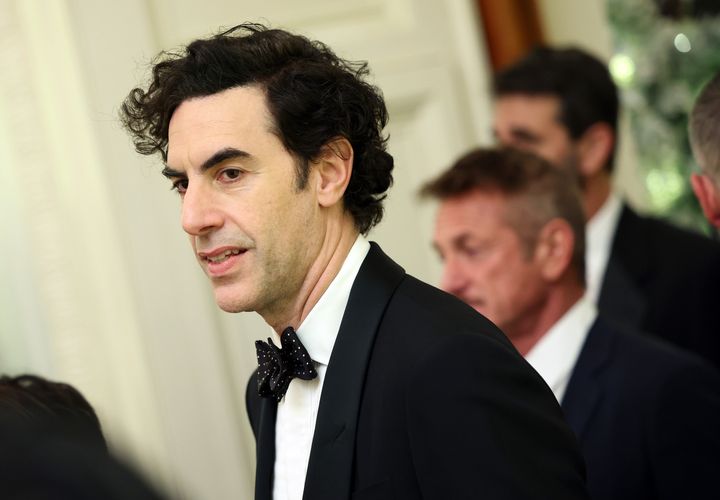
Sacha Baron Cohen

Kevin Dietsch via Getty Images

Sacha Baron Cohen’s team reiterated his original statement when contacted for comment by HuffPost UK.

Rebel previously opened up about her working relationship with the Borat creator during a 2014 radio interview with KIIS FM.

“Sacha is so outrageous,” she said a decade ago, as reported by Australia’s Courier Mail outlet.

“Every single day he’s like, ‘Rebel, can you just go naked in this scene?’ And I’m like, ‘No!’.

“Sacha and I have the same agent in America and I’m like, ‘Sacha, I’m going to call our agent Sharon and tell her how much you are harassing me’.

“Every day he’s like, ’Just go naked, it will be funny. Remember in Borat when I did that naked scene? It was hilarious’.”

She continued: “On the last day I thought I’d obviously won the argument and he got a body double to do the naked scene.

“Then in the last scene … he was like, ‘Rebel can you just stick your finger up my butt?’ And I went, ‘What do you mean Sacha? That’s not in the script.’ “And he’s like, ‘Look, I’ll just pull down my pants, you just stick your finger up my butt, it’ll be a really funny bit’.”

Rebel concluded: “You don’t wanna be a diva so I [said] I’ll slap you once on the butt and that’s it.”

This article has been updated to include a response from Sacha Baron Cohen via his spokesperson.

Share Button

Shakira Shares The Surprise Reason She Isn’t A Fan Of Barbie Movie

Shakira would’ve liked to have seen a bit more “Kenergy” in the 2023 blockbuster Barbie.

In an interview with Allure published on Monday, the Colombian pop singer shared her less-than-glowing take on Greta Gerwig’s acclaimed movie, which starred Margot Robbie in the title role.

“My sons absolutely hated it. They felt that it was emasculating,” she said, referring to her sons, 11-year-old Milan and nine-year-old Sasha, whom she shares with her ex-boyfriend, Gerard Piqué. “And I agree, to a certain extent.”

The three-time Grammy winner said she wanted her sons “to feel powerful too” while “respecting women,” something she felt Barbie didn’t adequately portray.

“I like pop culture when it attempts to empower women without robbing men of their possibility to be men, to also protect and provide,” Shakira said.

“I believe in giving women all the tools and the trust that we can do it all without losing our essence, without losing our femininity.

“I think that men have a purpose in society and women have another purpose as well. We complement each other, and that complement should not be lost.”

Margot Robbie in character as Barbie

Warner Bros

“Just because a woman can do it all doesn’t mean she should?” journalist Patricia Alfonso Tortolani asked on social media in response, with Shakira replying: “Why not share the load with people who deserve to carry it, who have a duty to carry it as well?”

Released in July last year, Barbie debuted to praise from critics and was a tremendous hit, raking in over $1 billion at the box office worldwide.

The movie also garnered a total of eight Academy Award nominations, including acting nods for Ryan Gosling and America Ferrera.

Despite the accolades Barbie received, a number of dissenting voices did emerge. Among those was director Oliver Stone, who criticised Ryan Gosling for not focusing on “more serious films”.

“Ryan Gosling is wasting his time if he’s doing that shit for money,” he told City A.M. in June last year. “He shouldn’t be a part of this infantilisation of Hollywood.

“Now it’s all fantasy, fantasy, fantasy, including all the war pictures: fantasy, fantasy.”

When Deadline reprinted some of his City A.M. interview in January, the Natural Born Killers director clarified that his remarks on Barbie were made before he’d had a chance to view the movie in its entirety.

“I was able to see Barbie in July and appreciated the film for its originality and its themes,” he wrote on X, formerly Twitter. “I found the filmmakers’ approach certainly different than what I expected. I apologise for speaking ignorantly.”

Share Button

Judge Expands Donald Trump Gag Order After Attacks On His Family

A Manhattan judge expanded the limited gag order imposed on former President Donald Trump over his upcoming hush money trial after a series of attacks on the judge and his family.

Judge Juan Merchan barred the former president from going after his family members or those of Manhattan District Attorney Alvin Bragg, saying Trump’s efforts served “no legitimate purpose.”

“It merely injects fear in those assigned or called to participate in the proceedings, that not only they, but their family members as well, are ‘fair game’ for Defendant’s vitriol,” Merchan wrote on Monday. “It is no longer just a mere possibility or a reasonable likelihood that there exists a threat to the integrity of the judicial proceedings. The threat is very real.”

His previous order blocked Trump from disparaging or making public comments about witnesses, prosecutors, court staff or jurors. But the judge pointed to Trump’s comments in recent days and said the court could not rely on the former president to modulate his behavior during the proceedings without explicit instructions.

“Admonitions are not enough, nor is the reliance on self-restraint,” Merchan added. “The average observer, must now, after hearing defendant’s recent attacks, draw the conclusion that if they become involved in these proceedings, even tangentially, they should worry not only for themselves, but for their loved ones as well.”

The judge declared that those concerns would “undoubtedly” interfere with the fair administration of justice in the Manhattan criminal case.

Former President Donald Trump faces an expanded gag order in the Manhattan hush money case that's set to go to trial on April 15.
Former President Donald Trump faces an expanded gag order in the Manhattan hush money case that’s set to go to trial on April 15.

Lev Radin/Pacific Press/LightRocket via Getty Images

Bragg’s office on Monday asked Merchan to expand the order after Trump took aim at the judge’s daughter, spreading false claims about her on social media.

“Defendant’s dangerous, violent, and reprehensible rhetoric fundamentally threatens the integrity of these proceedings and is intended to intimidate witnesses and trial participants alike — including this Court,” the district attorney wrote in a court filing.

“[Trump] knows what he is doing, and everyone else does too.”

The former president assailed Merchan after the judge imposed the order last week, claiming Merchan was attempting to deny the former president his “First Amendment Right to speak out against he Weaponization of Law Enforcement.” Trump claimed that Merchan’s daughter, Loren, had used an image of him behind bars as her profile picture on the social media platform X.

But that wasn’t true. The account once belonged to the judge’s daughter, but she deleted the handle about a year ago. It has since been taken over by someone else. A spokesperson for New York’s state court was forced to clarify that she was not linked to the account in any way.

“So, let me get this straight, the Judge’s daughter is allowed to post pictures of her ‘dream’ of putting me in jail, the Manhattan D.A. is able to say whatever lies about me he wants, the Judge can violate our Laws and Constitution at every turn, but I am not allowed to talk about the attacks against me,” Trump wrote on his Truth Social platform.

Loren Merchan is a Democratic political consultant.

Trump had been subject to a gag order during his civil fraud trial in New York. He was fined twice for violating the restrictions, and the judge overseeing the case warned the former president to refrain from doing so again or face even “worse” penalties.

Trump’s hush money trial is set to begin on April 15. It centers on payments made before the 2016 presidential election to quash accusations of extramarital affairs. The payments included a reported $130,000 to adult film star Stormy Daniels less than a month before Election Day.

Share Button

Trump’s Truth Social Bled Tens Of Millions Of Dollars Last Year

Truth Social, the conservative social media network that former President Donald Trump launched in 2022 after being banned from other platforms, lost more than $58 million and generated a mere $4.1 million in revenue last year.

The revelations about Truth Social’s current situation came in a Securities and Exchange Commission regulatory filing from Trump’s company, Trump Media & Technology Group, on Monday. The financial situation is so dire, an auditor warned in the filing, that it raises “a substantial doubt” about whether TMTG can “continue as a going concern”.

In other words, Truth Social may have to shut down, going the way of Parler ― another conservative social network that had to shutter after just a few years in business.

The news comes a week after TMTG completed a merger with a shell company, Digital World Acquisition, to go public, infusing Truth Social with $300 million. But shares in the company dropped more than 15% following Monday’s news.

To put Truth Social’s precarious finances into context, Twitter, now known as X, generated more than $660 million in revenue in the year leading up to its going public, and it generated $5 billion in the year before Elon Musk bought it and took the company private.

Truth Social had fewer than 500,000 monthly active users in February.

NurPhoto via Getty Images

Per the SEC filing, all of Truth Social’s money comes from advertisers buying space on the platform, and most of its expenses involve paying interest on debt.

The biggest problem Truth Social faces is that its user base is microscopic compared to that of other social platforms. In February, it had just 494,000 monthly active users, according to statistics obtained by CNN. That’s about 150 times smaller than Twitter’s roster of active users, and 290 times smaller than Facebook’s.

Despite its small community, and despite other social platforms lifting their bans on Trump, Truth Social remains the former president’s go-to forum for attacking his opponents and issuing reactions to news events. His posts there have repeatedly landed him in hot water, forcing various judges to impose gag orders on Trump while presiding over cases against him.

Last week, Trump came under fire for posting a video on Truth Social showing an image of a hogtied President Joe Biden painted on a truck. The Biden campaign accused the post of suggesting physical harm toward the president.

“Trump is regularly inciting political violence and it’s time people take him seriously,” Michael Tyler, the campaign’s communications director, said in a statement.

Share Button

Study aims to break brain injury link to depression

Half of those admitted to hospital with a brain injury report depression in the following year, research suggests.

Share Button

Diabetes patients offered artificial-pancreas tech

The rollout of new devices for thousands in England with type 1 diabetes is hailed as a landmark moment.

Share Button