Prepping for NaNoWriMo

I spent some time today learning more about NaNoWriMo, including sifting through their member forums looking for beginner tips and suggestions. Fortunately there’s a ton of advice from other writers who’ve done NaNoWriMo many times before.

I was curious how many people who sign up for NanoWriMo each year actually succeed at writing at least 50,000 words during the month of November. The completion percentage is different each year, but it seems to average around 15%. That lands within my expectations.

When it comes to 30-day challenges, I find that the early game is key. I usually win or lose the challenge before I even begin Day 1. How I frame the commitment matters. I have to get my mind right before I start, so I’m investing in that now for NaNoWriMo.

Here are some useful frames that have served me well over the years, which I’m also adapting to gear up for NaNoWriMo, which starts in less than two weeks.

  • Once I commit to the challenge, it’s a done deal that I’ll do all 30 days. There is no quitting except for some kind of critical emergency like a health crisis.
  • If 15% of people typically finish NaNoWriMo successfully, I see myself as a member of that 15% before we even begin. Even though this is my first NaNoWriMo and my first novel, I can mentally put myself in that top 15% now. That’s a decision, not a prediction.
  • Most 30-day challenges get difficult at some point, usually between days 6 and 15. The initial motivation will die off, and the finish line will still seem far away. It’s wise to expect this to happen and to pre-commit to enduring through that tough period.
  • It’s one day at a time. Do the daily actions, and the 30-day result will be achieved. In this case the daily commitment is to write at least 1667 words per day for 30 days. A daily commitment is easier to follow than a monthly one that allows wiggle room day by day. So I’m not looking at having 500-word days and making up for them with 3000-word days. I think the daily framing is easier. Then I can’t fall behind. A lot of people failed NaNoWriMo by using the framing that it was okay to fall behind and do extra writing to make up for it later in the month. So my framing is that falling behind on even one day’s quota is not an option, but exceeding it is okay. And exceeding the daily average doesn’t reduce the daily average for the upcoming days.
  • It’s best to focus on the core challenge, which is to write. The challenge isn’t to re-read, to edit, to research, or to plan – just to write. Many NaNoWriMo participants noted that it’s best to edit later and just get the first draft written, even if it’s ugly. Many also noted the trap of getting stuck in unnecessary research that killed their word count.
  • I’ll gain a lifetime memory from my first NaNoWriMo. That memory will be mine for decades. It’s clear that I want to look back on my first NaNoWriMo and remember that I made it to 50K words and succeeded. I don’t want the lifetime memory of failing or quitting.

Regarding that last point, I saw lots of references regarding how real these memories are for previous NaNoWriMo participants. They remember their past events, noting which ones were successes and which were failures. They remember why they failed and what derailed them.

Sometimes my best source of motivation comes from reminding myself that I’m creating a lifetime memory no matter what. Whatever happens in November, it’s either a gift or curse for my future self – for the rest of his life. When it’s only day 10 and motivation is low, it can be empowering to remind myself that I have a choice: I can give my future self the memory of pushing through to success, or I can curse him with the memory of quitting and making excuses. I can give him the memory of being in the 15% or the 85%, and that’s going to affect him indefinitely.

Writing 50K words in November is a done deal. No other framing makes sense. I will not curse my future self with the lifetime memory of failing my first NaNoWriMo. I’m going to gift him with the memory of an experience he will cherish for decades.

Do whatever it takes to give your future self some extra smiles. Soon enough those smiles will be yours.

Share Button

NaNoWriMo 2020

As I’ve shared previously, one of my goals for this year is to write a novel. I’ve never done that before. It’s been a stretch goal of mine for a long time, and I’ve decided the time has come to finally do it.

To move this goal forward in a more concrete way, I signed up for NaNoWriMo on Friday. NaNoWriMo stands for National Novel Writing Month, and it happens every year in the month of November. I’ve been aware of it for years, but this is the first time I’ve ever signed up for it.

If you have a NaNoWriMo account, feel free to add me to your buddy list. Here’s my NaNoWriMo profile, but I think you’ll need to be logged in there to see it. My account is Steve Pavlina, so it should be easy to find me there.

NaNoWriMo is both an annual online event and a non-profit organization. It started in 1999 with 21 people, and now hundreds of thousands of people participate each year. It’s entirely Internet-based, so you can participate from home. It’s also free if you want it to be, although they encourage donations. If you made a donation, they add a halo to your profile pic – cute!

The purpose of NaNoWriMo is to help you write the first draft of a novel. The stated goal is to write at least 50,000 words of a novel during the month of November. That can be an ugly first draft, and you don’t even have to finish the whole book.

There’s a lot of social support in NaNoWriMo as well. This includes an active community forum, recorded pep talks, and lots more. In fact, right after I post this, I’m going to hop on a two-hour call from my local NaNoWriMo chapter, which is hosting an online event to help members get started.

Why Write a Novel?

I’m already a published author, so that part won’t be new to me. My book Personal Development for Smart People was published by Hay House in 2008. Since I uncopyrighted my blog posts in 2010 as well, many more books have been published under my name – at least 150 of them last time I counted.

I can say that it was special experience to walk into a bookstore and see my book on the shelf many years ago. That does feel awesome. But since I’ve already had that experience, this isn’t a significant part of my motivation for writing fiction.

My motivation for writing a novel isn’t about the book aspect but rather the fiction aspect. I’m really curious about what it will be like to create a work of fiction.

I’m especially motivated by exploration and growth, and I love a good challenge. It seems like this would be a wonderful way to explore writing from a fresh perspective.

I don’t already have a story in mind. I don’t even know what genre I’d pick yet. Rachelle says I should write a sci-fi book, and that does have some appeal, but right now I still feel very open to the possibility space. I feel more interested in co-creating a novel with reality, much like the attitude I use with blogging.

I’m used to writing from inspiration, and I know how to do that whenever I want. This works for shorter pieces like blog posts and videos, and it also works for creating extensive courses. Reality always has my back when it comes to opening the floodgates of inspired ideas to share.

Since I already have a wonderful creative relationship with reality on the nonfiction side, I want to see if I can stretch this relationship to include fiction as well. Will it be radically different if I have to think about characters and settings and plot?

I do feel confident that I could write the first draft of a novel with a pantser approach – just write from start to finish without pre-planning – but it might be pretty bad. Then again, maybe this approach is good enough for a first draft.

Writing 50K words in a month doesn’t seem daunting to me. It actually sounds like fun. If I squeeze myself to write a novel in a month, what will come out? I don’t know.

Will it be something cerebral? Personally meaningful? Humorous? Slutty? All of those? I can’t say. Nothing has been decided yet.

Since I’ve never written a novel before, the pantser approach does appeal to me, at least for the first time, if only because I haven’t learned a more structured approach yet. It might be nice just to see what comes out of me by writing from inspiration. Maybe that adds up to a sucky story that’s painful to read, but maybe it generates enough good ideas that I could edit it into something semi-decent.

Any interest in joining me? About six weeks from today, you and I could both have the first draft of a novel done. Wouldn’t that be nice?

Share Button

Universal Timing Alignment

I’ve noticed that when I get an idea for a big new project, the timing often doesn’t feel good right away. It’s as if the idea wants to get my attention, so I can start thinking about it, but it also needs time to incubate.

If I try to force the idea forward faster, it’s like pushing through molasses. It takes lots of discipline, and I have to forcefully re-engage with the task again and again. The inspiration to move it forward isn’t present. These projects don’t succeed. If they ever get completed, the results are disappointing.

On the other hand, if I conclude that the idea isn’t right for me because the inspiration to take action isn’t there yet, that could kill the idea completely. I may never get around to doing it if I force the “now or never” attitude.

There’s an empowering alternative approach, which is to say yes to the idea and then to invite the alignment that can move it forward powerfully without having to force it. You can say yes to the idea and invite the inspiration to act. Then you wait.

I think of this as aligning with truth first, then love, and then power. I often see the appeal of an idea – the truth aspect – first. Then I need time to dance with the idea for a while. I have to play with it and explore different permutations of it. I need to discover what it wants to become and how I can bring it to expression. This phase of aligning with love for the project could take months, sometimes years. It’s very personal too – I must discover what the project means to me and why I’d want to do it. So this phase is really an exploration of deeper meaning.

This meaning doesn’t have to be so grandiose. Often it’s a very simple framing. Where’s the fun? Where’s the play? Where’s the growth? Why would I want to invest weeks or months of my life in this? What’s the point?

The answer is never money, by the way. If that’s the main reason for doing a project, the idea is lifeless.

The real key to discovering what a project means to me is exploring how it will affect my relationship with reality. Once I see the invitation to explore a fresh and expansive way of relating to reality, the idea starts generating a lot of its own energy. It becomes a power source. I feel waves of motivation and invitation drawing me forward, almost irresistibly so. That’s when I can fully enter the power phase, and I know it’s time to move forward strongly. The power isn’t really mine though. I don’t have to push forward with lots of discipline and force. It’s like surfing waves that are being generated. I just have to align with the waves and catch them, and their energy pulls me forward.

At this point it’s actually harder not to take action. It’s like seeing a delicious meal that’s right in front of you when you’re hungry. It would take more discipline not to take a bite. It’s easier to act when the motivation is there.

What’s the difference between an idea that dies and one that enters this power phase? I’d say the key is that I have to say a true yes to it. I have to commit myself. I don’t have to commit to the exact timing. I just have to get clear that sooner or later, I’m really going to do it. I decide that it will happen, not merely that it could happen.

Then I invite the universe to signal when it’s ready, as if it needs time to put all the pieces in place or to write the appropriate subroutines to simulate its parts of the project.

Sometimes I think of the idea as an energy bubble that hangs out in some subspace of reality for a while, and when enough other people are ready for this idea to be birthed, we all collectively combine our energies to make it happen. Even if it seems objectively like I’m doing most of the work on a project, it often feels like there’s a collective intention driving it forward.

This does require trust. It requires patience. It requires not settling for projects that aren’t very motivating. It requires the willingness to embrace a co-creative relationship with reality.

One reason I’ve learned to trust this process is that it leads to a really nice life that I appreciate and enjoy. I don’t have to work, work, work all the time. When I work in alignment with universal timing, it’s so efficient and flowing that it doesn’t feel like work much of the time. It’s more like a feeling of creative juiciness. The results of this approach are abundant, so there’s no need to scramble or hustle throughout the whole year.

When I have some downtime between these kinds of projects, I enjoy that too. I work on smaller tasks and projects. I make upgrades to my life and lifestyle. I enjoy time with Rachelle. I go through lots of books and courses. I do personal growth experiments. I ponder ideas, journal a lot, and develop new insights. I practice. I prepare. I write and share. And I live with the anticipation that another big wave of creative energy is coming up, and I know that when the timing is right, I’ll catch that wave and ride it.

Share Button

Problems You Only Need to Solve Once

If you have a recurring problem and you can reasonably expect it to recur, solve the problem once. Really solve it. Document your solution. Then run your solution each time the problem occurs.

This form of process documentation is common in business. I recommend you use it in your personal life as well.

Here are some examples of problems you can solve just once:

  • Do you get up right away when your alarm goes off in the morning without ever using the snooze button?
  • If you’re feeling anxious, stressed, worried, frustrated, depressed, or overwhelmed, do you know how to get back to feeling good relatively quickly?
  • If you start to lose clarity about your goals, do you have a reliable process for regaining clarity?
  • Do you exercise consistently? Or do you have to keep restarting?
  • If you’d like to create a new article or video, are you able to do that whenever you want without feeling blocked?
  • Are you able to have a productive workday when you want to?
  • If you catch yourself feeling distracted, do you know how to restore focus?
  • Do you keep your kitchen well-stocked with healthy food?
  • Do you know how to decide which task to do next?
  • How do you decide what to eat for breakfast or make for dinner?
  • Does it ever take you more than a minute to decide which clothes to wear?
  • Do you always have enough clean laundry?
  • How do you know when it’s time to upgrade your tech (phone, computer, etc)? Is it easy for you to choose your upgrade model?

You don’t have to document a process for every little thing. Maybe you’re okay deciding what to eat based on impulse or feelings. If your current process works for you and you don’t need a better solution, that’s great. But if you tend to get stuck on problems that repeatedly slow you down – and if you can expect those patterns to continue – then maybe it’s time for you to sit down and work out a more intelligent approach.

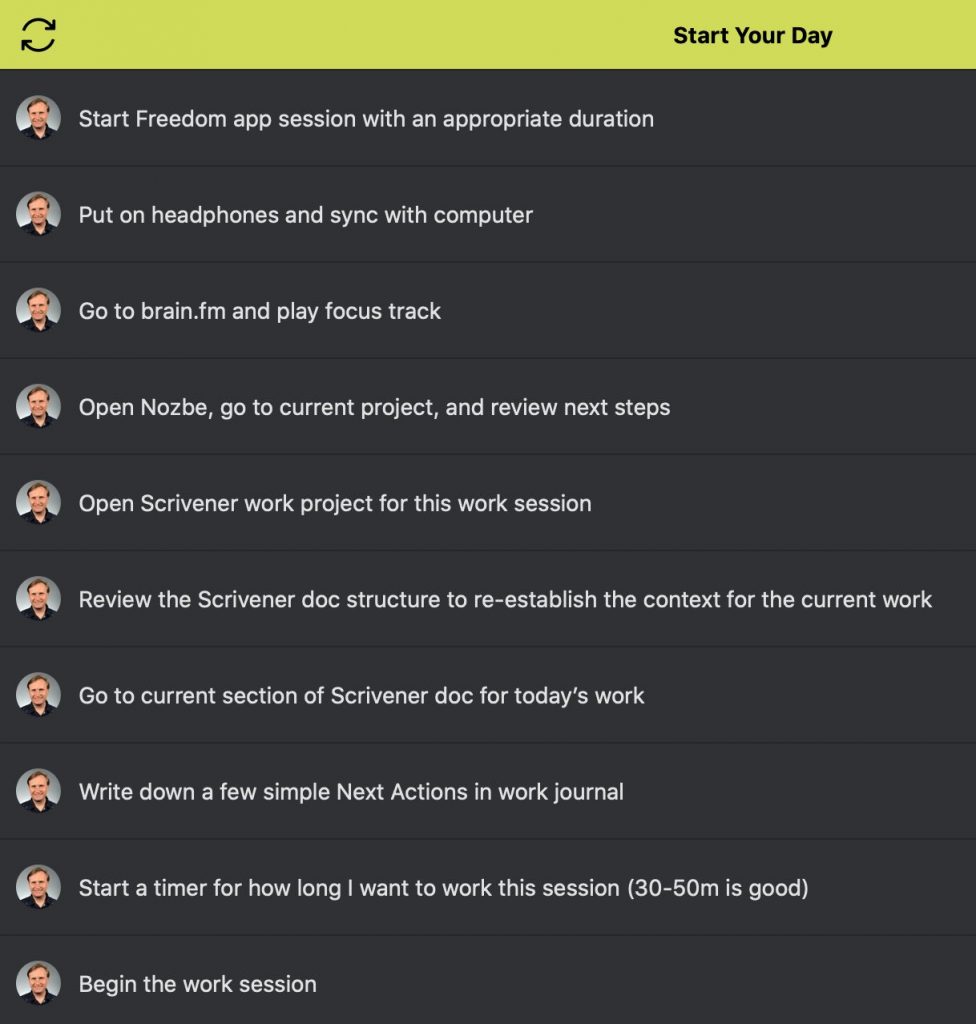
Sometimes I’ll document a process for an aspect of life just in case I ever need it. Here’s an example:

This is a Nozbe template I created for starting my workday. It’s not the only way that I can start my workday, but it’s a step-by-step routine that works well for me. If I ever feel unclear about how to begin my work for the day, I can run through this simple checklist to get started. It only takes a few minutes to run through these actions.

I have many other processes documented too. For instance, I have a detailed process for doing coaching calls in Conscious Growth Club, including getting the recordings published to the member portal afterwards. I’ve gone through this process more than 100 times, so I don’t ever need to use the checklist, but it’s nice to know that the process is fully documented. I never have to be confused or uncertain about the action steps. I also have a documented process for doing our quarterly planning sessions to help members set goals for each new calendar quarter.

A recurring event isn’t really a problem if whenever it occurs, you know exactly how to handle it.

Solving a problem once is very freeing. You can always go off-script and try something different if you like variety, but when you don’t feel like reinventing the wheel, it’s nice to have a scripted solution that you can trust.

Life is full of interesting problems to solve. There’s little point in solving the same problems repeatedly if you can solve them just once. When you aren’t stuck having to solve anew the same recurring problems, you can invest your mental energy elsewhere.

I encourage you to pick a recurring problem that you expect will happen again. Solve it once – in advance – by carefully thinking through the action steps. Document your solution. Save your solution. And use your solution when you need it.

You may want to print and post your solution in a convenient location, especially if it’s easy to forget because you don’t run it that often.

I have to adjust my home’s irrigation system four times per year to make sure the landscaping gets enough water for the season. During the summer we can legally run the irrigation six days a week. In the spring and fall, it’s three days a week. And during the winter, we can only run it one day per week. Reprogramming the system takes about 30 seconds if I remember the steps, but if I forget the steps, it may take me 5 minutes to figure them out again. So I wrote the action steps on a slip of paper and put that paper next to the irrigation controls. This makes it easy for me to run the process consistently without having to think about it.

The next time you catch yourself freshly solving a recurring problem, pause and ask yourself: How many more times will I re-solve this same problem over the course of my life? Is that really an intelligent approach? Why don’t I finally solve this once, so I don’t need to solve it again, at least for the next decade or so?

Share Button

Redefining Your Roles

You have many roles to play in life, such as various job to perform, being someone’s relationship partner, and being a a personal growth explorer.

That there may be gaps, however, in the roles you identify, and you may want to devise a new role to cover a gap.

Look especially for areas where you’ve been procrastinating or getting weaker results than you’d like. Do you have an appropriate role for that area? Have you chosen a suitable label for the role that you like?

Identity Encourages Behavior

Note that identity supports and reinforces behavior, as noted in the recent Be a Voter post. You’re more likely to succeed in making a behavior change if you seek to adopt an identity change to align with your new behavior.

If you’re not exercising regularly, for instance, could it be because you lack a proper role to support this behavior?

One role could be runner. Another could be yogini. A runner runs, and a yogini does yoga. If you want to call yourself a runner, you’ve got to run; otherwise you can’t honestly claim the label.

I like using the athlete label. It’s good role that encourages me to exercise in a more balanced way than runner. Athlete works as a good long-term label. It encourages me to keep growing, exploring, and challenging myself in this area of life.

Sometimes labels have interesting side effects. By thinking of myself as an athlete instead of as just a guy who exercises, I buy better running shoes and exercise clothes because it fits the role. This role helps me see exercise as a long-term pursuit worthy of decent financial support.

Another label that works well for me is vegan. Some people prefer plant-based, which labels the behavior but not the role. Consequently, plant-based is significantly weaker in terms of identity – it’s a label for wannabes and approval seekers. It’s better to lay claim to the vegan role and to not be so timid about it. The identity framing of being vegan is stronger than just calling yourself a plant-based person. Vegan is a lifestyle. My yard is plant-based.

What labels do you use for your health and fitness roles? How are they working for you?

Adopting New Roles for Growth

In addition to tweaking and improving your existing roles and labels, you can also add new ones.

For instance, if you want to really get into music or writing, start labeling yourself a musician or writer. If you want to get serious about coaching, don’t just do coaching – be a coach!

Become that which you want to embody. Create a role for an empowering behavior pattern.

Recently I felt a desire to improve at prioritizing and balancing various projects. Using labels like blogger or entrepreneur don’t help much in this area, so I added a new role to encourage more attention on this skill set: the role of manager.

Previously I didn’t think of myself as a manager, but I do have a lot to manage, and I like the idea of improving my skills to the point where I can genuinely think of myself as a highly effective manager. So this role has a positive association for me – it’s a path of growth.

Note that labels are very personal though. You might dislike a label that works exceptionally well for me. That’s fine. Your invitation is to pick the roles and labels that motivate you.

If a label doesn’t motivate you to engage with some area of life, dump that label, and pick a different one. Sometimes you have to test a few different labels to find one that actually motivates you.

Be careful as well to pick roles that allow room for growth. A good role helps you stretch. A bad role cages you. Take a look at your existing roles. Are there any that you’ve outgrown?

What new roles could you add to your life to remind you to invest in areas that you’ve been neglecting?

Good roles are invitations. They entice you to do some character building in new directions. A good role encourages you to make positive behavioral changes to align with it and to stay aligned. By reminding yourself of the role, you have a shortcut to remember the behaviors you want to adopt.

Share Button

Be a Voter

Which is better? To encourage someone to vote or to encourage them to be a voter?

If you want the person to actually vote, encourage them to be a voter. It’s been found that this framing is more likely to lead to action.

If you’d like to strengthen a behavior, weave it into your identity. And if you’d like to change someone else’s behavior, encourage them towards an identity change that includes that behavior.

Use this framing with yourself too.

Don’t just get up early. Be an early riser.

Don’t just make a difference. Be a contributor.

Don’t just do personal growth experiments. Be an explorer.

Don’t just post on social media. Be a blogger, podcaster, or YouTuber.

A similar framing shift motivated me to register to vote this year (my first time voting in any political election). Being encouraged to vote never motivated me to change, perhaps because it seemed like a pointless behavior. I decided to vote this time because I want to be a participant, not a spectator. Being a nonvoter in this election doesn’t feel like a good identity to embrace. This time I feel like I have to vote against stupidity in a way that didn’t seem necessary before.

I’ve found this framing especially helpful for leaning into long-term changes, like thinking of myself as an entrepreneur when starting my first business back in 1994. Being an entrepreneur is a stronger frame than starting or running a business. A behavioral frame lets you get a job when you hit a rough patch in your business, but an identity frame makes that option harder to consider.

Consequently, you may want to use behavioral framing when you’d prefer to keep your options open and give yourself more room to pivot. Behavioral framing is more flexible. If, however, you want to feel more committed and focused, so you can really invest in a particular path, identity framing is often the better choice.

Share Button

Raising Your Baseline

In practicing the slow, shallow breathing approach from The Oxygen Advantage that I shared about during the past two days, I’m grasping that the key to this approach is to define a new baseline for my breathing and then keep synching back to that new baseline whenever I catch myself drifting from it.

The initial temptation is to sync back to my old way of breathing, which can happen automatically when I lose awareness of my breath. Then I might catch myself and practice consciously reducing my breath so I’m not over-breathing.

An aspect of this change that’s easier to catch is when I moderately exert myself for a short burst, like walking up a flight of stairs. My breathing becomes a little heavier afterwards, so I make a conscious effort to bring it back down quickly, ideally within no more than 2-3 breaths.

So it’s like I have a breathing budget, and I’m doing my best not to squander it. My budget for air this week is much lower than it was last week. And next week I’ll try to nudge it even lower.

I realized that a similar strategy also works for adjusting our emotional baselines.

Suppose you often feel depressed, frustrated, angry, anxious, or some other emotion you’d prefer not to feel so much. Pretend that you’ve suddenly been allocated a lower budget for feeling negative emotions, and you have to be careful not to squander it too quickly.

Imagine if life dramatically cut your negative emotion budget by saying: Henceforth you’re only allowed to spend half as much time in negative emotion territory.

How would you obey this mandate?

You need two pieces to succeed here:

  1. Frequent check-ins with yourself to see how you’re doing
  2. A quick recovery strategy to shift from the old behavior to the new one

Whenever you catch yourself experiencing some negative emotion, you must leave that territory and return to a positive or neutral baseline as quickly as possible. Otherwise you’ll squander your negative emotion budget too quickly.

Do you already have such a strategy? Do you know how to quickly shift yourself back to neutral or positive emotional territory? Can you do this within a few breaths?

If you don’t have such a method, then finding one ought to be a key strategic piece for raising your baseline. Being aware of negative emotions isn’t enough – you’ve also got to change them.

To practice reducing my breathing immediately when it’s too rapid, I do the opposite of the unwanted behavior. I deliberately slow down. I can’t breathe slowly and quickly at the same time, so by doing what’s incompatible with rapid breathing, I stop the rapid breathing.

It’s much the same with negative emotion. What’s incompatible with negative emotion? Positive emotion. So if you do something – anything – that makes you feel good within seconds, the negative emotion has to drop off. It can’t hang around while you’re feeling good.

Then the long-term challenge is to habitualize this recovery pattern by always practicing it at every possible opportunity.

I’m doing my best to not let myself over-breathe. Whenever I notice that I’m doing that, I immediately take conscious control of my breathing and slow it down. If I don’t do this, my baseline won’t shift, and I won’t really get to test and experience the results on the other side.

Initially you may have to consciously take control a lot – like dozens of times per day – but if you stay as consistent as you can, you’ll raise your baseline, and the new behavior pattern will become your new default.

Where else could you apply this idea? You could use it for productivity habits, eating habits, early rising, and lots of other areas of life. The key is to develop a rapid strategy for shifting your behavior in a way that’s incompatible with your old baseline. Then apply that shifting behavior every time you catch yourself running the old pattern.

To really create an effective change, the old behavioral baseline must become unacceptable for you. In order to progress to a new baseline, you must eventually regard your old baseline as out of bounds and below standard, even if it still feels normal. This is a simple approach I’ve used repeatedly times for doing personal growth experiments and also for making long-term changes. To embrace the new, there must be some willingness to say: The old behavior is dead to me.

Share Button

Time Logging Insights

For the month of September, I maintained a daily time log, as described in the post called Long-Term Time Logging. Now I can share some insights from what I learned.

In this case it actually wasn’t that helpful to see where my time went. I was pretty aware of that already, so reviewing the logs didn’t give me many insights there. My logs matched up pretty closely with my assumptions and expectations.

What was surprising was what gave me the most joy. At the end of each day, I asked a simple question and briefly answered it at the bottom of the day’s time log. That question was:

Do I love this day?

I had assumed that by asking this question, it would help me become aware of which days I felt best about, and then I could deliberately embrace more of those positive patterns. That turned out to be true, but the surprising part was what actually created a day I loved versus a day I didn’t love.

I figured going into this that I’d love my most productive days. If I got a lot of work done, that should give me a sense of accomplishment, and then I’d feel great at the end of the day, right?

Wrong actually. My most productive day was the day I appreciated the least. Looking back, I was pleased that I got a lot done, but that satisfaction was so much at a mental level. That mental satisfaction didn’t reach into my heart and make me feel like I could genuinely say I loved the day.

The days I loved most when I reflected back on them had more to do with being than with doing. All that was required for me to love the whole day was to recall one delightful event from it, and these events were usually very simple and not particularly effortful.

One Delightful Event

Even if most of the activities of a day were routine or so-so, if I experienced one delightful event during the day, I would always feel a heartfelt sense of appreciation for the day when I reflected back on it afterwards. So my appreciation ultimately came down to simple moments.

Mostly these delightful events involved something new – usually not wildly different but with just enough novelty to create a special memory for that day.

Here are some examples of small but delightful events that made me reflect back on the day with feelings of love and appreciation:

  • Running a different route than I’d run before, along a new street that had just recently been paved on the western edge of the city. The streetlights were working, but the sidewalks and landscaping hadn’t been added yet. It felt special to be one of the first people to run down a new road that wasn’t open to car traffic, like it was my own private running route. On one side was a wall with newly built houses behind it, and on the other side was open desert. (See the photo below, taken during my first run down that street.)
  • Playing some new video games with Rachelle, especially A Short Hike and Untitled Goose Game – the goose game made us laugh a lot.
  • Going to the Apple Store with Rachelle, getting new Apple Watches, and chatting with the employees. The store had been closed for many weeks and just reopened last week, so the vibe was upbeat and happy.
  • Returning a monitor that broke (while under warranty) to that same Apple Store and getting a replacement for it, which made me appreciate it more.
  • Going for a longer than usual run with new running shoes one morning.
  • Cleaning up some parts of the house to restore them to a nicer state of cleanliness and order.
  • Watching Cobra Kai with Rachelle. The show is set in an area where I used to live, and it reconnected me with fond memories of martial arts training.
  • Discovering some useful insights during journaling sessions.
  • Participating in a weekend intensive with a coaching group on Zoom.
  • Connecting with CGCers during coaching calls.
  • Attending a live script reading of The Princess Bride with many of the original cast members, along with more than 100K other people.
  • Listening to Kevin Smith’s Tough Sh*t audiobook, laughing a lot, and loving all the geeky references.
  • Yummy sex.
  • Having a good dentist appointment and chatting with the hygienist. (I actually like going to the dentist since the people there are so friendly and down-to-earth.)
  • One day when I exercised for 150+ minutes – it felt good to move a lot.
  • Attending a diversity committee call for the Transformational Leadership Council – nice to connect with like-minded friends who care.
  • Watching the final episode of The Good Place with Rachelle and seeing her getting teary-eyed at the end.

September was a pretty happy month for me, probably because I paid extra attention to happiness. I realized that big accomplishments don’t fuel my happiness as much as I thought, but small delights do.

A nice morning run, an insightful journaling session, a fun video game – these are all good ways to create a day I’ll appreciate. But what seems to help the most is including some form of novelty in a day. Newness made me happier than routine.

It’s more special to play a new video game than one I’ve played many times before. It’s more special to try a new brand of running shoes that I’ve never worn before. It’s more special to go a slightly different direction instead of following a familiar route.

It’s okay if my experiences are rooted to familiar places and situations, but one little twist in the direction of novelty somehow makes me appreciate the experience – and the day – more than I otherwise would.

Just running down a different street instead of running one of my standard routes can make a meaningful difference in how I feel about the whole day. I could have the laziest day ever, but if I just had one new experience that day, it elevated my relationship with the day. That surprised me. I didn’t think novelty was so meaningful.

Work-wise I felt better about the days when I didn’t use a system or routine to get things done. I had more appreciation for the days when I went with the flow of inspiration, especially when it led to engaging with work a bit differently. This makes me really curious about how to leverage this further. Would I be more productive if instead of trying to systematize my approach to work, I went in the opposite direction and did something to make each day truly unique?

Note that having a routine and embracing novelty are not necessarily contradictory approaches. You can follow a structure and still include some novelty, like how many movies adhere to genre standards and then try to add some unique twists. A good structure often becomes invisible, so you’ll probably notice and appreciate the novel aspects more.

What I gained from this 30-day experiment is a greater respect for small delights created through novelty. When I feel a nudge to lean in the direction of doing something new, I’m more likely to trust that impulse now. When I have that thought to run a different route one morning, I trust that it serves a good purpose. Doing something even slightly new makes the activity more memorable, and it’s the memory that I appreciate.

I’m less likely to appreciate a very routine day because the day is harder to remember. When reviewing my time log entries, it’s hard to recall the details of a day filled with familiar items, even when I have a written record of the activities for that day. When there’s even one item that’s semi-unique though, I somehow remember the day with a smile.

Another realization is that newness stimulates more growth. Running a familiar route isn’t as stimulating for my body and mind as running a new route. Would I improve faster if I ran different routes more often instead of sticking with my familiar favorites? Probably.

I encourage you to do your own time logging experiment for at least a month, so you can discover your own insights, which won’t necessarily align with mine. Some readers have started their own logging practices within the past few weeks, and they’ve been emailing me to say that they’re finding it valuable too.

Share Button

Sliding Bad Habits Into Good Ones

As a follow-up to yesterday’s post on Honoring Your Hidden Goals, consider that hidden goals are similar to hidden habits. In each case the hidden aspect means that some part of you is finding a way to meet a need or desire that you’re not necessarily acknowledging.

When you identify hidden habits, you can also trace them back to their needs and desires, and then you can devise more deliberate ways to satisfy those desires.

It’s likely you have some habits you may identify as bad or problematic, but they’re actually serving you well.

Think of a bad habit as a good habit in disguise – as a habit with some negative side effects.

For instance, I love cuddling my wife in bed, but this desire can easily make me want to linger in bed longer each morning, such as by sleeping in super late – like until 6:30am or even an ungodly 7am.

At one point I did have this habit, which interfered with my other desire to get up at 5am and go for a pre-dawn run to start my day (which I love). But the cuddle-sleep habit does serve a nice need as well – human connection, touch, some extra happiness, and a happy wife who also loves to cuddle.

These mixed feelings were easy to resolve by sliding the habit of cuddle-sleeping into a different form. Instead of doing this in the morning, we often enjoy a 20-minute cuddle-nap together on the couch, usually shortly after lunch. This siesta gives us a nice midday connection and refreshes us for the afternoon, but it doesn’t interfere with my early riser habit.

Here are a couple of other examples of sliding problematic habits into better ones:

If you have a habit of over-checking the news lately (i.e. doomscrolling), maybe it’s because you like consuming content. Maybe you like learning something new each day. So you could experiment with sliding this into a deliberate content consumption habit like reading books, listening to audiobooks, listening to podcasts, or working through online courses. See if you can increase the quality of the content you consume each day. Many highly successful people swear by the habit of reading a lot each morning to start their workday, sometimes for 2-3 hours – they just do their best to make it purposeful. If you could slide this habit towards a more structured approach that involves higher quality content, it may be worth keeping.

Maybe you check social media a lot because it satisfies your desire for human connection. Of course it can also be shallow and distracting. Where else could you slide this habit to make it more beneficial? Perhaps you could invite people to join you on one-on-one calls to connect. Or you could continue using social media, but nudge yourself to do a live video each week to push further beyond your comfort zone, so it’s more of a growth experience for you. Alternatively, you could slide this habit towards five or six days per week instead of seven, so you have a day or two of screen-free time each week. Or you could slide towards meditation or a personally meaningful spiritual practice. For instance, the Submersion course includes daily lessons to help you improve your relationship with life, so you can feel more connected each day.

Whatever you’re doing that feels like a bad habit, look into what hidden need or desire it addresses. Does it give you a break? Help you relax? Make you feel more informed or connected? If the habit was all negative, you’d probably drop it, so you’re keeping it in your life for a reason.

Then see if you can raise your standards above and beyond what the hidden habit is realistically doing for you. If a habit helps you feel social, for instance, what would be a higher standard for socializing? Perhaps you could connect with smarter people, more depth, more impact, more ripples, more playfulness, more edginess, etc. Could you satisfy this desire in a more growth-oriented way without making it overly complicated?

Sometimes it’s best to start with a minimal slide. See if you can elevate the habit slightly, and then lock it in at the elevated level. You could keep checking the news, but add one lesson from an online course immediately afterwards (or right before). One way to do this is to create a tab group in your web browser for your favorite news sites, and then add one extra tab to that group for an online course you’d like to complete. As you work through (and close) the news tabs, you’ll soon reach the online course tab, and then you can do just one lesson of that course each day along with your news checking.

You can also slide good habits towards better ones. I did this with my morning runs this year. I gradually increased my running distance, just sliding it forward a little more week by week, till I was running double the distance I was running before. Now I’m doing something similar but with speed instead of distance, pushing myself to go a little faster on some of my runs. It’s a little slide forward each week, and it adds a lovely growth element to what I’d previously been regarding as a maintenance habit.

Another way to slide a habit forward is with appreciation and acknowledgement. Thank the existing habit for what it’s doing for you, even if you semi-dislike it. Thank it for the connection, the relaxation, the pleasure, the information, the satisfaction, the entertainment, etc. Don’t over-focus on the negative side since that can blind you to the needs and desires that still matter to you – and which you might lose abruptly if you tried to immediately drop the habit.

Sliding a habit into a better one is easier when you acknowledge the hidden needs and desires that habit is satisfying. Instead of demonizing the habit for being all bad, recognize that it’s actually serving a purpose. And accept that if you want to replace a problematic habit with a better one, it’s wise to keep fulfilling the habit’s beneficial purpose.

Broaden your awareness of what you actually care about by looking for the hidden needs and desires behind your so-called bad habits. Maybe you care a lot about being entertained, being informed, feeling connected, feeling secure, and so on. Maybe these aspects of life are more important to you than you’re willing to admit. It’s fine to value those parts of life, and it’s easier to fulfill those desires in more aligned ways if you acknowledge that you do indeed value what they’re doing for you.

Share Button

Honoring Your Hidden Goals

When you look back on the past calendar quarter, consider what you actually got done, even if your actions and behaviors didn’t align well with your stated goals. Your time went somewhere, so where did it actually go?

Use the lens of seeing everything you did as an accomplishment, even if your main achievement was watching Game of Thrones. Instead of beating yourself up for what you didn’t do, take a deeper look at what you did do.

So then your achievements might actually look like:

  • Watch Game of Thrones.
  • Spend two hours per day on Facebook.
  • Exercise sporadically, averaging about 30 minutes per week, mostly Yoga with Adriene videos.
  • Gain 10 pounds of fat.
  • And so on…

Now consider what goals you would have set at the start of the quarter if you wanted to match what you actually did during those three months. Take a step back from the actions, and see if you can connect them with a grander meaning. Why did you do these items? What did you gain from them? These are your hidden goals.

For example, your hidden goals based on the actions above might be:

  • Take a break from the world each day with a deep dive into fantasy entertainment.
  • Leverage the benefits of online socializing each day, so I can feel connected to people while also keeping my distance, thereby allowing me to have plenty of flexible alone time.
  • Let my body go a bit, so I can use that as a reason for not going out as much instead of having to focus on the virus situation. Also give me a reason to continue staying home even when the virus situation clears up.

Try to put a semi-positive frame on each hidden goal. Consider that you may have done what you did because you overlooked important desires that weren’t represented in your stated goals.

Maybe you actually did want to spend more time alone. Maybe you did want more downtime. Maybe what you actually did wasn’t just procrastination – maybe your actions were purposeful in ways you didn’t necessarily see as you went through the quarter.

Use what you learn from this while considering your goals for the next quarter. Would you like to elevate one or more of your hidden goals to give them a better form of deliberate expression?

For instance:

  • Do a deep dive into fantasy by reading all of the Harry Potter books in order.
  • Do a 30-day challenge of inviting a 30-minute Zoom call with a different Facebook friend each day, so I get to connect with people more deeply.
  • Go vegan for the next 90 days, and spend about two hours every Saturday experimenting in the kitchen with different recipes while streaming appealing Netflix series in the background.

By noticing where your time actually went and considering that it may have been purposeful, you can reveal desires that you may have been denying, and then you can give those desires more conscious forms of expression.

You may also discover that your hidden goals reveal hidden fears. Perhaps you’re not feeling ready to face your other goals, and you need to build more readiness first.

Sometimes our stated goals are overly narrow. Other desires still demand expression, and if we ignore them when setting goals, they’ll just express themselves through less conscious behavior patterns.

If you give more deliberate expression to your hidden goals, you can potentially satisfy a wider range of desires. Balancing your goals can help you balance your behaviors and therefore your results as well.

Share Button