The information on Health24 is for educational purposes only, and is not intended as medical advice, diagnosis or treatment. If you are experiencing symptoms or need health advice, please consult a healthcare professional. See additional information.
The more often young teens turn to social media, the more prone they are to eating disorders, new research suggests.
While the study does not prove social media use causes eating disorders, it raises a red flag, said study author Simon Wilksch. He’s a senior research fellow in psychology at Flinders University, in South Australia.
Peer influences and appearance
The study looked at close to 1 000 middle school students and their use of four social media networks: Facebook, Snapchat, Instagram and Tumblr. The researchers found the teens favored use of Instagram and Snapchat, which use video and photos to communicate.
“The core cognitive [mental] component of disordered eating is the placing of great importance on one’s body shape, weight, food intake or exercise,” Wilksch said. “Young adolescence is a time of both peer influences and appearance being very important, so it’s not hard to see how people this age could become very focused on how they are perceived online.”
Among the students studied, strict exercise, skipping meals and other behaviors associated with eating disorders were reported by almost 52% of girls and 45% of boys.
Of all the teens, over 75% of girls and nearly 70% of boys had at least one social media account. A greater number of social media accounts was associated with higher scores for both thoughts and behaviors linked to eating disorders.
“I can say that the presence of disordered eating behaviors in boys in the current study was nearly four times higher than found two decades ago in another Australian study,” Wilksch said.
“Also, in my eating disorder treatment clinic, I am seeing many more young males than previously. And for approximately a third of these, muscle-building is a significant concern.”
The study was published in the International Journal of Eating Disorders.
Results affected by different factors?
One expert not associated with the study said the findings are difficult to assess because many factors may have affected the results.
These factors include what the teens viewed or posted on social media, the rapidly changing popularity of various social media, the influence of friends and family, and what kinds of foods were available in their homes, said Dr. Kristopher Kaliebe. He’s an associate professor at the University of South Florida’s College of Medicine, Psychiatry and Behavioral Neurosciences, in Tampa, Fla.
Despite all that, he said “the results are pretty consistent and raise some concerns.”
Kaliebe said he believed social media “probably have a relatively small effect on some people.” What needs to be done is to try and determine which people are more vulnerable, he added.
“Thinspiration”
Eating disorders were on the rise before social media became prevalent, he noted, but social media may have contributed to the problem with targeted ads for highly processed foods, and “thinspiration” and related sites that promote unrealistic physical ideals for men and women.
The researchers noted that parents need to monitor their young adolescents’ social media use.
Wilksch added that “a finding of concern was that over half of our sample who had a social media account were younger than 13, the recommended minimum age for these platforms.”
No social media before 13, and other rules
He recommended parents not allow their children to use social media before age 13, set time limits on that use, and that a parent must be a friend or follower on their children’s accounts.
The researchers also suggested that young people be educated about social and other forms of media, so they can make informed decisions.
Wilksch and Flinders University have created an eight-lesson course called Media Smart that he said is being used at 40 schools in Australia and Asia.
Wilksch noted that a second program, Media Smart Online, has helped reduce the onset of eating disorders by 66% and remission by 75% in its first trial in Australia and New Zealand.
Previous studies on social media have mainly looked at its effect on body image in young women, and not on eating disorders, Wilksch said.
He will be involved next year in a study of young adults to see how the results compare with the teen study.
Twelve months of follow-up data has been collected from the teen group, and it will be analysed to see if the correlation between social media use and eating disorders continued, he said.
Obviously you’ve been through a lot of character sculpting already. You started as a baby, and you’ve grown into the person you are today. But much of that sculpting process was done to you, such as by your family upbringing, the culture you were raised in, and the education you received. Up to a certain point, you were sculpted by the world.
How well did the world do its job?
How do you feel about your character’s values, behaviors, habits, identity, lifestyle, and overall place in the world? How pleased are you with your internal state of being? How delighted are you with the results that are currently flowing into your life?
Do you feel like the world did a good job? Did it complete the task of fully sculpting your character, such that now you have a wonderful role to play for the rest of your life?
Some people might indeed feel the world did a great job on them. Others, myself included, would find these statements laughable, depending on when in our lives we ask them.
In my early years the world tried to sculpt me into a reverent, obedient Catholic. Nice try, world. Nice try.
Rebellion Phase
Of course I didn’t like where that was headed, so I rebelled against that fate and opted to take charge of my own path without the nuns and priests.
Actually I wish I had thought of it as sculpting my character, but I wasn’t that self-aware at the time. So it was mostly a phase of chaotic rebellion. That led to my getting arrested 4 times in 18 months… and almost going to prison for a year or two.
Eventually that situation scared me straight, and I abandoned the temporary dream of becoming a criminal mastermind. But I was still left hanging by the world. What now?
Personal Growth Phase
Eventually I stumbled upon personal growth, starting with a late night informercial to buy a memory improvement course. That seemed better than doing things that would get me arrested, albeit a bit tame relative to my previous lifestyle. The memory course was just okay, but it got me started on the long road of personal growth that I’ve been traveling ever since.
In the beginning I gobbled up random books and audio programs – whatever looked interesting to me. This material gradually taught me to think more consciously and deliberately about my life. In the beginning I consumed lots of material on goal setting, time management, and values. This led me to eventually set a really big goal for myself: graduate from college with two degrees in only three semesters. I succeeded and even won an award for being the top computer science student in my graduating class. That was a potent taste of what personal development could do for me. It was also my second attempt at university, my first run resulting in expulsion. Such a stark contrast in my results was enough to convince me that I should stick with personal growth work for many more years.
I was still being sculpted by the world in a way, but at least I had some say in how I was being sculpted. I could choose which books to read and which courses to buy. But I was still subjected to the values the authors injected into their work. Some of that was really good, and I liked being influenced and stretched, but I cringed whenever I heard someone utter the word God in their programs. I was an atheist at the time and wanted nothing more to do with religion.
This phase lasted for many years. I went through 1000+ books on various aspects of personal growth – relationships, health, business, spirituality, productivity, success, meditation, lifestyle, and more. I started going to workshops too. I hired a few different coaches.
The positive influence of this material definitely had an effect. I took a lot more growth-oriented action. I trained in martial arts for a few years. I got into distance running and ran the L.A. Marathon. I went vegan. I wrote an award-winning computer game. I bought and moved into a home that cost more than $1 million. I overcame my fear of public speaking. I started traveling. I got married (twice) and had kids (twice, but just with wife #1).
Conscious Character Sculpting
Being influenced by positive sources was really empowering, but I also felt that I could do better by engineering my own growth experiences. I sensed that there was yet another level I could progress to.
One method I used again and again was to do 30-day challenges. I did my first one in 1992, which was to go vegetarian for 30 days. It stuck and I never went back, even though I wasn’t intending to do it permanently. I used the same approach to go vegan 3.5 years later.
I’ve done so many of these challenges now that I lose track of them. I’ve probably done 6 or 7 of them in the past year alone. Even the more mundane ones, like learning chess for 30 days, added some delightful nuances to my character. Sometimes I do bigger challenges too, like my current challenge to blog every single day of 2020. Since I started on December 24 (why wait?), this is day 14. I still have 360 days to go after I publish this. It’s a leap year. 🙂
Long ago this type of challenge would have seemed unachievable. Now two weeks into it, I’m still enthusiastic about it. I know how good this will be for sculpting my character in the direction I want to go this year.
I saw the connection between the knowledge and experience I gained each year and the long-term effect on my character. Knowledge changed me. Experience changed me too.
Year after year of investing in personal growth had sculpted me into a different person. My past self who wasn’t yet into personal growth wouldn’t recognize me as I am today. He might even find me intimidating. I’d just hug him though, even though he’d probably cringe. Even though our scars are basically identical, he hadn’t yet repaired the damage related to being touched by humans.
I can still remember how I used to be in other decades of my life, so in that sense I’m the same person I was before. But I’ve added and shifted so much through gains in knowledge and experience that my dominant thoughts and feelings can be strikingly different each decade. I seem to become increasingly relaxed and confident in who I am as I get older. I find it easier and more effortless to express myself without worrying about being judged or criticized. Making money is easy and fun. And I get to enjoy a cool lifestyle. Later this month I’m going to visit the Panama Canal for the first time, and I’m heading back to Europe again this summer. I used to have a character that thought it must be a huge deal to leave the country, so he never did so. He’s really going to love his first trip to Paris.
Appreciating the World’s Role
I used to resent what my Catholic upbringing did to my character. Much of my early personal growth work involved repairing the damage. It’s so nice to live by my own well-formed sense of ethics instead of having some vapid nonsense like the Ten Commandments stuck in my head.
Today I feel differently about the world’s role in early character training – grateful actually. The religious “truths” I was taught early in life just seemed so ludicrous and nonsensical once I grew half a brain that it was a no-brainer (or half-brainer?) to reject that sooner or later.
The world handed me such a terribly misaligned character that clearly wasn’t going to work for me long-term. Self-pity wasn’t going to help. And doing heart-racing stuff that got me arrested, while often fun, clearly wasn’t sustainable unless I wanted to sculpt myself into a character who only wears orange pajamas.
The world gave me little choice but to try to fix the crappy ass NPC preset that it served up. But if not for that, I don’t think I’d have learned some of the most powerful self-development methods that are such an integral part of my life today. Life put me in a position where I had to put tons of work into my character if I wanted to have any chance at long-term happiness.
This kind of work is very difficult at times. It’s especially difficult to admit the truth that we aren’t as happy with our current characters as we’d like to be. So many of us pretend to be okay to fit in socially when we clearly aren’t inside. I have thousands of emails from people as evidence of that.
It’s hard to say yes to character sculpting work. It usually involves a lot of crying. But it does work, and it is worth it. And in the long run, it’s way, way better than denial.
I feel lucky that my starting point didn’t give me much room for denial. I felt like I slammed hard into the truth about myself shortly before I was even an adult. I think this road is more difficult for people who have the option of pretending that all is well with them. It’s harder for many other people to get started on this path because they aren’t ready to admit just how misaligned their characters have become. So they continue living those lives of quiet desperation, if only to remind the rest of us not to end up like that.
Fortunately a lot of us are ready and willing to admit that our characters need work. The challenge for us is figuring out how to do it effectively, so that we create clear signs of progress inside and out.
While my character sculpting journey began with damage repair mode, that’s no longer true today (and hasn’t been true for many years). Now I just want to take a character I really like and continue sculpting it into one that I really, really like. And when I get there, I’ll work on creating a character that I really, really, really like. It’s definitely possible to like who you’ve become yet still want to keep growing. When I go through some intense growth for a while, I often like to settle in for a bit, but eventually the promise of more growth always seduces me back into the game.
Conscious Character Sculpting
These days I really love the character I get to play each day. I like myself because I worked hard to turn my character into someone I’d like.
This requires figuring out what kind of character you’d like (not always easy) and then doing the work to actually become that character (pretty much never easy).
I’m happy that I developed my character into a creative entrepreneur who hasn’t been anyone’s employee since 1992. Would you enjoy playing a character who never needs to deal with job interviews, commuting, corporate politics, and bad coffee? I’m literally writing this article dressed like Arthur Dent.
I’m happy that I see money as something fun and flowing and playful, not as something to fret over.
I’m happy that I’m married to a woman who’s smart, funny, and yummy. She’s my best friend too. I love snuggle-sleeping with her every night. And I like working with her each day as well.
I’m happy I have a lifestyle that I like. I get to create and publish a lot, which I enjoy. I get to work with very growth-oriented people every day in Conscious Growth Club. I get to travel a nice amount. And I get to keep doing lots of stretchy personal growth experiments.
And I’m not stopping – ever! I know that my character will always be a work in progress, and it’s fun and rewarding to progress (once you learn how to get yourself to actually change). It’s also fun to keep dreaming up new ways I can train him and teach my character new tricks, like when I got him to go 40 days without food in 2017… or when I had him go to Disneyland for 30 days in a row in 2016. This year I’ve put him on a major training program for amping up his creative output, so he’ll create and publish more this year than any year before.
If you have to live with your character for the rest of your life, wouldn’t it be nice if the experience keeps getting better and better?
Let Me Help You Sculpt Your Character
If you wake up each day with a character you love to play, kudos to you, especially if you didn’t start out that way. We should compare notes.
If, however, your character needs work, then you have two options. Figure it out on your own like I did, which will take decades.
or…
Leverage my decades of acquiring knowledge and experience, including years of coaching people, and join us for the new character sculpting deep dive that we just launched at the beginning of this year. It’s called Stature, and its ultimate purpose is to help you sculpt your character into one that you love playing each day – taking it one day at a time with bite-sized lessons and exercises.
Character sculpting is truly a lifelong process, but if you learn these tools early enough in life, they’re going to save you so many years of false starts and dead ends. I know I can shave years off your learning curve here if you’ll let me.
More than 100 people have already joined in the first few days (135 last time I checked). You can see the current count at the top of the Stature page. How many do we have now? You can be our +1.
During the launch week, we’re offering Stature at a 70% discount from the long-term price, so this discount is only good for about 2 more days: Tuesday and Wednesday this week. It expires at midnight Pacific time at the end of Wednesday, January 8.
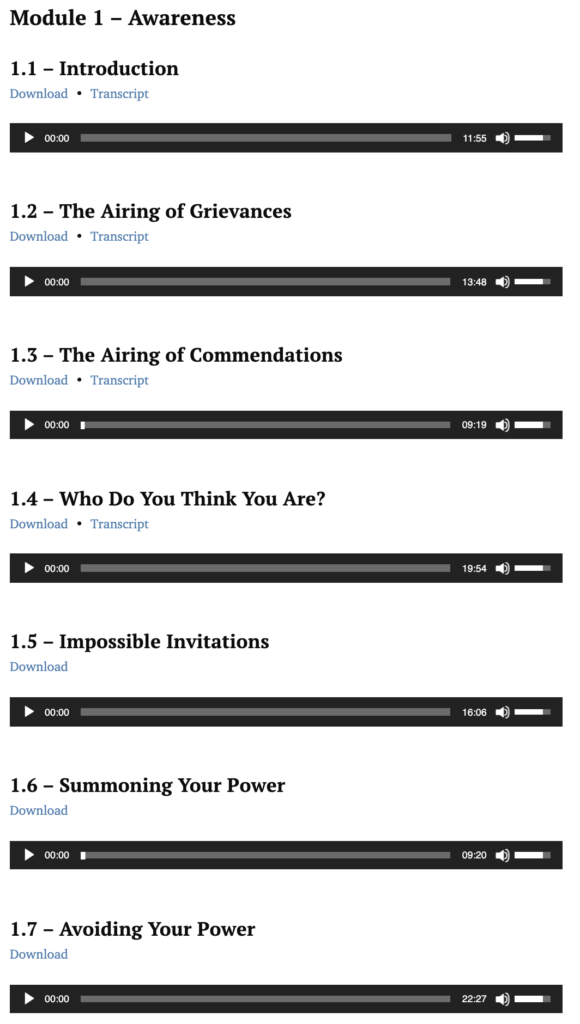
So far I’ve published the first 7 audio lessons, and we have full transcripts published for the first 4 of those. We’re co-creating this course together throughout January and February, during which time we’ll build the course to at least 42 lessons (probably more).
Here’s a screenshot of the lessons in our member portal, so you can see what we have so far. You can stream or download any lesson from your favorite device (the portal is mobile friendly). There’s also a workbook to accompany the lessons and bunch of other bonuses and supplementary material being created for this.
If you’re ready to dive in with 135+ other people and do some major character sculpting work to create not just an amazing 2020 but a happy and empowering life, you’d be wise to join us for the Stature course. You get to keep it for life and do the course as many times as you desire. My website is a long-term fixture in the personal growth community (operating continuously since 2004), so we have that stable longevity factor going for us.
Hopefully you have a character who’s empowered enough to say yes to this, but if you’re still on the fence, my tip is to go with your first gut instinct.
A recent study reported in the Washington Post today claimed that people make better decisions when they go with their first gut instinct instead of second-guessing themselves. I also asked growth-oriented friends on social media if they make better decisions from gut instinct or second-guessing analysis, and it was abundantly clear that gut instinct was the winner by far – many had regrets about second-guessing themselves and missing opportunities. So if your gut instinct is to join us, then join us.
I also trust my gut instinct, which told me that creating this course was one of the best projects I could do in my lifetime. I’m building a timeless course that will serve people for decades to come. This is just the beginning. I hope your character will join us in this special experience. The energy from the first group of people going through a course is just such a delight to behold.
We’re only 7 lessons in, and many people have told me they’ve cried a good bit already. Come share some tears with us if you’re brave enough. It’s part of the rebirthing process as we say goodbye to our old selves.
Seriously, please do join. Stature will do you a world of good.
This majestic spiral galaxy might earn the nickname the “Godzilla galaxy” because it may be the largest known in the local universe. The galaxy, UGC 2885, is 2.5 times wider than our Milky Way and contains 10 times as many stars.
But it is a “gentle giant,” say researchers, because it looks like it has been sitting quietly over billions of years, possibly sipping hydrogen from the filamentary structure of intergalactic space. This fuels modest ongoing star birth at half the rate of our Milky Way. In fact, its supermassive central black hole is a sleeping giant, too. Because the galaxy does not appear to be feeding on much smaller satellite galaxies, it is starved of infalling gas.
The galaxy has been nicknamed “Rubin’s galaxy,” after astronomer Vera Rubin (1928 — 2016), by Benne Holwerda of the University of Louisville, Kentucky, who observed the galaxy with NASA’s Hubble Space Telescope.
“My research was in a large part inspired by Vera Rubin’s work in 1980 on the size of this galaxy,” said Holwerda. Rubin measured the galaxy’s rotation, which provides evidence for dark matter, which makes up most of the galaxy’s mass as measured by the rotation rate. “We consider this a commemorative image. This goal to cite Dr. Rubin in our observation was very much part of our original Hubble proposal.”
In results being presented at the winter American Astronomical Society meeting in Honolulu, Hawaii, Holwerda is seeking to understand what led to the galaxy’s monstrous size. “How it got so big is something we don’t quite know yet,” said Holwerda. “It’s as big as you can make a disk galaxy without hitting anything else in space.”
One clue is that the galaxy is fairly isolated in space and doesn’t have any nearby galaxies to crash into and disrupt the shape of its disk.
Did the monster galaxy gobble up much smaller satellite galaxies over time? Or did it just slowly accrete gas for new stars? “It seems like it’s been puttering along, slowly growing,” Holwerda said. Using Hubble’s exceptional resolution, his team is counting the number of globular star clusters in the galaxy’s halo — a vast shell of faint stars surrounding the galaxy. An excess of clusters would yield evidence that they were captured from smaller infalling galaxies over many billions of years.
NASA’s upcoming James Webb Space Telescope could be used to explore the center of this galaxy as well as the globular cluster population. NASA’s planned Wide Field Infrared Survey Telescope (WFIRST) would give an even more complete census of this galaxy’s cluster population, especially that of the whole halo. “The infrared capability of both space telescopes would give us a more unimpeded view of the underlying stellar populations,” said Holwerda. This complements Hubble’s visible-light ability to track wispy star formation throughout the galaxy.
A number of foreground stars in our Milky Way can be seen in the image, identified by their diffraction spikes. The brightest appears to sit on top of the galaxy’s disk, though UGC 2885 is really 232 million light-years farther away. The giant galaxy is located in the northern constellation Perseus.
The popularity of bike-share systems has grown in popularity thanks to the younger, more environmentally conscious generation. While they have garnered considerable attention in cities from Paris to Washington, D.C., their promise of urban transformation is far from being fully realized.
New research in the INFORMS journal Management Science found a key reason is that while companies have focused on bike design and technology aspects, there has been minimal research done on operational aspects such as station density and bike-availability levels.
“Almost 80% of bike-share usage comes from areas within 1,000 feet of the stations, or roughly four city blocks,” said Elena Belavina, one of the study authors, from Cornell University. “Anything past 1,000 feet, potential users are almost 60% less likely to use a station.”
The study, “Bike-Share Systems: Accessibility and Availability,” conducted by Belavina alongside Ashish Kabra of the University of Maryland and Karan Girotra also at Cornell, analyzes the relationship between ridership and operational performance in bike-share design systems to achieve higher ridership.
Using data from the Vélib’ system in Paris, this paper estimates the impact of two facets of system performance on bike-share ridership: accessibility, or how far the user must walk to reach stations, and bike availability.
There are two impacts of availability: First, a short-term impact is that if nearby stations do not have bicycles when a user wants to take a trip, users must go to stations farther away or abandon using bike-share. Second, if users typically expect a lower chance of finding a bicycle, they are less likely to even consider bike-share for their commutes and the system will have lower ridership in the long-term.
“Most users choose to abandon using bike-share,” said Girotra, a professor at Cornell Tech and the Johnson College of Business at Cornell. “But overall, we find that a 10% increase in bike availability would increase ridership by more than 12%.”
Between increasing bike-availability and decreasing walking distance, the study finds that the latter has a higher impact. Bike-share operators with limited resources must prioritize building more stations closer to riders.
Where should those stations go? The authors recommend locations where there are many points of interest and locations with lower bike availabilities.
“Among these, adding stations in areas closer to supermarkets provides more bene?ts than adding them closer to public transit and other points of interest,” continued Girotra.
Astronomers in Europe, working with members of Canada’s CHIME Fast Radio Burst collaboration, have pinpointed the location of a repeating fast radio burst (FRB) first detected by the CHIME telescope in British Columbia in 2018. The breakthrough is only the second time that scientists have determined the precise location of a repeating source of these millisecond bursts of radio waves from space.
In results published in the January 9 edition of Nature, the European VLBI Network (EVN) used eight telescopes spanning locations from the United Kingdom to China to simultaneously observe the repeating radio source known as FRB 180916.J0158+65. Using a technique known as Very Long Baseline Interferometry (VLBI), the researchers achieved a level of resolution high enough to localize the FRB to a region approximately seven light years across — a feat comparable to an individual on Earth being able to distinguish a person on the Moon.
A ‘very different’ location for an FRB
With that level of precision, the research team was able to train an optical telescope onto the location to learn more about the environment from which the burst emanated. What they found has added a new chapter to the mystery surrounding the origins of FRBs.
“We used the eight-metre Gemini North telescope in Hawaii to take sensitive images that showed the faint spiral arms of a Milky-Way-like galaxy and showed that the FRB source was in a star-forming region in one of those arms,” said co-author Shriharsh Tendulkar, a former McGill University postdoctoral researcher who co-led the optical imaging and spectroscopic analyses of the FRB’s location.
“This is a very different environment for a repeating FRB, compared to the dwarf galaxy in which the first repeating FRB 121102 was discovered to reside.”
CHIME team’s hypotheses in line with observed data
advertisement
The discovery lined up with a number of ideas CHIME/FRB researchers had put forward following their initial detection of the burst in 2018.
“The FRB is among the closest yet seen and we even speculated that it could be a more conventional object in the outskirts of our own galaxy,” said co-author Mohit Bhardwaj, a McGill University doctoral student and CHIME team member.
“However the EVN observation proved that it’s in a relatively nearby galaxy, making it still a puzzling FRB, but close enough to now study using many other telescopes.”
Zooming in on the radio sky
Since it began operation in the summer of 2018, CHIME has detected dozens of fast radio bursts, greatly accelerating the rate of discovery of these transient astrophysical phenomena. With over 1,000 antennas, CHIME’s large field of view gives it a much greater chance of picking up fleeting bursts than conventional radio telescopes that are able to observe only a small area of the sky at a time.
advertisement
When it came to pinpointing FRB 180916, the CHIME/FRB team worked closely with their EVN colleagues to determine exactly where to point the VLBI telescopes.
“By recording and processing the raw signal from each of the antenna elements that make up CHIME, we were able to refine the source position to a level close enough for EVN to successfully observe and localize multiple bursts from this FRB source,” said co-author Daniele Michilli, a McGill University postdoctoral researcher and CHIME/FRB team member.
FRB’s proximity opens the way for further study
At half-a-billion light years from Earth, the source of FRB 180916 is around seven times closer than the only other repeating burst to have been localized, and more than 10 times closer than any of the few non-repeating FRBs scientists have managed to pinpoint. That’s exciting for astronomers because it will enable more detailed study that may help narrow down the possible explanations for FRBs.
“We have a new chance to perhaps detect emissions at other wavelengths — x-ray or visible light, for instance,” said McGill University astrophysicist Victoria Kaspi, a leading member of the CHIME/FRB collaboration. “And if we did, that would be hugely constraining of the models.”
Chronic migraine headaches plagued Adam Pressley from childhood, and by his 30s they had become a near-daily occurrence.
Pressley, 31, had tried everything to stop them: blood pressure drugs, antidepressants, seizure medications, and even quarterly injections of Botox.
Nerve-releasing plastic surgery
Then his doctor suggested something surprising, saying plastic surgery could potentially relieve nerve pressure that was contributing to the headaches.
“I kind of thought it was crazy, a plastic surgery procedure that could help people with their migraines,” said Pressley, who lives in Clarksville, Tennessee. “I was both sceptical and happy at the same time.”
The use of nerve-releasing plastic surgery to treat migraine has been around for a couple of decades, and the procedure is becoming more common and more effective, said Dr Salam Kassis, a plastic surgeon at Vanderbilt University Medical Center in Nashville, Tennessee.
Clinical research now indicates that about half of the people who undergo surgery to release entrapped nerves will experience complete relief from migraines, and another 40% will have fewer and less severe headaches, he said.
“Over the last 20 years, our percentages have improved dramatically. The success rate is even better than it was a decade ago,” Kassis said.
Not all headache experts are sold on the procedure, however.
“Certainly, there are some cases where this might be helpful, but it’s not something I generally recommend in my practice,” said Dr Rachel Colman, an assistant professor of neurology at the Icahn School of Medicine at Mount Sinai, in New York City.
Pressley started having migraines at age nine, and their frequency increased from about once a month in childhood to nearly every day.
Connection discovered by chance
“They can darn near incapacitate me,” he said. Noise and light become unbearable, his vision gets blurry, and the pain makes him nauseous.
Pressley, a computer science student, recently finished a six-year stint with the US Army, where he warned new commanding officers that he suffered severe migraines five to seven days a week.
He learned about the plastic surgery procedure from Kassis, who spoke to him during one of his regular Botox treatments, and decided it was worth a try.
Migraines generally are thought of as originating in the brain, but research has shown that some people might suffer the headaches due to compression of nerves running through the head and neck, Kassis said.
The connection was discovered by chance, he said.
“Plastic surgeons perform cosmetic procedures like brow lifts and resection of the frown muscles, and patients who had these types of surgeries had been coming in for follow-up appointments saying, ‘I feel so great, even my migraines went away,'” Kassis said.
It’s the same concept as carpal tunnel surgery to release nerves trapped in the wrist, he explained.
Outpatient procedure
The procedure also follows the same logic as treating migraine with Botox, Kassis said.
“The way Botox works is it causes the muscles to stop working and shrink, so the nerve will have more space and decompress,” he said.
Pressley had the nerve-releasing surgery last November. It’s a one- to two-hour outpatient procedure.
Three days later, he was back at work and school, albeit with a face so swollen that, he said, it “looked like I just lost a fight to a bear.”
The migraine relief was both immediate and substantial.
“After I had the surgery, I didn’t have a migraine for almost a month and a half. I still do have migraines but they’re substantially decreased,” Pressley said.
He averages one migraine every three to four weeks these days.
More and more common
“The day-to-day migraines I was getting – the ones that kept me from enjoying life – are out of my life,” Pressley said.
Nerve-releasing surgery is mainly practised at a handful of medical centres across the country, but use of the procedure is becoming more widespread, Kassis said.
“There are so many more people learning it now, and it is becoming more and more common,” he said.
The average cost of migraine surgery is $5,000 to $15,000 (±R76 000 to R220 000), according to the American Society of Plastic Surgeons.
Ideal candidates for the procedure can identify one or more trigger points on the face or neck where their migraine pain begins, Kassis said. They also suffer from migraines that are poorly controlled by medications.
Works on pain receptors
Colman said research supporting the procedure has generally been conducted by plastic surgeons and other types of specialists, rather than neurologists.
“I’m not as convinced by the current data we have that this is ‘generalise-able’ or very efficacious for most patients,” she said.
She added that Botox shouldn’t be used to explain why the surgery should work. That’s because while Botox does cause muscles to relax, it also works directly on pain receptors in the brain to relieve migraines.
“Botox works for chronic migraine above and beyond the muscle,” Colman said. “My preference would be that if Botox helps in these patients, use Botox rather than going to a surgical procedure.”