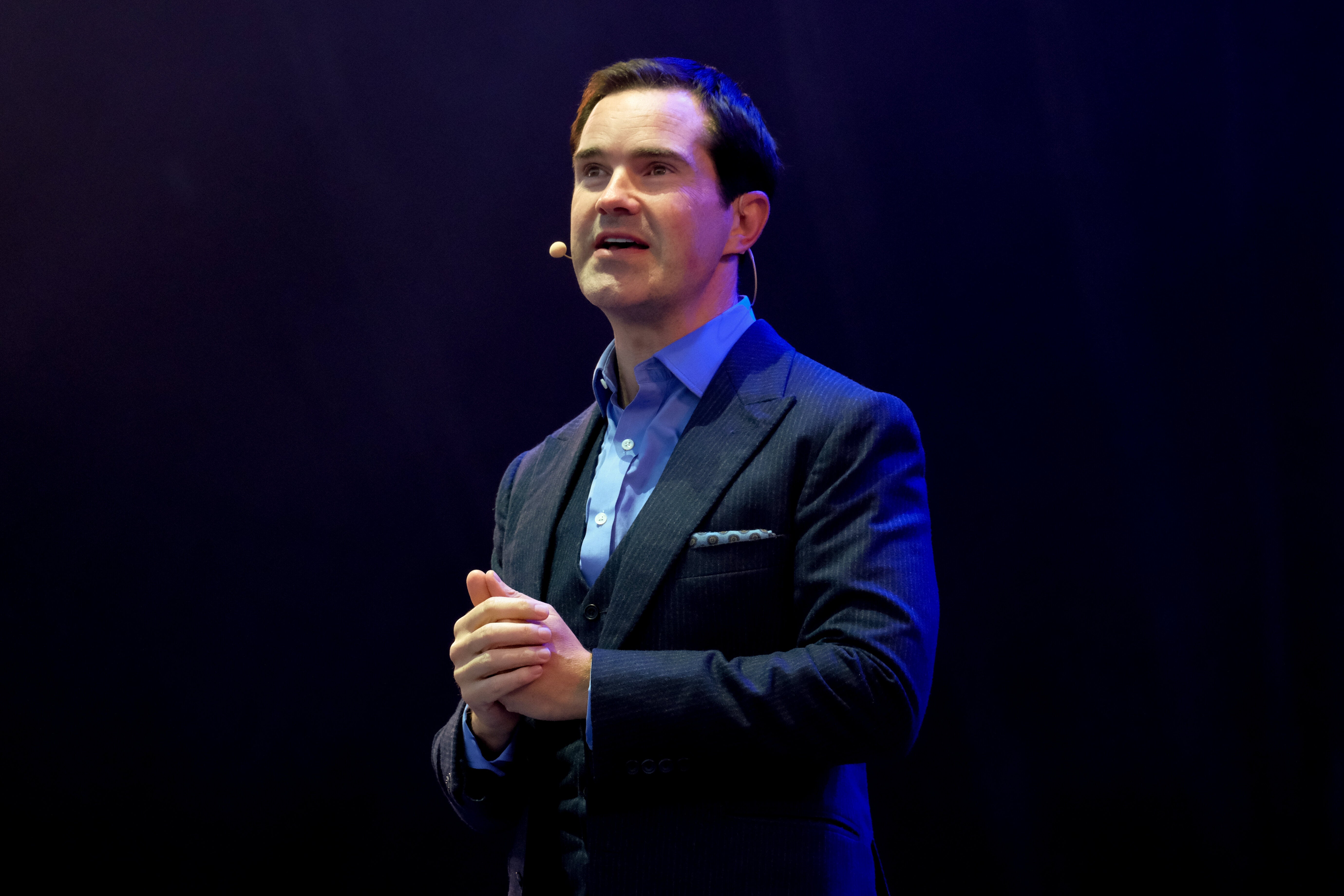
Victoria Coren Mitchell Defends ‘Decent’ Jimmy Carr After Holocaust Joke Backlash

In a widely-shared clip from the hour-long show, Carr joked about the horror of the Holocaust and “six million Jewish lives being lost” before making a disparaging remark about the deaths of thousands of Travellers at the hands of the Nazis as a punchline.

Carr has received widespread criticism over the remarks, with calls for Netflix to remove the joke and sparking petitions calling on him to apologise.

On Saturday evening, Only Connect host Victoria took to Twitter to defend her “close friend”, saying Carr was “a properly decent person”.

“While I’m here, might take a moment to mention I also love @JimmyCarr, a close friend who’s made about a thousand jokes I wouldn’t make myself, as a stage performer, but as a man is full of goodness and kindness,” she said.

When one unimpressed follower asked: “Do you think you would be similarly quick to defend him if he’d made a joke defending the murder of Jews in the Holocaust?”, Victoria responded: “Yes. It’s not about the joke.”

Others pointed the presenter towards comedian David Baddiel’s response to Carr’s comments.

The comedian had pointed out the difference between cruel jokes about the Holocaust and ones that target the oppressors.

“I said this every night during my Trolls: Not The Dolls tour as part of a bit arguing that it’s not the subject matter of a joke that counts, it’s the specifics of the individual joke. Clearly, Jimmy Carr’s was the former,” he said.

David added: “As a footnote, I’d add that Jimmy is a close friend of mine and a brilliant stand-up in general. Makes no difference to how I feel or think about this specific joke.”

Meanwhile, Judge Rinder star Robert Rinder labelled Carr and the audience at his Netflix special who “clapped, whooped and cheered” over the joke, “complete incorrigible turds”.

Robert, who is the grandson of a Holocaust survivor, made his feelings clear during a panel discussion about the hour-long special on Talk Radio

In a follow-up tweet posted on Saturday, Robert said the comedian’s comment was “breathtakingly racist” and reiterated his dismay at the audience’s reaction.

Culture Secretary Nadine Dorries has also condemned the remarks, suggesting that new laws would hold to account streaming sites from airing jokes.

“Jimmy Carr’s comments, no one can call that, you know, snowflake or wokeishness, that’s just… it was just appalling,” Dorries said during an interview on BBC Breakfast.

Nadia Whittome, Labour MP for Nottingham East, has also urged Netflix to remove Carr’s “vile anti-GRT and antisemitic material”.

HuffPost UK has contacted Carr’s reps for comment.

Share Button

Robert Rinder Labels Jimmy Carr And Audience At Netflix Special ‘Incorrigible Turds’ For Laughing At ‘Breathtakingly Racist’ Joke

Robert Rinder has labelled Jimmy Carr and the audience at his Netflix special who “clapped, whooped and cheered” over a joke he made about the Traveller community and the Holocaust, as “complete incorrigible turds”.

In a widely-shared clip from the His Dark Material show, Carr joked about the horror of the Holocaust and “six million Jewish lives being lost” before making a disparaging remark about the deaths of thousands of Travellers at the hands of the Nazis as a punchline.

Robert, who is best known as TV’s Judge Rinder and is the grandson of a Holocaust survivor, made his feelings clear during a panel discussion about the hour-long special on Talk Radio on Friday.

“I’ve got to say Jimmy Carr, I’m not going to repeat the joke, or anybody in the audience who whooped and clapped at a joke about the genocide of Travellers and gypsies, you are all, complete incorrigible turds,” he said.

In a tweet posted on Saturday, Robert said the comedian’s comment was “breathtakingly racist” and reiterated his dismay at the audience’s reaction.

“Jimmy Carr’s “joke” suggesting the systematic genocide of gypsies during the Holocaust was a “good thing” is breathtakingly racist,” he tweeted.

“The truly disturbing thing isn’t just the gag, it’s that on hearing it, instead of leaving, the audience clapped, whooped and cheered in approval.”

In a second tweet, the former Strictly star said that “middle class comedians can do irony and clever boundary pushing so it’s ‘ok’”.

“Let’s imagine the reaction to this joke had it been filmed at a working men’s club to a cheering whooping audience,” he added.

Carr has received widespread criticism over the remarks, with calls for Netflix to remove the joke and sparking petitions calling on him to apologise.

Roberts tweet came after Culture Secretary Nadine Dorries condemned the remarks during an interview on Saturday’s BBC Breakfast, suggesting that new laws would hold to account streaming sites from airing jokes.

Dorries suggested that in the future, new laws would “hold Netflix to account” for such content.

Nadine Dorries
Nadine Dorries

Future Publishing via Getty Images

“We are looking at legislation via the Media Bill which would bring into scope those comments from other video on-demand streaming outlets like Netflix,” she said.

“So it’s interesting that we’re already looking at future legislation to bring into scope those sort of comments.”

The MP said Carr’s comments were “abhorrent and they just shouldn’t be on television”, but it was then put to her that in a tweet in 2017 she had claimed that “left-wing snowflakes are killing comedy”.

She said: “Well, that’s not comedy.

“What Jimmy Carr did last night is not comedy. And you know, I’m no angel on Twitter, nobody is, but I just would like to say that nothing I’ve ever put on Twitter has been harmful or abusive.

“But that last night… Jimmy Carr’s comments, no one can call that, you know, snowflake or wokeishness, that’s just… it was just appalling.”

Nadia Whittome, Labour MP for Nottingham East, has also urged Netflix to remove Carr’s “vile anti-GRT and antisemitic material”.

The Traveller Movement, a charity supporting the traveller community in the UK, said: “This is truly disturbing and goes way beyond humour.”

In a tweet, the charity said: “We need all your support in calling this out #StopTravellerHate @StopFundingHate.”

The charity has launched a petition to Netflix calling for the “removal of the segments of His Dark Material which celebrates the Romani genocide”.

HuffPost UK has contacted Carr’s reps for comment.

Share Button

Nadine Dorries Says New Laws Would ‘Hold Netflix To Account’ Following Jimmy Carr’s ‘Appalling’ Holocaust Joke

Nadine Dorries has suggested new laws would hold to account streaming sites from airing jokes such as those made by Jimmy Carr about the Traveller community and the Holocaust.

During an interview on Saturday’s BBC Breakfast, the Culture Secretary condemned the comic’s joke made during his one-hour Netflix special, His Dark Material, as “shocking, abhorrent and unacceptable.”

Carr issued a “trigger warning” to the audience at the beginning of the Netflix show, admitting his performance contained “terrible things”.

In a widely-shared clip from the show, the comedian joked about the horror of the Holocaust and “six million Jewish lives being lost” before making a disparaging remark about the deaths of thousands of Travellers at the hands of the Nazis as a punchline.

Nadine Dorries and Jimmy Carr

Dorries suggested that in the future, new laws would “hold Netflix to account” for such content.

“We are looking at legislation via the Media Bill which would bring into scope those comments from other video on-demand streaming outlets like Netflix,” she said.

“So it’s interesting that we’re already looking at future legislation to bring into scope those sort of comments.”

The MP said Carr’s comments were “abhorrent and they just shouldn’t be on television”, but it was then put to her that in a tweet in 2017 she had claimed that “left-wing snowflakes are killing comedy”.

She said: “Well, that’s not comedy.

“What Jimmy Carr did last night is not comedy. And you know, I’m no angel on Twitter, nobody is, but I just would like to say that nothing I’ve ever put on Twitter has been harmful or abusive.

“But that last night… Jimmy Carr’s comments, no one can call that, you know, snowflake or wokeishness, that’s just… it was just appalling.”

She said the comments were “shocking and abhorrent and unacceptable, not just because he was making fun on the basis of people who died in the most appalling circumstances, but on the pain and suffering of many thousands of families”.

In a separate interview with Times Radio, she said: “We don’t have the ability now, legally, to hold Netflix to account for streaming that but very shortly we will.”

Asked on Sky News if there was any way this new law would put restrictions on free speech, she said: “No, absolutely not. We’ve been very, very… well because I’m a Conservative, I’ve been very, very careful about that.”

In a tweet, Nadia Whittome, Labour MP for Nottingham East, has also urged Netflix to remove Carr’s “vile anti-GRT and antisemitic material”.

The Traveller Movement, a charity supporting the traveller community in the UK, said: “This is truly disturbing and goes way beyond humour.”

In a tweet, the charity said: “We need all your support in calling this out #StopTravellerHate @StopFundingHate.”

The charity has launched a petition to Netflix calling for the “removal of the segments of His Dark Material which celebrates the Romani genocide”.

The not-for-profit organisation the Holocaust Memorial Day Trust shared a statement on Twitter from their CEO Olivia Marks-Woldman who was “horrified” to hear “gales of laughter” following Carr’s remarks.

Hope Not Hate, the anti-fascism and anti-racism campaigning group, also condemned the comedian’s joke on Friday.

In a tweet, they said: “Comedy is an amazing tool for progressive change and it’s such a shame that @jimmycarr decided to use his platform to celebrate the murder of one of the most marginalised groups in society.”

The Auschwitz Memorial called for Carr to “learn about the fate of some 23 thousand Roma & Sinti deported to Auschwitz” in a tweet to their 1.2 million followers.

They added: “It’s sad to hear words that can fuel prejudice, hurt people & defile memory of their tragedy.”

HuffPost UK has contacted Carr’s reps for comment.

Share Button

Strobe light for 5G: Imaging system spotlights the tiny mechanical hearts at the core of every cellphone

Inside every cellphone lies a tiny mechanical heart, beating several billion times a second. These micromechanical resonators play an essential role in cellphone communication. Buffeted by the cacophony of radio frequencies in the airwaves, these resonators select just the right frequencies for transmitting and receiving signals between mobile devices.

With the growing importance of these resonators, scientists need a reliable and efficient way to make sure the devices are working properly. That’s best accomplished by carefully studying the acoustic waves that the resonators generate.

Now, researchers at the National Institute of Standards and Technology (NIST) and their colleagues have developed an instrument to image these acoustic waves over a wide range of frequencies and produce “movies” of them with unprecedented detail.

The researchers measured acoustic vibrations as rapid as 12 gigahertz (GHz, or billions of cycles per second) and may be able to extend those measurements to 25 GHz, providing the necessary frequency coverage for 5G communications as well as for potentially powerful future applications in quantum information.

The challenge of measuring these acoustic vibrations is likely to increase as 5G networks dominate wireless communications, generating even tinier acoustic waves.

The new NIST instrument captures these waves in action by relying on a device known as an optical interferometer. The illumination source for this interferometer, ordinarily a steady beam of laser light, is in this case a laser that pulses 50 million times a second, which is significantly slower than the vibrations being measured.

The laser interferometer compares two pulses of laser light that travel along different paths. One pulse travels through a microscope that focuses the laser light on a vibrating micromechanical resonator and is then reflected back. The other pulse acts as a reference, traveling along a path that is continually adjusted so that its length is within a micrometer (one millionth of a meter) of the distance traveled by the first pulse.

When the two pulses meet, the light waves from each pulse overlap, creating an interference pattern — a set of dark and light fringes where the waves cancel or reinforce one another. As subsequent laser pulses enter the interferometer, the interference pattern changes as the microresonator vibrates up and down. From the changing pattern of the fringes, researchers can measure the height (amplitude) and phase of the vibrations at the location of the laser spot on the micromechanical resonator.

NIST researcher Jason Gorman and his colleagues deliberately chose a reference laser that pulses between 20 and 250 times more slowly than the frequency at which the micromechanical resonator vibrates. That strategy enabled the laser pulses illuminating the resonator to, in effect, slow down the acoustic vibrations, similar to the way that a strobe light appears to slow down dancers in a nightclub.

The slowdown, which converts acoustic vibrations that oscillate at GHz frequencies to megahertz (MHz, millions of cycles per second), is important because the light detectors used by the NIST team operate much more precisely, with less noise, at these lower frequencies.

“Moving to lower frequencies removes interference from communication signals typically found at microwave frequencies and allows us to use photodetectors with lower electrical noise,” said Gorman.

Each pulse lasts only 120 femtoseconds (quadrillionths of a second), providing highly precise moment-to-moment information on the vibrations. The laser scans across the micromechanical resonator so that the amplitude and phase of the vibrations can be sampled across the entire surface of the vibrating device, producing high-resolution images over a wide range of microwave frequencies.

By combining these measurements, averaged over many samples, the researchers can create three-dimensional movies of a microresonator’s vibrational modes. Two types of microresonators were used in the study; one had dimensions of 12 micrometers (millionths of a meter) by 65 micrometers; the other measured 75 micrometers on a side — about the width of a human hair.

Not only can the images and movies reveal whether a micromechanical resonator is operating as expected, they can also indicate problem areas, such as places where acoustic energy is leaking out of the resonator. The leaks make resonators less efficient and lead to loss of information in quantum acoustic systems. By pinpointing problematic areas, the technique gives scientists the information they need to improve resonator design.

In the Feb. 4, 2022, edition of Nature Communications, the researchers reported that they could image acoustic vibrations that have an amplitude (height) as small as 55 femtometers (quadrillionths of a meter), about one-five-hundredth the diameter of a hydrogen atom.

Over the past decade, physicists have suggested that micromechanical resonators in this frequency range may also serve to store fragile quantum information and to transfer the data from one part of a quantum computer to another.

Establishing an imaging system that can routinely measure micromechanical resonators for these applications will require further research. But the current study is already a milestone in assessing the ability of micromechanical resonators to accurately perform at the high frequencies that will be required for effective communication and for quantum computing in the near future, Gorman said.

Share Button

Preventing pandemics costs far less than controlling them

We can pay now or pay far more later. That’s the takeaway of a new peer-reviewed study, published Feb. 4 in the journal Science Advances, that compares the costs of preventing a pandemic to those incurred trying to control one.

“It turns out prevention really is the best medicine,” said Stuart Pimm, Doris Duke Professor of Conservation Ecology at Duke University, who was co-lead author of the study. “We estimate we could greatly reduce the likelihood of another pandemic by investing as little as 1/20th of the losses incurred so far from COVID into conservation measures designed to help stop the spread of these viruses from wildlife to humans in the first place.”

A smart place to start, the study shows, would be investing in programs to end tropical deforestation and international wildlife trafficking, stop the wild meat trade in China, and improve disease surveillance and control in wild and domestic animals worldwide.

COVID, SARS, HIV, Ebola and many other viruses that have emerged in the last century originated in wild places and wild animals before spreading to humans, the study’s authors note. Tropical forest edges where humans have cleared more than 25% of the trees for farming or other purposes are hotbeds for these animal-to-human virus transmissions, as are markets where wild animals, dead or alive, are sold.

“The bottom line is, if we don’t stop destroying the environment and selling wild species as pets, meat or medicine, these diseases are just going to keep coming. And as this current pandemic shows, controlling them is inordinately costly and difficult,” Pimm said. “It’s been two years since COVID emerged and the cure still isn’t working. Not enough people are vaccinated in the U.S, where shots are available and we can afford them, and not enough vaccines are going to other countries that can’t afford them.”

The new study, by epidemiologists, economists, ecologists, and conservation biologists at 21 institutions, calculates that by investing an amount equal to just 5% of the estimated annual economic losses associated with human deaths from COVID into environmental protection and early-stage disease surveillance, the risks of future zoonotic pandemics could be reduced by as much as half. That could help save around 1.6 million lives a year and reduce mortality costs by around $10 trillion annually.

“We’re talking about an investment of tens of billions of dollars a year. Government have that kind of money,” Pimm said.

One key recommendation of the new study is to use some of this money to train more veterinarians and wildlife disease biologists.

Another key recommendation is to create a global database of virus genomics that could be used to pinpoint the source of newly emerging pathogens early enough to slow or stop their spread, and, ultimately, speed the development of vaccines and diagnostic tests.

Aaron Bernstein of Boston Children’s Hospital and the Center for Climate, Health and the Global Environment at Harvard T.H. Chan School of Public Health, and Andrew Dobson of Princeton University were co-lead authors of the study with Pimm.

The need to put preventive measures in place as soon as possible is increasingly urgent, said Dobson. “Epidemics are occurring more frequently, they are getting larger, and spreading to more continents.”

“Prevention is much cheaper than cures,” noted Bernstein. Compared to the costs and social and economic disruptions associated with trying to control pathogens after they have already spread to humans, “preventing epidemics before they break out is the ultimate economic bargain.”

Researchers at 17 additional universities, medical centers, environmental nonprofits or government agencies in the United States, China, Brazil, South Africa, and Kenya coauthored the study.

The coauthors include Binbin V. Li, assistant professor of environmental science at Duke Kunshan University in China, who holds a secondary appointment at Duke’s Nicholas School of the Environment.

Funding for the study came from Johnson & Johnson; the U.S. Department of Agriculture; the Norwegian Agency for Development Cooperation; Brazil’s National Institute for Scientific and Technological Development; the U.S. Agency for International Development, and the National Natural Science Foundation of China.

Share Button

The abyssal world: Last terra incognita of the Earth surface

The first unified vision of the world ocean biodiversity, based on analysis of DNA sequences from the surface to deep-ocean sediments, unveils the rich and unknown life in the abyssal realm, the last terra incognita of the Earth surface. This collective effort was made possible by 15 international deep-sea expeditions, including scientists from MARUM.

The deep-ocean floor is the least explored ecosystem on the planet, despite covering more than 60% of the Earth surface. Largely unknown life in abyssal sediments, from benthic animals to microbes, helps to recycle and/or sequester the sinking (in)organic matter originating from pelagic communities that are numerically dominated by microscopic plankton. Benthic ecosystems thus underpin two major ecosystem services of planetary importance: the healthy functioning of ocean food-webs and the burial of carbon on geological timescales, both of which are critical regulators of the Earth climate. Researchers from the Norwegian Research Centre (NORCE), Bjerknes Centre for Climate research, the University of Geneva, as well as from the CNRS/Genoscope and IFREMER in France, have massively sequenced eukaryotic DNA contained in deep-sea sediments from all major oceanic basins, and compared these new data to existing global-scale plankton datasets from the sunlit and dark water column, obtained by the Tara Oceans and Malaspina circumglobal expeditions. This provides the first unified vision of the full ocean eukaryotic biodiversity, from the surface to the deep-ocean sediment, allowing marine ecological questions to be addressed for the first time at a global scale and across the three-dimensional space of the ocean, representing a major step towards “One Ocean ecology.”

“With nearly 1700 samples and two billion DNA sequences from the surface to the deep-ocean floor worldwide, high-throughput environmental genomics vastly expands our capacity to study and understand deep-sea biodiversity, its connection to the water masses above and to the global carbon cycle,” says Tristan Cordier, Researcher at NORCE and Bjerknes Centre for Climate Research, Norway, and lead author of the study.

What lives in this dark and hostile environment?

By comparing sediment DNA sequences with the ones from pelagic realms, it was possible to distinguish indigenous benthic organisms from sinking plankton that had reached the seafloor from the overlying water column. Results indicate that this benthic biodiversity could be three times larger than in the water masses above; and this diversity is composed of very different taxonomic groups that are mostly unknown.

“We compared our deep-sea benthic DNA sequences to all references sequences available for known eukaryotes. Our data indicates that nearly two third of this benthic diversity cannot be assigned to any known group, revealing a major gap in our knowledge of marine biodiversity,” says Jan Pawlowski, Professor at the Department of Genetics and Evolution of the University of Geneva and at the Institute of Oceanology of the Polish Academy of Sciences in Sopot.

What can plankton DNA in deep-sea sediments tell us?

Analysis of the abundance and composition of plankton DNA in deep-sea sediments confirmed that polar regions are hotspots of carbon sequestration. Moreover, the composition of the plankton DNA in sediments predicts the variation of the strength of the biological pump, an ecosystem process that transfer atmospheric carbon dioxide into the deep ocean, hence regulating the global climate.

“For the first time, we can understand which members of plankton communities are contributing most to the biological pump, arguably the most fundamental ecosystem processes in the oceans,” says Colomban de Vargas, Researcher at CNRS in Roscoff, France.

How will the deep-sea be impacted by global changes?

This genomic dataset represents the first consistent snapshot of whole eukaryotic diversity in the modern ocean. It provides a unique opportunity to reconstruct ancient oceans from the DNA contained in the cumulative sediment record, to assess how climate has impacted plankton and benthic communities in the past.

“Our data will not only address global-scale questions on the biodiversity, biogeography and connectivity of marine eukaryotes. It can also serve as a basis to reconstruct the past functioning of the biological pump from ancient sedimentary DNA archives. It would then inform on its future strength in a warmer ocean, which is key for modelling the future carbon cycle under climate change,” explains Tristan Cordier.

“Our study further demonstrates that deep-sea biodiversity research is of paramount importance. Huge numbers of unknown organisms inhabit ocean-floor sediments and must play a fundamental role in ecological and biogeochemical processes. A better knowledge of this rich diversity is crucial if we are to protect these vast, relatively pristine ecosystems from the impacts of possible future human incursions and understand the effects on it of climate change,” concludes Andrew J. Gooday, Emeritus Fellow at the National Oceanography Centre, Southampton, who was also involved in the research.

Share Button

Discovery unravels how atomic vibrations emerge in nanomaterials

A hundred years of physics tells us that collective atomic vibrations, called phonons, can behave like particles or waves. When they hit an interface between two materials, they can bounce off like a tennis ball. If the materials are thin and repeating, as in a superlattice, the phonons can jump between successive materials.

Now there is definitive, experimental proof that at the nanoscale, the notion of multiple thin materials with distinct vibrations no longer holds. If the materials are thin, their atoms arrange identically, so that their vibrations are similar and present everywhere. Such structural and vibrational coherency opens new avenues in materials design, which will lead to more energy efficient, low-power devices, novel material solutions to recycle and convert waste heat to electricity, and new ways to manipulate light with heat for advanced computing to power 6G wireless communication.

The discovery emerged from a long-term collaboration of scientists and engineers at seven universities and two U.S. Department of Energy national laboratories. Their paper, Emergent Interface Vibrational Structure of Oxide Superlattices, was published January 26 in Nature.

Eric Hoglund, a postdoctoral researcher at the University of Virginia School of Engineering and Applied Science, took point for the team. He earned his Ph.D. in materials science and engineering from UVA in May 2020 working with James M. Howe, Thomas Goodwin Digges Professor of materials science and engineering. After graduation, Hoglund continued working as a post-doctoral researcher with support from Howe and Patrick Hopkins, Whitney Stone Professor and professor of mechanical and aerospace engineering.

Hoglund’s success illustrates the purpose and potential of UVA’s Multifunctional Materials Integration Initiative, which encourages close collaboration among different researchers from different disciplines to study material performance from atoms to applications.

“The ability to visualize atomic vibrations and link them to functional properties and new device concepts, enabled by collaboration and co-advising in materials science and mechanical engineering, advances MMI’s mission,” Hopkins said.

Hoglund employed microscopy techniques to answer questions raised in experimental results Hopkins published in 2013, reporting on thermal conductivity of superlattices, which Hoglund likens to a Lego building block.

“You can achieve desired material properties by changing how different oxides couple to each other, how many times the oxides are layered and the thickness of each layer,” Hoglund said.

Hopkins expected the phonon to get resistance as it traveled through the lattice network, dissipating thermal energy at each interface of the oxide layers. Instead, thermal conductivity went up when the interfaces were really close together.

“This led us to believe that phonons can form a wave that exists across all subsequent materials, also known as a coherent effect,” Hopkins said. “We came up with an explanation that fit the conductivity measurements, but always felt this work was incomplete.”

“It turns out, when the interfaces become very close, the atomic arrangements unique to the material layer cease to exist,” Hoglund said. “The atom positions at the interfaces, and their vibrations, exist everywhere. This explains why nanoscale-spaced interfaces produce unique properties, different from a linear mixture of the adjoining materials.”

Hoglund collaborated with Jordan Hachtel, an R&D associate in the Center for Nanophase Materials Sciences at Oak Ridge National Laboratory, to connect local atomic structure to vibrations using new generations of electron microscopes at UVA and Oak Ridge. Working with high-spatial-resolution spectroscopic data, they mapped interlayer vibrations across interfaces in a superlattice.

“That’s the major advance of the Nature paper,” Hopkins said. “We can see the position of atoms and their vibrations, this beautiful image of a phonon wave based on a certain pattern or type of atomic structure.”

The Collaborative Trek to Collective Success

The highly collaborative effort began in 2018 when Hoglund was sharing research plans to characterize atomic vibrations at interfaces in perovskite oxides.

“I was going to Oak Ridge to work with Jordan for a week, so Jim and Patrick suggested I take the superlattice samples and just see what we can see,” Hoglund recalled. “The experiments that Jordan and I did at Oak Ridge boosted our confidence in using superlattices to measure vibrations at the atomic or nano-scale.”

During one of his later trips to Tennessee, Hoglund met up with Joseph R. Matson, a Ph.D. student conducting related experiments at Vanderbilt University’s Nanophotonic Materials and Devices laboratory led by Joshua D. Caldwell, the Flowers Family Chancellor Faculty Fellow and associate professor of mechanical engineering and electrical engineering. Using Vanderbilt’s instruments, they conducted Fourier-transform infrared spectroscopy experiments to probe optical vibrations in the entire superlattice. These well-established macroscopic measurements validated Hoglund’s novel microscopy approach.

From these experiments, Hoglund deduced that the properties he cared about — thermal transport and infrared response — stemmed from the interface’s influence on the superlattice’s well-ordered framework of oxygen atoms. The oxygen atoms arrange themselves in an eight-sided structure called an octahedra, with a metal atom suspended inside. The interaction between oxygen and metal atoms causes the octahedra to rotate across the material structure. The oxygen and metal arrangements in this framework generate the unique vibrations and give rise to the material’s thermal and spectral properties.

Back at UVA, Hoglund’s chance conversation with Jon Ihlefeld, associate professor of materials science and engineering and electrical and computer engineering, brought additional members and expertise to the effort. Ihlefeld mentioned that researchers affiliated with Sandia National Laboratories, Thomas Beechem, associate professor of mechanical engineering at Purdue University, and Zachary T. Piontkowski, a senior member of Sandia’s technical staff, were also trying to explain the optical behavior of phonons and had likewise found the exact same oxide superlattices to be an ideal material for their study.

Coincidentally, Hopkins had an ongoing research collaboration with Beechem, albeit with other material systems. “Rather than competing, we agreed to work together and make this something bigger than either of us,” Hoglund said.

Beechem’s involvement had an added benefit, bringing Penn State physicist and materials scientist Roman Engel-Herbert and his student Ryan C. Haisimaier into the partnership to grow material samples for the microscopy experiments underway at UVA, Oak Ridge and Vanderbilt. Up to this point, Ramamoorthy Ramesh, University of California, Berkeley, professor of physics and materials science and engineering, and his Ph.D. students Ajay K. Yadav and Jayakanth Ravichandran were the growers on the team, providing samples to Hopkins’ ExSiTE research group.

“We realized we had all of this really neat experimental data connecting vibrations at atomic and macroscopic length scales, but all of our explanations were still somewhat conjectures that we could not prove absolutely without theory,” Hoglund said.

Hachtel reached out to Vanderbilt colleague Sokrates T. Pantelides, University Distinguished Professor of Physics and Engineering, William A. & Nancy F. McMinn professor of physics, and professor of electrical engineering. Pantelides and his research group members De-Liang Bao and Andrew O’Hara employed density functional theory to simulate atomic vibrations in a virtual material with a superlattice structure.

Their theoretical and computational methods supported exactly the results produced by Hoglund and other experimentalists on the team. The simulation also enabled the experimentalists to understand how every atom in the superlattice vibrates with high precision and how this was related to structure.

At this point, the team had 17 authors: three microscopists, four optical spectroscopists, three computational scientists, five growers and two material scientists. It was time, they thought, to share their findings with the scientific community at large.

An initial peer reviewer of their manuscript advised the team to establish a more direct, causal connection between material structure and material properties. “We measured some cool new phenomena making connections over multiple length scales that should affect material properties, but we had not yet convincingly demonstrated whether and how the known properties changed,” Hoglund said.

Two graduate students in Hopkins’ ExSiTE lab, senior scientist John Tomko and Ph.D. student Sara Makarem, helped provide the final proof. Tomko and Makarem probed the superlattices using infrared lasers and demonstrated that the structure controlled non-linear optical properties and the lifetime of phonons.

“When you send in a photon of one unit of energy, the superlattices double that unit of energy,” Hopkins said. “John and Sara built a new capability in our lab to measure this effect, which we express as the second harmonic generation efficiency of these superlattices.” Their contribution expands the ExSiTE lab capabilities to understand new light-phonon interactions.

“I think this will enable advanced materials discovery,” Hopkins said. “Scientists and engineers working with other classes of materials may now look for similar properties in their own studies. I fully expect we will find that these phonon waves, this coherent effect, exists in a lot of other materials.”

The long-standing collaboration continues. Hoglund is in his second year as a postdoctoral researcher, working with both Howe and Hopkins. Together with Pantelides, Hachtel and Ramesh, he expects they will have new and exciting atomic structure-vibration ideas to share in the near future.


Share Button

Jimmy Carr Condemned For ‘Vile’ Holocaust Joke About Gypsy, Roma And Traveller Community

Jimmy Carr has been denounced for a “truly disturbing” joke made about the Gypsy, Roma and Traveller community and the Holocaust in his latest Netflix special.

The comedian, known for his stand-up and roles on shows including 8 Out Of 10 Cats, issued a “trigger warning” to the audience at the beginning of his one-hour show, His Dark Material, admitting his performance contained “terrible things”.

In a widely-shared clip from the show, Carr, 49, said: “When people talk about the Holocaust, they talk about the tragedy and horror of six million Jewish lives being lost to the Nazi war machine. But they never mention the thousands of Gypsies that were killed by the Nazis.

“No one ever wants to talk about that, because no one ever wants to talk about the positives.”

Mikey Walsh, author of the best-selling memoir Gypsy Boy, tweeted that he didn’t know what he should be more “disgusted” by, “the kind of Racism that us GRT people are forced to live with every day … that it’s still absolutely ok to demonise us & our demise as a joke … or the reactions of whooping and cheering from the audience.”

In a tweet referencing the joke, The Traveller Movement, a charity supporting the traveller community in the UK, said: “This is truly disturbing and goes way beyond humour.

“We need all your support in calling this out #StopTravellerHate @StopFundingHate.”

The charity have now launched a petition to Netflix calling for the “removal of the segments of His Dark Material which celebrates the Romani genocide”.

In a tweet, Nadia Whittome, Labour MP for Nottingham East, has also urged Netflix to remove Carr’s “vile anti-GRT and antisemitic material”.

“In funding, streaming and profiting from this material, Netflix is legitimising and perpetuating racism,” Whittome wrote in her letter.

“Material of the kind on your platform does not exist in isolation and it has real-life consequences.”

In a synopsis of the programme, which aired on Christmas Day, it says the special features jokes which are “career enders”.

Similarly, not-for-profit organisation the Holocaust Memorial Day Trust shared a statement on Twitter from their CEO Olivia Marks-Woldman who was “horrified” to hear “gales of laughter” following Carr’s remarks.

Hope Not Hate, the anti-fascism and anti-racism campaigning group, also condemned the comedian’s joke on Friday.

In a tweet, they said: “Comedy is an amazing tool for progressive change and it’s such a shame that @jimmycarr decided to use his platform to celebrate the murder of one of the most marginalised groups in society.”

The Auschwitz Memorial called for Carr to “learn about the fate of some 23 thousand Roma & Sinti deported to Auschwitz” in a tweet to their 1.2 million followers.

They added: “It’s sad to hear words that can fuel prejudice, hurt people & defile memory of their tragedy.”

A representative for Carr has been contacted for comment.

Share Button

Rita French: ‘Pandemic Heightened Risk Of FGM’

Last November I visited the county of Kajiado in Kenya, a short drive from Nairobi – the first county in Kenya to launch a robust policy designed to end female genital mutilation.

FGM is one of the most extreme examples of gender-based violence around the world. The physical, psychological and emotional impacts of being subjected to FGM last a lifetime.

At least 200 million girls and women alive today have undergone FGM, and more than 45 million more girls are at risk during this decade. Devastatingly, the pandemic has heightened the risk.

I arrived in a village in Kajiado to a warm Maasai welcome of traditional singing and dancing – a community proud to share their story.

I joined a group of older Maasai women who had been the ‘cutters’ performing FGM on women and girls. This was a tradition practised for generations and a source of livelihood for many. They explained to me that they had now downed their tools and committed to joining efforts to end FGM.

So how did this happen? A local programme, funded through the UN, had been established to engage and educate the community about FGM. Importantly, the programme also addressed the need for these women to have alternative sources of income. Today, they make jewellery that I am proudly wearing.

Rita French with Aggie Leina, Director of Kenya’s Anti-FGM Board.

I had the pleasure of meeting Aggie, who is leading conversations with men and women – young and old alike – and changing attitudes towards FGM. Aggie also runs a shelter providing housing and security for 150 girls that have survived FGM. Aggie told me her purpose in life is to end FGM. We owe so much to the brave and inspiring work of community champions like her.

The young women I met in the village appeared more hesitant to express their views. Efforts must continue to empower them to speak up for their rights.

The men, on the other hand, were vocal about their commitment to ending FGM. The older men told me that, whilst they are proud of their culture, they did not want pain and suffering inflicted on their daughters. And I spoke to young men who didn’t want this fate for their future wives: a young generation committed to driving change.

Kajiado County is clearly on the right track to ending FGM. I left the village truly invigorated and hopeful that young girls there will have a very different future.

Rita French and UNFPA Executive Director Monica Ferro in a discussion with Maasai women

UNFPA Mukiza Mwenzi

Changing the law can help to create the right legal environment to end FGM. Political leadership at the highest level is also key. In Kenya’s case, both exist: the President has made a powerful commitment to end the practice by the end of this year, which is accelerating progress.

But this isn’t enough. Real change will only be achieved when communities are fully engaged and involved. It means listening to everyone and being cognisant of local values. It means taking a holistic approach and offering alternative sources of income where necessary. Ending FGM will require changing hearts and minds. And that’s where community leaders like Aggie come in.

Sunday marks International Day for Zero Tolerance Against Female Genital Mutilation. It fills me with hope that the work being done in Kajiado County represents a powerful model that can be replicated in other parts of Kenya and beyond.

The UK is committed to supporting the UN and the Africa-Led Movement to give women and girls the freedoms they need to succeed.

Rita French is Britain’s Global Ambassador for Human Rights and Deputy Permanent Representative to the United Nations in Geneva.

Share Button

RNA ‘heroes’ can disarm bad-actor proteins in leukemia

Scientists at The University of Texas Health Science Center at San Antonio (UT Health San Antonio) believe it may be possible to prevent DNA changes driven by two proteins highly active in leukemia and other cancers. They reported a new mechanistic target for drug development Jan. 21 in the journal eLife.

The proteins, called METTL-3 and METTL-14, can alter the chemical structure of DNA — the molecular vault in cells that stores a person’s genetic information. This is a new understanding, said article senior author Yogesh Gupta, PhD, assistant professor of biochemistry at UT Health San Antonio’s Greehey Children’s Cancer Research Institute. For 27 years since the discovery of METTL-3 and -14, scientists believed that the proteins could only alter a separate molecule called RNA, but not DNA, he said.

RNA molecules, which float inside cells either reading out DNA instructions to make proteins or influencing this process indirectly, can form different shapes such as hairpins. Dr. Gupta, lead author; Shan Qi, a PhD student in the Gupta lab; and the team observed that RNA of a certain structure like a hairpin can act as a glue that binds to METTL-3 and -14, preventing it from changing DNA’s chemical structure.

“It is a desirable therapeutic target,” Dr. Gupta said. “By uncovering the DNA-altering function of METTL-3 and -14 and learning that it can be regulated by certain RNAs, we provided information that will help in drug discovery research.

“Our next step is to understand DNA, RNA and METTL-3 and -14 interaction so that we can identify the areas on the proteins for the purpose of drug development,” he said.

This work was supported by the Max and Minnie Tomerlin Voelcker Fund, the Cancer Prevention & Research Institute of Texas, the Institute for Integration of Medicine and Science/Clinical and Translational Science Award, the Greehey Children’s Cancer Research Institute, The University of Texas System and the National Institute of Allergy and Infectious Diseases (1R01AI161363).

Story Source:

Materials provided by University of Texas Health Science Center at San Antonio. Original written by Will Sansom. Note: Content may be edited for style and length.

Share Button