If you have a sore throat, runny nose and a headache, get a Covid test, experts advise.


If you have a sore throat, runny nose and a headache, get a Covid test, experts advise.
Scientists say early signs are good news but a big wave of infections could still overwhelm the NHS.
The former PM says Covid will come back to haunt us without a push to vaccinate the whole world.
The risk of needing hospital treatment could be 30 – 70% lower with Omicron than other variants.

There have been many research efforts describing the nature and progression of dog allergies, but there have been very few applied studies that use this information to try to cure people of dog allergies entirely by artificially inducing immune tolerance. But researchers have now for the first time identified candidates for those parts of the molecules that make up dog allergens that could give us precisely that: a “dog allergy vaccine.”
Their findings were published in the Federation of European Biochemical Societies journal on October 26.
Being allergic to dogs is a common malady and one that is growing worldwide. Over the years, scientists have been able to identify seven different dog allergens — molecules or molecular structures that bind to an antibody and produce an unusually strong immune response that would normally be harmless.
These seven are named Canis familiaris allergens 1 to 7 (Can f 1-7). But while there are seven, just one, Can f 1, is responsible for the majority (50-75 percent) of reactions in people allergic to dogs. It is found in dogs’ tongue tissue, salivary glands, and their skin.
Researchers have yet to identify Can f 1’s IgE epitopes — those specific parts of the antigens that are recognized by the immune system and stimulate or ‘determine’ an immune response (which is why epitopes are also called antigen determinants). More specifically, epitopes are short amino acid sequences making up part of a protein that induces the immune response.
Epitopes bind to a specific antigen receptor on the surface of immune system antibodies, B cells, or T Cells, much like how the shape of a jigsaw puzzle piece fits the specific shape of another puzzle piece. (The part of the receptor that binds to the epitope is in turn called a paratope). Antibodies, also known as immunoglobulin, come in five different classes or isotypes: IgA (for immunoglobulin A), IgD, IgE, IgG, or IgM. The IgE isotype (only found in mammals) plays a key role in allergies and allergic diseases. There is also an IgE epitope that is the puzzle piece that fits the IgE isotype’s paratope.
In recent years, there has been extensive effort at developing epitope-focused vaccines — in this case, a vaccine against dog allergies.
“We want to be able to present small doses of these epitopes to the immune system to train it to deal with them, similar to the principle behind any vaccine,” said Takashi Inui, a specialist in allergy research, professor at Osaka Prefecture University and a lead author of the study. “But we can’t do this without first identifying the Can f 1’s IgE epitope.”
So the researchers used X-ray crystallography (in which the diffraction of x-rays through a material is analyzed to identify its ‘crystal’ structure) to determine the structure of the Can f 1 protein as a whole — the first time this had ever been done.
They found that the protein’s folding pattern is at first glance extremely similar to three other Can f allergens. However, the locations of surface electrical charges were quite different, which in turn suggest a series of ‘residues’ that are good candidates for the IgE epitope.
Using this basic data, further experimental work needs to be performed to narrow the candidates down, but the findings suggest the development of a hypoallergenic vaccine against Can f 1 — a dog-allergy vaccine — is within our grasp.
The production of a ‘hypoallergenic vaccine’ by use of such epitopes would not just be a world-first with respect to dog allergies but is rare with respect to any allergic reaction. If the researchers’ work is indeed used to develop a dog allergy vaccine, the principles behind it could be used much more widely against various allergies.
Story Source:
Materials provided by Osaka Prefecture University. Note: Content may be edited for style and length.

When winds loft fine desert dust high into the atmosphere, iodine in that dust can trigger chemical reactions that destroy some air pollution, but also let greenhouse gases stick around longer. The finding, published today in the journal Science Advances, may force researchers to re-evaluate how particles from land can impact the chemistry of the atmosphere.
“Iodine, the same chemical added as a nutrient to table salt, is eating up ozone in dusty air high in the atmosphere,” said Rainer Volkamer, a CIRES Fellow and professor of chemistry at CU Boulder. Volkamer led the team that made precision atmospheric measurements by aircraft over the eastern Pacific Ocean several years ago. The new finding, he said, has implications for not only air quality, but climate, too — iodine chemistry can make greenhouse gases stick around longer and should give us pause to re-think geoengineering schemes involving dust.
“Our understanding of the iodine cycle is incomplete,” Volkamer said. “There are land-based sources and chemistry we didn’t know about, which we must now consider.”
Atmospheric researchers have long been interested in the observation that dusty layers of air are often very low in the air pollutant ozone, which, when concentrated, can damage people’s lungs and even crops. It seemed that some kind of dust-surface chemistry was eating up ozone, but no one had been able to show that happening in laboratory experiments. Others have speculated about this, but there’s been a lot of doubt, said Volkamer. By contrast, lab experiments have long shown that a gaseous form of iodine can gobble up ozone — but there were only hints of a connection between dust and iodine.
There were other tantalizing hints about the process in a dataset from 2012, from a series of aircraft flights offshore Chile and Costa Rica. Dust seen blowing offshore from South America had striking levels of gaseous iodine. Volkamer handed the data to then-CU Boulder graduate student Theodore Koenig, lead author on this study. Koenig describes those data as one in a set of blurry photographs shared by atmospheric chemists around the world. In one image, for example, “iodine seemed to correlate with dust … but not absolutely clearly,” he said. Everywhere, dust seemed to destroy ozone, but why? “Iodine and ozone clearly connect, but there weren’t any ‘photos’ of both with dust,” said Koenig, who is now an air pollution researcher at Peking University in China.
The data from TORERO (the “Tropical Ocean Troposphere Exchange of Reactive Halogens and Oxygenated Hydrocarbons,” a field campaign funded by the National Science Foundation) captured those three characters together, finally, in one image he said, and it was clear that where desert dust contained significant levels of iodine — like dust from the Atacama and Sechura deserts in Chile and Peru — the iodine was quickly transformed into a gaseous form and ozone dropped to very low levels. But how did that dust-based iodine transform? “The mechanism still remains elusive,” Volkamer said. “That’s future work.”
So the picture is another blurry one, Koenig said, but still, the science is sharper than it was. “I have more questions at the end of the project than at the start,” he said. “But they’re better, more specific questions.”
They’re also very important, for anyone interested in the future of the atmosphere, Volkamer said. Iodine’s reactions in the atmosphere are known to play a role in reducing levels of OH, for example, which can increase the lifetime of methane and other greenhouse gases. Perhaps more importantly, various geoengineering ideas involve injecting dust particles high into Earth’s atmosphere, to reflect incoming solar radiation. There, in the stratosphere, ozone is not a pollutant; rather, it forms a critical “ozone layer” that helps shield the planet from incoming radiation.
If iodine from dust was chemically transformed into an ozone-depleting form in the stratosphere, Volkamer said, “well, that’d not be good, as it could delay the recovery of the ozone layer. Let’s avoid adding anthropogenic iodine into the stratosphere!”

From the smooth tubes of our arteries and veins to the textured pockets of our internal organs, our bodies are made of tissues arranged in complex shapes that aid in performing specific functions.
But how do cells fold themselves so precisely into such complicated configurations during development? What are the fundamental forces driving this process?
Now, researchers at Harvard Medical School have discovered a mechanical process by which sheets of cells morph into the delicate, looping semicircular canals of the inner ear.
Published Dec. 22 in Cell, the research, done in zebrafish, reveals that the process involves a combination of hyaluronic acid, produced by cells, that swells with water, and thin connectors between cells that direct the force of this swelling to shape the tissue.
Although conducted in zebrafish, the work reveals a basic mechanism for how tissues take on shapes — one that is likely to be conserved across vertebrates, the researchers say, and may also have implications for bioengineering.
A Model of Transparency
Study senior author Sean Megason, professor of systems biology in the Blavatnik Institute at HMS, and his team study how cells develop into complex, three-dimensional structures. To address this question, they turned to a classic — and ideal — model organism: zebrafish.
“They’re transparent, so we just stick them under a microscope and look at this entire process from a single cell to a larva that can swim and has all its parts,” explained study first author Akankshi Munjal, who conducted the research as a postdoctoral researcher at HMS and is now an assistant professor of cell biology at Duke University.
These parts include the semicircular canals, three fluid-filled tubes in the inner ear that are needed for balance and orienting in space. Little is known about how the semicircular canals form, in part because in many species they are obscured by the middle and outer ear. In zebrafish, however, the canals sit close to the surface, allowing researchers to watch them develop under a microscope.
“This was an exciting opportunity for us to look at how a three-dimensional organ forms from a simple sheet of cells,” Munjal said. “We could look at the inner ear in the embryo with complete accessibility.”
“The inner ear is a model for how cells work together to make complex structures that are needed for organisms to function,” Megason added. “We went into it thinking it was a beautiful structure, but not knowing what we would find.”
What they did find surprised them.
The conventional thinking is that the proteins actin and myosin act as tiny motors inside cells, pushing and pulling them in different directions to fold a tissue into a specific shape. However, the researchers discovered that zebrafish semicircular canals form through a markedly different process. During development, the cells produce hyaluronic acid, which is perhaps most well known as an antiwrinkle agent in beauty products. Once in the extracellular matrix the acid swells up, not unlike a diaper in a swimming pool. This swelling creates enough force to physically move nearby cells, but since the pressure is the same in all directions, the researchers wondered how the tissue ends up stretching in one direction and not another to form an elongated shape. The team found that this is accomplished by thin connectors between cells — dubbed cytocinches — that constrain the force.
“It’s like if you were to put a corset on a water balloon and deform it into an oblong structure,” Munjal said. This combination of swelling and cinching progressively shapes an initially flat sheet of cells into tubes.
“Our work shows a new way of doing things,” Megason said, adding that he hopes it will encourage people to consider additional mechanisms that may be involved in shaping tissues. “Cells have to use many different forces in order to accomplish what they need to, and time will tell exactly what the balance is between the molecular approaches of actin and myosin and the more physical approaches of pressure.”
Their discovery likely has broader implications, Megason and Munjal added.
The genes that control hyaluronic acid production in zebrafish semicircular canals are also present in the semicircular canals of mammals, suggesting that a similar process may be occurring. Moreover, hyaluronic acid is found in multiple parts of the human body, including skin and joints, indicating that it may play a role in shaping many tissues and organs — an avenue for future research.
If that does turn out to be the case, then studying the genes involved in hyaluronic acid production could help researchers understand congenital defects in organs where hyaluronic acid drives development.
“This is likely to be a widespread, conserved mechanism across species and organs,” Munjal said.
The mechanism could also be applied to bioengineering, where researchers are attempting to prod stem cells into forming buds, tubes, and other complicated shapes, with the ultimate goal of culturing organs in the lab.
Lab-grown organs are still a work in progress, Megason noted, but a key step will be parsing how organs form inside an organism. “We’re trying to dissect the steps of how a complex organ such as the inner ear is made in vivo, and then quantitatively understand those steps,” Megason said. “We hope this will set the foundational groundwork for having cells grow into whatever pattern and shape we want.”
This work was supported by the National Institutes of Health (R01DC015478), the Eunice Kennedy Shriver National Institute of Child Health and Human Development (K99HD098918), and a Human Frontier Science Program Long-Term Fellowship.

The UK has recorded 106,122 daily Covid-19 cases – the first time the total has gone above six figures as the Omicron surge continues.
The lab-confirmed coronavirus cases were as of 9am on Wednesday, the government said, which added a further 140 people had died within 28 days of testing positive for Covid.
Advertisement
It comes as Boris Johnson has been urged to outline his post-Christmas Covid strategy, as Wales became the latest part of the UK to outline a tightening of restrictions.
The prime minister has reassured people that no further curbs will be introduced in England before December 25, given there is not enough evidence on the severity of the Omicron variant and hospital admission to justify stricter measures.
Advertisement
But in Wales, first minister Mark Drakeford has announced new measures to be introduced from 6am on Boxing Day and claimed Johnson and his Cabinet are “paralysed by their internal divisions”.
Elsewhere, a new formulation of the Pfizer/BioNTech coronavirus vaccine has been approved for use in children aged five to 11.
Advertisement
The Joint Committee on Vaccination and Immunisation (JCVI) is advising that children aged five to 11, who are in a clinical risk group, or who are a household contact of someone (of any age) who is immunosuppressed, should be offered a primary course of vaccination.
it was also reported that UK Government scientists are set to conclude that Omicron is causing a milder disease than the Delta strain in most Britons.
Politico’s London Playbook said the UK Health Security Agency is expected to publish early real-world data on the disease’s severity before Christmas, with its findings also suggesting Omicron is not necessarily mild enough to avoid large numbers of hospital admissions.
This is a breaking news story and will be updated. Follow HuffPost UK on Twitter, Facebook and Instagram.

Omicron’s rapid takeover has left most of us feeling pretty deflated – at best – about the coming months.
Worries about further restrictions, another lockdown and the variant’s major threat to general public health have already overshadowed this festive period.
Advertisement
But it’s not all bad. Here are five snippets of good Covid-related news that might have slipped under your radar.
Advertisement
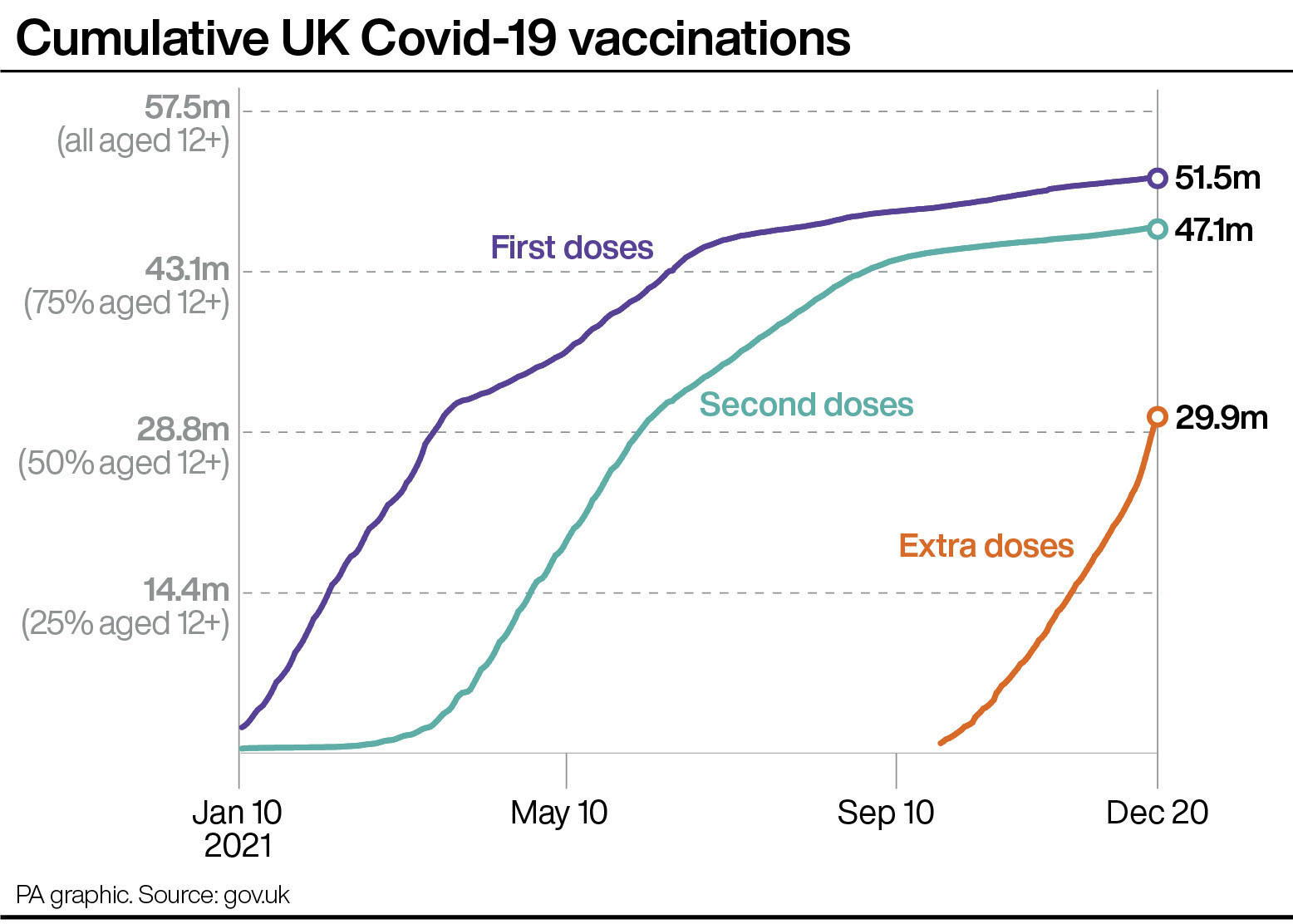
According to NHS England, more than two thirds of those aged 18 and over who are eligible for a booster vaccine have received it.
The news follows the huge extended rollout from the health service which meant the NHS would have to administer around one million booster shots in the days leading up to the end of December.
Advertisement
Prime minister Boris Johnson wanted every eligible adult to be offered a booster shot before the end of the year, a target denounced as overly ambitious when it was first revealed.
Now, 25,130,453 people who had their second dose more than three months ago have already been boosted in England.
More than 1.5 million boosters were also reported across Saturday and Sunday, making the booster campaign the most successful vaccine drive in the health service’s history.

PA GraphicsPress Association Images
Advertisement
Despite the surge in Omicron cases, Covid deaths have dropped.
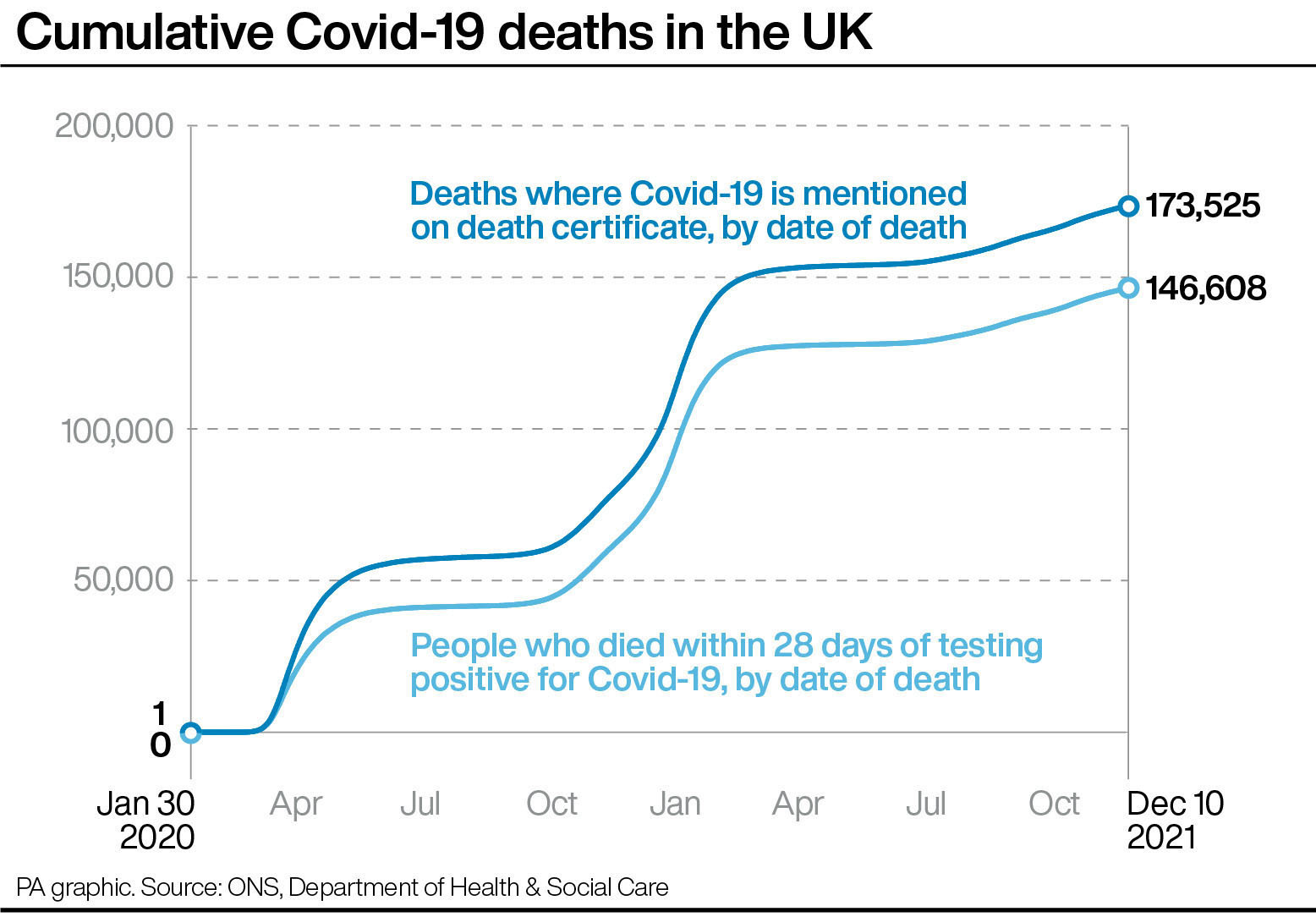
The Office for National Statistics (ONS) has revealed that weekly registered deaths linked to Covid in England and Wales have fallen to a rate lower than those seen in October.
According to the ONS, there were 764 deaths in the week leading up to 10 December with “novel coronavirus” on the death certificate.
This equates to 6.4% of all deaths registered over that seven-day period. This is a decrease from the previous week, when 792 deaths were recorded.
It also meant these latest figures are the lowest since 15 October, when there were 713 recorded Covid deaths.
However, these numbers do not reflect the impact from Omicron just yet. There is always a two-to-three week lag between infection and hospitalisations, and the new variant only swept into the UK at the beginning of the month.

PA GraphicsPress Association Images
The UK has recorded an average 90,000 daily cases of Covid for six days in a row. While this is still exceptionally high, it could suggest that the infection rates are stabilising.
So, despite the high transmissibility of Omicron, cases may have reached their peak in Britain.
However, the exact reason behind the plateauing cases is unclear. Experts have pointed to a potential reduction of tests being taken, the booster taking effect, or the new measures introduced have led the public to be more cautious.
Advertisement
It is also still too early to predict if Omicron has actually reached its highest levels in the UK.
Omicron was first reported in the South African province of Gauteng back on 24 November, and yet case numbers already appear to be dropping off.
South Africa hit a peak close to 27,000 daily cases last Thursday. On Tuesday, this had dropped to 15,000 cases.
The highly transmissible variant is estimated to account for 90% of Covid cases in Gauteng since mid-November – but cases there peaked at 16,000 on 12 December and have since dropped to 3,300 on Tuesday.
Speaking to Associated Press, the senior researcher at the Vaccines and Infectious Diseases Analytics department from the South African University of Witwatersrand, Marta Nunes, said: “It was a short wave…and the good news is that it was not very severe in terms of hospitalisations and deaths.”
However, professor Chris Whitty, chief medical officer for England, took on the data surrounding South Africa last week and warned that in some cases it had been “over-interpreted”.

TOLGA AKMEN via Getty Images
He explained: “The amount of immunity for this wave [in South Africa is] because of a prior Delta wave and vaccination is far higher than it was for their last wave and, therefore, the fact they have a lower hospitalisation rate this time is unsurprising.
“That doesn’t mean there is some degree of milder disease — that is possible — but I think there is a danger that people have over-interpreted this to say this is not a problem and there’s nothing to worry about. I want to be clear, I am afraid [Omicron] is going to be a problem.”



Tony Blair has said “you’re an idiot” if you have no health reason not to get vaccinated against Covid but still have not had the jab.
In an interview with Times Radio, the former prime minister said it would now be “incredibly difficult” for the government to introduce another full lockdown.
Advertisement
“One of the reasons I’m not in favour of shutting everything down is I’m not sure with this Omicron thing there’s anything you can do,” he said. “You’ve just got to give people the best protection.”
Blair added: “If you’re not vaccinated at the moment and you’re, you’re eligible and you’ve got no health reason for not being vaccinated, you’re not just irresponsible, I mean, you’re an idiot. I’m sorry, I mean, truthfully you are.”
Advertisement
It came as Boris Johnson was urged to outline his post-Christmas Covid strategy.
The prime minister has ruled out introducing new rules before Christmas, but there is an expectation tighter restrictions will be brought in soon after.
Advertisement
Gillian Keegan, a health minister, warned earlier today there is “uncertainty” around people making new year’s eve plans.
“We can’t predict what the data is going to tell us before we’ve got the data,” she told LBC.
“We are trying to take a balanced and proportionate approach so that people can see their families over Christmas to try and plan some stuff. But of course it is difficult to anticipate.”
But Labour pressed for decisions to be made as soon as possible. Shadow work and pensions secretary Jon Ashworth told Sky News: “People are anticipating that some form of restrictions will come in post-Christmas, and I think we just need to give people certainty.
Advertisement
Elsewhere, it was reported that UK Government scientists are set to conclude that Omicron is causing a milder disease than the Delta strain in most Britons.
Politico’s London Playbook said the UK Health Security Agency is expected to publish early real-world data on the disease’s severity before Christmas, with its findings also suggesting Omicron is not necessarily mild enough to avoid large numbers of hospital admissions.