An intensive care consultant says most Covid cases are those aged between 40 and 50.


An intensive care consultant says most Covid cases are those aged between 40 and 50.

A new study of brain activity patterns in people doing a memory task finds that the way we make inferences — finding hidden connections between different experiences — changes dramatically as we age. The study’s findings might one day lead to personalized learning strategies based on a person’s cognitive and brain development.
The researchers found that whereas adults build integrated memories with inferences already baked in, children and adolescents create separate memories that they later compare to make inferences on the fly.
“How adults structure knowledge is not necessarily optimal for children, because adult strategies might require brain machinery that is not fully mature in children,” said Alison Preston, professor of neuroscience and psychology and senior author of the study published today in the journal Nature Human Behaviour. She co-led the study with first author Margaret Schlichting, formerly a doctoral student in Preston’s lab and currently assistant professor of psychology at the University of Toronto.
To understand the distinction between how adults and children make inferences, imagine visiting a day care center. In the morning, you see a child arriving with one adult, but in the afternoon that child leaves with a different adult. You might infer that the two grown-ups are the child’s parents and are a couple, and your second memory would include both the second person you saw and information from your earlier experience in order to make an inference about how the two adults — whom you didn’t actually see together — might relate to each other.
This new study finds that a child who has the same experiences isn’t likely to make the same kind of inference that an adult would during the second experience. The two memories are less connected. If you ask your child to infer who that child’s parents are, your child can still do it; he or she just has to retrieve the two distinct memories and then reason about how each adult might be related.
The neural machinery of children and adults differs, and the strategy that children use may be optimal for the way their brains are wired before key memory systems in the hippocampus and prefrontal cortex fully mature, the researchers believe. That difference could keep children from recalling past memories during new learning and limit their ability to connect events.
“In the absence of a mature memory system, the best thing a child can do is lay down accurate, non-overlapping memory traces,” Preston said. “From those accurate memory traces, children can later bring them to mind to promote inferences about their connections.”
The researchers asked 87 subjects, ages 7 to 30, to look at pairs of images while lying in an fMRI (functional magnetic resonance imaging) scanner, which measures brain activity by detecting small changes in blood flow with images that, as in the day care example above, provide opportunities to infer relationships between objects that had not appeared together.
The researchers found that the strategy adolescents used for making inferences was different from both that of young children and adults. Going back to the example of the parents at the day care, when an adolescent stores a memory of the second grown-up with the child, the adolescent suppresses the earlier memory involving the first one. Each memory becomes even more distinct than with younger children, and there are even fewer automatic inferences about how the two adults relate.
“Teenagers may have learning strategies that are tuned to explore the world more so than exploiting what they already know,” Preston said.
This and other lessons from the study could inform strategies for improving teaching and learning at various ages.
“From a brain maturation perspective, different people are going to be at different places,” Preston said, “and we can devise learning strategies that take advantage of the neural machinery that an individual has at hand, no matter if they are 7 years old or 70 years old.”
The study’s other authors are Katharine Guarino at Loyola University Chicago and Hannah Roome of UT Austin.
This work was supported by the National Institutes of Health and by the Canada Foundation for Innovation. Preston holds the Dr. A. Wilson Nolle and Sir Raghunath P. Mahendroo Professorship in Neuroscience.

Refugees are on the move in forests across the western U.S. As climate conditions change, the ranges of tree species are shifting, especially toward cooler or wetter sites. A new Stanford analysis provides some of the first empirical evidence that wildfire is accelerating this process, likely by reducing competition from established species. The study, published Nov. 15 in Nature Communications, raises questions about how to manage land in an era of shifting ecosystems — a key issue as President Biden prepares to sign into law an infrastructure bill that allocates more than $5 billion for forest restoration and wildfire risk reduction.
“Complex, interdependent forces are shaping the future of our forests,” said study lead author Avery Hill, a graduate student in biology at Stanford’s School of Humanities & Sciences. “We leveraged an immense amount of ecological data in the hopes of contributing to a growing body of work aimed at managing these ecosystem transitions.”
As the climate changes, animal and plant species are shifting their ranges toward conditions suitable for their growth and reproduction. Past research has shown that plant ranges are shifting to higher, cooler elevations at an average rate of almost five feet per year. In many studies, these range shifts lag behind the rate of climate change, suggesting that some species may become stranded in unsuitable habitats. The factors that impact plant species’ ability to keep up with climate change are key to maintaining healthy populations of the dominant trees in western forests, yet have remained largely mysterious.
To better understand the distance, direction and rate at which tree ranges are shifting, Hill and study co-author Chris Field, the Perry L. McCarty Director of the Stanford Woods Institute for the Environment, looked at how the phenomenon is affected by wildfire, a potent and widespread driver of ecosystem structure and composition in the western United States.
Using U.S. Forest Service data collected from over 74,000 plots across nine Western states, the researchers identified tree species that are shifting their ranges toward cooler, wetter sites — an expected response to the recent warming and drying. Then, they compared the rate of these range shifts between places that were burned by wildfire and places that were not.
Of eight species that had seedlings growing in climates significantly different from mature trees of the same species, Hill and Field found strong evidence that two — Douglas fir and canyon live oak — had larger range shifts in areas that burned than in areas that did not.
Although the analysis did not reveal the mechanism for how wildfire accelerates range shifts for certain trees, the researchers hypothesized that burned areas with their open canopies and scorched understory present less competition from other plant species.
The findings demonstrate not only that fire can accelerate tree migration, but that some species may be slowing the range shifts of others through competition. This, in turn, raises questions about the impact of fire management on trees’ ability to keep up with climate change, and points to the importance of low-intensity prescribed and natural fires.
“This study highlights a natural mechanism that can help forests remain healthy, even in the face of small amounts of climate change,” said Field. “It also illustrates the way that ecosystem processes often have several layers of controls, a feature that emphasizes the value of detailed understanding for effective management.”
Field is also the Melvin and Joan Lane Professor for Interdisciplinary Environmental Studies, a professor of Earth system science and biology, and a senior fellow at the Precourt Institute for Energy.
The research was funded by the Gordon and Betty Moore Foundation.
Story Source:
Materials provided by Stanford University. Original written by Rob Jordan. Note: Content may be edited for style and length.

The Sahel extends south of the Sahara from Senegal in the west to Ethiopia in the east of Africa. Vast areas of the formerly fertile region are now virtually uncultivated. Reasons are droughts, poor agricultural cultivation methods as well as overuse due to the growing demand for food and firewood.
The “Great Green Wall” initiative aims to compensate for and reverse this loss through mass planting of native trees and grasses. 100 million hectares of land are to be restored in this way. So far, however, this ambitious goal is very far from being achieved — partly because of a lack of financial resources.
However, this could change in the future: Earlier this year, various donor countries pledged nearly $15 billion to the project at the One Planet Summit for Biodiversity. “In order to use these funds efficiently, we now have to ask ourselves where and for which measures they should be used most sensibly,” emphasizes Dr. Alisher Mirzabaev of the Center for Development Research (ZEF) at the University of Bonn.
Every dollar invested yields a 20-cent of net returns
The agricultural economist has led a study that provides an answer. The researchers divided the Sahel region into 40 million plots of 25 hectares each. For each of these, they then analyzed which land restoration measures would be possible and how much they would cost. They compared this calculation with the economic benefits that could be achieved.
“On the one hand, these include the so-called provisioning services,” explains Mirzabaev: “These are the things that are produced by the ecosystems: Food and drinking water, raw materials such as wood or medicinal plants.” There are also other effects, such as a better climate, less wind erosion or pollinators services, which in turn increase the farmers’ crop yields. They, too, can have a price tag attached to them today.
The results show that building the “Green Wall” is also economically worthwhile. But how much depends on a number of factors. As a rule, reforestation would be the most advantageous economically and ecologically. But it takes decades for a few hundred seedlings to grow into a forest. The investment therefore only bears fruit in the very long term.
The situation is different when degraded areas are converted into farmland. “Ideally, the first harvest is then possible after just one year,” says Mirzabaev. Cropland restoration can thus pay for itself comparatively quickly, with many poor smallholder farmers also preferring quick returns from their restoration activities. However, the profits that can be achieved as a result are significantly lower, as are the environmental effects.
“In our analysis, we work with different scenarios, some of which are aimed more at short-term benefits, while others are more long-term,” explains the agricultural economist, who is a member of the Transdisciplinary Research Area “Sustainable Futures” at the University of Bonn. The so-called baseline scenario, for example, includes a mixture of both short-term and long-term returns. In it, every dollar spent yields an average net return of 20 cents.
Half of the profitable regions are too uncertain for action
However, there are huge regional variations in this. The most positive economic balance is for parts of Nigeria, Eritrea and Ethiopia. This is where the investment in the “Green Wall” is most worthwhile. To finance all the proposed measures in this scenario, a sum of 44 billion U.S. dollars would be needed. This would allow 28 million hectares of land to be restored.
However, the analysis also shows that this will probably only work in theory. The reason is that, due to violent conflicts, many of the regions where it would make sense to build the Green Wall are simply too unsafe for such measures. “If we take out these areas, we are left with just 14 million hectares,” Mirzabaev points out. “This shows how much such disputes not only cause direct human suffering, but also prevent positive development of the affected regions.”
Also, 16- and 17-year-olds should receive a second dose of vaccine, according to official UK advice.
Covid positive cases have increased in England, Wales, Scotland and Northern Ireland in recent days.
The government continues to push the public to get booster vaccines and has just announced that it will roll out the second vaccine doses to those aged 16 and 17.
Advertisement
Despite concerns about putting the NHS under strain this winter, prime minister Boris Johnson has insisted that Downing Street will not be implementing plan B and bringing stricter social distancing measures – or mandatory face masks – back any time soon.
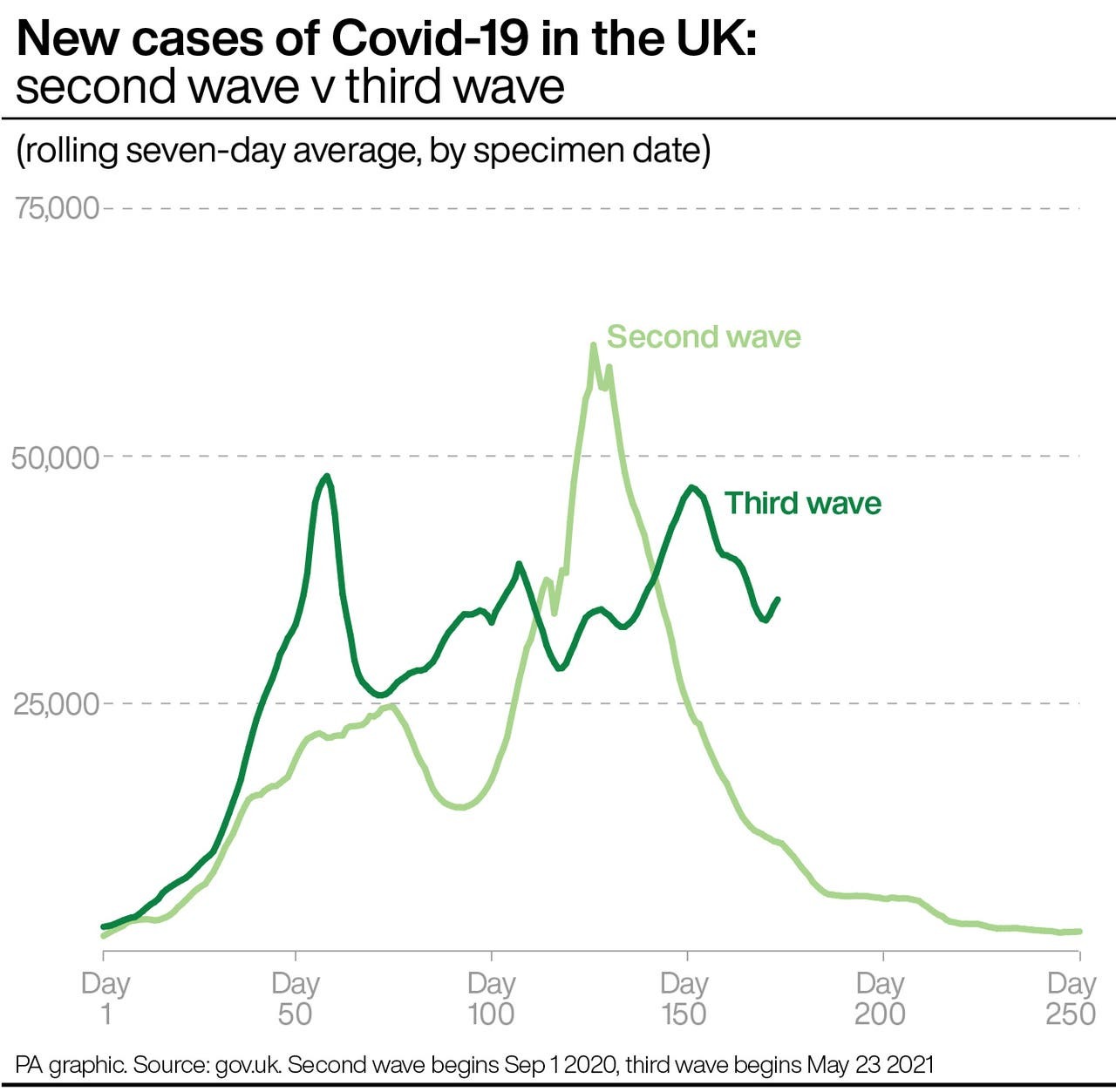
Yet Covid cases continue to climb.
Advertisement
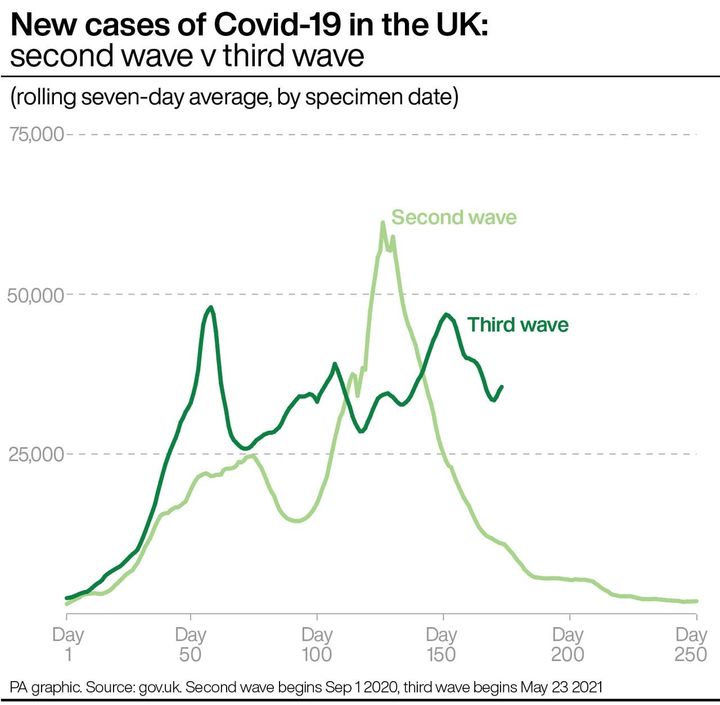
There were a total of 244,134 new Covid cases reported between November 3 and November 10 in the UK – data from November 11 to November 14 is incomplete and so has not been included.
This equates to 363.9 cases per 100,000 overall, which is higher than the last few days, but slightly below the previous week of 392.2 cases.
Advertisement
PA GraphicsPress Association Images
As a third of UK local authorities are recording an increase in rates, here’s a breakdown of just which areas are experiencing the largest jump in the Covid infection.
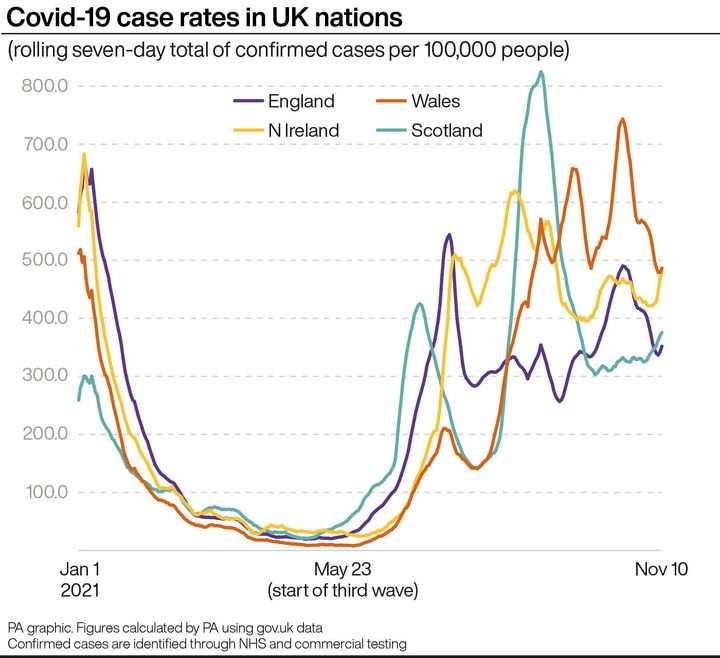
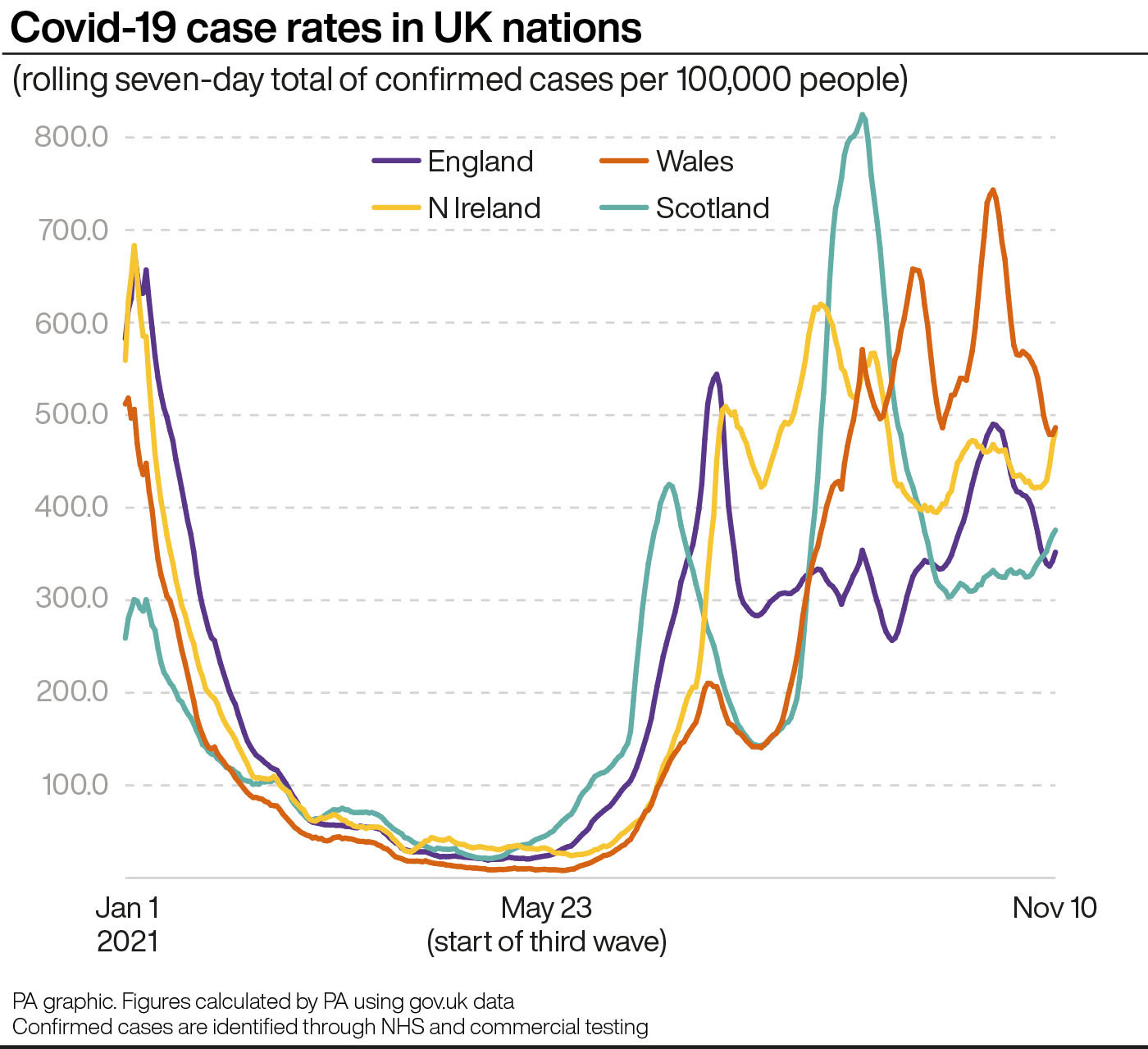
The current rate in England is 351.9 infections per 100,000 people.
Out of 312 local authorities in England, 85 have experienced a week on week increase. The data shows most of these infections are among schoolchildren aged between five and nine and 10 to 14, likely prompted by their return to the classroom after the October half-term.
Advertisement
The three local authorities in England which have seen the largest jump in new Covid cases are:
Torridge in Devon, case rate increased from 376.9 to 638.8.
Charnwood in Leicestershire’s rate has jumped from 350.8 to 530.7.
North Devon now has the highest rate in England, as its rates increased from 495.1 to 645.8.
Scotland has seen its case numbers rise up to 375.7 per 100,000 – this is an increase up week-on-week from 334.7.
This means the nation has the most Covid cases it has experienced since September 26.
Only six out of 32 areas in Scotland have experienced a decrease in case numbers.
The areas with the worst Covid rates are:
Moray, where cases shot up from 318.7 to 501.5.
Perth & Kinross – cases rose from 306-8 to 479.2.
Dumfries & Galloway, where the rate increased from 394.5 to 529.4.
Scotland has the highest local rate in the whole of the UK, in the Orkney Islands – the current infection rate is at 696.4 per 100,000.
The current rate of new cases in Northern Ireland is 482.7 per 100,000 – this has increased from 421.2 the previous week.
Advertisement
This is also the highest rate the nation has experienced since September 14, as Covid cases have soared in nine of the 11 local authority areas.
The case rate has jumped the most in:
Causeway Coast & Glens, has seen a large increase from 442.9 to 628.5 – the highest rate in Northern Ireland.
Mid-Ulster has seen an increase from 394.1 to 515.6.
Fermanagh & Omagh’s rate has increased from 484.9 to 591.5.
Wales has the highest case rate per 100,000 across the four nations, with 486.5 cases. Most of these cases are among just five of 22 areas in the nation.
The rate had recently risen to 551.1, so Wales has actually seen a drop in its overall week-on-week data.
The largest increases between November 3 and November 10 were seen in:
Gwynedd, where it increased from 475.3 to 551.2.
Carmarthenshire, from 480.3 to 529.3.
Vale of Glamorgan has the highest rate out of Wales, with 626.0 – down from 759.8.
PA Graphics
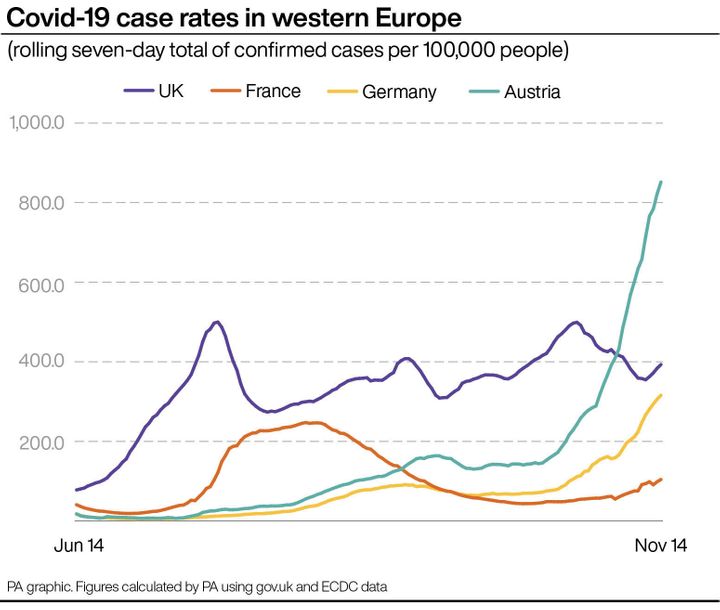
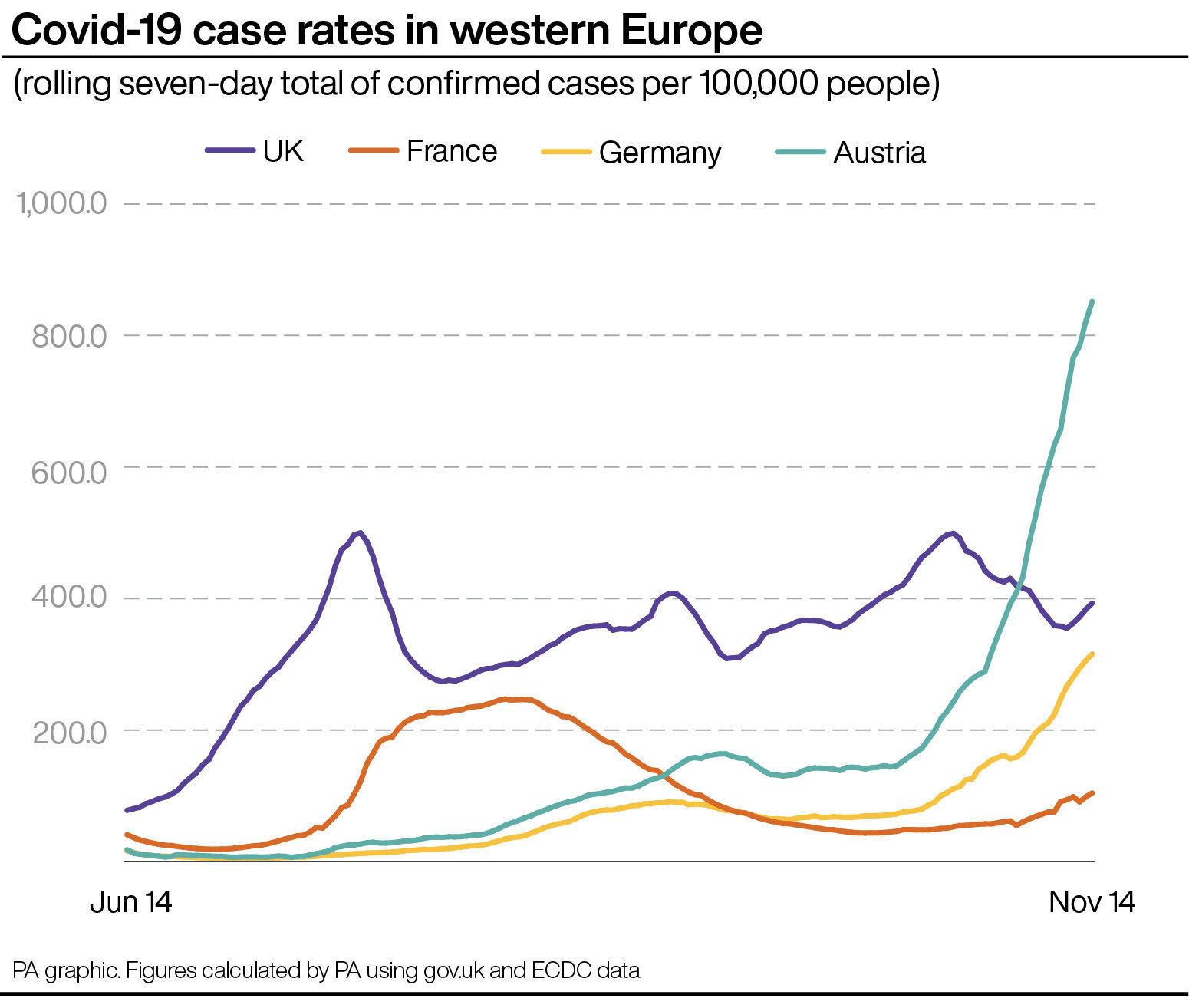
Concerns over a winter wave has seen the Netherlands implement a partial lockdown for at least three weeks and Austria impose a complete lockdown for unvaccinated people for 10 days, to start with.
Advertisement
Both countries have see a rapid increase in Covid cases recently, with Austria’s cases soaring to more than 800 per 100,000 people.
The UK has a higher case rate than both France and Germany, but with a rate just under 400 cases per 100,000 people, it’s still a long way off Austria’s infections.
PA GraphicsPress Association Images

Parliamentary report says some patients report being racially abused by doctors and nurses.
Some two million people are told to stay at home amid growing pressure on hospitals as cases surge.
A single dose of the Pfizer jab has been available to 12 to 15-year-olds since 20 September.

Boris Johnson will host a Downing Street press conference at 5pm today, it has been announced.
The briefing will be on the Cop26 climate change conference and the prime minister will appear alongside the summit’s president Alok Sharma.
It comes after a pact was finally agreed in Glasgow last night which saw a dramatic last-minute intervention from China and India to water down the deal to end the use of coal power.
Sharma today said the two states would have to “justify themselves” to climate vulnerable countries.
He made the comments after fighting back tears on the world stage as the deal was finally completed.
The agreement had been due to include a pledge to accelerate the “phase-out” of coal power but it was switched to “phase-down”.
The word change reduces the urgency with which countries are required to reduce the use of coal – the worst fossil fuel for greenhouse gases.
This morning, Sharma told Sky News: “On the issue of coal, China and India of course are going to have to justify to some of the most climate vulnerable countries what happened. You heard that disappointment on the floor.”
A tearful Sharma told delegates last night: “I apologise for the way this process has unfolded. I am deeply sorry.”
However, the Glasgow Climate Pact is the first ever climate deal to explicitly plan to reduce coal.
The overall deal saw nearly 200 countries agree to keep the goal of limiting global warming to 1.5C above pre-industrial levels “alive” or within reach.