Researchers’ novel mind-body program outperforms other forms of treatment for chronic back pain

Chronic back pain is the leading cause of disability worldwide. In the United States, patients spend up to $300 billion each year to treat the condition, according to a 2012 study published in the Journal of Pain. However, common therapies such as surgery and steroid injections intended to address physical origins of back pain have not been clearly proven to work in randomized clinical trials, and a growing body of evidence suggests that psychological factors may be associated with of some forms of back pain.

Physician-scientists from Beth Israel Deaconess Medical Center (BIDMC) developed a 12-week mind-body program that takes a new approach to chronic back pain. The novel intervention — which is not yet available at BIDMC to the general public — is based on an idea pioneered by the late John Sarno, MD, a professor of rehabilitation medicine at the New York University School of Medicine. In a new publication appearing in journal PAIN, the team demonstrated that the mind-body intervention was highly beneficial for treating back pain when compared to standard care, with 64 percent of research volunteers reporting being 100 percent pain free six months later.

“The current paradigm of pain management focuses mostly on treatment of a physical origin of pain, however, in many cases of chronic back pain a physical source of pain cannot be identified,” said corresponding author Michael W. Donnino, MD, a physician in the Departments of Critical Care and Emergency Medicine at BIDMC. “Our group focused on the hypothesis that non-specific back pain is the symptomatic manifestation of a psychological process, substantively driven by stress, repressed emotions and other psychological processes. The exact mechanism remains unclear, but an analogy could be made to other known effects of acute emotional states on acute physiological changes, such as how the emotion of embarrassment may result in the capillary vasodilation we know as blushing.”

Donnino and colleagues’ experimental program, termed Psychophysiologic Symptom Relief Therapy (PSRT), is designed to address underlying stressors and psychological contributors to persistent pain as well as conditioned pain responses and fear avoidant behaviors. Treatment strategies include educating patients about the links between stressors and pain, as well as the relationship with emotions. Armed with this knowledge, participants learn healthier ways to process stress and express emotions. The program also focuses on desensitization or reverse conditioning to help patients break the associations that often are formed with triggers of pain such as bending or sitting.

“Often these triggers are assumed to be cause of pain, but they are perhaps better described as associations that can be unknowingly conditioned in a way that is similar to how Pavlov conditioned dogs to salivate to a bell by pairing the bell with food,” Donnino noted. “Our program works to reverse these conditioned responses and thus improve pain and pain disability.”

The program’s final eight weeks focus on mindfulness-based stress reduction, or MBSR, the goal of which is to provide the tools to better process current and future stressors, while allowing time to practice the techniques from the first portion of the program.

To assess whether PSRT can reduce symptoms and pain-related anxiety in patients with non-specific chronic back pain, Donnino and colleagues enrolled 35 participants, 18 to 67 years old with chronic back pain that lacked a clear physical origin. Participants were randomly assigned to receive either the novel 12-week PSRT intervention, eight weeks of MBSR only, or usual care under the guidance of their physicians without influence from the study team. All participants filled out pain-related questionnaires prior to the interventions and periodically up to six months after the interventions to assess changes in functional limitations or disability, back pain bothersomeness and pain-related anxiety.

After just four weeks, researchers saw an astonishing 83 percent decrease in reported pain disability in the PSRT group compared to 22 percent and 11 percent in the MBSR and usual care groups, respectively. With regard to pain bothersomeness over the same time period, the PSRT group had a 60 percent drop compared to 8 percent and 18 percent decreases in pain bothersomeness for the mindfulness and usual care groups, respectively.

The PSRT group was superior to both usual care and MBSR for the primary endpoint of pain disability at every interval and at the end of the six-month monitoring period. Moreover, at the end of the six-month period, 64 percent of patients with chronic back pain in the PSRT group were completely pain free (reporting 0 out 10 on a pain scale) whereas only 25 percent and 17 percent reported being pain free in the mindfulness and usual care arms, respectively.

“Within four weeks, differences between PSRT, MBSR, and usual care were apparent across multiple domains including the primary outcome measure of functional disability as well as pain bothersomeness,” Donnino said. “When patients recognize the relationship between the mind and their physical pain, this orientation sheds new light and provides them a basis to engage with the multifaceted program that works interchangeably to improve pain and disability. This study shows that our program has the potential to be highly beneficial when compared to both usual care as well as usual care plus additional treatments such as MBSR.”

Co-authors included Garrett S. Thompson, Shivani Mehta, Patricia Howard, Lakshman Balaji, Long H. Ngo, and Anne V. Grossestreuser of BIDMC; and Myrella Paschali, Robert Edwards, Sofie B. Antonsen and Suzanne M. Bertisch of Brigham & Women’s Hospital. This work was supported by a philanthropic donation from Adam D’Angelo. The authors have declared no conflicts.


Share Button

Small but mighty: Microgreens go from trendy vegetables to functional food

Starting decades ago as fashionable, high-value gourmet greens, today microgreens have gained popularity among consumers for their nutritional profile and high content of antioxidant compounds. Now, a new study suggests that the tiny plants have the potential to help provide global nutrition security.

As part of a project titled, “Food Resilience in the Face of Catastrophic Global Events,” an international team of researchers has found that these vegetables can be grown in a variety of soilless production systems in small spaces indoors, with or without artificial lighting. The findings are especially relevant amid a pandemic that has disrupted food supply chains.

With microgreens, people can produce fresh and nutritious vegetables even in areas that are considered food deserts, according to team leader Francesco Di Gioia, assistant professor of vegetable crop science, College of Agricultural Sciences, Penn State.

“The current COVID-19 pandemic revealed the vulnerability of our food system and the need to address malnutrition issues and nutrition-security inequality, which could be exacerbated by potential future emergencies or catastrophes,” he said. “Nutrient-dense microgreens have great potential as an efficient food-resilience resource.”

Microgreens’ nutritional profile is associated with the rich variety of colors, shapes, textural properties and flavors obtained from sprouting a multitude of edible vegetable species, including herbs, herbaceous crops and wild edible species.

With a short growth cycle requiring only minimal inputs of fertilizer, microgreens have great potential to provide essential nutrients and antioxidants, Di Gioia noted. Using simple agronomic techniques, it is possible to produce microvegetables that could address specific dietary needs or micronutrient deficiencies, as well as nutrition-security issues in emergency situations or in challenging environmental conditions.

Consumers could produce microgreens at home using simple tools available in a kitchen, Di Gioia pointed out. A grower also would need seeds, growing trays and a growth medium — which could consist of a common peat or peat and perlite growth mix.

Given all the characteristics of microgreens, scientists at NASA and the European Space Agency also have proposed them as a source of fresh food and essential nutrients for astronauts engaged in long-term space missions. And because microgreens may be used as functional food to enhance nutrition security under current conditions and during future emergencies or catastrophes, Di Gioia suggested that microgreen production kits including seeds could be prepared and stored, then made available when needed.

“Under such circumstances, a variety of fresh and nutrient-rich microgreens could be grown providing a source of minerals, vitamins and antioxidants in a relatively short time,” he said. “Or alternatively, kits could be distributed to vulnerable segments of the population as a short-term nutrition-security resource.”

Di Gioia presented the study virtually during the International Symposium on Soilless Culture and Hydroponics sponsored by the International Society for Horticultural Science last spring. Originally scheduled to be held in Lemesos, Cyprus, the symposium took place online because of COVID concerns. The research paper was published recently in Acta Horticulturae, the journal of the International Society for Horticultural Science.

Also on the research team were Spyridon Petropoulos, Department of Agriculture, University of Thessaly, Magnissia, Greece; Isabel C.F.R. Ferreira, Instituto Politécnico de Bragança, Centro de Investigaçã o de Montanha, Campus de Santa Apolónia, Bragança, Portugal; and Erin Rosskopf, Horticultural Research Laboratory, U.S. Department of Agriculture’s Agriculture Research Service, Fort Pierce, Florida.

Open Philanthropy and the U.S. Department of Agriculture’s National Institute of Food and Agriculture supported this research.

Story Source:

Materials provided by Penn State. Note: Content may be edited for style and length.

Share Button

Vitamin-A treatment trial for Covid loss of smell

Volunteers will receive brain scans and be asked to sniff powerful odours such as rotten eggs and roses.

Share Button

People also suffer ‘long flu’, study shows

Similar to Covid, other viruses can cause prolonged symptoms that take time to get over.

Share Button

Plasmodium falciparum evolving to escape malaria rapid diagnostics in Africa

A major tool against malaria in Africa has been the use of rapid diagnostic tests, which have been part of the “test-treat-track” strategy in Ethiopia, the second most-populated country in Africa. But researchers studying blood samples from more than 12,000 individuals in Ethiopia now estimate these tests missed nearly 10% of malaria cases caused by the parasite Plasmodium falciparum, the most common cause of malaria cases and deaths.

The research, published in Nature Microbiology, showed that two genetic mutations to the parasite allow it to escape detection.

“This is a serious problem for malaria control efforts and a reminder that pathogens are very capable of adapting to survive,” said senior author Jonathan B. Parr, MD, assistant professor in the division of infectious diseases at the UNC School of Medicine. “Surveillance across the Horn of Africa and alternative malaria diagnostic approaches in affected regions are urgently needed.”

Co-corresponding authors are Sindew M. Feleke, MSc, at the Ethiopian Public Health Institute, Jane Cunningham, MD, at the WHO, and Dr. Parr.

This research project was conducted in partnership with the Ethiopian Public Health Institute and the World Health Organization. The research team enrolled 12,572 participants along Ethiopia’s border with Eritrea, Sudan, and South Sudan, using RDTs, PCR diagnostics, an ultrasensitive immunoassay for antigen detection, and next-generation sequencing to find that P. falciparum lacking the genes histidine-rich protein 2 (pfhrp2) and histidine-rich protein 3 (pfhrp3) escape detection by the RDTs and appear to have spread rapidly.

In collaboration with Brown University’s Jeffrey A. Bailey, MD, PhD, and Ozkan Aydemir, PhD, the researchers applied a molecular sequencing approach to pinpoint the particular deletion patterns of these genetic mutations. “Our method allowed us to study the rich genomic information surrounding these genes in fine detail and at scale, facilitating the identification of evolutionary origins of these deletions,” Aydemir said.

“Our work indicates that prhrp3 deletions have arisen independently multiple times over the course of years,” said Parr, who is a member of the UNC Institute for Global Health and Infectious Diseases. “We also found signs that RDT-based testing and treatment are driving a recent rise in pfhrp2 deletion mutation prevalence, allowing parasites to escape detection.”

In the Nature Microbiology paper, the authors ask, “What other advantages might pfhrp2/3-deleted parasites have over those with intact genes? Our limited understanding of the biology of these deletions makes this question hard to answer.” But the authors posit several lines of inquiry in the paper, though one thing is certain.

Parr said, “We found clear evidence that parasites have recently evolved to escape detection by malaria rapid diagnostic tests along Ethiopia’s borders with Sudan and Eritrea. False-negative results were common in multiple sites and will lead to misdiagnosis and malaria deaths without intervention.”

“The results of this joint research effort have prompted us to change our diagnostic testing policies from HRP2/3-detecting RDTs to non-HRP2/3 targeted RDTs in the most affected regions of Ethiopia,” Feleke said.

Also, along with several other unpublished reports, this study prompted the WHO to issue a statement of concern.

Cunningham, said, “The WHO recommends that all malaria endemic countries start and maintain surveillance for pfhrp2/3 deletions and respond appropriately when they are confirmed, in order to prevent unnecessary morbidity and deaths and to safeguard inroads that have been made towards malaria elimination, particularly in sub-Saharan Africa.”

Share Button

Covid: Boris Johnson makes inquiry pledge to bereaved families

Boris Johnson says he will appoint an inquiry chair before Christmas, after meeting a campaign group.

Share Button

Covid: Kettering’s high rate ‘not all about children’

Kettering has the highest rate of new coronavirus cases per 100,000 people in the country.

Share Button

NHS Highland pays out millions to bullied staff

The health authority says it expects payments to reach £3.4m after a culture of bullying was exposed.

Share Button

Fuel Crisis: Chaotic Video Shows Panic-Buyer Filling Water Bottles At Petrol Station

Videos on social media have captured the chaos unfolding on the fifth day of supposed petrol “shortages” across the UK.

While Britain’s refineries actually have plenty of fuel, a shortage of HGV drivers means the petrol is not being distribution across the country fast enough.

Fuel prices are now skyrocketing as panic-buyers drain the petrol pumps, leading to widespread complaints from drivers, particularly those working for the emergency services who can no longer do their jobs.

The Army has now been put on standby in a bid to get the supply chains working again.

But there have already been several reports – and videos – of people pouring petrol into water bottles and taking more than their fair share of fuel.

According to The Independent, one woman filled so many water bottles with petrol she caused a 30-minute queue in Cobham Services on the M25 on Saturday.

Fights are breaking out across the country as people confront one another over their petrol shortages as well.

One man is thought to have been carrying a knife on Monday when he visited a petrol station, while other people have been seen furiously arguing with one another over the limited fuel supplies over the last few days.

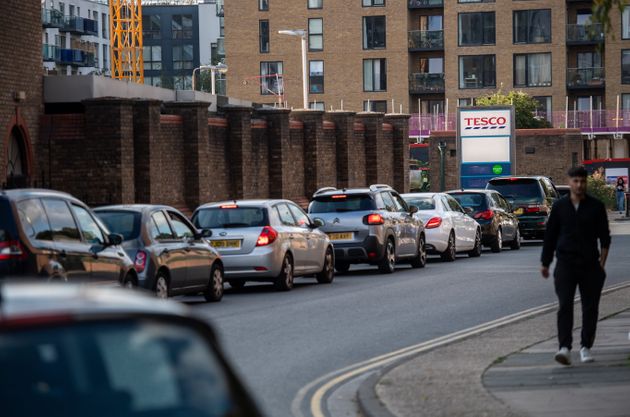
Outside the petrol stations which have remained fully open, queues are also stretching down the roads outside, and oil companies have imposed a £30 spending limit to ration the supplies.

Chris J Ratcliffe via Getty Images

Motorists queue for fuel at a Tesco garage in Lewisham on September 26, 2021

Ambulance drivers have complained that they are now suffering as well.

Emergency services driver Becky Hough tweeted on Friday: “To everyone that panicked and went to fuel their cars when it wasn’t needed, well done. On shift on an emergency ambulance, low on fuel and struggling to find somewhere that isn’t sold out.”

On Sunday, she wrote: “FINALLY! A BP garage that has let us use the reserves. However whilst fuelling we received verbal abuse from the public driving past, horns being honked and many hand gestures.”

Another ambulance driver also told LBC on Tuesday: “I was in the petrol queue for over an hour, and when the attendant actually saw that I was in patient transport, he let me jump the queue.

″The abuse I got yesterday was horrendous.”

Share Button

Britney Spears Unimpressed By Wave Of New Documentaries About Her Private Life: ‘That’s The Past’

Britney Spears has spoken out about the release of several new films documenting her personal life.

The singer, who is currently embroiled in a legal battle to bring an end to the conservatorship she has been under for the last 13 years, has been the subject of several documentaries in recent times, put together by media outlets like the New York Times and the BBC.

With a hearing about the legal arrangement scheduled for Wednesday, two more docs about Britney have arrived, including the Netflix offering Britney vs. Spears.

Controlling Britney Spears – a sequel to Framing Britney Spears, which sparked a lot of conversation earlier this year – was also released in the last week, with CNN recently unveiling their own project titled Toxic: Britney Spears’ Battle For Freedom.

Lester Cohen via Getty Images

Britney Spears at a Grammys event in 2017

In the early hours of Tuesday morning, Britney shared her thoughts on one of the documentaries after claiming she’d sat down to watch it, although she did not specify which.

“It’s really crazy guys,” she wrote on Instagram. “I watched a little bit of the last documentary and I must say I scratched my head a couple of times!!!

“I really try to disassociate myself from the drama!!! Number one… that’s the past!!! Number two… can the dialogue get any classier??? Number three … wow they used the most beautiful footage of me in the world !!! What can I say… the EFFORT on their part!!!”

Back in May, Britney voiced her upset at being the subject of so many recent documentaries, branding the producers behind them “hypocritical” and accusing them of “criticising the media and then doing the same thing”.

“2021 is definitely way better than 2020 but I never knew it was gonna be like THIS!!!!” she wrote. “So many documentaries about me this year with other people’s takes on my life… what can I say… I’m deeply flattered!!!!”

Britney continued: “These documentaries are so hypocritical… they criticise the media and then do the same thing?????

“Damn… I don’t know y’all but I’m thrilled to remind you all that although I’ve had some pretty tough times in my life… I’ve had waaaayyyy more amazing times in my life and unfortunately my friends… I think the world is more interested in the negative!!!!”

The Womanizer singer added: “I mean… isn’t this supposed to be a business and society about THE FUTURE???? Why highlight the most negative and traumatising times in my life from forever ago???? I mean DAMN…”

She previously said of Framing Britney Spears: “I didn’t watch the documentary but from what I did see of it I was embarrassed by the light they put me in… I cried for two weeks and well… I still cry sometimes!!!!”

Share Button