Ian Hislop Savages ‘Idiot’ Dominic Cummings In Brutal Have Got News For You Take Down

Ian Hislop did not hold back about what he thought of Dominic Cummings’ appearance at the Commons Select Committee on Friday night’s Have I Got News For You.

The team captain blasted Boris Johnson’s former chief advisor in a savage take down following the seven hour hearing in which he made explosive claims about the PM and the government’s handling of the coronavirus pandemic. 

Ian described Cummings’ appearance as “one of the most disgusting performances in public life.”

Other captain Paul Merton said: “Dominic Cummings has been giving evidence, Seven hours’ worth I believe. He made lots of powerful statements and somebody’s lying, somewhere in the middle of all this. Not everybody is telling the truth. 

’He’s made various accusations and Boris and Matt Hancock have denied them.”

Ian – who was joined by David Mitchell – joked: “It’s good that we’ve got David on tonight, because it’s an episode of Would I Lie To You?’, and the answer is, for everyone… yes they did.” 

He continued: “He said ‘Boris Johnson is not fit to be Prime Minister.’ Of course he isn’t, he appointed you! That doesn’t take eight hours, does it?

“He did that classic thing at the start of saying it’s all everybody else’s fault. Would you believe it? 

“The government has really handled this very badly… if only there’d been someone at the heart of government who could have said ‘this whole thing is going wrong.’ Maybe an advisor… maybe a senior advisor… 

“It was one of the most disgusting performances in public life that I can remember.”

BBC/Getty

(L-R) Ian Hislop and Dominic Cummings

David then asked: “Assuming we can believe a word the devious bastard says, who is to blame for everything?”

Ian replied: “The Prime Minister is to blame for everything, and the Prime Minister should never have become Prime Minister. Except, this is the man who almost single-handedly worked to make him Prime Minister.

“It’s absolutely extraordinary that he only noticed that the Prime Minister was utterly useless when he was sacked. 

“It just didn’t occur to him the whole time he was on board with the project, and then suddenly, ‘Oh my goodness, I’ve suddenly realised… you’re an idiot, and so am I’”.

Have I Got News For You continues on BBC One at 9.00pm tonight, guest hosted by David Mitchell.

Share Button

Love Island Host Laura Whitmore Sounds The Alarm For The Return Of The Dating Show In First Teaser

Laura Whitmore sounds the alarm for the return of Love Island in the first teaser for the new series of the ITV2 dating show.

The host swings a pink mallet to smash the heart-shaped glass on an alarm, which reads: “In case of Love Island, crack on.”

Dressed in a red jumpsuit and sunglasses, Laura, who recently gave birth to her first child with husband Iain Stirling, the show’s narrator, smiles at the camera before taking a swing.

The 10-second promo ends with the words: “This is not a drill!”

The dating show is returning to the screen for the first time since February 2020 after the summer series was cancelled last year because of the coronavirus pandemic.

The first ever winter series was won by Paige Turley and Finley Tapp.

Another teaser for the new series shows a camera zooming in on the licence plate of a 4×4 which typically carries the new arrivals to the villa.

The plate reads LOV3.

The new series has been filmed adhering to government guidelines surrounding Covid-19.

The teaser will be shown during the first episode of The Masked Dancer, which starts at 7pm on Saturday on ITV and the ITV Hub.

Love Island returns this summer on ITV2 and the ITV Hub.

Share Button

Glee Star Heather Morris Reveals Why She Was ‘Scared’ To Call Out Lea Michele During Time On Show

Heather Morris is speaking out again about her time on Glee, offering an explanation about why it took so many years for her and her co-stars to talk about Lea Michele’s allegedly toxic behaviour on set.

On an episode of the podcast “Everything Iconic with Danny Pellegrino” that came out this week, Morris said that she and other members of the Glee cast “absolutely could have stepped up and gone to the Fox execs and said how we felt about the situation and nobody really did.”

“Now we are living in a culture where it’s acceptable to go do things like that, whereas I think many people were very scared,” she said. “I know, genuinely, I didn’t feel like it was my place and I don’t know why, because I was a cast member just like everybody else, and we all deserve to feel comfortable on a set.”

Glee ended in 2015, but interest in what happened behind the scenes has increased over the years. It spiked last summer when many cast members began airing allegations against Michele.

In 2016, the late Naya Rivera wrote in her memoir, Sorry Not Sorry, that the dynamics with Michele on set were less than ideal. 

“If I’d complained about anyone or anything, she’d assumed I was bitching about her. Soon, she started to ignore me, and eventually it got to the point where she didn’t say a word to me for all of Season 6,” Rivera wrote.

FOX via Getty Images

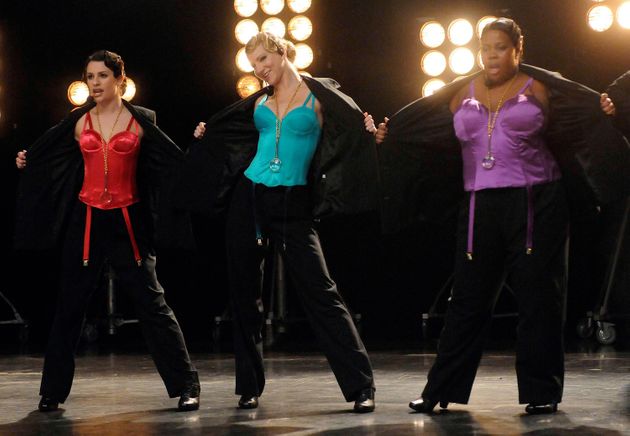
Lea Michele, Heather Morris and Amber Riley in “Glee.”

Last summer, during protests against racial inequality and police brutality, Michele tweeted support for Black Lives Matter. Glee alum Samantha Marie Ware replied, mentioning that Michele made her time on the show a “living hell” and said that the star had perpetrated “traumatic microaggressions.”

Other cast members, including Amber Riley and Dabier Snell, responded supportively to Ware, with Snell even saying: “Girl, you wouldn’t let me sit at the table with the other cast members cause ‘I didn’t belong there.’ … Fuck you Lea.”

After these grievances were made public, Michele issued a lengthy apology on social media, writing: “Whether it was my privileged position and perspective that caused me to be perceived as insensitive or inappropriate at times or whether it was just my immaturity and me just being unnecessarily difficult, I apologize for my behavior and any pain which I have caused.”  

On Pellegrino’s podcast, Morris elaborated on why her initial response to her co-stars speaking out was a bit milquetoast. At the time, Morris tweeted a statement declaring that “hate is a disease in America that we are trying to cure” and that Michele “SHOULD be called out,” but didn’t offer much more. 

“I remember getting so much shade,” said Morris, “because people were like, ‘This is so fucking cryptic,’ like, ‘Why don’t you just go and say it?’ I’m like, ‘Guys, she’s pregnant, and all this stuff is going around and … it’s true.’” 

Morris said that she wasn’t sure if she and the rest of the cast “were victims of bullying and that’s a typical victim thing to do, is to blame yourself, which is what people were saying.” 

“But it also is very true and the only person who was honest about it was Naya [Rivera]. And it was something that was very hush-hush on set. And now you see all these things coming out with these bigger names, who were very disrespectful and mistreated a lot of people and people allowed it to happen,” Morris said.

The actor and singer emphasised that while everyone was “close with Lea at certain points,” they all went on to not be as “close with her.”

“So there’s that human element to it to understanding who this person is, growing with that person, seeing her try to become better,” she said.

You can listen to the entire episode here or below:

Share Button

NHS calls for ban on toy neodymium magnets amid child safety fears

In England, 65 children have needed urgent surgery after swallowing magnets in the last three years.

Share Button

Depressive symptoms linked to rapid kidney function decline

In a study of adults with normal kidney function, those who had frequent depressive symptoms were more likely to later experience a rapid decline in kidney function. The study will appear in an upcoming issue of CJASN.

Depression is a common condition in middle-aged and older adults, and it can contribute to a variety of mental and physical problems. Previous research has found a link between depressive symptoms and rapid kidney function decline in patients with chronic kidney disease (CKD). To look for a potential link in adults with normal kidney function as well, a team led by Xianhui Qin, MD (Nanfang Hospital, Southern Medical University, in China) examined information on 4,763 individuals with healthy kidneys when they enrolled in the China Health and Retirement Longitudinal Study (CHARLS).

At the start of the study, 39% of participants had high depressive symptoms, and during a median follow-up of 4 years, 260 (6%) participants experienced rapid kidney function decline. There was a significant association between depressive symptoms at the start of the study and rapid decline in kidney function during follow-up. Participants with frequent depressive symptoms were 1.4-times more likely to experience rapid kidney function decline than participants with infrequent depressive symptoms, after adjustments.

“CKD is a leading risk factor for cardiovascular disease, kidney failure, and mortality worldwide. Therefore, the identification of more modifiable risk factors may possibly reduce the huge burden of CKD and its related complications by leading to early detection and prevention,” said Dr. Qin. “While our study does not show causality, it demonstrated that high depressive symptoms were significantly associated with rapid decline in kidney function among Chinese adults with normal kidney function. If further confirmed, our data provide some evidence for depressive symptom screening and effective psychosocial interventions to improve the prevention of CKD.”

An accompanying Pantiet Voice article provides the perspective of a two-time kidney transplant recipient with an American-Born Chinese background.

Story Source:

Materials provided by American Society of Nephrology. Note: Content may be edited for style and length.

Share Button

Candy-like models used to make STEM accessible to visually impaired students

About 36 million people have blindness including 1 million children. Additionally, 216 million people experience moderate to severe visual impairment. However, STEM (science, technology, engineering and math) education maintains a reliance on three-dimensional imagery for education. Most of this imagery is inaccessible to students with blindness. A breakthrough study by Bryan Shaw, Ph.D., professor of chemistry and biochemistry at Baylor University, aims to make science more accessible to people who are blind or visually impaired through small, candy-like models.

The Baylor-led study, published May 28 in the journal Science Advances, uses millimeter-scale gelatin models — similar to gummy bears — to improve visualization of protein molecules using oral stereognosis, or visualization of 3D shapes via the tongue and lips. The goal of the study was to create smaller, more practical tactile models of 3D imagery depicting protein molecules. The protein molecules were selected because their structures are some of the most numerous, complex and high-resolution 3D images presented throughout STEM education.

“Your tongue is your finest tactile sensor — about twice as sensitive as the finger tips — but it is also a hydrostat, similar to an octopus arm. It can wiggle into grooves that your fingers won’t touch, but nobody really uses the tongue or lips in tactile learning. We thought to make very small, high-resolution 3D models, and visualize them by mouth,” Shaw said.

The study included 396 participants in total — 31 fourth- and fifth-graders as well as 365 college students. Mouth, hands and eyesight were tested at identifying specific structures. All students were blindfolded during the oral and manual tactile model testing.

Each participant was given three minutes to assess or visualize the structure of a study protein with their fingertips, followed by one minute with a test protein. After the four minutes, they were asked whether the test protein was the same or a different model than the initial study protein. The entire process was repeated using the mouth to discern shape instead of the fingers.

Students recognized struc¬tures by mouth at 85.59% accuracy, similar to recognition by eyesight using computer animation. Testing involved identical edible gelatin models and nonedible 3D-printed models. Gelatin models were correctly identified at rates comparable to the nonedible models.

“You can visualize the shapes of these tiny objects as accurately by mouth as by eyesight. That was actually surprising,” Shaw said.

The models, which can be used for students with or without visual impairment, offer a low-cost, portable and convenient way to make 3D imagery more accessible. The methods of the study are not limited to molecular models of protein structures — oral visualization could be done with any 3D model, Shaw said.

Additionally, while gelatin models were the only edible models tested, Shaw’s team created high-resolution models from other edible materials, including taffy and chocolate. Certain surface features of the models, like a proteins pattern of positive and negative surface charge, could be represented using different flavor patterns on the model.

“This methodology could be applied to images and models of anything, like cells, organelles, 3D surfaces in math or 3D pieces of art — any 3D rendering. It’s not limited to STEM, but useful for humanities too,” said Katelyn Baumer, doctoral candidate and lead author of the study.

Shaw’s lab sees oral visualization through tiny models as a beneficial addition to the multisensory learning tools available for students, particularly those with extraordinary visual needs. Models like the ones in this study can make STEM more accessible to students with blindness or visual impairment.

“Students with blindness are systematically excluded from chemistry, and much of STEM. Just look around our labs and you can see why — there is Braille on the elevator button up to the lab and Braille on the door of the lab. That’s where accessibility ends. Baylor is the perfect place to start making STEM more accessible. Baylor could become an oasis for people with disabilities to learn STEM,” Shaw said.

Shaw isn’t new to high-profile research related to visual impairment. He has received recognition for his work on the White Eye Detector app. Shaw and Greg Hamerly, Ph.D., associate professor of computer science at Baylor, built the mobile app which serves as a tool for parents to screen for pediatric eye disease. Shaw’s inspiration for the app came after his son, Noah, was diagnosed with retinoblastoma at four months of age.

Share Button

Climate change-resistant corals could provide lifeline to battered reefs

In 2015, nearly half of Hawai’i’s coral reefs were affected by the most severe bleaching event to date. Coral bleaching occurs when warmer-than-normal ocean temperatures prompt corals to expel the algae that normally live inside them and on which the corals rely for food.

Bleaching events are dismaying, but corals can sometimes recover, while others resist bleaching altogether. In a new study in the journal Proceedings of the National Academy of Sciences, researchers led by Katie Barott of the University of Pennsylvania found that these battle-tested, resilient corals could thrive, even when transplanted to a different environment and subjected to additional heat stress. The findings offer hope that hardy corals could serve as a founding population to restore reefs in the future.

“The big thing that we were really interested in here was trying to experimentally test whether you an take a coral that seems to be resistant to climate chage and use that as the seed stock to propagate and put out on a different reef that might be degraded,” Barott says. “The cool thing was we didn’t see any differences in their bleaching response after this transplant.”

Mass coral bleaching events are getting increasingly frequent, raising worries that corals will become victims of climate change in the near future. Yet Barott and colleagues have been studying the corals that resist bleaching, with an eye toward buying corals more time to hang on in the face of warming and acidifying ocean waters.

One strategy they and others have envisioned, and which has been trialed in areas such as the Great Barrier Reef, is coral transplantation. Researchers could replenish reefs damaged by climate change — or other anthropogenic insults, such as sedimentation or a ship grounding — with corals that had proved sturdy and able to survive in the face of tough conditions.

For this to work, however, would require the coral “survivors” to continue to display their resilient characteristics after being moved to a new environment.

“If you take a coral that is resistant to bleaching in its native habitat, it could be that the stress of moving to a new place might make them lose that ability,” Barott says.

Just as a fern that grew well in the shade might wilt if moved to a sunny plot, the conditions of a new environment, including water flow rate, food access, light, and nutrient availability, could could affect the resilience of transplanted corals.

Barott and colleagues went after this question with an experiment in two reefs in Hawaiʻi’s Kāneʻohe Bay on the island of Oʻahu: one closer to shore with more stagnant waters and another farther from shore with higher flow. In each area, the researchers identified coral colonies that had resisted bleaching during the 2015 bleaching event and collected samples from them the following year. Corals are clonal organisms, and so a chunk taken from a colony can regrow and will have the same genetics as the “mother” coral. For each colony, they kept some samples on their native reef and transplanted others to the second reef.

After the corals had spent six months at their new location, the biologists also put coral samples from each site in tanks in the lab and simulated another bleaching event by raising the water temperature over a period of several days.

Carefully tracking the corals’ health and the conditions of the surrounding environment, the team measured photosynthesis rates, metabolism, and calcification rates, as well as the health of the symbiotic algae. They found that bleaching-resistant corals stayed that way, even in a new environment.

“What was really novel is that we had this highly replicated experiment,” Barott says, “and we saw no change in the coral’s bleaching response.”

The researchers also looked at how well the corals reproduced the summer that followed their collection. A coral’s native site conditions had an impact on their future reproductive fitness, they discovered.

“The corals from the ‘happy’ site — the outer lagoon that had higher growth rates prior to the bleaching event — generally seemed a little happier and their fitness was higher,” Barott says. “That tells us that, if you’re going to have a coral nursery, you should pick a site with good conditions because there seems to be some carryover benefit of spending time at a nicer site even after the corals are outplanted to a less ‘happy’ site.”

The “happy” site, the lagoon farther from shore, had higher flow rates than the other reef, which is closer to shore, less salty, and more stagnant. “Higher flow rates are really important for helping corals get rid of waste and get food,” Barott says.

Barott, who started the work as a postdoc at the Hawaiʻi Institute of Marine Biology, is continuing to pursue research on coral resiliency in her lab at Penn, including an investigation of the effects of heat stress and bleaching on reproductive success and the function of coral sperm.

While the results of the transplantation study are promising, she says that it would only be a temporary solution to the threat of climate change.

“I think techniques like this can buy us a little bit of time, but there isn’t a substitute for capping carbon emissions,” she says. “We need global action on climate change because even bleaching-resistant corals aren’t going to survive forever if ocean warming keeps increasing as fast as it is today.”

Share Button

A fiery past sheds new light on the future of global climate change

Centuries-old smoke particles preserved in the ice reveal a fiery past in the Southern Hemisphere and shed new light on the future impacts of global climate change, according to new research published in Science Advances.

“Up till now, the magnitude of past fire activity, and thus the amount of smoke in the preindustrial atmosphere, has not been well characterized,” said Pengfei Liu, a former graduate student and postdoctoral fellow at the Harvard John A. Paulson School of Engineering and Applied Sciences (SEAS) and first author of the paper. “These results have importance for understanding the evolution of climate change from the 1750s until today, and for predicting future climate.”

One of the biggest uncertainties when it comes to predicting the future impacts of climate change is how fast surface temperatures will rise in response to increases in greenhouse gases. Predicting these temperatures is complicated since it involves the calculation of competing warming and cooling effects in the atmosphere. Greenhouse gases trap heat and warm the planet’s surface while aerosol particles in the atmosphere from volcanoes, fires and other combustion cool the planet by blocking sunlight or seeding cloud cover. Understanding how sensitive surface temperature is to each of these effects and how they interact is critical to predicting the future impact of climate change.

Many of today’s climate models rely on past levels of greenhouse gasses and aerosols to validate their predictions for the future. But there’s a problem: While pre-industrial levels of greenhouse gasses are well documented, the amount of smoke aerosols in the preindustrial atmosphere is not.

To model smoke in the pre-industrial Southern Hemisphere, the research team looked to Antarctica, where the ice trapped smoke particles emitted from fires in Australia, Africa and South America. Ice core scientists and co-authors of the study, Joseph McConnell and Nathan Chellman from the Desert Research Institute in Nevada, measured soot, a key component of smoke, deposited in an array of 14 ice cores from across the continent, many provided by international collaborators.

“Soot deposited in glacier ice directly reflects past atmospheric concentrations so well-dated ice cores provide the most reliable long-term records,” said McConnell.

What they found was unexpected.

“While most studies have assumed less fire took place in the preindustrial era, the ice cores suggested a much fierier past, at least in the Southern Hemisphere,” said Loretta Mickley, Senior Research Fellow in Chemistry-Climate Interactions at SEAS and senior author of the paper.

To account for these levels of smoke, the researchers ran computer simulations that account for both wildfires and the burning practices of indigenous people.

“The computer simulations of fire show that the atmosphere of the Southern Hemisphere could have been very smoky in the century before the Industrial Revolution. Soot concentrations in the atmosphere were up to four times greater than previous studies suggested. Most of this was caused by widespread and regular burning practiced by indigenous peoples in the pre-colonial period,” said Jed Kaplan, Associate Professor at the University of Hong Kong and co-author of the study.

This result agrees with the ice core records that also show that soot was abundant before the start of the industrial era and has remained relatively constant through the 20th century. The modelling suggests that as land use changes decreased fire activity, emissions from industry increased.

What does this finding mean for future surface temperatures?

By underestimating the cooling effect of smoke particles in the pre-industrial world, climate models might have over-estimated the warming effect of carbon dioxide and other greenhouse gasses in order to account for the observed increases in surface temperatures.

“Climate scientists have known that the most recent generation of climate models have been over-estimating surface temperature sensitivity to greenhouse gasses, but we haven’t known why or by how much,” said Liu. “This research offers a possible explanation.”

“Clearly the world is warming but the key question is how fast will it warm as greenhouse gas emissions continue to rise. This research allows us to refine our predictions moving forward,” said Mickley.

The research was co-authored by Yang Li, Monica Arienzo, John Kodros, Jeffrey Pierce, Michael Sigl, Johannes Freitag, Robert Mulvaney and Mark Curran.

It was funded by the National Science Foundation’s Geosciences Directorate under grants AGS-1702814 and 1702830, with additional support from 0538416, 0538427, and 0839093.

Share Button

Declining biodiversity in wild Amazon fisheries threatens human diet

A new study of dozens of wild fish species commonly consumed in the Peruvian Amazon says that people there could suffer major nutritional shortages if ongoing losses in fish biodiversity continue. Furthermore, the increasing use of aquaculture and other substitutes may not compensate. The research has implications far beyond the Amazon, since the diversity and abundance of wild-harvested foods is declining in rivers and lakes globally, as well as on land. Some 2 billion people globally depend on non-cultivated foods; inland fisheries alone employ some 60 million people, and provide the primary source of protein for some 200 million. The study appears this week in the journal Science Advances.

The authors studied the vast, rural Loreto department of the Peruvian Amazon, where most of the 800,000 inhabitants eat fish at least once a day, or an average of about 52 kilograms (115 pounds) per year. This is their primary source not only of protein, but fatty acids and essential trace minerals including iron, zinc and calcium. Unfortunately, it is not enough; a quarter of all children are malnourished or stunted, and more than a fifth of women of child-bearing age are iron deficient.

Threats to Amazon fisheries, long a mainstay for both indigenous people and modern development, are legion: new hydropower dams that pen in big migratory fish (some travel thousands of miles from Andes headwaters to the Atlantic estuary and back); soil erosion into rivers from deforestation; toxic runoff from gold mines; and over-exploitation by fishermen themselves, who are struggling to feed fast-growing populations. In Loreto, catch tonnages are stagnating; some large migratory species are already on the decline, and others may be on the way. It is the same elsewhere; globally, a third of freshwater fish species are threatened with extinction, and 80 are already known to be extinct, according to the World Wildlife Fund.

Different species of animals and plants contain different ratios of nutrients, so biodiversity is key to adequate human nutrition, say the researchers. “If fish decline, the quality of the diet will decline,” said the study’s senior coauthor, Shahid Naeem, director of Columbia University’s Earth Institute Center for Environmental Sustainability. “Things are definitely declining now, and they could be on the path to crashing eventually.”

To study the region’s fish, the study’s lead author, then-Columbia PhD. student Sebastian Heilpern, made numerous shopping trips to the bustling Belén retail market in the provincial capital of Iquitos. He also visited the city’s Amazon River docks, where wholesale commerce begins at 3:30 in the morning. He and another student bought multiple specimens of as many different species as they could find, and ended up with 56 of the region’s 60-some main food species. These included modest-size scale fish known locally as ractacara and yulilla; saucer-shaped palometa (related to piranha); and giant catfish extending six feet or more. (The researchers settled for chunks of the biggest ones.)

The fish were flown on ice to a government lab in Lima, where each species was analyzed for protein, fatty acids and trace minerals. The researchers then plotted the nutritional value of each species against its probability of surviving various kinds of ongoing environmental degradation. From this, they drew up multiple scenarios of how people’s future diet would be affected as various species dropped out of the mix.

Overall, the biomass of fish caught has remained stable in recent years. However, large migratory species, the most vulnerable to human activities, comprise a shrinking portion, and as they disappear, they are being replaced by smaller local species. Most fish contain about the same amount of protein, so this has not affected the protein supply. And, the researchers found, many smaller fish in fact contain higher levels of omega-3 fatty acids, so their takeover may actually increase those supplies. On the other hand, as species compositions lean more to smaller fish, supplies of iron, zinc are already going down, and will continue to decline, they say.

“Like any other complex system, you see a tradeoff,” said Heilpern. “Some things are going up while other things are going down. But that only lasts up to a point.” Exactly which species will fill the gaps left when others decline is difficult to predict — but the researchers project that the overall nutritional value of the catch will nosedive around the point where 40 of the 60 food species become scarce or extinct. “You have a tipping point, where the species that remain can be really lousy,” said Heilpern.

One potential solution: in many places around the world where wild foods including fish and bush meat (such as monkeys and lizards) are declining, people are turning increasingly to farm-raised chicken and aquaculture — a trend encouraged by the World Bank and other powerful organizations. This is increasingly the case in Loreto. But in a separate study published in March, Heilpern, Naeem and their colleagues show that this, too, is undermining human nutrition.

The researchers observed that chicken production in the region grew by about three quarters from 2010 to 2016, and aquaculture nearly doubled. But in analyzing the farmed animals’ nutritional values, they found that they typically offer poorer nutrition than a diverse mix of wild fish. In particular, the move to chicken and aquaculture will probably exacerbate the region’s already serious iron deficiencies, and limit supplies of essential fatty acids, they say. “Because no single species can offer all key nutrients, a diversity of species is needed to sustain nutritionally adequate diets,” they write.

Besides this, chicken farming and aquaculture exert far more pressure on the environment than fishing. In addition to encouraging clearing of forests to produce feed for the animals, animal farming produces more more greenhouse gases, and introduces fertilizers and other pollutants into nearby waters, says Heilpern.

“Inland fish are fundamental for nutrition in many low-income and food-deficit countries, and of course landlocked countries,” said John Valbo Jørgensen, a Rome-based expert on inland fisheries with the UN Food and Agriculture Organization. “Many significant inland fisheries, including those of Peru, take place in remote areas with poor infrastructure and limited inputs. It will not be feasible to replace those fisheries with farmed animals including fish.”

Heilpern is now working with the Wildlife Conservation Society to produce an illustrated guide to the region’s fish, including their nutritional values, in hopes of promoting a better understanding of their value among both fishermen and consumers.

The other authors of the new study are Ruth deFries and Maria Uriarte of the Earth Institute; and Kathryn Fiorella, Alexander Flecker and Suresh Sethi of Cornell University.

Share Button

Can Boris Johnson Survive His Own Chaos?

Anadolu Agency via Getty Images

Prime Minister Boris Johnson leaves 10 Downing Street 

You’re reading The Waugh Zone, our daily politics briefing. 

Debate rages over Dominic Cummings’ bombshell evidence to MPs and whether he, a man once at the very heart of power, is a trustworthy source on what went on in Downing Street. 

But when the former Vote Leave chief described his erstwhile boss Boris Johnson as “just like a shopping trolley smashing from one side of the aisle to the other”, it certainly had a ring of truth. 

And perhaps never more than today, as it was confirmed what has long been alleged: that the Conservative Party and Tory donors did indeed initially fund an expensive revamp of the prime minister’s Downing Street flat. 

A report by the government’s new ethics adviser, Christopher Geidt, said Johnson acted “unwisely” by embarking on the refurb without “rigorous regard for how this would be funded”. 

Johnson was not aware Tory donor David Brownlow and his party had settled the bill – said to be £200,000 – and the work began in April, when the PM was hospitalised with coronavirus. 

The PM has since made a declaration of interests and settled the bill. As such, Geidt ruled that Johnson did not breach the ministerial code. 

“Chaos isn’t that bad – it means people have to look to me to see who is in charge,” Cummings claimed was Johnson’s mantra. 

Separately, Geidt found health secretary Matt Hancock guilty in “technical terms” of a “minor breach” of the code, in that he failed to declare he had retained shares in his sister’s firm Topwood Limited when it won an NHS contract.

Which, on a week filled with revelations about the government’s handling of Covid, rather begs the question: when, if ever, will chaos become a destructive force for Johnson’s administration? 

Keir Starmer vowed Labour would be a “constructive opposition” under his leadership. 

His cautious approach has not been rewarded by voters, however, with a recent YouGov poll putting the Conservatives nearly 20 points ahead of Labour. 

Despite Cummings’ many grenades this week, which included him confirming under oath he heard Johnson say that he’d rather see “bodies pile high” than order a third lockdown – something the PM denied in parliament – Labour has not called for anyone to resign. 

This has frustrated some on the left in the party, including MPs in the Socialist Campaign Group who could not hold back and defied Starmer with a statement of their own calling for ministers’ resignations. 

Those close to Starmer believe he looks across the despatch box at a PM complacent about the constant mayhem and how damaging it could be to his authority over time. 

But, however much Labour may wish to portray Johnson as a clown, it would be foolish of them to believe the PM is blind to threats. 

Despite the successful vaccine rollout, another ‘red wall’ victory in Hartlepool and him weathering all criticism of the government’s handling of Covid, Johnson has taken steps to maintain his position. 

As HuffPost UK reported last week, lockdown-sceptic Graham Brady could face a challenge as chair of the powerful 1922 committee of backbench Tory MPs.

The man vying to replace him, Robert Goodwill, is a noted ally of Johnson’s and believes the group should be less critical – something which would come in handy if the roadmap out of lockdown slips because of the India variant. 

And when it comes to Geidt’s role as adviser on ministerial standards, he has no power to launch investigations of his own and, Downing Street confirmed last month, the prime minister remains the “ultimate arbiter” of the ministerial code.

Meaning that, when put under pressure over his or his ministers’ conduct, Johnson reserves the right to mark his own homework. 

Perhaps the only unknown factor after this extraordinary week is what level of chaos Cummings has unleashed.  

Share Button