Victoria Atkins is challenged to name some health trusts meeting their targets to cut waiting lists.


Victoria Atkins is challenged to name some health trusts meeting their targets to cut waiting lists.
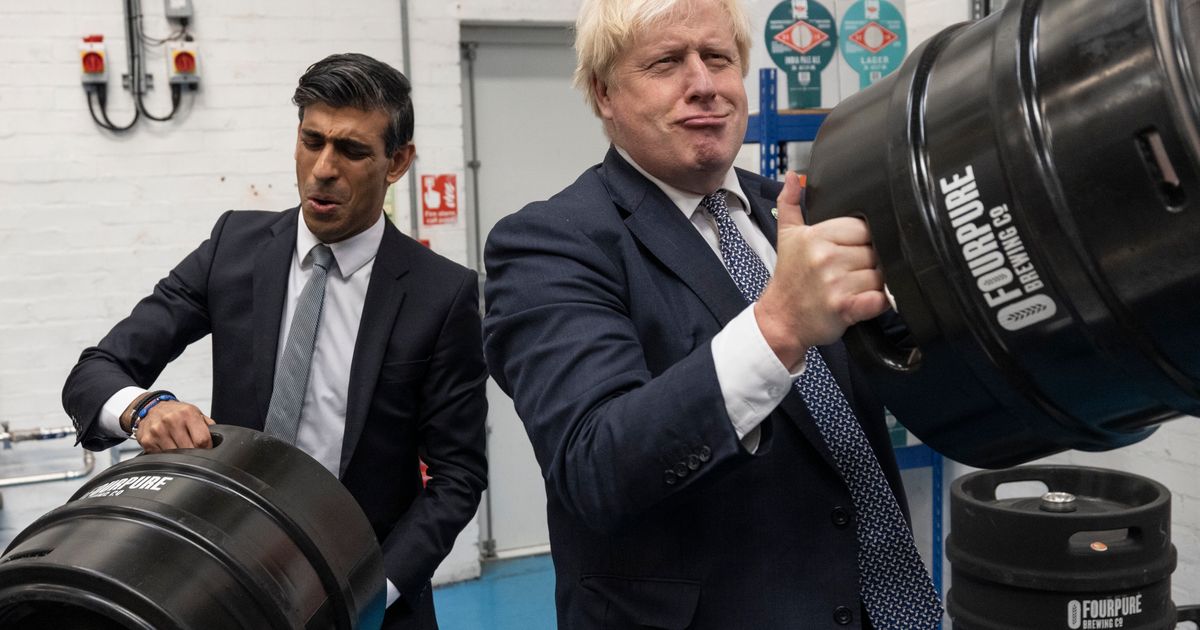
Boris Johnson has launched a furious attack on Rishi Sunak’s “absolutely nuts” policies as prime minister.
The former PM took aim at Sunak’s plan to ban the sale of tobacco to future generations and also suggested the government is not spending enough on defence.
Advertisement
Johnson’s comments, at a conference in Canada, are the latest salvo in his ongoing feud with the man he believes plotted to bring him down as prime minister.
Sunak announced at last autumn’s Tory Party conference in Birmingham that anyone currently aged 14 or under would never be able to buy tobacco products in their life.
The measure has sparked a backlash within his own party, with dozens of Conservative MPs expected to vote against the plan when it comes to parliament next week.
Johnson said some of Sunak’s policies that are “being done in the name of conservatism” are “absolutely, absolutely nuts”.
Advertisement
He said: “I see my beloved party… we’re banning cigars. And what is the point? The party of Winston Churchill wants a ban. I mean, donnez-moi un break as they say in Quebec. It’s just mad.”
On defence spending, Johnson said: “Now is the moment for an even more robust posture.
“We all need to recognise the world is more uncertain, more dangerous, we all need frankly to be spending more on defence — that goes for the UK as well as everybody else.”
Johnson’s remarks come just two weeks after Sunak bemoaned the “hospital pass” he had been handed by his predecessors when he became PM in 2022.

The first year of an infant’s life is dependent on milk. Whether you choose to breast feed or give formula, milk makes up all the calories they need.
Of course after 6 months of age you can start weaning them on to food, but this is to get infants ready for eating solids as part of their daily diet by 12 months. Before that, food is essentially getting them to practice the skill of eating.
Advertisement
However, if they are eating solids, the milk intake will be less than it was when they were infants.
Above the age of 12 months, children can have full fat cows milk instead of formula, and the NHS recommends you give your child at least 350ml (12oz) of milk a day.
My daughter began to refuse milk completely at 14 months after we decided to transition her to a beaker instead of bottle. This came as a shock because for the first year of her life all she did was drink milk.
She also wasn’t great at eating solid foods at 14 months, but that might have been because of the amount of milk she was drinking before she quit cold turkey.
After a lot of stressing, I learned that if your child doesn’t drink milk, it’s actually OK as long as you make up the calcium in other ways.
Advertisement
Children from the age of 1 to 3-years-old need 350mg of calcium a day and the NHS suggests you can give two servings of foods made from milk, such as cheese, yoghurt or fromage frais if your child doesn’t have milk.
You should be giving your child a variety of calcium-rich foods as well as keep offering milk as they might eventually find their way back to it. According to the Centre of Family Medicine you can try adding milk to foods to up their intake.
These foods can include:
With foods that are usually made with water, you can also try replacing with milk.
If you’re really worried about the lack of calcium your child is getting, make sure to contact your GP.

The oral treatment – the first of its kind – could soon be available after being recommended for NHS use.

University of Montana researchers and their partners have found a new method to generate human cartilage of the head and neck.
Mark Grimes, a biology professor in UM’s Division of Biological Sciences, said they have induced stem cells to become the cell type that normally makes up human craniofacial cartilage. Stem cells can replicate themselves and also develop into different types of cells.
“The cells that normally give rise to this type of cartilage are called neural crest cells,” Grimes said. “We found a novel method for generating craniofacial organoids from neural crest cells.”
Organoids are a simplified, miniature version of an organ that mimic the architecture and gene expression of the organ. “Organoids are a good model for certain human tissues that we can study in ways that are not possible using tissue from human beings,” he said.
Grimes said there is a critical unmet need for new methods to regenerate human cartilage for the 230,000 children born annually in the U.S. with craniofacial defects. Growing cartilage in the laboratory also could lead to effective treatments to repair craniofacial cartilage damage due to injuries.
The researchers studied gene expression data at the RNA and protein level to reveal how cartilage cells arise from stem cells. They revealed that stem cells communicate in the early stages to become elastic cartilage, which makes up human ears.
To accomplish this, the team used extensive analysis of biological markers and machine-learning pattern-recognition techniques to understand the cell signaling pathways involved when cells differentiate into cartilage.
It is difficult to reconstruct natural features such as a person’s ears, nose or larynx with current plastic surgery techniques, and transplanted tissue is often rejected without immunosuppressants.
“To use patient-derived stem cells to generate craniofacial cartilage in the laboratory, you need to understand the human-specific differentiation mechanisms,” Grimes said. “Our aim is to develop a protocol for craniofacial cartilage generation for transplantation using human stem cells.”
The research was published in the journal iScience. Besides Grimes, contributing UM authors include Lauren Foltz, Nagashree Avabhrath and Jean-Marc Lanchy. Other authors are Bradly Peterson of Missoula’s Pathology Consultants of Western Montana and Tyler Levy, Anthony Possemato and Majd Ariss of Cell Signaling Technology of Danvers, Massachusetts.

Donald Trump said the Arizona Supreme Court overstepped when it ruled Tuesday that a 160-year-old law criminalizing most abortions can go into effect.
Asked by reporters outside his plane Wednesday in Georgia if the ruling in Arizona “went too far”, Trump replied: “Yeah they did, and that will be straightened out.”
Advertisement
“As you know, it’s all about states’ rights,” he continued, saying he believes Gov. Katie Hobbs (D) will “bring it back into reason”. He did not explain what he thought a reasonable restriction would be.
His remarks echo a murky statement he made on abortion days earlier that left voters wondering whether he would support a federal ban pushed by members of his party. But shortly after speaking to reporters outside his plane, Trump said he wouldn’t sign a national abortion ban if elected.
Arizona’s 1864 law is a near-total ban on abortion at every stage of pregnancy that only makes exceptions to save the pregnant person’s life, overriding a 15-week ban that went into effect in 2022. Abortion providers who violate the law could face two to five years in prison.
The law does not immediately go into effect, as the Arizona court stayed it for 14 days to allow a lower court to hear additional arguments.
Advertisement
Arizona Attorney General Kris Mayes vowed Tuesday that she would not enforce such an “unconscionable” and “draconian law” during her term even if the law were to be enacted.
“Today’s decision to reimpose a law from a time when Arizona wasn’t a state, the Civil War was raging, and women couldn’t even vote will go down in history as a stain on our state,” Mayes said in a statement. “This is far from the end of the debate on reproductive freedom, and I look forward to the people of Arizona having their say in the matter.”
A coalition of reproductive rights groups is spearheading an effort to ask the residents of Arizona to vote on adding an amendment protecting abortion to the state’s constitution. They said last week they’ve collected enough signatures for the amendment to appear on the ballot this November.
Trump’s remarks come two days after he issued a vague statement on abortion rights, seemingly responding to pressure he clarify his stance on the issue before officially becoming the GOP nominee for president. In a video he posted to social networking site Truth Social, Trump took credit for the overturning of Roe v. Wade in 2022 and said he thinks abortion rights should remain up to the states.
“My view is now that we have abortion where everybody wanted it from a legal standpoint. The states will determine by vote or legislation, or perhaps both, and whatever they decide must be the law of the land — in this case, the law of the state,” he said in the video.
Advertisement
Though he clarified Wednesday he wouldn’t sign a national abortion ban, he’s yet to offer an opinion on attempts to limit access to the drug mifepristone ― the most common method of terminating pregnancies.
Following Trump’s statements Wednesday, President Joe Biden’s campaign emphasised that Trump cannot be trusted on abortion and questioned the veracity of his promise not to sign a national abortion ban.
“Trump lies constantly ― about everything ― but has one track record: banning abortion every chance he gets,” communications director Michael Tyler said. “The guy who wants to be a dictator on day one will use every tool at his disposal to ban abortion nationwide, with or without Congress, and running away from reporters to his private jet like a coward doesn’t change that reality.”

At the time of Ms Mercer’s death possession was not illegal but that changed last November.

A user could ask ChatGPT to write a computer program or summarize an article, and the AI chatbot would likely be able to generate useful code or write a cogent synopsis. However, someone could also ask for instructions to build a bomb, and the chatbot might be able to provide those, too.
To prevent this and other safety issues, companies that build large language models typically safeguard them using a process called red-teaming. Teams of human testers write prompts aimed at triggering unsafe or toxic text from the model being tested. These prompts are used to teach the chatbot to avoid such responses.
But this only works effectively if engineers know which toxic prompts to use. If human testers miss some prompts, which is likely given the number of possibilities, a chatbot regarded as safe might still be capable of generating unsafe answers.
Researchers from Improbable AI Lab at MIT and the MIT-IBM Watson AI Lab used machine learning to improve red-teaming. They developed a technique to train a red-team large language model to automatically generate diverse prompts that trigger a wider range of undesirable responses from the chatbot being tested.
They do this by teaching the red-team model to be curious when it writes prompts, and to focus on novel prompts that evoke toxic responses from the target model.
The technique outperformed human testers and other machine-learning approaches by generating more distinct prompts that elicited increasingly toxic responses. Not only does their method significantly improve the coverage of inputs being tested compared to other automated methods, but it can also draw out toxic responses from a chatbot that had safeguards built into it by human experts.
“Right now, every large language model has to undergo a very lengthy period of red-teaming to ensure its safety. That is not going to be sustainable if we want to update these models in rapidly changing environments. Our method provides a faster and more effective way to do this quality assurance,” says Zhang-Wei Hong, an electrical engineering and computer science (EECS) graduate student in the Improbable AI lab and lead author of a paper on this red-teaming approach.
Hong’s co-authors include EECS graduate students Idan Shenfield, Tsun-Hsuan Wang, and Yung-Sung Chuang; Aldo Pareja and Akash Srivastava, research scientists at the MIT-IBM Watson AI Lab; James Glass, senior research scientist and head of the Spoken Language Systems Group in the Computer Science and Artificial Intelligence Laboratory (CSAIL); and senior author Pulkit Agrawal, director of Improbable AI Lab and an assistant professor in CSAIL. The research will be presented at the International Conference on Learning Representations.
Automated red-teaming
Large language models, like those that power AI chatbots, are often trained by showing them enormous amounts of text from billions of public websites. So, not only can they learn to generate toxic words or describe illegal activities, the models could also leak personal information they may have picked up.
The tedious and costly nature of human red-teaming, which is often ineffective at generating a wide enough variety of prompts to fully safeguard a model, has encouraged researchers to automate the process using machine learning.
Such techniques often train a red-team model using reinforcement learning. This trial-and-error process rewards the red-team model for generating prompts that trigger toxic responses from the chatbot being tested.
But due to the way reinforcement learning works, the red-team model will often keep generating a few similar prompts that are highly toxic to maximize its reward.
For their reinforcement learning approach, the MIT researchers utilized a technique called curiosity-driven exploration. The red-team model is incentivized to be curious about the consequences of each prompt it generates, so it will try prompts with different words, sentence patterns, or meanings.
“If the red-team model has already seen a specific prompt, then reproducing it will not generate any curiosity in the red-team model, so it will be pushed to create new prompts,” Hong says.
During its training process, the red-team model generates a prompt and interacts with the chatbot. The chatbot responds, and a safety classifier rates the toxicity of its response, rewarding the red-team model based on that rating.
Rewarding curiosity
The red-team model’s objective is to maximize its reward by eliciting an even more toxic response with a novel prompt. The researchers enable curiosity in the red-team model by modifying the reward signal in the reinforcement learning set up.
First, in addition to maximizing toxicity, they include an entropy bonus that encourages the red-team model to be more random as it explores different prompts. Second, to make the agent curious they include two novelty rewards. One rewards the model based on the similarity of words in its prompts, and the other rewards the model based on semantic similarity. (Less similarity yields a higher reward.)
To prevent the red-team model from generating random, nonsensical text, which can trick the classifier into awarding a high toxicity score, the researchers also added a naturalistic language bonus to the training objective.
With these additions in place, the researchers compared the toxicity and diversity of responses their red-team model generated with other automated techniques. Their model outperformed the baselines on both metrics.
They also used their red-team model to test a chatbot that had been fine-tuned with human feedback so it would not give toxic replies. Their curiosity-driven approach was able to quickly produce 196 prompts that elicited toxic responses from this “safe” chatbot.
“We are seeing a surge of models, which is only expected to rise. Imagine thousands of models or even more and companies/labs pushing model updates frequently. These models are going to be an integral part of our lives and it’s important that they are verified before released for public consumption. Manual verification of models is simply not scalable, and our work is an attempt to reduce the human effort to ensure a safer and trustworthy AI future,” says Agrawal.
In the future, the researchers want to enable the red-team model to generate prompts about a wider variety of topics. They also want to explore the use of a large language model as the toxicity classifier. In this way, a user could train the toxicity classifier using a company policy document, for instance, so a red-team model could test a chatbot for company policy violations.
“If you are releasing a new AI model and are concerned about whether it will behave as expected, consider using curiosity-driven red-teaming,” says Agrawal.
This research is funded, in part, by Hyundai Motor Company, Quanta Computer Inc., the MIT-IBM Watson AI Lab, an Amazon Web Services MLRA research grant, the U.S. Army Research Office, the U.S. Defense Advanced Research Projects Agency Machine Common Sense Program, the U.S. Office of Naval Research, the U.S. Air Force Research Laboratory, and the U.S. Air Force Artificial Intelligence Accelerator.

Humans can sense five different tastes: sour, sweet, umami, bitter, and salty, using specialized sensors on our tongues called taste receptors. Other than allowing us to enjoy delicious foods, the sensation of taste allows us to determine the chemical makeup of food and prevents us from consuming toxic substances.
Researchers at the UNC School of Medicine, including Bryan Roth, MD, PhD, the Michael Hooker Distinguished Professor of Pharmacology, and Yoojoong Kim, PhD, a postdoctoral researcher in the Roth Lab, recently set out to address one very basic question: “How exactly do we perceive bitter taste?”
A new study, published in Nature, reveals the detailed protein structure of the TAS2R14 bitter taste receptor. In addition to solving the structure of this taste receptor, the researchers were also able to determine where bitter-tasting substances bind to TAS2R14 and how they activate them, allowing us to taste bitter substances.
“Scientists know very little about the structural make up of sweet, bitter, and umami taste receptors,” said Kim. “Using a combination of biochemical and computational methods, we now know the structure of the bitter taste receptor TAS2R14 and the mechanisms that initializes the sensation of bitter taste in our tongues.”
This detailed information is important for discovering and designing drug candidates that can directly regulate taste receptors, with the potential to treat metabolic diseases such as obesity and diabetes.
From Chemicals to Electricity to Sensation
TAS2R14s are members of the G protein-coupled receptor (GPCR) family of bitter taste receptors. The receptors are attached to a protein known as a G protein. TAS2R14 stands out from the others in its family because it can identify more than 100 distinct substances known as bitter tastants.
Researchers found that when bitter tastants come into contact with TAS2R14 receptors, the chemicals wedge themselves into to a specific spot on the receptor called an allosteric site, this causes the protein to change its shape, activating the attached G protein.
This triggers a series of biochemical reactions within the taste receptor cell, leading to activation of the receptor, which can then send signals to tiny nerve fibers — through the cranial nerves in the face — to an area of the brain called the gustatory cortex. It is here where the brain processes and perceives the signals as bitterness. And of course, this complex signaling system occurs almost instantaneously.
Cholesterol’s Role in Bitter Taste Reception
While working to define its structure, researchers found another unique feature of TAS2R14 — that cholesterol is giving it a helping hand in its activation.
“Cholesterol was residing in another binding site called the orthosteric pocket in TAS2R14, while the bitter tastant binds to the allosteric site,” said Kim. “Through molecular dynamics simulations, we also found that the cholesterol puts the receptor in a semi-active state, so it can be easily activated by the bitter tastant.”
Bile acids, which are created in the liver, have similar chemical structures with cholesterol. Previous studies have suggested that bile acids can bind and activate TAS2R14, but little is known about how and where they bind in the receptor.
Using their newfound structure, researchers found that bile acids might be binding to the same orthosteric pocket as cholesterol. While the exact role of bile acid or cholesterol in TAS2R14 remains unknown, it may play a role in the metabolism of these substances or in relation to metabolic disorders such as obesity or diabetes.
How This Can Help Drug Development
The discovery of this novel allosteric binding site for bitter tasting substances is unique.
The allosteric binding region is located between TAS2R14 and its coupled G protein is called G-protein alpha. This region is critical to form a signaling complex, which helps to transfer the signal from the taste receptor to the G-protein to the taste receptor cells.
“In the future, this structure will be key to discovering and designing drug candidates that can directly regulate G proteins through the allosteric sites,” said Kim. “We also have the ability to affect specific G-protein subtypes, like G-protein alpha or G-protein beta, rather than other G-protein pathways that we don’t want to cause any other side effects.”
Roth and Kim have made a number of new discoveries, but some leave more questions than answers. While running a genomics study, they found that the TAS2R14 protein in complex with the GI is expressed outside the tongue, especially in the cerebellum in the brain, the thyroid, and the pancreas. Researchers are planning future studies to elucidate the function these proteins may have outside of the mouth.
This work was supported by the NIH Illuminating the Druggable Genome Initiative.
A landmark report says “toxicity” of debate is hampering medical research into gender services.
