Discover Clarity: Illuminate Your Way to Happiness

Are you seeking more clarity and direction in your life? I recorded this new video to share insights and guidance on how to let go of confusion, ambivalence, and resistance, empowering you to create a clear path forward. I put a lot of thought into it – I hope you enjoy it!

If you watch the video, I invite you to post a comment on YouTube to let me know your thoughts about the role of clarity in your life.

I enjoyed the creative process of making this one and recorded the whole 20 minutes in a single take – no retakes. That made the editing especially easy. I used Stable Diffusion to create the forest background in the thumbnail image.

I’ve been working hard on improving my video production skills, including investing in some upgrades to my home studio. I felt that lighting had long been my weakest area, so I’ve been seeking to patiently transform that into a strength through many hours of experimentation. I actually used 7 different lights to make this one. This is especially challenging since I’m color blind, but Rachelle helps me out with with picking the colors, which I very much appreciate. 😀

Share Button

Novel ultrasound uses microbubbles to open blood-brain barrier to treat glioblastoma in humans

A major impediment to treating the deadly brain cancer glioblastoma has been that the most potent chemotherapy can’t permeate the blood-brain barrier to reach the aggressive brain tumor.

But now Northwestern Medicine scientists report results of the first in-human clinical trial in which they used a novel, skull-implantable ultrasound device to open the blood-brain barrier and repeatedly permeate large, critical regions of the human brain to deliver chemotherapy that was injected intravenously.

The four-minute procedure to open the blood-brain barrier is performed with the patient awake, and patients go home after a few hours. The results show the treatment is safe and well tolerated, with some patients getting up to six cycles of treatment.

This is the first study to successfully quantify the effect of ultrasound-based blood-brain barrier opening on the concentrations of chemotherapy in the human brain. Opening the blood-brain barrier led to an approximately four- to six-fold increase in drug concentrations in the human brain, the results showed.

Scientists observed this increase with two different powerful chemotherapy drugs, paclitaxel and carboplatin. The drugs are not used to treat these patients because they do not cross blood-brain barrier in normal circumstances.

In addition, this is the first study to describe how quickly the blood-brain barrier closes after sonication. Most of the blood-brain barrier restoration happens in the first 30 to 60 minutes after sonication, the scientists discovered. The findings will allow optimization of the sequence of drug delivery and ultrasound activation to maximize the drug penetration into the human brain, the authors said.

“This is potentially a huge advance for glioblastoma patients,” said lead investigator Dr. Adam Sonabend, an associate professor of neurological surgery at Northwestern University Feinberg School of Medicine and a Northwestern Medicine neurosurgeon.

Temozolomide, the current chemotherapy used for glioblastoma, does cross the blood-brain barrier, but is a weak drug, Sonabend said.

The paper will be published May 2 in The Lancet Oncology.

The blood-brain barrier is a microscopic structure that shields the brain from the vast majority of circulating drugs. As a result, the repertoire of drugs that can be used to treat brain diseases is very limited. Patients with brain cancer cannot be treated with most drugs that are otherwise effective for cancer elsewhere in the body, as these do not cross the blood-brain barrier. Effective repurposing of drugs to treat brain pathology and cancer require their delivery to the brain.

In the past, studies that injected paclitaxel directly into the brain of patients with these tumors observed promising signs of efficacy, but the direct injection was associated with toxicity such as brain irritation and meningitis, Sonabend said.

Blood-brain barrier recloses after an hour

The scientists discovered that the use of ultrasound and microbubble-based opening of the blood-brain barrier is transient, and most of the blood-brain barrier integrity is restored within one hour after this procedure in humans.

“There is a critical time window after sonification when the brain is permeable to drugs circulating in the bloodstream,” Sonabend said.

Previous human studies showed that the blood-brain barrier is completely restored 24 hours after brain sonication, and based on some animal studies, the field assumed that the blood-brain barrier is open for the first six hours or so. The Northwestern study shows that this time window might be shorter.

In another first, the study reports that using a novel skull-implantable grid of nine ultrasound emitters designed by French biotech company Carthera opens the blood-brain barrier in a volume of brain that is nine times larger than the initial device (a small single-ultrasound emitter implant). This is important because to be effective, this approach requires coverage of a large region of the brain adjacent to the cavity that remains in the brain after removal of glioblastoma tumors.

Clinical trial for patients with recurrent glioblastoma

The findings of the study are the basis for an ongoing phase 2 clinical trial the scientists are conducting for patients with recurrent glioblastoma. The objective of the trial — in which participants receive a combination of paclitaxel and carboplatin delivered to their brain with the ultrasound technique — is to investigate whether this treatment prolongs survival of these patients. A combination of these two drugs is used in other cancers, which is the basis for combining them in the phase 2 trial.

In the phase 1 clinical trial reported in this paper, patients underwent surgery for resection of their tumors and implantation of the ultrasound device. They started treatment within a few weeks after the implantation.

Scientists escalated the dose of paclitaxel delivered every three weeks with the accompanying ultrasound-based blood-brain barrier opening. In subsets of patients, studies were performed during surgery to investigate the effect of this ultrasound device on drug concentrations. The blood-brain barrier was visualized and mapped in the operating room using a fluorescent die called fluorescein and by MRI obtained after ultrasound therapy.

“While we have focused on brain cancer (for which there are approximately 30,000 gliomas in the U.S.), this opens the door to investigate novel drug-based treatments for millions of patients who suffer from various brain diseases,” Sonabend said.

Other Northwestern authors include: A. Gould, C. Amidei, R. Ward, K. A. Schmidt, D.Y. Zhang, C. Gomez, J.F. Bebawy, B.P. Liu, I.B. Helenowski, R.V. Lukas, K. Dixit, P. Kumthekar, V. A. Arrieta. Lesniak, H. Zhang and R. Stupp.

This work is funded by the grants 1R01CA245969-01A1 and P50CA221747 from the National Cancer Institute of the National Institutes of Health and SPORE support from the Moceri Family Foundation and the Panattoni family.

Share Button

New guidance to help diagnose hoarding disorder

Experts from Anglia Ruskin University (ARU) have published new guidance to help doctors correctly diagnose hoarding disorder.

Hoarding disorder affects around 2% of the population but remains a largely misunderstood mental health condition. It was only added to the International Classification of Diseases in 2019, having previously been classified under Obsessive Compulsive Disorder (OCD).

Published in the British Journal of General Practice, the new guidance was written by Dr Sharon Morein and Dr Sanjiv Ahluwalia of Anglia Ruskin University (ARU) in Cambridge, England, to help health professionals spot the signs of hoarding disorder and intervene.

ARU experts have also organised a free conference on Wednesday, 10 May to provide the public with more information about the condition.

Hoarding disorder involves clutter in the home environment taking over living spaces, as well as excessive acquisition and difficulty discarding possessions, and affects an individual’s quality of life.

However, it typically comes to the fore only when patients seek support for other mental health or physical conditions and can then act as a barrier to treatment due to concerns about hygiene, safety, or access to the home.

People with hoarding disorder most commonly suffer from depression, while other comorbidities include Obsessive Compulsive Disorder (OCD), and Attention Deficit Hyperactivity Disorder (ADHD).

Dr Morein, an Associate Professor in Psychology at Anglia Ruskin University (ARU) and leader of the ARU Possessions and Hoarding Collective said: “Labels can be very useful in the healthcare system and can be the first stage for people receiving the support they need.

“It is really important that doctors and other frontline healthcare professionals are aware that hoarding disorder is a diagnosable medical condition and that it is usually linked to other issues so that proper support can be offered.

“Typically, hoarding disorder is something that sneaks up on people — it doesn’t happen overnight — and people don’t necessarily recognise they have a problem. One of the major difficulties with hoarding disorder is that sufferers often don’t seek help themselves, and it only presents itself to medical professionals alongside other issues. The sooner the problem is spotted, the sooner support can be provided.”

To help people understand more about hoarding disorder, the ARU Possessions and Hoarding Collective is hosting a free conference at ARU’s Cambridge campus on Wednesday, 10 May.

The event, which will feature expert speakers including Professor Nick Neave of Northumbria University, will explain more about the disorder and the latest support strategies, and is aimed at service providers who help people with hoarding as part of their role, those affected by the hoarding behaviour of others, as well as individuals who themselves are struggling with hoarding.

Dr Morein added: “The ARU Possessions and Hoarding Collective is a group of academics and professionals aiming to improve our understanding of how people interact with their possessions.

“As part of our work, we research how hoarding can affect individuals and their families, as well as how service provision is currently delivered, and how it can be improved. We are inviting all these groups to attend the event in Cambridge on 10 May as we aim to increase awareness and ultimately provide better support for all.”

Share Button

Scientists discover how mutations in a language gene produce speech deficits

Mutations of a gene called Foxp2 have been linked to a type of speech disorder called apraxia that makes it difficult to produce sequences of sound. A new study from MIT and National Yang Ming Chiao Tung University sheds light on how this gene controls the ability to produce speech.

In a study of mice, the researchers found that mutations in Foxp2 disrupt the formation of dendrites and neuronal synapses in the brain’s striatum, which plays important roles in the control of movement. Mice with these mutations also showed impairments in their ability to produce the high-frequency sounds that they use to communicate with other mice.

Those malfunctions arise because Foxp2 mutations prevent the proper assembly of motor proteins, which move molecules within cells, the researchers found.

“These mice have abnormal vocalizations, and in the striatum there are many cellular abnormalities,” says Ann Graybiel, an MIT Institute Professor, a member of MIT’s McGovern Institute for Brain Research, and an author of the paper. “This was an exciting finding. Who would have thought that a speech problem might come from little motors inside cells?”

Fu-Chin Liu PhD ’91, a professor at National Yang Ming Chiao Tung University in Taiwan, is the senior author of the study, which appears today in the journal Brain. Liu and Graybiel also worked together on a 2016 study of the potential link between Foxp2 and autism spectrum disorder. The lead authors of the new Brain paper are Hsiao-Ying Kuo and Shih-Yun Chen of National Yang Ming Chiao Tung University.

Speech control

Children with Foxp2-associated apraxia tend to begin speaking later than other children, and their speech is often difficult to understand. The disorder is believed to arise from impairments in brain regions, such as the striatum, that control the movements of the lips, mouth, and tongue. Foxp2 is also expressed in the brains of songbirds such as zebra finches and is critical to those birds’ ability to learn songs.

Foxp2 encodes a transcription factor, meaning that it can control the expression of many other target genes. Many species express Foxp2, but humans have a special form of Foxp2. In a 2014 study, Graybiel and colleagues found evidence that the human form of Foxp2, when expressed in mice, allowed the mice to accelerate the switch from declarative to procedural types of learning.

In that study, the researchers showed that mice engineered to express the human version of Foxp2, which differs from the mouse version by only two DNA base pairs, were much better at learning mazes and performing other tasks that require turning repeated actions into behavioral routines. Mice with human-like Foxp2 also had longer dendrites — the slender extensions that help neurons form synapses — in the striatum, which is involved in habit formation as well as motor control.

In the new study, the researchers wanted to explore how the Foxp2 mutation that has been linked with apraxia affects speech production, using ultrasonic vocalizations in mice as a proxy for speech. Many rodents and other animals such as bats produce these vocalizations to communicate with each other.

While previous studies, including the work by Liu and Graybiel in 2016, had suggested that Foxp2 affects dendrite growth and synapse formation, the mechanism for how that occurs was not known. In the new study, led by Liu, the researchers investigated one proposed mechanism, which is that Foxp2 affects motor proteins.

One of these molecular motors is the dynein protein complex, a large cluster of proteins that is responsible for shuttling molecules along microtubule scaffolds within cells.

“All kinds of molecules get shunted around to different places in our cells, and that’s certainly true of neurons,” Graybiel says. “There’s an army of tiny molecules that move molecules around in the cytoplasm or put them into the membrane. In a neuron, they may send molecules from the cell body all the way down the axons.”

A delicate balance

The dynein complex is made up of several other proteins. The most important of these is a protein called dynactin1, which interacts with microtubules, enabling the dynein motor to move along microtubules. In the new study, the researchers found that dynactin1 is one of the major targets of the Foxp2 transcription factor.

The researchers focused on the striatum, one of the regions where Foxp2 is most often found, and showed that the mutated version of Foxp2 is unable to suppress dynactin1 production. Without that brake in place, cells generate too much dynactin1. This upsets the delicate balance of dynein-dynactin1, which prevents the dynein motor from moving along microtubules.

Those motors are needed to shuttle molecules that are necessary for dendrite growth and synapse formation on dendrites. With those molecules stranded in the cell body, neurons are unable to form synapses to generate the proper electrophysiological signals they need to make speech production possible.

Mice with the mutated version of Foxp2 had abnormal ultrasonic vocalizations, which typically have a frequency of around 22 to 50 kilohertz. The researchers showed that they could reverse these vocalization impairments and the deficits in the molecular motor activity, dendritic growth, and electrophysiological activity by turning down the gene that encodes dynactin1.

Mutations of Foxp2 can also contribute to autism spectrum disorders and Huntington’s disease, through mechanisms that Liu and Graybiel previously studied in their 2016 paper and that many other research groups are now exploring. Liu’s lab is also investigating the potential role of abnormal Foxp2 expression in the subthalamic nucleus of the brain as a possible factor in Parkinson’s disease.

The research was funded by the Ministry of Science and Technology of Taiwan, the Ministry of Education of Taiwan, the U.S. National Institute of Mental Health, the Saks Kavanaugh Foundation, the Kristin R. Pressman and Jessica J. Pourian ’13 Fund, and Stephen and Anne Kott.

Share Button

Rise in UK measles cases causing concern

Parents encouraged to check their children are up to date with their vaccinations.

Share Button

5 Makeup Mistakes That’ll Age You, According To Makeup Artists Over 60

It’s easy to fall into comfortable beauty routines and use the same cosmetics and application techniques year after year. But the face you have at 50 isn’t the same as the one you had even a few years ago, so what worked before may not be enhancing your best features.

“Most of us learned to apply makeup when we were in our early 20s, and all we wanted to do then was look older,” said Ariane Poole, a 66-year-old expert in makeup for women over 50 and the founder of Ariane Poole Cosmetics. “If you tell an 18-year-old she looks 25, she’ll be thrilled. But if you tell someone who’s 58 that she looks 65, she’ll be horrified. We don’t want to look good for our age, we want to look good whatever our age, so it’s important to adapt.”

We talked to professional makeup artists ― all over 60 themselves ― about how they help other women let go of what’s no longer working and try new approaches to stay fresh and glowing. They pointed out some of the most common mistakes they see and offered smart techniques to avoid them.

“I firmly believe you can correct anything with makeup,” Poole said. “You don’t need to pile loads of product on your face, and you don’t need filler and Botox, either.”

Foundation absorbs into the skin differently as we age, which may require choosing one with a different formulation.

Klaus Vedfelt via Getty Images

Foundation absorbs into the skin differently as we age, which may require choosing one with a different formulation.

When it comes to the five key topics below, take note if you haven’t already made adjustments to the products you’re using and the way you apply them.

1. Foundation

If you haven’t used primer before, now is a good time to start. The experts we spoke with hailed it as a lifesaver. “A common problem with foundation is that it disappears within a couple of hours when applied to older, thirstier skin,” said Tricia Cusden, 75, the founder of Look Fabulous Forever. “Eye shadows may crease on crepey eyelids, and lipstick may feather into the lines around the mouth. The solution to all these frustrations is to use primers to help makeup stay put.”

It’s important to reevaluate colors and shades from time to time, too. “The shade you choose should match your neck, not your face,” Poole said. “Test a swatch on your chin and compare. If you feel washed out at first, don’t resort to a darker foundation, but try some bronzer instead.”

Makeup artist Sandy Linter, 76, said that if you’ve gotten used to using powder, you may want to try a reformulation. “I tell my clients they can get a glowier look with a combination of moisturizer, primer and foundation,” she said. If you’ve had bad experiences with foundation before, Linter suggested you reconsider: “Foundations are nothing to be afraid of now, even though they had a bad reputation in the past for being too mask-like. Now there are foundations that improve your skin quality and looks.”

2. Eyebrows

Hair can get thinner and sparser as we age, which can affect the look of eyebrows ― and that has a big impact on overall appearance. “Brows add balance to the whole face and definition to the eye area, so they’re important,” Cusden said. The color you’re using to enhance them makes a big difference, she added, warning against using the same old eyebrow pencil you’ve always used. “Enhancing brows to match one’s original hair color may look a bit heavy,” she said. “If your hair has gone from brown to gray or blonde, then a soft taupe color for brows can look good.”

It’s also a good idea to pay attention to what’s happening with each brow. “They don’t tend to age evenly,” Poole noted. “I recommend using brow pomade or mascara, while noticing if you need more on one brow than another. And remember that the end of your brow should be straight across, not dropping down, which can make eyes seem more hooded.”

3. Eyeliner

Yes, you still can use eyeliner. No, it shouldn’t be black. “Our eyes lose definition and seem smaller as we age, so you definitely need eyeliner,” Poole said. “But it shouldn’t look harsh. Instead of black, opt for charcoal gray or deep navy. Fair skin might do well with muted brown or soft olive. Deeper skin tones look great with navy or deep plum colors.”

Black eyeliner can look harsh on eyes that are losing definition.

Guillermo Spelucin via Getty Images

Black eyeliner can look harsh on eyes that are losing definition.

Still wondering how to do eyeliner like a pro? Here’s Poole’s tip: “Apply the liner along the base of the top lashes, but stop just before you reach the end of the eye. This helps open the eyes and stops the eye from looking downturned.”

4. Concealer

If you’ve been putting concealer on first, it’s time to switch things up and “apply it on top of your foundation or tinted moisturizer,” Poole said. In the past, she explained, concealers tended to be thick and heavy, but they’re now more lightweight. Because of that, you don’t want to displace them when you apply foundation, which is why they go on after.

“And if you’re dry under the eyes, I love using a daytime eye cream, followed by concealer and then foundation,” she said.

5. Blush

Even if you didn’t wear blush when you were younger, you may find it helpful now as your skin tone changes. “I feel that blusher is essential on an older face to restore a lovely healthy glow which lights up the whole face,” Cusden said.

Where should it go? The experts suggested a more thoughtful approach than a quick swipe somewhere between your nose and your eyes. “If you place it too high on the cheekbones, you’ll draw attention to under your eyes and even your jowls,” Poole said. Her suggestion? “Apply it right on the cheekbone, not any higher.”

This might be a good time to toss out your old powdered blush and switch to something dewier. “I prefer a cream-to-powder blush formulation so that you can position the blusher easily as a cream, but then move it with a brush like a powder,” Cusden said.

While Poole prefers applying blush right on the cheekbone, Cusden suggested a more “shaped” approach: “I aim to create a tear-drop shape, but at an angle with the round part on the cheeks and the thinnest point at the hairline, just level with your eyes.” To accomplish this, she suggested starting from the center of the eye and moving down until you can feel the lower part of your cheekbone. “Start to apply the blush there and then, using a brush, blend and sweep the color up towards your hairline,” she advised.

Beauty Is Ageless

Finally, whatever you do, be kind to yourself. “I don’t accept the attitude that aging is some sort of failure of will,” Cusden said. “Everyone gets old, but age is no barrier to fabulousness. Nor does it mean we can’t apply some beautiful products to enhance our looks. I love my older face, because it has all the hallmarks of a good life, well lived.”

Share Button

Is this anti-vaccine conspiracy theorist the next Alex Jones?

An anti-vaccine conspiracy film is supercharging the harassment of bereaved people

Share Button

US drug regulator approves world’s first RSV vaccine

Officials say the vaccine against the deadly virus could be rolled out for older adults by August.

Share Button

At Its Height In The ’90s, The Jerry Springer Show Exploited Black, Trans And Poor Experiences

It’s always more than a little uncomfortable when a divisive public figure dies and so many obituaries and tributes emerge that go out of their way to avoid a pretty glaring truth. This came to mind after politician-turned-talk show host Jerry Springer died last week.

If you were around during his heyday in the ’90s, you’re well familiar with the barrage of wig-pulling, name-calling, fist-throwing and bleeped-out profanity from real people seated on TV stages in front of live audiences. By the end of the decade, The Jerry Springer Show was the source of a lot of that, and it held the morbid interest of nearly 7 million people daily.

The show also routinely perpetuated harmful stereotypes about some of the most vulnerable populations in the US — chiefly, poor, Black and transgender people. And that truth is just as much a part of Springer’s story as his well-documented ringleader role at the dawn of debased daytime television, which included contemporaries like The Jenny Jones Show and Maury.

It’s easy to look back and consider something that many already understood at the time: Springer helped popularize sensationalized, conflict-based entertainment for his own gain. But it’s more troubling now to reflect on the issues that viewers either didn’t see or disregarded throughout the ’90s — like Black mental health, transphobia and racism.

If you go down a YouTube spiral, clips from The Jerry Springer Show become more and more disturbing. Young Black female guests scream at each other over a romantic partner. Men talk about leaving a bowl of food on the floor for their mystery “trailer park queen”. Black people get surprised on stage by Ku Klux Klan members, contriving the ultimate drama for viewers.

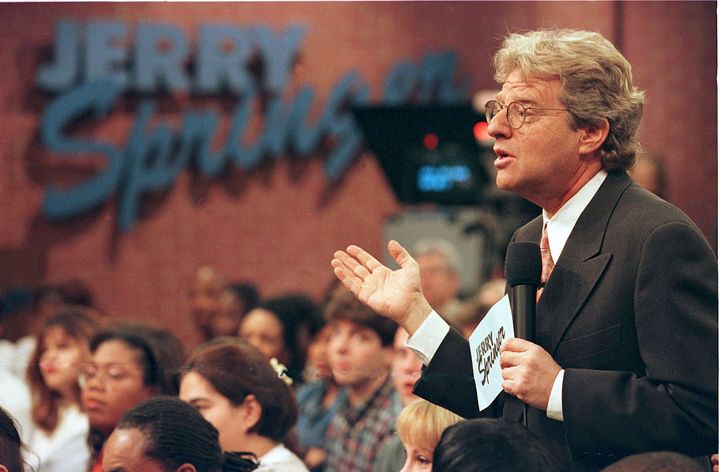
A guest attacks his romantic partner after learning they are transgender on the Dec. 17, 1997 episode of "The Jerry Springer Show."
A guest attacks his romantic partner after learning they are transgender on the Dec. 17, 1997 episode of “The Jerry Springer Show.”

Getty Images via Getty Images

And trans people come out on live television while declaring their love for a friend, only to be met with open disdain from both their crush and the perpetually unruly live audience.

This was all happening amid tumultuous race relations following Los Angeles’ civil unrest in 1992 and drastically reduced federal aid for impoverished people. Hate crimes and other targeted violence, like the 1998 murder of gay 21-year-old Matthew Shepard, also ripped across the nation, and news outlets continued to do their part to reinforce negative images of Black people.

The Jerry Springer Show began as an issue-based talk show in 1991, before quickly devolving into a program that made no effort to mediate or understand urgent social topics. Rather, it mocked the people that these impacted most.

“It seemed very much like it was for the entertainment of the middle-class white majority,” said Veronica McComb, a professor of history and social sciences at Rhode Island’s Bryant University.

But it was framed as a show for everyone and certainly had an outsize viewership, which included Black audiences. A lot of that, McComb explained, came down to a greater appetite for real stories about Black people — which was, in turn, distorted by the biased agenda of the largely white media.

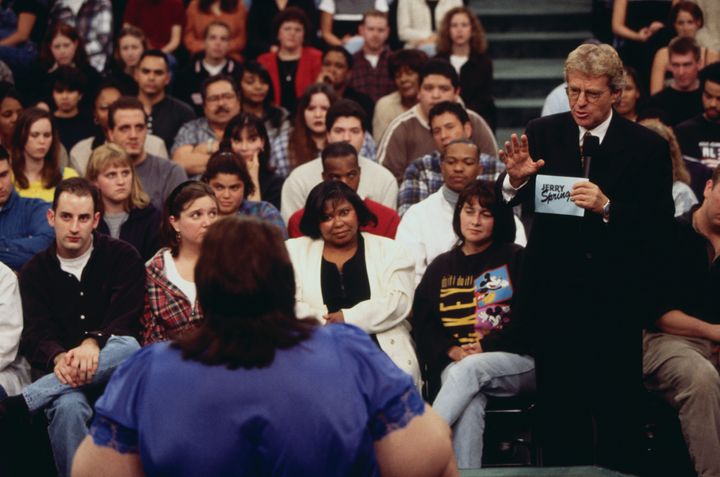
Jerry Springer acts as the ringleader on the Dec. 17, 1998 episode of his talk show.

Getty Images via Getty Images

“The real height of American entertainment in the ’90s, coupled very closely with race riots that are happening across the country,” McComb said, “gives this intrigue of what’s happening in Black America that I think Jerry Springer capitalised on.”

That’s an understatement. A single-dimensional narrative of Black violence had begun to dominate the nightly news, giving programs like The Jerry Springer Show more ammunition.

“You have a television show that brings that onto the stage, so to speak, and then presents it as reality,” McComb added, “which then feeds into the white imagination of and reinforcing of the historical notion that Black people are inherently violent or incapable of rational choices.”

The “reality” part of it all marks an important distinction. At the time, scripted shows like The Fresh Prince of Bel-Air, Martin and Living Single humanised the Black experience far more deftly. But The Jerry Springer Show purported to present actual stories about Black people that you couldn’t find in traditional small-screen programming.

This isn’t to say that the show didn’t have entertainment value, or that its producers and Springer should have catered to the respectability politics of how Black folks would come across to racist white audiences. It’s that it never provoked any thought or questions at all, by design.

Springer engages with a guest on an episode of his show titled I Am a Slave to My 600 Lb. Wife.

Ralf-Finn Hestoft via Corbis via Getty Images

And that was increasingly necessary in an era plagued by myriad unchecked social issues that influenced viewers across the country. This not only includes the treatment of Black people but trans and queer people, who were prone to intense derision and hate when they came out on shows like Springer’s.

Their appearances on the program didn’t inspire conversation or a desire to learn. This was a time when, at best, viewers were unable to articulate their feelings around queer people. At worst, people reacted with violence. And you saw a mix of these responses from the live audience.

Bryan Adamson, a professor of law at Ohio’s Case Western Reserve University, remembers this all too well. He recalled the use of “gay panic” justifications for excusing violence after undesired same-gender sexual advances. Though there have been some strides in banning this as a legal defense, in the ’90s it thrived.

Adamson referenced the case of Scott Amedure, who was murdered after revealing his crush on friend Jonathan Schmitz during a 1995 episode of Jenny Jones.

“There was always some type of twist to either head up the audience or certainly to head up the guest, right?” Adamson said. “That was the trick.”

This was all at the expense of the most vulnerable parties on the stage, whose identities and experiences were never more than a spectacle for audiences offering verbal abuse and ridicule. The issues at hand remained undiscussed and even unacknowledged.

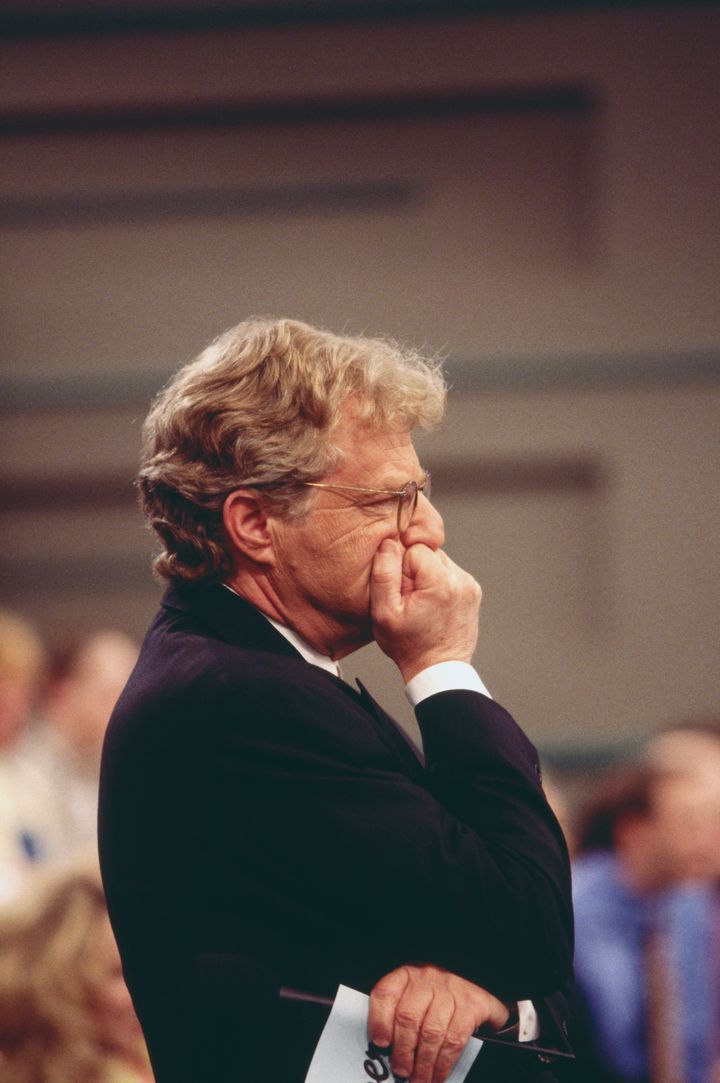
Springer watches a scene from the stage he helped create on "The Jerry Springer Show."
Springer watches a scene from the stage he helped create on “The Jerry Springer Show.”

Ralf-Finn Hestoft via Corbis via Getty Images

“Sexuality, homosexuality, certainly trans issues — none of that,” Adamson said. “They’re basically on there to be mocked and scorned, or at least that’s the angle that’s taken. It’s become more and more distressing as I think about it.”

Springer may not have blatantly encouraged these sentiments, but he certainly understood how to stir the live crowd and create the most entertaining moments from audience members.

McComb likened the host’s halfhearted “final thought” that ended each episode to the narrator of a classic story guiding the reader as a moral authority.

“It’s almost as if Springer’s doing the same, but without people realising that they’re watching theatre — watching drama, not reality,” she said. “This is him being his own form of Mister Rogers for an adult audience that should know better but, given its time, doesn’t obviously.”

The focus on entertainment should have always been a concern, since Jerry Springer guests often belonged to groups that were poorly represented by mainstream news outlets — groups that desperately needed to be heard.

Instead, guests were met with what Adamson called “carnival barkers” — those in the audience who couldn’t wait to hit them with metaphorical “slings and arrows”.

"The Jerry Springer Show" never provoked thought around urgent social issues of the decade. Rather, it ridiculed them.
“The Jerry Springer Show” never provoked thought around urgent social issues of the decade. Rather, it ridiculed them.

Ralf-Finn Hestoft via Getty Images

“It was that catharsis that perhaps audiences were attracted to,” Adamson said. “It problematizes it even more when you have that type of audience that participates. And that audience in some ways is an extension of the audience members sitting at home.”

These are the same ones that had been fed a steady diet of tropes from the news media at the time.

“The war on drugs, the ‘three strikes and you’re out’ [legislation], the Black mother as the ‘welfare queen,’ the war on poverty — all those conversations that were all still framing Black folks as either helpless or as criminals or as lacking social anchors,” Adamson said.

He noted that Springer and his producers would argue that the show was “just entertainment” or that it wasn’t their responsibility to act as moral arbiters or advocates for a cause. As true as that was, Springer did, in fact, cast himself in such a role, and then proceeded to interfere in actual people’s lives to exploit social issues for ratings.

“It makes me think about who’s doing the watching and what do they do with the issues,” Adamson said. “The concern from this show should always be: What are we taking away about how we understand a group of people to be?”

Were Springer and his ilk ever curious about this? It seems unlikely.

Share Button

New mums missing out on mental health services, report finds

A report says the NHS is failing to meet targets around services for pregnant women and new mums.

Share Button