Trevor Noah To Bring Mock The Week To US TV Viewers

Trevor Noah, who left The Daily Show after seven years in December, is returning to TV.

Noah will officially work behind the scenes this time and executive produce an American version of Britain’s popular Mock the Week, a topical panel show that pits two teams of comedians and celebrities against each other to satirize national news and global events.

Panel shows are quite popular in the UK and have seen nationally beloved satirists like Jimmy Carr, Rob Brydon and David Mitchell hilariously debate everything under the British sun. Noah believes the US could use some of that levity to brighten the American climate.

“Two things I’m most passionate about in life are paying my landlord and making people laugh,” said Noah in a Monday’s news release from Amazon Freevee, which is producing. “We could all use a little bit more laughter as we continue to navigate today’s crazy world.”

“By bringing Mock the Week to America with the talented Dan Patterson, I’m looking forward to doing just that,” he continued.

According to Deadline, Patterson created the original series — and the internationally beloved improv show Whose Line Is It Anyway? — with Mark Leveson in 2005. It was canceled after 17 years. The US version will hit Freevee, a former IMDb channel, in 2024.

Noah will executive produce alongside Dan Patterson, who created the original series.

Kevin Winter via Getty Images

“After 21 successful seasons on the BBC, we can’t wait to bring the format to the U.S. and work with America’s deep pool of brilliant comedians,” said Patterson in Monday’s news release, which did not reveal who would host the show’s upcoming iteration.

For Lauren Anderson, head of original, unscripted and targeted programming for Amazon’s Prime Video and Freevee platforms, Noah and Patterson will bring the best of both worlds — from mining the news to giving comedians free rein to trounce it — to the table.

“For years, Mock the Week delivered a witty spin on the news — entertaining a broad cross-section of the UK audience through funny conversations, one-liners, and improv comedy,” Anderson said.

“In one episode, you can catch up on weekly headlines, hear multiple points of view on a topic, and find your next favorite stand-up comedian,” she continued. “We are thrilled to expand our comedic slate on Amazon Freevee, with … two enormously talented producers.”

Share Button

5 Bizarre Moments From Donald Trump’s Interview With Nigel Farage

Donald Trump has given an interview to former Ukip leader Nigel Farage for GB News during his recent visit to Scotland.

It contained many of his usual talking points – including bashing Meghan Markle and US president Joe Biden – but also a number of curiosities.

1. War in Ukraine “analysis”

Trump claimed it would be “easy” to end the grinding, 14-month war in Ukraine – defying every serious analysis of the conflict.

He said: “If I were president, I will end that war in one day. It’ll take 24 hours. I will get that ended. It would be easy.

“That deal would be easy. A lot of it has to do with the money. That war has to be stopped. It is a disaster.”

Trump said he “got along great” with Russian president Vladimir Putin, adding: “Putin never would have gotten into Ukraine if it weren’t for the incompetence of this administration, this current administration.

“Putin was not going in, it was never mentioned and I knew him very well.”

2. Gets angry with “windmills”

Trump has had a long-running battle with the Scottish government over blocking his plans for golf course development – with wind farms often standing in his way.

Here, Trump tried to re-frame his reputation as an uncompromising industrialist, and suggested he opposed “windmills” because he’s actually a bit of an environmentalist.

“You want to see a cemetery of birds?,” he asked Farage, a fellow turbine sceptic. “Walk under a windmill.”

He also had something to say about whales: “Wind farms seem to be driving them onshore. I don’t know what that’s all about that, but that’s certainly not good.”

3. Compliments Farage’s eyesight

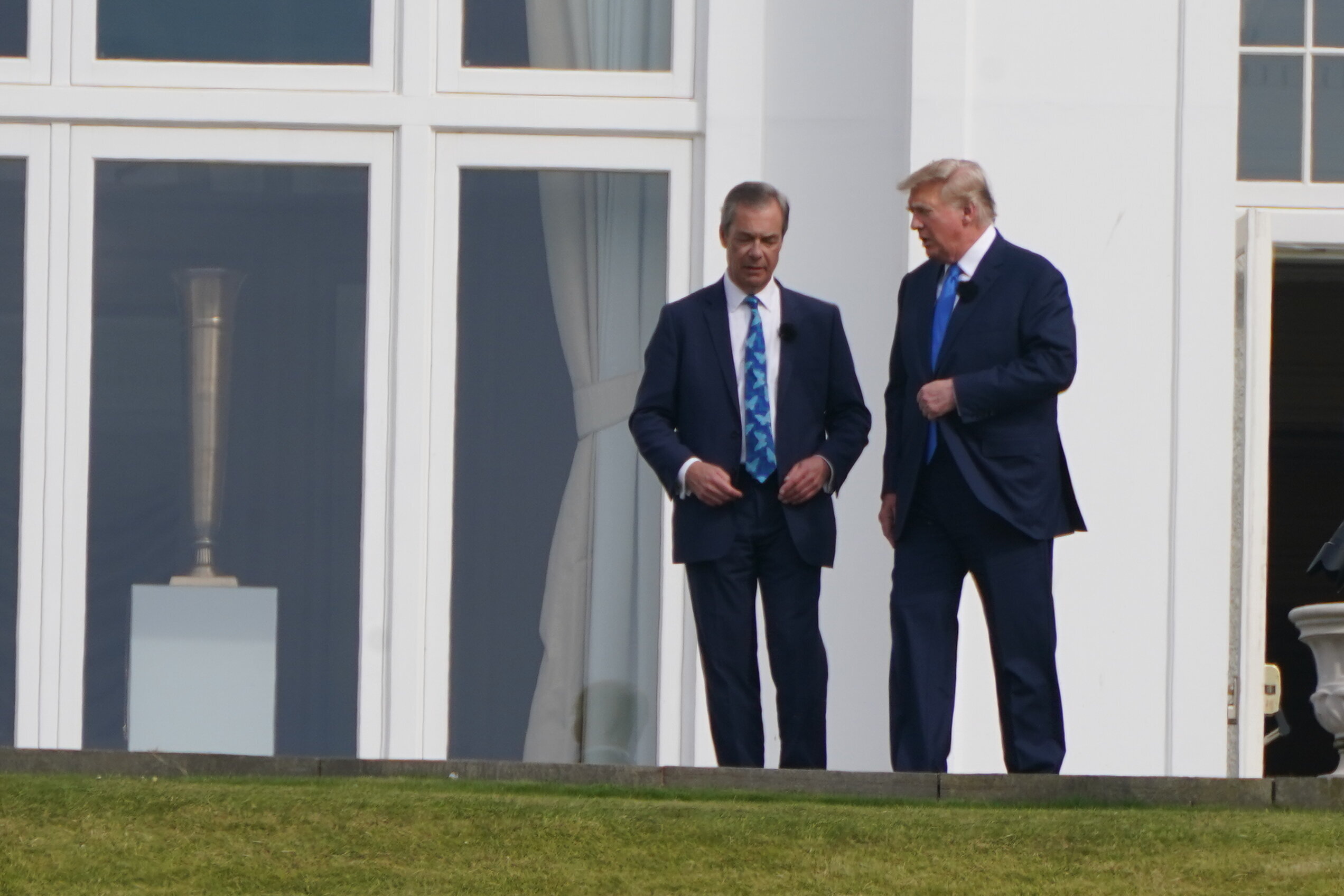
After the interview, Trump and Farage took a filmed, leisurely stroll around the ex-president’s Turnberry golf course, with the pair stopping at the clubhouse to look out on the manicured holes. An odd back-and-forth took place.

<img class="img-sized__img landscape" loading="lazy" alt="Former US president Donald Trump alongside Nigel Farage at the Trump Turnberry course in South Ayrshire.” width=”720″ height=”480″ src=”https://www.wellnessmaster.com/wp-content/uploads/2023/05/5-bizarre-moments-from-donald-trumps-interview-with-nigel-farage-2.jpg”>
Former US president Donald Trump alongside Nigel Farage at the Trump Turnberry course in South Ayrshire.

Andrew Milligan – PA Images via Getty Images

Farage: “I saw you hole a good putt on the 18th.”

Trump: “Yeah, that was good.”

Farage: “That was for the four, wasn’t it?”

Trump: “That was for a four. Did you watch it from here? Were you able to see the ball go in the hole?

Farage: “Yeah!”

Trump: “You have good eyes. You don’t have any help with your eyes? You can see the ball going in the hole from here?”

Farage: “The only thing I need help with is short reading.”

Trump: “But long you have great eyes.”

Farage: “Almost be a pilot, you know.”

4. Calls Boris Johnson “far-left”

Trump said the ex-prime minister “changed a lot in office”, suggesting policies under his Conservative administration were “far-left”.

Trump said the Tories “really weren’t staying Conservative”.

“They were going – I mean they were literally going far-left,” he continued.

“It never made sense. I’m saying this as an insider looking in, they were going far-left. What were they doing?”

5. Drops a Sean Connery impression

Trump was also critical of former Scotland first minister Nicola Sturgeon – again mainly as a result of perceived obstacles put in the way of his beloved golf courses.

Trump said he did not think that the former SNP leader, who announced her intention to step down in February, loved her country, adding: “Somebody who comes in and spends a lot of money … I remember Sean Connery saying ‘let him build his bloody golf courses!’.”

Share Button

High-throughput experiments might ensure a better diagnosis of hereditary diseases

Researchers at the Department of Biology, University of Copenhagen, have now contributed to solving this problem for a specific gene called GCK. The study has just been published in Genome Biology.

Figure: GCK gene

Rasmus Hartmann-Petersen, Professor at the Department of Biology, explains:
– “The GCK gene, which codes for the enzyme glucokinase, regulates the secretion of insulin in the pancreas. GCK gene variants can therefore cause a form of hereditary diabetes. Although the connection between GCKand diabetes has been known for several years, we have, until now, only known the effect of a few percent of the possible variants of this gene”.

Together with colleagues at the PRISM centre, UCPH, who are currently studying the effects of genetic variations, the researchers measured the effect of all of the possible variants of GCK.

PhD student Sarah Gersing, who is the first author of the article, explains:
– “We used yeast cells to measure the activity of over 9000 different GCK variants. In this way, we were able to generate a list of the effects — both of already known variants, but also of variants that patients might carry, but that have not yet been discovered. This provides us with a reference for future GCK diagnostics”. 

Prof. Kresten Lindorff-Larsen, who heads the PRISM centre, continues:
– “Our results are quite unique; not only have we measured the effect of several thousand variants, but for many of the variants, we can now explain what they do to the glucokinase protein. In our centre, we have gathered researchers working across a range of research fields, bridging from data analysis and biophysics to cell biology and medicine, and it is now clear how this broad approach pays off in explaining how diseases arise”.

Gene variants of GCK can, among other things, cause a form of hereditary diabetes called “GCK maturity onset diabetes of the young” (GCK-MODY).

Professor of genetics, dr. med. Torben Hansen, who is also a member of the PRISM centre, says: – “Although GCK-MODY patients exhibit elevated blood glucose levels, this is often not associated with complications. Hence, unlike other forms of diabetes, most GCK-MODY patients might therefore not need to be treated with medication. However, due to missing or inaccurate genetic data, more than half of the GCK-MODY patients are classified with having either type 1 or type 2 diabetes – and are therefore unnecessarily medicated. We estimate that approx. 1% of those who have recently been diagnosed with type 2 diabetes in Denmark have a variant in the GCK gene, meaning that they don’t need treatment, or need to be treated differently. Our new map of GCK variants can hopefully help give these patients a more correct diagnosis.”

The next step for PRISM is to transfer these methods to other genes and diseases.
– “We are already well underway with genes involved in e.g., neurodegenerative diseases, and we are trying to develop precise methods that can provide us with insights on disease mechanisms”, says Rasmus Hartmann-Petersen.

 Kresten Lindorff-Larsen continues:
– “Our data gives us the opportunity to test and develop computational models for variant effects, which will then be transferable to other genes and diseases.”

– “Now, we have measured the effects of almost all variants of GCK, giving us knowledge on which variants that function, and which that do not. The next step is to understand why, and how the same underlying molecular mechanisms can give rise to a wide range of different diseases”, concludes Sarah Gersing.

Share Button

What does it take to thrive in cities, if you’re a bird?

As cities gobble up natural spaces, some birds have learned to live alongside skyscrapers, traffic and noise — and large numbers of humans.

A UCLA-led team of biologists wondered if those city-dwelling birds share common characteristics around the world that help them survive. In a paper published in Current Biology, they reveal the answer: Urban bird species tend to be smaller and less territorial and have greater ability to fly long distances. They also tend to have broader dietary and habitat niches, to lay more eggs at a time, to have longer lifespans and to live at a wider range of elevations than other species.

Several factors moderate the importance of those traits in how birds adapt to urban living, and the importance of those traits varies predictably across the planet.

The only trait that didn’t appear to be consistent globally among urban-dwelling birds, the resesarchers found, was the shape of their bills.

By 2030, the paper notes, the amount of urban land cover worldwide will have grown by 1.2 million square kilometers (or more than 463,000 square miles) since 2000 — roughly tripling over a 30-year period. That increase in urban space would be larger than the land area of California and Texas combined.

The authors write that a dramatic loss of biodiversity will accompany that urbanization unless there are practical plans to preserve it.

“Identifying traits that help wildlife adapt or even thrive in cities can help urban planners bolster biodiversity by, for example, increasing green spaces, planting more and taller trees, building more varied potential habitats, or reducing housing density,” said the paper’s lead author, Monte Neate-Clegg, a UCLA postdoctoral researcher. “It can also help conservation biologists to identify which types of species are most threatened by urbanization.”

Neate-Clegg and Morgan Tingley, a UCLA associate professor of ecology and evolutionary biology, combined data including records of more than 125 million individual bird sightings from the public science project eBird to calculate an “urban association index” that describes how closely each species is associated with living in urban settings.

They applied the measure to 3,768 bird species — around 35% of all bird species — in 137 cities across six continents.

The index takes into account factors like physical characteristics of the birds themselves and the geographic, population and landscape characteristics of the cities.

“Many of the most common urban birds globally are very familiar to us here in the U.S., including the house sparrow, barn swallow, osprey, and peregrine falcon,” Tingley said. “Although, interestingly, the species with the strongest associations with urban areas are actually three species of parakeet and a tanager from South America. Plus, of course, the feral pigeon.”

Interestingly, some of the species with the highest scores on the index — meaning that they were most closely associated with urban living — were not native to their regions, but such species made up less than 4% of the dataset, suggesting that invasive species might not have as big of an advantage as logic would suggest. Bird families with high average scores on the index — indicating that many species within that family were common in cities — included starlings, swifts, swallows, parrots, orioles and blackbirds.

Traits like smaller body size, lower territoriality, greater ability to fly longer distances — which scientists refer to as “dispersal ability” — broader dietary and habitat niches, larger clutch sizes, all tend to make it easier for city birds to find food and suitable nesting places, and to raise young that survive.

Bird species that generally build nests on the ground were not likely to live in cities, for fairly obvious reasons.

“In a city like Los Angeles, for example, the American crow is a cosmopolitan species whose broad diet, arboreal nesting habits and long lifespan favor life in the concrete jungle,” Neate-Clegg said. “In contrast, canyon wrens are highly territorial insectivores with low dispersal ability that shun cities and keep to steep, rocky terrain.”

But cities’ geographic properties — most notably their latitude — moderated the importance of those traits. For example, a broad diet was more important in temperate cities such as New York, while habitat generalists were more prevalent in tropical cities such as Bogotá, Colombia. The cities’ population sizes and surrounding terrain also played important roles: Anchorage, Alaska, with its small population and plentiful natural surroundings, is home to large birds like bald eagles that mostly feed on fish from rivers and lakes. Meanwhile, smaller birds that don’t require as much raw land and that can adapt to eating a variety of foods to survive would be more likely to inhabit sprawling, densely populated metropolises like Bangkok.

Share Button

Single-molecule valve: Breakthrough in nanoscale control

Scientists dream of using tiny molecules as building blocks to construct things, similar to how we build things with mechanical parts. However, molecules are incredibly small — around one hundred millionth the size of a softball — and they move randomly in liquids, making it very difficult to manipulate them in a single form. To overcome this challenge, “nanofluidic devices” that can transport molecules in extremely narrow channels, similar in size to one millionth of a straw, are attracting attention as a way to directly manipulate single molecules in solutions.

A joint research team led by Associate Professor Yan Xu of the Osaka Metropolitan University Graduate School of Engineering has succeeded in regulating the flow of single molecules in solution by opening and closing a nanovalve in a nanofluidic device by applying external pressure.

The research team fabricated a nanofluidic device with a thin, flexible glass sheet on the top, and a hard glass plate with small structures that forms nanochannels and nanovalve seats on the bottom. By applying external pressure to the flexible glass sheet to open and close the valve, they succeeded in directly manipulating and controlling the flow of individual molecules in solution. They also found that when they trapped single fluorescent molecules in the nanospace inside the valve, the fluorescence of the single molecules became brighter. This happened because the small space made it harder for the single molecules to move around randomly. Professor Xu said that “this effect of fluorescence signal amplification could help with detecting very small amounts of pathogens for early diagnosis of diseases such as cancers and Parkinson’s disease, without requiring expensive equipment.”

The findings of this study could be a significant step towards freely assembling materials using single molecules as building blocks in solution. This technology has the potential to be useful in various fields, such as developing personalized medicines for rare diseases and creating better displays and batteries. Its applications are limitless.

“We have been addressing various challenges by proposing and promoting the concept of ‘Single-Molecule Regulated Chemistry (SMRC),’ where molecules are treated as building blocks and all processes involved in chemical and biochemical reactions in solution are performed on a single-molecule basis. The single-molecule valve marks the first step towards the goal, which could one day revolutionize chemistry, biology, and materials science, as well as transform various industries,” said Professor Xu.

Share Button

New Alzheimer’s drug slows disease by a third

The second such drug in a year raises hopes we can start treating dementia.

Share Button

ADHD on TikTok: Raising awareness or driving inaccurate self-diagnosis?

Content about the condition generates billions of views, but is it driving too many to self-diagnose?

Share Button

Medicinal cannabis helps cancer pain – study

More rigorous trials are needed to confirm the findings, the Canadian researchers say.

Share Button

Is King Charles Hiding His Huge ‘Sausage Fingers’ Ahead Of The Coronation?

Chalk it down to coronation fatigue, but some royal watchers are asking an unlikely question – is King Charles hiding his “sausage fingers” from public view?

With days still to go before the big day, and seemingly ever angle covered, attention online has turned to the monarch’s infamous distended digits. Eagle-eyed commentators have seized on two official photographs of the king – one with has his hands behind his back as he stands alongside Camilla, the Queen Consort. Another shows the 74-year-old with one hand in his pocket.

The royal himself dubbed them his “sausage fingers” in a letter he wrote to a friend when he was describing the birth of his son, Prince William, in 1982.

“He really does look surprisingly appetising and has sausage fingers just like mine,” Charles wrote according to the book, The Man Who Will Be King, by Howard Hodgson. The phrase has also repeatedly featured in reports, including while on tour in Australia in 2012.

Not for the first time, the monarch’s puffy pointers have been the talk of social media, with the tabloids picking up on the suggestion Charles has been “bullied” into hiding them. “Show us his hands cowards,” one Twitter user demanded while quote-tweeting the royal family account.

Former BBC broadcaster Jon Sopel, who now fronts the popular The News Agents podcast, joined the speculation. He tweeted: “The coronation story we’ve all missed…going to say it’s not first time I’ve seen him with hands behind his back….”

When the former prince and his pinkies previously topped Google searches, doctors have stepped forward to attempt to explain what’s going on (Charles has not offered an explanation).

On TikTok last year, soon after he took the throne, Dr David Reiner explained there’s probably a biological reason for the swelling in the royal’s fingers.

He explained: “Throughout your body you’ve got blood vessels that deliver oxygen to your cells.

“These blood vessels are full of red blood cells and fluids – now there are pressures within the blood vessels that cause fluid to exit them.”

<img class="img-sized__img landscape" loading="lazy" alt="The then Prince of Wales pulling a pint during a visit to the Prince of Wales pub in Clapham, south London in 2021.” width=”720″ height=”480″ src=”https://www.wellnessmaster.com/wp-content/uploads/2023/05/is-king-charles-hiding-his-huge-sausage-fingers-ahead-of-the-coronation-3.jpg”>

HEATHCLIFF O’MALLEY via Getty Images

The then Prince of Wales pulling a pint during a visit to the Prince of Wales pub in Clapham, south London in 2021.

Dr Reiner went on to share that “oncotic forces” pull this fluid back into the blood vessels – in most people, if there’s fluid build-up outside the vessel at all, this is usually returned to the heart via the lymphatic system.

So, because King Charles has massive swollen fingers, Dr Reiner says that the new monarch’s lymphatic system might not be working correctly and that fluid is getting stuck outside the blood vessels causing the extreme swelling in his fingers.

Although there may be many other reasons for the King’s swollen digits, according to this doctor, fluid retention may be the answer.

Share Button

Sue Gray Refused To Co-Operate With Inquiry Into Job With Labour, Government Says

An inquiry into Sue Gray’s proposed move to the Labour Party has been put on hold after the partygate investigator refused to take part in the probe, a government minister has said.

Her appointment as the Labour leader’s chief-of-staff proved hugely controversial among Tory MPs given that she led the official government probe into Downing Street rule-breaking during lockdown.

Some reports suggested she could have breached the civil service code with her job move.

According to an update on a review into the appointment, Gray declined to make representations into the inquiry looking into her discussions with Labour about the senior party role, Oliver Dowden has said.

In a written statement to the House of Commons on Tuesday, cabinet office secretary Oliver Dowden said his department has made a “confidential assessment” to the anti-corruption watchdog and will not provide further information on Gray’s departure “whilst we consider next steps”.

As well as a cabinet office probe, the anti-corruption watchdog, the Advisory Committee on Business Appointments (Acoba), is reviewing the terms of Gray’s departure.

It can set recommendations for when senior people leave government, including calling for a cooling-off period to avoid any conflict of interest.

Who Is Sue Gray?

The senior civil servant was thrust into the limelight when she took over the probe into coronavirus rule-breaking at No 10 in 2021.

She stepped in to lead the investigation after cabinet secretary Simon Case – her boss – recused himself following allegations that his own office held a Christmas event amid a lockdown.

An initial dossier, published in January 2022, included several strong criticisms of Downing Street’s drinking culture, but was short on details about the parties as it was hampered by an investigation launched by the Metropolitan Police.

But her full report in May 2022 proved to be a bombshell. It detailed events at which officials drank so much they were sick, sang karaoke, became involved in altercations and abused security and cleaning staff at a time when millions of people across the country were unable to see friends and family.

She criticised “failures of leadership and judgment” in No 10 and said “the senior leadership at the centre, both political and official, must bear responsibility”.

Six weeks later, Johnson was forced out of office by his own cabinet and Conservative MPs.

While Gray, in her mid-60s, is said to shun the media spotlight, some politicians have gone so far as to suggest the former publican is the “real leader” of the UK.

In her former role as director-general of propriety and ethics in the Cabinet Office from 2012 to 2018, she is said to have overseen cabinet reshuffles, served as a guiding hand in compiling honours lists, and even signed off political memoirs before their publication.

In the statement, Dowden said Gray was “given the opportunity to make representations as part of this process but chose not to do so”.

He added that “in order to maintain confidentiality towards an individual former employee, I am unable at this stage to provide further information relating to the departure of Ms Gray whilst we consider next steps”.

Dowden also highlighted sections of the civil service code relating to the political activity of civil servants, adding: “The impartiality and perceived impartiality of the Civil Service is constitutionally vital to the conduct of government.”

Earlier in the day Starmer insisted he had no discussions with Gray while she was investigating Boris Johnson and he was “confident” she had not broken any rules.

“Firstly I had no discussions with her while she was investigating Boris Johnson whatsoever, I don’t think anyone is suggesting that’s the case,” the Labour leader told BBC Breakfast ahead of an expected update later from the Cabinet Office on the circumstances of her departure.

He went on: “I’m confident she hasn’t broken any of the rules.”

Starmer claimed the government was trying to resurrect a story about Gray, because they do not want to talk about the cost of living crisis.

Share Button