China’s Mars Rover Is Hibernating And Doesn’t Want To Wake Up

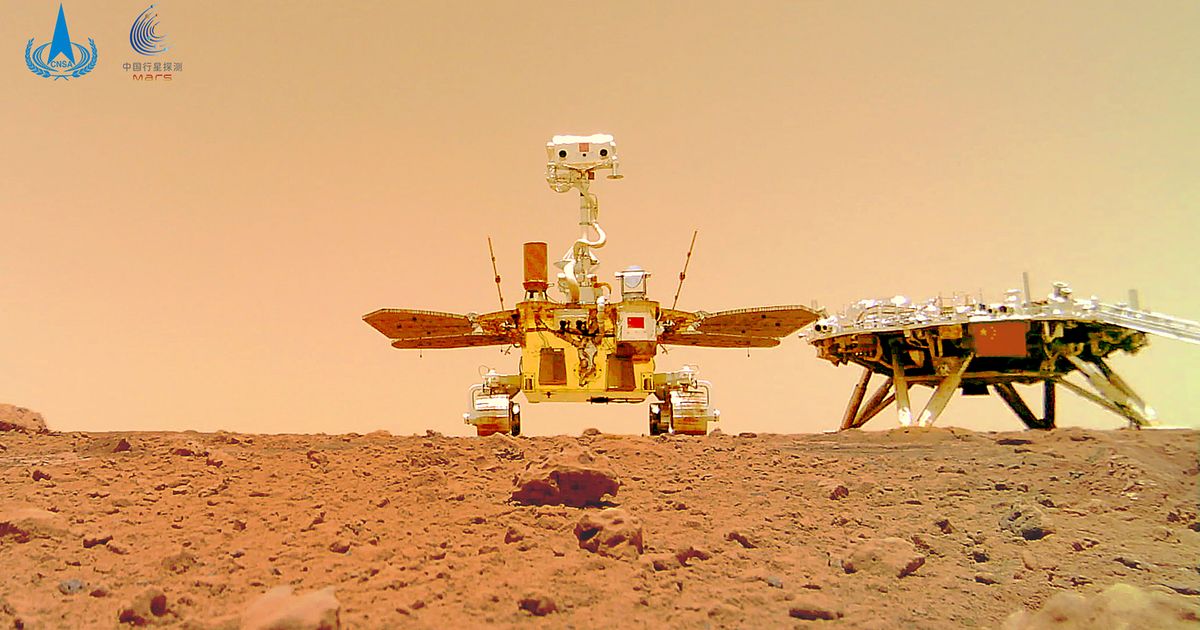
China’s rover on Mars has not woken up after months of hibernating, the scientists operating it finally explained on Tuesday.

Zhurong, as the solar-powered rover is known, was in a scheduled sleep during the red planet’s winter. And though it was named after an ancient Chinese god of fire, it seems remarkably… docile, right now.

So what’s stopping it from waking up? Dust, apparently, as this stops it turning sunlight into electricity.

Chief designer of the Mars exploration programme, Zhang Rongqiao, explained: “Based on our analysis, the most likely possibility is that an unpredictable accumulation of dust from Mars led to a decrease in its ability to produce electricity, such that it’s insufficient for it to wake up.”

If the dust levels exceed more than 40% that the Chinese engineers had prepared for, it would become inactive “forever”. No amount of solar activity could help it, Zhang told Chinese state broadcasters.

He did not explain how much dust is already on it.

The rover successfully landed back in May 2021, meaning China was only the second country after the US to succeed to landing a probe like this on Mars.

The landing was seen as a sign that Beijing was really starting to establish itself in space exploration.

When the rover first touched down, it explored Mars for about a year in Earth days (358 days in Martian time) and covered 1.2 miles, even though it was only meant to look around for three Martian months.

It was then put to sleep in May 2022, and was meant to autonomously wake up December 2022 during the planet’s northern spring equinox.

Five months later, it’s looking like the rover has decided it would rather stay sleeping. And who can blame it?

Share Button

Brits Need To Accept They’re Poorer, Says Bank Of England Economist

Britain needs to stop playing “pass-the-parcel” with someone accepting that they are poorer to get inflation under control, the chief economist of the Bank of England has said.

Huw Pill said that people and businesses have responded to higher bills and costs by asking for higher wages or charging their customers more money.

But households and companies trying to pass on their higher costs, he said, adds to inflation, pushing up prices even further across the economy.

UK inflation – the measure of the rising cost of goods and services – hit 10.1% in the year to March. It was a fall from 10.4% in February, but still remains stubbornly high – and above the 9.8% that experts had predicted.

The Bank of England is tasked with keeping inflation under control, targeting 2% a year.

Speaking on the Beyond Unprecedented podcast from Columbia Law School, Pill said: “The UK, which is a big net importer of natural gas, is facing a situation where the price of what you’re buying from the rest of the world has gone up a lot, relative to the price of what you’re selling to the rest of the world, which is mainly services in the case of the UK.

“You don’t need to be much of an economist to realise that if what you’re buying has gone up a lot relative to what you’re selling, you’re going to be worse off.

“So, somehow in the UK, someone needs to accept that they’re worse off and stop trying to maintain their real spending power by bidding up prices whether through higher wages or passing energy costs on to customers etc.

“What we’re facing now is that reluctance to accept that, yes, we’re all worse off and we all have to take our share; to try and pass that cost onto one of our compatriots and saying, ‘we’ll be alright, but they will have to take our share too’.

“That pass-the-parcel game that’s going on here, that game is one that’s generating inflation, and that part of inflation can persist.”

Share Button

NHS dentistry crisis: Crowdfunding my new teeth has changed my life

Danielle Watts had gum disease and pulled 13 of her own teeth because there were no NHS dentists.

Share Button

Superbug study to invite 2,000 stool samples

Scientists want to find out more about levels of antibiotic-resistant bacteria in healthy people.

Share Button

Alternative to epidural recommended for women in labour

Draft guidelines for the NHS say women giving birth can ask for a morphine-like painkiller instead of a spinal block.

Share Button

Mudskippers could be key to understanding evolution of blinking

Blinking is crucial for the eye. It’s how animals clean their eyes, protect them, and even communicate. But how and why did blinking originate? Researchers at the Georgia Institute of Technology, Seton Hill University, and Pennsylvania State University studied the mudskipper, an amphibious fish that spends most of its day on land, to better understand why blinking is a fundamental behavior for life on land.

Although mudskippers are distantly related to tetrapods, the group that includes humans and other four-limbed vertebrates, researchers believed studying the fish could unlock how blinking evolved as these animals began to move on land.

The research team, which included several undergraduates, published their findings in the paper, “The Origin of Blinking in Both Mudskippers and Tetrapods Is Linked to Life on Land,” in Proceedings of the National Academies of Science.

“By comparing the anatomy and behavior of mudskippers to the fossil record of early tetrapods, we argue that blinking emerged in both groups as an adaptation to life on land,” said Tom Stewart, an assistant professor at Penn State and an author of the paper. “These results help us understand our own biology and raise a whole set of new questions about the variety of blinking behaviors we see in living species.”

Breaking Down Blinking

Mudskippers blink by sucking their eye downward into their eye socket. The evolution of this behavior did not require the evolution of a lot of new parts such as new muscles or special glands, though. Instead, mudskippers use their existing set of eye muscles in a new way.

“This is a very exciting result because it demonstrates that the evolution of a new, complex behavior can be achieved using a relatively rudimentary set of structures,” said Brett Aiello, a former postdoctoral fellow in the Agile Systems Lab and now assistant professor at Seton Hill.

Next, the research team set out to determine why mudskippers blink. In a series of experiments, they found that mudskippers blink for three main functions: to wet, clean, and protect the eye. These functions are also why humans and other land-dwelling vertebrates blink.

“We find that a single behavior can be deployed to accomplish three complex, distinct functions,” said Aiello. “These results not only help humans understand our own history, but also help us reevaluate the adaptations necessary for major transitions in the evolutionary history of vertebrates, like moving from water to land.”

Blinking isn’t just a unique research question, but also an important mechanism to understand, according to Saad Bhamla, an assistant professor in Georgia Tech’s School of Chemical and Biomolecular Engineering and author on the paper.

“We all blink without thinking, and understanding why we blink is just such a beautiful puzzle right in front of our eyes,” Bhamla said. “Through our research on mudskippers and by conducting biophysical and morphological analyses, we expose how blinking serves a multitude of functions for adapting to life out of water.”

Engaging Undergraduates

To explore such open-ended questions, the researchers engaged the Vertically Integrated Projects (VIP) program, which allows undergraduates to conduct long-term, large-scale research projects as part of their coursework at Georgia Tech.

“The structure of the VIP course empowers students to really lean on their own creativity and drive the project in the directions that are most exciting to them,” said Aiello. “It helps our students gain the ability to solve unknown problems on the ground as they arise — a lot of people become scientists to push research somewhere where nobody else has tried to go before.”

The VIP structure is inherently multidisciplinary. While Aiello is a biologist, most students were engineers and brought their respective expertise. Manognya Sripathi was a biomedical engineering major with a minor in computer science and offered her unique experience to the mudskipper problem.

“I used my computer science skills to gather raw data and analyze and plot them using programs like MATLAB or Python,” Sripathi said. “I also used engineering skills to help build the experimental equipment, allowing us to apply engineering methods to study a biological problem in a unique way.”

Moving Beyond Mudskippers

Te research didn’t just expand knowledge of mudskippers — it also contributed to each student’s future aspirations. For example, Kendra Washington’s trajectory was influenced by the two semesters she spent in the lab.

“VIP drew me closer to the programming and device areas of my biomedical engineering major and solidified why I picked up a computer science minor,” she said. “I continued to pursue that fusion through later internships and research, and now work with hemodynamic monitoring. But in a sense, I still help characterize physiology through programming.”

VIP also expanded the students’ knowledge and scientific experience that have propelled them far beyond the lab. Hajime Minoguchi, a biomedical engineering graduate, now works as a systems integration research and development engineer thanks to his experience in the class.

“Working in an interdisciplinary team like this has allowed me to learn how to understand and communicate ideas between disciplines, which allowed me to be a more well-rounded engineer,” Minoguchi said. “My work requires a thorough understanding of biology, electrical circuitry, software, firmware, mechanical interactions, and physics. This VIP experience was instrumental for me in being successful at my current job.”

The research is far greater than the sum of its parts and brings a greater understanding of evolution, noted Simon Sponberg, an associate professor in the School of Physics and the School of Biological Sciences.

“Blinking is a reflection of a bigger question,” Sponberg said. “How did major evolutionary transitions occur that enabled organisms to inhabit basically every environment on this planet? What we learned is you don’t need the evolution of a lot of specialized musculature or glands; evolution can tinker with the structures that are already there, allowing them to be used in a new way and for a new behavior.”

Share Button

Scientists detect seismic waves traveling through Martian core

Scientists observed seismic waves traveling through Mars’ core for the first time and confirmed model predictions of the core’s composition.

An international research team — which included University of Maryland seismologists — used seismic data acquired by the NASA InSight lander to directly measure properties of Mars’s core, finding a completely liquid iron-alloy core with high percentages of sulfur and oxygen. Published in the Proceedings of the National Academy of Sciences on April 24, 2023, these findings reveal new insights into how Mars formed and geological differences between Earth and Mars that may ultimately play a role in sustaining planetary habitability.

“In 1906, scientists first discovered the Earth’s core by observing how seismic waves from earthquakes were affected by traveling through it,” said UMD Associate Professor of Geology Vedran Lekic, second author of the paper. “More than a hundred years later, we’re applying our knowledge of seismic waves to Mars. With InSight, we’re finally discovering what’s at the center of Mars and what makes Mars so similar yet distinct from Earth.”

To determine these differences, the team tracked the progression of two distant seismic events on Mars, one caused by a marsquake and the other by a large impact, and detected waves that traveled through the planet’s core. By comparing the time it took those waves to travel through Mars compared to waves that stayed in the mantle, and combining this information with other seismic and geophysical measurements, the team estimated the density and compressibility of the material the waves traveled through. The researchers’ results indicated that Mars most likely has a completely liquid core, unlike Earth’s combination of a liquid outer core and solid inner core.

Additionally, the team inferred details about the core’s chemical composition, such as the surprisingly large amount of light elements (elements with low atomic numbers) — namely sulfur and oxygen — present in Mars’ innermost layer. The team’s findings suggested that a fifth of the core’s weight is made up of those elements. This high percentage differs sharply from the comparatively lesser weight proportion of light elements in Earth’s core, indicating that Mars’ core is far less dense and more compressible than Earth’s core, a difference that points to different conditions of formation for the two planets.

“You can think of it this way; the properties of a planet’s core can serve as a summary about how the planet formed and how it evolved dynamically over time. The end result of the formation and evolution processes can be either the generation or absence of life-sustaining conditions,” explained UMD Associate Professor of Geology Nicholas Schmerr, another co-author of the paper. “The uniqueness of Earth’s core allows it to generate a magnetic field that protects us from solar winds, allowing us to keep water. Mars’ core does not generate this protective shield, and so the planet’s surface conditions are hostile to life.”

Although Mars does not currently have a magnetic field, scientists hypothesize that there was once a magnetic shielding similar to Earth’s core-generated field due to traces of magnetism lingering in Mars’ crust. Lekic and Schmerr noted that this might mean that Mars gradually evolved to its current conditions, changing from a planet with a potentially habitable environment into an incredibly hostile one. Conditions in the interior play a key role in this evolution, as might violent impacts, according to the researchers.

“It’s like a puzzle in some ways,” Lekic said. “For example, there are small traces of hydrogen in Mars’ core. That means that there had to be certain conditions that allowed the hydrogen to be there, and we have to understand those conditions in order to understand how Mars evolved into the planet it is today.”

The team’s findings have ultimately confirmed the accuracy of current modeling estimates that aim to unravel the layers hidden beneath a planet’s surface. For geophysicists like Lekic and Schmerr, research like this is also paving the way for future geophysics-oriented expeditions to other celestial bodies, including planets like Venus and Mercury.

“This was a huge effort, involving state-of-the-art seismological techniques which have been honed on Earth, in conjunction with new results from mineral physicists and the insights from team members who simulate how planetary interiors change over time,” noted Jessica Irving, a senior lecturer at Bristol University and first author of the study. “But the work paid off, and we now know much more about what’s happening inside the Martian core.”

“Even though the InSight mission ended in December 2022 after four years of seismic monitoring, we’re still analyzing the data that was collected,” Lekic said. “InSight will continue to influence how we understand the formation and evolution of Mars and other planets for years to come.”

Share Button

‘The Benefits Are Pure Fantasy’: MPs Debate Brexit Impact For First Time

The benefits of Brexit have been written off as “pure fantasy” as MPs debated the consequences of leaving the European Union amid growing concern over the decision.

On Monday, a three-hour debate took place in Westminster Hall triggered by 183,000 people signing a petition calling for a public inquiry into the impact of Brexit.

Brexit and its consequences have been discussed periodically in parliament, but it is thought this is the first time a full debate has examined what leaving the bloc has led to.

Brexit has been cited repeatedly as the UK’s economy is expected to perform the worst out of any G20 economies apart from Russia this year and next, an IMF analysis has suggested.

On the same day as the debate, Gerry Murphy, the chairman of Burberry, said leaving the EU had been a “drag on growth” as he hit out at the “spectacular own goal” of a post-Brexit VAT change during a Q&A with Rishi Sunak.

Ministers have previously rejected a call for an official probe into the effects of leaving the EU.

The debate was opened by SNP MP Martyn Day, speaking in favour of the petition.

He told parliamentarians: “Nearly seven years on from the Brexit referendum, the UK public are still waiting for the elusive ‘Brexit benefits’ that were promised.

“It seems to me, having raised just some of the areas where leaving the EU has impacted on the UK, that the benefits of Brexit are pure fantasy.

“The economic fallout from Brexit is stark and it has been made starker by the current cost of living crisis that is being inflicted on households up and down the country.

“From my perspective, Brexit has been an unmitigated disaster—politically, economically and socially, for Scotland and the rest of the UK.

“The UK government, of course, have a means to refute this.

“When major events occur, public inquiries can be held into matters of public concern to establish facts, to learn lessons so that mistakes are not repeated, to restore public confidence and to determine accountability.”

Speaking against the petition, Conservative MP Adam Holloway said the biggest benefit was that “our sovereignty has been repatriated”.

“It is easy to disdain patriotism if you’re economically and socially mobile and derive your self-worth from a well-paid job, or if you life is made easier by cheap labour brought by free movement,” the MP said.

Labour MP Hilary Benn picked up on sovereignty issue as he argued proponents of Brexit were “in a state of confusion and denial”.

He said: “I met many people during the campaign who made that argument. Indeed, they said, ‘I don’t care about the economic impact. My sovereignty is more important.’ I respect people’s right to hold that view; I fundamentally disagree with it.

“But what was unforgiveable was to claim that we could have all our sovereignty, keep all the benefits of being a member of the European Union and get further benefits on top of that. It simply was not true, and we now know it was not true. Therefore, those who argued for us to leave the European Union are now in a state of confusion and denial.

“That is what is going on, particularly around the economic consequences. If we do not understand what those are, how on earth are we going to build a different relationship with our European colleagues over the months and years ahead?”

Labour’s Fleur Anderson hit out at “delusion” ministers.

She said: “In December 2021, I called for a debate on the impact of Brexit and a region-by-region report. The then leader of the House (Jacob Rees-Mogg) gave me this response: ’We can start prayers every morning…with a celebration of Brexit. We should have the Brexit prayer and perhaps even the Brexit song…because it has been a triumph for this nation in reasserting its freedom.′

“He said that we now have ‘happy fish’ and that across the country ‘there is general celebrating and rejoicing’.

“That level of delusion, flippancy and not taking the issue seriously is very frustrating for people across the country, and it is why they signed the petition in such large numbers. This cannot be the last word—just writing it off and saying that Brexit has been a success without giving evidence.”

The UK government has said: “The UK’s departure from the EU was a democratic choice, and the UK-EU institutions are functioning as intended. The Government does not believe this to be an appropriate subject for a public inquiry,”

Share Button

Queen Camilla’s Son Expertly Dodges Question About Prince Harry And The Coronation

Tom Parker Bowles expertly dodged a question about his stepbrother, Prince Harry, during an appearance on The News Agents podcast with Jon Sopel and Emily Maitlis last week.

The food writer and critic, who is the son of the former Camilla Parker Bowles, was asked by Maitlis if “there’s a panic about whether Harry would come or not” to King Charles and Queen Camilla’s coronation, which takes place on May 6.

Parker Bowles replied that the decision had “nothing to do with me”, before jokingly saying he and his son were concerned about whether Harry Kane, captain of England’s national team, was coming to the coronation.

The 48-year-old also defended his mother from those that may speculate that she always wanted to be queen.

“I think change happens, but I don’t care what anyone says, this wasn’t any sort of end game,” the writer said. “She married the person she loved and this is what happened.”

Tom Parker Bowles, Laura Parker Bowles, Prince Harry and Prince William following the civil ceremony marriage between HRH Prince of Wales and Mrs. Camilla Parker Bowles on April 9, 2005, in Berkshire, England.

Julian Herbert via Getty Images

Maitlis ― a journalist who conducted the infamous Prince Andrew interview in 2019 that led to him stepping back as a working royal ― also asked Parker Bowles if it was “weird” to think of his mother as queen.

“Not really because she’s still our mother,” Parker Bowles answered. “I say ‘our’ but not the royal ‘we,’ speaking for my sister [Laura Lopes] and me. She’s our mother.”

And despite his mother’s new title, Parker Bowles insisted he will not be given one of his own.

“I become nothing,” the writer said with a laugh. “There’d be revolution if they started handing it out to people like me… You’re not going to find us with great estates, being called the ‘duke of whatever.’ No, that would be appalling.”

Camilla, then-Duchess of Cornwall, with her son Tom Parker Bowles (left) and daughter Laura Lopes (right) watch the racing as they attend the Cheltenham Festival on March 11, 2015.

Max Mumby/Indigo via Getty Images

He also defended those who may protest at the coronation ― like the anti-monarchy group, Republic ― telling the podcast hosts that “everyone has the right to think what they want”.

“You know, going back to Extinction Rebellion and Animal Rebellion and Republic and whatever it is, everyone has a right to their say,” he said. “We live in, thankfully, a free country.”

He added that “if people want to protest that’s their right to do so”.

Charles’ coronation will be held at Westminster Abbey next month, though he became king when his mother, Queen Elizabeth, died in September of last year.

Buckingham Palace recently revealed that the Duke of Sussex will be in attendance at the ceremony, while Meghan Markle will remain in California, as it is the couple’s son Archie’s fourth birthday.

Share Button

Vaccine printer could help vaccines reach more people

Getting vaccines to people who need them isn’t always easy. Many vaccines require cold storage, making it difficult to ship them to remote areas that don’t have the necessary infrastructure.

MIT researchers have come up with a possible solution to this problem: a mobile vaccine printer that could be scaled up to produce hundreds of vaccine doses in a day. This kind of printer, which can fit on a tabletop, could be deployed anywhere vaccines are needed, the researchers say.

“We could someday have on-demand vaccine production,” says Ana Jaklenec, a research scientist at MIT’s Koch Institute for Integrative Cancer Research. “If, for example, there was an Ebola outbreak in a particular region, one could ship a few of these printers there and vaccinate the people in that location.”

The printer produces patches with hundreds of microneedles containing vaccine. The patch can be attached to the skin, allowing the vaccine to dissolve without the need for a traditional injection. Once printed, the vaccine patches can be stored for months at room temperature.

In a study appearing today in Nature Biotechnology, the researchers showed they could use the printer to produce thermostable Covid-19 RNA vaccines that could induce a comparable immune response to that generated by injected RNA vaccines, in mice.

Jaklenec and Robert Langer, the David H. Koch Institute Professor at MIT and a member of the Koch Institute, are the senior authors of the study. The paper’s lead authors are former MIT postdoc Aurelien vander Straeten, former MIT graduate student Morteza Sarmadi ’21, and postdoc John Daristotle.

Printing vaccines

Most vaccines, including mRNA vaccines, have to be refrigerated while stored, making it difficult to stockpile them or send them to locations where those temperatures can’t be maintained. Furthermore, they require syringes, needles, and trained health care professionals to administer them.

To get around this obstacle, the MIT team set out to find a way to produce vaccines on demand. Their original motivation, before Covid-19 arrived, was to build a device that could quickly produce and deploy vaccines during outbreaks of diseases such as Ebola. Such a device could be shipped to a remote village, a refugee camp, or military base to enable rapid vaccination of large numbers of people.

Instead of producing traditional injectable vaccines, the researchers decided to work with a novel type of vaccine delivery based on patches about the size of a thumbnail, which contain hundreds of microneedles. Such vaccines are now in development for many diseases, including polio, measles, and rubella. When the patch is applied to the skin, the tips of the needles dissolve under the skin, releasing the vaccine.

“When Covid-19 started, concerns about vaccine stability and vaccine access motivated us to try to incorporate RNA vaccines into microneedle patches,” Daristotle says.

The “ink” that the researchers use to print the vaccine-containing microneedles includes RNA vaccine molecules that are encapsulated in lipid nanoparticles, which help them to remain stable for long periods of time.

The ink also contains polymers that can be easily molded into the right shape and then remain stable for weeks or months, even when stored at room temperature or higher. The researchers found that a 50/50 combination of polyvinylpyrrolidone and polyvinyl alcohol, both of which are commonly used to form microneedles, had the best combination of stiffness and stability.

Inside the printer, a robotic arm injects ink into microneedle molds, and a vacuum chamber below the mold sucks the ink down to the bottom, making sure that ink reaches all the way to the tips of the needles. Once the molds are filled, they take a day or two to dry. The current prototype can produce 100 patches in 48 hours, but the researchers anticipate that future versions could be designed to have higher capacity.

Antibody response

To test the long-term stability of the vaccines, the researchers first created an ink containing RNA that encodes luciferase, a fluorescent protein. They applied the resulting microneedle patches to mice after being stored at either 4 degrees Celsius or 25 degrees Celsius (room temperature) for up to six months. They also stored one batch of the particles at 37 degrees Celsius for one month.

Under all of these storage conditions, the patches induced a strong fluorescent response when applied to mice. In contrast, the fluorescent response produced by a traditional intramuscular injection of the fluorescent-protein-encoding RNA declined with longer storage times at room temperature.

Then, the researchers tested their Covid-19 microneedle vaccine. They vaccinated mice with two doses of the vaccine, four weeks apart, then measured their antibody response to the virus. Mice vaccinated with the microneedle patch had a similar response to mice vaccinated with a traditional, injected RNA vaccine.

The researchers also saw the same strong antibody response when they vaccinated mice with microneedle patches that had been stored at room temperature for up to three months.

“This work is particularly exciting as it realizes the ability to produce vaccines on demand,” says Joseph DeSimone, a professor of translational medicine and chemical engineering at Stanford University, who was not involved in the research. “With the possibility of scaling up vaccine manufacturing and improved stability at higher temperatures, mobile vaccine printers can facilitate widespread access to RNA vaccines.”

While this study focused on Covid-19 RNA vaccines, the researchers plan to adapt the process to produce other types of vaccines, including vaccines made from proteins or inactivated viruses.

“The ink composition was key in stabilizing mRNA vaccines, but the ink can contain various types of vaccines or even drugs, allowing for flexibility and modularity in what can be delivered using this microneedle platform,” Jaklenec says.

Other authors of the paper are Maria Kanelli, Lisa Tostanoski, Joe Collins, Apurva Pardeshi, Jooli Han, Dhruv Varshney, Behnaz Eshaghi, Johnny Garcia, Timothy Forster, Gary Li, Nandita Menon, Sydney Pyon, Linzixuan Zhang, Catherine Jacob-Dolan, Olivia Powers, Kevin Hall, Shahad Alsaiari, Morris Wolf, Mark Tibbitt, Robert Farra, and Dan Barouch.

The research was funded by the Biomedical Advanced Research and Development Authority (BARDA), the Belgian American Educational Foundation, Wallonia-Brussels International, the Bodossaki Foundation, the Onassis Foundation, the National Institutes of Health, and the Koch Institute Support (core) Grant from the National Cancer Institute.

Share Button