Want healthy Valentine chocolates? We can print them

A Rutgers scientist has developed a formulation of low-fat chocolate that can be printed on a 3D printer in pretty much any shape a person can conceive, including a heart.

The work heralds what the researcher hopes will be a new line of “functional foods” — edibles specially designed with health benefits. The aim is to develop healthier kinds of chocolate easily accessible to consumers.

Reporting in the scientific journal, Food Hydrocolloids, a Rutgers-led team of scientists described the successful creation and printing of a mixture producing low-fat chocolate — substituting fatty cocoa butter with a lower-fat, water-in-oil emulsion.

“Everybody likes to eat chocolate, but we are also concerned with our health,” said Qingrong Huang, a professor in the Department of Food Science at the Rutgers School of Environmental and Biological Sciences. “To address this, we have created a chocolate that is not only low-fat, but that can also be printed with a 3D printer. It’s our first ‘functional’ chocolate.”

Huang, an author of the study, said he already is working on manipulating sugar content in the new chocolate formulation for low-sugar and sugar-free varieties.

Researchers create emulsions by breaking down two immiscible liquids into minute droplets. In emulsions, the two liquids will usually quickly separate — as is the case with oil and vinegar — unless they are held together by a third, stabilizing ingredient known as an emulsifier. (An egg is the emulsifier in a vinaigrette.)

Chocolate candy is generally made with cocoa butter, cocoa powder and powdered sugar and combined with any one of a variety of different emulsifiers.

For the study, the scientific team experimented with different ratios of the ingredients for a standard chocolate recipe to find the best balance between liquid and solid for 3D printing. Seeking to lower the level of fat in the mixture, researchers created a water-in-cocoa butter emulsion held together by gum arabic, an extract from the acacia tree that is commonly used in the food industry, to replace the cocoa butter. The researchers mixed the emulsion with golden syrup to enhance the flavor and added that combination to the other ingredients.

As delightful as it is to eat, Huang said, chocolate is a material rich with aspects for food scientists to explore.

Employing advanced techniques examining the molecular structure and physical properties of chocolate, researchers investigated the printed chocolate’s physical characteristics. They were seeking the proper level of viscosity for printing and looking for the optimal texture and smoothness “for a good mouthfeel,” Huang said. Experimenting with many different water-oil ratios, they varied the percentages of all the main ingredients before settling on one mixture.

In 3D printing, a printer is used to create a physical object from a digital model by laying down layers of material in quick succession. The 3D printer, and the shapes it produces, can be programmed by an app on a cellphone, Huang said.

Ultimately, Huang said he plans to design functional foods containing healthy added ingredients — substances he has spent more than two decades studying, such as extracts from orange peel, tea, red pepper, onion, Rosemary, turmeric, blueberry and ginger — that consumers can print and eat.

“3D food printing technology enables the development of customized edible products with tailored taste, shape and texture as well as optimal nutrition based on consumer needs,” Huang said.

Other researchers on the study included Siqi You and Xuanxuan Lu of the Department of Food Science and Engineering at Jinan University in Guangzhou, China.


Share Button

Daily, consistent parental reading in the first year of life improves infants’ language scores

Daily reading improved language development in infants 12 months and younger, according to a recent study by researchers at the Marshall University Joan C. Edwards School of Medicine.

The study, which builds on well-established research of early language development in toddlers 12 months and older, found that the infants who received consistent, daily reading of at least one book a day, starting at two weeks of age, demonstrated improved language scores as early as nine months of age. The findings were published in December in the Journal of the American Board of Family Medicine, the official peer-reviewed journal of the American Board of Family Medicine.

During the randomized study, parents/guardians were given a set of 20 children’s books specifically chosen to support early language development and interaction with print media. Enrolled families agreed to read at least one book per day and have their infants tested with an expressive and receptive language test at their well-child visits.

“One book each day is an easy goal for new families to try. To see that there is a measurable improvement in speaking and understanding before one year old is very exciting,” said Adam M. Franks, M.D., professor of family and community health at the Joan C. Edwards School of Medicine and corresponding author on the study.

In addition to Franks, physicians Callie Seaman, M.D., and William Rollyson, M.D., and researcher Todd Davies, Ph.D., teamed with Emily K. Franks, a speech-language pathologist, to co-author the article.

“While our team is excited about our findings, the real winners are the participating children and families in this area that have been benefited from the bonding experience of experiencing this co-reading through their participation in the project,” Franks said.

The authors hope to expand this research to assess the benefits in infants of mothers with opioid use disorder who are suffering from withdrawal.

This work is supported by a rural research grant from the Robert C. Byrd Center for Rural Health.

Share Button

Complex subsurface of Mars imaged by Chinese rover Zhurong

Ground-penetrating radar from China’s Martian rover Zhurong reveals shallow impact craters and other geologic structures in the top five meters of the red planet’s surface. The images of the Martian subsurface are presented in a paper published in Geology Thursday.

The Zhurong rover was sent to Mars as part of China’s Tianwen-1 mission. Launched in July 2020, the rover landed on the surface on 15 May 2021. The rover was sent to a large plain in the northern hemisphere of Mars named Utopia Planitia, near the boundary between the lowlands where it landed and highlands to the south. The region was chosen because it’s near suspected ancient shorelines and other interesting surface features, where the rover could look for evidence of water or ice. A large body of underground ice was identified in a nearby part of Utopia Planitia in 2016 by radar from NASA’s Mars Reconnaissance Orbiter. After landing, the Zhurong rover traveled about 1.9 km south, taking pictures of rocks, sand dunes, and impact craters, and collecting ground-penetrating radar data along the way.

Ground-penetrating radar detects features underground by sending electromagnetic pulses into the ground that are reflected back by any subsurface structures it passes over. The Zhurong rover uses two radar frequencies — a lower frequency that reaches deeper (~80 meters) with less detail, and a higher frequency used for the latest study, which shows more detailed features but only reaches ~4.5 meters down. Researchers hope that imaging the subsurface of Mars will help to shed light on the planet’s geologic history, previous climate conditions, and any water or ice the planet may host now or in the past.

The researchers saw several curving and dipping underground structures in the Martian soil that they identify as buried impact craters, as well as other sloping features with less certain origins. They did not see any evidence of water or ice in the top five meters of soil. Radar images of the deeper structures revealed layers of sediment left by episodes of flooding and deposition in the past, but also found no evidence of water in the present day. This does not rule out the possibility of water deeper than the eighty meters imaged with the radar.

In the new paper, the researchers contrast the data from Mars with ground-penetrating radar previously collected from the moon, which shows a much different shallow subsurface structure. Where the shallow Martian surface contains several distinct features that show up in the radar, the top 10 meters of the moon has fine layers but no evidence of other structures like impact crater walls, despite also being subjected to meteorite bombardment. The walls of impact craters are, however, observed at greater depths on the moon, buried beneath the 10-meter-thick layer of fine debris.

The difference may be in the atmosphere — while Mars’ atmosphere is a meager 1% of the volume of Earth’s, the moon has virtually no atmosphere. With essentially no atmospheric protection, the moon’s surface is bombarded by more of the smallest micrometeorites that rework the surface, eroding smaller-scale features and leaving behind fine layers of ejecta. By contrast, the surface of Mars is not being subjected to as many micrometeorite impacts because these smaller objects burn up in the atmosphere. In the regions imaged by Zhurong, burial by wind-blown sediment may have also protected the impact craters from erosion. One of the craters imaged had its rim exposed at the surface, but the other crater was buried.

Yi Xu, the lead author on the study, explains, “We found a lot of dunes on the surface at the landing site, so maybe this crater was quickly buried by the sand and then this cover reduced space weathering, so we can see the full shape of these craters walls.”

Share Button

Male contraceptive pill prototype stops sperm swimming

Early tests in mice look promising for a non-hormonal, on-demand pill that immobilises sperm.

Share Button

Waves Of Strike Action Not ‘Going Away’, Warns Unite General Secretary

The wave of strikes across the UK “isn’t going away” the leader of the Unite union has warned, as figures showed December saw the highest number of working days lost to strike action for more than a decade.

About 843,000 working days were lost to labour disputes in the month, the Office for National Statistics (ONS) said on Tuesday.

It said this represents the heaviest impact from strike action during a month since November 2011, when 997,000 working days were hit.

Sharon Graham, the general secretary of Unite, told the government that unions were not about to back own.

“The latest record strike figures announced today are a warning to the government and employers,” she said.

“The wave of industrial action across the UK isn’t going away. In the face of the cost of living crisis workers now have no option but to fight for better wages.

Graham accused Rishi Sunak of acting like the “captain of the Titanic” by “rearranging the deck chairs in his latest cabinet reshuffle” rather than trying to resolve the strikes.

The surge in lost days came after rolling industrial action involving Post Office, rail and NHS workers among others.

ONS director of economic statistics Darren Morgan said: “The number of working days lost to strikes rose again sharply in December.

“Transport and communications remained the most heavily affected area, but this month there was also a large contribution from the health sector.”

Last week the ONS released separate data which showed that the vast majority (97%) of working adults have not missed work as a result of the strikes, with just 3% saying they had.

It came as the ONS also said that regular pay growth reached 6.7% over the three months to December.

However, once consumer prices index (CPI) inflation is taken into account, regular pay fell by 3.6% in the three-month period, compared with the previous year.

Share Button

Why Your Council Tax May Go Up – And What It Means For Your Bills

Millions of homes will face a hike in their council tax bills from April onwards as the UK economy continues to falter.

According to the County Councils Network (CCN), three-quarters of English councils with social care duties are going to increase council tax by 5%.

That’s the most each council can increase it by without taking a local vote from residents.

Out of the 114 councils who offer social care and have published their 2023/24 budget proposals, 84 are planning to go with the maximum hike – that’s almost three in every four.

Only Central Bedfordshire council plans to keep tax at its current rate.

The remaining councils are still yet to reveal their plans, although Croydon, Thurrock and Slough have permission to go above the 5% threshold because they are particularly low on funds.

Here’s what you need to know.

What is council tax?

It’s a compulsory charge on all properties in England, Scotland and Wales, which is the main source of income for most councils.

Local authorities decide how much residents need to pay based on how much they want to spend on the services in their area.

These services include rubbish collection, libraries, police and fire services, snd libraries.

It also fluctuates according to each home’s value. They are all graded into different bands at a certain time, with more expensive properties being higher grades. Find out what your property’s is here, on the government website.

The average property in England – which will have been valued on April 1, 1991 – is and D. The yearly council tax for that is £1,966.

Scottish councils can set their own rates with complete independence, while in Wales, the government can cap the council tax rises if they are seen to be “excessive”.

Councils also receive some funding from business rates, and central government grants.

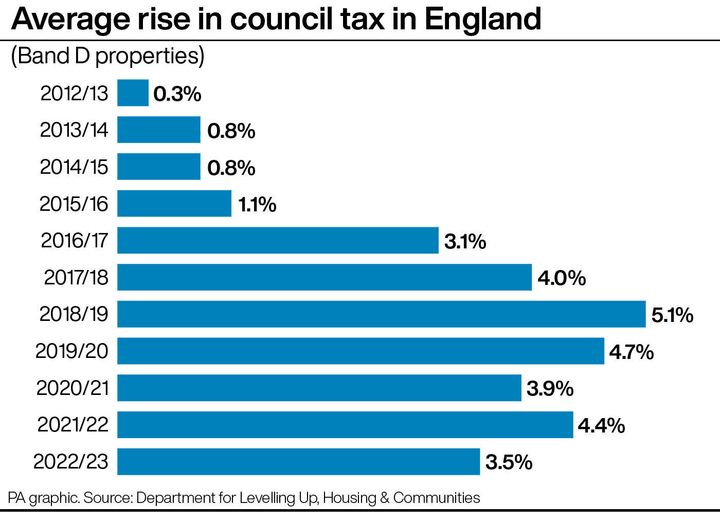
Average rise in council tax in England.

PA Graphics via PA Graphics/Press Association Images

Average rise in council tax in England.

Who pays council tax?

Almost everyone over 18 who owns or rents a home has to pay council tax – that means tenants, not the landlords, are responsible for footing this bill.

If you live alone you can get a 25% discount, and student homes are exempt, as are those living in halls or residence or care home.

If you work away from home and your property is empty you can get it half price.

Why is the bill going up?

The UK already has the highest tax burden in 70 years.

The government has also agreed to let local authorities spend an extra £5.1 billion next year (that’s a 9% rise for local authorities), with the most deprived areas of England set to receive 17% more per household this year than the least deprived.

But, council leaders say they have “little choice” but to raise the tax to protect the services offered to residents.

Labour vice-chair of CCN, leader of Cheshire East Council, Sam Corcoran, said: “With inflation reaching levels not seen for over 40 years and with demand-led pressures for care services showing no sign of abating, local authority leaders are setting their budgets in the most difficult circumstances in decades.”

He said that while the cost of living crisis is affecting every household, particularly those on low incomes, many local authorities are “reluctantly opting for maximum rises”.

“With councils facing multi-million funding deficits next year, the alternative to council tax rises would be drastic cuts to frontline services at a time when people at the sharp end of the cost of living crisis need us to be there for them.

“With the financial situation for councils looking extremely tough for the next few years, we will be calling on the chancellor for further help in the March budget.”

The Office for Budget Responsibility (OBR) says this will raise £3.3billion in 2026/27, and will increase to £4.8billion in 2027/28.

What does this mean for your bills, in real terms?

It would add £98 a year to bills for the average Band D properties.

Band D properties in England already pay £1,966 per year – so from April, this will probably be around £2,064.30.

The council tax amount varies from property to property. To find out how yours might change, calculate 5% of your annual rate (find it here) and then add it on to your current bill.

What does the government say?

The government made it possible to increase the council tax levy by 5% without a vote last autumn.

Before that decision from chancellor Jeremy Hunt, local authorities needed to hold a referendum to raise the levy by more than 3%.

The government also seems to have encouraged councils to apply this money pressure to residents.

A Levelling Up department spokesperson said: “Our approach to council tax balances the need to deliver vital services while protecting residents from excessive increases.

“We expect local authorities to take into consideration the challenges many households are facing.”

Levelling up minister Lee Rowley is also reviewing the council tax system, after complaints about different amounts being raised in different parts of the country.

Share Button

Banksy Unveils Powerful New Valentine’s Day Artwork Themed Around Violence Against Women

Banksy has revealed he was behind a powerful new piece of street artwork which centres around domestic violence against women.

The mural in question appeared recently in Margate, Kent, depicting a traditional 1950s housewife with a swollen eye and missing tooth.

In the piece – which is seemingly titled Valentine’s Day Mascara – the abused female figure is shown pushing her husband into a freezer, which sits in front of the wall art.

Posting a photo of his latest creation on his Instagram page, the anonymous street artist zoomed in twice to show a close-up of the woman’s smiling face.

A new artwork by street artist Banksy, titled 'Valentine's Day Mascara' on the side of a building in Margate, Kent.
A new artwork by street artist Banksy, titled ‘Valentine’s Day Mascara’ on the side of a building in Margate, Kent.

Gareth Fuller – PA Images via Getty Images

The piece also features a variety of rubbish on the ground in front of the artwork, including a broken white garden chair, a blue crate and an empty beer bottle.

It is set on a white wall backdrop, with users online speculating it is off Grosvenor Place in the seaside Kent town.

Comments about the post have suggested the Bristol-born artist is referencing fighting violence against women on Valentine’s Day.

Undated handout file photo of one of the new works by Banksy, appears to show a 1950's housewife, wearing a classic blue pinny and yellow washing up gloves, with a swollen eye and a missing tooth seemingly shoving her male partner into a chest freezer, the piece is set on a white wall backdrop in Kent. Issue date: Tuesday February 14, 2023.
Undated handout file photo of one of the new works by Banksy, appears to show a 1950’s housewife, wearing a classic blue pinny and yellow washing up gloves, with a swollen eye and a missing tooth seemingly shoving her male partner into a chest freezer, the piece is set on a white wall backdrop in Kent. Issue date: Tuesday February 14, 2023.

Banksy via PA Media

In December, the elusive graffiti artist announced they had created 50 screenprints which would be sold to raise funds for a charity supporting the people of Ukraine.

Banksy previously confirmed they had spent time in Ukraine after posting a video of an artist spray-painting designs in the war-torn country and speaking to locals.

The artist has managed to conceal his identity despite his work’s popularity, with former Art Attack favourite Neil Buchanan being forced to issue a statement insisting that he is not Bansky back in September 2020.

Help and support:

If you, or someone you know, is in immediate danger, call 999 and ask for the police. If you are not in immediate danger, you can contact:

  • The Freephone 24 hour National Domestic Violence Helpline, run by Refuge: 0808 2000 247
  • In Scotland, contact Scotland’s 24 hour Domestic Abuse and Forced Marriage Helpline: 0800 027 1234
  • In Northern Ireland, contact the 24 hour Domestic & Sexual Violence Helpline: 0808 802 1414
  • In Wales, contact the 24 hour Life Fear Free Helpline on 0808 80 10 800.
  • National LGBT+ Domestic Abuse Helpline: 0800 999 5428
  • Men’s Advice Line: 0808 801 0327
  • Respect helpline (for anyone worried about their own behaviour): 0808 802 0321
Share Button

Coventry mum’s comfort to hear from those with son’s organs

Aaron Wilson’s organs were donated after he died in a hit-and-run crash.

Share Button

West Lane Hospital: Trust mixed up dead teenagers’ names

Three young women died in eight months and a report then mixed up two of their names, it emerges.

Share Button

Can hearing loss be reversed? Research reveals clues that could regrow the cells that help us hear

Taking a bite of an apple is considered a healthy choice. But have you ever thought about putting in earplugs before your favorite band takes the stage?

Just like your future body will thank you for the apple, your future ears (specifically your cochlear hair cells) will thank you for protecting them. The most common cause of hearing loss is progressive because these hair cells — the primary cells to detect sound waves — cannot regenerate if damaged or lost. People who have repeated exposure to loud noises, like military personnel, construction workers, and musicians, are most at risk for this type of hearing loss. But, it can happen to anyone over time (even concert goers).

On the other hand, birds and fish can regenerate these hair cells, and now researchers at the Del Monte Institute for Neuroscience are getting closer to identifying the mechanisms that may promote this type of regeneration in mammals, as explained in research recently published in Frontiers in Cellular Neuroscience.

“We know from our previous work that expression of an active growth gene, called ERBB2, was able to activate the growth of new hair cells (in mammals), but we didn’t fully understand why,” said Patricia White, PhD, professor of Neuroscience and Otolaryngology at the University of Rochester Medical Center. The 2018 study led by Jingyuan Zhang, PhD, a postdoctoral fellow in the White lab at the time, found that activating the growth gene ERBB2 pathway triggered a cascading series of cellular events by which cochlear support cells began to multiply and activate other neighboring stem cells to become new sensory hair cells.

“This new study tells us how that activation is happening — a significant advance toward the ultimate goal of generating new cochlear hair cells in mammals,” said White.

Using single-cell RNA sequencing in mice, researchers compared cells with an overactive growth gene (ERBB2 signaling) with similar cells that lacked such signaling. They found the growth gene — ERBB2 — promoted stem cell-like development by initiating the expression of multiple proteins — including SPP1, a protein that signals through the CD44 receptor. The CD44 receptor is known to be present in cochlear-supporting cells. This increase in cellular response promoted mitosis in the supporting cells, a key event for regeneration.

“When we checked this process in adult mice, we were able to show that ERBB2 expression drove the protein expression of SPP1 that is necessary to activate CD44 and grow new hair cells,” said Dorota Piekna-Przybylska, PhD, a staff scientist in the White Lab and first author of the study. “This discovery has made it clear that regeneration is not only restricted to the early stages of development. We believe we can use these findings to drive regeneration in adults.”

“We plan to further investigation of this phenomenon from a mechanistic perspective to determine whether it can improve auditory function after damage in mammals. That is the ultimate goal,” said White.

Additional authors include Daxiang Na, Cameron Baker, and John Ashton, PhD, at the University of Rochester and Medical Center. The research was supported by the U.S. Army Medical Research Mechanism, the National Institute on Deafness and Other Communication Disorders, UR Ventures, and the Schmitt Program on Integrative Neuroscience.

Share Button