Hydrothermal vents have been identified as a previously undiscovered source of dissolved black carbon in the oceans, furthering the understanding of the role of oceans as a carbon sink.
The ocean is one of the largest dynamic carbon sinks in the world, and is susceptible to increased carbon emissions from human activities. There are even proposals to use the ocean to sequester carbon in an effort to reduce the carbon emissions. However, much of the processes by which the ocean functions as a carbon sink are not fully understood.
Associate Professor Youhei Yamashita and grad student Yutaro Mori at Hokkaido University, along with Professor Hiroshi Ogawa at AORI, The University of Tokyo, have revealed conclusive evidence that hydrothermal vents are a previously unknown source of dissolved black carbon in the deep ocean. Their discoveries were published in the journal Science Advances.
“One of the largest carbon pools on the Earth’s surface is the dissolved organic carbon in the ocean,” explains Ogawa. “We were interested in a portion of this pool, known as dissolved black carbon (DBC), which cannot be utilized by organisms. The source of DBC in the deep sea was unknown, although hydrothermal vents were suspected to be involved.”
The researchers analyzed the distribution of DBC in the ocean basins of the North Pacific Ocean and Eastern South Pacific Ocean, and compared the data with previously reported concentrations of a helium isotope that is associated with hydrothermal vent emissions, as well as oxygen utilization in these areas.
Their findings showed that hydrothermal vents were an important source of DBC in the Pacific Ocean. This hydrothermal DBC is most likely formed due to the mixing of the hot fluids from hydrothermal vents with cold seawater, and is transported over long distances — up to thousands of kilometers away.
“Most importantly, our research indicates that the DBC from hydrothermal vents is an important source of dissolved organic carbon in the deep ocean. In terms of DBC inputs to the ocean, hydrothermal vents may contribute up to half as much DBC as that which is formed by biomass burning or fossil fuel combustion and subsequently transported via rivers or atmospheric deposition,” concluded Yamashita. Further research is required to understand exactly how DBC is formed from hydrothermal vents.
Researchers have found that the movement of glaciers in Greenland is more complex than previously thought, with deformation in regions of warmer ice containing small amounts of water accounting for motion that had often been assumed to be caused by sliding where the ice meets the bedrock beneath.
The international team of researchers, led by the University of Cambridge, used computer modelling techniques based off earlier fibre-optic measurements from the Greenland Ice Sheet to build a more detailed picture of the behaviour of the world’s second-largest ice sheet.
Their results, reported in the journal Science Advances, could be used to develop more accurate predictions of how the Greenland Ice Sheet will continue to move in response to climate change.
Mass loss from the Greenland Ice Sheet has increased sixfold since the 1980s and is now the single largest contributor to global sea-level rise. Around half of this mass loss is from surface meltwater runoff, while the other half is driven by discharge of ice directly into the ocean by fast-flowing glaciers that reach the sea.
The RESPONDER project, funded by the European Research Council, is exploring the dynamics of the Greenland Ice Sheet using a combination of physical measurements and computer modelling.
The current research builds on earlier observations reported by the RESPONDER team in 2021 using fibre-optic cables. In that work, the team found that the temperature of ice sheets does not vary as a smooth gradient, but is far more heterogeneous, with areas of highly localised deformation warming the ice further.
The borehole measurements also showed that the ice at the base contains small amounts — up to roughly two percent — of water. In some parts of the ice sheet, this mixed ice-water layer, called temperate ice, was around eight metres thick, but in other parts it was up to 70 metres thick.
“The addition of even tiny amounts of water softens the ice considerably, transforming it into a unique material with substantially altered mechanical characteristics,” said first author Dr Robert Law, who completed the work while based at Cambridge’s Scott Polar Research Institute and is now based at the University of Bergen. “We wanted to know why the thickness of this layer varied so much, because if we don’t fully understand it, our models of ice sheet behaviour won’t fully capture the physical processes occurring in nature.”
“The textbook view of glacier motion is that it occurs with a neat partitioning of basal sliding and internal deformation, and that both are well understood,” said co-author and RESPONDER project leader Professor Poul Christoffersen, who is based at SPRI. “But that’s not what we observed when we looked carefully in boreholes with new techniques. With less detailed observations in the past, it was difficult to get a really good picture of how the ice sheet moves and even more challenging to replicate it with computer models.”
Law, Christoffersen and their colleagues from the UK, US, Switzerland and France developed a model based on their earlier borehole measurements that can account for all of the new observations.
Importantly, they accounted for natural variations in the landscape at the base of the ice, which, in Greenland, is full of rocky hills, basins and deep fjords. The researchers found that as a glacier moves over a large obstacle or hill, there is a deformation and heating effect which sometimes extends several hundred metres from the ice sheet base. Previously, this effect was omitted in models.
“The stress on the ice base is highest at the tops of these hills, which leads to more basal sliding,” said Law. “But so far most models have not accounted for all of these variations in the landscape.”
By incorporating these variations, the model developed by the researchers showed that a variable layer of temperate ice forms as the glacier moves over the landscape, whether the glacier itself is fast- or slow-moving. The thickness of this temperate ice layer agrees with the earlier borehole measurements, but diverges significantly from standard modelling methods used to predict sea level rise from ice sheets.
“Because of this hilly landscape, the ice can go from sliding across its base almost entirely to hardly sliding at all, over short distances of just a few kilometres,” said Law. “This directly influences the thermal structure — if you’ve got less basal sliding then you’ve got more internal deformation and heating, which can lead to the layer of temperate ice getting thicker, altering the mechanical properties of the ice over a broad area. This temperate basal ice layer can actually act like a deformation bridge between hills, facilitating the fast motion of the much colder ice directly above it.”
The researchers hope to use this improved understanding to build more accurate descriptions of ice motion for the ice sheet models used in predicting future sea level rise.
The research was funded in part by the European Union and the Natural Environment Research Council (NERC), part of UK Research and Innovation (UKRI).
In a study of nearly 3,000 schoolchildren, silver diamine fluoride — a liquid that is brushed onto the surface of teeth to prevent cavities or keep them from worsening — was as effective against cavities as dental sealants, the standard of care. A single dose of either topical treatment given in elementary schools prevented roughly 80% of cavities and kept 50% of cavities from worsening when children were seen two years later.
The findings, published in JAMA Network Open, offer an efficient and cost-effective approach to improving children’s oral health through school-based care.
Dental cavities are the most common chronic disease in children, and kids from low-income families are twice as likely to have cavities as those from higher-income families. Without proper and timely intervention, cavities can lead to severe infections, reduce children’s quality of life, and are associated with lower student academic performance and school attendance. But getting kids to a dentist for the recommended twice-yearly visits can be challenging, especially when parents need to take time off of work.
To reduce the barriers to seeing a dentist, some basic dental services can be offered in schools, especially those serving children from low-income families. For example, the Centers for Disease Control and Prevention recommends and funds school sealant programs. In 2017, NYU College of Dentistry researchers received funding from the Patient-Centered Outcomes Research Institute (PCORI) to run the nation’s largest school-based cavity prevention study, which they named CariedAway.
CariedAway is a randomized trial comparing the effectiveness of two cavity-prevention techniques: a “simple” treatment using silver diamine fluoride (SDF) and fluoride varnish, and a “complex” treatment using traditional glass ionomer sealants and fluoride varnish. Both are non-invasive and applied to the surface of teeth to prevent and arrest cavities in children, but for the same time and cost, providers can treat more children with the simpler SDF therapy.
The study included 2,998 children in kindergarten through third grade at 47 New York City schools. The schools — which serve a racially diverse group of students, most of whom are from low-income families — were randomized to receive either the simple or complex treatment.
Upon visiting each school, the clinical research team — which included a supervising dentist, dental hygienists, registered nurses, and assistants — did baseline exams to measure any tooth decay, and then applied fluoride varnish and either sealants or SDF, depending on whether the school was assigned to receive the complex or simple treatment.
The initial visits took place in 2019 and early 2020, and were paused when the COVID-19 pandemic temporarily closed New York City schools and halted all school-based care. Two years later, schools allowed the clinical research team to resume, and they returned to each school for follow-up visits.
The researchers found that both the simple and complex treatments were successful: just one cavity prevention treatment prevented more than 80% of cavities (81% for SDF and 82% for sealants) and stopped half of cavities from progressing (56% for SDF and 46% for sealants).
“Without prevention, dental cavities grow continuously if not treated. One CariedAway cavity prevention treatment, provided just before schools closed during the pandemic, was remarkably effective over the following two-year period,” said Richard Niederman, DMD, professor in the Department of Epidemiology & Health Promotion at NYU College of Dentistry, co-principal investigator of CariedAway, and the study’s senior author. “I know of no other dental preventive intervention that had this great a beneficial impact across the pandemic.”
While the limited availability of trained dental professionals can pose challenges for school sealant programs, as sealants are applied by a dentist or dental hygienist, SDF may be an attractive alternative, as it can also be applied by nurses — a workforce already in place in many schools.
“Our results support the use of SDF for cavity prevention in school-based oral health programs and offer an opportunity for expanding access to critical oral health care,” said Ryan Richard Ruff, MPH, PhD, associate professor in the Department of Epidemiology & Health Promotion at NYU College of Dentistry, co-principal investigator of CariedAway and the study’s first author.
Tamarinda Barry-Godín, DDS, MPH, was a study co-author. This research was funded by the Patient-Centered Outcomes Research Institute (award PCS-1609-36824).
New adoptive T cell therapies — in which T cells, the immune system’s natural hunters patrolling the body for foreign adversaries, are retrieved from cancer-riddled patients, super-charged and amplified outside the body, and then infused back into the same patient — are changing the prospects of cancer patients. Since 2017, when CAR (chimeric antigen receptor)-T cells were green-lighted as the first modified therapeutic cells by the Federal Drug Administration (FDA) to treat leukemia, five similar products have since been approved and more than 20,000 people have been treated with this game-changing immunotherapy.
CAR-T cells are engineered to carry synthetic membrane-spanning receptor molecules that use their outside-facing portion to bind to antigens on cancer cells, which their inside-facing portion responds to by switching on a powerful tumor cell-destroying program. However, not all patients respond equally well to CAR-T cell therapies, and cancer immunologists have been trying to figure out what makes them work well or fail. Despite a budding understanding of differences between cancer patients’ T cells and healthy individuals’ T cells, these insights have not been taken into account in CAR-T cell manufacturing processes. All processes use a similar type of stimulation with T-cell specific agonists and general immune-stimulating cytokines to create infusible CAR-T cell products, irrespective of variations in the original T cells’ phenotype.
Now, a collaboration between bioengineers at the Wyss Institute for Biologically Inspired Engineering at Harvard University and Harvard John A. Paulson School of Engineering and Applied Sciences (SEAS) led by David Mooney, Ph.D. and cancer-immunologists at the Dana-Farber Cancer Institute (DFCI) led by Catherine Wu, M.D., Ph.D. has demonstrated that personalizing CAR-T cell stimulation during manufacturing can significantly enhance the consistency and potency of the resulting CAR-T cell products. By using artificial antigen-presenting cell mimicking scaffolds (APC-ms), the team was able to fine-tune the levels of T cell stimulation to match the phenotype of T cells obtained from leukemia patients, and significantly enhanced their ex vivo and in vivo tumor-clearing abilities. The findings are published in Nature Communications.
“We show that CAR-T cell products made from T cells derived from cancer patients are generally less functional than CAR-T cells products derived from healthy individuals,” said Founding Wyss Core Faculty member Mooney. “Matching the CAR-T cell antigen-stimulation dose to the phenotype of patients’ T cells using a precisely controllable biomaterials approach that closely mimics natural antigen presentation can significantly improve their function. This approach could further personalize CAR-T cell therapy and remove an existing inadequacy from current T cell manufacturing.” Mooney also is Robert P. Pinkas Family Professor of Bioengineering at SEAS, and a lead of the NIH-funded Immunomaterials to Improve Immunotherapy (i3) Center coordinated at the Wyss Institute. This project was conceived at the Center, and Wu is one of its Principal Investigators.
Cutting the keys for personalized CAR-T therapies
The team investigated the phenotypes of T cells that they isolated from samples obtained from patients suffering from acute lymphoblastic leukemia (ALL) and chronic lymphoblastic leukemia (CLL), as well as from healthy donors. Next, they utilized APC-ms to provide the T cells with different doses of anti-CD3/anti-CD28 antigen stimulation and thus created a CAR-T cell library. All CAR-T cell products contained in the library were then probed again for functional differences, including their ability to kill cancer cells in vitro. The researchers directly compared their approach with one that is commonly used in CAR-T cell manufacturing, which presents the same antigens on rigid magnetic beads (Dynabeads) to T cells.
A key finding was that cancer patients’ T cells were much more easily over-stimulated at antigen doses commonly used during CAR-T cell manufacturing than “healthy” T cells. This made them lose their functionality, or become more “exhausted” as immunologists say, and decreased their ability to proliferate. CAR-T cells not only need to be transformed into a functional state but also amplified by millions to be able to eliminate tumor cells and metastasis in the entire body.
“By exploring a precise, narrow range of stimulation doses made possible with APC-ms, we show that there is something like a personalized ‘sweet spot’ for patient-derived T cells that maximizes functionality and amplification, which is, on average, lower than the usual doses,” said first-author David Zhang, who is a graduate student on Mooney’s team. “The APC-ms approach functions much more naturally than Dynabeads, because highly controllable levels of T-cell signals are embedded into a lipid bilayer, which allows the CAR-T cells to push and pull at them as just as T cells usually do across the ‘immunological synapse’ between them and antigen-presenting cells when T cell stimulation is at its best.”
From in vitro studies to cell manufacturing
While the team did not observe any significant differences between CAR-T cells created from ALL and CLL patient samples, overall their approach generated more cells with high cytotoxic potential toward tumor cells, a more balanced ratio between cytotoxic CD8+ T cells and CD4+ T cells that support their function, and more memory T cells that themselves are not cytotoxic but can be activated in later responses. In a mouse in vivo study, infused CAR-T cell products created with different levels of stimulation also exhibited significantly different abilities to control CD19-expressing Burkitt’s lymphoma, with cells again stimulated at lower than usual levels during manufacturing showing the strongest potential.
“We constructed a proof-of-concept model that is based on the quantifiable relationship between the phenotype of a T cell blood sample and its CAR-T cell products, and that outputs an optimal T cell stimulation dose for personalized CAR-T cell production,” said Wu. “Given that T cell samples are always fingerprinted for important markers at the beginning of the cell manufacturing process, similar strategies could be devised to further personalize the therapy using the APC-ms approach.” Wu is the Lavine Family Chair, Preventative Cancer Therapies at DFCI, and Professor of Medicine at Harvard Medical School.
“Dave Mooney’s team in the Wyss’ Immunomaterials platform is pushing the envelope of CAR-T cell and other immunotherapies using entirely new engineering and materials-based approaches. Hopefully, this will eventually enable us to also mobilize the immune system against recalcitrant solid tumors for which no therapies exist yet. It’s also a great example of where less is more,” said Wyss Founding Director Donald Ingber, M.D., Ph.D., who is also the Judah Folkman Professor of Vascular Biology at HMS and Boston Children’s Hospital, and Hansjörg Wyss Professor of Bioinspired Engineering at the Harvard John A. Paulson School of Engineering and Applied Sciences.
Additional authors on the study are Wyss and SEAS researchers Kwasi Adu-Berchie, Siddharth Iyer, Yutong Liu, and Joshua Brockman; DFCI researcher Nicoletta Cieri, and Donna Neuberg, Sc.D., a data scientist at the DFCI and member of the i3 Center. The study was funded by the Wyss Institute at Harvard University, the Food and Drug Administration (under award #5R01FD006589), the National Cancer Institute of the NIH (under award #U54CA244726), as well as a fellowship from the Canadian Institutes of Health Research.
New York Fashion Week begins Friday, and after years of a demand for more body inclusivity, the industry event still has a long way to go. Although many fashion brands have made an effort to introduce plus-size clothing and models, even the crowd invited to attend doesn’t feel inclusive to many.
Blogger Chastity Garner told HuffPost that she felt like an outsider from the beginning. When she was at fashion week in 2015, she was 360 pounds and couldn’t wear any of the clothing on the runways. “What was I really attending for?” she asked. “It’s like when you want a seat at the lunch table in school. I’m a person who loves fashion and wants to be included in fashion, but I didn’t feel included at fashion week.” To Garner, this wasn’t a surprise. “You can barely shop in malls if you’re over a certain size, so I expected not to be represented at fashion week,” she said.
Advertisement
Instagram influencer Greivy was only invited to one New York Fashion Week show in February — for Tiffany Brown, a designer who has featured full-figured models in the past. “The PR [public relations] people are limiting the reach their client can get by making a list that isn’t inclusive,” she shared. In the past, Greivy was invited to shows for Cynthia Rowley, Libertine, Anna Sui and more designers, but this year she chose not to email PR teams to request invitations. “I knew I would just be disappointed because TikTok influencers get all the seats now. It’s ridiculous,” she said. “I know very well these TikTokers don’t reach out like I used to, either. They don’t know how or who is in charge.” Greivy sees a constant struggle to prove she belongs at fashion week: “Sometimes, designers have a few seats, but plus-size influencers are more than just a sacrifice.”
Most attendees of designer shows are dressed by the brand. However, plus-size guests are often left out of clothing pulls. “Brands are only dressing sample sizes. It’s really hard to show up and not wear the brand while everyone else is because I don’t fit the clothing,” Greivy said. “It feels like I’m not cool or like I’m a loser because I stick out.” She has noticed these brands have oversize pieces that may fit, but they don’t offer them to her in the first place. “They want their image to be a certain way, and that way is sample size,” Greivy said. “Sometimes, a jacket can or belt can fit five different sizes, but they only gift the clothes to people who are a size 2. I’ll probably get a handbag or a shoe from the brand, but that’s it.”
Advertisement
For DJ Ty Alexander, being left out of fashion week has become the norm. Not only did she receive no invitations this year, but the influencer hasn’t attended since 2017. “In addition to being plus size, I am also Black, so most of my existence in fashion — in the world, really — feels like I’m on the outside looking in,” she said. “There is pressure in the world to stay thin. This isn’t a fashion issue. Fashion is only mimicking what society is doing. Everything about the world is thin, and I’m afraid that will not change.”
Models are also being affected, as they are instructed to maintain their tall, thin physique for runways. Surrendering to standards proved detrimental to Nathalia Novaes’ mental health. She views the fashion industry as the catalyst for her eating disorder, a struggle she endured for seven years as a model. “I built this international career that I’m super grateful for. But I built that with a body that wasn’t really natural because I was dieting all the time,” she told HuffPost. “I was never able to relax around food. I was always hungry.”
She cited a 2014 fashion week in Brazil as a particularly toxic experience. “All the models are really focused on not gaining weight. Nobody was actually eating,” she recalled. “I remember going back to my home with this mental exhaustion and feeling of hunger. I couldn’t eat because I had all of these shows.” By the end of fashion week, Novaes would resort to binging. “I was starving myself so much. It’s a triggering environment where everyone is self-conscious,” she said.
“Inclusivity is more than just the model on the runway. It’s also the clothing that is being offered.”
– Chastity Garner, blogger
When Novaes was just a size 4, clients started to complain about her weight. “I was called a balloon,” she said. “I have big hips, and I think they’re beautiful. But I’m not like the stereotypical model that’s a straight line.” Eventually, Novaes’ work stopped completely. She dropped her agency at the time, and it was eager to let her go. “I told my agency I was leaving. They said they were relieved because I wasn’t getting any work,” Novaes said.
Advertisement
Models and influencers aren’t the only ones privy to industry pressures; photographers avoid shooting larger bodies, as well. “Body exclusivity has been the norm for a fairly good portion of my career,” said photographer Alvin Toro. “Everything from the runway shows to editorials, advertisements and catalog shoots have been and still are plagued with outdated beauty ‘standards.’ The 1990s brought digital image manipulation and the rise of the supermodel. With them came the unrealistic beauty standards we are still fighting against today during fashion week.”
Toro said he even fell into patterns of body exclusivity in his own shoots. “It was almost impossible to have anyone consider your work if the models did not fit the editor’s vision,” he said. “Because of the top-down way the industry works, advertising agencies and brands would adopt a similar stance.”
In an industry that still struggles to be fully body-inclusive, it is up to the models, influencers and photographers as individuals to spark change. After years of dieting, Novaes decided enough was enough. “I sent an email to my agents and said: ’OK, I’m probably going to gain weight, but I’m just not going to diet. I don’t want to hear any comments about my body anymore,’” she said.
Toro, meanwhile, has taken steps to showcase more diversity in his work. In 2019, the photographer partnered with Hungarian fashion designer Eni Hegedus-Buiron of Lulu et Gigi Couture for an editorial shoot in Paris, which featured several plus-size models and a double amputee.
However, designers often use plus-size models to check off a box and avoid criticism or controversy. As plus-size fashion became more mainstream, the industry realised it could profit by tokenising curvy models. “Real inclusivity looks like more than a token model. It looks like more than this one girl who gets a chance to walk for a major brand,” Garner said. “Inclusivity is more than just the model on the runway. It’s also the clothing that is being offered.”
Advertisement
Although progress has been made, people are still excluded from fashion week because of their size. “When I became a plus-size model, I was a size 8, which is ridiculous,” Novaes said. “I didn’t get much work, because whenever [designers] want to cast someone diverse, they go for the extreme. They think, ‘OK, putting this plus-size woman in makes us inclusive.’” The model sees it as an either-or situation: You’re either plus size or you’re not, and there is no in between.
Body-inclusive efforts are seen as a rebellion against the status quo. Designers receive honourable mentions for introducing a greater size range, but there is no consideration of why those sizes weren’t present to begin with. “These brands need to do better. Just because we’re over a size 14 doesn’t mean we can’t be invited [to fashion week],” Greivy said.
A 2022 study published in the Journal of Applied Psychology surveyed a racially diverse and stratified sample of professionals, all from a large global financial institution and who all had white managers. Employees answered a survey about their self-promotional behavior with prompts such as “I talk proudly about my contributions or education with others at [company name],” and a group of management researchers used manager surveys and human resources information to see how supervisors rated the employees’ performance.
The researchers found that although white, Asian and Latinx employees received higher job ratings when they talked more about their contributions and accomplishments, Black employees were penalised by white managers for doing the same thing. Black employees who rated themselves highly on self-promotion received lower ratings of their job performance and assessments of their fit with the organisation.
In other words, self-promoting at work benefited white, Asian and Latinx employees while it had negative consequences for Black colleagues.
What explains this racial bias? The researchers think that white supervisors could be holding negative stereotypes of lower job competence against their Black employees while other racial groups were not dealing with the same thing.
Advertisement
As a result, when Black employees excel and communicate their accomplishments, strengths and contributions, their white managers see this as something that goes against their stereotypes of Black employees’ competence and skills.
“When managers perceive the violation of their stereotypical ‘norm’ of Black employees, they feel uneasy and thus react negatively,” said Jiaqing Sun, an assistant professor in the London School of Economics’ department of management, and a co-author of the study.
“The unique bias revealed in our study is more likely to happen in [occupations] highly emphasising competence, education, and skills, and also with a low representation of Black employees, such as financial banking, high technology and higher education,” Sun told HuffPost via email.
“It’s really not you, it’s them.”
– Career coach Ebony Joyce
The study controlled for employees’ education levels, tenure at the company, length of time in their current position and how long they had worked with their direct manager to “really try to isolate the extent to which self-promotion is positively impacting performance ratings,” said Sandy Wayne, a management professor at the University of Illinois at Chicago and the lead author of the study.
Advertisement
“What we did find was that African Americans, controlling all those other potential predictors of performance ratings, were getting lower ratings than other groups when they engaged in higher levels of self-promotion.”
Black employees can find sponsors to advocate on their behalf, but this is not their problem to fix.
Career coach and diversity consultant Ebony Joyce said the study’s findings resonated with her experience as a Black professional and with what she has seen with clients.
“We’re faced with this double-edged sword. You’re taught to do the work, put your head down and your work will speak for itself,” she said. “And you notice after a while that everyone is getting promoted around you. And you’re like, ‘I’m doing the work. What do I need to do?’ And then when it comes to advocating for yourself, that doesn’t work, either.”
Joyce said she has worked with many Black clients in this situation who wonder if there is another certification or degree that they need to get to be promoted. To them, Joyce advises, “You already have the education and the expertise and everything that you need already. You are just not supported within the organisation that you are in.”
Advertisement
If you’re a Black employee looking to stay within your organisation, it can help to find a sponsor at your company, outside of your direct manager, who can speak up on your behalf. As Morgan Stanley senior client adviser Carla Harris put it in a TED talk, a sponsor is someone, usually within your same company, who is not just going to speak positively about you but will be willing to spend “their valuable political and social capital on you” and “has the power to get it — whatever it is for you — to get it done behind closed doors.”
Wayne said it is also critical for Black employees “to track and to maintain documentation on areas in which you have excelled and accomplished a great deal, so almost more objective indices of one’s competence and performance, rather than just communicating that yourself to your manager.”
But in many cases, the best option is to leave.
This is what Joyce said she did when she experienced this trap of self-promotion. At her then-job, she noticed people she started with the same day were getting promoted while she was not. Joyce would do the things being asked of her in performance reviews and would go to leadership and human resources with documentation, but she still saw no change and continued to watch less-experienced co-workers advance.
“[I was] getting overlooked to where it was really a slap in the face and almost, I felt like, an embarrassment to me, as to ‘What am I not doing?’” she said. “After, I think, year three of not being promoted, I had decided to leave the organisation, which was the best thing for me. And the next place that I chose to work was for a manager who looked like me.”
For Black employees who do exit unsupportive companies, Joyce advises them to look at the turnover of diverse staff and the representation in leadership of places they want to work at next to lower the chances of the situation happening again.
Advertisement
Ultimately, however, the burden should not be on Black employees to deal with their white managers’ bad managing. Instead, it is the organisation’s responsibility to rectify the problem.
“The backlash toward Black employees’ self-promotion only exists when the manager holds a negative competence-related stereotype, so the most direct method to mitigate the bias is to mitigate the stereotypes,” Sun said. “This is, of course, not an easy job, but it is organisations’ responsibility and the only pathway to create an equitable workplace.”
Or, as Joyce put it, “This is one of those cases where it’s really not you, it’s them.”
After shrinking for one quarter, it (ever so slightly) jumped back between October and December by just…not growing at all.
Chancellor Jeremy Hunt said this was a sign “our economy is more resilient than many feared” – but warned that we’re still not “out of the woods yet”.
Advertisement
It’s also worth noting that Friday’s data – which has helped experts decide if we’re in recession – is only the first estimate. These numbers are often revised later.
But what does all this mean?
What has just happened to our economy?
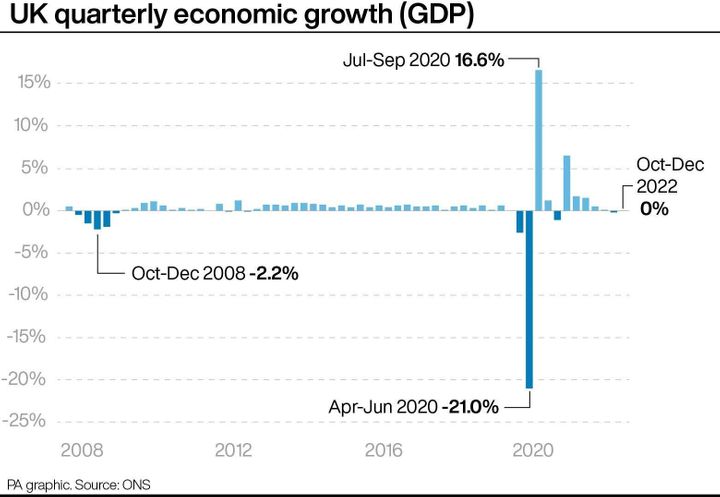
Data from the Office for National Statistics (ONS) said the economy recorded zero growth between October and December.
According to the ONS’s director of economic statistics Darren Morgan, it comes down to a few different factors – including strikes.
“Public services were hit by fewer operations and GP visits, partly due to the impact of strikes, as well as notably lower school attendance,” he said.
Advertisement
“The break in Premier League football for the World Cup and postal strikes also caused a slowdown.
“However, these falls were partially offset by a strong month for lawyers, growth in car sales and the cold snap increasing energy generation.”
Across the whole of 2022, the economy did grow by 4%, despite the cost of living crisis squeezing household incomes.
PA Graphics via PA Graphics/Press Association Images
UK quarterly economic growth (GDP)
What is a recession?
A recession is defined as two consecutive quarters (so six months in total) where the economy shrinks. This is also known as a decrease in the value of goods and services we produce, Gross Domestic Product, or GDP.
If GDP declines in value people’s income tend to fall.
In the third quarter of 2022, July to September, the economy did shrink by 0.2%. But because it didn’t shrink again the next quarter, we’ve just missed out on meeting the criteria for a recession.
Advertisement
The last recession was in 2020 at the height on the pandemic, but it only lasted for six months, although it did see a 20.4% reduction in the UK economy between April and June in 2020 though – the largest on record.
Before that, the 2008 global financial crash went on for five quarters.
Why is 2023 still expected to feel like we’re in recession?
Even if we don’t meet the technical definition for being in a recession right now, experts believe that it will very much feel like the country is in a period of negative growth already.
And experts at the International Monetary Fund (IMF) still expect the UK to be the only G7 country to fall into recession this year, and set to perform even worse than Russia.
And 2023 is still set to feel like a recession for many, according to an economist at National Institute of Economic and Social Research (NEISR).
Advertisement
“A focus on the economic crisis faced by most of the British population, rather than technicalities, offers a more insightful perspective,” NEISR’s Paula Bejarano Carbo told POLITICO.
One in four UK households (potentially seven million families) will not be able to fully pay off their food and energy bills in 2023 – that’s an increase from one in five last year, according to NEISR.
So how would a recession affect you?
The job market
Recessions usually trigger companies to let more people go, as consumers spend less and businesses have to adjust their margins.
Employers may also reduce workers’ hours, cut wages, pull back on bonuses and financial incentives or introduce a hiring freeze to an effort to reduce their outgoings.
The stock market will probably struggle too. As people tend to send less, companies report lower earnings, investors consider liquidating their stocks.
The Bank of England has been increasing interest rates in recent months in an effort to decrease the double-digit inflation. That means the price of borrowing increases.
So your credit card balance will also come with higher payments, and anyone looking to secure a mortgage will likely only be offered more expensive deals.
Only if you have a fixed rate mortgage will your monthly payback stay the same.
So lenders may want to think twice before letting people take out loans, which could affect people’s ability to go after large purchases.
Government spending
More economic growth means the government usually gets more money in taxes.
It can then spend more on benefits, public services, government workers wages or reduce taxes – but this can equally all be negatively affected if the economy shrinks too.
Advertisement
How can you prepare for a possible recession?
The Office for Budget Responsibility (OBR) still expects the economy to shrink by 1.4% in 2023, with the recession causing an overall drop of 2% in GDP.
Although it is expected to grow again by 2025, it’s still best to prepare now.
Pay off your debt sooner rather than later – interest rates are expected to continue rising this yer
Save, if you can, in the event of sudden redundancy
Recently I’ve been pondering how our mind’s expectations often block us from experiencing more richness and possibility. Even when we set goals and invite new desires, we can easily stop ourselves from taking accessible actions to advance. This month I ran into my own personal example of this phenomenon.
One aspirational goal that I set months ago was to eventually do an hour-long group training session at my gym called UltraFit. That class looked intimidating from the online videos I’d seen of it. You can see the description on the UltraFit web page if you’re curious, with lines like “Our most intense workout yet. Get ready to challenge your mental and physical limits.”
Here’s a 2-minute video preview of UltraFit:
The video includes such inviting phrases as:
“We created UltraFit to serve our high-intensity fitness fanatics.”
“UltraFit is advanced. It is no joke.”
“helps our competitive athletes stay in peak physical condition”
“We help them get through the hard work, the type of training that people don’t want to do on their own.”
Am I competitive athlete? No. But I loved the idea of building up enough fitness to handle this class – eventually. 😅
I’ve been doing GTX group training sessions with a few different trainers at this gym since Summer 2022, with some breaks for injury, illness, and travel. GTX stands for Group Training eXperience. Doing a 6am workout with other early risers who are into fitness is such a beautiful way to get my day started. I love the social aspect of working out with trainers and trainees in small groups.
GTX can be challenging, especially the Zone 4 sessions (higher heart rate exercises). UltraFit seemed pretty next-level relative to the GTX sessions though.
After some remodeling that our gym did in December, the UltraFit class which used to be on the third floor was moved down to the second floor – the floor where I normally do GTX sessions and also train on my own. Now the GTX and UltraFit sessions both use the same training area in the center of the second floor, so it’s much easier to observe.
Last Thursday morning when I was starting a cardio session on my own, I noticed that an UltraFit session was going to begin soon. I hopped on a treadmill close enough to observe. It seemed like a great opportunity to at least watch part of it, so I could form a clearer vision of what I might eventually build towards.
I was captivated from the start and ended up staying on that treadmill for 92 minutes, so I could watch the whole hour-long session. There were around seven people doing the training together.
I was using my Beats Fit Pro headphones to listen to an audiobook, but instead of only using noise cancelling mode, I sometimes switched to transparency mode. Transparency mode acts like a hearing aid, so it amplifies nearby sounds. This let me hear the trainer’s words more clearly, which gave me more insights into the training session.
By the end of it, I was thinking, that actually looks doable. I could surely do the first 45 minutes at least. The last 15 minutes looked tough, but I felt I could handle that too, although it was sure to get my heart rate pretty high. It wasn’t as intimidating in-person as it looked from the video, and the people actually doing the training didn’t look like the super fit athletes in the video either. They were generally fit, but not THAT fit.
I recognized a few of my fellow GTX trainees in UltraFit too, and I thought that if they could do it, so could I.
So I boldly signed up for the following week’s class. After I described what I saw and encouraged her to join me, Rachelle opted to try it with me too. We normally do the GTX sessions together – often enough that if we don’t show up together, the trainer will invariably ask us where the other one is.
We went to our first UltraFit session this morning at 6am.
The format was similar to the session I observed in its overall structure but with different exercises. It was challenging but doable, just as I thought. I couldn’t do all the moves perfectly – far from it – but I did my best. My heart rate peaked at 185 bpm, which is about as high as I’m physically capable of, so it really did push me to my limit in that regard.
In terms of intensity, it’s probably comparable to a Zone 4 GTX workout, which we just did yesterday. But whereas GTX has a more even, wave-like distribution of intensity, UltraFit starts fairly out mild and gradually builds to a peak of intensity over the course of the hour.
Each time we’d get on the treadmill, we’d sprint faster than before but for shorter durations, with sprinting rounds being 2 minutes, then 1 minute, then 45 seconds, 30 seconds, and the last couple of rounds being 15 seconds all out.
The hardest part was returning to the floor to do more high intensity exercises while still trying to catch my breath after sprinting fast at the end. The class had this flow of building up fatigue with round after round of sprinting and core exercises, and then you have to do more physical challenges while you’re already tired, and near the end, also breathless.
I liked the experience, which gave me a delightful sense of accomplishment afterwards, and Rachelle and I chatted with the instructor for a while afterwards. I’m sure I’ll do it again, maybe even next week. I like how it challenges me in different ways than the GTX sessions.
I wasn’t thinking that I’d accomplish my stretch goal of successfully completing an UltraFit class this soon. I figured it was still many months away. I’m glad I got the chance to visually audit the class first, which helped me picture myself just going for it.
This was a good reminder that our limits tend to be more mental than physical or financial. It’s amazing how our expectations can block us from opportunities and experiences that are more accessible than we realize.
What got me around that block in this case was exercising my curiosity to watch a class without having to commit to it. I leaned in to probe the goal a bit more, and that helped to crack my self-limiting thoughts about it.
That said, I might be pretty sore tomorrow unless my mind can find a way around that expectation too. 😉
The invitation for you is to consider how you might be blocking a seemingly distant stretch goal or desire due to your expectations regarding how you think it’s likely to show up. Are you piling on unnecessary prerequisites? How could you lean in with some noncommittal curiosity?
These expectation traps can be hard to spot within ourselves. One way to spot them is to ask where you wouldn’t feel that you belong. What experiences are other people having that you don’t feel ready for yet?
I had previously felt that I had to do a lot more training to earn the right to claim a spot in an UltraFit session. If I showed up before then, I’d surely be an impostor, right? I imagined a group of people like the ones in the video taking one look at me and saying, “Are you lost?” And that turned out to be pure fiction.
This morning I replaced the old frame with a new frame based on actual truth, including a fabulous UltraFit trainer named Gina encouraging Rachelle and me to come back for more. That feels like a lovely little graduation to have gone through – not physically as I had assumed would be necessary, but mentally and emotionally in terms of giving myself permission to access new experiences that were genuinely accessible.
I really think that LifeTime Athletic ought to consider replacing that video though. 🤣