Here’s the video of my Conscious Conversation call with author, speaker, fellow Transformational Leadership Council member, and long-time friend Martin Rutte.
We had a lively chat about Martin’s Project Heaven on Earth (which is about how to create a better world for all of humanity), pursuing impossible goals, and many other personal growth topics.
We had an interesting discussion on a recent Conscious Growth Club coaching call about making sure that the financial rewards of your career path are aligned with the ways you’d like to be rewarded.
For instance, you may want or expect to be rewarded for some of the following:
devising a creative solution to a problem
successfully completing a project
helping a co-worker solve a problem
reporting a problem that could cost the company if not solved
acting with honor and integrity
telling the truth in a difficult situation
encouraging and/or mentoring a team member
stretching yourself to develop a new skill
working hard
But what people are actually rewarded for often includes:
keeping your mouth shut and your head down
obeying orders without question
agreeing with the boss
looking busy
lying
closing sales at any cost
successfully hiding how distracted and unproductive you are
leaning on team members to cover for you
completing trivial tasks
generating data that doesn’t help the company achieve any meaningful purpose
Misalignments like these can occur regardless of how much control and independence you have over your work.
When I started my computer games business in 1994, I expected to be rewarded for my creativity, programming skills, work ethic, and for project completion. I went bankrupt waiting for such rewards to come through.
What actually generated income was closing deals with publishers, and those deals introduced dynamics which were misaligned with my expectations. Creativity wasn’t high on the list of what publishers wanted at the time.
Eventually I was able to create better alignment, partly by shifting my expectations and partly by shifting the reward structure of my business. That involved changing my business model. No one really cared about my programming skills but me, but at least I could be rewarded for my creative ideas and execution. The area where I most had to shift my expectations was marketing. In order to succeed with that business, I needed to up-level my marketing skills, and I had to adjust my expectations to account for good marketing as an activity that would be financially rewarded. I also had to note that weak marketing was financially punished.
I ran into similar challenges with my personal development business some years later. My initial income streams rewarded me in mixed ways. When I generated income from ads on the site, I was rewarded for blogging, for traffic growth, and also for selling and optimizing ads. I was okay with the first two, but I wasn’t as fond of being rewarded for people clicking on ads and leaving the site instead of sticking around to read more articles.
I dropped that model in 2008 and explored other models that felt more aligned. My current models, such as doing workshops, offering courses, and hosting Conscious Growth Club, are good at rewarding me for helping people achieve positive transformations. The more people get good results, the better it is for me since this means more repeat business. This also financially incentivizes me to keep creating more and better courses, to design and deliver more workshops, and to keep supporting and improving Conscious Growth Club.
In this case too, however, I also have to adapt to what the real-world situation rewards. Almost any business, including mine, rewards good marketing. I’ve wanted to improve at marketing too, so I’m okay with this. I’ve tried to set things up so as to align my rewards with doing marketing honestly and honorably, and that’s been working well.
When the actual rewards are nicely aligned with the desired behaviors, life and business flow more easily. You can focus on doing the work and getting better at your core skills, and you can expect to be rewarded for this because the business model is aligned with rewarding you for such behaviors.
What can really mess you up is when your business or employment situation has a misaligned reward structure, so you get rewarded for behaviors you’d rather not reinforce, and/or you don’t get rewarded for behaviors where you feel like you really do deserve some acknowledgement.
In this article so far, I’ve mainly focused on the financial rewards since those tend to be the easiest to assess and measure. But we can extend this to other rewards such as how you’re being appreciated.
When I generated income from ads, people would thank me for my articles and how they benefitted from my writing and ideas. They wouldn’t usually thank me for the ads, although some people did when an ad helped them discover something personally useful.
These days I normally get thanked for insights and ideas I share, especially those that help people get results. I get thanked most often for course lessons, for blog articles, and for helping people in Conscious Growth Club. So that’s all pretty well aligned because these are all areas where I’m continuing to invest.
I don’t typically receive appreciation or rewards for all the study, research, and experimentation I do in private, unless I share something beneficial to others along the way. I don’t get rewarded for making mistakes or pursuing false starts, such as partly developing something that never ships. But I do get rewarded down the road for the results that these activities eventually lead to, and that seems adequate for now.
It’s important to keep an eye on sustainability too. I can be rewarded temporarily for overworking, for instance, but then I get punished for it when it catches up with me. I can generate surges of extra income when I want, such as by launching something new, but if I overdo it, then I get punished on the lifestyle side when life becomes nothing but work, work, work all the time.
Take a look at how you’re being financially (and otherwise) rewarded in life and business. How well do these rewards align with your desired behaviors? Are you being incentivized to grow, improve, and execute in the ways you like? Is the current reward structure sculpting your character in ways you like and appreciate? How are you being over-rewarded or under-rewarded?
If you like what you see, great. And if not, then you have an important problem to solve. One option is to re-align your personal priorities, and get with the program. See if you can release resistance to how you’re being rewarded, and agree to let those rewards sculpt your character as they will. So if you’re rewarded for sales, then get aligned with up-leveling your sales skills, and accept that you’re pursuing a path of becoming a better salesperson. Sometimes this is workable while other times it’s just too unpalatable.
Your other option is to change the reward structure. This may involve negotiating with an employer for different terms, switching employers to find a more aligned reward structure, or changing the business model you’re using.
It’s important to be proactive here. You do have options. If you don’t like what the current reward structure is doing to you, then get into a more aligned reward structure, even if you have to design the business model yourself.
Once when I was going through customs at the airport in Winnipeg, Canada to visit Rachelle, I got pulled aside for extra questioning. The suspicious young agent somehow convinced himself that I was on an errand of ill intent and interrogated me about my reasons for visiting. He went through the files on my laptop, searching for evidence of illegal activity. He read through the recent text messages on my cell phone. Much to his chagrin, I wasn’t actually crossing the border to destroy Canadian society, so he came up empty handed and grudgingly waved me through, although for good measure he gave me a bonus lecture about the risks of doing anything illegal while visiting Canada.
I felt mostly creeped out afterwards, as if I someone had just vomited fear into my personal energy matrix. It took me several hours to slough off those feelings. Fortunately hanging out with Rachelle and the other nice people of Winnipeg was all it took to bring me back up again.
At the time I blamed that event on the overzealous agent, but if I look back on it now, I can interpret the whole experience as a reflection – and perhaps an amplification – of my own thoughts and beliefs at the time.
Even before I got to that agent, I approached the customs area with a suspicious vibe. I didn’t trust the agents, so when I was asked about the reasons for my visit, I gave a vague answer – “tourism” – which of course made the guy suspicious that I was hiding something. Who travels from Las Vegas to Winnipeg for tourism?
If I’d been a tad less suspicious and a bit more open with the agents, I probably wouldn’t have been subjected to the extra grilling.
I’ve seen similar patterns echoed back to me through blogging as well. When I’d write about a topic while feeling guarded about getting a negative reaction, my posts would attract plenty of criticism and judgmental responses. But when I fully owned what I was writing about, and I felt unattached to how people would react, there usually weren’t any negative responses to speak of.
I’m reminded of an episode of Star Trek: The Next Generation where the ship is being shaken by energy waves of increasing magnitude, and the waves are getting so strong that they’re about to tear the ship apart. But it turned out that the ship’s own shields were causing these violent waves. The waves were proportionate reflections of the shield energy. Once the shields were dropped, the waves stopped, and the ship was no longer in danger.
One important zone of clarity is your relationship with reality. Reality will often reflect back to you what you put out, even when you’re unaware of this relationship. I think it would be an exaggeration to say that this happens with a magical degree of perfect balance, but the effect is there nonetheless.
Occasional missteps aren’t usually such a big deal, but if you see recurring patterns in what reality seems to be reflecting back to you, consider that you may actually be creating these effects more powerfully than you previously realized.
When you identify a recurring result in your life that you don’t feel aligned with, pause now and then to ask yourself, How am I creating this? Don’t ask this question with an attitude of blame but rather with an attitude of curiosity. Consider the possibility that your own thoughts or actions are causing or contributing to these outcomes.
Suppose, for instance, that you keep encountering a significant lack of social support in your life. Maybe everyone around you seems indifferent to your goals, and no one seems to lift a finger to help you. You may believe that you’re taking positive actions such as behaving gregariously and generously with other people. You may believe that you’re a good person, that you have worthy goals, and that you deserve some help. But if you privately feel distrustful of people, if you’re pretending to care about helping others but you don’t really care that much, or if your thoughts are otherwise out of alignment with the outcome you seek, then you can expect that people will subtly pick up on your true intentions, and they may respond with some resistance in return.
You’ll likely find it easier to spot these waves of reflection in other people. Perhaps someone tells you about a persistent problem they’re having, and it’s abundantly obvious to you how this person is creating that very problem. You may think to yourself, Well… duh! Of course that’s what you’re going to experience. Meanwhile the person remains completely oblivious to the causal links between thoughts, actions, and results.
You may also know that if you share your honest impressions with the person, they’ll probably be surprised, insulted, or defensive. They’re unlikely to see what you’re seeing. They’re too close to the situation to see it through the lens of self-created reflections coming back to them. So you may offer up a polite response instead.
I think it’s wise to assume that you’re also blind to many of your own self-created reflections. What you’re experiencing from life is in many ways just basic feedback regarding what you’re putting out.
Now the mistake people make here is to attempt to alter the reflections by doing even more of what caused them in the first place.
As I dealt with the overzealous border agent, I became increasingly annoyed with him. I asked if he could speed up the process, suggesting that I had more important things to do (like hang out with friends). I made facial expressions and shifted my body language to overtly communicate my irritation with his behavior. I did even more of what invited these reflections in the first place. Did this help my situation? Of course not. It simply motivated the agent to hold me up longer as he searched in vain for evidence of increasingly far-fetched breeches of Canadian law.
Have you ever done something similar by doubling down on an approach that clearly isn’t working?
When life threatens you with a financial problem, do you tighten up and go even deeper into the scarcity mindset that gave rise to this problem in the first place? Or do you use the challenge as an invitation to shift into abundance mode, such as by being more generous than usual?
When you’re stressed at work, do you procrastinate even more, thereby amplifying the stress? Or do you turn towards relaxation and find a way to play your way through the work instead?
If you go deeper into the thoughts, feelings, and energy patterns that give rise to your problems, you’ll attract more and bigger versions of those same problems. You’ll be like the character in that Star Trek episode who keeps calling “more shields, more shields, more shields” till the ship is about to be torn apart, never realizing that the shields are causing the problem.
Which persistent problems in your life might you actually be creating? Is it possible that you’re creating financial scarcity by acting like a financially scarce person would? Is it possible you’re creating social disconnection? Is it possible you’re creating the health status of your body? Again I’m not suggesting 100% perfect causality here, but can you entertain the possibility that your own thoughts and behaviors may be contributing to your results?
You may not learn the real truth until you deliberately shift your patterns of thought and behavior and give yourself the opportunity to see different patterns being reflected back. That’s when it will finally dawn on you that you’ve been playing a major role in creating your experiences all along. It’s when you break the old patterns and try something incongruent with your previous mindset that you can finally see the causal links that were previously hidden to you.
I suggest that you start small here. Test this idea when it doesn’t feel super critical. When you’re experiencing scarcity, try donating a small amount of money online to a cause you like. When you’re bored at work, play one of your favorite songs, shake out your body, and take a dance break for a few minutes. When you’re feeling angry, try sending someone a thank you note. If you don’t like the outcomes you’ve been experiencing, try setting a radically different cause in motion, and see how it affects your results.
Turn towards the patterns that feel more loving and more powerful to you, even if you can only manage this for a short time. When you disrupt your previous patterns, you’ll also raise your awareness of the old reflections you’ve been serving up unconsciously. And this will help you step into a zone of power that lets you change those patterns – and improve your results too.
Why do so many transitions have annoyingly high price tags? Why can’t we just transition with ease whenever we want?
Imagine the opposite for a moment. Suppose that major transitions could always be made with grace and ease, and none required a price to be paid. Suppose you could make big changes whenever you wanted. Switch jobs. Switch cities. Switch relationships. Switch anything at the push of a button.
If transitions could be undertaken at little or no cost, it stands to reason that people would transition more often. There’d be less opportunity to delve deeply into stable experiences because reality wouldn’t be as stable. People and circumstances would shift around much more, so reality would be in a perpetual state of flux. It wouldn’t stay still.
This would rob us of the opportunity to experience the benefits of a more stable reality. We wouldn’t experience as much contrast because as soon as things began to get a little unpleasant, we’d immediately shift to something more pleasant. We’d miss out on those prolonged deep dives into unpleasant situations.
Why should this matter? Why should reality want us to remain stuck now and then? What’s the point? Is it sadistically trying to punish us?
Suppose this was by design. Imagine that we’re living in a simulator that was programmed to function this way. Why would the programmer code it like this?
One powerful reason is that the more we experience the darker side of life, the more we appreciate the lighter side. Scarcity helps us appreciate abundance. Loneliness helps us appreciate togetherness. Sickness helps us appreciate health.
Is it possible that when you stop appreciating the good things in life, you invite their opposites? Is it possible that when you stop appreciating abundance, you attract more scarcity? Or when you stop appreciating good health, that’s when you’re more likely to get sick? Or when you stop appreciating your relationship, that’s when you’re headed for a breakup? In each case the purpose could be that experiencing the darker side renews and restores your appreciation for the lighter side.
If there’s any truth to this, might it also be possible that this reality makes the transitions harder when we aren’t yet ready to transition? Perhaps the price we’d have to pay to transition seems high for a reason. On the one hand, a high price serves as a bit of a barrier, so we’ll have to keep experiencing the unpleasant situation for a while longer. On the other hand, the price also serves as a constant reminder that transition is possible; it may seem out of reach at the moment, but the possibility still dangles before us.
Now when we find ourselves stuck in such a situation, we could accept the price and resolve to pay it. That may require pursuing a long and difficult path though, which can be discouraging. So is there anything we can do to effectively lower the price and make the transition easier?
Yes, there is. We could appreciate the value that the unpleasant situation adds to our lives. Appreciate the scarcity. Appreciate the loneliness. Appreciate the sickness.
During the first five years of running my computer games business, I pursued success, but my efforts didn’t pan out. I sank into debt year after year and eventually went bankrupt. I don’t regret the debt or the bankruptcy, but I regret the stress I created by resisting my financial situation at the time. I regret the experiences I told myself I couldn’t have because I was so deep in debt. I regret that I failed to appreciate many of the little things because I was worried about money – or the lack thereof. I used to run along the beach regularly and not pay enough attention to the beauty all around me – which was free to enjoy – because I was concerned about money.
Going bankrupt really wasn’t that bad. It’s basically a lot of paperwork. The process actually relieves stress once you surrender to it. As part of going bankrupt, you have to document every possession you own. As I went through this process, compiling a list of my every possession and estimating its fair market value, I felt grateful for what I still had. I still had my clothes. I still had a car. I still had my furniture… well, some of it. I didn’t appreciate those possessions as much before the bankruptcy. Afterwards I began appreciating them a lot more.
I actually felt relieved after the bankruptcy. I felt relieved to finally be on the other side of the collapse instead of constantly resisting and fighting it. I felt grateful for the fresh chance to try again. I still had to move to a cheaper place to live. I had to sell many possessions. I had to downgrade my lifestyle. But after all of that, I felt mostly gratitude. The experience didn’t actually kill me. I wasn’t kicked off the planet.
Spending five years of my life resisting reality was enough for me. After that I decided to cultivate a new relationship with life, one that incorporated gratitude, appreciation, and playfulness. I learned to appreciate a long walk in the moonlight. I appreciated the opportunity to use a computer to express my creativity. I appreciated having friends and family to help me when I needed it. I appreciated smiles and hugs.
I’ve observed over the decades since then that life seems to repeatedly reward me for this attitude. Sometimes I feel like I’m living in a simulator that’s programmed to reward such thoughts, feelings, and behaviors… and to discourage me from doing the opposite for too long.
Appreciate what you experience, and you’ll be given more to appreciate. Worry about what you’re experiencing, and you’ll be given more to worry about.
Moreover, I learned to say thank you for life’s various problems and challenges too. It was easy to appreciate the bankruptcy because of how it woke me up and sent me down a better path. So with that as a powerful reference experience, I learned to bring a similar mindset to other challenges. Sometimes this was difficult to do, and sometimes I was overly stubborn. But eventually I could see that my resistance wasn’t helping and was in fact only making things worse, and I reminded myself to shift back to gratitude and appreciation again and again.
This sense of appreciation turned everything around. My business began doing well, and every year since then has been pretty abundant. This current year has barely begun, and due to the recent Stature course launch, we’re already past $100K in revenue for 2020. I appreciate that too, just as I learned to appreciate my bankruptcy, and just as I can appreciate a nice walk in the moonlight. In fact, after I publish this, my wife and I are going out for a long moonlit walk together. We’ll appreciate spending time together and enjoying the cool night air.
There have been times where I’ve experienced a short dip towards scarcity, but I don’t perceive those dips as threatening. I accept them as reminders of how much this reality seems to value appreciation. I’ve learned that I can quickly steer back to abundance by remembering to appreciate the heck out of every little part of life, including appreciating the role of scarcity itself.
This is also how you reduce the price of a transition. You reduce the price by extracting every gram of appreciation you can from the experience. As long as you fail to appreciate your current reality, you’re actually holding it stable. When you begin to appreciate the heck out of a seemingly undesirable situation – when you can say a genuine, heartfelt “thank you” for the valuable lessons within that situation – then you can progress. Then life lowers the price of transitioning and makes it easier for you to shift over to new experiences, such as the flow of abundance.
If you’re bored at work, remember to appreciate small acts of fun. Appreciate laughter. Appreciate good coffee. (Except if your workplace serves bad coffee… then maybe pick up some hipster coffee on the way and appreciate that instead. But still notice that bad coffee helps you appreciate good coffee even more!)
If you feel like your current relationship is lifeless, then appreciate what little life there is. Appreciate the good memories. Appreciate a fleeting touch. Appreciate the love you once had. Can you still say “thank you” to your partner for the role they’ve played in your life? If you can’t say it directly, then say it indirectly. Write it down privately somewhere. No one else has to know.
Such mindset shifts lower the price of transitions. When you extract the lessons from seemingly unpleasant situations, and when you can genuinely thank life for these experiences, life tends to drastically lower the transitional barrier, so you can finally move through your transition with relative ease and lightness.
Many entrepreneurs find pricing decisions for their products and services really challenging. You’ll often hear such people asking each other, “What should I charge?”
I’ve read a number of books about pricing with complex ideas on how to do it correctly. Most involved some form of testing and optimization. They all shared the same underlying assumption though: that the optimal prices are those which extract the most long-term profit. Since that’s extremely difficult to predict, testing is essential.
Testing of that nature can be dreadfully boring though, and you still won’t know if your tests are accurate. Since economies fluctuate anyway, a test done one month could yield different results than if you run it a month later.
I dislike that approach mainly because I find the framing too limiting. It’s a very objective model, and I have a long history of getting better results when I use subjective framing. If my reality is some kind of simulation, it seems unlikely that my simulation is programmed to train me to care about pricing optimizing by doing split tests. That seems like a rather useless skill to develop, akin to improving my telephone sanitizing skills (which admittedly aren’t very polished). I have no desire to sculpt my character into a split testing mogul.
Pricing as Communication
A model I like much better is to think of pricing as a form of communication. The pricing is part of the offer and inseparable from it. The price isn’t something to be tacked on later.
Pricing can communicate whether you’re trying to provide something cheaply or luxuriously, for instance. If I tell you that I bought a car for $8000, that would communicate something different than if I say I bought one for $80,000, even if I told you nothing else about the car.
In this sense pricing also serves as a filter. Your price will affect the types of customers and clients you attract. For instance, I could price Conscious Growth Club at $10K per year instead of $2K a year, and the group would still work, but we’d have different types of members and fewer of them. Otherwise the program’s structure and design could be entirely the same. The price would communicate what types of members we’re looking for. Similarly I know someone who charges $80K per year for his coaching program and $5K for his seminars. Are they objectively any better than our $2K coaching program and $500 workshops? Nope, but the pricing difference will attract different people.
So when I think about pricing from this perspective, I think about the kinds of people I’d like to attract and work with. If I want to offer a coaching program for the kinds of people who like $10K programs, I’ll price it at $10K. I’m personally one of those people, currently enrolled in a friend’s $12K coaching program for the year.
Pricing From the Customer’s Perspective
Another frame I like is to think about what price is best for the customer to pay. This is a good model if you know your customer base really well, and you know how different prices will make them feel.
You could price something low to communicate that it’s easy and accessible if that’s what you think is best for the customer.
Or you could price something higher if you want to communicate that a product or service is a bigger investment or a bigger value. People often appreciate higher priced products more. Pricing too low can reduce a person’s appreciation.
I use this on myself too. I know that if I join a coaching program that costs $10K per year, I’ll appreciate it more and gain more value from it than if I pay $1K per year. When making purchasing decisions, I think about pricing and features in terms of what will help me appreciate a purchase.
Pricing can be a bit funny that way. It’s hard to admit that sometimes it’s better to pay more because you’ll appreciate the ownership experience more. If you pay too little, you may communicate to yourself that you don’t value the purchase as much. Trying to get something for less isn’t always wise.
Setting prices based on what’s likely to be best for my core customer base has been super helpful. I could continue to maintain a healthy business just with this pricing model alone. It seems to work very well in practice, as I get more compliments than complaints about my pricing. People pay enough that they value and appreciate the investment, but it’s still low enough that they can extract lots of value from their purchase to make it very worthwhile. This generates a lot of repeat business too. Most of the sign-ups for our new Stature course are from repeat customers.
The best price for the customer to pay is the price that helps them extract the most value, satisfaction, and appreciation from their purchase. One key factor for the courses I offer is that people need to do the lessons to extract the value. When someone completes the course, I know from experience that they’re very likely to get really good value from it and feel that the deal was more than fair, generous even. But they also have to invest time and energy to extract the full value. If they pay too little, there’s less buy-in and less motivation to do the work and finish the lessons, even if it will benefit them immensely. Paying too little sends a message to their minds that maybe they shouldn’t value this investment as much.
On the other hand, if the price is too high, then people feel stressed out and worried. Or they talk themselves out of making that kind of commitment. Some people, however, will feel even more excited when they commit to a price that’s a stretch for them. I’ve experienced this myself when I’ve stepped up to pay for high-end coaching programs. It can be exciting and fun to spend enough money such that it feels edgy and risky, and so far I’ve always gotten more than my money’s worth when I’ve stretched myself to pay more. That’s mainly because when I take a bigger financial risk, I’m very committed to doing my part to extract the value; otherwise I’d feel really stupid for paying that much for something and not leveraging the heck out of it.
Another factor could be that I join a group with other people who’ve stretched themselves to join as well, and such groups are just awesome to participate in because people really put in the effort to make it work, which benefits everyone in the group. We’re all committed, so we all pitch it and make it work for each other. When everyone has to stretch a bit to get in, it’s even better inside. Higher pricing can serve as a good filter for attracting ambitious, growth-oriented people – not perfectly but pretty well.
One reason I price Conscious Growth Club at $2K is that for much of my audience, that pricing feels pretty edgy already while $10K would feel out of reach for them. Based on the great community I’m seeing inside, I think it’s the right pricing for most members. For some I can tell it’s not edgy enough though. If you’re looking for a community of only entrepreneurs, for instance, a $10K program would be better. In our community people work on all different types of goals: health, relationships, finances, life purpose, meaningful work, creative skills, and more.
Pricing for Trust
Another frame I like using today is what you might call trust-based pricing. I didn’t learn about this somewhere else, at least not to my knowledge. It just gradually evolved from trying to find better frames for this aspect of business.
In doing workshops, creating courses, and running Conscious Growth Club, I experience just how wonderful it is to work closely with people who trust me. High-trust relationships are so win-win all around. Trust reduces friction and makes it easier for people to get results, which in turn leads to more appreciation. Appreciation is good all around, both for business and personal reasons.
When people ask me questions about our products and services, and I can tell they’re not really aligned with what we provide or the kind of relationship I’d like to have with them, I gently recommend that they don’t buy anything. Sometimes I’ll suggest free articles to read instead, and sometimes I’ll suggest other resources in this field that might be a better fit for them. I don’t try to invite everyone to become a customer. To me that’s a special relationship, and the alignment matters.
I’m not suggesting that people need to trust my advice blindly. That’s not the type of trust we’re talking about here.
In this case I’m referring to trust in my intentions, experience, and honesty. I want people to trust that I’m on their side and that I genuinely want to help them grow and improve. If they can at least buy into that, it makes a world of difference for us. These days I only want to work only with people who can feel aligned with having this kind of relationship. I feel very fortunate that I can maintain this standard and still attract plenty of business. Not everyone is right for this kind of relationship, but for the right people who are aligned with it, they tend to love and want nothing less. Having such a high-trust relationship is just beautiful.
I love these kinds of relationships with other businesses too. For instance, I really like the dental practice that I’ve been going to for the past several years. I’ve worked with multiple dentists there, and they’re all great. The people at the front desk are super friendly, and I sometimes joke around with them. The hygienist is awesome too. She and I chat about all sorts of things like travel and even ayahuasca. I’ve never been to another dental practice like this; previous ones felt somber, cold, and heartless. But in this place, it’s obvious that the people like working with each other, and they like their patients too. In the past, I’ve gone at least a decade between dental appointments because I disliked the experience so much. With these people I’m currently going 3x per year, which I’ve never done before. Most importantly, I trust them. They aren’t just friendly. They’re also good at what they do. I hope they stay in business for as long as possible.
I’m a good customer for them too. I show up on time. I follow their advice. I pay every bill on the spot, so they never have to bill me. I never complain about prices or try to negotiate them down.
With high trust in a coaching situation, people are willing to share deeper truths about themselves. If you only get the surface truth, coaching can only go so deep. With more trust people will share the more vulnerable parts of themselves, and that leads to even deeper trust.
When someone trusts me in this way, such as by sharing something that’s really difficult for them to share, I feel honored. It’s a privilege to be trusted with that level of intimacy. It makes me feel more invested in helping the person. Handling such situations can be delicate. Delicate is a word that in my distant past, I’d never have applied to myself. But today I like sculpting my character in that direction. I love the realm of high-trust relationships because it leads into a world of subtlety and delicacy, yet there’s still room for playfulness and fun.
In terms of pricing models, I think about pricing for trust. If I want to attract more high-trust customers (if only because they’re delightful to serve), then I think about what price will best align with attracting and developing high-trust relationships.
If I price too cheaply, it means people can buy without having to trust as much, which can flood the business with too many jaded and skeptical people that I’d rather not deal with. If they want something too cheaply, they probably don’t want something really good, which means they won’t have the right attitude for supporting me in doing my best work. That isn’t going to create a win-win relationship.
If I price too high though, it can damage trust because then people might assume I’m just doing it for personal greed. So if there’s a valid reason for pricing higher than usual, it’s important to communicate that clearly.
It’s also wise to consider the existing trust relationship. I like to offer launch discounts for new courses, such as for the new Stature course that’s launching now. Most of the people who will join during the launch already have a trusting relationship with me, like repeat customers and long-term blog readers or newsletter subscribers, so from my view they don’t have to prove themselves to me. I want to make it easier for them to join, so we’ll have a nice, high-trust group inside. And I also want to make the price lower for them as a way of saying that I trust them too and that I appreciate our relationship. I trust that even at the lower price, they’ll still take it seriously enough and do the work of the course, so they can get the benefits.
After the launch, the course can continue selling for many years, but the new people who discover it probably aren’t part of my core, high-trust audience yet. They may be new to my work. They’re not sure if they can trust me, and I’m not sure if I can trust them. So it may be better if they start with reading free articles for a while. Then they can think about taking a course when they trust me enough to do so. The higher price is a bigger hurdle for them, so it takes more trust for them to say yes.
Some people are really into growing their businesses. For me alignment is way more important than growth. If I can do both, that’s great, but between the two, I see alignment as far more important. I’d be a lot less happy if I 10X’d my business but messed up the alignment in the process. I just don’t want to work closely with people unless we can develop and maintain high-trust relationships.
I really, truly don’t want to do business with people who don’t trust me enough to make it win-win. Even if I made a lot more money trying to capture those extra sales, I wouldn’t want it. Even if I could delegate way more, including all of the customer service, I wouldn’t feel good about a customer service rep having to deal with misaligned customers either. It wouldn’t be right.
Alignment Pricing
I think the ultimate pricing model is to price for alignment. What would an aligned business look like for you, and what pricing decisions would help you create that?
Incidentally, you can use this mindset even if you’re an employee. What’s the right salary for you to request and for your employer to pay such that the alignment is there, and you’re able to invest in a high-trust relationship?
We can also see why split-testing and traditional optimization strategies look good on paper but often fall short in reality. Trying to optimize for profit is short-sighted and risks attracting many misaligned customers. That can increase support costs, negative reviews, product returns, staff turnover, etc. Many people I know who use this model would consider a refund rate of 5-10% to be pretty good. My business’ current refund rate is 0.0%. And the reason is simple, we don’t offer refunds. Instead we have an honor code. If you’d like to see my explanation of the honor code and why we have it, watch the Stature video from 27:33 onward. But the main reason is that I tested offering a money-back guarantee, and while it brought in more sales, it messed up the alignment and created more problems and friction inside the business. It really sucks to feel hesitant about investing fully in someone because I suspect they might request a refund. It’s so nice not to have to deal with that anymore.
Having an honor code instead of money-back guarantee really does turn away some business. I would almost certainly make more money in the short-term by offering unconditional refunds. But the reason I don’t is simple. The headaches aren’t worth it to me.
People have to meet a higher standard of trust to buy with our honor code – trust in me and trust in themselves to follow through. That’s the standard I want. It means fewer people getting through but way more alignment inside. And it makes the business so much nicer and more fulfilling to run. People who are jaded or suspicious just aren’t going to accept such an offer, and I’m glad for that. I’m delighted to refer their business to other people who’d welcome it.
I also think that in the long run, this approach will make the business better for staff members too. It means that staff also get to work with aligned customers who will trust and appreciate them. No staff member should have to deal with customers from hell. We’ll fire such customers from hell and keep the aligned staff. Our staff won’t be treated poorly.
Creating win-win relationships is a high standard, but it elevates so many other parts of the business. It removes so much friction and makes it easier to just do the real work of serving people. Financially it works well too. This will be a six-figure January for us, which is a nice way to start the year.
One of the biggest traps is life is trying to achieve goals that only you will care about, such as making money or achieving success in your career. Yes, those kinds of goals can still create some ripples for others, but if your intention is mostly about you and your personal gains, I’d predict a lot of stuckness and stagnation for you.
I fell into this trap as well. In my 20s I thought my goals were well-intentioned enough. I was trying to get my computer games business going, make some money, and have a nice life in the field of game development. I certainly wasn’t trying to hurt anyone. But I didn’t really care much about what happened beyond my immediate sphere. That seemed logical at the time, but I realized later that it was an irrational approach.
When I thought about goals back then, they were personal goals. I set fitness goals and financial goals and relationship goals. I achieved some of them, but the money and success goals always eluded me, even though at the time I made them a high priority.
What I didn’t realize back then was that money and business success goals are social goals, not personal goals. Do you see that?
Suppose you lived on an island by yourself. What sense does it make to set financial and business or career goals? There’s no economy. There are no social constructs. Such goals are meaningless.
Try Service on for Size
In 1999, mostly out of desperation, I decided to start volunteering in a nonprofit association. I was a member for a few years but never did much with my membership other than receiving the monthly newsletters. I recognized that something was terribly wrong with my previous approach to success because my results were terrible – lots of debt and then bankruptcy – even though I invested a lot of time and energy in the business.
I finally surrendered to the poor results I was getting and decided that I should explore new directions, if only to gain experience with other modes of living. Anything looked better than the stressed and frustrated mode of working hard on goals that I wasn’t achieving.
So I began volunteering and helping people more without worrying about personal gains. I began writing articles that same year, starting slowly at first. This totally turned my life around within a year. Sometimes it’s good to take a blind leap into unexplored areas when you aren’t getting results you want from what you’ve been doing thus far.
This attitude and practice helped me achieve what I previously thought were my personal goals. Every year since then I’ve been writing articles and seeking to be of service in other ways, which have created many ripples for other people. I know that because many of them tell me. And every year since then has been pretty financially abundant. This year will likely be the best ever in that regard.
What blocks a lot of people from being more service-oriented is that they can’t see the logic behind it. When you’re so concerned about your own gains, how are you possibly supposed to free up even more time and energy to help others on top of that?
I understand that mindset since it used to be mine. It’s an ineffective mindset though. It seems rational, but it isn’t. Is it getting good results for you? Do you see it working in your real time? Or does it only seem logical in an abstract way?
Do you really think that money and success will flow into your life because you’re hyper-focused on your own goals and needs? Great… try doing that alone on an isolated island. That should give you the best focus since no one will be there to distract you. See how far you get. What you don’t realize is that you’re essentially acting out this metaphor in real life if you regard financial and success goals mainly as personal goals.
Being hyper-focused on your personal goals for personal reasons can work in some areas of life, but it’s unlikely to get much flow going for more social goals. Financial and success goals are inherently social.
Success Is Social
Money flows from other people. Any evidence of your success, including having customers and clients, flows through people too. If you can’t achieve such goals without other people’s cooperation, doesn’t it make sense to deliberately invite their cooperation instead of just hoping it will happen?
When your goals are mostly solo, that creates friction and resistance. People aren’t likely to spend money to help you achieve such goals unless you provide a decent reason for them to care. Your own success isn’t a decent reason; it’s a pretty pathetic one actually.
Other may spend money for own their personal priorities and interests, which probably doesn’t include helping you succeed. But they may be very willing to spend money in order to participate in an interesting social flow that’s extends beyond you and them.
A simple way to sum this up is that you’re likely to receive way more help by reaching out and caring about others. If you focus on what only you want to receive, virtually no one will care to help you.
You want more abundance flowing to you? It flows from other people. And if they don’t care much about helping you, you’ll find it 10X more difficult to get that flow going, maybe 100X. Everything you try to achieve will be self-powered, and self power is weak.
You can test living in a more service-based mode for a few years like I did, but admittedly that can become draining after a while. I put in hundreds of hours in volunteer effect, and while it did help me turn things around, it’s hard to give, give, and give more.
For me this was an example of swinging the pendulum. I got terrible results from certain personal goals, so I wanted to see what would happen if I went into full-on service and volunteer mode to the extent that I had the time and energy to do so. That did improve my results very quickly, especially because it opened me up to a world of networking in my field. By reaching out to help others, a lot more people reached out to help me, such as members of the press who helped my games get more attention or other software developers who gave me good marketing advice.
Throw a Party
So what’s a good way to balance the solid social benefits of service with the inner drive and ambition of working on your personal goals?
Basically you throw a party. A good party is fun for you and for everyone else. Fun is a great binder because it’s personal and social.
There are many different kinds of fun, so you have lots of options for what kind of fun you want to create. Your party could be entertaining, amusing, playful, sexy, mentally stimulating, rowdy, etc.
The key is to recognize that a good party is both personal and social, especially if you host it in your home.
A good party is also very sensitive to the people you invite. You’ll need the right people to make it work. Invite the wrong people, and your party may become boring, creepy, frustrating, or some other form of bad.
A party is also sensitive to a good invitation. If your goals are entirely personal, that’s like making this offer:
You: Hey, I’m having a party at my house on Friday, and you’re invited!
Friend: Oh I love parties! What kind of party is it?
You: I’m inviting a bunch of people over to help me achieve my personal goals. We’ll have chips and guacamole too (as a lead magnet).
Friend: Umm… okay. Who else is coming?
You: Just me so far. Everyone keeps saying they’re busy.
Friend who’s about to ghost you for life: Okay, well I’ll try to make it, but I might be having surgery that day, so I’ll let you know!
How is that kind of offer working for you so far?
If you make equivalent offers in business and life, people will ghost you. Life will ghost you. That isn’t because you’re not a good person. It’s because you made a ridiculously lame offer. Everyone knows that wine is a much better lead magnet. 😉
If you want more money and success flowing through your life, don’t focus so much on trying to acquire and achieve. Think instead about throwing parties and inviting people with fun, interesting, and stimulating offers. Direct your ambition towards creating nice social flow.
Think about the people and businesses that you love to patronize. Think about the best companies or fields you’d love to work in. Can you see how their perceived invitations and offers are more interesting than just, Come help us achieve our goals? We wants moolah! That isn’t a typo, Dimi. 😉
When you host a party and invite people to it, everyone wants it to be a good experience, so your intentions are nicely aligned. You may still need to do some boundary management to make sure people don’t trash your home, but that mainly comes down to inviting the right people who can agree to your standards.
One of the greatest areas of stuckness among my readers stems from trying to work on personal goals that would work so much better when framed as social goals. When you do that, you have to self-power everything. It’s like hosting a party all by yourself and trying to make it fun and interesting all alone, with no one to help you, and with no guests participating. Then you may tell yourself that once you have a really good party going alone, then you’ll finally invite some people. What you don’t see is that people are the party.
In business and life, people are the success. People are the money. People are the fun.
The best part is that you don’t have to figure out all of the party details by yourself. You can co-create an awesome party together. It all starts with your intention. A party based on your personal goals isn’t likely land well. So step back and create a more aligned intention. Start telling people you want to host a fun party, and ask them if they’ll help steer you in the right direction. Ask them what would make them happy to attend? Listen. Involve them. Even if you only talk to one person about this, that can build momentum.
I’m hosting such a party right now – a character sculpting party where we all connect online to work on diagnosing, understanding, improving, enhancing, and upgrading our characters together. All for one and one for all. It’s intellectually stimulating and also playful as we explore the characters we’d most like to become, and then we work on becoming those characters for real. So far 266 people have opted into the party this year, and 150 others were already pre-invited, so there are 400+ people already inside. Fortunately I have a big house. 😉
What I’d really love for you to grasp is the mindset of moving beyond framing your goals as strictly personal and opening yourself up to the world of social flow. Most of the good stuff you want in life will come from this social flow, so it’s wise to stop trying to achieve your goals by acting like you’re on an island bouncing ideas off a shredded volleyball. If you honor this social flow and learn to appreciate it, you’ll achieve your goals more easily, and you’ll have a lot more fun in life as well.
I just finished 14 days of daily blogging (15 if we include this post), publishing an article called Sculpting Your Character 7 minutes before midnight last night. That was fun piece to write. 🙂
The commitment of this one-year daily blogging challenge is energizing and motivating. And my writing is becoming faster, easier, and more flowing.
Previously I’d prefer to blog in the morning. I love the early morning hours and like to get up around 5am. But with the current Stature course launch happening (2 days left to go), my blogging time has shifted to later in the day sometimes, like starting at 9 or 10 pm or even later. I’d normally go to bed between 10-10:30pm, so that’s very late for me. Previously it would be highly unusual for me to write that late in the day.
Now two weeks into this challenge, I’m liking the flow of it so far. With the launch happening, I’m only getting 4-5 hours of sleep per night this week, but somehow I still feel energized. I am looking forward to when the launch is over since I haven’t had a day off since… I can’t even remember, but it was before Christmas. The best I’ve had since then has been a light day of only 10 hours of work. I am looking forward to making it through the final two days of the launch, so my schedule can become a bit more relaxed.
I often tell myself that I’ll just write a shorter piece this time, maybe 1000 words or so, and then go to bed. But then as I start writing, I feel increasingly inspired and engaged. Writing is fun and energizing, especially when I write in a playful way like last night’s 2700-word article, which flowed very easily. I started out tired but felt energized by the time I hit the publish button.
Sending Energy
It feels like people are sending me energy whenever they read my work. There’s always a surge of readers when a new article first gets published, perhaps since many people subscribe to my blog via email or RSS. I’m most sensitive to this energy during the first hour after I publish something new since that’s when the greatest number of people are reading it. If I publish late in the day, and people’s reactions are positive and energizing like they were last night, I can’t go to sleep right away because I don’t feel tired anymore. Hence my bedtimes have shifted till 1-2 am lately.
Clicking the publish button is like downing a double shot of espresso, not because I’m nervous about people’s potential reactions, but because the energy that flows through very shortly afterwards is usually very loving, enthusiastic, and happy.
I also notice major differences in the energy patterns based on the tone with which I write. If I feel nervous it’s because I wrote something that made people feel insecure. I’m becoming increasingly aligned with expressing caring and connection through my creative work, partly because the energetic feedback feels a lot better to me. If I share something that makes people feel bad about themselves, they transmit those feelings to me, and I’m soon feeling what they’re feeling, although in my case it’s more of an aggregate summation of many frequencies of energy, which isn’t always harmonious. Maybe it’s a form of writer’s karma. It’s very noticeable.
I realize that some people aren’t into the notion that we can somehow transmit energy and emotion to each other at a distance. I’m convinced it’s real though because it just happens so much, the sensations are so pronounced, and I’ve received (and continue to receive) ample validation that we’re energetically synching up. Plus I find it to be an empowering perspective, and I get better results from thinking this way.
On many of our Conscious Growth Club coaching calls, I’ll sometimes feel a surprisingly strong burst of energy or emotion that I can tell isn’t originating from me. I’ll often ask which person on the call just got triggered by the last sentence or phase I said, and someone (often multiple people) chime in to validate that what I was sensing was coming from them. As anyone can verify from the recordings, this also happened on the Deep Abundance Integration calls more than once.
It doesn’t matter if the other person is 10 timezones away. The feedback happens just as quickly at a distance, so apparently the planet doesn’t block such signals.
Honoring the Endless Creative Flow
I love being sensitive to people’s energy and emotional feedback because I think it’s part of the same channel that gives me an endless flow of ideas to write about. I think that because I write so much, this channel sends me more good ideas than most people because I honor the intentions of this energy flow, which is to share and broadcast the ideas and not keep them bottled up in my mind.
I never get writer’s block. I feel like there’s always beautiful waves of inspiration flowing towards me, and I can tune into these waves anytime, anywhere, whenever I want, and I’ll be gifted with new creative ideas to express through any medium I like. I believe this privilege is bestowed upon me because I honor this flow. I’m loyal to it, I cherish it, and I serve it well, even when it yanks me out of bed before dawn to get up and write.
This flow is very real-time, so it’s always best if I act on it immediately. This morning I woke up with an inspired idea for a new article called “Are You Bored with Your Character?” I told my wife who is not a space alien that I was getting up to write such a piece right away, even though I’d only had about 4.5 hours sleep. But then when I got downstairs, I felt like checking on some launch stats and the latest feedback to see how that was going. And then I realized I was hungry, so I had breakfast. That only delayed me an hour or so, but I sensed that the energy transmission for the original article idea was falling out of sync. I had waited a little too long, and I knew that if I tried to write it, it would be more difficult. There was a different idea coming through for writing at this present time. And that’s this article.
When I’m at my best and really in the flow of inspiration, I won’t write the same article at 8am than I would have written at 6am. Even if I’m certain of what I’m going to write about at 6am, if I wait a few hours, I know it’s best to tune in and pick up a fresh idea that’s appropriate for that new time. Ideas have a time signature, and they’re super sensitive to delay. When I postpone an idea, it may revisit me again, usually in an altered form, but much of the time it’s gone forever, never to return with the same inspiration. Only the mental shadow of the idea lingers once that initial wave of energy is left, and there’s little or no joy in trying to create from lifeless shadows (shadow puppetry excluded).
If you get an inspired idea, I recommend that you act on it immediately – as in the very same minute. Don’t wait. Don’t delay, not even by an hour. The energy is there, but it won’t stick around for long. The universe is offering you a tremendous gift. Open it!
If you delay then you slam that gift back in its face, and it will remember that slight. It will divert that beautiful and life-enhancing flow of ideas to someone else… perhaps someone like me who will act immediately.
Does Your Muse Trust You?
I’m not perfect about this of course, but I do take action consistently enough that my muse knows it can trust me. Does your muse trust you, or have you betrayed it so much that it has pretty much abandoned you? Don’t disrespect your muse – unless you want to spend the rest of your life barely squeaking by and always having to do boring or tedious work just to make ends meet. That’s on you. Your dance partner deserves better.
If your muse has abandoned you, it’s never too late to repair that relationship. Ask for an inspired idea today, and then act immediately when it shows up. Prove that you’ll honor this energy, and it will dance with you. Screw it over by getting stuck in your head and second-guessing yourself, and it will abandon you. The gifts that were meant for you will flow to someone else.
There’s more than enough of this creative energy flow for all of us, more than you could ever exhaust in a lifetime. This energy knows no scarcity. It can flood you with abundance across all areas of life if you’ll simply dance with it.
Dance playfully. Dance fearlessly. Dance fiercely. Sometimes slow-dance to “Careless Whisper.”
[embedded content]
It may feel awkward at first, but if you just keep showing up, you will get better and better at it. And that’s when dancing with this energy becomes life’s true delight.
Aligned Intentions
This energy is super sensitive to aligned intentions. If your intention is based on neediness, it won’t be kind to you. But if your intention stems from love, caring, creative expression, growth, expansion, contribution, and other energy signatures that light you up inside, then you can dance, dance, dance.
I love how the daily blogging challenge has enhanced and improved my relationship with this energy channel. It’s become louder and clearer. I think it recognizes the strength of my commitment on some level. It doesn’t just feed me endless ideas. It also feeds me energy, so that while I’m writing, I’m bestowed the energy to cross the finish line. Even if I’m tired when I start, I feel awake and alive when I’m done. It’s just like dancing. You can start out tired, but once you get moving and loosen up a bit, it can be fun and energizing.
I anticipated that something like this might happen when I began this challenge, but it’s even more delicious than I expected. I feel like this channel of inspired energy and I are dancing together like never before. Instead of wondering how I’ll make it another 360 days, I have this sense of knowing that because of this long-form dance, this is going to be the most beautiful year of my life so far.
Every day I’m also getting more emails from people, expressing gratitude and appreciation for the recent articles. A few have said that they’ve been reading my blog for 10+ years, and this is this is the first time they’ve sent me any kind of feedback ever, but they felt inspired by a recent piece to finally reach out and connect. I’m genuinely touched by that. I too can tell that something has shifted in a really beautiful direction this year.
I’m not the only one experiencing this type of shift. We’re seeing this energy being stirred up in many Conscious Growth Club members, and I’m seeing it in some friends who are amping up their creative output this year too – such beautiful ripples.
In the past I used to think I could only use this flow of inspiration for short-form content, but with practice and experimentation, I’ve learned to use it for long-form content, such as our courses. That was trickier than I thought due to my own limiting beliefs about how it would be different from short-form content, but I finally got out my way, and now I know how to do the long-form dance too, which is immensely rewarding on a whole new level. I’m pouring this same kind of inspired energy into creating Stature, which is now up to 147 sign-ups… make that 148 since another one came in just as I was typing this. I’m sure a lot more will join today or tomorrow to get the launch discount.
Let’s dance! 💃🕺
P.S. Here’s a fun sync… I actually started playing “Careless Whisper” on YouTube when I first posted the link to it above. YouTube continued streaming a couple more songs after that automatically as YouTube normally does, and just as I typed “Let’s Dance!” to close out this article, the song “Lady in Red” started playing – a song about dancing.
If you enjoy applying Subjective Reality interpretations to songs as we covered in lesson 9 of Submersion (“Listen to Reality”), maybe try interpreting the lyrics from “Lady in Red” to see if they have any special meaning for you right now. For me this was just beautiful, so I’m gonna listen to it again right after I post this.
[embedded content]
For some reason that song often makes me wanna cry. 😭
Obviously you’ve been through a lot of character sculpting already. You started as a baby, and you’ve grown into the person you are today. But much of that sculpting process was done to you, such as by your family upbringing, the culture you were raised in, and the education you received. Up to a certain point, you were sculpted by the world.
How well did the world do its job?
How do you feel about your character’s values, behaviors, habits, identity, lifestyle, and overall place in the world? How pleased are you with your internal state of being? How delighted are you with the results that are currently flowing into your life?
Do you feel like the world did a good job? Did it complete the task of fully sculpting your character, such that now you have a wonderful role to play for the rest of your life?
Some people might indeed feel the world did a great job on them. Others, myself included, would find these statements laughable, depending on when in our lives we ask them.
In my early years the world tried to sculpt me into a reverent, obedient Catholic. Nice try, world. Nice try.
Rebellion Phase
Of course I didn’t like where that was headed, so I rebelled against that fate and opted to take charge of my own path without the nuns and priests.
Actually I wish I had thought of it as sculpting my character, but I wasn’t that self-aware at the time. So it was mostly a phase of chaotic rebellion. That led to my getting arrested 4 times in 18 months… and almost going to prison for a year or two.
Eventually that situation scared me straight, and I abandoned the temporary dream of becoming a criminal mastermind. But I was still left hanging by the world. What now?
Personal Growth Phase
Eventually I stumbled upon personal growth, starting with a late night informercial to buy a memory improvement course. That seemed better than doing things that would get me arrested, albeit a bit tame relative to my previous lifestyle. The memory course was just okay, but it got me started on the long road of personal growth that I’ve been traveling ever since.
In the beginning I gobbled up random books and audio programs – whatever looked interesting to me. This material gradually taught me to think more consciously and deliberately about my life. In the beginning I consumed lots of material on goal setting, time management, and values. This led me to eventually set a really big goal for myself: graduate from college with two degrees in only three semesters. I succeeded and even won an award for being the top computer science student in my graduating class. That was a potent taste of what personal development could do for me. It was also my second attempt at university, my first run resulting in expulsion. Such a stark contrast in my results was enough to convince me that I should stick with personal growth work for many more years.
I was still being sculpted by the world in a way, but at least I had some say in how I was being sculpted. I could choose which books to read and which courses to buy. But I was still subjected to the values the authors injected into their work. Some of that was really good, and I liked being influenced and stretched, but I cringed whenever I heard someone utter the word God in their programs. I was an atheist at the time and wanted nothing more to do with religion.
This phase lasted for many years. I went through 1000+ books on various aspects of personal growth – relationships, health, business, spirituality, productivity, success, meditation, lifestyle, and more. I started going to workshops too. I hired a few different coaches.
The positive influence of this material definitely had an effect. I took a lot more growth-oriented action. I trained in martial arts for a few years. I got into distance running and ran the L.A. Marathon. I went vegan. I wrote an award-winning computer game. I bought and moved into a home that cost more than $1 million. I overcame my fear of public speaking. I started traveling. I got married (twice) and had kids (twice, but just with wife #1).
Conscious Character Sculpting
Being influenced by positive sources was really empowering, but I also felt that I could do better by engineering my own growth experiences. I sensed that there was yet another level I could progress to.
One method I used again and again was to do 30-day challenges. I did my first one in 1992, which was to go vegetarian for 30 days. It stuck and I never went back, even though I wasn’t intending to do it permanently. I used the same approach to go vegan 3.5 years later.
I’ve done so many of these challenges now that I lose track of them. I’ve probably done 6 or 7 of them in the past year alone. Even the more mundane ones, like learning chess for 30 days, added some delightful nuances to my character. Sometimes I do bigger challenges too, like my current challenge to blog every single day of 2020. Since I started on December 24 (why wait?), this is day 14. I still have 360 days to go after I publish this. It’s a leap year. 🙂
Long ago this type of challenge would have seemed unachievable. Now two weeks into it, I’m still enthusiastic about it. I know how good this will be for sculpting my character in the direction I want to go this year.
I saw the connection between the knowledge and experience I gained each year and the long-term effect on my character. Knowledge changed me. Experience changed me too.
Year after year of investing in personal growth had sculpted me into a different person. My past self who wasn’t yet into personal growth wouldn’t recognize me as I am today. He might even find me intimidating. I’d just hug him though, even though he’d probably cringe. Even though our scars are basically identical, he hadn’t yet repaired the damage related to being touched by humans.
I can still remember how I used to be in other decades of my life, so in that sense I’m the same person I was before. But I’ve added and shifted so much through gains in knowledge and experience that my dominant thoughts and feelings can be strikingly different each decade. I seem to become increasingly relaxed and confident in who I am as I get older. I find it easier and more effortless to express myself without worrying about being judged or criticized. Making money is easy and fun. And I get to enjoy a cool lifestyle. Later this month I’m going to visit the Panama Canal for the first time, and I’m heading back to Europe again this summer. I used to have a character that thought it must be a huge deal to leave the country, so he never did so. He’s really going to love his first trip to Paris.
Appreciating the World’s Role
I used to resent what my Catholic upbringing did to my character. Much of my early personal growth work involved repairing the damage. It’s so nice to live by my own well-formed sense of ethics instead of having some vapid nonsense like the Ten Commandments stuck in my head.
Today I feel differently about the world’s role in early character training – grateful actually. The religious “truths” I was taught early in life just seemed so ludicrous and nonsensical once I grew half a brain that it was a no-brainer (or half-brainer?) to reject that sooner or later.
The world handed me such a terribly misaligned character that clearly wasn’t going to work for me long-term. Self-pity wasn’t going to help. And doing heart-racing stuff that got me arrested, while often fun, clearly wasn’t sustainable unless I wanted to sculpt myself into a character who only wears orange pajamas.
The world gave me little choice but to try to fix the crappy ass NPC preset that it served up. But if not for that, I don’t think I’d have learned some of the most powerful self-development methods that are such an integral part of my life today. Life put me in a position where I had to put tons of work into my character if I wanted to have any chance at long-term happiness.
This kind of work is very difficult at times. It’s especially difficult to admit the truth that we aren’t as happy with our current characters as we’d like to be. So many of us pretend to be okay to fit in socially when we clearly aren’t inside. I have thousands of emails from people as evidence of that.
It’s hard to say yes to character sculpting work. It usually involves a lot of crying. But it does work, and it is worth it. And in the long run, it’s way, way better than denial.
I feel lucky that my starting point didn’t give me much room for denial. I felt like I slammed hard into the truth about myself shortly before I was even an adult. I think this road is more difficult for people who have the option of pretending that all is well with them. It’s harder for many other people to get started on this path because they aren’t ready to admit just how misaligned their characters have become. So they continue living those lives of quiet desperation, if only to remind the rest of us not to end up like that.
Fortunately a lot of us are ready and willing to admit that our characters need work. The challenge for us is figuring out how to do it effectively, so that we create clear signs of progress inside and out.
While my character sculpting journey began with damage repair mode, that’s no longer true today (and hasn’t been true for many years). Now I just want to take a character I really like and continue sculpting it into one that I really, really like. And when I get there, I’ll work on creating a character that I really, really, really like. It’s definitely possible to like who you’ve become yet still want to keep growing. When I go through some intense growth for a while, I often like to settle in for a bit, but eventually the promise of more growth always seduces me back into the game.
Conscious Character Sculpting
These days I really love the character I get to play each day. I like myself because I worked hard to turn my character into someone I’d like.
This requires figuring out what kind of character you’d like (not always easy) and then doing the work to actually become that character (pretty much never easy).
I’m happy that I developed my character into a creative entrepreneur who hasn’t been anyone’s employee since 1992. Would you enjoy playing a character who never needs to deal with job interviews, commuting, corporate politics, and bad coffee? I’m literally writing this article dressed like Arthur Dent.
I’m happy that I see money as something fun and flowing and playful, not as something to fret over.
I’m happy that I’m married to a woman who’s smart, funny, and yummy. She’s my best friend too. I love snuggle-sleeping with her every night. And I like working with her each day as well.
I’m happy I have a lifestyle that I like. I get to create and publish a lot, which I enjoy. I get to work with very growth-oriented people every day in Conscious Growth Club. I get to travel a nice amount. And I get to keep doing lots of stretchy personal growth experiments.
And I’m not stopping – ever! I know that my character will always be a work in progress, and it’s fun and rewarding to progress (once you learn how to get yourself to actually change). It’s also fun to keep dreaming up new ways I can train him and teach my character new tricks, like when I got him to go 40 days without food in 2017… or when I had him go to Disneyland for 30 days in a row in 2016. This year I’ve put him on a major training program for amping up his creative output, so he’ll create and publish more this year than any year before.
If you have to live with your character for the rest of your life, wouldn’t it be nice if the experience keeps getting better and better?
Let Me Help You Sculpt Your Character
If you wake up each day with a character you love to play, kudos to you, especially if you didn’t start out that way. We should compare notes.
If, however, your character needs work, then you have two options. Figure it out on your own like I did, which will take decades.
or…
Leverage my decades of acquiring knowledge and experience, including years of coaching people, and join us for the new character sculpting deep dive that we just launched at the beginning of this year. It’s called Stature, and its ultimate purpose is to help you sculpt your character into one that you love playing each day – taking it one day at a time with bite-sized lessons and exercises.
Character sculpting is truly a lifelong process, but if you learn these tools early enough in life, they’re going to save you so many years of false starts and dead ends. I know I can shave years off your learning curve here if you’ll let me.
More than 100 people have already joined in the first few days (135 last time I checked). You can see the current count at the top of the Stature page. How many do we have now? You can be our +1.
During the launch week, we’re offering Stature at a 70% discount from the long-term price, so this discount is only good for about 2 more days: Tuesday and Wednesday this week. It expires at midnight Pacific time at the end of Wednesday, January 8.
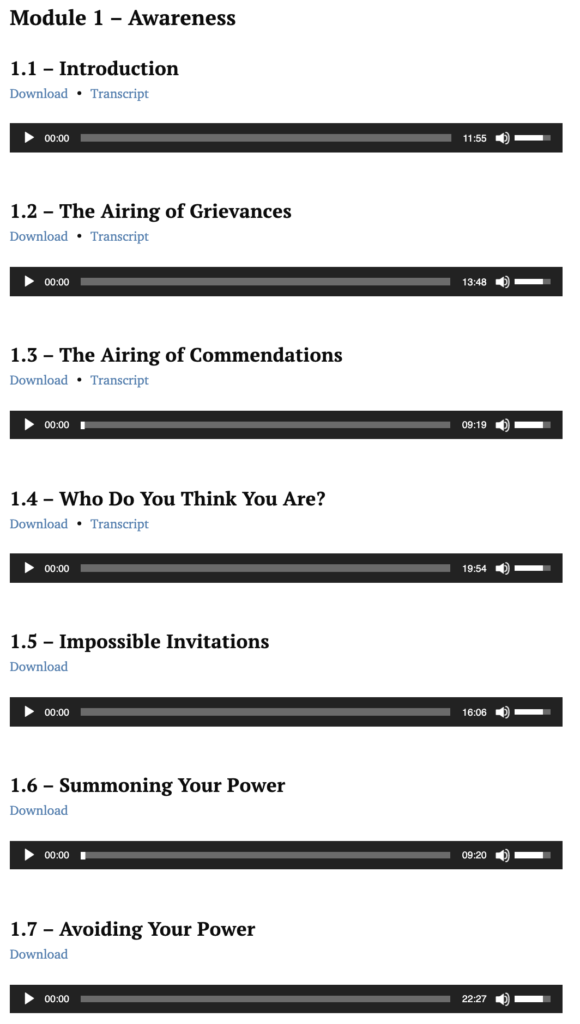
So far I’ve published the first 7 audio lessons, and we have full transcripts published for the first 4 of those. We’re co-creating this course together throughout January and February, during which time we’ll build the course to at least 42 lessons (probably more).
Here’s a screenshot of the lessons in our member portal, so you can see what we have so far. You can stream or download any lesson from your favorite device (the portal is mobile friendly). There’s also a workbook to accompany the lessons and bunch of other bonuses and supplementary material being created for this.
If you’re ready to dive in with 135+ other people and do some major character sculpting work to create not just an amazing 2020 but a happy and empowering life, you’d be wise to join us for the Stature course. You get to keep it for life and do the course as many times as you desire. My website is a long-term fixture in the personal growth community (operating continuously since 2004), so we have that stable longevity factor going for us.
Hopefully you have a character who’s empowered enough to say yes to this, but if you’re still on the fence, my tip is to go with your first gut instinct.
A recent study reported in the Washington Post today claimed that people make better decisions when they go with their first gut instinct instead of second-guessing themselves. I also asked growth-oriented friends on social media if they make better decisions from gut instinct or second-guessing analysis, and it was abundantly clear that gut instinct was the winner by far – many had regrets about second-guessing themselves and missing opportunities. So if your gut instinct is to join us, then join us.
I also trust my gut instinct, which told me that creating this course was one of the best projects I could do in my lifetime. I’m building a timeless course that will serve people for decades to come. This is just the beginning. I hope your character will join us in this special experience. The energy from the first group of people going through a course is just such a delight to behold.
We’re only 7 lessons in, and many people have told me they’ve cried a good bit already. Come share some tears with us if you’re brave enough. It’s part of the rebirthing process as we say goodbye to our old selves.
Seriously, please do join. Stature will do you a world of good.
Which investments in your education, skills, work, and lifestyle will be most valuable to you in the long run?
A lot is going to change in the next 10 years for you, both personally and professionally. The problem is that you can’t accurately predict what will change and how it will change. This makes it difficult to know where to invest your time, energy, and money today. It’s hard to be sure what will pay off in the long run.
But now consider what isn’t likely to change. What can you say about yourself, the world, and other people that will likely remain essentially the same 10 years from now? What will be predictably stable?
Some years ago Amazon’s team pondered what wasn’t likely to change about their business over the next 10 years. They realized that customers are always going to want speedier delivery, so they opted to make a huge, multi-year investment in building the capabilities to deliver items faster. Other investments were more speculative or risky, but it was a safe bet that customers were going to value faster delivery for many years to come. Amazon’s team recognized that people are always going to want their items faster, which made it easier for Amazon to place really big bets on speedier delivery.
Future Proofing Your Career
What if you thought about your current work and lifestyle the way Amazon approaches its business?
Let’s start with your work and work-related skills. What about your work, your field, or the demand for certain skills will remain unchanged in the next 10 years? How could you invest more in the unchangeable aspects?
I can predict with high certainty is that many people will still be interested in personal growth in 10 years. I can predict that people will still have personal problems to solve. I can predict that people’s lives will become more complicated than they are today. I can predict that people will have even more distractions to deal with. I can predict that many people will want more clarity and certainty about their paths in life. I can predict that many people will feel disconnected and will want more love and connection in their lives.
Even if AI steps in to do more in this area, I can also predict that many people will still like working with other humans to improve their lives. I can predict that many people will value caring, compassion, and honesty.
I think you get the idea. Over the long run, there’s a lot about this field of work that’s stable and predictable, mainly because human beings have certain qualities that are remarkably stable.
One way I apply this realization is that as I develop new courses, I think about what will still matter to people in 10 or 20 years. I’m not developing a course on email efficiency since I don’t know if that will still be relevant enough in a decade or two. I prefer to develop courses where it’s a pretty sure bet that the topics will still be relevant decades from now. This affects the topics I choose as well as the individual lessons I record. When I design a lesson, I think about whether it will seem dated in 20 years. Sometimes I even think about whether it will be relevant in 100 years, 500 years, or 1000 years. To reflect upon this, I consider which books from 1000+ years ago that I found worth reading, such as The Iliad and The Odyssey. This helps me zero in on timeless qualities like courage and honor. And so my work is rich in such topics. I think that timeless topics help us go to connect more deeply than topics with shorter lifespans.
I even consider whether each course may be helpful to an AI that consumes the content. I think about whether the lessons are AI-relevant, not just human-centric. For instance, an AI has a relationship with its reality just as a human does, so it may find value in the Submersion course, which is about upgrading your relationship with reality. How can I develop a course today and expect it to be just as meaningful, relevant, and worthwhile for people in 20 years? I have to focus on those core aspects of people’s lives that are unlikely to change.
I encourage you to think a decade or two ahead as well, especially when it comes to skill-building. It takes years to build really strong skills. It would be a shame if your investment only has a short lifespan, and then you have to start over. It’s so nice to continue leveraging skills that took 10+ years to build, knowing that they aren’t going out of style anytime soon.
To figure out which skills to invest in, you can guess or try to predict how the future will be different, but it’s actually easier to predict how it won’t be different.
Predicting What You’ll Love
What will you still love, enjoy, and appreciate in 10 years?
Your answers to this question signal another good way to decide how to invest your time and energy in the years ahead.
Your tastes and preferences will change over time, but some interests will remain stable for decades. What are those stable parts of your character?
I can predict that I’ll still be into personal growth in 10 years. I’ll still like connecting with other growth-oriented people. I’ll still be vegan. I’ll still like writing and speaking. I’ll still like to exercise. I’ll still like to travel. I’ll still like doing growth challenges to stretch myself. I’ll still love hugs and cuddles. These are all long-term commitments that aren’t likely to change in the next decade. I may change how I express them, but the core patterns behind them will likely remain very stable.
Other aspects of my life could change though. Will I still be living in Las Vegas 10 years from now? That’s possible since I’ve lived here for 16 years, but I could see myself moving during that time, maybe to another country. Will I still be blogging in 10 years? That’s possible too, but I could shift to other modes of expression. Something new could arise that I like even better.
Investing in Your Core
When you understand the stable parts of your character, you can invest in them more deeply. You can make much bigger bets on those areas of your life that you know you’re still going to enjoy and appreciate many years ahead.
Now if you combine the stable parts of your character and lifestyle with the stable parts of your work and skills, that’s where you can make your biggest bets of all.
For me a pattern in both areas is personal growth. It’s part of my business and my personal life, and I can predict that these patterns will remain stable for at least another 10 or 20 years. So that’s where I can justify betting bigger – a lot bigger.
One way you can gauge your investments is to note where you’re spending your money. What we’re really looking for is your investment of energy, and money is a decent yet imperfect way to assess where energy is flowing. This is especially true when you spend enough money that it feels a bit edgy or scary to you, just like a stock or real estate investor who’s making a big bet on a company or property. If your investments don’t stir up some emotion, you’re probably investing too little, playing it safe, and staying too far inside your comfort zone. That edgy feeling is a sign that you care about what you’re doing. It wakes you up, keeps you stimulated, and ensures that you’ll do whatever it takes to help your investment succeed.
For the upcoming year, I’ve enrolled in a yearlong coaching program and renewed a couple of other memberships to private groups. I’m pre-committed to spending about $14,500 on personal growth expenses (not counting related travel), and the year hasn’t started yet. I’ll undoubtedly spend more as the year progresses. This feels good to me. It’s enough to feel moderately edgy and stimulated but not so much that it would make me feel paranoid. I know I’m making intelligent bets on stable, long-term areas of value. It’s essentially the same logic that convinced Amazon to pour billions into speedier delivery.
But if I were to take that same amount and invest it on tech for my business, such as buying a new Mac Pro, I wouldn’t feel good about it. It seems like a waste that’s unlikely to pay off as well. I love good tech, but spending thousands more for slightly better tools that I can fully leverage doesn’t sit well with me. My investment in tech hardware will only depreciate. I only have so much time to recoup my investment as my hardware’s market value goes to zero.
Investments in personal growth are very different because those investments don’t depreciate. In fact, they tend to appreciate. Due to the long-term stability of personal growth, I can recoup huge gains over time. What I spend for 2020 is likely to still be paying dividends 5 years, 10 years, 20 years out, and beyond. The payoff is just so wonderful.
So for this reason, each year I like to spend way more on personal growth than I do on tech, even in years when I upgrade every device I own to the newest, fully decked out version.
I was in Toastmasters for 6 years (2004 to 2010). I think it was $60 every 6 months to be a member, so $120 per year, so that’s $720 in total dues. Add in the cost of transportation to and from the meetings, buying extra clothes for doing more speeches, occasional conference fees and travel (like for the Toastmasters International Conference, which I attended twice, and some district level conferences), and miscellaneous related expenses, and it probably adds up to less than $5K total. Toastmasters was hugely helpful in enabling me to reach my goal of doing a 3-day workshop on the Las Vegas Strip. That first event made more than $50K in profit. And that’s also where my wife Rachelle and I first met. The ripples from that event are still paying dividends today, and we’ve done 15 other 3-day workshops since then as well. My 2020 plans include doing a new event in Vegas in the Fall as well.
So the ongoing ripples from my Toastmasters investment are still paying dividends year after year. It’s like receiving lifetime royalties for a book written many years ago. Being able to get on a stage, speak confidently, and have fun with it has greatly enhanced my lifestyle as well. Next month I’ll be emceeing the first day of a leadership conference at a hotel next to the Panama Canal. I don’t normally play the emcee role, but thanks to my prior Toastmasters experience, I know how to do it and make it fun.
Toastmasters is inexpensive, but it still takes a lot of time and energy to go to meetings; create, practice, and deliver speeches; and engage with the group. So initially it may seem like a big deal. But consider that you have your whole life to recoup that investment. I so wish I’d gotten into Toastmasters while in my 20s instead of my 30s.
Are you spending more on the unchangeable parts of your life (like personal growth or communication skills) than you do on the changeable parts (like tech)? If not, consider flipping that pattern around, and watch the long-term ROI from your investments soar.
Amping Up Your Core Investments
It’s easy to flow time, energy, and money into investments that don’t pay off. This is especially true when you chase after the latest technique- or method-based programs, the ones that promise you fast and easy results. I think of these as “game the system” programs, like ones that will teach you how to make money selling stuff on Amazon or how to rank higher on Google. It’s nice while it lasts, but will it endure for decades? How many times have you strayed away from your core to fall for such traps? I was guilty of that a lot in my 20s… till I finally found my footing and grew a bit wiser.
To make really good investments in yourself, your knowledge, your skills, and your lifestyle, seek to identify and understand the unchangeable core within you. What about you seems stable and isn’t likely to change much in the next 10 years? These are terrific areas for making big, bold bets on yourself.
By contrast, what’s really just a whim that you aren’t likely to care about in 10 years? Steer clear of plunking money down on those areas.
I challenge you to keep stretching your comfort zone when it comes to investing in your core. For many years I would spend less than $1K per year on personal growth, and it felt nice and cozy. I’d buy all the books I wanted and some audio programs too. Now and then I might attend a local workshop. I advanced little by little.
Then at some point I progressed to spending about $1-5K per year on personal growth: more books, more audio programs, nice seminars, club memberships, courses, conferences, and a little coaching here and there. That was still pretty cozy but stretched me more.
These days I like to spend somewhere in the $15-40K range per year on personal growth: lots of books and audiobooks, workshops, conferences, seminars, memberships, and coaching. This still feels cozy, but it also feels more powerful. Mostly I’d describe it as fun and stimulating. It feels more social and connected too since I now work on personal growth with other people every day, including as part of running Conscious Growth Club.
This also makes me wonder what it would be like to eventually spend $100K+ per year on personal growth and to have that feel normal. Right now I’m still getting so much value from the 5-figure level that I’d like to stay here a bit longer and keep soaking up the fun and stimulation that it provides. It’s not just the money to consider but also the time investment. Shoving more money into the pot isn’t the point. The money is just an indicator of energy flow, but it’s really the energy that matters. You can flow a lot of energy into an investment without spending much money, like I did with Toastmasters, but sometimes it’s also good to get plenty of money flowing towards your core. If you aren’t willing to spend your money on what truly matters to you, that’s a sign that you’re probably holding back due to fear, self-doubt, or some other internal misalignment. Be willing to bet bigger on yourself.
Don’t be so worried about making a mistake now and then. It happens. Even a fairly weak course or program might yield one good idea, and if it’s a fairly timeless idea, you still have decades to recoup the investment. Sometimes the best I can do is look back on a foolish investment and laugh at it, but somehow even the foolish ones really aren’t that regrettable in the long run.
Since I’ve been investing in personal growth for decades now, I notice that I am indeed still gaining from investments I made years ago, even from the smallest expenses like books and movies. A book I read 20 years ago may provide an insight that I share on a coaching call today. I often leverage the knowledge gained from personal growth investments I made during the 1990s in my work today. And I expect that today’s investments will still be paying dividends many years from now.
Enter the Dragon
On our quarterly planning review call in Conscious Growth Club yesterday, I anchored the call with a Bruce Lee quote about a finger pointing to the Moon. When I first watched Enter the Dragon as a teenager, I couldn’t have predicted that it would be useful professionally decades later. It’s a fun movie and will likely seem pretty dated today, but it does contain some nice personal growth lessons.
Here’s a 2-minute Bruce Lee clip that I think you’ll like, which contains the quote I referenced on yesterday’s call. It’s a fun clip to watch and may add some extra sparkle to your day.
[embedded content]
Enter the Dragon premiered in 1973, one month after Bruce Lee’s death at age 32. Rachelle and I once visited his grave in Seattle. Does Bruce Lee’s work still inspire people 46 years later? You bet!
Bruce Lee is a great example of someone who invested in his core. He trained hard, and then he turned that investment towards creating ripples for others – inspiring millions with his work ethic, skills, philosophy, and movies.
Investing in your core pays off so ridiculously well over time because you have a long timespan to make gains from your investment, Bruce Lee’s early departure notwithstanding.
Are you investing enough in your core? Are you expressing your core outwardly into the world? Have you been feeding your inner dragon and encouraging it to soar?
What would Bruce Lee think of your level of investment? Well, first he’d smack you for using the word think. Then he’d ask: How do you feel?
For some people it seems unfathomable to invest such an amount on a one-year membership to an online personal growth program. Seriously… you should see some of the reactions people are having to the Facebook and Instagram ads I’ve been running for the past few days to promote the launch. Those ads are actually doing well, and we’ve gained many great members in the past few days, but sharing such an invitation with a wide audience sure does unearth a plethora of limiting beliefs and irrational assumptions. So I’d like to address that since I know the price is a sticking point for many people.
Of course the exterior perspective looking in is often very different than the interior perspective looking out. I actually see my past self in a lot of those limiting beliefs, back when I had no clue about what such groups were really like on the inside.
I’ve personally been a paid member of private groups that range in cost from $2K to $30K per year, and all of them have been worthwhile. The first one I joined was in 2009, and as you might imagine, it was a stretch experience to spend that kind of money. But having done this multiple times now, I always felt like I got my money’s worth and then some.
These experiences helped inspire me to create and launch Conscious Growth Club, which has been going since April 2017. We have more than 100 paying members, so there are indeed plenty of people who like the idea enough to join, more than enough to make the group viable, sustainable, and abundant on the inside. (You can see the current member count at the top of the invitation page if you’d like. It increases whenever someone joins.)
Let me share a bit of the interior perspective, in the simple form of a bullet list. By the time you read to the bottom, you should have a better idea of why people actually do this sort of thing, including me.
For accessible connections with other people willing to do the same (which is an unusual group of people)
To immediately immerse yourself in a strong peer group
Filling your social circle with smart, fascinating, wickedly creative people
For the energy, excitement, and enthusiasm
Because it stretches you as a person
It changes your self-image, makes you think more is possible
Because the payoff from such an investment is worth it, often hugely so
Getting results you otherwise wouldn’t have gotten
Getting results faster
For the increased accountability of putting your money where your mouth is
Feeling fully committed to growth and change
Feeling certain that you’re going to move forward and make progress
To shatter your old limitations
It’s highly motivating and stimulating
It gets you taking action in a way nothing else will
Becoming more ambitious and goal-oriented
Feeling compelled to step up to the level of peers you respect and admire
Being surrounded by people who take lots of action and getting swept up in their energy
Because it will turn out to be one of the best decisions of your life
Having tons of fun playfully achieving your goals
Channeling your powerful heart energy instead of being stuck in your head
Going after bigger goals that you wouldn’t dare to pursue before
Having to redefine how you relate to yourself because you’ve blown through so many limitations
Because initially you think you can’t afford it, and then you somehow observe yourself joining anyway
Because you’re at your best when you do things you don’t feel ready for
Because you like speed
Because you like pausing now and then to appreciate the opposite of speed
Because you want to be fully present
Because you realize that this is an invitation from your simulation
Because you can’t stop thinking about the possibility
Because you want to explore what’s on the other side of “What if?”
Because achieving big goals can be so much more fun if you share the journey with good friends
Because lots of people have to stretch their possibility space to join, and befriending people who can and will achieve their stretch goals is inspiring
Because it upgrades your relationship with reality
Because the alternative is to say yes to a limiting belief instead
Because you’re done taking the blue pill
To keep inviting you to refocus on action steps towards your goals when you might otherwise have a tendency to drift
Finally letting that unapologetic genius inside you come out and play
Getting more clarity about what you want than you ever had before
Seeing your spiritual side being fully expressed into the world
Bearing witness to positive ripples you’re creating
Feeding and fueling the very best parts of you
Surrounding yourself with “Yes, and…” people
Enjoying the company of health-conscious friends who don’t need alcohol to socialize playfully
Staying consistent as you make progress
Getting used to a faster rate of growth and change
Future-proofing your career path
Feeling that your life is finally aligned
Really discovering what your best looks like instead of knowing that you could be doing better
Watching your social circle sculpt and chisel you into your best self
Observing that you’re finally becoming the powerful person you’ve always dreamed of being
Belonging to a caring and generous tribe that supports you in being your best
Waking up each morning feeling excited by the progress you’re making
Working, living, and connecting in the space of deep meaning
Looking back on the past year and thinking, “Wow… how did I do all of that?”
Feeling super secure because you always have smart, caring friends who’ve got your back
Having smart people you can immediately turn to for help and advice
Finding the best creative flow of your life
Receiving some of the best invitations of your life, which flow through your frictionless social network
Meeting an outstanding relationship partner and falling in love
Solving long-term problems you’ve been stuck with for years
Actually having those experiences you almost gave up on
Having friends who will raise you up
Having close friends that you respect, admire, and find inspiring
Deeply appreciating what you have
Expecting your life to keep getting better year after year
Seeing clear evidence that your life really is getting better
Leveraging your social abundance to upgrade your financial abundance
Easily affording experiences that were previously out of reach
Knowing what it feels like to live in abundance
Tackling meaningful creative projects and finally getting them done and published
Proving your critics wrong and making them lose all their hair and cry
Creating a new normal for yourself
Because that $2K will soon seem ridiculously small to you
The exterior perspective is that you’d have to be crazy to do this. The interior perspective is that you’d have to be crazy not to. That’s basically why the border is hard to cross. The first time is the hardest, and after that it’s a lot easier because then you know what it’s like.
It’s not the price that matters per se. It’s the value derived from belonging to such a group, and that value can be tremendous.
What’s really interesting is that the objections to being in such a group are usually irrational. They’ll seem like rational objections at first, but it’s really your emotional brain fooling you.
Many people see the investment as an unfathomably big expense, yet they actually could afford it if they wanted to. And even if they couldn’t do so right away, the challenge of coming up with an extra $2K is an interesting one. It’s a solvable problem. It may take some creativity, but even children have been able to solve that type of problem if they’re motivated enough. If a highly motivated child could do it, why not an intelligent adult? In some ways it’s harder for the adult because their mental baggage makes it harder than necessary. It probably won’t surprise you to know that on the inside of such a group, you’ll find a lot of people who are willing to let go of their mental baggage and start blowing past their previous limitations. That’s how they were able to get themselves to join.
I share this from personal experience because I had much the same limiting beliefs about these types of experiences as anyone else. I had my financial comfort zone, and I stayed within its boundaries. But then I started getting some invitations that challenged me to question those boundaries.
People see that price tag as a big, scary risk. It feels unsafe. And yeah, it is a bit of a risk, but there’s an even bigger risk to assess. Considering the full breadth and depth of benefits that can (rather predictably) arise from belonging to a motivated and committed group of people, isn’t it a much bigger long-term risk to never test this? Wouldn’t it be wise to test it at least a few times, just to be sure? That’s how I framed it – what if a group like this is even more amazing and beneficial than I imagine on the inside, and I never allowed myself to have that experience in my entire life? I figured that if I took the risk and it didn’t pan out, oh well, I could always earn more money. It would be a minor inconvenience in the grand scheme of my life. But what if it did pan out? What if the potential gain turned out to be one of the best bets and biggest wins of my whole life?
After all, it’s fairly predictable that if you were to join a group like this, you’re going to get lots of value out of it. And that’s because you’ll do your part to make damned well sure that you do. You wouldn’t let yourself waste that kind of money. You’ll push yourself to extract the value, if only because you don’t want to look like an idiot for making a bad decision. So you’re going to do what it takes to get your money’s worth. That’s always been true for me when I’ve joined such groups. I realized that if I’m going to do this, I’d better be all-in with it and do what it takes to extract the value. Otherwise I’m going to look really foolish. Believe it or not, this is actually good motivation for getting the value. We’ll often work harder to avoid looking like a fool than we will to look like a genius. In this case the risk of loss is your friend, as weird as that may seem.
I almost didn’t join an amazing group a few years ago because I thought it wouldn’t be good timing for me. But that was actually another irrational objection, as I soon realized after pondering it more deeply. When I was invited to join, the timing wasn’t great because I had a lot of things going on at the time, but beyond that the timing was actually decent because I could always dive into it when I was ready, and I could still get plenty of value from the one-year membership even if I was only going to get 10-11 months worth. I’m really glad I didn’t miss out on that whole year just because I wasn’t going to be as available for the first month.
When is the timing ever going to feel right when you’re making the decision to create a major discontinuity in your path? Joining a group like this can feel like taking a hard turn – most likely an amazingly beneficial one – but where on your calendar have you made space for such a thing? In other to really think about this rationally, you must recognize and accept that the timing for a decision of this nature is most likely never going to feel like it fits all that well. If it does fit perfectly into your life, that’s unusual. Most people have to do whatever it takes to make it fit, as opposed to having it feel like a natural fit as soon as the invitation comes up.
In terms of making the decision to join Conscious Growth Club, I encourage you to think about the decision rationally, especially when it comes to the cost-benefit calculation. For many people, the price really isn’t such a big deal as they initially make it out to be. It feels like a big deal emotionally at first – I get that – but how does it look when you consider the big picture from a more rational perspective? Is it really such a huge expense relative to the potential gains you’ll invite into your life? Could the value be worth it to you?
That’s how I made the decision to start buying into such groups. Initially my emotional brain exploded with objections, and I almost got stuck there. Then I actually wrote down those objections and began analyzing them with my best logical thinking. I realized that if I was in a group of 100+ people who’d all paid the same amount, it was highly likely I’d get my money’s worth and then some. I knew I’d participate and make an effort, and so would the other members most likely. I knew I’d be in a group of smart people who were willing to risk some cash for the chance to team up and help each other make real progress. We’d all be on the same side, all wanting to help each other get the value we were paying for. We’d be so committed that we’d co-create the experience. Even if the program itself was only so-so, the kinds of motivated people it attracted would step up and help each other get results. The math added up. And really when I joined and reached the other side, my calculations were validated. In fact, I was pleasantly surprised that I’d vastly underestimated the full range of benefits. Hence the bullet list I shared above, which covers a lot but not even all of them.
So I encourage you to do the same. This isn’t really an emotional choice. There’s actually a very rational assessment to be made in order to make an intelligent decision. And because of the rationality it takes to join this kind of group, what you’ll find on the inside of such a group are lots of very grounded, rationally minded people. They’re enthusiastic and motivated of course, but they’re also sharp, intelligent, and down-to-earth.
You see… the $2K price for Conscious Growth Club is actually something of a rationality filter. People who can’t get past their emotional blocks aren’t going to join. They’ll get hung up on some reflexive objection like I can’t afford it or it’s not good timing. But those who can calm themselves and look at the big picture are more likely to determine that joining a group like this is a good bet with a positive expected value.
Just look around at other forms of social media these days. Haven’t you noticed that there’s been a brain drain from these services since you first joined them?
I remember when Google+ first launched some years ago. I was an early adopter and signed up right away. I actually liked it because the people I encountered there seemed very bright, especially compared to what I saw on Facebook and Twitter. But the Google+ community gradually died off, and Google finally shut it down. In the rest of the social media world, it’s been feeling like we’re stuck in a race to the bottom. They’re good places for interacting in quantity, but are there lots of quality interactions focused on making real progress towards full self-actualization? Not so much…
More and more, what I’ve found is that the smart, successful, and ambitious people are flowing into paid, private communities to connect with each other away from the constant noise and drama of social media. It’s in these private communities that people genuinely help each other to make intelligent progress. Such communities favor quality over quantity, and this is perhaps the main reason they pay off so well.
I’m not saying there aren’t good free communities out there – we hosted a large one several years ago – but they seem increasingly rare these days. By pushing for quantity over quality, these services just don’t provide very good value for smart, ambitious, growth-oriented people. They’re more likely to distract you from focusing on your goals and making real progress. This is partly why I’ve been seen paid community participation on the rise – and also why I created one.
Conscious Growth Club can’t compete with what Facebook and Instagram provides in terms of quantity, but we can and do absolutely, positively blow them away in terms of quality. Seriously, even our cat pics are better. 😉
When I ask most reasonably intelligent people, “Do you still see yourself being active on Facebook 5 years from now?” I can never seem to get a yes. Well, those who use it for business will often say yes, but not those who use it on the personal side. If you’d rather not be on Facebook for the rest of your life, then what other doors are open to you. I can think of one…
Join us or don’t join us. There are no fence sitters inside the group.
Our enrollment period for 2019 ends at midnight Pacific time on May 1st, so if you’re going to join us, please do so soon. There’s something of a welcoming party for all the new members happening inside the group right now. 🙂