NHS chief warns against complacency and says “risk of serious illness is very real”.


NHS chief warns against complacency and says “risk of serious illness is very real”.
Robert Glynn says getting the all-clear after being told he had 12 months to live was “overwhelming”.
At its best, fashion is subjective, and anything and everything goes. One can argue that in 2022, people did their own thing more than ever before.
Still, some of the most compelling fashion criticism comes in the form of the worst dressed list – a franchise coined by the critic Richard Blackwell. There’s value in curating a “worst dressed list,” not to ridicule, but rather as a barometer of our time, and to gauge what’s working for us (and what’s not) when it comes to pop culture.
Advertisement
It should be noted Blackwell also published a list of “Fabulous Fashion Independents” which was frequently populated by those he deemed “worst dressed.” Some would argue that you’re not really considered cool until you’ve graced the worst dressed list.
In this spirit, HuffPost curated the 10 worst fashion trends of 2022, and we tapped stylists to explain why these looks just didn’t work for us.
Beverly Osemwenkhae is a New York- and London-based style expert and the founder of ProjectBee Wardrobe Consulting. Her company services are uniquely designed to build individual images and develop personal style.
Chelsea Volpe is a Manhattan-based fashion and still life stylist, known for her idiosyncratic combination of vibrant color and imagery. Clients include Bloomingdale’s, Estée Lauder, Highsnobiety, Hypebeast, Paper Magazine, Vogue and Women’s Wear Daily.
Advertisement

Rachpoot/Bauer-Griffin via Getty Images
“The number of 20-somethings I’ve seen bopping around the New York night scene in ultra luxe sunnies is astounding,” Volpe tells HuffPost. “Is the darkness not dark enough for you? It is not chic, or frankly practical, to wear a pair of Balenciaga sunglasses to your local Bushwick dive bar, darlings.”
John Phillips via Getty Images
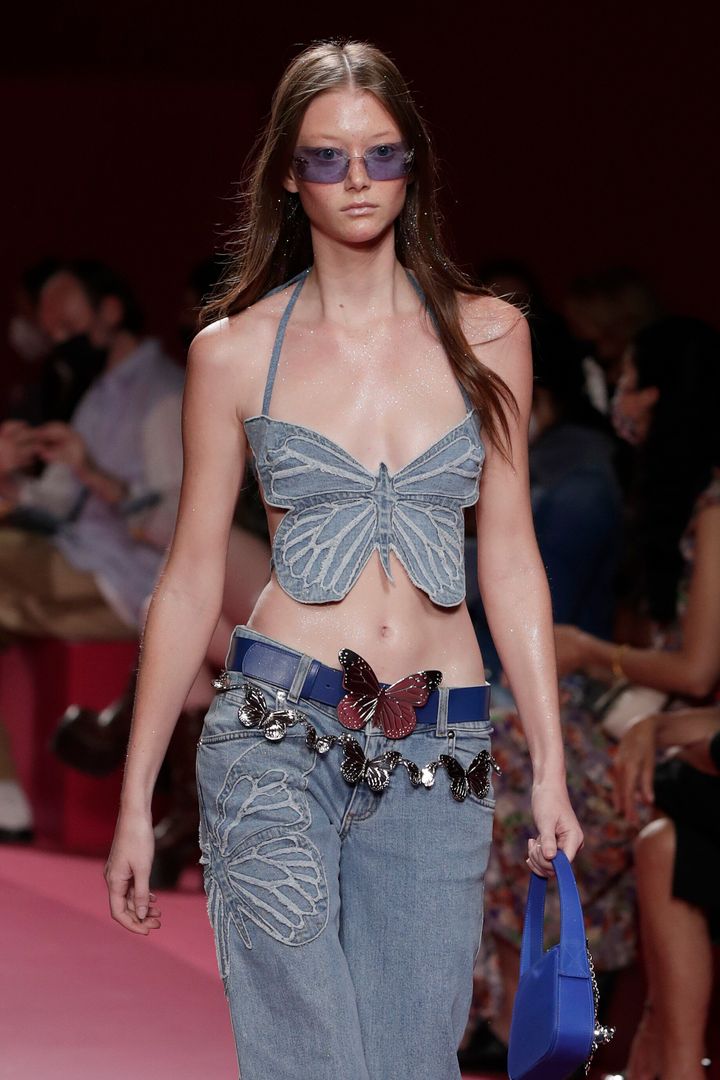
Osemwenkhae is not a fan of glitter, hearts or butterflies when it comes to dressing. “There’s a few things that should stay in the early 2000s like the Y2K aesthetic. Yes, there’s a cool factor that this trend stems from millennium pop culture, but there’s nothing flattering about dressing like a Bratz doll unless you’re under 21.”

Jacopo Raule via Getty Images
Advertisement
The coastal grandmother look had a moment this summer, but Volpe found the barrage of floral patterns completely basic, and not in a good way. “Wearing your grandma’s bathroom wallpaper in dress form is so dated. Let’s swap the archaic Nantucket floral print for something more interesting shall we?” She suggests, instead, opting for solids.

Rachpoot/Bauer-Griffin via Getty Images
Low-rise jeans made a comeback this year, but why? “Low-rise jeans highlight the wrong parts of your body,” Osemwenkhae notes. Showing butt-cleavage or a cheeky thong is not, she argued, empowering. Of course style is subjective, and so are the feelings of empowerment associated with it. But to Osemwenkhae’s point, the first time this trend saw popularity in the aughts, it had shock value associated with it. Twenty years later, showing your thong trend feels a little empty, statement-wise.

Jeremy Moeller via Getty Images
Another pant faux-pas that made waves in 2022 was the prevalence of cargo pants, which cast, in Volpe’s opinion, a silhouette that looks untailored. “Wearing cargo pants the size of a parachute isn’t cute. When your pants look like two garbage bags merged into one tragic nightmare, it’s an issue.”
Advertisement

Rachpoot/Bauer-Griffin via Getty Images
This isn’t the first time we’ve seen the rise of platforms in footwear – the style has lingered since the 1970s. In the 1990s we saw platforms on everything, from Mary Janes to sneakers, but the most offensive, according to Osemwenkhae, is the platform flip-flop, which returned in 2022. She tells HuffPost she found the trend “a little bulky and heavy on the foot,” and adds when styling resort wear this winter, opt for something more tasteful.
Conscious consumerism has been a mainstay of Gen Z, quick to use buying choices to let brands know when they do something uncool, or worse, offensive and inhumane. “Wearing a walking billboard for antisemitism is not fashion forward, loves. Tsk, tsk, Adidas for being complacent with the Kanye fiasco.” Here, Volpe references the outrage people felt over why it took Adidas so long to sever ties with Kanye West, following a barrage of hate speech and antisemitic remarks. She added that “major name brands need to take accountability.” This December, Balenciaga released two campaigns that prompted allegations of the brand condoning child exploitation. TikTokers reacted by destroying Balenciaga goods in their feed.

Edward Berthelot via Getty Images
Advertisement
How short is too short when it comes to minis? For Osemwenkhae, it’s all about wearability. “There’s a cutoff point where it’s so mini that it’s impractical to wear.” She says she’s ready to retire the mini and bring back slip midi skirts instead.

Jeremy Moeller via Getty Images
After two years of lockdown loungewear, Volpe notes, “it’s so easy to throw on a sexy corset top or slinky barely there negligee for a night out.” But according to her, lingerie belongs in the bedroom, and evening wear needs to have a little more substance in 2023.

Daniel Zuchnik via Getty Images
Painted-on pants are passé. Osemwenkhae notes it’s time to trade in your skinny jeans for a pair of “relaxed straight jeans. It’s a style that’s easy to wear and really flatters the body.” She adds that this fit is “proportionally appealing, especially for a pear shape.”
Advertisement









Endometriosis impacts an estimated 1 in 10 women and girls of reproductive age worldwide. Moreover, recent research suggests that polycystic ovary syndrome (PCOS) is thought to affect somewhere between 4 to 20% of women of reproductive age globally. Though endometriosis and PCOS are common health conditions, people often mistake one for the other or vice versa.
“Endometriosis and PCOS are two reproductive health conditions that are not well understood among many in the medical community,” Dr Stephanie Hack, board-certified obstetrician and gynaecologist and host of the Lady Parts Doctor podcast, tells HuffPost. “They both are associated with the menstrual cycle and fertility issues, making it easy to confuse them. However, they are very different.”
Advertisement
HuffPost spoke with experts about the differences between PCOS and endometriosis, and why it’s important to understand the unique symptoms and treatments for each health condition.
“Endometriosis is a condition in which cells that resemble the lining of the uterus are present anywhere in the body,” says Dr Gaby Moawad, a clinical associate professor of obstetrics and gynaecology at The George Washington University and founder of The Center for Endometriosis & Advanced Pelvic Surgery (CEAPS).
This means that endometrial-like tissue grows in areas such as the ovaries, fallopian tubes, and tissue lining the pelvis. However, this tissue cannot shed like healthy endometrial tissue inside the uterus does during your period. In turn, endometriosis can cause severe pelvic pain, pain during menstruation and intercourse, nausea, bloating, and even pain during urination and bowel movements.
Endometriosis may increase the risk of developing ovarian cancer, and there is also a correlation between endometriosis and certain autoimmune diseases.
Advertisement
In some cases, people with endometriosis can form endometriomas, which are commonly referred to as “chocolate cysts” due to their dark brown appearance. Though people with endometriosis can form cysts, this is not the same as having PCOS.
According to Moawad, “PCOS by definition is irregular ovulation,” and is a health condition in which the ovaries produce “excess male hormones in the body,” aka androgens. Due to hormonal imbalances and elevated androgen levels, Hack explains that PCOS symptoms include “irregular and/or infrequent periods, weight gain, acne, ovaries with multiple cysts and excessive body hair.”
In addition, people with PCOS regularly develop other serious health conditions. June-Ann Joseph, an advocate and host of the Black Broke and Anxious podcast, says that her PCOS has caused her to experience insulin resistance, difficulty losing weight, and the formation of acanthosis nigricans, which is a skin condition that causes dark, velvety patches to form on different areas of the body.
Though endometriosis and PCOS are completely different health conditions, Moawad says a “chronic inflammation pattern” is present in both. Some studies suggest that, though rare, people can have both endometriosis and PCOS.
As Hack notes, both conditions can cause subfertility, an unwanted delay in becoming pregnant, or infertility, which is a complete inability to get pregnant after one year or more of having regular, unprotected sex.
Advertisement
Though PCOS is a common cause of infertility, endometriosis typically creates more complicated fertility issues. This is because, as Moawad says, “endometriosis not only affects the quality of eggs and ovaries, but it also creates a lot of scar tissue which could close the fallopian tubes, as well as damage the uterus.” An estimated 30 to 50% of women with endometriosis experience infertility.
Neither PCOS nor endometriosis can be cured, but rather symptoms can be managed through different treatment methods.
Obstetrician-gynaecologists typically take a holistic approach when treating people with PCOS, utilizsng medications that induce ovulation or address potential hormonal imbalances, vitamins to address any nutritional deficiencies that may worsen PCOS symptoms, and working alongside patients to modify lifestyle habits – such as diet – that may contribute to inflammation.
Moawad explains that, for people with endometriosis, the “gold standard” treatment is surgical excision. People who experience severe pain or fertility issues may opt to undergo a laparoscopy; this is a minimally invasive procedure in which a surgeon will use a laparoscope to find areas of endometriosis and remove any lesions or scar tissue. Hormonal therapies such as gonadotropin-releasing hormone (GnRH) agonists, birth control pills and hormonal IUDs are also often prescribed for endometriosis.
However, Moawad says that these “medications tend to quiet the symptoms for a period of time, but they don’t cure [endometriosis].” Similarly, surgical interventions for endometriosis are not permanent, and up to 80% of women experience pain again within two years of surgery.
Advertisement

SDI Productions via Getty Images
Misinformation is ultimately harmful, and may lead to a delay in diagnosis and treatment for many people with these health conditions. Rachel Ennis, a psychology project worker, was only diagnosed with endometriosis in 2022 after experiencing symptoms of the health condition for over 15 years.
“I wish people understood just how exhausting it is to have to fight with medical professionals to get taken seriously, and to get a diagnosis,” Ennis says. “Endometriosis is a whole body disease that can impact every area of your life.”
Further, Joseph stressed that more research about PCOS needs to be done so that doctors can better support patients – and so that people don’t turn to social media for medical advice.
“There are a lot of scam artists and influencers telling you that if you follow their diet plan, you can cure your PCOS,” she explains.
Advertisement
It’s crucial to find a doctor who specialises in specific health conditions like endometriosis and PCOS, and specific practice areas such as surgical excision. Though many people may think endometriosis and PCOS are minor conditions, Hack explained they are serious health issues that can be detrimental to a person’s day-to-day life in their own unique ways.
It’s well past time to ditch the misconceptions surrounding both PCOS and endometriosis, and to develop a greater understanding of these health conditions that impact millions of people across the world.
“The most important thing is that we have to empower our patients, validate their concerns and their symptoms, and give them the highest quality of care that they deserve,” Moawad says.


Since 19 September, 122 people in England have died from an invasive form of the bacterial infection, UKHSA data shows.
Beijing is finally opening its borders – but some countries are wary of a Covid threat.

The higher the temperatures, the faster physiological processes are. But there is an exception: the so-called circadian clock, which regulates the sleep-wake cycle in organisms. A fascinating question for scientists is why the inner clock runs in an almost unchanging way despite fluctuations in temperatures. This is a phenomenon known as temperature compensation. Studies indicate that different molecular mechanisms contribute to this. A team of biologists headed by Prof. Ralf Stanewsky from the University of Münster (Germany), and in collaboration with teams at Dalhousie University in Canada and the University of Mainz in Germany, have now found an important piece in the puzzle providing an answer to this question. The results of their work have been published in the journal “Current Biology”.
The team discovered a point mutation in the fruit fly Drosophila melanogaster which leads to a temperature-dependent lengthening of circadian clock periods. It is located in a central “clock gene” known as a “period” (per). Flies which have this perI530A mutation display a normal sleep-wake rhythm of 24 hours at 18 degrees Celsius. In contrast, at 29 degrees Celsius the inner clock runs about five hours slower, i.e. it lasts 29 hours. This lengthening of periods also affects the expression, in other words the activity, of the period gene in the clock neurones of the brain.
Normally, the protein concerned (PERIOD) is gradually changed chemically in the course of 24 hours – specifically, it is phosphorylated. After maximum phosphorylation it is degraded. Here, too, this process is normally the same at temperatures between 18 and 29 degrees Celsius, at which fruit flies are active. As the researchers showed, phosphorylation occurs in a normal way in the perI530A mutant at 18 degrees Celsius but decreases as the temperature increases. This leads to a stabilisation of the “PERIOD” protein at warmer temperatures.
The mutation studied by the team affects a so-called nuclear export signal (NES), which also occurs in this form in the period genes of mammals and plays a role in transporting the PERIOD proteins out of the cell nucleus. No biological function of this export from the cell nucleus had previously been known of. The current study shows that the mutation leads to an extended retention of the PERIOD protein in the cell nucleus of central clock neurones – and again, only at higher temperatures. “We therefore assume,” says Ralf Stanewsky, “that the export of the protein from the cell nucleus plays an important role in temperature compensation – at least as far as the fruit fly is concerned.”
Method used
In their investigations, the scientists used fruit fly mutants with a modification in the period gene (perI530A) which they had produced using modern molecular genetics methods (CRISPR/Cas9 mutagenesis and homologous recombination). These animals were then tested to see whether their sleep-wake cycle – and, as a result, their running activity – differed, depending on the ambient temperature. Using a variety of methods, the researchers visualised the clock genes and their activity in the brain neurones. One of the things they used was a new method called Locally Activatable BioLuminescence (LABL) which the Münster team had developed in collaboration with researchers in Canada. This method involving bioluminescence makes it possible to measure, in living flies, the rhythmic gene expression in clock neurones – which only make up a fraction of all brain neurones.
Story Source:
Materials provided by University of Münster. Note: Content may be edited for style and length.
The UK is considering restrictions on visitors from China as the US, Japan and Italy reintroduce testing.

Between the time you read the Wi-Fi password off the café’s menu board and the time you can get back to your laptop to enter it, you have to hold it in mind. If you’ve ever wondered how your brain does that, you are asking a question about working memory that has researchers have strived for decades to explain. Now MIT neuroscientists have published a key new insight to explain how it works.
In a study in PLOS Computational Biology, scientists at The Picower Institute for Learning and Memory compared measurements of brain cell activity in an animal performing a working memory task with the output of various computer models representing two theories of the underlying mechanism for holding information in mind. The results strongly favored the newer notion that a network of neurons stores the information by making short-lived changes in the pattern of their connections, or synapses, and contradicted the traditional alternative that memory is maintained by neurons remaining persistently active (like an idling engine).
While both models allowed for information to be held in mind, only the versions that allowed for synapses to transiently change connections (“short-term synaptic plasticity”) produced neural activity patterns that mimicked what was actually observed in real brains at work. The idea that brain cells maintain memories by being always “on” may be simpler, acknowledged senior author Earl K. Miller, but it doesn’t represent what nature is doing and can’t produce the sophisticated flexibility of thought that can arise from intermittent neural activity backed up by short-term synaptic plasticity.
“You need these kinds of mechanisms to give working memory activity the freedom it needs to be flexible,” said Miller, Picower Professor Neuroscience in MIT’s Department of Brain and Cognitive Sciences (BCS). “If working memory was just sustained activity alone, it would be as simple as a light switch. But working memory is as complex and dynamic as our thoughts.”
Co-lead author Leo Kozachkov, who earned his PhD at MIT in November for theoretical modeling work including this study, said matching computer models to real-world data was crucial.
“Most people think that working memory ‘happens’ in neurons — persistent neural activity gives rise to persistent thoughts. However, this view has come under recent scrutiny because it does not really agree with the data,” said Kozachkov who was co-supervised by co-senior author Jean-Jacques Slotine, a professor in BCS and mechanical engineering. “Using artificial neural networks with short-term synaptic plasticity, we show that synaptic activity (instead of neural activity) can be a substrate for working memory. The important takeaway from our paper is: these ‘plastic’ neural network models are more brain-like, in a quantitative sense, and also have additional functional benefits in terms of robustness.”
Matching models with nature
Alongside co-lead author John Tauber, an MIT graduate student, Kozachkov’s goal was not just to determine how working memory information might be held in mind, but to shed light on which way nature actually does it. That meant starting with “ground truth” measurements of the electrical “spiking” activity of hundreds of neurons in the prefrontal cortex of an animal as it played a working memory game. In each of many rounds the animal was shown an image that then disappeared. A second later it would see two images including the original and had to look at the original to earn a little reward. The key moment is that intervening second, called the “delay period,” in which the image must be kept in mind in advance of the test.
The team consistently observed what Miller’s lab has seen many times before: The neurons spike a lot when seeing the original image, spike only intermittently during the delay, and then spike again when the images must be recalled during the test (these dynamics are governed by an interplay of beta and gamma frequency brain rhtyhms). In other words, spiking is strong when information must be initially stored and when it must be recalled but is only sporadic when it has to be maintained. The spiking is not persistent during the delay.
Moreover, the team trained software “decoders” to read out the working memory information from the measurements of spiking activity. They were highly accurate when spiking was high, but not when it was low, as in the delay period. This suggested that spiking doesn’t represent information during the delay. But that raised a crucial question: If spiking doesn’t hold information in mind, what does?
Researchers including Mark Stokes at the University of Oxford have proposed that changes in the relative strength, or “weights,” of synapses could store the information instead. The MIT team put that idea to the test by computationally modeling neural networks embodying two versions of each main theory. As with the real animal, the machine learning networks were trained to perform the same working memory task and to output neural activity that could also be interpreted by a decoder.
The upshot is that the computational networks that allowed for short-term synaptic plasticity to encode information spiked when the actual brain spiked and didn’t when it didn’t. The networks featuring constant spiking as the method for maintaining memory spiked all the time including when the natural brain did not. And the decoder results revealed that accuracy dropped during the delay period in the synaptic plasticity models but remained unnaturally high in the persistent spiking models.
In another layer of analysis, the team created a decoder to read out information from the synaptic weights. They found that during the delay period, the synapses represented the working memory information that the spiking did not.
Among the two model versions that featured short-term synaptic plasticity the most realistic one was called “PS-Hebb,” which features a negative feedback loop that keeps the neural network stable and robust, Kozachkov said.
Workings of working memory
In addition to matching nature better, the synaptic plasticity models also conferred other benefits that likely matter to real brains. One was that the plasticity models retained information in their synaptic weightings even after as many as half of the artificial neurons were “ablated.” The persistent activity models broke down after losing just 10-20 percent of their synapses. And, Miller added, just spiking occasionally requires less energy than spiking persistently.
Furthermore, Miller said, quick bursts of spiking rather than persistent spiking leaves room in time for storing more than one item in memory. Research has shown that people can hold up to four different things in working memory. Miller’s lab plans new experiments to determine whether models with intermittent spiking and synaptic weight-based information storage appropriately match real neural data when animals must hold multiple things in mind rather than just one image.
In addition to Miller, Kozachkov, Tauber and Slotine, the paper’s other authors are Mikael Lundqvist and Scott Brincat.
The Office of Naval Research, the JPB Foundation, and ERC and VR Starting Grants funded the research.

If you want to open a restaurant, you first have to invest — in waiters, chefs, facilities, and equipment — to be profitable later on. “Political decision-makers and investors of a region face a similar situation. If they decide to invest in a new field of research, they have to become leaders at a certain point to be profitable,” CSH researcher Vito D. P. Servedio explains.
Rich Get Richer
Therefore, they need financial resources and scientists. “Early investment in emerging areas of research is a key driver of scientific dominance,” he continues. Once the pioneer has established an area or technology, researchers are also more likely to move into this new, stimulating environment. This “get-rich-richer” phenomenon underlies the development of scientific strength in a region. And scientists’ mobility drives the development of scientific disciplines. The question is, then, how many scientists does a region need to hire so that other scientists find its environment attractive and join its institutions?
No Critical Mass
The team found no evidence for the existence of a minimum number of researchers to hire. Or in technical terms: there is no critical mass to start and carry on a new research field successfully. Here, the scientists focused on three scientific areas: semiconductors, embryonic stem cells (ESC) and internet research.
“In a way, this contradicts the generally held belief that you need a minimum number or critical mass of researchers to make a field successful. In our study, it becomes apparent that this is not the case,” Stefan Thurner from CSH states.
Be a Pioneer
In fact, regions seem to be successful when they manage to jump early on a train and become pionEe rs in a field. “We also find, as common sense suggests, that regions moving early into new technologies tend to dominate the corresponding scientific fields in the future,” Thurner explains.
China: Expensive Race to Catch Up
If a region was not a pioneer, but still wants to achieve leadership in a given area of research it has to make extraordinary efforts to catch up. “Strategic interventions must be sustained over decades to compete for a leading position in a field, as is evident, for example, in Chinese semiconductor science, where the catch up-process began in the late 1970s and has led to a dominant role today,” Servedio says.
A model specially developed by the researchers can explain the development pattern of China — how they take over specific research areas and grow the number of scientists publishing in those fields. “After all, China has some of the fastest-growing institutions worldwide. With our model, you can clearly see that China is closing the gap with the US, potentially taking on huge costs, but also showing their ability to effectively engage with high impact research. While first movers may have an advantage in some contexts, it is not necessarily impossible for late-comers to catch up or even surpass first movers in a scientific field.” CSH researcher Márcia R. Ferreira says.
Three Research Fields and Millions of Data
With the help of the Dimensions database, the researchers at CSH could track scientists moving across regions of the world (they derived these movements from the scientists’ affiliations) in three fields — namely semiconductors, embryonic stem cells (ESC) and internet research. “In this way, we analyzed data spanning several decades with information on millions of publications, 20 million researchers and more than 98,000 research institutions worldwide,” Servedio states.
In the field of semiconductor research, they tracked 5,062,639 articles and 2,011,170 researchers in 1,633 regions worldwide between 1941 and 2019; in the field of stem cell research, they tracked 1,083,100 articles and 752,575 researchers in 1,161 regions worldwide over the same period; and in the field of internet research, they tracked 246,953 articles and 109,098 researchers in 1,032 regions worldwide between 1956 and 2019.
“What our results clearly show is if regions want to become a leader in a field, they must try to get involved early on. It is possible to catch up, but this comes at tremendous costs,” Thurner and Servedio state. “Nonetheless, our model of scientific capacity building is a simplification. There are other factors contributing to the success of a field that we have not yet been able to explore here and which will be the subject of future analysis,” Ferreira states.
