Making Sense of Infinite Possibilities

You could say that one reason we can make simple decisions each day with relative ease is that we only have a handful of options to choose from, and that makes it easier to make a reasonably good choice.

For instance, if you only have so much food in your home, or so many stores and restaurants within reach, then you may find it easier to decide what to eat each day. You don’t have to consider infinite options. You narrow your focus to what’s most accessible.

But what about making bigger life choices, like what career path to explore next? This is a situation where you may feel like you’re drowning in possibilities. There are so many factors to consider. Many decisions could lead to positive outcomes, but many could lead to undesirable ones. What if you pursue a career you don’t like? How do you know how to make this choice?

What does it mean to have clarity in such a situation? How can you possibly achieve clarity when there are so many options to consider?

The simple answer is that you must collapse the possibility space to make it smaller. You must somehow narrow your options.

How can you do this? Aren’t all things possible?

You may have this sense that in each moment, you can make any possible decision. But is that really accurate?

Consider a simple decision like what to have for your next meal. On the one hand, it may seem like you could potentially eat any possible food for that meal. This may seem especially true if you live in a big city with lots of accessible restaurants within easy walking or driving distance. You may literally have thousands of different meal options accessible to you.

Now and then you may even feel overwhelmed by all the choices. But somehow you still decide, and you make such decisions every day. Even deciding not to eat anything is a choice.

How on earth do you do that? How do you face such immense possibilities and still decide?

When you actually make such a decision, you don’t consider every possible option. You only consider a small number of possibilities. You collapse the space by giving attention to certain factors that will eliminate most options. You might consider your mood, how much time you have, the cost, the relative distance, your cravings, past memories, and so on. Sometimes you’ll simply think in terms of patterns. Ultimately you may find yourself making the decision pretty quickly. And then you get to experience the result.

Now if you get a bad result, you may avoid making that same choice again in the future. And if you get a good result, you’ll probably be more likely to make a similar choice in the future.

So over time you may develop some internal heuristics to help you make better choices. You can rely upon past experience to guide your future choices.

When you’re new to a situation, you can make a choice semi-randomly or based on simpler factors like convenience. You may also lower your expectations and not worry so much about a bad outcome, knowing that such outcomes are more likely when you lack experience.

But you also have another option, which is to let someone else make the decision for you. For instance, if you go to a new city where you know someone, you could ask that person for a recommendation and then just eat at whichever place they suggest.

Letting other people decide for you is what you probably experienced a lot when you were a child. Someone else decided what to feed you, and you just ate it. And you also had your internal reaction to what you ate, which helped give you a basis for making decisions on your own later in life.

Notice the power of those internal reactions. I think that sometimes we don’t pay enough attention to this.

How did you discover your favorite foods? You probably tried a bunch of foods, and you paid attention to your internal reactions when you ate them. And somewhere along the way, you learned to predict that certain foods would give you favorable internal reactions when you ate them. Of course there are other factors involved too, like the company you’re with or how frequently you eat certain meals, but over time you learned to make predictions from past experience.

So first you had to map the possibility space well enough by choosing semi-randomly or by letting someone else decide for you. And eventually that led to some improvement in clarity about what you liked to eat.

We could say then that the clarity we seek is the ability to predict our internal responses to different events. This predictive ability becomes more accurate as we gain experience. Without experience we cannot make accurate predictions, and hence we cannot expect to have intelligent clarity.

Here’s the counter-intuitive part. We may think that gaining more experience and exposing ourselves to more options and possibilities will lead to massive overwhelm. It’s the paradox of choice, isn’t it? The more options we have, the less clear the correct choice is, and the more overwhelmed we feel, right? But this only applies to unexplored spaces.

Suppose you walk into a wine store, and you’re thinking of buying a bottle of wine. And suppose that you’re a total novice when it comes to buying and drinking wine. You may have a hard time choosing. There are too many options to consider. It’s hard to make a good decision. And even after making the decision, you’re likely to doubt yourself.

But now suppose you’re a master sommelier, and you walk into that same store. Are you likely to feel just as overwhelmed as the novice? It’s more likely that you’ll find it easier to make what you consider a good choice – a choice that gives you a positive internal reaction. You must still confront the same massive stock of wine bottles as the novice, but your greater experience cuts the field of possibilities down to a manageable size. Your superior mental map of the space allows you to rule out entire sections of the store as unlikely to yield the results you seek. And you’ll probably consider fewer options than the novice will, and you’ll be able to make your choice with less stress and greater ease.

Experience compresses reality. As you gain understanding and skill within a pocket of this existence, you also refine your palette. You learn where to go and what to do to achieve worthwhile results that satisfy you. What’s counter-intuitive is that as you expand your circle of experience, your level of clarity will tend to increase as well. As you explore what appears to be a vast space of infinite possibilities, you construct mental models that bring order to the chaos, and this has the effect of simplifying your impressions of the space of possibilities.

Another way to express this idea is by saying that clarity is at least partially a result of the relationship between the explorer and the terrain. A novice explorer in uncharted territory cannot hope to have much clarity. But if the novice simply explores anyway, even if in a bumbling way initially, the explorer will gradually learn the territory, and the explorer’s sense of clarity within that territory will increase.

Now transplant this same explorer to a new territory and repeat the process numerous times. There are surprises to be found in each new area, but every surprise encountered improves the mental maps and models of the explorer. Eventually our explorer becomes less frequently surprised and may even become good at finding the most worthwhile and valuable parts of new expanses of terrain. The experience of clarity stems from the explorer’s increasingly sophisticated mental maps as well as an increasingly sophisticated set of personal preferences. This is because both understanding and desires are refined and polished by experience.

It’s fair to say – and to accept – that there is no clarity to be found outside of experience. Experience is the mother of clarity. And this points us in an actionable direction. If we wish to gain clarity, we must get busy gaining experience. And we’ll generally achieve the greatest gains by courting fresh, new experiences as opposed to repeating previous ones. Thus, if you want to hit the accelerator in terms of clarity gains, make a habit of embracing new and different experiences. Go where you’ve never been. Do what you’ve never done. Try what you’ve never tried. This will have the triple benefit of upgrading your mental models of reality (truth), refining your palette of desires (love), and boosting your ability to blaze a trail to your desires (power).


Share Button

Becoming Aware of Your Reflections

Once when I was going through customs at the airport in Winnipeg, Canada to visit Rachelle, I got pulled aside for extra questioning. The suspicious young agent somehow convinced himself that I was on an errand of ill intent and interrogated me about my reasons for visiting. He went through the files on my laptop, searching for evidence of illegal activity. He read through the recent text messages on my cell phone. Much to his chagrin, I wasn’t actually crossing the border to destroy Canadian society, so he came up empty handed and grudgingly waved me through, although for good measure he gave me a bonus lecture about the risks of doing anything illegal while visiting Canada.

I felt mostly creeped out afterwards, as if I someone had just vomited fear into my personal energy matrix. It took me several hours to slough off those feelings. Fortunately hanging out with Rachelle and the other nice people of Winnipeg was all it took to bring me back up again.

At the time I blamed that event on the overzealous agent, but if I look back on it now, I can interpret the whole experience as a reflection – and perhaps an amplification – of my own thoughts and beliefs at the time.

Even before I got to that agent, I approached the customs area with a suspicious vibe. I didn’t trust the agents, so when I was asked about the reasons for my visit, I gave a vague answer – “tourism” – which of course made the guy suspicious that I was hiding something. Who travels from Las Vegas to Winnipeg for tourism?

If I’d been a tad less suspicious and a bit more open with the agents, I probably wouldn’t have been subjected to the extra grilling.

I’ve seen similar patterns echoed back to me through blogging as well. When I’d write about a topic while feeling guarded about getting a negative reaction, my posts would attract plenty of criticism and judgmental responses. But when I fully owned what I was writing about, and I felt unattached to how people would react, there usually weren’t any negative responses to speak of.

I’m reminded of an episode of Star Trek: The Next Generation where the ship is being shaken by energy waves of increasing magnitude, and the waves are getting so strong that they’re about to tear the ship apart. But it turned out that the ship’s own shields were causing these violent waves. The waves were proportionate reflections of the shield energy. Once the shields were dropped, the waves stopped, and the ship was no longer in danger.

One important zone of clarity is your relationship with reality. Reality will often reflect back to you what you put out, even when you’re unaware of this relationship. I think it would be an exaggeration to say that this happens with a magical degree of perfect balance, but the effect is there nonetheless.

Occasional missteps aren’t usually such a big deal, but if you see recurring patterns in what reality seems to be reflecting back to you, consider that you may actually be creating these effects more powerfully than you previously realized.

When you identify a recurring result in your life that you don’t feel aligned with, pause now and then to ask yourself, How am I creating this? Don’t ask this question with an attitude of blame but rather with an attitude of curiosity. Consider the possibility that your own thoughts or actions are causing or contributing to these outcomes.

Suppose, for instance, that you keep encountering a significant lack of social support in your life. Maybe everyone around you seems indifferent to your goals, and no one seems to lift a finger to help you. You may believe that you’re taking positive actions such as behaving gregariously and generously with other people. You may believe that you’re a good person, that you have worthy goals, and that you deserve some help. But if you privately feel distrustful of people, if you’re pretending to care about helping others but you don’t really care that much, or if your thoughts are otherwise out of alignment with the outcome you seek, then you can expect that people will subtly pick up on your true intentions, and they may respond with some resistance in return.

You’ll likely find it easier to spot these waves of reflection in other people. Perhaps someone tells you about a persistent problem they’re having, and it’s abundantly obvious to you how this person is creating that very problem. You may think to yourself, Well… duh! Of course that’s what you’re going to experience. Meanwhile the person remains completely oblivious to the causal links between thoughts, actions, and results.

You may also know that if you share your honest impressions with the person, they’ll probably be surprised, insulted, or defensive. They’re unlikely to see what you’re seeing. They’re too close to the situation to see it through the lens of self-created reflections coming back to them. So you may offer up a polite response instead.

I think it’s wise to assume that you’re also blind to many of your own self-created reflections. What you’re experiencing from life is in many ways just basic feedback regarding what you’re putting out.

Now the mistake people make here is to attempt to alter the reflections by doing even more of what caused them in the first place.

As I dealt with the overzealous border agent, I became increasingly annoyed with him. I asked if he could speed up the process, suggesting that I had more important things to do (like hang out with friends). I made facial expressions and shifted my body language to overtly communicate my irritation with his behavior. I did even more of what invited these reflections in the first place. Did this help my situation? Of course not. It simply motivated the agent to hold me up longer as he searched in vain for evidence of increasingly far-fetched breeches of Canadian law.

Have you ever done something similar by doubling down on an approach that clearly isn’t working?

When life threatens you with a financial problem, do you tighten up and go even deeper into the scarcity mindset that gave rise to this problem in the first place? Or do you use the challenge as an invitation to shift into abundance mode, such as by being more generous than usual?

When you’re stressed at work, do you procrastinate even more, thereby amplifying the stress? Or do you turn towards relaxation and find a way to play your way through the work instead?

If you go deeper into the thoughts, feelings, and energy patterns that give rise to your problems, you’ll attract more and bigger versions of those same problems. You’ll be like the character in that Star Trek episode who keeps calling “more shields, more shields, more shields” till the ship is about to be torn apart, never realizing that the shields are causing the problem.

Which persistent problems in your life might you actually be creating? Is it possible that you’re creating financial scarcity by acting like a financially scarce person would? Is it possible you’re creating social disconnection? Is it possible you’re creating the health status of your body? Again I’m not suggesting 100% perfect causality here, but can you entertain the possibility that your own thoughts and behaviors may be contributing to your results?

You may not learn the real truth until you deliberately shift your patterns of thought and behavior and give yourself the opportunity to see different patterns being reflected back. That’s when it will finally dawn on you that you’ve been playing a major role in creating your experiences all along. It’s when you break the old patterns and try something incongruent with your previous mindset that you can finally see the causal links that were previously hidden to you.

I suggest that you start small here. Test this idea when it doesn’t feel super critical. When you’re experiencing scarcity, try donating a small amount of money online to a cause you like. When you’re bored at work, play one of your favorite songs, shake out your body, and take a dance break for a few minutes. When you’re feeling angry, try sending someone a thank you note. If you don’t like the outcomes you’ve been experiencing, try setting a radically different cause in motion, and see how it affects your results.

Turn towards the patterns that feel more loving and more powerful to you, even if you can only manage this for a short time. When you disrupt your previous patterns, you’ll also raise your awareness of the old reflections you’ve been serving up unconsciously. And this will help you step into a zone of power that lets you change those patterns – and improve your results too.

Share Button

Honoring Negative Predictions

There are situations in life where we develop fairly consistent negative predictions regarding how those situations will turn out, but then we don’t actually honor those predictions.

For instance, suppose you’ve had some corporate jobs, and they’ve never turned out well for you. You never really liked them. They’ve never put you in situations where you’ve deeply enjoyed your work each day and where you’ve felt aligned with the company’s purpose. Suppose that something about these jobs always felt off to you.

And suppose that currently you find yourself unemployed and wanting some income. Does it make sense to apply for another corporate job?

If you repeat this type of experience again, it may yield some income for you, but it will likely hurt your sense of clarity because you’ll be deliberately acting in opposition to the clarity you’ve already developed. You already know this isn’t likely to lead to a positive outcome. You’re already able to predict that the outcome won’t be very good.

So why would you repeat what’s likely to be a predictable mistake? Why would you make a deliberately bad decision like this?

Well… note that you can still do this. People do such things often. But you also have to accept that if you’re willing to do this, it absolutely will hurt your ability to have clarity. How can you possibly hope to have more clarity if you’re failing to act in alignment with the clarity you’ve already achieved?

If you desire clarity, then clarity must become a high value in your life. You have to elevate it to a level of importance and keep it there.

Otherwise if something else is more important to you than clarity, such as having a stable job, you’ll keep going back to the stable job even if it degrades your experience of clarity. Or if you need a relationship more than you need clarity, you may often find yourself in a confusing relationship.

One obvious way to improve your experience of clarity is to stop doing whatever opposes your current best predictions. Stop taking those actions that give you a negative outcome, which you’ll perceive as a negative internal reaction.

This doesn’t mean that you have to avoid every negative situation. Just start avoiding the most predictable ones. Stop taking the actions that you already know aren’t going to lead to positive outcomes with positive internal reactions.

The sheer obviousness of this stares us right in the face, doesn’t it?

How can you expect to discover foods you like if you always keep eating foods you already know you don’t like? It’s never going to happen. You’ll never get clarity about the foods you love if you’re wasting time eating what you don’t like. The way out of this trap is to stop eating the foods you don’t like. Reject them soundly. Honor your best predictions.

What would happen to a kid who adamantly refused to eat certain foods that she didn’t like? Eventually the parents would get a clue and would stop offering her those unwanted foods. And then she’d have a much better chance of being offered foods that she actually liked. This isn’t particularly complicated, right? Just say no to what you don’t want, and you’ll have a better chance of getting what you do want.

But what if this same child doesn’t object. Or what if she only puts up some token resistance and then eventually caves in and grudgingly accepts the unwanted food? Well… most likely the parents will keep offering her that same food in the future, right? If they learn that she tolerates it, then she’ll be given more of what she tolerates.

Moreover, if the parents keep giving her tolerable but still mostly undesirable meals, then what chance will she have of discovering more desirable foods? Very little, unless some outside force disturbs the situation.

Are you succumbing to this pattern in any areas of your life?

Are you tolerating a job that you don’t really like?

Are you tolerating a relationship that isn’t what you actually want?

Are you tolerating living in a city that you don’t like living in?

If you’re doing anything along those lines, then here’s a big dose of clarity for you. As long as you’re willing to keep doing those things – as long as you’re willing to tolerate these situations – you’ll make it essentially impossible to improve your sense of clarity. You’re absolutely going to stay confused, and you’re very likely to keep experiencing what you don’t want.

That’s pretty much a given, isn’t it? How are you supposed to map out what you want while you’re still tolerating what you don’t want? Those paths are incompatible.

Is it absolutely guaranteed that if you leave such situations, you’ll find something better? Not quite. But it’s highly likely, especially if you haven’t explored much of the possibility space yet. If there’s an expansive space you haven’t explored yet, you have a good chance of finding something much better than the merely tolerable.

That said, you may have to explore a bit to find it. But isn’t it better to explore and have real hope of finding something better than not to explore and cling to irrational false hope?

The lesson here is both simple and unpopular. When you’ve figured out what you don’t want, stop doing it. Stop doing what’s similar to it as well. Say no loudly and proudly. You needn’t explain yourself. You needn’t apologize for your lack of interest. Just let your no be a no. This is critical if you ever hope to discover your bigger yes.

Share Button

Stay or Go Decisions

What if you’re currently tolerating a situation you don’t want, but you’re unclear about where to go next? What if your current job, relationship, or lifestyle is a mismatch for you, but you feel hesitant to leave it behind?

Imagine being stuck on an island, but you don’t like it there. It’s too small. The weather is often bad. And it smells like rotting fish. And suppose that when you climb to the tallest point on this island and look around, all you can see is the vastness of the sea in every direction.

What do you do?

Well, you have two options. You can stay or you can leave.

If you stay you’ll survive, but you’ll be grudgingly tolerating an undesirable situation for the rest of your life. You’ll never be very happy there. You’ll always wonder what it would have been like to leave and if you could have found something better. And you’ll die on that island still wondering what could have been.

If you build a raft and try to sail away from the island, you may encounter different problems. How will you survive the journey? How will you navigate? What if you get lost at sea? What if you die of thirst or starvation or exposure? What if you run into a storm or get attacked by sharks? There’s no guarantee that you’ll survive. It may have been safer to stay.

This framing is similar to how many people approach tricky stay-or-go decisions. They frame it as something that requires a leap of faith into the risky unknown – an unknown filled with potential storms, sharks, scarce resources, and more. So of course when they use such framing, they stay on their original island. This framing keeps them stuck where they are.

But this framing is only a story. It may seem like a reasonable analogy because it matches up with how people sometimes feel about major life decisions. But it doesn’t match up with the actual risks in play. This type of framing packages up a bunch of limiting beliefs and makes them seem like genuine dangers.

If you quit your job, you’re unlikely to be eaten by sharks. Same goes for leaving an unfulfilling relationship. Same goes for moving to a new city. Yes, there are risks, but they’re manageable risks you can cope with. And in most of these transitions, the realistic worst case scenario really isn’t so bad. You’re probably looking at risks that certain professionals, such as divorce lawyers, deal with as a part of their daily routine without breaking a sweat. Your extraordinary transition is equivalent to a minor line item in someone else’s ordinary day.

While going through some transitions that seemed like a big deal to me at the time, such as a bankruptcy and a divorce, I was struck by just how ordinary these experiences were to those who had to process the paperwork. My life-altering experience was no more special than a cup of coffee to someone else. Even when I was arrested multiple times as a teenager, for the police officers and court officials who had to be involved, my situation wasn’t even close to memorable. I was just a few minutes of their time in a routine day.

Let’s consider a different analogy here. Let’s drop the extraordinary Castaway-style framing from our island scenario. And let’s replace it with something a bit more manageable.

You’re on the same starting island, and it’s still just as bad. But now when you go to the tallest point and look around, you can see a few other islands out there. If you built a raft, you could surely make it to some of them. But you can only carry so much on the raft, so you’ll have to leave most of your familiar possessions behind. You’ll have to abandon your precious hut that you worked so hard to build and repaired after so many storms. If you go to a new island, you’ll basically be starting over.

But so what? People start over all the time. It’s not such a big deal. You can make a big deal out of it, but it’s really just a normal part of life. We all experience it now and then. And we’re going to keep experiencing this sort of thing throughout our lives. Reboots happen.

You can still carry the skills you’ve learned from your old island to the new one. You’ve built a hut once, so you can do it again. Because of your experiences gained on the first island, it will be faster to create a new life somewhere else. And for anything new you encounter, you’ll adapt.

You might not like the journey though. It will be tiring. You’ll probably get sunburned. But it’s reasonable to expect that at least one of the new islands will be better than this stinky island. You know that you don’t like your current situation. You might as well go explore and look for something better.

One aspect that keeps you stuck on your current island is resisting the unpleasantness of the journey. You may dislike that the journey will be difficult, but you could surrender to the fatigue, surrender to the sunburn, and surrender to the challenge of rebuilding your life on the other side. Accept that this is the price you must pay.

If you’re facing a challenging transition, what’s the price to be paid? Will you need to pack up and move? Will you need to downgrade your lifestyle for a while? Will you need to deal with lots of extra paperwork? Could you navigate the transition if you accepted the price you must pay?

Sometimes we retreat from clarity because we don’t like the price of the transition before us. We don’t like the lifestyle downgrade. We don’t like the criticism or the embarrassment. We don’t like the paperwork. We don’t want to go through another reboot. But when a transition has a price tag, the clarity we need is already there. Pay the price and make the transition. Or don’t pay the price and stay where you are.

Don’t make the price any bigger than it is. If the price includes sleeping in your car, don’t turn it into a deadly storm. If the price includes having to apologize, don’t turn it into a shark. If the price includes lots of paperwork… well, that one really sucks. But still… you’ll survive. 😉

Share Button

More Than 300 Have Now Joined Stature

Stature

So far 304 people have joined the new character sculpting deep dive since the start of the year, which is terrific to see.

You can see the real-time sign-up count at the top of the Stature page if you’re curious… at least during the initial launch. Since today is the last day of the launch discount, I’m sure we’ll see more people joining by the end of the day.

This is a truly unique, one-of-a-kind course, especially since we’re co-creating it with the people going through the experience right now.

Get the details and sign up here:

Stature: Character Sculpting Deep Dive Experience

Stature consists of several weeks of audio lessons (streamable or downloadable to any device). On average it’s about 15 minutes per lesson, so it’s easy to fit it in. And each day there’s an exercise to do afterwards, usually some form of journaling. The course guides you through the process of re-sculpting your character step by step.

Early Feedback on Stature

Since we opened the doors for Stature, many participants are well into the experience. Some have done 10+ lessons already. The feedback thus far has been very positive.

Here are some quotes from the public Facebook group:

1.5 was a great lesson for me in the present because I am creating my 5 Year Vision. In the past, I felt like my vision was based on what my ego desired and not so much what my higher self, or soul wants to express. Now I can have a different focus in planning the next 5 years!

The voice modality vs. just journaling was actually really cool. I felt like I was addressing my problems from a fresh angle. Of course the injection of humor is great too.

And from a Conscious Growth Club member going through the course (re-shared with permission from our private forum):

I did the first 3 today and I was laughing so much thinking about Festivus! When I talked to myself in the mirror I couldn’t take anything seriously, actually all my grievances seemed petty and lame! Loving it so far! Thanks Steve, Rachelle and CGC! 😄 ❤️

[… then some days later …]

I just completed 7 through 9. What beautiful flow, vulnerability, connection, humor, caring, so touching, I can feel myself expanding 😄 I am resonating particularly with releasing the resistance by shedding the misaligned at all costs. Been getting lots of practice with that lately. Thank you so much Steve, Rachelle and everyone in CGC! This is epic! 😄 ❤️❤️❤️

I also found this comment insightful:

I used to think stretching myself too much was creating imbalance in my life. But now I realize that not stretching myself equals avoidance, suppression, and neglect of my dreams and goals and that’s actually what’s creating a greater and more intolerable imbalance.

Here are some comments about the experience of stretching oneself to take action and join:

Wow, can’t believe I signed in…with my hand hiding my eyes. I’m in and very happy! Hi everyone 😍

All right! I’m joined in to Stature. Feels Terrific.

olá caballeros and caballeras!

I’m full in! Let’s get this party started!

Some people had interesting synchronicities encouraging them to participate as well:

Enjoying Stature – jump in if you’re not already… I’ve had a lot of synchs with numbers lately … comes up as I lean into more inspired actions. I think a very timely deep dive as we open up to a new decade & who we want to be.

Now that you mention it, yes. An unusual alignment of intentions and goals with my partner and reconnecting with your content just before the course became available. Thanks for beckoning us, Steve. 😄

I moved to USA for couple of months with an intention to build my character. And after couple of days of being here I am finding out that you are soon launching the course. Perfect timing!

After taking on the CGC creativity challenge, I started blogging every day and maintaining some healthy daily habits. This was (and still is) very encouraging, but I quickly felt ready to push my personal growth to some deeper work. It was right then that Stature popped up for me! It’s been a really aligned experience going through the lessons so far.

I thought it was serendipitous that I reached out after going through deep abundance feeling like I was missing some key character development and you were just getting ready to publish this course. Could not have been better timing for me and I think I was one of the first five or ten people to sign up.

I had an unusual sync related to the course as well. In the first Stature audio lesson, I mention looking up and seeing 11:11 AM on the clock just as I’m wrapping up the recording, which I found to be a nice little nod from the universe at the time. What I didn’t realize until someone pointed it out was that after editing the recording and splicing in the intro and outro music, my saying the words “eleven eleven” somehow occurs precisely at time index 11:11 in the recording.

That wasn’t planned. I’ve seen a lot of freaky syncs in my life, but this one is definitely up there.

Stature’s lessons have a modern, playful yet compassionate style, often using movie scenes or characters as examples to help you understand the ideas better (which still works even if you haven’t seen the movie):

Pop culture references are the BEST way to teach personal development as it helps people to create ‘shortcuts’ by making patterns easy to understand. Movie characters are great models for character sculpting too.

It makes the concepts easy to understand. In lesson 1.2, the Seinfeld reference really helped when I was doing the ‘Airing of Grivances’.

These truths you share are universal, as are Gandalf, Harry Potter, and Agent Smith. They are the flavor you throw into your work. Everybody’s got it and this is yours!

That’s it! Humor, lightness, and self-acceptance for the process. You’ve got it, Steve. Did you know our brains are wired to learn and change many times faster when something is fun? I’m sure you do. This is great! ❤️

Those impressions at the end of lesson 10 had me dying 👌😂

This also encourages requests for more fun references, such as:

I’d love a Twin Peaks reference 😃… 🕵️‍♂️☕️

I try to pick playful references that are very popular most of the time, so more people will have a chance to connect with them through prior experience. I also explain the scenes, characters, and themes directly for the benefit of those who aren’t familiar with them. It’s good to see that people like the richness and flavor this adds to the lessons, even if they aren’t familiar with some references.

Although I’ve lived here (in the US) almost my entire life I don’t get most of the references directly as I am not well-versed in that space. However I still appreciate them because it does have a light hearted energy to it and sometimes they even make me laugh out loud even though I haven’t seen the movies myself, I have enough context to piece things together

Stature is an intense course at times because we look at some deep, hidden parts of ourselves – especially parts that need healing, acknowledgement, appreciation, and re-integration. In the first lesson, I share that crying now and then as you go through the course is to be expected.

For a few days, I was like “what tears”? …. then 😭😭😭. 😝💜

I’m all-in with cultivating a long-term relationship with the people I serve through our courses, so we can all help each other grow and prosper.

I can also leave some feedback about the course, if needed, but I prefer to give full attention and dedication to follow it properly. For now I’m greatly enjoying the quality of the lessons. In this regard, it really feels like somehow a leap has been made from Submersion, which admittedly I didn’t expect, as it was already pretty darn good.

A friend of mine … asked me if Steve’s courses are worth it, I actually almost cried yesterday listening to a Submersion episode, so I had to admit I was biased 😀

I still can’t even really fathom who could I be if I didn’t choose to take that first DAI course. It’s been a transformation so huge that I frankly have moments where I feel I’m simply too grateful towards Steve and his work and I worry I may never be able to give something back 😅

Seriously though, course is absolutely solid ’till now. Again, almost unbelievably solid, as I trusted that it would have been good, but it was somehow very difficult to me to even imagine its quality.

“He asked me if Steve’s courses are worth it” 😉 I’m smiling because of how much Steve’s courses have changed the entire trajectory of my life!

Absolutely agree. DAI and Submersion both launched separate catapults of me into entirely new modes of living very quickly. And every time I begin to immerse myself in any of Steve’s work, this happens!

When I did DAI and submersion, things escalated very quickly for me. I didnt even complete submersion yet, only a few episodes in and my life skyrocketed (also skyrocketed during DAI too). Then just a couple months ago I tried doing DAI again in slow mo, skyrocketed again! I’m not even ready to begin stature. I’m still trying to maintain up here at the 50 million miles high marker 😆 but im getting there!

I was in Abundance Deep Dive as well as Submersion. Can’t wait for this one to happen. The wonderful thing is that the lessons inform each other, making them richer in meaning. Submersion/DAI is my go-to audio in my car!:-)

As people start thinking about and engaging with this group and this course, I thought this might be a helpful share:

I’ve been a member of Steve’s Conscious Growth Club for the last couple of years, so I’ve been able to watch the buildup to this course over a 2 year period (an earlier version of this course was almost created in February 2018, but Steve felt it wasn’t quite what he wanted it to be yet). I have to say that from what I’ve seen in CGC, I think this is quite likely (almost certain?) to be one of the best things Steve has ever created and shared with the world. I’m excited, and if it sounds interesting to you I would nudge you to be a part of it.

It’s super rewarding creating these in-depth courses, knowing that they really do change people’s lives for the better. I’m so looking forward to hearing about the ripples that Stature creates too.

Save $700 on Stature Today Only

Today is the final day of the Stature launch – so it’s also the last day of the launch discount. After today the price goes from $297 to $997.

From the time of posting this, there are about 14 hours left…

Going forward I want to direct the energy of the launch into creating more lessons and serving the hundreds of people who’ve signed up, as we invest in improving and upgrading our characters together.

Get the details, watch the invitation video, and join us here:

Stature: Character Sculpting Deep Dive Experience

I’ll see you inside! 😄 ❤️❤️❤️

Share Button

Zones of Clarity

There are multiple zones of clarity. Let’s consider them.

First, there’s clarity with yourself – clarity about who you are, what you are, and about your skills and capabilities. This zone of clarity could be called self knowledge, self awareness, and self understanding.

Second, there’s clarity about this reality – about the world, the universe, and life in general. What is this place you find yourself in? What is its nature? What’s possible here? How does it work? What are its laws and rules?

And third, there’s clarity about your relationship with this reality. How do you connect with this world of existence? Can you trust it? Are you safe here? Do you need to protect yourself from threats, risks, or dangers? Which parts of this reality can you control or influence? And which would seem to be outside your control?

Those are the three big types of clarity:

  • clarity about yourself
  • clarity about this reality
  • clarity about the relationship between you and this reality

Think of this like a human relationship such as a friendship, a romantic relationship, or a marriage. We can say there are three types of clarity in such situations. There’s clarity about who you are. There’s clarity about who your partner is. And there’s clarity about how you relate to each other. A lack of clarity in any one of those areas could inject confusion and uncertainty into the relationship. If you’re unclear about yourself, if your partner is unclear in their identity, or if you’re unclear about how you and your partner are connecting with each other, then any or all of those issues could lead to fuzziness and uncertainty about the relationship.

If we go another step further here, we can see that there are even more layers to the clarity puzzle. First, we have your understanding of your identity, of your partner’s identity, and of the connection between you and your partner. But additionally we also have your partner’s understanding of these three roles as well. So we have how your partner perceives you, your partner’s self-perception, and how your partner perceives your relationship connection.

And then we could go even more layers deep, like how you think your partner sees you, your mental model of your partner’s self-perception, and how you think your partner sees your relationship connection. And if we wanted to, we could keep considering more and more layers: I think that my partner thinks that I think that she’s… and so on.

Therein lies the challenge of clarity. Here we’re only considering a relationship between two people who may claim to know each other to some degree. Now add the entire physical universe and all of the people within it to this puzzle, and also note that all of these entities are in flux and never remain static, and the potential for confusion just grows astronomically huge.

So what hope do we possibly have to resolve the clarity puzzle for ourselves as individuals? It is such a hopeless challenge as it may seem?

Well, yes – it is as hopeless as it may seem. If we look at this challenge from a certain perspective, we have to admit that we can’t possibly know all there is to know about ourselves, about the universe, and about our relationship with the universe – and keep all of that information 100% current and accurate 100% of the time. It’s a truly impossible task. There’s just no way we can hope to achieve clarity this way.

The shortcoming to this approach is that we can never hope to achieve clarity through information. We’ll simply get lost in infinite possibilities with such an approach. We won’t be able to predict how circumstances will unfold with sufficient accuracy. We’ll be frequently surprised – surprised by other people, by the world at large, and even by our own behaviors. A sense of consistency will always elude us with this approach.

So let’s just admit the truth of this. An information-based approach to clarity is doomed to failure. It will never work for us. Does this mean our efforts are doomed to failure though? Not necessarily. It just means that we have to approach clarity from a different angle. We can’t rely solely on gathering information.

When you catch yourself needing to do more research, reading, and information acquisition to gain clarity about a major life decision, beware the bottomless pit. Information alone won’t answer your most important questions, although it may help you research and buy a good toaster.

So what’s the alternative? I recommend focusing on the relationship between you and your reality because improving that relationship also improves your clarity about yourself and about reality. The challenge is that improving this relationship is akin to deciding to trust reality more. The more you trust reality, the more your relationship with reality improves, and the more clarity you gain across the board.

This trust factor is up to you. It’s within your control to trust more, to trust the same, or to trust less. So in that sense, clarity is really a decision to be made. It’s the decision to commit to creating a deeper level of trust with reality.

This makes sense when you look at the other side of clarity. Suppose you do gain tremendous clarity. Then what? Now the expectation is that you’ll take action in alignment with that clarity. This requires trust as well.

So I encourage you to frame your clarity challenges not as challenges of figuring out the right information but rather as trust challenges. How much are you willing to trust? If you want more clarity, especially with the expectation that you’ll act in alignment with greater clarity, then work on trust.

A good way to begin is just to say aloud to reality when you’re alone, “I want to trust you more. Help me do that.” This works with people too. 🙂

Share Button

Being Overruled by the Universe

I feel like I’ve had a hefty dose of wrestling with the universe’s timing this week.

I had wanted to get the invitation video for Stature’s launch done much sooner – several days ago – but I also tried to do this video differently than the other course invitation videos. Mainly I wanted to make it shorter and more succinct.

My previous invitation videos for Deep Abundance Integration, Submersion, and Conscious Growth Club were all more than an hour long. I wanted to get Stature’s invite video down to about 35 minutes and still cover all the same bases as the longer videos.

Well, I succeeded. The video is finally done, and it’s 35:24 in duration. You can watch it now on the Stature page. But it took way longer to create than the previous videos. I ended up using a very different process to design and record it.

I wasn’t actually planning to change up my process for making these videos when I first started. I started out with the same approach I’d used before and just tried to make it more efficient length-wise. But I also sensed that my approach wasn’t the best way to go in the long run.

I ended up following an intuition-based trail that led me to a different way of designing and recording these videos. It took way longer the first time because of all the changes and having to figure out some things for the first time, but now I know how to make these a lot shorter for future course launches as well.

Over the past several days, I was a bit frustrated at times with how long this was taking. But it’s actually going to save more time in the long run, so from that perspective it was perhaps worth the effort. I also learned to think about making videos differently than before, so in that sense it was a growth experience too.

Stature Launch Discount Extended

Tonight at midnight Pacific time is supposed to be the launch discount deadline for Stature. I’m extending it though. I posted a message in the Stature launch Facebook group several hours ago to at least let the people there know, but I still have to update various other outlets with this news. I wanted to prioritize getting the video finally done and published.

This was a weird launch week. While it’s been going well in terms of hundreds of people joining Stature and lots of great feedback on the course so far, I felt like reality was fighting my intended timing. I had a schedule that I wanted to follow, and reality just didn’t cooperate with it at all. But I can also see that what did actually get done was actually really good for the long-term.

Timing-wise it feels a bit ridiculous that I finally got the invitation video done and added to the Stature page about 30 minutes before midnight, and since it’s 35 minutes long, it’s almost like the universe was playing a joke on me.

Even though they aren’t essential for launching a new course, many people like and appreciate these invitation videos because it helps them get a better idea of what the course is about versus plain text. So I want to give people a chance who’ve been waiting for the video to watch it and still have the ability to get the launch discount if they want. I think that’s only fair. Hence I’ll extend the launch discount at least a few days and possibly for as much as a week. I’ll decide that tomorrow when I’m fresh.

I’ve actually been pondering whether it would be better to do 10-14 day launches instead of the weeklong launch I had originally planned. It would allow more time for better communication, connection, and spontaneity, which is more my style than trying to follow a rigid schedule. Even if a launch looks smooth and simple on the public side, the backend side tends to be way more complex. There are a lot of behind-the-scenes details that people never see.

I’ll share more updates about this in the days ahead when I get back in tune with where this launch-with-a-mind-of-its-own seems to want to go next, but rest assured the 70% off launch discount for Stature will remain available for at least a few more days, so for now you can ignore the January 8 deadline you may see elsewhere on the site… till I have a chance to update everything.

Share Button

Does Your Muse Trust You?

I just finished 14 days of daily blogging (15 if we include this post), publishing an article called Sculpting Your Character 7 minutes before midnight last night. That was fun piece to write. 🙂

The commitment of this one-year daily blogging challenge is energizing and motivating. And my writing is becoming faster, easier, and more flowing.

Previously I’d prefer to blog in the morning. I love the early morning hours and like to get up around 5am. But with the current Stature course launch happening (2 days left to go), my blogging time has shifted to later in the day sometimes, like starting at 9 or 10 pm or even later. I’d normally go to bed between 10-10:30pm, so that’s very late for me. Previously it would be highly unusual for me to write that late in the day.

Now two weeks into this challenge, I’m liking the flow of it so far. With the launch happening, I’m only getting 4-5 hours of sleep per night this week, but somehow I still feel energized. I am looking forward to when the launch is over since I haven’t had a day off since… I can’t even remember, but it was before Christmas. The best I’ve had since then has been a light day of only 10 hours of work. I am looking forward to making it through the final two days of the launch, so my schedule can become a bit more relaxed.

I often tell myself that I’ll just write a shorter piece this time, maybe 1000 words or so, and then go to bed. But then as I start writing, I feel increasingly inspired and engaged. Writing is fun and energizing, especially when I write in a playful way like last night’s 2700-word article, which flowed very easily. I started out tired but felt energized by the time I hit the publish button.

Sending Energy

It feels like people are sending me energy whenever they read my work. There’s always a surge of readers when a new article first gets published, perhaps since many people subscribe to my blog via email or RSS. I’m most sensitive to this energy during the first hour after I publish something new since that’s when the greatest number of people are reading it. If I publish late in the day, and people’s reactions are positive and energizing like they were last night, I can’t go to sleep right away because I don’t feel tired anymore. Hence my bedtimes have shifted till 1-2 am lately.

Clicking the publish button is like downing a double shot of espresso, not because I’m nervous about people’s potential reactions, but because the energy that flows through very shortly afterwards is usually very loving, enthusiastic, and happy.

I also notice major differences in the energy patterns based on the tone with which I write. If I feel nervous it’s because I wrote something that made people feel insecure. I’m becoming increasingly aligned with expressing caring and connection through my creative work, partly because the energetic feedback feels a lot better to me. If I share something that makes people feel bad about themselves, they transmit those feelings to me, and I’m soon feeling what they’re feeling, although in my case it’s more of an aggregate summation of many frequencies of energy, which isn’t always harmonious. Maybe it’s a form of writer’s karma. It’s very noticeable.

I realize that some people aren’t into the notion that we can somehow transmit energy and emotion to each other at a distance. I’m convinced it’s real though because it just happens so much, the sensations are so pronounced, and I’ve received (and continue to receive) ample validation that we’re energetically synching up. Plus I find it to be an empowering perspective, and I get better results from thinking this way.

On many of our Conscious Growth Club coaching calls, I’ll sometimes feel a surprisingly strong burst of energy or emotion that I can tell isn’t originating from me. I’ll often ask which person on the call just got triggered by the last sentence or phase I said, and someone (often multiple people) chime in to validate that what I was sensing was coming from them. As anyone can verify from the recordings, this also happened on the Deep Abundance Integration calls more than once.

It doesn’t matter if the other person is 10 timezones away. The feedback happens just as quickly at a distance, so apparently the planet doesn’t block such signals.

Honoring the Endless Creative Flow

I love being sensitive to people’s energy and emotional feedback because I think it’s part of the same channel that gives me an endless flow of ideas to write about. I think that because I write so much, this channel sends me more good ideas than most people because I honor the intentions of this energy flow, which is to share and broadcast the ideas and not keep them bottled up in my mind.

I never get writer’s block. I feel like there’s always beautiful waves of inspiration flowing towards me, and I can tune into these waves anytime, anywhere, whenever I want, and I’ll be gifted with new creative ideas to express through any medium I like. I believe this privilege is bestowed upon me because I honor this flow. I’m loyal to it, I cherish it, and I serve it well, even when it yanks me out of bed before dawn to get up and write.

This flow is very real-time, so it’s always best if I act on it immediately. This morning I woke up with an inspired idea for a new article called “Are You Bored with Your Character?” I told my wife who is not a space alien that I was getting up to write such a piece right away, even though I’d only had about 4.5 hours sleep. But then when I got downstairs, I felt like checking on some launch stats and the latest feedback to see how that was going. And then I realized I was hungry, so I had breakfast. That only delayed me an hour or so, but I sensed that the energy transmission for the original article idea was falling out of sync. I had waited a little too long, and I knew that if I tried to write it, it would be more difficult. There was a different idea coming through for writing at this present time. And that’s this article.

When I’m at my best and really in the flow of inspiration, I won’t write the same article at 8am than I would have written at 6am. Even if I’m certain of what I’m going to write about at 6am, if I wait a few hours, I know it’s best to tune in and pick up a fresh idea that’s appropriate for that new time. Ideas have a time signature, and they’re super sensitive to delay. When I postpone an idea, it may revisit me again, usually in an altered form, but much of the time it’s gone forever, never to return with the same inspiration. Only the mental shadow of the idea lingers once that initial wave of energy is left, and there’s little or no joy in trying to create from lifeless shadows (shadow puppetry excluded).

If you get an inspired idea, I recommend that you act on it immediately – as in the very same minute. Don’t wait. Don’t delay, not even by an hour. The energy is there, but it won’t stick around for long. The universe is offering you a tremendous gift. Open it!

If you delay then you slam that gift back in its face, and it will remember that slight. It will divert that beautiful and life-enhancing flow of ideas to someone else… perhaps someone like me who will act immediately.

Does Your Muse Trust You?

I’m not perfect about this of course, but I do take action consistently enough that my muse knows it can trust me. Does your muse trust you, or have you betrayed it so much that it has pretty much abandoned you? Don’t disrespect your muse – unless you want to spend the rest of your life barely squeaking by and always having to do boring or tedious work just to make ends meet. That’s on you. Your dance partner deserves better.

If your muse has abandoned you, it’s never too late to repair that relationship. Ask for an inspired idea today, and then act immediately when it shows up. Prove that you’ll honor this energy, and it will dance with you. Screw it over by getting stuck in your head and second-guessing yourself, and it will abandon you. The gifts that were meant for you will flow to someone else.

There’s more than enough of this creative energy flow for all of us, more than you could ever exhaust in a lifetime. This energy knows no scarcity. It can flood you with abundance across all areas of life if you’ll simply dance with it.

Dance playfully. Dance fearlessly. Dance fiercely. Sometimes slow-dance to “Careless Whisper.”

[embedded content]

It may feel awkward at first, but if you just keep showing up, you will get better and better at it. And that’s when dancing with this energy becomes life’s true delight.

Aligned Intentions

This energy is super sensitive to aligned intentions. If your intention is based on neediness, it won’t be kind to you. But if your intention stems from love, caring, creative expression, growth, expansion, contribution, and other energy signatures that light you up inside, then you can dance, dance, dance.

I love how the daily blogging challenge has enhanced and improved my relationship with this energy channel. It’s become louder and clearer. I think it recognizes the strength of my commitment on some level. It doesn’t just feed me endless ideas. It also feeds me energy, so that while I’m writing, I’m bestowed the energy to cross the finish line. Even if I’m tired when I start, I feel awake and alive when I’m done. It’s just like dancing. You can start out tired, but once you get moving and loosen up a bit, it can be fun and energizing.

I anticipated that something like this might happen when I began this challenge, but it’s even more delicious than I expected. I feel like this channel of inspired energy and I are dancing together like never before. Instead of wondering how I’ll make it another 360 days, I have this sense of knowing that because of this long-form dance, this is going to be the most beautiful year of my life so far.

Every day I’m also getting more emails from people, expressing gratitude and appreciation for the recent articles. A few have said that they’ve been reading my blog for 10+ years, and this is this is the first time they’ve sent me any kind of feedback ever, but they felt inspired by a recent piece to finally reach out and connect. I’m genuinely touched by that. I too can tell that something has shifted in a really beautiful direction this year.

I’m not the only one experiencing this type of shift. We’re seeing this energy being stirred up in many Conscious Growth Club members, and I’m seeing it in some friends who are amping up their creative output this year too – such beautiful ripples.

In the past I used to think I could only use this flow of inspiration for short-form content, but with practice and experimentation, I’ve learned to use it for long-form content, such as our courses. That was trickier than I thought due to my own limiting beliefs about how it would be different from short-form content, but I finally got out my way, and now I know how to do the long-form dance too, which is immensely rewarding on a whole new level. I’m pouring this same kind of inspired energy into creating Stature, which is now up to 147 sign-ups… make that 148 since another one came in just as I was typing this. I’m sure a lot more will join today or tomorrow to get the launch discount.

Let’s dance! 💃🕺

P.S. Here’s a fun sync… I actually started playing “Careless Whisper” on YouTube when I first posted the link to it above. YouTube continued streaming a couple more songs after that automatically as YouTube normally does, and just as I typed “Let’s Dance!” to close out this article, the song “Lady in Red” started playing – a song about dancing.

If you enjoy applying Subjective Reality interpretations to songs as we covered in lesson 9 of Submersion (“Listen to Reality”), maybe try interpreting the lyrics from “Lady in Red” to see if they have any special meaning for you right now. For me this was just beautiful, so I’m gonna listen to it again right after I post this.

[embedded content]

For some reason that song often makes me wanna cry. 😭

Share Button

Sculpting Your Character

Obviously you’ve been through a lot of character sculpting already. You started as a baby, and you’ve grown into the person you are today. But much of that sculpting process was done to you, such as by your family upbringing, the culture you were raised in, and the education you received. Up to a certain point, you were sculpted by the world.

How well did the world do its job?

How do you feel about your character’s values, behaviors, habits, identity, lifestyle, and overall place in the world? How pleased are you with your internal state of being? How delighted are you with the results that are currently flowing into your life?

Do you feel like the world did a good job? Did it complete the task of fully sculpting your character, such that now you have a wonderful role to play for the rest of your life?

Some people might indeed feel the world did a great job on them. Others, myself included, would find these statements laughable, depending on when in our lives we ask them.

In my early years the world tried to sculpt me into a reverent, obedient Catholic. Nice try, world. Nice try.

Rebellion Phase

Of course I didn’t like where that was headed, so I rebelled against that fate and opted to take charge of my own path without the nuns and priests.

Actually I wish I had thought of it as sculpting my character, but I wasn’t that self-aware at the time. So it was mostly a phase of chaotic rebellion. That led to my getting arrested 4 times in 18 months… and almost going to prison for a year or two.

Eventually that situation scared me straight, and I abandoned the temporary dream of becoming a criminal mastermind. But I was still left hanging by the world. What now?

Personal Growth Phase

Eventually I stumbled upon personal growth, starting with a late night informercial to buy a memory improvement course. That seemed better than doing things that would get me arrested, albeit a bit tame relative to my previous lifestyle. The memory course was just okay, but it got me started on the long road of personal growth that I’ve been traveling ever since.

In the beginning I gobbled up random books and audio programs – whatever looked interesting to me. This material gradually taught me to think more consciously and deliberately about my life. In the beginning I consumed lots of material on goal setting, time management, and values. This led me to eventually set a really big goal for myself: graduate from college with two degrees in only three semesters. I succeeded and even won an award for being the top computer science student in my graduating class. That was a potent taste of what personal development could do for me. It was also my second attempt at university, my first run resulting in expulsion. Such a stark contrast in my results was enough to convince me that I should stick with personal growth work for many more years.

I was still being sculpted by the world in a way, but at least I had some say in how I was being sculpted. I could choose which books to read and which courses to buy. But I was still subjected to the values the authors injected into their work. Some of that was really good, and I liked being influenced and stretched, but I cringed whenever I heard someone utter the word God in their programs. I was an atheist at the time and wanted nothing more to do with religion.

This phase lasted for many years. I went through 1000+ books on various aspects of personal growth – relationships, health, business, spirituality, productivity, success, meditation, lifestyle, and more. I started going to workshops too. I hired a few different coaches.

The positive influence of this material definitely had an effect. I took a lot more growth-oriented action. I trained in martial arts for a few years. I got into distance running and ran the L.A. Marathon. I went vegan. I wrote an award-winning computer game. I bought and moved into a home that cost more than $1 million. I overcame my fear of public speaking. I started traveling. I got married (twice) and had kids (twice, but just with wife #1).

Conscious Character Sculpting

Being influenced by positive sources was really empowering, but I also felt that I could do better by engineering my own growth experiences. I sensed that there was yet another level I could progress to.

One method I used again and again was to do 30-day challenges. I did my first one in 1992, which was to go vegetarian for 30 days. It stuck and I never went back, even though I wasn’t intending to do it permanently. I used the same approach to go vegan 3.5 years later.

I’ve done so many of these challenges now that I lose track of them. I’ve probably done 6 or 7 of them in the past year alone. Even the more mundane ones, like learning chess for 30 days, added some delightful nuances to my character. Sometimes I do bigger challenges too, like my current challenge to blog every single day of 2020. Since I started on December 24 (why wait?), this is day 14. I still have 360 days to go after I publish this. It’s a leap year. 🙂

Long ago this type of challenge would have seemed unachievable. Now two weeks into it, I’m still enthusiastic about it. I know how good this will be for sculpting my character in the direction I want to go this year.

I saw the connection between the knowledge and experience I gained each year and the long-term effect on my character. Knowledge changed me. Experience changed me too.

Year after year of investing in personal growth had sculpted me into a different person. My past self who wasn’t yet into personal growth wouldn’t recognize me as I am today. He might even find me intimidating. I’d just hug him though, even though he’d probably cringe. Even though our scars are basically identical, he hadn’t yet repaired the damage related to being touched by humans.

I can still remember how I used to be in other decades of my life, so in that sense I’m the same person I was before. But I’ve added and shifted so much through gains in knowledge and experience that my dominant thoughts and feelings can be strikingly different each decade. I seem to become increasingly relaxed and confident in who I am as I get older. I find it easier and more effortless to express myself without worrying about being judged or criticized. Making money is easy and fun. And I get to enjoy a cool lifestyle. Later this month I’m going to visit the Panama Canal for the first time, and I’m heading back to Europe again this summer. I used to have a character that thought it must be a huge deal to leave the country, so he never did so. He’s really going to love his first trip to Paris.

Appreciating the World’s Role

I used to resent what my Catholic upbringing did to my character. Much of my early personal growth work involved repairing the damage. It’s so nice to live by my own well-formed sense of ethics instead of having some vapid nonsense like the Ten Commandments stuck in my head.

Today I feel differently about the world’s role in early character training – grateful actually. The religious “truths” I was taught early in life just seemed so ludicrous and nonsensical once I grew half a brain that it was a no-brainer (or half-brainer?) to reject that sooner or later.

The world handed me such a terribly misaligned character that clearly wasn’t going to work for me long-term. Self-pity wasn’t going to help. And doing heart-racing stuff that got me arrested, while often fun, clearly wasn’t sustainable unless I wanted to sculpt myself into a character who only wears orange pajamas.

The world gave me little choice but to try to fix the crappy ass NPC preset that it served up. But if not for that, I don’t think I’d have learned some of the most powerful self-development methods that are such an integral part of my life today. Life put me in a position where I had to put tons of work into my character if I wanted to have any chance at long-term happiness.

This kind of work is very difficult at times. It’s especially difficult to admit the truth that we aren’t as happy with our current characters as we’d like to be. So many of us pretend to be okay to fit in socially when we clearly aren’t inside. I have thousands of emails from people as evidence of that.

It’s hard to say yes to character sculpting work. It usually involves a lot of crying. But it does work, and it is worth it. And in the long run, it’s way, way better than denial.

I feel lucky that my starting point didn’t give me much room for denial. I felt like I slammed hard into the truth about myself shortly before I was even an adult. I think this road is more difficult for people who have the option of pretending that all is well with them. It’s harder for many other people to get started on this path because they aren’t ready to admit just how misaligned their characters have become. So they continue living those lives of quiet desperation, if only to remind the rest of us not to end up like that.

Fortunately a lot of us are ready and willing to admit that our characters need work. The challenge for us is figuring out how to do it effectively, so that we create clear signs of progress inside and out.

While my character sculpting journey began with damage repair mode, that’s no longer true today (and hasn’t been true for many years). Now I just want to take a character I really like and continue sculpting it into one that I really, really like. And when I get there, I’ll work on creating a character that I really, really, really like. It’s definitely possible to like who you’ve become yet still want to keep growing. When I go through some intense growth for a while, I often like to settle in for a bit, but eventually the promise of more growth always seduces me back into the game.

Conscious Character Sculpting

These days I really love the character I get to play each day. I like myself because I worked hard to turn my character into someone I’d like.

This requires figuring out what kind of character you’d like (not always easy) and then doing the work to actually become that character (pretty much never easy).

I’m happy that I developed my character into a creative entrepreneur who hasn’t been anyone’s employee since 1992. Would you enjoy playing a character who never needs to deal with job interviews, commuting, corporate politics, and bad coffee? I’m literally writing this article dressed like Arthur Dent.

I’m happy that I see money as something fun and flowing and playful, not as something to fret over.

I’m happy that I’m married to a woman who’s smart, funny, and yummy. She’s my best friend too. I love snuggle-sleeping with her every night. And I like working with her each day as well.

I’m happy I have a lifestyle that I like. I get to create and publish a lot, which I enjoy. I get to work with very growth-oriented people every day in Conscious Growth Club. I get to travel a nice amount. And I get to keep doing lots of stretchy personal growth experiments.

And I’m not stopping – ever! I know that my character will always be a work in progress, and it’s fun and rewarding to progress (once you learn how to get yourself to actually change). It’s also fun to keep dreaming up new ways I can train him and teach my character new tricks, like when I got him to go 40 days without food in 2017… or when I had him go to Disneyland for 30 days in a row in 2016. This year I’ve put him on a major training program for amping up his creative output, so he’ll create and publish more this year than any year before.

If you have to live with your character for the rest of your life, wouldn’t it be nice if the experience keeps getting better and better?

Let Me Help You Sculpt Your Character

If you wake up each day with a character you love to play, kudos to you, especially if you didn’t start out that way. We should compare notes.

If, however, your character needs work, then you have two options. Figure it out on your own like I did, which will take decades.

or…

Leverage my decades of acquiring knowledge and experience, including years of coaching people, and join us for the new character sculpting deep dive that we just launched at the beginning of this year. It’s called Stature, and its ultimate purpose is to help you sculpt your character into one that you love playing each day – taking it one day at a time with bite-sized lessons and exercises.

Character sculpting is truly a lifelong process, but if you learn these tools early enough in life, they’re going to save you so many years of false starts and dead ends. I know I can shave years off your learning curve here if you’ll let me.

More than 100 people have already joined in the first few days (135 last time I checked). You can see the current count at the top of the Stature page. How many do we have now? You can be our +1.

During the launch week, we’re offering Stature at a 70% discount from the long-term price, so this discount is only good for about 2 more days: Tuesday and Wednesday this week. It expires at midnight Pacific time at the end of Wednesday, January 8.

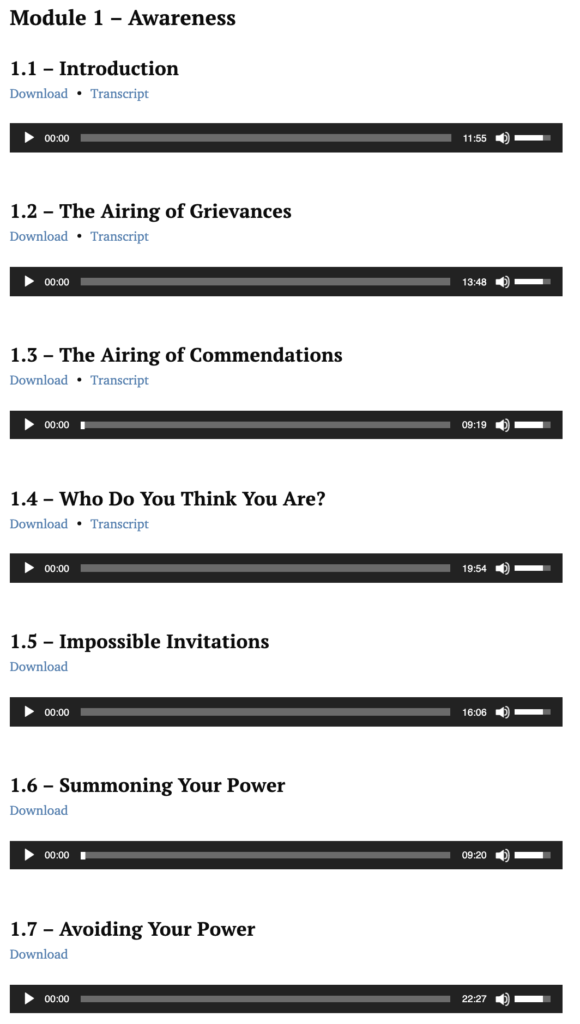
So far I’ve published the first 7 audio lessons, and we have full transcripts published for the first 4 of those. We’re co-creating this course together throughout January and February, during which time we’ll build the course to at least 42 lessons (probably more).

Here’s a screenshot of the lessons in our member portal, so you can see what we have so far. You can stream or download any lesson from your favorite device (the portal is mobile friendly). There’s also a workbook to accompany the lessons and bunch of other bonuses and supplementary material being created for this.

Stature Lessons

If you’re ready to dive in with 135+ other people and do some major character sculpting work to create not just an amazing 2020 but a happy and empowering life, you’d be wise to join us for the Stature course. You get to keep it for life and do the course as many times as you desire. My website is a long-term fixture in the personal growth community (operating continuously since 2004), so we have that stable longevity factor going for us.

Hopefully you have a character who’s empowered enough to say yes to this, but if you’re still on the fence, my tip is to go with your first gut instinct.

A recent study reported in the Washington Post today claimed that people make better decisions when they go with their first gut instinct instead of second-guessing themselves. I also asked growth-oriented friends on social media if they make better decisions from gut instinct or second-guessing analysis, and it was abundantly clear that gut instinct was the winner by far – many had regrets about second-guessing themselves and missing opportunities. So if your gut instinct is to join us, then join us.

I also trust my gut instinct, which told me that creating this course was one of the best projects I could do in my lifetime. I’m building a timeless course that will serve people for decades to come. This is just the beginning. I hope your character will join us in this special experience. The energy from the first group of people going through a course is just such a delight to behold.

We’re only 7 lessons in, and many people have told me they’ve cried a good bit already. Come share some tears with us if you’re brave enough. It’s part of the rebirthing process as we say goodbye to our old selves.

Seriously, please do join. Stature will do you a world of good.

Share Button

NPC to Player

Yesterday I shared a blog post about the 5 major characters transformations my readers want to experience as we transition from 2019 to 2020.

After extracting those original 5 transformations, I pondered whether they could be compressed a bit further. Could they be summed up as a single transformation?

Each time we compress, we lose some detail, so it’s not going to be perfect if we squish this down to a single transformation. But one answer that Rachelle and I came up with together is that the transformation is about shifting from NPC to player mode.

Let me ‘splain.

In a video game, an NPC is a non-player character, so this simply refers to a computer-controlled character in the game. Most often I associate the term with role-playing or adventure games, but other game genres may feature NPCs as well.

So you might wander across a village in a game world, and there are farmers, merchants, and townsfolk who’ve been mostly waiting around for you to show up and engage with them. You might interact with them to get information, buy weapons or supplies, or receive invitations to perform mini-quests. These characters are all computer-controlled, so no human player is directly in charge of them. They do whatever their pre-programmed algorithms direct them to do, and they respond to your actions according to their programming.

The NPC’s job is mainly to be part of the story experience for the main player (or players, if it’s a multi-player game). In more sophisticated games, the NPCs may follow daily routines, including sleeping in their beds at night and tending to their shops or fields during the day.

An NPC doesn’t get to experience the main story. They don’t get to face dragons and go on adventures. They do whatever their programming directs them to do, like serving up coffee at the local Starbucks until the real adventurer – the true player – walks in. I’m over-simplifying here a bit, but I think you get the idea.

In terms of our original five transformations, each one connects with a transition from living an NPC type of life to growing into a more empowered player role.

When you’re playing a game and wander into an NPC-rich area like a village or camp, the NPCs will often complain about something when you talk to them. They have problems they can’t solve, so they fret and worry till you solve those problems for them. Some of them may act as if they’re traumatized by their current state of affairs. They need you to rescue them, save them, help them.

Notice that difference in attitude. An NPC waits to be rescued. A hero does the rescuing. If you’re not actively rescuing yourself from your own problems, are you giving people the impression that you’re waiting to be rescued? Are you like a traumatized villager surrounded by a bunch of other traumatized villagers, all hoping that life will somehow get better with the passage of time? What if instead of wasting energy on judgment and resistance, you accepted whatever problems are showing up in your life and decided to face them head on? Imagine a village of NPCs who finally decide to go slay the dragon themselves instead of waiting for a hero to show up.

While the NPCs may spin themselves in circles fussing over their problems, you the player have to get busy solving them. Even in a game world with lots of misalignments, somehow you’re able to create your own alignment as the player. You do this by working on subgoals one by one and taking lots of action. You don’t have to be confused and internally conflicted because there’s always something interesting to work on. You just keep chipping away at one quest after another. Resisting what the game offers up is obviously a complete waste of time. You can’t possibly progress if you rail against the game’s unfairness, lameness, or ridiculousness. Real life is the same in that respect, isn’t it?

In a game world with enough flexibility (Zelda: Breath of the Wild being a good example), there are nice opportunities for self-expression as the player, opportunities that the NPCs lack. If you feel like exploring, you can wander off into new territories. If you’re feeling aggressive, you can run boldly into battle and fight, fight, fight. If you’re feeling more chill, you can talk to some NPCs, cook some food, or do some simple side quests. Different people can play the game with very different styles and still win.

When Rachelle and I have played Zelda: BOTW (which we finished twice together), our playing styles were very different, especially when it comes to attacking a group of enemies. I like to rush in like a berserker, maybe toss a bomb into the middle of the group to get everyone’s attention. Sometimes I’ll verbally taunt them (even though they can’t hear me). Then I go toe to toe with as many as I can, doing only offense and rarely defense, never using shields or dodging. I’ll frequently take out a whole group in less than a minute. Of course I may take some damage, sometimes major damage. If I die, I just try again, perhaps a little more cautiously the next time. I only go in stealthily or strategically when I really have to, especially in situations where overt aggression is heavily punished. I don’t mind dying a bunch. I’d rather die a few times and learn a little more from each assault. To me it’s just a form of probing to figure out what works. I love being in the thick of combat with lots of action, having to make fast decisions in real-time to survive. I favor this style because it’s the most fun for me.

Rachelle, on the other hand, never plays like this, even if I prod her to try it. She prefers to assess a situation strategically first. She’ll pick off enemies from a distance first, selecting her targets carefully and cautiously. She’ll optimize her armor and weapon choice to appropriately suit each battle. She plays a lot more defensively, valuing every heart. She seems to feel disappointed if she loses 2 hearts out of 20 in a battle, whereas I’d still feel victorious if I lost 18 hearts and was still standing at the end.

I feel perfectly okay walking through the game world with less than half my hearts, whereas Rachelle feels uncomfortable if her hearts aren’t nearly fully (preferably completely full). So we have different styles of play – i.e. self-expression – and yet we still enjoy the player role in our own ways. We each have our own version of what it takes to create relaxed confidence and have a chill yet fun experience. If I tried to play the game like Rachelle does, I’d be bored. And I think if she tried to play like I do, she’d feel stressed or frustrated.

The way you play the game of life will undoubtedly be uniquely your own as well. You have many options for how to express yourself. The key is to find the modes of expression that feel most aligned to you, so the game of life is fun and stimulating but not overwhelming or boring. If you live too much like an NPC, you’re probably going to feel bored or frustrated a lot because NPCs have persistent problems they can’t solve.

How does this NPC to player analogy resonate with you so far? I imagine that if you’re a gamer, you may like it more than most. But if not, that’s okay. You can focus on the original five transformations, or you can challenge yourself to come up with your own single compressed version.

Which way did you lean most often throughout 2019? Would you say that you lived primarily as an NPC? Or do you feel that you really owned this year like a true player character? Did you play scared? Or did you play fiercely? Did you have a fun and stimulating year overall, or did you spend too much time in the realm of frustration, the kingdom of worry, or the dungeon of boredom?

Rachelle and I are both eagerly looking forward to Zelda: BOTW2 by the way. Zelda: BOTW was among the most impressive games I’ve ever played. Now let’s make 2020 your most impressive year. Just try not to play it too much like Rachelle because it’s not as fun to watch. You can still fight even when you only have 3 hearts, okay!

My character may lose a few hearts when she reads this. 😉

Share Button