New method can improve explosion detection

Computers can be trained to better detect distant nuclear detonations, chemical blasts and volcano eruptions by learning from artificial explosion signals, according to a new method devised by a University of Alaska Fairbanks scientist.

The work, led by UAF Geophysical Institute postdoctoral researcher Alex Witsil, was published recently in the journal Geophysical Research Letters.

Witsil, at the Geophysical Institute’s Wilson Alaska Technical Center, and colleagues created a library of synthetic infrasound explosion signals to train computers in recognizing the source of an infrasound signal. Infrasound is at a frequency too low to be heard by humans and travels farther than high-frequency audible waves.

“We used modeling software to generate 28,000 synthetic infrasound signals, which, though generated in a computer, could hypothetically be recorded by infrasound microphones deployed hundreds of kilometers from a large explosion,” Witsil said.

The artificial signals reflect variations in atmospheric conditions, which can alter an explosion’s signal regionally or globally as the sound waves propagate. Those changes can make it difficult to detect an explosion’s origin and type from a great distance.

Why create artificial sounds of explosions rather than use real-world examples? Because explosions haven’t occurred at every location on the planet and the atmosphere constantly changes, there aren’t enough real-world examples to train generalized machine-learning detection algorithms.

“We decided to use synthetics because we can model a number of different types of atmospheres through which signals can propagate,” Witsil said. “So even though we don’t have access to any explosions that happened in North Carolina, for example, I can use my computer to model North Carolina explosions and build a machine-learning algorithm to detect explosion signals there.”

Today, detection algorithms generally rely on infrasound arrays consisting of multiple microphones close to each other. For example, the international Comprehensive Test Ban Treaty Organization, which monitors nuclear explosions, has infrasound arrays deployed worldwide.

“That’s expensive, it’s hard to maintain, and a lot more things can break,” Witsil said.

Witsil’s method improves detection by making use of hundreds of single-element infrasound microphones already in place around the world. That makes detection more cost-effective.

The machine-learning method broadens the usefulness of single-element infrasound microphones by making them capable of detecting more subtle explosion signals in near real-time. Single-element microphones currently are useful only for retroactively analyzing known and typically high-amplitude signals, as they did with January’s massive eruption of the Tonga volcano.

Witsil’s method could be deployed in an operational setting for national defense or natural hazards mitigation.

This work was funded by the Defense Threat Reduction Agency.

Story Source:

Materials provided by University of Alaska Fairbanks. Original written by Rod Boyce. Note: Content may be edited for style and length.


Share Button

International study identifies risks for long COVID in children

Nearly 6 percent of children who presented to the Emergency Department (ED) with COVID-19 reported symptoms of long COVID 90 days later, according to a study conducted in eight countries and published in JAMA Network Open. Initial hospitalization of 48 or more hours, four or more symptoms at the initial ED visit, and age 14 years or older were associated with long COVID.

“We found that in some children, illness with COVID-19 is associated with reporting persistent symptoms after 3 months,” said Principal Investigator Stephen Freedman, MDCM, MSc, with the Cumming School of Medicine at University of Calgary, and Alberta Health Services. “Our results suggest that appropriate guidance and follow-up are needed, especially for children at high risk for long COVID.”

The study included 1,884 children with COVID-19 who had 90-day follow-up. Long COVID was found in nearly 10 percent of hospitalized children and 5 percent in children discharged from the ED.

“Reported rates of long COVID in adults are substantially higher than what we found in children,” said Co-Principal Investigator Nathan Kuppermann, MD, MPH, from University of California, Davis School of Medicine, Sacramento. “Our findings can inform public health policy decisions regarding COVID-19 mitigation strategies for children and screening approaches for long COVID among those with severe infections.”

The most reported persistent symptoms in children were fatigue or weakness, cough, difficulty breathing or shortness of breath.

“Our finding that children who had multiple COVID-19 symptoms initially were at higher risk for long COVID is consistent with studies in adults,” said Co-Principal Investigator Todd Florin, MD, MSCE, from Ann & Robert H. Lurie Children’s Hospital of Chicago and Northwestern University Feinberg School of Medicine. “Unfortunately, there are no known therapies for long COVID in children and more research is needed in this area. However, if symptoms are significant, treatment targeting the symptoms is most important. Multidisciplinary care is warranted if symptoms are impacting quality of life.”

Story Source:

Materials provided by University of Calgary. Note: Content may be edited for style and length.

Share Button

Nonthermal plasma-promoted CO2 hydrogenation in presence of alloy catalysts

Nonthermal plasma (NTP) is used to activate CO2 molecules for hydrogenation into alternative fuels at low temperatures, also enabling the conversion of renewable electricity to chemical energy. Researchers from Tokyo Tech combined experimental and computational methods to investigate the hydrogenation pathway of NTP-promoted CO2 on the surface of Pd2Ga/SiO2 catalysts. The mechanistic insights from their study can help improve the efficiency of catalytic hydrogenation of CO2 and allows the engineers to design new concept catalysts.

Climate change accelerated by excess CO2 emissions has been a major concern over the past few years. To deal with this problem, technologies that can not only reduce and remove excess CO2 emissions but also transform them into value-added chemicals are being developed. One such method is the hydrogenation of CO2 using renewable hydrogen to produce alternative fuels.

Over the years different strategies have been developed to improve CO2 hydrogenation in the presence of metallic catalysts. The most promising among them is nonthermal plasma (NTP). It promotes hydrogenation of CO2 beyond the thermodynamic limit even at low temperatures without deactivating metallic catalysts, which are vulnerable to higher temperatures. Despite the rising popularity of this technique, the interactions between the NTP-activated species and metallic catalysts are still not well understood.

Fortunately, a team of researchers from Tokyo Institute of Technology (Tokyo Tech), Japan, led by Prof. Tomohiro Nozaki, devised a study to overcome this gap in understanding. In their recent breakthrough, published in the Journal of the American Chemical Society, the researchers revealed the reaction dynamics for NTP-assisted CO2 hydrogenation on the surface of Pd2Ga/SiO2 alloy catalysts that lead to the formation of formate. Prof Nozaki explains “Reaction mechanisms like Eley-Rideal or E-R pathway have been proposed to explain efficient CO2 conversion at lower temperatures and the activation energy for this reaction decreases dramatically. Moreover, NTP produces a copious amount of vibrationally activated CO2 which is the key to enhancing CO2 conversion beyond the thermal equilibrium.”

The team investigated the reactions between NTP activated CO2 and Pd2Ga/SiO2 alloy catalysts in a fluidized-bed dielectric barrier discharge reactor  and compared them to conventional thermal catalysis. The results revealed that the CO2 conversion into formate was more than two-fold in the case of NTP-assisted hydrogenation when compared to thermal conversion. To further establish the mechanics of the mentioned conversion, the scientists adopted in situ spectroscopic analysis and density functional theory (DFT) calculations.

The results revealed that the NTP activation gave rise to vibrationally excited CO2 molecules which directly react with hydrogen atoms adsorbed by the Pd sites on the catalyst via the E-R pathway. One of the O atoms from the reacted species then got adsorbed at the neighboring Ga site resulting in the formation of monodentate-formate or m-HCOO. The DFT calculations also deduced a decomposition pathway for the same m-HCOO species.

This experimental-theoretical study showed that NTP can promote CO2 hydrogenation to limits those conventional thermal methods can hardly reach. It also provided mechanistic insights into NTP activated CO2 and catalyst interaction, which can be utilized to develop better catalysts and improve the hydrogenation process. “With our research, we wanted to accelerate the waste to wealth initiative. Capturing CO2 and using it as feedstock for synthesis of fuels and valuable chemicals will not only help us deal with climate problem but also slow down fossil fuel depletion to some extent,” concludes Prof. Nozaki.

Story Source:

Materials provided by Tokyo Institute of Technology. Note: Content may be edited for style and length.

Share Button

Paddy And Christine McGuinness Announce Split After 11 Years Of Marriage

Paddy and Christine McGuinness have publicly announced they have separated after 11 years of marriage.

In a joint statement posted on Instagram Stories, the couple revealed they had made the decision to part ways “a while ago”.

However, Paddy and Christine – who married in 2011 after four years of dating – are still living together with their three children, daughter Felicity and twins Penelope and Leo.

“We hadn’t planned on sharing this publicly until we were ready but after the lack of privacy surrounding our personal life, we feel left with no other option but to clarify,” the Top Gear presenter and former The Real Housewives Of Cheshire cast member said, referring to recent speculation about their marriage in the tabloid press.

“A while ago we took the difficult decision to separate but our main focus as always is to continue loving and supporting our children.

“This was not an easy decision to make but we’re moving forward as the best parents we can be for our three beautiful children.

“We’ll always be a loving family, we still have a great relationship and still live happily in our family home together.

“We hope this now draws a line under any more unwanted and unnecessary intrusion into our private life. Although we work in the public eye we ask kindly if you could respect our wishes for privacy on this matter.”

Paddy and Christine married in 2011

Jeff Spicer via Getty Images

The couple met in 2007 at the Liverpool Tennis Tournament, and got married at Thornton Manor in Cheshire in June 2011.

In December, the couple, whose three children all have autism, shone a light on the condition in a BBC documentary, Our Family And Autism.

Christine subsequently received a diagnosis at the age of 33, describing it as “a huge relief” that helped her understand “why I am the way I am”.

Share Button

UK Covid cases continuing to rise

Latest figures show around 5.8% of the population has coronavirus compared with 5.4% a week earlier.

Share Button

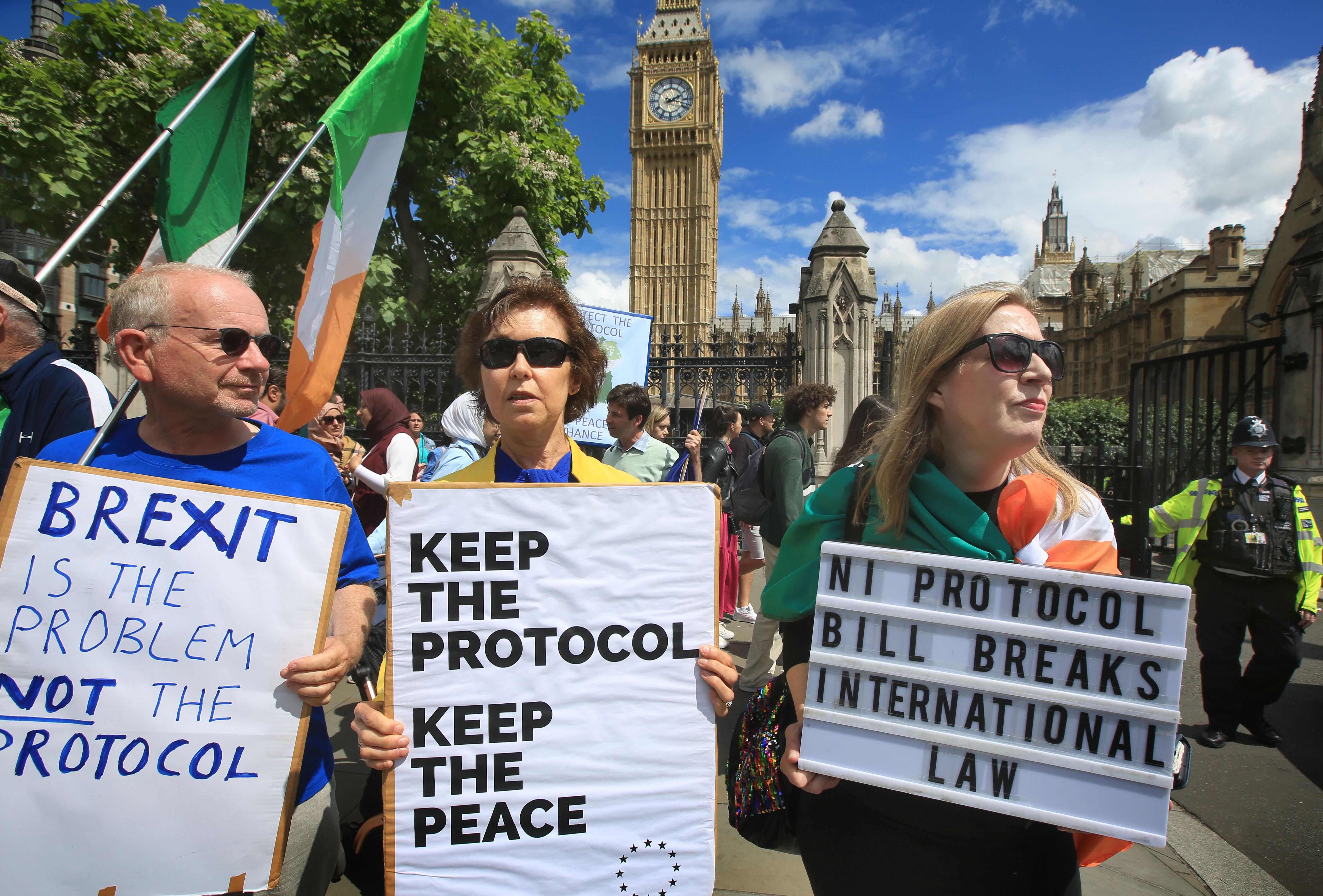
EU Launches Fresh Legal Action Against The UK Over Northern Ireland Protocol Breaches

Brussels has launched fresh legal action against the UK for failing to comply with aspects of the controversial Northern Ireland protocol.

The European Commission said it was bringing four new claims against the UK despite “repeated calls” on the government to implement the agreement on trade between Britain and Northern Ireland.

It comes in addition to infringement claims lodged in response to the UK’s refusal to carry out checks on certain agrifoods.

Relations between the government and the EU were made even worse by the introduction of the Northern Ireland Protocol Bill, which would give ministers the power to unilaterally over-ride key parts of the agreement.

Critics have said that would be a breach of international law, something the government denies.

The commission said in a statement: “Despite repeated calls by the European parliament, the 27 EU member states and the European Commission to implement the protocol, the UK government has failed to do so.

“In a spirit of constructive co-operation, the commission refrained from launching certain infringement procedures for over a year to create the space to look for joint solutions with the UK.

“However, the UK’s unwillingness to engage in meaningful discussion since last February and the continued passage of the Northern Ireland protocol bill through the UK parliament go directly against this spirit.”

The UK has been at loggerheads with the EU over aspects of the protocol — the mechanism that has prevented a hard border on the island of Ireland by keeping Northern Ireland in the single market — since its inception.

This means that goods entering Northern Ireland from mainland Britain must undergo checks.

The government says customs checks are disrupting trade and causing delays, as well as causing problems with those who do not want the province to be treated differently from Britain.

At the core of the Northern Ireland Bill are plans to simplify checks on goods travelling between Britain and the province by creating so-called green and red lanes.

Goods that enter Northern Ireland from mainland Britain, and are destined to stay there, would enter the green lane where there would be no checks and minimal paperwork, which is frustrating businesses.

Goods that move from Britain to Ireland would have to use a red lane, where checks would be applied at Northern Ireland ports. This is so the EU can be certain that goods entering its market are compatible with the its trade rules.

The Northern Ireland protocol bill cleared its final stages in the Commons just days ago by 267 votes to 195 and will be sent to the House of Lords in the autumn.

A government spokesperson said: “It is disappointing that the EU has chosen to bring forward further legal action, particularly on goods leaving Northern Ireland for Great Britain which self-evidently present no risk to the EU single market.

“A legal dispute is in nobody’s interest and will not fix the problems facing the people and businesses of Northern Ireland. The EU is left no worse off as a result of the proposals we have made in the Northern Ireland Protocol Bill.

“We will review the EU’s arguments and respond in due course. ”

Share Button

Monkeypox: Vaccination programme to be stepped up in London

Infection rates continue to rise with most cases across England in the capital, health bosses say.

Share Button

NHS waits force patients to pay for private ops

People are taking out loans and turning to crowdfunding to pay private medical bills of up to £15,000.

Share Button

Polio: New York reports first US case in nearly a decade

An unvaccinated young adult in New York is experiencing paralysis after contracting the virus.

Share Button

US President Joe Biden ‘doing great’ after testing positive for Covid

The 79-year-old is experiencing mild symptoms and will continue to work, the White House says.

Share Button